bookmark_borderThe End of Days: Floods

While record breaking droughts have been recorded on 5 of the 6 continents Africa, Australia, North and South America, and Eurasia, parts of the world are also seeing recorded breaking floods.

“A warmer atmosphere holds more moisture—about 7 percent more per 1.8°F (1°C) of warming—and scientists have already observed a significant increase in atmospheric moisture due to the air’s ability to hold more moisture as it warms,” reports Climate Signals.

The increased moisture in the air can create atmospheric rivers.

As the Earth warms, the air will hold more moisture. More moisture-laden air moves over land and creates atmospheric rivers (Pineapple Express). The Journal EOS in the article Atmospheric Rivers Spur High-Tide Floods on U.S. West Coast said, “Atmospheric rivers are narrow bands of moisture that travel across the lower troposphere, generally at the leading edges of massive low-pressure systems. At their peak, they can carry as much water through the sky as the Amazon River does on land. They unleash intense winds and heavy rain as they surge across the Pacific Ocean, eventually making landfall on the U.S. West Coast, contributing to many high-tide flooding events.”

The atmospheric rivers also bring heavy rainfall inland causing extreme flooding.

2022 has brought record flooding to much of the world:

* All across Appalachian Eastern Kentucky, the story of flood victims is the same: Homes that they had lived in for decades, properties that were safe for generations were wiped out by a 1,000-year flood of torrential rain. — Time

“My papaw was almost 80 years old. He lost everything in the house that he has lived in since he was two years old,” says Lakyn Bolen, 26, a resident of Knott County, where 14 inches of rain fell. “It’s nothing that we’re used to, we don’t get stuff like this. And the thing is, a lot of the people in this area don’t have flood insurance because they’re not even in a flood zone.”

* Residents in the area of Dallas, Texas are recovering from torrential rains and floodwaters that inundated entire neighborhoods and roads and prompted dozens of high-water rescues this week. More than 100 homes have been damaged after parts of the Dallas area saw more than 10 inches of rainfall on Monday. Flooding also caused sanitary sewers to overflow in several locations. — CNBC

* Officials hope to fully reopen the main highway from Los Angeles to Phoenix by early next week after a flash flood washed out part of the road through the Southern California desert. — AP

* After record-setting rainfall this week, Jackson, Mississippi, is preparing for the Pearl River to reach 36 feet by Tuesday, leading to flooded streets. — CNN

* Authorities in eastern New Mexico on Wednesday warned residents of continued flooding along the Pecos River. Storm runoff has led to historic flows, prompting the National Weather Service to issue a flood warning for the area near Lake Arthur. — AP

* SALT LAKE CITY (AP) — An Arizona woman has died after she was swept away during flash flooding four days ago at Utah’s Zion National Park, officials said Tuesday. — AP

* The Pakistan floods have been compared to The End of Days with desperation and displacement in Sindh province. The floods have killed nearly 1,000 people across Pakistan since June, while thousands have been displaced – and millions more affected. The full scale of the devastation in the province is yet to be fully understood – but the people described it as the worst disaster they’ve survived. Floods are not uncommon in Pakistan, but people here said these rains were different – more than anything that’s ever been seen. One local official called them “floods of biblical proportions”. — BBC

* Heavy rains set off flash floods, killing 182 in Afghanistan. At least 182 people have been killed and hundreds more injured during a month of heavy flooding from seasonal rains in Afghanistan, according to the United Nations and the ruling Taliban. — AP

* A tropical storm blew out of the northern Philippines on Wednesday, leaving at least three people injured and thousands displaced and prompting authorities to shut down schools and government offices in the capital and several provinces prone to flooding and landslides. — AP

* Torrential rainfall hit Paris on Tuesday evening after a recent heatwave across France, flooding metro stations in the French capital. — France 24

* The death toll from flash floods in Sudan since the start of the country’s rainy season in May has climbed to at least 89, an official said Tuesday, as the downpours continued to inundate villages across the east African nation. — AP

* Mass floods and heatwaves hit Asia: the role of global warming in extreme weather events. In recent weeks, India and Bangladesh have experienced floods that have killed close to 200 people and displaced 7 million. Beyond these numbers, these events pose serious consequences for people’s livelihoods, whether in rural areas or urban settings. — France 24

* Days of deadly floods and landslides wreak havoc in Iran. Dozens are dead and at least 45 people missing after most Iranian provinces were affected by the inundations (of rain and mudslides.) — Al Jazeera

More articles on Flood Insurance, Rising Sea Levels and Global Warming.

bookmark_borderFlorida Insurance Regulators Taking an “unprecedented” and “extraordinary” Step

The St. Lucie News Tribune reports:

Florida insurance regulators are taking an “unprecedented” and “extraordinary” step to try and prevent tens of thousands of homeowners from being forced to look for new property insurance coverage if rating agency Demotech follows through on plans to downgrade many Florida carriers.

The Florida Office of Insurance Regulation announced a plan Wednesday to provide companies that are downgraded with reinsurance coverage through state-run Citizens Property Insurance.

The dramatic decision to assume financial responsibility for a raft of struggling insurers underscores the dire circumstances Florida is facing as a large portion of its homeowners insurance market teeters on the brink of collapse.

Downgrading so many companies could wreak havoc in the state, causing big problems for homeowners and the real estate industry.

Mortgage giants Fannie Mae and Freddie Mac require borrowers to have a home insurance policy from a highly-rated company. Florida’s home insurance market is dominated by smaller companies that only get ratings from Demotech, giving the company significant sway in the industry.

“Fannie Mae and Freddie Mac each offer an exception to the financial rating requirements for an insurer that is covered by a reinsurer who assumes, by endorsement, 100 percent of the insurer’s liability for any covered loss payable, but unpaid by the insurer, by reason of insolvency,” the release states.

Gov. Ron DeSantis said Wednesday that it makes sense to use Citizens as a financial backstop for insurers, because if the companies are downgraded many of their policies would ultimately flow into Citizens – the state’s insurer of last resort.

“If the companies get downgraded and they have to shed policies those will end up going on Citizens anyway, so the exposure to Citizens is more to take on the policies than it will be to act as a reinsurer of last resort,” DeSantis said during a press conference in Tampa.

Reinsurance is insurance for insurance companies. By providing such coverage, Citizens would be on the hook to pay the claims if the downgraded insurers aren’t able to meet their financial obligations. Spiking reinsurance costs have contributed to the home insurance industry’s problems in Florida, which is heavily reliant on such coverage.

The additional reinsurance coverage comes on top of a $2 billion rescue fund approved by state lawmakers during a special session earlier this year. That fund provides reinsurance at no cost to Florida insurers. It was part of a package of reforms intended to stabilize the insurance industry.

Demotech had planned to release its ratings revisions on Tuesday, but said in a statement provided to USA TODAY Network – Florida that it is taking more time to update the ratings.

“As the current regulatory climate has become hostile and negative and we have and will expend a significant effort creating responses to third party letters, we will be taking additional time to review information and consider the issues affecting the companies operating in Florida,” the statement reads.

More articles on Flood Insurance, Rising Sea Levels and Global Warming.

bookmark_borderCost of Property Insurance in Florida

Florida Politics reports in their article, As climate in Florida sets ‘new normal,’ cost of property insurance will separate haves, have-nots:

“Insurers believe that due to climate change, this is the new normal. They’re finding that catastrophic and non-catastrophic weather events are increasing in severity every year,” said Paul Handerhan, president of the Federal Association for Insurance Reform, a national nonprofit advocacy organization based in Fort Lauderdale.

The consequences of climate change not only include catastrophic — and increasingly expensive — weather such as hurricanes and wildfires, but also more everyday events such as storms that pelt residential and commercial properties with straight-line wind and hail.

The actuarially sound way to respond to the new normal is to raise rates, reduce coverage, or throw in the towel, as eight property insurance companies in Florida have done since 2018. Just this week, three others asked state insurance regulators to approve hefty rate increases — as high as 49 percent on policyholders not among the tens of thousands who recently lost coverage altogether due to non-renewals.

Over time, Handerhan said, property insurance coverage will become so expensive that only the wealthiest of the wealthy can “afford to live in paradise.”

“This market is completely,100% out of control,” said Barry Gilway, president, CEO, and executive director of Citizens, during the board of governors meeting. “It all has to do with the total collapse of the overall Florida marketplace, and that collapse continues.”

More articles on Flood Insurance, Rising Sea Levels and Global Warming.
bookmark_borderFrequency of Flash Floods

As the climate warms, the air holds more moisture. Theoretically, there is a 7% increase in atmospheric water holding capacity per degree Celsius warming. A recent study published in Nature The conterminous United States are projected to become more prone to flash floods in a high-end emissions scenario suggests extreme precipitation might be increasing even more due to changes in storm structure, storm dynamics, and large-scale weather patterns resulting in even more severe flash flooding that previously projected.

“Flash floods are largely driven by high rainfall rates in convective storms that are projected to increase in frequency and intensity in a warmer climate in the future. US floods are becoming 7.9% flashier by the end of the century assuming a high-emissions scenario. The Southwest (+10.5%) has the greatest increase in flashiness among historical flash flood hot spots, and the central US (+8.6%) is emerging as a new flash flood hot spot. Additionally, future flash flood-prone frontiers are advancing northwards.”

More articles on Flood Insurance, Rising Sea Levels and Global Warming.
bookmark_border26% Increase in US Flood Risk by 2050 Due to Climate Change

A study published in the Journal Nature, Inequitable patterns of US flood risk in the Anthropocene, models a 26.4% (24.1–29.1%) increase in US flood risk by 2050 due to climate change.

Flood Risk % Increase

“Our national depiction of comprehensive and high-resolution flood risk estimates in the United States indicates current average annual losses of US$32.1 billion (US$30.5–33.8 billion) in 2020’s climate, which are borne disproportionately by poorer communities with a proportionally larger White population. The future increase in risk will disproportionately impact Black communities, while remaining concentrated on the Atlantic and Gulf coasts. Furthermore, projected population change (SSP2) could cause flood risk increases that outweigh the impact of climate change fourfold. These results make clear the need for adaptation to flood and emergent climate risks in the United States, with mitigation required to prevent the acceleration of these risks.”

This study/model shows the heaviest impact on the Atlantic and Gulf coasts; however, as the Earth warms, the air will hold more moisture.
More moisture-laden air moves over land and creates atmospheric rivers (Pineapple Express). The Journal EOS in the article Atmospheric Rivers Spur High-Tide Floods on U.S. West Coast said, “Atmospheric rivers are narrow bands of moisture that travel across the lower troposphere, generally at the leading edges of massive low-pressure systems. At their peak, they can carry as much water through the sky as the Amazon River does on land. They unleash intense winds and heavy rain as they surge across the Pacific Ocean, eventually making landfall on the U.S. West Coast, contributing to many high-tide flooding events.”

The atmospheric rivers also bring heavy rainfall inland causing extreme flooding. In October of 2021 NOAA said, “a convergence of storms brought more than half a foot of rain to parts of the Bay area in addition to strong winds, flash floods, and mud/landslides. They also bring the potential for heavy snow to higher elevations in the Sierra Nevada mountain range.” (Atmospheric River Hits the West Coast)

More articles on Flood Insurance, Rising Sea Levels and Global Warming.

bookmark_border25% of Critical Infrastructure at Risk of Flooding

The First Street Foundation, a nonprofit research and technology group that assesses the threat posed by flooding across the country, released a report that found one-forth of critical infrastructure in the USA is at risk of flooding including: police and fire stations, hospitals, airports and wastewater treatment facilities.

“With an increasing number of flooding 1events making U.S. headlines, there is a greater awareness of the economic and human cost that
flood-damaged infrastructure can produce. For instance, Hurricane Sandy flooded hospitals, crippled electrical substations, overwhelmed waste water treatment centers, and shut down power and water to tens of millions of people (U.S. Senate Committee on Commerce, Science, and Transportation, 2012). More recently, the impact of Hurricane Ida stretched across the country crippling the electrical grid in southern Louisiana, flooding the transportation infrastructure in the NYC metro area, and killing nearly 100 people. It is clear, now more than ever, that the ways and places in which we live are likely to continue to be impacted by our changing environment. One of the most important implications in this development is the vulnerability of our national infrastructure.”

About 1/4 (2 million miles) of roads are already at risk of becoming impassable due to flooding.

“And as global warming melts ice sheets, raises sea levels and tilts the odds in favor of more extreme rainfall events, the risk will grow in many more communities, the First Street report found. Over the next 30 years, the number of residential properties at risk of flooding is expected to grow from 12.4 million today to 13.6 million by 2051, the report says. For critical infrastructure and commercial properties, the number of vulnerable facilities are projected to grow by 6% and 7% respectively over the next three decades,” said Drew Kann and Ella Nilsen.

Infrastructure Flood Risk

More articles on Flood Insurance, Rising Sea Levels and Global Warming.

bookmark_borderThe Cost of Flood Insurance

An article in the New York Times entitled The Cost of Insuring Expensive Waterfront Homes Is About to Skyrocket states, “Federal officials say the goal is fairness — and also getting homeowners to understand the extent of the risk they face, and perhaps move to safer ground, reducing the human and financial toll of disasters.”

“Subsidized insurance has been critical for supporting coastal real estate markets,” said Benjamin Keys, a professor at the University of Pennsylvania’s Wharton School. Removing that subsidy, he said, is likely to affect where Americans build houses and how much people will pay for them. “It’s going to require a major rethink about coastal living.”

In 2019, FEMA said it would instead price flood insurance based on the particular risks facing each individual property, a change the agency called “Risk Rating 2.0.”

“With a rapidly escalating threat of natural disasters, Risk Rating 2.0 is a much needed and timely change,” said Laura Lightbody of Pew Charitable Trusts, which has pushed governments to better respond to climate threats. Higher insurance costs, she said, were “a reflection of our new, wet reality.”

“For the first time, our policyholder premiums will be based on their individual risk,” said David Maurstad, who runs the flood insurance program at FEMA. “We pledge to continue to evaluate and make adjustments where and when it’s warranted.”

But the growing threat of climate change may make that kind of intervention less successful, said Roy Wright, who ran the flood insurance program until 2018 and now runs the Insurance Institute for Business & Home Safety.

“We cannot hide the truth of this increasing risk,” Mr. Wright said. “We shouldn’t hide it. Tell people the truth.”

More articles on Flood Insurance, Rising Sea Levels and Global Warming.

bookmark_borderNational Flood Insurance Program Increasing Rates

FEMA is updating the National Flood Insurance Program’s (NFIP) risk rating methodology through the implementation of a new pricing methodology called Risk Rating 2.0. The methodology leverages industry best practices and cutting-edge technology to enable FEMA to deliver rates that are actuarily sound, equitable, easier to understand and better reflect a property’s flood risk.

The Bradenton Herald reports, “More than a million Floridians will see their flood insurance premium rise next year, FEMA said Thursday.

The good news is, most will see increases of less than $120 a year. The bad news is that homeowners will likely see annual rate hikes like that for the foreseeable future.

The new strategy is meant to help pull the program out of its $20 billion debt and encourage people to live in safer, less flood-prone homes.

The new program will stop charging flood insurance premiums based solely on whether a home is within or outside of a flood zone and instead consider a range of factors like distance from the ocean, rainfall flooding and the cost to rebuild a home.

Starting April 2022, this pricing revamp will lead to higher prices for a majority of Florida’s 1.7 million policyholders — the most of any state — as well as a decrease for about 20% of policies, more than 340,000 policyholders.

“It allows us to set accurately sound rates and communicate flood risk better than we ever have before,” David Maurstad, senior executive of FEMA’s National Flood Insurance Program.

More articles on Flood Insurance, Rising Sea Levels and Global Warming.

bookmark_borderIncreasing Cost and Risk of Flood Insurance

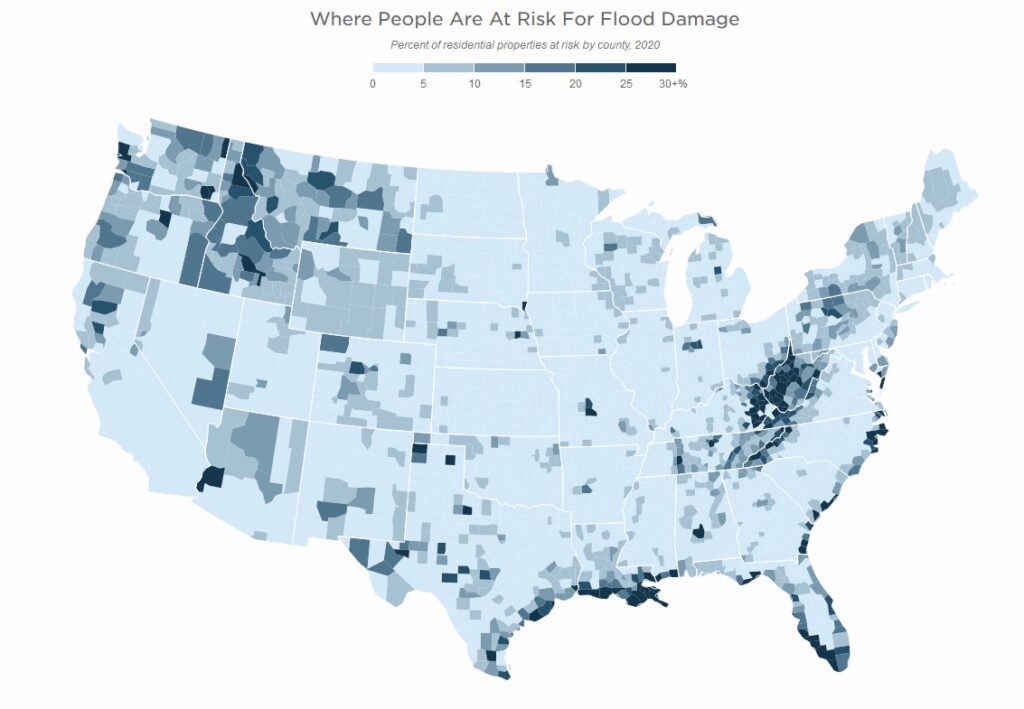
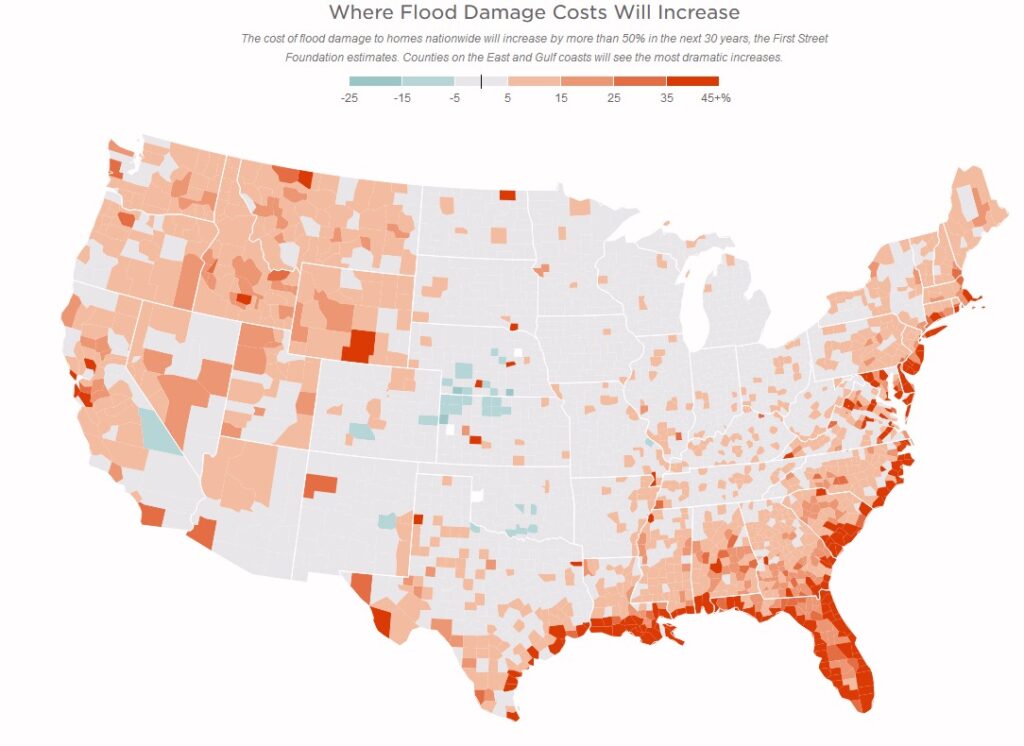
The cost of flood damage to homes nationwide will increase by more than 50% in the next 30 years, the First Street Foundation estimates.

Flood Insurance Forecast

A report by NPR radio, A Looming Disaster: New Data Reveal Where Flood Damage Is An Existential Threat, found:
The federal government provides the vast majority of residential flood insurance in the U.S. Most policies are underpriced relative to the actual cost of flood damage.

The new data show that flood insurance rates would need to more than quadruple to keep up with the costs of climate-driven flooding. The Federal Emergency Management Agency is already preparing to raise insurance premiums in many places later this year in an effort to save the National Flood Insurance Program, which has accrued more than $36 billion in debt.

FEMA warns that the First Street Foundation’s analysis is only an estimate and that FEMA didn’t provide the research group with details about the new flood insurance pricing plan, known as Risk Rating 2.0.

“Any entity claiming that they can provide insight or comparison to the Risk Rating 2.0 initiative, including premium amounts, is misinformed and setting public expectations that are not based in fact,” writes David Maurstad, the senior executive of the National Flood Insurance Program, in an email to NPR. “While entities are free to suggest or estimate their opinion of what flood insurance premiums should be, they are offering exactly that — an opinion — and they do not have insight into the Risk Rating 2.0 initiative.”

For homeowners who are currently underpaying for flood insurance, FEMA says it plans to raise rates by up to 18% each year until the price is accurate, according to a January report by the Congressional Research Service. The agency will begin rolling out the new pricing in October.

As the cost of insurance goes up, many people who need flood insurance will likely be unable to afford it, leaving them to face lasting damage. Research has found that disasters can erode family stability and exacerbate mental and physical ailments when people don’t have the money they need to repair their homes.

“If you don’t have the finances you need to recover, then families have to make really difficult trade-offs, like maybe forgo spending on medical expenses because otherwise you don’t have a safe home,” says Carolyn Kousky, the executive director of the Wharton Risk Management and Decision Processes Center at the University of Pennsylvania.

Flood Damage Risk
Flood Damage Risk
Flood Damage Cost
Flood Damage Cost

More articles on Flood Insurance, Rising Sea Levels and Global Warming.

bookmark_borderIncreasing Cost of Flood Insurance

“Increased awareness of flood risk and rising future insurance costs impact perceptions of value, which will impact real estate markets,” said Matthew Eby, founder and executive director of First Street Foundation.

First Street Foundation published a report that concludes: “Rising sea levels and extreme weather could cause $20 billion of flood damage to at-risk U.S. homes this year, rising to $32 billion (per year) by 2051.”

First Street Foundation Flood Insurance Forecast

“Roughly 4.3 million homes – concentrated in Florida, California, South Carolina and Texas – have a substantial risk of sustaining economic damage from flooding this year, the report shows. The majority are not required by the U.S. government to have flood insurance. Were all of them to buy federal insurance, National Flood Insurance Program (NFIP) rates would need to increase 4.5 times to cover the risk, according to the report. The current average NFIP premium for these 4.3 million homes is $981,” reports Kate Duguid of Reuters.

More articles on Flood Insurance, Rising Sea Levels and Global Warming.