bookmark_borderThe Importance of CFOs and Their Pessimistic Outlook on the U.S. Economy

by Daniel Brouse
April 1, 2025

The Role of CFOs in Business and the Economy

Chief Financial Officers (CFOs) play a crucial role in guiding businesses through financial strategy, risk management, and economic uncertainty. They are responsible for overseeing a company’s financial planning, ensuring liquidity, optimizing capital allocation, and mitigating financial risks. Because CFOs are deeply involved in forecasting and resource management, their perspectives offer valuable insights into broader economic trends.

Their importance extends beyond individual companies, as CFO sentiment often serves as a leading indicator of economic health. Their concerns and expectations influence corporate investment decisions, hiring trends, capital expenditures, and market stability. When CFOs express caution, businesses may delay expansion plans, cut costs, or limit hiring, which in turn can have ripple effects throughout the economy.

CFOs’ Pessimistic Outlook in Q1 2025

According to the CNBC CFO Council quarterly survey for Q1 2025, CFOs are generally “pessimistic” about the overall state of the U.S. economy and uncertain about the stock market. This outlook reflects growing concerns over several key economic factors:

  1. Inflation and Interest Rates – Persistent inflation, coupled with high interest rates set by the Federal Reserve to curb rising prices, continues to strain corporate budgets and consumer spending. Many CFOs anticipate higher costs of capital, which could limit investment and expansion efforts.

  2. Rising National Debt and Fiscal Policy Uncertainty – The U.S. national debt has reached historic levels, and concerns over government spending and potential tax policy changes contribute to market uncertainty. CFOs may fear tighter fiscal conditions leading to slower economic growth.

  3. Stock Market Volatility – Uncertainty in the stock market stems from fluctuating corporate earnings, geopolitical tensions, and potential shifts in Federal Reserve policy. CFOs, as key financial decision-makers, must navigate these market dynamics to protect their companies’ financial health.

  4. Trade Wars and Global Instability – With ongoing trade disputes, particularly with China, companies face supply chain disruptions and higher costs. Many CFOs worry that an ill-conceived trade war could further slow economic growth and increase financial instability.

  5. Labor Market Challenges – While the labor market remains relatively strong, businesses are struggling with higher wages, a skills gap, and labor shortages in key industries. CFOs must balance cost-cutting measures with maintaining a competitive workforce.

Implications of CFO Pessimism

When CFOs express widespread pessimism, it can have significant economic implications:

  • Reduced Business Investment – Companies may hold off on capital expenditures, delaying projects that could contribute to economic growth.

  • Slower Hiring or Layoffs – Businesses may become more conservative in workforce expansion, potentially leading to higher unemployment.

  • Stock Market Reactions – Investors take CFO sentiment seriously, and negative outlooks from financial leaders can contribute to market fluctuations.

  • Shift Toward Financial Conservatism – Many companies may prioritize cost-cutting, debt reduction, and liquidity preservation instead of expansion.

As the economy moves through 2025, CFO sentiment will remain a key indicator of corporate confidence and economic momentum. If pessimism persists, it could signal broader economic challenges ahead, reinforcing the need for policymakers to address inflation, trade policies, and fiscal stability to restore business confidence.
Trumpenomics: The Decline of the US

bookmark_borderTrump Economic Facts

Amazingly, some still suffer from Trump Delusionment Syndrome, defending his economic policies while claiming Biden ‘destroyed the economy’ or insisting that Trump needs to ‘break some eggs’ to bake a cake—meaning we need to endure pain. No, we don’t need pain. The economy performed the best in history during Biden’s term, in sharp contrast to both Trump 1.0 and the early signs of Trump 2.0.

Let’s look at the numbers: During Trump’s first term (2017–2021), the national debt increased by about $7.8 trillion, mainly due to tax cuts that didn’t pay for themselves and pandemic-related spending. Under Biden (2021–2025), the debt rose by about $6.3 trillion—but a significant portion of that came from legislation and tax policies enacted under Trump.

Now, three months into Trump’s second term (2025–2029), debt projections are looking even worse. Estimates suggest Trump 2.0 will add an additional $10 trillion, driven by an extension of his tax cuts and increasing deficits. By the end of Trump 2.0, Trump will have added more to the national debt than all Democratic presidents combined.

So if debt is your concern, you might want to rethink which administration is actually running up the tab. On the other hand, if you’re talking about GDP, we are currently experiencing the sharpest decline since Trump’s last term—when he oversaw the fastest economic contraction in U.S. history.

Protectionism is one of the worst economic policies. Tariffs are regressive taxes that disproportionately harm marginalized communities while failing to boost the economy or reduce the deficit. The last time a president imposed broad tariffs, it contributed to the Great Depression—a global economic catastrophe that took decades to recover from and provided no lasting benefits to society.

Trumpenomics: The Decline of the US

bookmark_borderGold: A Growing Influence in Today’s Market

by Daniel Brouse
March 28, 2025

Gold: A Growing Influence in Today’s Market

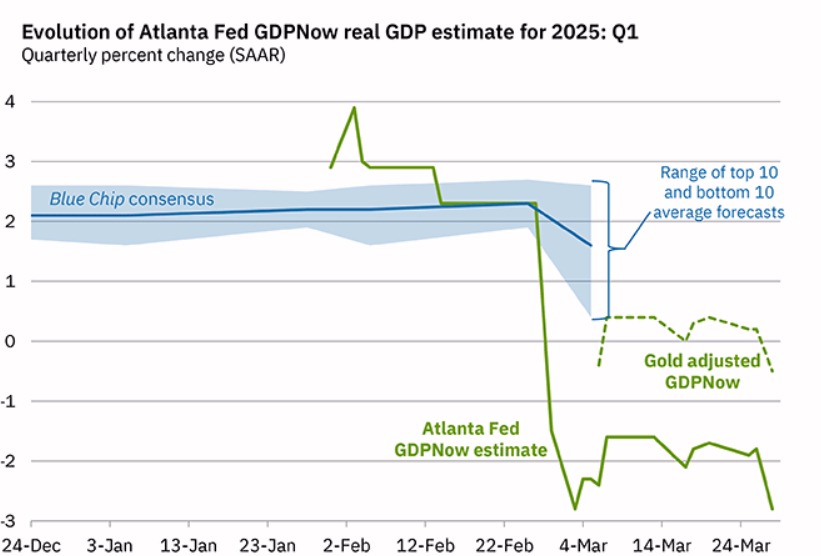
Gold has always been a significant asset in the global financial landscape, but recently, its influence has grown in ways not seen for quite some time. One key reason for this increased attention is its impact on the Atlanta Federal Reserve’s GDPNow tracker. In fact, the Fed had to add a special line in its graph to account for the significant influence of net gold imports on U.S. GDP. This is not a typical occurrence and signals that gold is playing a more prominent role in the economy than it has in recent decades.

Why is Gold Significant?

Gold is generally considered in two primary ways: as a store of wealth and as a commodity used in products such as jewelry and electronics. Traditionally, gold flows have been relatively stable. That means the Fed typically does not focus much on gold as it doesn’t typically cause significant economic disruption or fluctuation. However, recent trends have shown an increase in gold imports that is disproportionate to other sectors of the economy. This surge has been so large that it has skewed GDP calculations, prompting the Fed to specifically acknowledge it.

The challenge with accurately tracking gold’s economic impact stems from how it is measured and classified. Imports and exports of gold can be difficult to track, especially considering the different forms in which gold is used. It is not always clear whether gold is entering the country for industrial use or simply as a hedge against economic uncertainty, making it harder for analysts to determine its full economic impact.

The Fed’s Usual Disregard for Gold

So why doesn’t the Federal Reserve usually pay more attention to gold? In past decades, gold flows were relatively predictable and static. It was a safe asset that largely served as a store of value, with only small fluctuations in demand. Therefore, gold didn’t play a significant role in influencing broader economic data like GDP growth. This predictability, combined with the move away from the gold standard, meant that gold was seen as less relevant in day-to-day monetary policy decisions.

However, recent patterns have changed. A combination of global economic uncertainties, inflation fears, and geopolitical tensions has led to a surge in demand for gold as a safe haven asset. As a result, huge gold imports have recently overshadowed other aspects of the GDP, pushing the Federal Reserve to reconsider its influence.

What Does This Mean for You?

For the average investor, the growing prominence of gold has several potential implications. The most significant impact could be felt if you have a 401(k), invest in mutual funds, or hold ETFs. Many of these investment vehicles, particularly index funds and mutual funds, are required to stay fully invested in the market. This can leave investors vulnerable during periods of market volatility or when certain asset classes, like stocks, are underperforming.

In these times, it might be wise to consider reducing risk, or “beta,” in your portfolio. This means adjusting your investment strategy to become more defensive, moving away from riskier equities, and diversifying into other assets—such as gold. By reallocating a portion of your investments into gold, you can help hedge against volatility, preserve wealth, and potentially capitalize on gold’s rising demand. This is especially pertinent when traditional markets experience instability, and gold continues to serve as a long-standing safeguard against inflation and market turmoil.

The Bottom Line

The growing significance of gold in today’s economic environment is not a passing trend. As illustrated by the Fed’s GDPNow tracker, the surge in gold imports is not merely a statistical anomaly but a clear indication of broader economic shifts. Such movements in asset flows are valuable signals for individual investors, offering insight into changing market dynamics. Other key indicators to watch include currency and credit flows, which also provide clues about the direction of the economy. However, for small investors, participating directly in many of these trades can be challenging—especially with issues like storing gold, soy, or pork bellies.

In times like these, your best investment strategy is likely to focus on tangible assets. Housing should remain your largest asset, offering long-term stability and growth potential. For additional savings and retirement funds, consider allocating 90% to short-term treasuries, 5% to Treasury I Bonds, and 5% to gold and other real assets. This diversified approach can help protect your wealth and provide a hedge against economic uncertainty.


GDPnow 3-28-2025
GDPnow 3-28-2025

Capital Preservation During Trumpenomics

Trumpenomics: The Decline of the US

bookmark_borderTrump’s Sector-Specific Tariffs

March 27, 2025

Since January 2025, the United States has implemented several sector-specific tariffs in an effort to protect domestic industries. These tariffs are in addition to any existing country-specific tariffs and represent a continuation of protectionist trade policies. However, historical data suggests that such high sector-specific tariffs often fail to achieve their intended goals. Instead of revitalizing domestic production, they tend to result in a net job loss across affected industries due to increased input costs, supply chain disruptions, and retaliatory measures from trade partners. In many cases, the cost to consumers and businesses far outweighs any economic benefits, with each job “saved” coming at an exorbitant price to taxpayers and the broader economy.

  • Steel and Aluminum: Effective March 12, 2025, a 25% tariff was imposed on all steel and aluminum imports, eliminating previous country exemptions. ​

  • Automobiles and Auto Parts: Announced on March 26, 2025, a 25% tariff on all imported cars and car parts will take effect on April 2, 2025. This measure aims to bolster domestic manufacturing but raises concerns about increased consumer prices and potential disruptions in global supply chains. ​

Additionally, the administration has proposed tariffs on other sectors:​

  • Pharmaceuticals: Plans to impose a 25% tariff on imported pharmaceuticals have been signaled, though specific details and implementation dates are yet to be announced. ​

  • Lumber: A Section 232 investigation into timber and lumber imports has been initiated, potentially leading to future tariffs. ​

  • Copper: The administration has threatened to impose a tariff of up to 25% on all copper imports, aiming to increase U.S. production.

These measures reflect the administration’s strategy to protect domestic industries, though they have sparked concerns about escalating trade tensions and potential retaliatory actions from trading partners.

Trumpenomics: The Decline of the US

bookmark_borderThe Inevitable Collapse: How Trump’s Policies and Climate Neglect Will Reshape the Economy

The Balancing of Wealth Inequality

Wealth inequality may correct itself sooner than anticipated. Trump’s rapid and unconstitutional actions are already causing his political influence to unravel. The economy is entering a significant slowdown. Historically, 80% of GDP has been driven by immigrants, and the effects of their declining contributions are becoming increasingly apparent.

On April 2nd, Trump imposed another round of tariffs—the most devastating since the Great Depression. These tariffs could trigger an economic crash from which the U.S. may struggle to recover, especially given the ongoing neglect of the climate crisis. A stock market collapse would likely be followed by a real estate market downturn.

These economic shifts are already affecting wealth inequality, as demonstrated by the decline in Elon Musk’s fortune.

Within 6 to 12 months of the new tariffs, a similar downward trend is expected to impact all billionaires. Meanwhile, as climate change worsens due to inaction and harmful environmental policies, the intensification of extreme weather events and rising sea levels will drive a fundamental redistribution of asset classes.

Simultaneously, the climate crisis is accelerating. Financial forecasts predict that 25% of all real estate will become uninsurable due to climate disasters, with 84% of properties expected to lose value over the life of a mortgage. This will mark the first time in history that the distribution of real estate wealth is so significantly and permanently altered.


The Human Induced Climate Change Experiment

Donald Trump has consistently dismissed the science of climate change, calling it a hoax and dismissing policies aimed at addressing it as “The Green New Scam.” His repeated use of the phrase “Drill, Baby, Drill” symbolizes an energy policy that prioritizes fossil fuel extraction over sustainable alternatives. These policies have only intensified the climate crisis, posing severe risks not only to the environment but to the global economy as well. If left unchecked, Donald Trump’s economic and environmental policies will render the planet uninhabitable for future generations.

In the 1990s, we first hypothesized the non-linear acceleration of climate change. By the early 2000s, this hypothesis had evolved into an established climate theory, now widely recognized as scientific fact. My lab partner, a Doctor of Physics from Ohio State, and I collaborated to provide the key evidence creating this theory. Over the years, we have observed a dramatic reduction in the doubling time of climate change impacts—the rate at which these effects intensify. Initially, the doubling time was approximately 100 years, but it has since decreased to 10 years and, more recently, to just 2 years. This trend implies that the damage caused by climate change today is double what it was two years ago. In two years, it could be four times worse; in four years, eight times worse; and within a decade, potentially 64 times worse. These projections are conservative, assuming the doubling period does not continue to shrink further. Alarmingly, this rapid acceleration does not appear to be an anomaly. If this trajectory persists, the consequences will likely be far more catastrophic than previously anticipated.

The evidence is clear: climate change is rapidly accelerating, and the costs—both economic and human—are growing exponentially. The future demands decisive and immediate action to curb greenhouse gas emissions and prevent further environmental and societal collapse. Our updated climate model, now integrating complex social-ecological factors as part of a dynamic and non-linear system, shows that global temperatures could rise by up to 9°C within this century—far beyond previous predictions of a 4°C rise over the next thousand years. This level of warming will render much of the world uninhabitable within this century.

The Great Depression vs. The Climate Crisis: Why the Stock Market May Never Recover

Drill, Baby, Drill (How Hate and Ignorance Distort Economic Perspectives)

July 2024 – Pre-Election Warning: Concerns were raised about candidate Trump’s proposed economic policies, highlighting potential unintended consequences such as heightened inflation and increased national debt—both of which could undermine economic stability. Additionally, experts cautioned that his administration’s environmental stance, including withdrawing from the Paris Agreement and rolling back over 100 environmental regulations, could have devastating effects on both the economy and the environment. Now, much of this forecast is unfolding before our very eyes.

Economic Outlook 2025 – 2035

November 2024 – Post-Election Analysis: Concerns are mounting over the potential consequences of President Elect Trump’s proposed economic policies, particularly their impact on inflation, national debt, and climate change. The Committee for a Responsible Federal Budget estimates these policies could add $7.75–$10 trillion to the national debt over the next decade. Additionally, projections suggest inflation could rise to at least 6% by 2026, with consumer prices potentially increasing by 20% by 2028. These forecasts have since been revised, reflecting higher inflation and slower economic growth, compounded by the significant fallout of an ill-conceived trade war.

Trumpenomics: The Decline of the US

bookmark_borderWhy Are People Boycotting Tesla?

Elon Musk’s extreme hypocrisy has led to widespread boycotts and protests against Tesla. It’s the only company in U.S. history to achieve profitability primarily through carbon credits and remains one of the largest recipients of government subsidies, including tax credits. Yet Musk publicly opposes these very policies, making his contradictions even more damaging—not just to his brand but also to his employees.

My biggest concern is the economic hypocrisy and Tesla’s role in slowing the transition to sustainable energy. While Tesla benefits from more government subsidies than any other company in the world, the U.S. has imposed a 120% tariff on higher-quality, more affordable EVs like those from BYD. This has left the U.S. with an uncompetitive, inefficient EV industry, while China has become the global leader in EV manufacturing.

This isn’t just about Tesla—it’s about fairness and the fastest path to sustainability. The U.S. is blocking competition by slapping massive tariffs on superior, lower-cost EVs while funneling billions in subsidies to Tesla, despite its questionable labor practices and supply chains. If the goal is to fight climate change, we should prioritize the best EVs at the best prices, regardless of where they’re made, rather than propping up a single company with government handouts.

Finally, Trump remains the only president to openly violate ethics rules, conflict-of-interest laws, and bans on endorsing private products—most notably by purchasing a Tesla on the White House lawn. The Secretary of Commerce further compounded these violations by publicly promoting Tesla stock.

In summary, Elon Musk leveraged taxpayer money to amass his fortune, then hypocritically denounced such practices—even accusing others of fraud for doing the same. Additionally, he acted without congressional authority, making his actions unconstitutional and unlawful. As a government employee, he violated ethics rules, conflict-of-interest laws, and bans on endorsing private products. He should have divested his assets before entering government service and stepped down as CEO of Tesla.

Trumpenomics: The Decline of the US

bookmark_borderGOP Socializes Egg Prices

Ironically, President Trump has taken a far-left liberal approach by socializing the egg industry. Unable to keep his campaign promise to lower egg prices, the U.S. government has subsidized the industry to the tune of billions of dollars.

​U.S. Agriculture Secretary Brooke Rollins announced that the United States is importing hundreds of millions of eggs from South Korea and Turkey. ​

The U.S. government is actively addressing soaring egg prices through a comprehensive strategy that includes both financial support for domestic producers and increased imports. In February 2025, the USDA unveiled a $1 billion plan to combat avian influenza and stabilize egg prices. This plan allocates $400 million in financial relief for affected farmers, effectively subsidizing domestic egg production to mitigate the impact of the outbreak. Additionally, to quickly augment the egg supply and alleviate price pressures, the U.S. is importing hundreds of millions of eggs from countries like South Korea and Turkey. During his campaign this is what Trump referred to as radical liberals.

Trumpenomics: The Decline of the US

bookmark_borderBeyond Tariffs: How International Boycotts Are Quietly Crippling the U.S. Economy

by Daniel Brouse
March 21, 2025

Retaliatory tariffs are just one piece of the broader economic damage facing the U.S. economy. Equally significant—but often overlooked—are the growing international boycotts against the U.S., which further erode economic stability. For example, Canada has reported a staggering 40% decline in travel to the U.S., a trend that could potentially cost the U.S. economy hundreds of thousands of jobs across tourism, hospitality, retail, and transportation sectors. Such boycotts, whether driven by political tensions, safety concerns, or policy disagreements, compound the impact of tariffs by reducing foreign investment, consumer spending, and business engagement with the U.S. If this trend continues, it could signal a long-term shift in global economic relationships, with ripple effects on trade, job creation, and overall economic growth.

International boycotts against the U.S. are having widespread economic consequences across multiple industries, beyond just the drop in Canadian tourism. Here are several other key examples:

  1. China’s Shift Away from U.S. Agriculture – In response to trade tensions and tariffs, China has significantly reduced its imports of American soybeans, pork, and other agricultural products. U.S. farmers, particularly in the Midwest, have suffered major financial losses, with some forced into bankruptcy.

  2. European Consumer and Business Boycotts – Following political disagreements over climate policies, trade, and foreign relations, some European consumers have actively avoided American brands. This includes a decline in sales for U.S. tech companies, fast food chains, and clothing brands, as consumers opt for local or alternative suppliers.

  3. Decline in International Students – The U.S. has historically been a top destination for international students, contributing billions to the economy through tuition, housing, and living expenses. However, visa restrictions, anti-immigration rhetoric, and concerns about safety have led to declining enrollments from countries like China and India, benefiting countries like Canada, the U.K., and Australia instead.

  4. Tourism Declines from Multiple Countries – While Canada’s 40% drop in travel to the U.S. is alarming, similar trends have been observed in Europe and Asia. Negative perceptions of the U.S. as a safe or welcoming destination have led to fewer visitors, reducing revenue in hotels, restaurants, theme parks, and local attractions.

  5. Foreign Investment Diverted Elsewhere – Some multinational corporations and sovereign wealth funds are choosing to invest in Europe and Asia instead of the U.S. due to concerns over economic instability, political unpredictability, and trade barriers. This affects U.S. job creation and limits economic expansion.

  6. Tech Sector Challenges – U.S. companies like Apple, Google, and Microsoft have faced boycotts or restrictions from foreign governments and consumers, especially in China and the EU. In some cases, foreign companies are developing their own alternatives, reducing dependence on American technology and services.

These boycotts, combined with tariffs and trade wars, are contributing to a slow erosion of U.S. economic dominance. If the trend continues, the U.S. risks long-term damage in key sectors that have traditionally been strong pillars of growth.

Trumpenomics: The Decline of the US

bookmark_borderTariffs: The Most Regressive Tax That Hurts the Economy Without Reducing the Deficit

by Daniel Brouse
March 20, 2025

Tariffs function as one of the most regressive forms of taxation because they disproportionately burden lower-income individuals, harm economic efficiency, and provide minimal benefit in terms of reducing the deficit. Here’s why:

1. Tariffs as a Regressive Tax

A regressive tax is one that takes a larger percentage of income from low-income earners than from high-income earners. Tariffs fit this definition because:

  • They increase the price of goods—especially necessities like food, clothing, and household items—forcing lower-income consumers to spend a greater portion of their income on these essentials.
  • They do not scale with income—everyone pays the same higher price for imported goods, meaning that the burden is disproportionately heavier on those with less disposable income.

2. Damage to the Economy

Tariffs hurt the economy in multiple ways:

  • Higher Prices for Consumers – Import taxes make foreign goods more expensive, allowing domestic producers to raise prices due to reduced competition.
  • Supply Chain Disruptions – Many U.S. industries rely on imported components; tariffs increase their costs, reducing competitiveness and efficiency.
  • Retaliatory Tariffs – Other countries impose their own tariffs in response, harming U.S. exports and industries reliant on international markets.
  • Reduced Investment and Growth – Businesses facing higher costs and uncertainty are less likely to invest, expand, or hire new workers.

3. Minimal Impact on the Deficit

While tariffs generate revenue, their contribution to reducing the deficit is small because:

  • Tariff Revenues Are Limited – Even in years of aggressive tariff policies, they typically raise tens of billions—not enough to significantly impact a deficit that runs in the hundreds of billions or trillions.
  • Indirect Economic Costs Offset Revenue Gains – The economic drag from tariffs (reduced trade, job losses, lower productivity) often results in lower tax revenues elsewhere, negating much of the benefit.
  • Political Pressure for Subsidies – When tariffs hurt domestic industries (e.g., farmers suffering from retaliatory tariffs), the government often responds with subsidies, which further erode any fiscal gains.

Conclusion

Tariffs act as an inefficient, indirect tax on consumers, particularly the poor, while harming overall economic growth. They offer little benefit in reducing the deficit because their revenue is small relative to overall spending, and the economic damage they cause reduces other sources of tax revenue. In essence, they function more as a political tool than an effective economic policy.

Trumpenomics: The Decline of the US

bookmark_borderTrump’s Sweeping Tariff Plan Threatens to Reverse Decades of Trade Progress

by Daniel Brouse
March 20, 2025

Trump aides are preparing to implement a sweeping new set of tariffs on imports valued in the trillions of dollars, aligning with the administration’s push for a more protectionist trade policy. This plan, part of Trump’s so-called “reciprocal” trade agenda, is expected to significantly alter U.S. trade relations by targeting countries that impose tariffs or non-tariff barriers on American goods.

According to Edward Gresser, a trade policy expert, Trump’s proposed tariff plan could push the average U.S. tariff rate to levels not seen since the early 1930s—approximately 20 percent. Such a shift would mark a dramatic departure from decades of trade liberalization, reversing much of the progress made in reducing global trade barriers since World War II.

This is the first indication of the scope and magnitude of the April 2nd tariffs.

Economic and Historical Concerns

Critics warn that imposing tariffs at such high levels could trigger retaliatory measures from trading partners, leading to increased costs for American consumers and businesses. Economists and industry leaders have expressed concerns that a tariff regime reminiscent of the 1930s could result in supply chain disruptions, inflationary pressures, and reduced global economic growth. Historically, these types of tariffs were a significant factor in exacerbating the Great Depression.

There is no evidence that tariffs protect American industries or bring manufacturing back to the U.S. During Trump’s first term, the administration imposed 25% tariffs on steel and 10% on aluminum under the justification of protecting American jobs and reducing reliance on foreign imports. However, studies, including one from the Peterson Institute for International Economics, found that these policies were a net negative for the economy.

The Economic Damage of Trump’s First Tariffs

  • Net Loss of 75,000 U.S. Manufacturing Jobs – While a handful of domestic steel jobs were temporarily created, the broader manufacturing sector suffered significantly. Industries reliant on steel and aluminum, such as automotive production, construction, and appliance manufacturing, faced higher input costs, leading to layoffs and production cuts.
  • Each Job Saved Cost Taxpayers $900,000 – The few jobs protected by tariffs came at an extraordinarily high cost, making it one of the least efficient job protection policies in U.S. history.
  • Higher Prices for American Businesses and Consumers – U.S. companies paid 15-20% more for steel and aluminum compared to international competitors, leading to price increases for consumer goods, vehicles, and infrastructure projects.
  • Decline in U.S. Exports Due to Retaliatory Tariffs – In response to Trump’s tariffs, major trading partners—including Canada, China, and the European Union—imposed retaliatory tariffs on U.S. goods. This particularly hurt the agriculture sector, leading to billions in lost revenue for American farmers.
  • Stock Market and Business Uncertainty – The tariffs increased economic volatility, with markets reacting negatively to heightened trade tensions and uncertainty in key manufacturing industries.

As Trump pushes forward with his sweeping tariff agenda, the potential consequences for the U.S. economy, global trade relations, and domestic industries remain a significant concern.

Trumpenomics: The Decline of the US