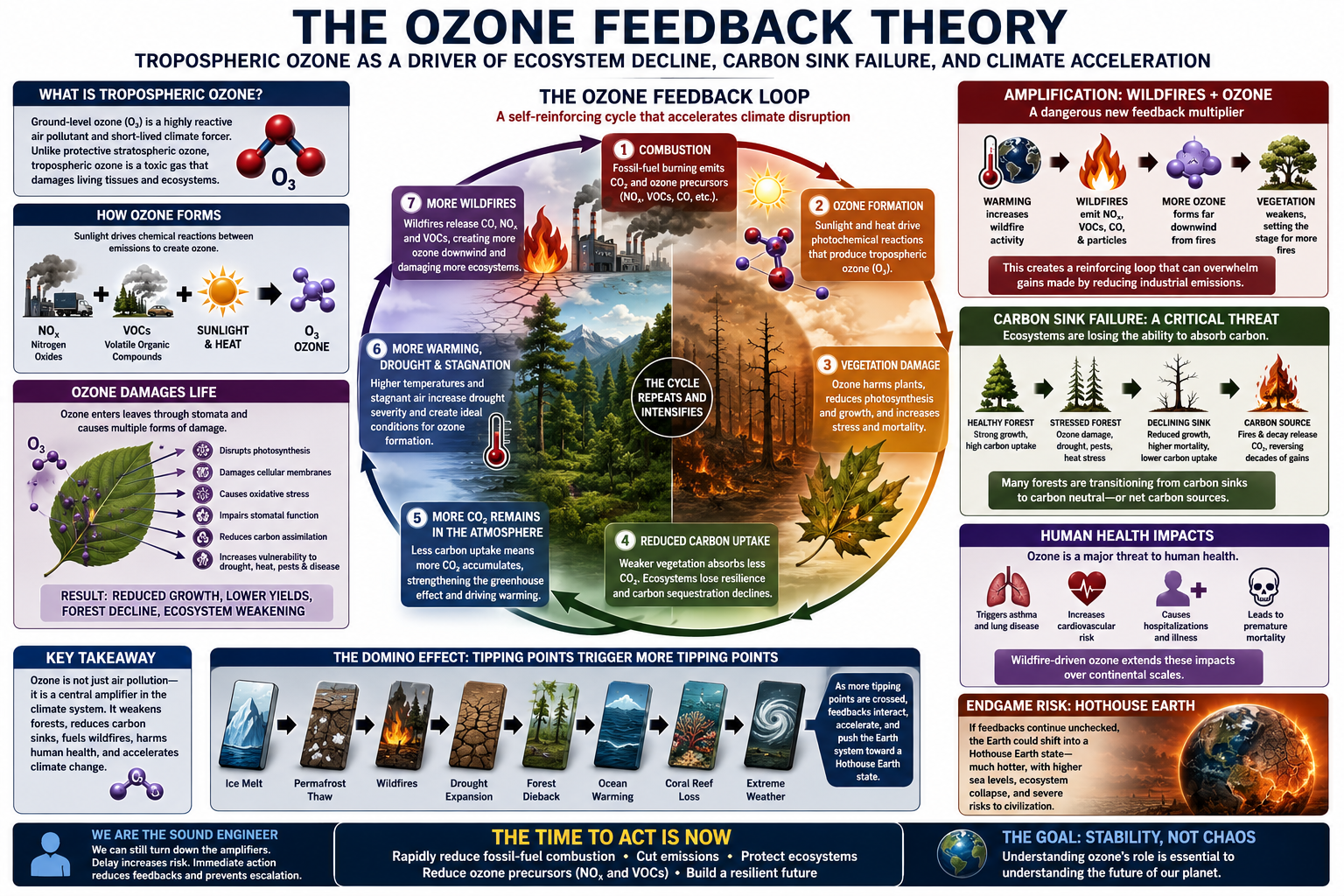
bookmark_borderThe Ozone Feedback Theory: Tropospheric Ozone as a Driver of Ecosystem Decline, Carbon Sink Failure, and Climate Acceleration

Abstract

Tropospheric ozone is a major air pollutant, a significant short-lived climate forcer, and an increasingly recognized driver of ecosystem decline. While carbon dioxide (CO₂) remains the dominant anthropogenic greenhouse gas, growing evidence demonstrates that ozone plays a critical role in accelerating climate disruption through its impacts on vegetation, carbon cycling, wildfire activity, atmospheric chemistry, and human health. This paper introduces the Ozone Feedback Theory, which describes how fossil-fuel combustion simultaneously increases atmospheric CO₂ concentrations and ozone precursors, creating interconnected feedbacks that weaken terrestrial carbon sinks, reduce ecosystem resilience, increase wildfire risk, and amplify climate change. Recent observations showing widespread declines in forest productivity, increasing wildfire-driven ozone formation, and the emerging transition of forests from net carbon sinks to net carbon sources provide strong support for this framework. The evidence increasingly indicates that ozone is not merely a secondary pollutant but a central amplifier within the Earth system.

1. Introduction

Tropospheric ozone is among the most underestimated drivers of ecological degradation and climate acceleration.

For decades, climate discussions have focused primarily on carbon dioxide, methane, and other greenhouse gases. While these gases remain fundamental to understanding climate change, this emphasis has often obscured the broader consequences of combustion. Fossil-fuel combustion does not simply release CO₂; it also produces the atmospheric precursors that generate ground-level ozone, one of the most biologically destructive pollutants in the modern environment.

Over the past two decades, a growing body of evidence has demonstrated that ozone damages forests, reduces agricultural productivity, weakens ecosystem resilience, increases susceptibility to drought and wildfire, and contributes significantly to human disease and premature mortality. What initially emerged as a working hypothesis has matured into a broader theoretical framework supported by observations from atmospheric chemistry, ecology, forestry, agronomy, public health, and climate science.

This framework, referred to here as the Ozone Feedback Theory, proposes that ozone functions not merely as an environmental pollutant but as an active participant in a network of self-reinforcing climate feedbacks. Through its impacts on vegetation and carbon sequestration, ozone contributes directly to the weakening of natural carbon sinks while simultaneously increasing vulnerability to drought, pests, disease, and wildfire. These processes, in turn, generate additional greenhouse gases and ozone precursors, creating a cascading cycle of environmental degradation.

The significance of this theory has increased dramatically in recent years as evidence accumulates that many of the world’s major forest systems are experiencing declining productivity, increasing mortality, and reduced carbon uptake. The emerging reversal of forests from net carbon sinks to net carbon sources represents one of the most consequential developments in modern climate science.

2. Origins of the Theory

The origins of the Ozone Feedback Theory were rooted in long-term observation.

Beginning in the early 2000s, repeated observations of mature forest canopies revealed a gradual but persistent decline in canopy density and overall forest health. Initially subtle, the changes became increasingly difficult to ignore. Trees that had stood for generations exhibited thinning crowns, reduced foliage, and declining vigor. Over time, measurable reductions in canopy density and height became evident.

Subsequent investigation suggested that these observations could not be adequately explained by a single factor. Instead, they appeared consistent with the combined effects of warming temperatures, drought stress, ecological disruption, and chronic ozone exposure.

What began as a localized observation eventually aligned with a growing body of scientific literature documenting ozone-induced declines in forest productivity, agricultural yields, and ecosystem resilience across multiple continents.

3. Tropospheric Ozone: A Potent Biological Toxin

Ground-level ozone forms through photochemical reactions involving nitrogen oxides (NOₓ), volatile organic compounds (VOCs), sunlight, and heat.

Unlike stratospheric ozone, which shields life from harmful ultraviolet radiation, tropospheric ozone is highly reactive and directly toxic to living tissues.

Ozone damages plants through multiple pathways:

  • Disruption of photosynthesis;
  • Damage to cellular membranes;
  • Oxidative stress;
  • Impairment of stomatal function;
  • Reduction in carbon assimilation;
  • Increased vulnerability to drought, heat, pests, and disease.

The consequences extend far beyond temporary stress. Numerous studies have documented significant reductions in plant growth, crop yields, forest productivity, and net primary productivity (NPP). Depending on species sensitivity and exposure levels, productivity losses ranging from 10% to more than 40% have been observed, with some ecosystems experiencing substantially greater impacts.

Ozone is therefore not simply a pollutant. It is a large-scale ecological forcing agent.

4. The Ozone Feedback Theory

The central premise of the Ozone Feedback Theory is straightforward:

Combustion generates both greenhouse gases and ozone precursors.

Those emissions simultaneously accelerate warming and increase ozone formation.

The resulting ozone damages vegetation, weakening ecosystems and reducing their capacity to absorb atmospheric carbon.

Reduced carbon uptake allows more CO₂ to remain in the atmosphere, contributing to additional warming.

Additional warming increases drought severity, wildfire activity, and atmospheric stagnation events, which further increase ozone formation.

The cycle then repeats.

In simplified form:

Combustion → Ozone Formation → Vegetation Damage → Reduced Carbon Uptake → Increased Atmospheric CO₂ → Additional Warming → Increased Wildfire Activity → Additional Ozone Formation

Unlike traditional climate frameworks that often treat ozone as a secondary pollutant, the Ozone Feedback Theory places ozone near the center of an interconnected network of biological, atmospheric, and climatic feedbacks.

5. Carbon Sink Failure and Ecosystem Destabilization

One of the most important implications of the theory is its relationship to carbon sink stability.

Forests, wetlands, and other ecosystems have historically absorbed a substantial fraction of anthropogenic carbon emissions. This natural buffering capacity has slowed the pace of climate change.

However, growing evidence suggests that this buffering capacity is weakening.

Multiple studies have documented:

  • Declining forest productivity;
  • Increased tree mortality;
  • Reduced carbon sequestration;
  • Expansion of drought stress;
  • Increased wildfire activity;
  • Large-scale ecosystem degradation.

Ozone contributes to each of these processes.

By reducing photosynthetic capacity and weakening plant defenses, ozone lowers ecosystem resilience precisely when climate stress is increasing. The result is a gradual erosion of the natural systems that have historically moderated atmospheric carbon accumulation.

The recent transition of many forest systems from carbon sinks toward carbon neutrality—or even net carbon emissions—represents one of the strongest lines of evidence supporting the theory.

6. Wildfires, Ozone, and Emerging Amplification Loops

Recent research has strengthened the theoretical framework considerably.

The 2026 Science paper, Fires Reverse Progress Toward Ozone Air Quality Standards in the United States, demonstrated that wildfire emissions are increasingly offsetting decades of improvements in ozone pollution achieved through reductions in industrial and transportation emissions.

The study showed that wildfire smoke generates substantial quantities of carbon monoxide, nitrogen oxides, and volatile organic compounds. These emissions undergo photochemical reactions that produce ozone far downwind from the original fire source.

This finding is critically important because it reveals a previously underestimated amplification mechanism:

Climate warming increases wildfire activity.

Wildfires increase ozone formation.

Ozone weakens vegetation.

Weakened vegetation becomes increasingly vulnerable to drought, heat stress, and future fires.

Future fires become more likely and more severe.

The result is a reinforcing feedback system operating across atmospheric, ecological, and climatic domains simultaneously.

7. Human Health Implications

The ozone feedback is not limited to ecosystems.

Tropospheric ozone is a major contributor to respiratory and cardiovascular disease worldwide. Chronic exposure increases the incidence of asthma, chronic obstructive pulmonary disease, cardiovascular stress, hospitalization, and premature mortality.

Wildfire-driven ozone formation extends these impacts over continental scales.

As wildfire activity increases, the health burden associated with ozone exposure is expected to increase as well.

The Ozone Feedback Theory therefore describes a dual crisis:

  • The degradation of natural systems that support life.
  • The deterioration of human health caused by the same atmospheric processes.

8. Conclusion

The evidence increasingly supports the conclusion that tropospheric ozone is not a peripheral component of the climate system. It is a major amplifier operating at the intersection of atmospheric chemistry, ecosystem function, human health, and climate dynamics.

The Ozone Feedback Theory provides a framework for understanding how combustion-driven ozone formation contributes simultaneously to ecosystem decline, carbon sink failure, wildfire amplification, and accelerating climate change.

The critical question is no longer whether these interactions exist. They are now directly observable across forests, agricultural systems, atmospheric measurements, wildfire records, and public-health statistics.

The challenge before climate science is to quantify the strength of these feedbacks, identify emerging tipping points, and determine how rapidly they are reshaping the Earth system.

Understanding ozone’s role in these processes may prove essential to understanding the trajectory of climate change itself.

Sources and References

  1. Runaway Climate Feedbacks and Systemic Collapse
  2. Fires Reverse Progress Toward Ozone Air Quality Standards in the United States Science (2026).
  3. Ozone as a Climate Multiplier: Key Coupling Agent in Chemistry–Climate Feedbacks
  4. Introduction to Ozone and Climate Change
  5. The Decline of Penn’s Sylvania
  6. The Dangers of Tropospheric Ozone: A Silent Threat to Health and the Environment
  7. The Domino Collapse of Earth’s Climate Systems: Amazon Rainforest Dieback and the Ozone Feedback Loop
  8. Ozone Feedbacks From Carbon Combustion: Tropospheric Ozone, Ecosystem Collapse, and the Failure of Biofuel Narratives
  9. Why Models Underestimated Climate Change
  10. Loss of Tropical Moist Broadleaf Forest Has Turned Africa’s Forests from a Carbon Sink into a Source
  11. Reduced Productivity and Carbon Drawdown of Tropical Forests from Ground-Level Ozone Exposure Nature Geoscience (2024).

Additional Reading

The references above collectively examine the role of tropospheric ozone as a climate forcing agent, ecosystem stressor, public-health hazard, and amplifier of climate feedbacks. Particular attention is given to ozone-induced reductions in forest productivity, weakening carbon sinks, wildfire-driven ozone formation, and the interaction between atmospheric chemistry and nonlinear climate-system responses.
bookmark_borderSingularity: Turn Down Your Guitar!

This paper is focused on the definitions of three key concepts: runaway climate change feedbacks, Hothouse Earth, Venus Syndrome, and singularity. Understanding the distinctions between these terms is essential because they describe different stages and mechanisms of large-scale system change.

I think part of the confusion stems from the distinction between runaway climate change feedbacks and the Hothouse Earth framework.

  • Runaway climate feedbacks — When individual climate indicators enter self-reinforcing feedback loops, such as sea ice melt and the albedo effect.
  • Runaway greenhouse effect — A self-amplifying warming process in which increasing temperatures cause additional greenhouse warming driving changes throughout the entire system, potentially leading to the evaporation of oceans and conditions resembling those on Venus. This is the classic “Venus scenario.”
  • Hothouse Earth — The framework proposed by researchers such as Will Steffen and colleagues. It does not describe a true Venus-style runaway greenhouse. Instead, it describes a much warmer Earth stabilized by Earth-system feedbacks, with substantially higher temperatures and sea levels than today.
  • Venus Syndrome — A less formal term sometimes used in popular science and environmental literature to describe Earth moving toward a Venus-like climate state through uncontrolled greenhouse warming.

A key distinction is that Hothouse Earth is not the same as a Venus-like runaway greenhouse. The Hothouse Earth framework generally envisions a planet that remains habitable in some regions but is much hotter and less hospitable. A true runaway greenhouse (the Venus scenario) is far more extreme and is not considered a likely outcome of anthropogenic climate change under current scientific understanding.

Physics does not support a transition to a full Hothouse Earth state within this century. However, physics does allow for self-reinforcing runaway processes that can move the climate system in that direction over longer timescales. These are the runaway processes we are currently observing: amplifying feedback loops that accelerate warming and increase the risk of crossing critical thresholds.

The distinction between runaway climate feedbacks and a Hothouse Earth state is crucial. Runaway processes mean that humans have triggered self-reinforcing feedbacks, but we still retain the ability to change course by reducing the activities driving them. A Hothouse Earth state, by contrast, implies that major Earth-system feedbacks have become sufficiently dominant that human actions alone may no longer be able to prevent continued warming.

If we still have a window of opportunity, it is now. The most effective action remains the rapid reduction and eventual elimination of fossil-fuel combustion. Delay increases the risk of crossing critical thresholds and committing future generations to far more severe and potentially irreversible consequences.

The easiest way for me to understand it is this:

Tipping points and feedback loops drive the acceleration of climate change. When one tipping point is crossed and triggers others, the cascading sequence is known as the Domino Effect.

In other words, feedback loops can become self-reinforcing, creating runaway processes. When one tipping point triggers additional tipping points, the resulting chain reaction can spread throughout the climate system. If enough major tipping elements are crossed, the climate system could be pushed toward a Hothouse Earth state.

A Simplified Framework

Tipping point crossed → feedback loop activated → runaway process

The Domino Effect

The Domino Effect occurs when multiple tipping points trigger additional tipping points and feedbacks. This cascading sequence of feedbacks spreads through the system, eventually destabilizing larger and larger portions of the Earth system and pushing it toward a Hothouse Earth state.

Another way to describe it is:

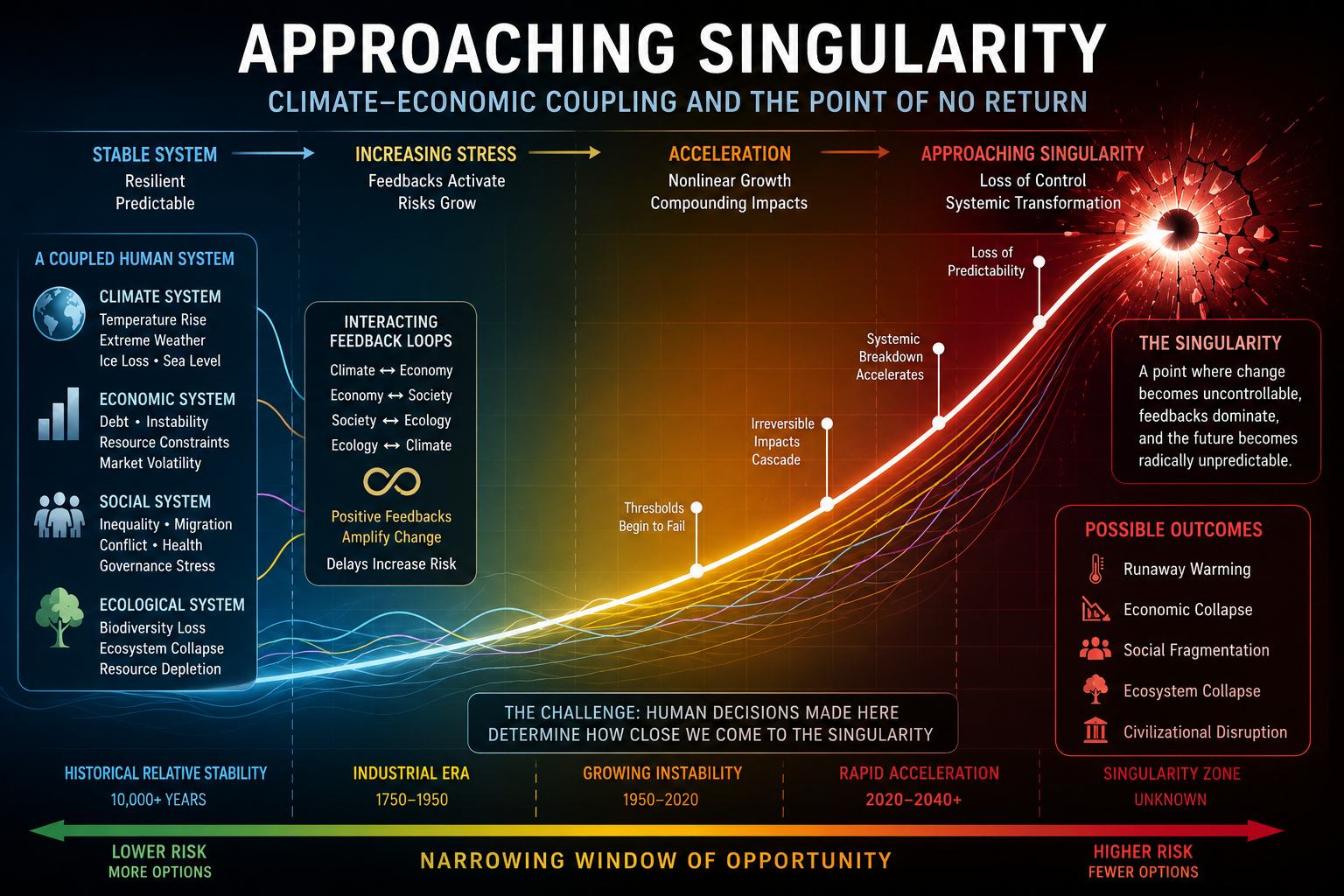
Tipping points trigger self-reinforcing feedback loops that enter a runaway state. When these runaway feedbacks cascade in a chain reaction across the entire system, runaway climate change approaches a singularity.

Amplifier Feedback Example

One last analogy for musicians.

A band is on stage, and a guitar amp begins to feed back. Left unchecked, the feedback becomes self-reinforcing. As it grows more intense, it triggers feedback in the vocalist’s microphone, which in turn triggers feedback in the stage monitors. The cascading feedbacks spread throughout the sound system, resulting in pure chaos across the entire arena – “approaching” singularity.

So when the sound engineer yells at the guitarist to “turn it down,” that’s essentially where we are today.

The Earth has at least several dozen major tipping points. At present, roughly nine appear to have entered self-reinforcing feedback loops. This is like having a large band with nine guitarists, each trying to hear themselves over the others. As a result, each guitarist turns up their amplifier a little louder. Soon, all nine amps are feeding back.

Humanity is the sound engineer. We must take immediate action because these feedbacks can spill over and trigger additional feedbacks. Those new feedbacks can then amplify the original ones, creating a cascading network of self-reinforcing processes.

A simple real-world example is sea ice melt and the albedo effect. As highly reflective sea ice melts, it exposes darker ocean water that absorbs more solar energy. This is analogous to the first guitarist turning the amplifier up too loud and creating feedback. The darker ocean surface warms more rapidly, accelerating the melting of additional ice and exposing even more dark water.

It is possible that this process has entered a self-reinforcing runaway feedback loop. However, it is important to recognize that not all runaway processes continue indefinitely. Once the sea ice is largely gone, that particular feedback will eventually reach its limit and stabilize. In the meantime, however, it can amplify numerous other feedbacks throughout the climate system, including those that affect carbon storage and carbon dioxide sequestration.

Conclusion

Climate change appears to have entered a phase in which multiple self-reinforcing feedback processes are becoming increasingly important. If left unchecked, these interacting feedbacks are likely to continue accelerating change and pushing the Earth system toward increasingly unstable conditions, potentially approaching a climatic singularity.

Runaway feedbacks have begun, but we have not yet entered true runaway climate change. That’s an important difference. Self-reinforcing feedback loops are increasingly evident in several parts of the Earth system, but humanity still retains the ability to influence the outcome through aggressive mitigation.

That’s why I believe our primary focus must remain on mitigation. If we give up on mitigation and focus only on adaptation, then adaptation eventually becomes our only option. The goal is to prevent that future, not simply prepare for it.

  • The accompanying graphic includes a timeline along the bottom that illustrates the concept. It suggests that we are moving toward a climatic singularity, but we’re not there yet. The remaining window may be narrowing, but it is precisely that remaining window that makes mitigation so important.

Singularity

Advances in technology, modeling, and artificial intelligence have significantly improved our ability to understand and track the accelerating dynamics of climate change. These tools have provided new insight into how quickly complex systems can evolve—and how difficult it may be to keep pace with that acceleration.

Our latest analysis suggests that the climate–economic system is now exhibiting third-derivative behavior, indicating that not only are impacts increasing, and accelerating, but the acceleration itself is increasing. This places the system within a singularity-like regime, characterized by nonlinear amplification, rising instability, and reduced predictability.

Historically, such transitions were assumed to unfold over tens of thousands to millions of years based on paleoclimate evidence. However, current observations indicate that these dynamics may be occurring on dramatically compressed timescales, raising the possibility that singularity-like behavior could emerge within contemporary time horizons.

Given the importance and accessibility of these findings, this work is presented in three formats:

Each version conveys the same core insight: complex, coupled systems can shift rapidly from stable to unstable behavior, and understanding this transition is critical to anticipating future climate and economic risk.

bookmark_borderIs Climate Change on a Runaway Train?

by Daniel Brouse and Sidd Mukherjee

A Public-Access Discussion of Nonlinear Climate Risk

Abstract

Climate change is often discussed in terms of gradual warming. However, growing evidence suggests that many climate impacts may be accelerating through interacting feedback loops and nonlinear system behavior. This raises an important question:

Is climate change entering a runaway state?

The answer depends largely on how the term runaway is defined. While current observations do not support the conclusion that Earth is undergoing a Venus-like runaway greenhouse effect, numerous climate, ecological, and economic subsystems are exhibiting increasingly self-reinforcing dynamics. Understanding these dynamics is essential for evaluating future risks and identifying effective mitigation and adaptation strategies.


What Does “Runaway” Mean?

The word runaway is often interpreted as an absolute condition: a system that has become completely uncontrollable.

In reality, complex systems rarely transition from stable to unstable in a single step. Instead, they often move through a spectrum of increasingly nonlinear behavior as feedback mechanisms strengthen and begin interacting with one another.

One of the challenges facing climate science is that there is no universally accepted definition of what constitutes a runaway state in the Earth system, nor is there a single observable threshold that clearly indicates when such a transition has occurred.

This uncertainty is scientifically important.

In many complex systems, critical transitions are only fully recognized in hindsight, after the system response is already underway.

The scientific question is therefore not whether Earth has entered a fully runaway state. Rather, the question is:

To what extent are self-reinforcing feedbacks becoming dominant drivers of system behavior?


The Train Analogy

A useful way to think about climate change is through the analogy of an accelerating train.

Imagine riding on a train.

Looking out the window, you can clearly see that the train is moving faster than it was before. That increase in speed is observable and largely undisputed.

At the same time, the ride is becoming less smooth. There is more vibration, more instability, and greater variability throughout the system.

The train is still on the tracks.

The engineer still has control.

But momentum is increasing.

The critical question is not whether the train is moving. The critical question is what lies ahead.

A train can safely accelerate for a very long time under favorable conditions. Problems arise when increasing speed encounters constraints that the system was not designed to handle.

A steep decline.

A sharp curve.

A damaged bridge.

The faster the train is moving when it reaches those conditions, the more difficult it becomes to avoid derailment.

Climate change presents a similar risk-management challenge.

The prudent course is not to wait until the curve becomes visible.

The prudent course is to reduce risk while options remain available.


Evidence of Increasing Nonlinearity

A growing number of climate indicators exhibit behavior that appears inconsistent with simple linear change.

Examples include:

  • accelerating sea-level rise,
  • increasing atmospheric moisture,
  • intensifying precipitation extremes,
  • expanding wildfire activity,
  • growing ocean heat content,
  • ice-sheet instability,
  • ecosystem degradation,
  • climate-related insurance losses,
  • and increasing infrastructure vulnerability.

Each of these processes is influenced by multiple interacting feedback mechanisms.

The concern is not any single indicator in isolation.

The concern is the coupling among many indicators simultaneously.

As feedbacks strengthen, the response of the overall system may become increasingly nonlinear, making future outcomes more difficult to predict using historical trends alone.


Climate, Economics, and Systemic Risk

Climate change is not solely an environmental issue.

It is increasingly becoming an economic risk-management problem.

My own research background is in economics, complex systems, and climate risk management. My research partner, Sidd Mukherjee, is a physicist. Although our disciplines differ, we have independently arrived at similar conclusions regarding the growing importance of coupled climate–economic feedbacks.

One of the clearest examples may be found in the insurance industry.

Insurance functions as society’s primary mechanism for distributing risk. When insurers withdraw from regions, significantly increase premiums, or reduce coverage availability, they are responding to observed changes in risk rather than theoretical possibilities.

These responses can propagate through:

  • housing markets,
  • mortgage systems,
  • infrastructure investment,
  • municipal finance,
  • migration patterns,
  • and broader economic networks.

Understanding how climate risks move through these interconnected systems remains a major focus of our research.


The Nonlinear Acceleration Framework

Our work has explored what we call the Nonlinear Acceleration Framework.

The central idea is simple:

Climate impacts are not driven solely by direct warming. They are also influenced by interactions among physical, ecological, social, and economic feedback loops.

When feedbacks interact, change may occur faster than expected from temperature trends alone.

Whether specific acceleration estimates ultimately prove accurate is less important than the broader observation:

Many climate indicators appear to be changing at rates that challenge assumptions of gradual, linear progression.

This possibility deserves serious scientific attention.


What We Think

Although uncertainty remains substantial, both Sidd and I believe several major climate-related systems are already experiencing significant destabilization.

My greatest concern is the increasing fragility of climate-linked economic systems, particularly insurance and real estate.

Sidd’s greatest concern is the potential destabilization of large ecological systems, especially the Amazon rainforest, which plays a critical role in global carbon cycling, hydrology, and biodiversity.

Where we strongly agree is that many of these processes are not future possibilities waiting to begin.

They are already observable today.

The debate increasingly concerns magnitude, timing, interaction, and ultimate consequences.

In 2023 and 2024 much of the scientific community came to the conclusion that multiple major tipping points had entered self-reinforcing feedbacks. 2024 was the hottest year on record. The Antarctic saw recording breaking ice sheet destabilization. Large portions of Siberia caught on fire. The most alarming signal was Canada’s borreal forests catching on fire. In 2023, Sidd said, “Do you remember back in the early 2000’s when we thought we wouldn’t live to see the extreme changes due to global warming?”

Daniel replied, “I think 2023 is the most significant year so far. We saw confirmation of tipping points being crossed for Mountain Glacier Loss, Greenland Ice Sheet Collapse, Antarctic Ice Sheet Collapse, and potentially the Collapse of AMOC.”

Sidd continued, “We already knew that. It was Canada catching on fire that I could not believe. I never thought I’d live to see the day.”

Daniel asked, “Do you think the permafrost and peatlands will have zombie fires and cause the permafrost tipping point?”

Sidd responded, “Yes. They are gone, too. We already know from the permafrost peatland fires in Siberia.”

2023 was the year we saw confirmation that multiple tipping points were accelerating and feeding each other.


Conclusion

Climate change is not a runaway greenhouse catastrophe unfolding overnight.

Nor is it a simple linear process that can be understood by extending historical trends indefinitely into the future.

The evidence increasingly points toward a complex system characterized by interacting feedback loops, threshold behavior, and growing nonlinear responses.

The most important question is no longer whether climate change is occurring.

The question is how rapidly interconnected climate, ecological, economic, and social systems will respond as feedbacks continue to strengthen.

Understanding that response may determine how effectively humanity navigates the century ahead.


Important Scientific Note

A full “Hothouse Earth” or Venus-like runaway greenhouse scenario is not considered plausible within the next century based on current scientific understanding.

However, present-day emissions and feedback processes may commit future generations to long-term warming pathways that become increasingly difficult to reverse.

Some research has explored high-end warming outcomes exceeding 10°C over multi-century timescales under strong feedback participation. The key issue is not whether such outcomes occur in the near term, but whether current decisions influence long-term climate trajectories in ways that constrain future options.

The central challenge is therefore not immediate runaway warming, but the possibility of crossing thresholds that commit the Earth system to progressively more difficult and costly futures.

* Our probabilistic, ensemble-based climate model — which incorporates complex socio-economic and ecological feedback loops within a dynamic, nonlinear system — projects that global temperatures are becoming unsustainable this century. This far exceeds earlier estimates of a 4°C rise over the next thousand years, highlighting a dramatic acceleration in global warming. We are now entering a phase of compound, cascading collapse, where climate, ecological, and societal systems destabilize through interlinked, self-reinforcing feedback loops.

We examine how human activities — such as deforestation, fossil fuel combustion, mass consumption, industrial agriculture, and land development — interact with ecological processes like thermal energy redistribution, carbon cycling, hydrological flow, biodiversity loss, and the spread of disease vectors. These interactions do not follow linear cause-and-effect patterns. Instead, they form complex, self-reinforcing feedback loops that can trigger rapid, system-wide transformations — often abruptly and without warning. Grasping these dynamics is crucial for accurately assessing global risks and developing effective strategies for long-term survival.

bookmark_borderHeat Stress, Environmental Stressors, and the Limits of Human Adaptability

A Follow-Up to Heat Stress, Human Survivability, and the Emerging Physiological Limits of Climate Change

http://membrane.com/global_warming/Heat-Survivability-Thresholds.html

Q: How Adaptable Are Humans to Rising Heat and Compounding Environmental Stressors?

A: Far less adaptable than many assume.

Modern humans (Homo sapiens) are approximately 200,000 years old, with some of our closest ancestral lineages dating back roughly 140,000 years. One of the oldest known oral traditions may provide a remarkable example of humanity’s long environmental memory: the story of the Seven Sisters of the Pleiades.

The Pleiades are a cluster of stars in the Taurus constellation. Today, six stars are easily visible to the naked eye, yet many ancient traditions across the world describe seven visible sisters. Some researchers suggest these stories may preserve observations from many tens of thousands of years ago, before stellar movement made the seventh star difficult to see without magnification.

Among the oldest continuous cultural traditions associated with the Pleiades are the Dreaming stories of Aboriginal Australians. These interconnected “songlines” span much of the Australian continent, linking ecological knowledge, astronomy, navigation, and seasonal cycles across dozens of language groups and cultures.

First Nations Australians are also among the earliest groups to recognize localized ecological disruptions associated with anthropogenic climate change. Their approximately 65,000 years of continuous connection to Country produced highly localized ecological calendars based not on fixed months, but on relationships among plants, animals, weather patterns, and stars. This deep environmental literacy enabled them to track subtle shifts in ecosystems long before modern climate science emerged.

Yet even populations with millennia of environmental adaptation have limits.

Although Aboriginal Australians survived in some of the harshest climates on Earth, they have not escaped the physiological and societal burdens associated with environmental stress. Today, Indigenous Australians continue to experience significantly lower life expectancy compared to non-Indigenous populations, reflecting the complex interaction of environmental, social, economic, and health stressors.

There are important lessons in this history:

Long-term adaptation over thousands of years is fundamentally different from rapid climate destabilization unfolding over mere decades.


Heat, Health, and Compounding Stressors

The dangers of rising temperatures extend far beyond mass casualty events during heatwaves.

Heat exposure increasingly functions as a chronic, whole-body stressor capable of degrading human health over time.

Recent analyses estimate that the average person now experiences roughly 19 days per year of potentially life-threatening heat exposure, with most of that increase attributable to human-caused climate warming.

The impacts extend well beyond heatstroke.

Prolonged exposure to elevated temperatures contributes to:

  • dehydration,
  • kidney injury,
  • cardiovascular strain,
  • worsening respiratory disease,
  • impaired sleep and recovery,
  • reduced labor productivity,
  • and increased mortality risk.

Emerging research also indicates that chronic heat exposure can accelerate biological aging by damaging tissues, impairing mitochondrial function, and shortening telomeres at the cellular level.

These processes are associated with elevated risks of:

  • diabetes,
  • dementia,
  • cardiovascular disease,
  • immune dysfunction,
  • and several forms of cancer.

Heat stress also significantly affects mental health, increasing rates of:

  • anxiety,
  • depression,
  • aggression,
  • cognitive impairment,
  • and suicide risk.

The cumulative burden of these stressors becomes even more dangerous when combined with pollution exposure, infectious disease, nutritional instability, and economic stress.


Adaptation Timescales Matter

Arguments that humans have “always adapted” to heat fundamentally misunderstand the timescale problem.

Human adaptation historically occurred across evolutionary and cultural timescales spanning thousands of years.

Modern climate destabilization is unfolding within decades.

This compression of time severely limits both biological adaptation and societal infrastructure response.

The challenge is not simply rising temperature — it is the accelerating interaction of multiple environmental stressors occurring simultaneously within highly interconnected systems.


Epigenetic Changes: The Molecular Convergence of Climate Stressors

One of the most important emerging areas of research involves epigenetics — chemical modifications that influence how genes are expressed without changing the underlying DNA sequence itself.

These mechanisms function somewhat like biological dimmer switches, activating or suppressing genetic pathways in response to environmental conditions.

Extreme heat, particularly when combined with:

  • air pollution,
  • wildfire smoke,
  • ozone exposure,
  • chronic stress,
  • and infections such as COVID-19,

is increasingly associated with epigenetic modification.

Research suggests these changes may influence genes linked to:

  • cancer,
  • diabetes,
  • cardiovascular disease,
  • neurological disorders,
  • inflammation,
  • immune regulation,
  • and accelerated aging.

Critically, when multiple environmental stressors occur simultaneously, their effects may not simply add together — they may compound through interacting biological feedback loops.

This molecular-level disruption may represent a shared underlying mechanism connecting many climate-related health threats.

The implications are profound.

Climate change may not only reduce lifespan through direct heat mortality, but also through the gradual amplification of chronic disease, immune dysfunction, cognitive decline, and systemic physiological stress across entire populations.

Researchers are also increasingly concerned about potential transgenerational effects, where environmentally induced epigenetic changes in one generation may influence disease susceptibility in the next.


Conclusion

Climate change is not simply an environmental crisis.

It is increasingly a physiological, neurological, immunological, and societal stress crisis operating across multiple interconnected systems simultaneously.

The question is no longer whether humans can survive occasional extreme heat events.

The emerging scientific question is:

How well can human biology, infrastructure, healthcare systems, economies, and societies adapt to accelerating, compounding environmental stressors occurring at historically unprecedented rates?

Current evidence suggests the limits may be approaching far sooner than previously assumed.

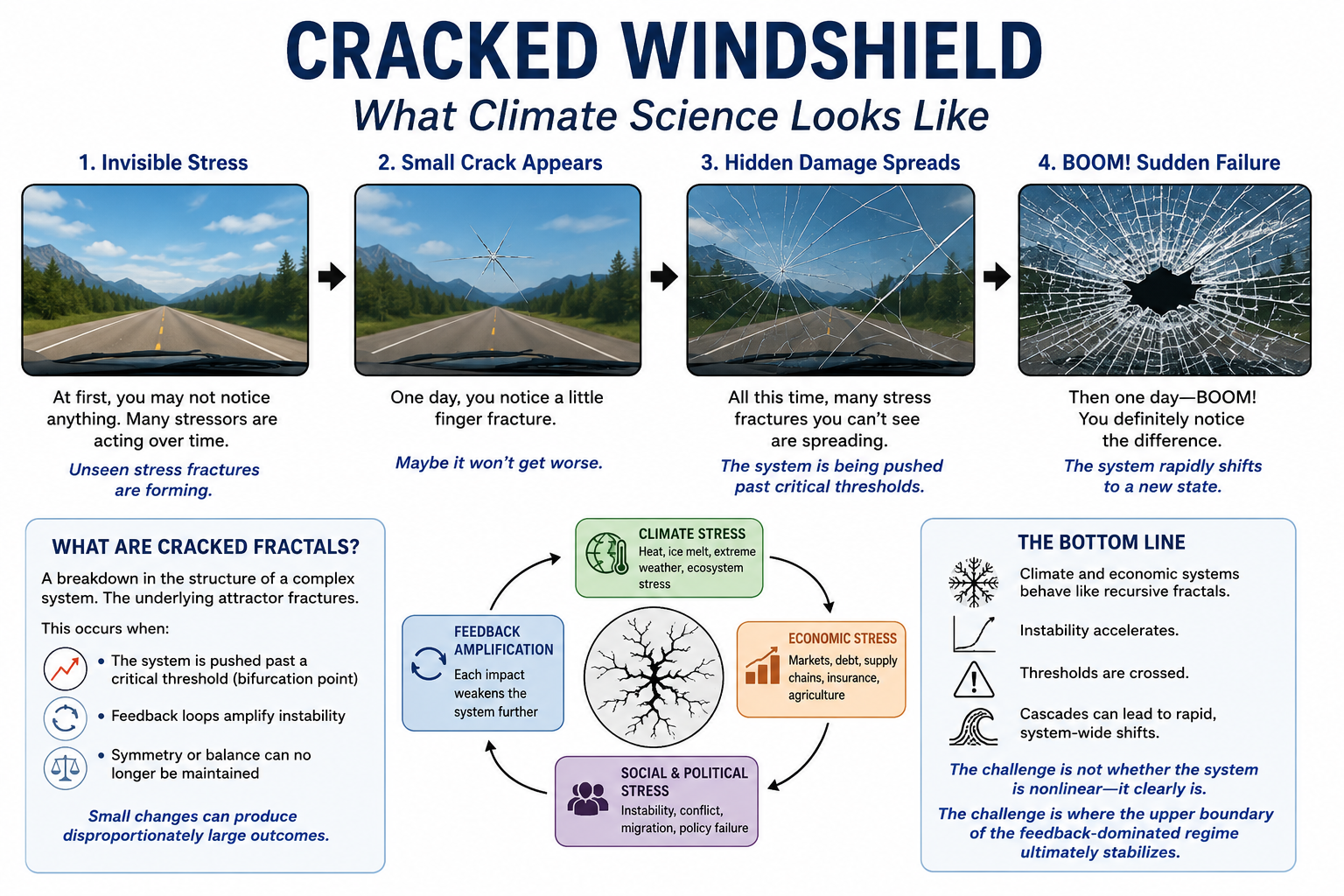
bookmark_borderCracked Windshields and Cracked Fractals

What Climate Science Looks Like

What does climate change look like?

In many ways, it resembles a cracked windshield.

At first, you may not notice anything at all. Time passes. The damage appears minor or even invisible. Then one day, a small fracture catches your eye — just a tiny finger crack stretching across the glass.

You think:

“Maybe it won’t get worse.”

But during all that time, unseen stress fractures have already been spreading beneath the surface. Temperature changes, vibration, pressure, and repeated impacts continue weakening the structure. The windshield may appear stable right up until the moment it suddenly fails.

Then one day:

BOOM.

The entire system changes.

Climate systems often behave the same way.

>A Graphical Representation

The graph is a simplified representation of an extraordinarily complex system. Nevertheless, it provides a familiar visual analogy that helps make nonlinear climate dynamics easier to understand.

Up through the 1990s, we were largely in Frame 1 — invisible stress. The underlying pressures were building, but most of the damage remained hidden from view.

By the early 2000s, the first visible cracks began to emerge. Evidence of accelerating climate change, ecological degradation, and feedback amplification became increasingly difficult to ignore. Even then, many observers assumed the system might stabilize on its own and argued that the damage would remain limited.

Today, we are in the phase where hidden fractures are propagating throughout the system and becoming increasingly apparent. The accumulating damage can now be observed across multiple interconnected indicators, including rising temperatures, ocean heat content, ice-sheet instability, biodiversity loss, extreme weather, and economic disruption. It is becoming clear that the system is not simply going to repair itself.

The central question is no longer whether the cracks exist, but how rapidly the system moves toward the next phase — the point where cascading failures become unavoidable and the damage accelerates dramatically.

Because this is a nonlinear system dominated by interacting feedback loops, historical timelines provide only limited guidance. As stress accumulates, change can occur gradually for long periods and then suddenly accelerate, making future conditions arrive much faster than past trends alone would suggest.

What Are Cracked Fractals?

A “cracked fractal” describes the breakdown of a complex system that once maintained a relatively stable internal structure.

Traditional fractals exhibit self-similarity — repeating patterns that remain bounded within a recognizable range of behavior. But under sufficient stress, the underlying attractor of the system begins to fracture. The system no longer returns to its previous equilibrium.

Instead, instability begins propagating through the network itself.

This breakdown often occurs when:

  • the system is pushed beyond a critical threshold or bifurcation point,
  • feedback loops begin amplifying instability,
  • nonlinear interactions overwhelm stabilizing forces,
  • or the original symmetry and balance can no longer be maintained.

At that stage, small disturbances can produce disproportionately large outcomes.

Climate Change as a Cracked Fractal System

In climate science, cracked fractals may manifest as:

  • rapid destabilization of ocean circulation systems,
  • accelerating polar amplification,
  • persistent jet-stream distortions,
  • collapsing ice-sheet dynamics,
  • ecosystem dieback,
  • or cascading climate feedback loops.

The challenge is that coupled climate systems do not behave linearly. They increasingly exhibit characteristics similar to recursive fractal systems:

  • accelerating instability,
  • collapsing doubling times,
  • threshold behavior,
  • and emergent feedback amplification.

The question is no longer whether the climate system is nonlinear. That is already evident in the observational data.

The deeper uncertainty is where the upper boundary of the feedback-dominated system ultimately stabilizes — and whether critical subsystems fracture faster than humanity can adapt.

Economic Systems Fracture the Same Way

The same dynamics apply to economic systems.

Financial markets, supply chains, energy systems, insurance structures, and sovereign debt networks all depend upon relative stability and predictable feedback behavior. Under sufficient stress, these systems can also enter cracked-fractal regimes where volatility compounds recursively.

Examples include:

  • sovereign debt spirals,
  • liquidity collapses,
  • insurance market failures,
  • climate-driven migration shocks,
  • agricultural destabilization,
  • and cascading infrastructure breakdowns.

What appears stable on the surface may already contain invisible structural fractures spreading through the underlying system.

By the time the cracks become obvious, the destabilization process may already be well underway.

The Domino Effect

Complex systems rarely fail in isolation.

Climate stress amplifies economic stress. Economic stress weakens political stability. Political instability undermines coordinated mitigation and adaptation. Ecological degradation further weakens resilience.

The result is a coupled climate–economic–ecological system increasingly vulnerable to synchronized failure cascades.

Like a cracked windshield, the system may appear intact right up until the moment the fractures suddenly connect.

bookmark_borderHeat Stress, Human Survivability, and the Emerging Physiological Limits of Climate Change

For decades, many researchers assumed humans could generally survive “wet-bulb” temperatures near 35°C (95°F at 100% humidity) for limited periods. This threshold was widely treated as the upper survivability boundary for healthy individuals under shaded and ventilated conditions.

Many newer experiments now indicate that:

  • 31°C wet-bulb (~87.8°F) may already be dangerous or unsurvivable for many healthy adults after prolonged exposure.
  • For elderly individuals or vulnerable populations, critical stress may begin closer to: 28–30°C wet-bulb (~82–86°F).

These newer laboratory experiments using controlled climate chambers now suggest that the true physiological danger threshold may be substantially lower for large portions of the population — particularly:

  • the elderly,
  • individuals with cardiovascular or respiratory disease,
  • outdoor workers,
  • children,
  • and populations without reliable access to cooling infrastructure.

These findings significantly alter our understanding of human vulnerability in a warming world.

Why the Research Matters

The emerging research demonstrates that heat stress is not merely a matter of discomfort or dehydration. Elevated temperatures directly impair critical biological systems, including:

  • thermoregulation,
  • immune response,
  • cardiovascular stability,
  • cellular metabolism,
  • mitochondrial function,
  • and DNA repair mechanisms.

This is critically important because public discussions often continue framing heatwaves as isolated “weather events” rather than systemic physiological stressors capable of destabilizing multiple organ systems simultaneously.

The newer findings instead suggest that prolonged heat exposure functions as a whole-body biological destabilizer.

Heat, Immunity, and Cellular Damage

One of the most significant emerging findings is that elevated temperatures can impair immune-cell stability while simultaneously increasing inflammatory stress and cellular damage.

Related NIH-supported research has shown that fever-range temperatures can increase mitochondrial dysfunction and DNA damage in critical immune cells. These processes may contribute to:

  • weakened immune resilience,
  • increased systemic inflammation,
  • accelerated aging processes,
  • greater cardiovascular strain,
  • impaired recovery capacity,
  • and potentially elevated long-term disease risk through cumulative cellular stress.

Additional studies suggest that prolonged heat exposure may even accelerate epigenetic aging markers — effectively speeding aspects of the body’s biological aging clock.

The implications extend well beyond temporary heat exhaustion.

The Climate Change Connection

These findings become even more significant when viewed in the context of accelerating climate instability.

Extreme heat events are increasing:

  • in frequency,
  • duration,
  • nighttime persistence,
  • humidity,
  • and geographic reach.

This is occurring alongside broader atmospheric and oceanic destabilization, including:

  • slowing jet-stream dynamics,
  • amplified Rossby-wave blocking patterns,
  • urban heat-island amplification,
  • weakening ocean circulation systems such as the AMOC,
  • and increasing atmospheric moisture content.

In practical terms, temperatures once considered rare anomalies are increasingly becoming sustained seasonal conditions across large regions of the world.

Why Humidity Is So Dangerous

A major focus of current research is wet-bulb temperature — a combined measure of heat and humidity.

Humans cool themselves primarily through evaporative cooling via sweating. High humidity dramatically reduces the body’s ability to dissipate heat into the surrounding environment.

As humidity rises:

  • sweat evaporates less efficiently,
  • internal body temperature increases more rapidly,
  • cardiovascular stress intensifies,
  • and recovery becomes increasingly difficult.

This means a moderately lower humid temperature can be more physiologically dangerous than a much hotter dry environment.

The danger becomes especially severe when:

  • nighttime temperatures remain elevated,
  • indoor cooling is unavailable,
  • populations are exposed for prolonged periods,
  • or electrical infrastructure fails during heatwaves.

Under these conditions, the body may no longer recover adequately from cumulative daytime heat stress.

A Growing Public Health Crisis

Perhaps the most important implication is this:

Many regions may approach dangerous human survivability thresholds far earlier than current infrastructure, public-health planning, and policy assumptions anticipate.

Heat is already among the deadliest weather-related hazards globally. Unlike hurricanes or tornadoes, heat-related deaths are often undercounted because they frequently manifest indirectly through:

  • cardiac failure,
  • respiratory collapse,
  • kidney injury,
  • stroke,
  • immune dysfunction,
  • and secondary medical complications.

Climate change is therefore no longer solely an environmental issue. It is increasingly a direct human physiological and public-health crisis.

The Broader Systems Implication

As temperatures continue rising, societies become increasingly dependent upon:

  • air conditioning,
  • electrical grids,
  • water infrastructure,
  • cooling centers,
  • healthcare systems,
  • and indoor climate stabilization technologies.

This creates a dangerous reinforcing feedback loop.

Extreme heat increases demand for cooling precisely when heat also strains:

  • power grids,
  • transmission infrastructure,
  • water systems,
  • and energy supplies.

The result is a compounding systems dynamic:

more heat → greater cooling demand → higher energy consumption → greater emissions → more heat

Without major improvements in energy efficiency, emissions reductions, and climate adaptation infrastructure, this cycle risks becoming increasingly self-reinforcing.

The growing body of heat-survivability research suggests that human physiological limits may become one of the defining constraints shaping civilization’s climate future during the twenty-first century.

Nature: What is the hottest temperature humans can survive?

bookmark_borderRossby Waves, Climatic Whiplash, and the Nonlinear Destabilization of Atmospheric Circulation

By Daniel Brouse and Sidd Mukherjee

May 25, 2026

Abstract

Rapid Arctic amplification, accelerating Antarctic ice loss, and weakening ocean circulation are increasingly destabilizing Earth’s atmospheric circulation systems. One of the clearest manifestations of this destabilization is the amplification and persistence of Rossby waves — large-scale meanders in the jet stream that regulate heat transport, storm movement, and regional weather stability.

Historically, strong equator-to-pole temperature gradients maintained a relatively fast, organized jet stream and stable atmospheric circulation regime. However, as polar regions warm substantially faster than the global average, these gradients are weakening. The result is a slower, more amplified, and increasingly persistent jet stream characterized by stronger atmospheric blocking, prolonged weather extremes, and increasing climatic whiplash.

This paper examines the relationship between Rossby-wave amplification, Arctic amplification, Sudden Stratospheric Warming (SSW) events, and nonlinear atmospheric destabilization within the framework of the Nonlinear Acceleration Hypothesis. Evidence suggests that atmospheric persistence and circulation instability may now be compressing on nonlinear timescales, contributing to unprecedented heat domes, stalled flooding events, prolonged droughts, polar intrusions, and compound climate disasters.


1. Introduction

Historically, large temperature differences between the tropics and the polar regions helped maintain a fast-moving, organized jet stream in the upper atmosphere. These thermal gradients also supported the Atlantic Meridional Overturning Circulation (AMOC), one of the Earth’s most important oceanic heat redistribution systems.

Together, the jet stream and AMOC helped:

  • redistribute planetary heat,
  • reduce atmospheric stagnation,
  • moderate regional climate variability,
  • and maintain relatively stable seasonal patterns.

However, this equilibrium is increasingly destabilizing.

The Arctic is now warming approximately four times faster than the global average, while Antarctica is experiencing accelerating ice-sheet destabilization and record cryospheric loss. As these polar regions warm disproportionately, the equator-to-pole temperature gradient weakens.

This weakening fundamentally alters atmospheric dynamics.


2. Jet Stream Destabilization and Rossby-Wave Amplification

Under historically stable conditions, the jet stream generally flowed in a relatively progressive west-to-east pattern across the United States and southern Canada.

As thermal gradients weaken:

  • zonal winds slow,
  • the jet stream elongates,
  • Rossby waves become more amplified,
  • wave propagation slows,
  • and atmospheric blocking becomes increasingly persistent.

The result is a circulation regime characterized by “stuck” weather patterns and amplified climatic extremes.

Observed Consequences Include:

  • persistent heat domes,
  • prolonged cold-air outbreaks,
  • stalled storm systems,
  • multi-day severe weather outbreaks,
  • extreme rainfall persistence,
  • prolonged droughts,
  • and compound climate disasters.

Many of the most extreme recent weather events globally exhibit these characteristics.


3. Climatic Whiplash

One of the defining signatures of Rossby-wave amplification is climatic whiplash — rapid transitions between opposing weather extremes.

Examples include:

  • severe drought followed by catastrophic flooding,
  • unseasonable warmth followed by polar intrusions,
  • prolonged stagnation followed by explosive cyclogenesis,
  • and abrupt oscillations between heatwaves and cold outbreaks.

These transitions reflect increasing instability within atmospheric circulation systems rather than isolated weather anomalies.

The atmosphere increasingly appears to be shifting from:

a fast-moving progressive flow regime

toward:

a slower, more amplified, and more persistent nonlinear circulation regime.


4. Sudden Stratospheric Warming Events

Sudden Stratospheric Warming (SSW) events represent another major component of atmospheric destabilization.

During SSW events:

  • polar stratospheric temperatures can increase by as much as 50°C within only a few days,
  • the polar vortex weakens or destabilizes,
  • and Arctic air masses can plunge far southward while anomalous warmth penetrates polar regions.

These disruptions increase atmospheric volatility and are increasingly associated with:

  • severe winter storms,
  • tornado outbreaks,
  • bomb cyclones,
  • prolonged southern cold spells,
  • historic flooding,
  • and early-season heat extremes.

As atmospheric circulation destabilizes, SSW behavior itself may become increasingly nonlinear and persistent.


5. The Nonlinear Acceleration Hypothesis

Rossby waves have always existed. The critical issue is not the mere existence of Rossby waves, but rather the observed shift toward:

  • larger amplitudes,
  • slower propagation,
  • longer persistence,
  • and stronger atmospheric blocking.

Within the framework of the Nonlinear Acceleration Hypothesis, atmospheric destabilization follows nonlinear dynamics:y∝xn(n>1)y \propto x^n \quad (n > 1)

Small increases in forcing can therefore generate disproportionately large responses once critical thresholds are crossed.

Interacting feedback systems include:

  • Arctic amplification,
  • weakening thermal gradients,
  • sea-ice decline,
  • ocean circulation instability,
  • latent heat amplification,
  • land-atmosphere coupling,
  • drought feedbacks,
  • and altered planetary-wave resonance.

The result is increasingly unstable atmospheric behavior.


6. Compression of Atmospheric Doubling Times

Evidence suggests that atmospheric persistence and Rossby-wave amplification may now be compressing on increasingly short timescales.

Estimated effective doubling intervals for persistence and intensity metrics have evolved approximately as follows:

PeriodApproximate Doubling Time
1990s~40 years
2000s~20 years
2010s~10 years
Early 2020s~5 years
Mid-2020s~2–3 years

Using:Td(t)=ln⁡(2)k(t)T_d(t)=\frac{\ln(2)}{k(t)}Td​(t)=k(t)ln(2)​

where:

  • Td(t)T_d(t)Td​(t) = doubling time,
  • k(t)k(t)k(t) = time-dependent growth constant,
  • ln⁡(2)\ln(2)ln(2) = natural logarithm of 2,

the implied atmospheric instability growth constant rises nonlinearly as doubling intervals compress.


7. Approximate Decadal Amplification

If effective atmospheric doubling intervals approach approximately 2–3 years:

Over One Decade:

2(10/2.5)=24=162^{(10/2.5)} = 2^4 = 162(10/2.5)=24=16

This implies a potential:

~16-fold increase in persistence or intensity metrics per decade.

Using a 2-year interval:2(10/2)=25=322^{(10/2)} = 2^5 = 322(10/2)=25=32

Using a 1.5-year interval:2(10/1.5)≈26.67≈1022^{(10/1.5)} \approx 2^{6.67} \approx 1022(10/1.5)≈26.67≈102

These calculations illustrate why nonlinear atmospheric destabilization can appear gradual for decades before suddenly producing:

  • unprecedented heat domes,
  • stalled megafloods,
  • prolonged droughts,
  • polar intrusions,
  • and compound climate catastrophes
    within compressed timescales.

8. Atmospheric Blocking and Extreme Weather Persistence

The most significant climate signal may not simply be “more storms” or “more Rossby waves.”

Rather, it is the increasing persistence of atmospheric patterns.

Persistent blocking systems dramatically increase:

  • heatwave duration,
  • rainfall accumulation,
  • drought intensity,
  • wildfire risk,
  • agricultural disruption,
  • and infrastructure stress.

The atmosphere is increasingly exhibiting quasi-stationary circulation patterns capable of locking regions into prolonged extremes.

This persistence amplifies societal, ecological, and economic vulnerability.


9. Conclusion

The destabilization of atmospheric circulation represents one of the clearest emerging manifestations of nonlinear climate acceleration.

Rossby-wave amplification, atmospheric blocking, Arctic amplification, and Sudden Stratospheric Warming events are increasingly interacting within a destabilizing Earth system characterized by:

  • weakening thermal gradients,
  • slower circulation,
  • amplified persistence,
  • and accelerating climatic whiplash.

The central issue is no longer whether atmospheric instability is increasing, but rather:

how rapidly nonlinear feedback systems may continue compressing climatic timescales.

The emerging evidence suggests that Earth’s atmospheric circulation is transitioning away from historically stable progressive flow patterns toward a slower, more amplified, and increasingly nonlinear regime capable of generating unprecedented compound climate extremes.

bookmark_borderClimate-Driven Range Shifts and the Nonlinear Acceleration of Ecosystem Destabilization

Apparent Biodiversity Gains as Indicators of Systemic Ecological Collapse

Daniel Brouse and Sidd Mukherjee
May 24, 2026


Abstract

Recent climate-driven ecological research has revealed a critical paradox: local biodiversity may temporarily increase even as global extinction risk accelerates. A major study published in Science examining the climate-induced redistribution of more than 60,000 plant species found that while some regions may experience short-term increases in local plant diversity due to species migration, overall extinction risk continues to rise substantially under all warming scenarios.

This paper examines those findings through the framework of the Nonlinear Acceleration Hypothesis, which proposes that climate destabilization compresses ecological transition timescales through interacting feedback systems, threshold failures, and cascading ecosystem reorganization.

We argue that apparent increases in local biodiversity do not represent ecosystem stability, but rather transient states of systemic strain preceding broader ecological restructuring and collapse. The observed acceleration of climate-driven range shifts supports a growing body of evidence that Earth-system transitions are occurring faster, more nonlinearly, and more synchronously than traditional linear climate assumptions predicted.


Introduction

Traditional ecological and climate models have often assumed that ecosystems would gradually adapt to warming through species migration and redistribution. Under this framework, climate-driven range shifts were frequently interpreted as evidence of ecological resilience.

However, recent empirical evidence increasingly challenges that assumption.

A landmark study published in Science titled Climate-induced range shifts support local plant diversity but don’t reduce extinction risk analyzed projected redistribution patterns for over 60,000 plant species globally. The researchers found that although local biodiversity may temporarily increase in some regions as species migrate into newly favorable climates, extinction risk still rises substantially overall.

This distinction is critically important.

The findings suggest that increasing local species richness during climate destabilization may not reflect resilience at all, but rather rapid ecosystem reorganization under accelerating environmental stress.

This phenomenon aligns closely with the Nonlinear Acceleration Hypothesis:y∝xn(n>1)y \propto x^n \quad (n > 1)

Under nonlinear forcing conditions, environmental systems do not respond proportionally or gradually. Instead, interconnected feedback loops amplify instability, compress transition timescales, and accelerate systemic change.


The Illusion of Biodiversity Stability

One of the study’s most important conclusions is that local biodiversity gains can coexist with increasing global ecological instability.

At first glance, rising species richness appears beneficial. New species entering warming regions may create the appearance of ecological adaptation or recovery.

However, ecosystems are not merely collections of independent species. They are highly interconnected functional systems built through long evolutionary co-adaptation.

Rapid species migration disrupts these relationships simultaneously:

  • pollinator synchronization weakens,
  • soil microbial interactions destabilize,
  • predator-prey dynamics reorganize,
  • nutrient cycling shifts,
  • and hydrological balances change.

In nonlinear systems physics, this represents a transient destabilization phase rather than stable adaptation.

The appearance of increasing complexity may therefore mask accelerating systemic fragility beneath the surface.

This mirrors patterns observed in other nonlinear collapse systems, including financial bubbles, infrastructure failures, and ecological tipping points, where apparent surface activity temporarily expands even as structural resilience deteriorates.


Climate Velocity and Compressed Ecological Timescales

The study fundamentally reflects the growing problem of climate velocity — the rate at which climatic zones are shifting geographically across Earth’s surface.

Under stable climatic conditions, species redistribution typically unfolds over centuries or millennia. Evolutionary adaptation, ecosystem restructuring, and species migration historically occurred on relatively slow geological timescales.

Today, those transitions are unfolding within decades.

This compression of ecological adjustment intervals represents one of the clearest signatures of nonlinear climate acceleration.

The central issue is not simply whether species can move geographically. The deeper issue is whether biological adaptation, ecosystem synchronization, and ecological restructuring can occur rapidly enough to maintain systemic stability.

Increasingly, evidence suggests they cannot.

Once forcing rates exceed adaptive capacity, ecological systems begin transitioning toward threshold-driven instability.


Ecosystem Reorganization as a Feedback System

The study also reinforces a broader principle emerging throughout climate science: ecosystem destabilization itself amplifies climate destabilization.

As ecological systems weaken:

  • carbon sinks deteriorate,
  • drought resilience declines,
  • wildfire susceptibility rises,
  • soil carbon storage weakens,
  • ozone damage intensifies,
  • and atmospheric instability increases.

These feedbacks are not isolated.

They interact simultaneously and reinforce one another.

For example:

  • warming accelerates drought,
  • drought weakens forests,
  • weakened forests increase wildfire risk,
  • wildfires release CO2 and ozone precursors,
  • ozone suppresses plant productivity,
  • reduced plant productivity weakens carbon sequestration,
  • and additional atmospheric carbon accelerates warming further.

This represents a classic positive-feedback cascade.

The climate system is therefore transitioning from a state dominated primarily by direct anthropogenic emissions toward one increasingly influenced by self-reinforcing Earth-system feedbacks.


Why Range Shifts Do Not Eliminate Extinction Risk

Perhaps the most important conclusion of the study is that species migration alone does not prevent extinction risk.

Multiple constraints limit adaptive redistribution:

  • habitat fragmentation,
  • agricultural conversion,
  • urbanization,
  • ecological incompatibility,
  • migration corridor disruption,
  • reproductive timing mismatches,
  • and rapid climate-zone displacement.

Even where migration occurs successfully, newly assembled ecosystems may remain highly unstable due to disrupted functional relationships.

In effect, species movement does not guarantee ecosystem persistence.

The core problem is not simply warming itself, but the accelerating rate of environmental change.

Under nonlinear forcing, systems frequently fail not because adaptation is impossible in theory, but because adaptation cannot occur rapidly enough to keep pace with accelerating disruption.


The Nonlinear Acceleration Hypothesis

The observed dynamics strongly support the Nonlinear Acceleration Hypothesis, which proposes that climate destabilization operates through interacting reinforcing feedback systems that compress ecological and climatic transition timescales.

Under this framework:

  • ecological stress weakens resilience,
  • weakened resilience amplifies disturbance vulnerability,
  • disturbances accelerate greenhouse gas release,
  • and accelerating warming further intensifies ecological stress.

The resulting system behaves nonlinearly:y∝xn(n>1)y \propto x^n \quad (n > 1)

Small increases in forcing can therefore trigger disproportionately large ecosystem responses once thresholds are crossed.

Importantly, nonlinear systems rarely collapse uniformly or gradually.

They often exhibit periods of apparent stability immediately before rapid reorganization occurs.

The temporary increase in local biodiversity documented in the study may therefore represent not resilience, but a precursor to accelerating ecological transition.


Conclusion

The Science study on climate-driven plant range shifts provides important empirical support for the growing recognition that climate destabilization is unfolding through nonlinear ecosystem reorganization rather than gradual equilibrium adjustment.

The findings demonstrate that:

  • local biodiversity gains can mask systemic fragility,
  • ecosystem transitions are accelerating geographically,
  • extinction risk remains high despite species migration,
  • and climate-driven ecological restructuring is already underway globally.

Most importantly, the research reinforces a central insight of nonlinear systems theory:

Apparent adaptation can coexist with accelerating systemic failure.

The climate crisis is therefore not simply a problem of rising temperatures alone. It is an increasingly interconnected process of ecological destabilization, biosphere reorganization, weakening resilience, and reinforcing feedback amplification occurring simultaneously across Earth systems.

The critical scientific challenge is no longer merely forecasting direct human emissions.

It is understanding how rapidly Earth’s own ecological and climatic feedback systems may accelerate destabilization once critical thresholds are crossed.


References

bookmark_borderThe Dangerous Push Toward Autonomous Warfare

This is exactly what many of us feared when defense officials and political leaders turned against Palantir Technologies over concerns surrounding autonomous weapons systems and mass surveillance capabilities.

According to critics, Palantir resisted efforts to fully embrace autonomous lethal decision-making systems and broad domestic surveillance applications targeting U.S. citizens. Now, instead of slowing the development of AI-driven warfare, lawmakers appear to be accelerating it.

Pennsylvania Senators Dave McCormick and John Fetterman have introduced legislation aimed at rapidly expanding U.S. military drone and autonomous systems capabilities.

As Senator McCormick stated:

“Autonomous drone systems are reshaping modern warfare — China is moving fast, and America can’t afford to play catch-up.”

The proposed legislation calls for a comprehensive strategy to accelerate deployment of autonomous military technologies in order to “protect our troops” and preserve U.S. military dominance.

Supporters argue these systems are necessary to compete with rapidly advancing drone and AI warfare programs in countries like China and Russia. Critics, however, warn that the world is moving dangerously close to normalizing autonomous killing systems where machines — not humans — increasingly make battlefield targeting decisions.

The concern is not simply military competition. It is the long-term ethical and societal implications of handing life-and-death decisions to algorithmic systems while simultaneously expanding surveillance infrastructure, predictive targeting, and AI-driven warfare capabilities.

History shows that once such technologies are normalized in foreign conflicts, pressure often grows to expand their use domestically in the name of “security,” “stability,” or “public safety.”

The world is rapidly entering an era where the line between defense technology, autonomous warfare, and mass surveillance is becoming increasingly blurred — and far too few leaders are seriously debating the consequences.

bookmark_borderThe Future: Feedback Loops and the Limits of Human Adaptation

Introduction: Bounded — But Potentially Extreme

Q: What is the most likely future climate scenario?

A: Accelerating climate disruption driven by interacting feedback loops.

The good news is that physics places limits on the absolute worst-case outcomes. Earth is not expected to undergo a runaway Venus-style greenhouse effect in which oceans boil away and the atmosphere becomes permanently uninhabitable.

The danger facing humanity is different — and arguably more immediate.

The true risk is rapid, nonlinear climate acceleration occurring within thermodynamic bounds: a trajectory capable of producing severe ecological disruption, widespread biodiversity collapse, destabilization of global food and water systems, large-scale migration, economic fragmentation, and profound stress on human civilization.

Current evidence increasingly suggests that warming is not progressing through simple linear relationships alone. Multiple climate feedback mechanisms are now interacting simultaneously, amplifying one another through what can best be described as a cascading “Domino Effect” of destabilized Earth systems.

While uncertainties remain, current research increasingly points toward two dominant warming pathways over the next century.


The Two Most Likely Climate Pathways

Current Policy Trajectory (~3–4°C Warming)

This pathway reflects scenarios in which emissions plateau or decline slowly without deep structural reductions in fossil-fuel dependence.

Even under this comparatively moderate scenario, the world would experience:

  • chronic extreme heat,
  • intensified droughts and flooding,
  • major agricultural disruption,
  • accelerating sea-level rise,
  • ecosystem destabilization,
  • and substantial economic stress.

Large portions of the subtropics and tropics would experience increasingly dangerous wet-bulb temperatures, while many coastal megacities would face escalating flooding risks and infrastructure instability.


High-Feedback / Tipping Cascade Scenario (~4–7°C Warming)

This increasingly likely high-risk pathway assumes that major climate feedback loops begin substantially amplifying warming beyond direct human emissions alone.

These feedbacks include:

  • weakening land carbon sinks,
  • accelerating boreal and Arctic wildfires,
  • permafrost thaw,
  • methane release,
  • forest dieback,
  • declining biosphere productivity,
  • ozone-driven reductions in photosynthesis,
  • altered atmospheric circulation,
  • and destabilization of polar ice systems.

Under this scenario, the climate system increasingly becomes self-reinforcing.

The central concern is no longer simply how much carbon humans emit directly, but how strongly Earth’s own feedback systems begin adding additional greenhouse gases while simultaneously weakening natural carbon removal systems.


The World at ~3–7°C Warming

A world experiencing 3–7°C of warming would be profoundly transformed environmentally, biologically, economically, and socially.

The resulting conditions would not represent merely a “warmer version” of today’s civilization. They would constitute a fundamentally different planetary operating environment.


Extreme Heat and Wet-Bulb Stress

Extreme heatwaves would become routine across much of the planet, especially in tropical, subtropical, and low-income regions.

Of particular concern are rising wet-bulb temperatures — combinations of heat and humidity at which the human body can no longer effectively cool itself through sweating.

Once wet-bulb temperatures approach critical physiological thresholds, even healthy individuals resting in the shade can experience:

  • heat exhaustion,
  • organ failure,
  • cardiovascular collapse,
  • and death after prolonged exposure.

This represents one of the clearest biological limits confronting human civilization under severe warming scenarios.


Rising Seas and Infrastructure Collapse

Sea-level rise would intensify coastal flooding, saltwater intrusion, erosion, and storm-surge damage.

Major urban centers, ports, industrial zones, and transportation networks would face escalating instability.

The economic consequences would extend far beyond coastlines, disrupting:

  • global trade,
  • insurance systems,
  • supply chains,
  • energy infrastructure,
  • and freshwater access.

Climate migration pressures would increase substantially as populations relocate away from increasingly uninhabitable regions.


Ecosystem Collapse and Biodiversity Loss

Warming at this scale would likely trigger widespread ecological restructuring.

Expected impacts include:

  • mass coral reef die-offs,
  • accelerating rainforest decline,
  • collapse of Arctic ecosystems,
  • expanding desertification,
  • and widespread species extinction.

Many ecosystems evolved within relatively stable climatic ranges and may not adapt quickly enough to the pace of modern warming.

As biodiversity declines, ecosystem resilience weakens further, increasing the likelihood of cascading ecological failures.


Agricultural Destabilization and Food Insecurity

Climate change threatens agriculture through multiple simultaneous stressors:

  • heat stress,
  • water scarcity,
  • ozone damage,
  • soil degradation,
  • shifting precipitation patterns,
  • and expanding pest and pathogen ranges.

Crop viability would progressively shift toward higher latitudes and elevations.

At the same time, many historically productive agricultural regions could become increasingly difficult to farm reliably.

This raises the risk of chronic food insecurity, volatile food prices, geopolitical instability, and humanitarian crises.


Crossing Climate Tipping Points

Perhaps most importantly, severe warming increases the probability of crossing major climate tipping elements.

Potential tipping systems include:

  • Greenland Ice Sheet collapse,
  • West Antarctic Ice Sheet destabilization,
  • Amazon rainforest dieback,
  • boreal forest collapse,
  • Atlantic circulation weakening,
  • and large-scale methane release from thawing permafrost.

Once critical thresholds are crossed, some processes may become partially self-sustaining over centuries or millennia.

This introduces the possibility of long-term warming amplification even if human emissions later decline.


Human Biology Under Climate Stress

Reproductive Stress and Fertility Decline

Climate change is increasingly emerging as a reproductive health issue.

Environmental stressors associated with warming — including extreme heat, pollution exposure, wildfire smoke, endocrine-disrupting chemicals, malnutrition, and chronic psychological stress — directly affect fertility and pregnancy outcomes.

Declining Fertility

High ambient temperatures impair spermatogenesis, contributing to:

  • lower sperm counts,
  • reduced motility,
  • altered morphology,
  • and hormonal disruption.

For women, heat stress may interfere with:

  • ovulation,
  • follicular development,
  • menstrual regularity,
  • and reproductive hormone balance.

Large-scale demographic studies have observed measurable declines in birth rates approximately nine months following major heatwaves.


Adverse Pregnancy Outcomes

Extreme heat and air pollution exposure — particularly fine particulate matter (PM2.5) and wildfire smoke — increase systemic inflammation and oxidative stress.

These conditions are associated with elevated risks of:

  • miscarriage,
  • stillbirth,
  • preterm birth,
  • low birth weight,
  • and developmental complications.

Epigenetics and Long-Term Biological Stress

A growing area of concern involves epigenetic changes — chemical modifications that influence how genes are expressed without altering the DNA sequence itself.

These changes function like biological switches, activating or silencing genetic pathways in response to environmental conditions.

Chronic exposure to:

  • pollution,
  • heat stress,
  • malnutrition,
  • environmental toxins,
  • psychological stress,
  • and sleep disruption

may contribute to harmful epigenetic changes associated with:

  • inflammation,
  • immune dysfunction,
  • metabolic disease,
  • neurological disorders,
  • accelerated aging,
  • and reduced resilience to future stressors.

Researchers are also investigating potential transgenerational effects, in which environmentally induced epigenetic stress in one generation may increase disease vulnerability in subsequent generations.


Pathogen Expansion Versus Immune Suppression

Perhaps even more concerning is the difference in adaptation timescales between humans and pathogens.

Viruses, bacteria, fungi, and parasites evolve rapidly over short timescales, while human biological adaptation occurs slowly across many generations.

As warming expands tropical and subtropical conditions into new regions:

  • mosquitoes,
  • ticks,
  • fungal pathogens,
  • and waterborne diseases

are expected to spread into populations with limited immunity and inadequate infrastructure preparedness.

At the same time, climate-related stressors — including heat exposure, pollution, malnutrition, dehydration, and chronic physiological stress — weaken immune system performance.

In effect, while human biological adaptation proceeds slowly, many pathogens and environmental stressors are accelerating rapidly under changing climate conditions.


Psychological and Social Stress

Climate instability also produces profound psychological consequences.

Increasing climate anxiety, displacement pressures, food insecurity, economic instability, and disaster exposure contribute to:

  • chronic stress,
  • depression,
  • trauma,
  • social fragmentation,
  • and declining long-term reproductive confidence.

Many individuals are already reporting declining “fertility aspirations” due to uncertainty surrounding future planetary habitability.


Evolutionary Lag and Maladaptation

Modern human civilization evolved during an unusually stable climatic period known as the Holocene.

Agriculture, cities, infrastructure, political systems, and global trade networks were all built around relatively predictable environmental conditions.

Rapid climate destabilization threatens to outpace the adaptive capacity of many biological and societal systems simultaneously.

When a species adapts too slowly to environmental change, this is known as an evolutionary lag.

If environmental disruption becomes severe enough that survival and reproduction can no longer be maintained effectively, the result becomes maladaptation — or an evolutionary trap.

Historically, such processes have contributed to mass extinction events throughout Earth’s history.


PART II

Extreme Energy Events: Immediate and Escalating Risks

While many long-term climate threats continue to develop over decades, some of the most dangerous impacts are already unfolding in real time through what can be described as extreme energy events — high-energy atmospheric events driven by excess heat accumulating within the Earth system.

These include:

  • deadly humid heat,
  • violent rainfall and flash flooding,
  • atmospheric instability,
  • wildfire outbreaks,
  • drought intensification,
  • and cascading public health emergencies.

Unlike slower-moving environmental changes, these events directly translate excess atmospheric energy into immediate human mortality, infrastructure failure, economic disruption, and declining quality of life.


A Growing Public Health Emergency

Health feedback loops, violent rain, and deadly humid heat are now contributing to a rapidly accelerating rise in climate-related illness and mortality.

This emerging lethal triad — disease, extreme heat, and extreme precipitation — demonstrates that climate change is no longer a distant environmental concern. It is increasingly becoming a systemic public health emergency.

These stressors do not operate independently. Instead, they interact and amplify one another through cascading feedback loops:

  • heat worsens ozone formation and air pollution,
  • pollution weakens respiratory and cardiovascular health,
  • flooding spreads pathogens and contaminates water systems,
  • infrastructure failures reduce emergency response capacity,
  • and chronic stress weakens immune resilience.

The result is a compounding system of interconnected risks.


Deadly Humid Heat

All 50 U.S. states — including Alaska — are already experiencing dangerous humid-heat conditions and recurring heat advisories.

Large regions of the United States and other parts of the world are becoming increasingly difficult to inhabit safely during portions of the year due to prolonged heat exposure and rising humidity.

Of particular concern are rising wet-bulb temperatures — a combined measure of heat and humidity that determines whether the human body can cool itself through sweating.

In some regions, wet-bulb temperatures are now approaching physiological danger thresholds where prolonged outdoor survival becomes impossible, even for healthy individuals with access to water and shade.

This represents one of the clearest biological limits confronting human civilization under accelerating warming scenarios.


Violent Rainfall and Atmospheric Instability

At the same time, violent rainfall events are increasing in frequency and intensity.

A warmer atmosphere holds substantially more moisture — approximately 7% more water vapor per degree Celsius of warming. This increases the likelihood of:

  • hyper-intense downpours,
  • atmospheric river events,
  • flash flooding,
  • stalled storm systems,
  • and destructive rainfall extremes.

These events already cause:

  • hundreds to thousands of deaths annually,
  • billions in infrastructure damage,
  • agricultural disruption,
  • water contamination,
  • and long-term economic instability.

In many regions, stormwater systems, drainage infrastructure, and emergency services were never designed for this new level of atmospheric energy.


1. Hot-Humid Heat Events: The Biology of Lethal Heat

In a warming climate, the combination of extreme heat and humidity may become the most immediate direct threat to human survival.

Mortality Risks

Heat Stroke and Multi-Organ Failure

When humidity becomes too high, sweating loses effectiveness as a cooling mechanism.

At sufficiently elevated wet-bulb temperatures, core body temperature begins rising uncontrollably, leading to:

  • heat stroke,
  • neurological dysfunction,
  • cellular breakdown,
  • cardiovascular collapse,
  • and multi-organ failure.

Even healthy individuals cannot survive prolonged exposure under these conditions without artificial cooling.


Cardiovascular and Renal Stress

Extreme heat forces the cardiovascular system to work far harder in order to move heat away from internal organs toward the skin.

This dramatically increases the risk of:

  • heart attacks,
  • strokes,
  • dehydration,
  • electrolyte imbalance,
  • and acute kidney injury.

Outdoor workers, elderly populations, children, and individuals without reliable cooling access face especially high risks.


Quality-of-Life Impacts

The Energy Poverty Trap

As heat intensifies, survival increasingly depends on continuous access to air conditioning.

This creates a dangerous dependency on electrical infrastructure precisely when energy systems are under maximum strain.

During major heatwaves:

  • power demand surges,
  • grids become unstable,
  • blackouts become more likely,
  • and indoor spaces can rapidly become lethal.

This disproportionately affects low-income communities already struggling with energy costs.


Loss of Labor Capacity

Extreme heat also reduces the number of safe outdoor working hours available each day.

Agriculture, construction, logistics, transportation, and emergency services become increasingly difficult to sustain safely during prolonged heatwaves.

Workers may face a choice between:

  • severe health risks,
  • reduced income,
  • or complete labor disruption.

Over time, this degrades household economic stability and broader economic productivity.


2. Violent Rain and Flash Flooding: The Chaos of Uncontrolled Water

As the atmosphere stores more heat and moisture, rainfall events become increasingly concentrated and destructive.

Instead of steady precipitation, warming favors shorter-duration but far more intense rainfall extremes.


Mortality Risks

Drowning and Physical Trauma

Flash floods can develop within minutes, overwhelming roads, vehicles, homes, and low-lying communities before evacuation is possible.

Floodwaters often contain:

  • debris,
  • collapsed infrastructure,
  • sewage,
  • chemicals,
  • and landslide material.

These conditions create high risks of:

  • drowning,
  • blunt-force trauma,
  • electrocution,
  • and building collapse.

Waterborne Disease Outbreaks

Extreme rainfall frequently overwhelms sewage and drainage systems, allowing contaminated water to mix with drinking supplies.

This increases the risk of:

  • cholera,
  • leptospirosis,
  • gastrointestinal infections,
  • mosquito-borne disease expansion,
  • and mold-related respiratory illness.

Stagnant floodwaters also create breeding grounds for mosquitoes and pathogens.


Quality-of-Life Impacts

Displacement and Housing Instability

Flooding destroys homes, transportation networks, and public infrastructure.

Even after floodwaters recede, chronic moisture intrusion and toxic mold growth can make buildings unsafe for long periods.

This contributes to:

  • displacement,
  • respiratory illness,
  • economic instability,
  • and long-term psychological stress.

Infrastructure and Supply Chain Breakdown

Violent rainfall events can:

  • collapse bridges,
  • wash out roads,
  • disable power systems,
  • disrupt hospitals,
  • and interrupt food and medical supply chains.

Communities may lose access to:

  • clean drinking water,
  • emergency services,
  • fuel,
  • communications,
  • and healthcare.

As these disruptions compound, societal resilience weakens further.


Intersecting Climate Impacts

Event TypePrimary Mortality DriversMajor Quality-of-Life Disruptions
Hot-Humid HeatHeat stroke, cardiovascular failure, kidney injuryBlackouts, labor loss, indoor confinement
Violent RainDrowning, trauma, waterborne diseaseDisplacement, mold exposure, infrastructure collapse

A System Under Increasing Stress

Extreme energy events illustrate how climate change transforms excess atmospheric heat into cascading human consequences.

The danger is not simply higher temperatures alone.

The danger emerges from interacting systems under stress:

  • biological limits,
  • energy infrastructure,
  • water systems,
  • agriculture,
  • healthcare,
  • labor capacity,
  • and economic stability.

When multiple systems fail simultaneously, the impacts become nonlinear.

Climate change is therefore not merely an environmental issue. It is increasingly a systemic risk multiplier capable of destabilizing the interconnected foundations of modern civilization.


Conclusion

If humanity continues accelerating climate change at the current pace, we are likely to face many of the same environmental stresses associated with ancient greenhouse worlds:

  • extreme heat,
  • expanding drought,
  • ecosystem disruption,
  • declining biosphere productivity,
  • atmospheric instability,
  • and increasing difficulty sustaining large-scale agriculture and stable civilizations.

Unlike ancient species, however, modern human civilization is deeply dependent upon highly interconnected infrastructure systems vulnerable to rapid environmental disruption.

The challenge is therefore not simply survival at the level of individual organisms, but maintaining the stability of the complex technological, agricultural, economic, and social systems upon which billions of people depend.

In essence, humanity is increasingly entering a planetary system operating under climatic conditions fundamentally hostile to modern human physiology and modern civilization simultaneously.

The greatest uncertainty is no longer whether climate change will occur.

The central question is how rapidly interacting climate feedback systems, ecological destabilization, and human maladaptation will accelerate once critical thresholds are crossed.