bookmark_borderTrump Economic Facts

Amazingly, some still suffer from Trump Delusionment Syndrome, defending his economic policies while claiming Biden ‘destroyed the economy’ or insisting that Trump needs to ‘break some eggs’ to bake a cake—meaning we need to endure pain. No, we don’t need pain. The economy performed the best in history during Biden’s term, in sharp contrast to both Trump 1.0 and the early signs of Trump 2.0.

Let’s look at the numbers: During Trump’s first term (2017–2021), the national debt increased by about $7.8 trillion, mainly due to tax cuts that didn’t pay for themselves and pandemic-related spending. Under Biden (2021–2025), the debt rose by about $6.3 trillion—but a significant portion of that came from legislation and tax policies enacted under Trump.

Now, three months into Trump’s second term (2025–2029), debt projections are looking even worse. Estimates suggest Trump 2.0 will add an additional $10 trillion, driven by an extension of his tax cuts and increasing deficits. By the end of Trump 2.0, Trump will have added more to the national debt than all Democratic presidents combined.

So if debt is your concern, you might want to rethink which administration is actually running up the tab. On the other hand, if you’re talking about GDP, we are currently experiencing the sharpest decline since Trump’s last term—when he oversaw the fastest economic contraction in U.S. history.

Protectionism is one of the worst economic policies. Tariffs are regressive taxes that disproportionately harm marginalized communities while failing to boost the economy or reduce the deficit. The last time a president imposed broad tariffs, it contributed to the Great Depression—a global economic catastrophe that took decades to recover from and provided no lasting benefits to society.

Trumpenomics: The Decline of the US

bookmark_borderTrump’s Sector-Specific Tariffs

March 27, 2025

Since January 2025, the United States has implemented several sector-specific tariffs in an effort to protect domestic industries. These tariffs are in addition to any existing country-specific tariffs and represent a continuation of protectionist trade policies. However, historical data suggests that such high sector-specific tariffs often fail to achieve their intended goals. Instead of revitalizing domestic production, they tend to result in a net job loss across affected industries due to increased input costs, supply chain disruptions, and retaliatory measures from trade partners. In many cases, the cost to consumers and businesses far outweighs any economic benefits, with each job “saved” coming at an exorbitant price to taxpayers and the broader economy.

  • Steel and Aluminum: Effective March 12, 2025, a 25% tariff was imposed on all steel and aluminum imports, eliminating previous country exemptions. ​

  • Automobiles and Auto Parts: Announced on March 26, 2025, a 25% tariff on all imported cars and car parts will take effect on April 2, 2025. This measure aims to bolster domestic manufacturing but raises concerns about increased consumer prices and potential disruptions in global supply chains. ​

Additionally, the administration has proposed tariffs on other sectors:​

  • Pharmaceuticals: Plans to impose a 25% tariff on imported pharmaceuticals have been signaled, though specific details and implementation dates are yet to be announced. ​

  • Lumber: A Section 232 investigation into timber and lumber imports has been initiated, potentially leading to future tariffs. ​

  • Copper: The administration has threatened to impose a tariff of up to 25% on all copper imports, aiming to increase U.S. production.

These measures reflect the administration’s strategy to protect domestic industries, though they have sparked concerns about escalating trade tensions and potential retaliatory actions from trading partners.

Trumpenomics: The Decline of the US

bookmark_borderHow BYD Surpassed Tesla: The Role of Innovation, Tariffs, and Free Market Dynamics

by Daniel Brouse
March 25, 2025

BYD, a leading Chinese electric vehicle (EV) manufacturer, reported annual revenues of approximately $107 billion, surpassing Tesla’s $97.7 billion for the same period. This milestone underscores BYD’s rapid ascent in the global EV market, driven by innovation, affordability, and superior battery technology. Meanwhile, U.S. protectionist tariffs have not only contributed to China’s dominance in the EV sector but have also stifled competition, delayed the clean energy transition, and harmed public health. By restricting access to lower-cost, high-quality EVs, these policies have jeopardized both economic competitiveness and the well-being of future generations.

Tariffs Delay of an Energy Transition and Destruction of the Planet

The imposition of 120% tariffs on Chinese EVs has significantly hampered the U.S. transition to zero-emission transportation. By artificially inflating the prices of more affordable and technologically advanced EVs, these tariffs have limited consumer access to the very vehicles that could accelerate the shift away from fossil fuels. Meanwhile, countries without such restrictive trade barriers have rapidly expanded their adoption of clean transportation, leaving the U.S. behind in both market penetration and infrastructure development.

As a result, American consumers face fewer choices and higher costs for EVs, discouraging widespread adoption. This delay extends reliance on gasoline-powered vehicles, exacerbating carbon emissions and worsening climate change. Furthermore, as U.S. automakers struggle to compete due to higher production costs and weaker incentives for innovation, the global market continues to be dominated by manufacturers in China and Europe that are advancing rapidly in battery efficiency, charging infrastructure, and affordability.

The tariffs not only stifle competition but also undermine global efforts to combat climate change. By slowing the transition to clean energy, the U.S. risks missing critical emissions-reduction targets, leading to more severe environmental consequences, including intensified extreme weather events, rising sea levels, and habitat destruction. In contrast, a free-market approach—one that encourages technological exchange, competition, and lower costs—would accelerate the adoption of EVs, reduce emissions more effectively, and help mitigate the catastrophic impact of climate change.

Impacts of 120% Tariffs on U.S. Competitiveness

  • Increased Costs for Consumers and Businesses: Tariffs function as taxes on imports, leading to much higher prices for EV’s. This tax hurts consumers the most, as they face much higher prices for basic and better transportation.

  • Reduced Global Competitiveness: Elevated tariffs have prompted retaliatory measures from other countries, diminishing the competitiveness of U.S. exports in international markets. Such trade barriers have lead to a decline in market share for U.S. companies abroad.

  • Negative Impact on Employment: Industries reliant on global supply chains are experiencing increased production costs due to tariffs, leading to reduced hiring and layoffs.

Free Markets vs. Tariffs: The Case of BYD

BYD’s success underscores the advantages of free-market principles:​

  • Innovation Through Competition: In an open market, companies are incentivized to innovate to maintain a competitive edge. BYD’s advancements in battery technology and charging infrastructure exemplify how competition fosters technological progress. ​

  • Consumer Benefits: Free markets encourage companies to improve product quality and reduce prices, benefiting consumers. BYD’s ability to offer high-quality EVs at competitive prices demonstrates how market dynamics can lead to better consumer outcomes.

Examples of BYD’s Innovation Through Competition

  1. Diverse Product Portfolio: BYD offers a wide range of vehicles, including both pure electric and plug-in hybrid models. This diversity caters to various consumer preferences and has broadened its market appeal. BYD offers a far superior product at a fraction of the price.

  2. Advanced Battery Technology: The company has invested heavily in battery innovation, leading to superior battery performance and charging speeds. BYD’s proprietary battery technology has enhanced the efficiency and appeal of its vehicles. ​The newest models can charge 3 times faster than a Tesla.

  3. Competitive Pricing: By leveraging economies of scale and efficient production methods, BYD has managed to offer its vehicles at more affordable prices compared to some competitors, making EVs accessible to a broader consumer base. BYD’s are 1/2 to 1/3 the price of Tesla and are superior in every aspect.

Why Are People Boycotting Tesla?

Protectionism 101: Trump Economics

Trumpenomics: The Decline of the US

bookmark_borderThe Inevitable Collapse: How Trump’s Policies and Climate Neglect Will Reshape the Economy

The Balancing of Wealth Inequality

Wealth inequality may correct itself sooner than anticipated. Trump’s rapid and unconstitutional actions are already causing his political influence to unravel. The economy is entering a significant slowdown. Historically, 80% of GDP has been driven by immigrants, and the effects of their declining contributions are becoming increasingly apparent.

On April 2nd, Trump imposed another round of tariffs—the most devastating since the Great Depression. These tariffs could trigger an economic crash from which the U.S. may struggle to recover, especially given the ongoing neglect of the climate crisis. A stock market collapse would likely be followed by a real estate market downturn.

These economic shifts are already affecting wealth inequality, as demonstrated by the decline in Elon Musk’s fortune.

Within 6 to 12 months of the new tariffs, a similar downward trend is expected to impact all billionaires. Meanwhile, as climate change worsens due to inaction and harmful environmental policies, the intensification of extreme weather events and rising sea levels will drive a fundamental redistribution of asset classes.

Simultaneously, the climate crisis is accelerating. Financial forecasts predict that 25% of all real estate will become uninsurable due to climate disasters, with 84% of properties expected to lose value over the life of a mortgage. This will mark the first time in history that the distribution of real estate wealth is so significantly and permanently altered.


The Human Induced Climate Change Experiment

Donald Trump has consistently dismissed the science of climate change, calling it a hoax and dismissing policies aimed at addressing it as “The Green New Scam.” His repeated use of the phrase “Drill, Baby, Drill” symbolizes an energy policy that prioritizes fossil fuel extraction over sustainable alternatives. These policies have only intensified the climate crisis, posing severe risks not only to the environment but to the global economy as well. If left unchecked, Donald Trump’s economic and environmental policies will render the planet uninhabitable for future generations.

In the 1990s, we first hypothesized the non-linear acceleration of climate change. By the early 2000s, this hypothesis had evolved into an established climate theory, now widely recognized as scientific fact. My lab partner, a Doctor of Physics from Ohio State, and I collaborated to provide the key evidence creating this theory. Over the years, we have observed a dramatic reduction in the doubling time of climate change impacts—the rate at which these effects intensify. Initially, the doubling time was approximately 100 years, but it has since decreased to 10 years and, more recently, to just 2 years. This trend implies that the damage caused by climate change today is double what it was two years ago. In two years, it could be four times worse; in four years, eight times worse; and within a decade, potentially 64 times worse. These projections are conservative, assuming the doubling period does not continue to shrink further. Alarmingly, this rapid acceleration does not appear to be an anomaly. If this trajectory persists, the consequences will likely be far more catastrophic than previously anticipated.

The evidence is clear: climate change is rapidly accelerating, and the costs—both economic and human—are growing exponentially. The future demands decisive and immediate action to curb greenhouse gas emissions and prevent further environmental and societal collapse. Our updated climate model, now integrating complex social-ecological factors as part of a dynamic and non-linear system, shows that global temperatures could rise by up to 9°C within this century—far beyond previous predictions of a 4°C rise over the next thousand years. This level of warming will render much of the world uninhabitable within this century.

The Great Depression vs. The Climate Crisis: Why the Stock Market May Never Recover

Drill, Baby, Drill (How Hate and Ignorance Distort Economic Perspectives)

July 2024 – Pre-Election Warning: Concerns were raised about candidate Trump’s proposed economic policies, highlighting potential unintended consequences such as heightened inflation and increased national debt—both of which could undermine economic stability. Additionally, experts cautioned that his administration’s environmental stance, including withdrawing from the Paris Agreement and rolling back over 100 environmental regulations, could have devastating effects on both the economy and the environment. Now, much of this forecast is unfolding before our very eyes.

Economic Outlook 2025 – 2035

November 2024 – Post-Election Analysis: Concerns are mounting over the potential consequences of President Elect Trump’s proposed economic policies, particularly their impact on inflation, national debt, and climate change. The Committee for a Responsible Federal Budget estimates these policies could add $7.75–$10 trillion to the national debt over the next decade. Additionally, projections suggest inflation could rise to at least 6% by 2026, with consumer prices potentially increasing by 20% by 2028. These forecasts have since been revised, reflecting higher inflation and slower economic growth, compounded by the significant fallout of an ill-conceived trade war.

Trumpenomics: The Decline of the US

bookmark_borderWhy Are People Boycotting Tesla?

Elon Musk’s extreme hypocrisy has led to widespread boycotts and protests against Tesla. It’s the only company in U.S. history to achieve profitability primarily through carbon credits and remains one of the largest recipients of government subsidies, including tax credits. Yet Musk publicly opposes these very policies, making his contradictions even more damaging—not just to his brand but also to his employees.

My biggest concern is the economic hypocrisy and Tesla’s role in slowing the transition to sustainable energy. While Tesla benefits from more government subsidies than any other company in the world, the U.S. has imposed a 120% tariff on higher-quality, more affordable EVs like those from BYD. This has left the U.S. with an uncompetitive, inefficient EV industry, while China has become the global leader in EV manufacturing.

This isn’t just about Tesla—it’s about fairness and the fastest path to sustainability. The U.S. is blocking competition by slapping massive tariffs on superior, lower-cost EVs while funneling billions in subsidies to Tesla, despite its questionable labor practices and supply chains. If the goal is to fight climate change, we should prioritize the best EVs at the best prices, regardless of where they’re made, rather than propping up a single company with government handouts.

Finally, Trump remains the only president to openly violate ethics rules, conflict-of-interest laws, and bans on endorsing private products—most notably by purchasing a Tesla on the White House lawn. The Secretary of Commerce further compounded these violations by publicly promoting Tesla stock.

In summary, Elon Musk leveraged taxpayer money to amass his fortune, then hypocritically denounced such practices—even accusing others of fraud for doing the same. Additionally, he acted without congressional authority, making his actions unconstitutional and unlawful. As a government employee, he violated ethics rules, conflict-of-interest laws, and bans on endorsing private products. He should have divested his assets before entering government service and stepped down as CEO of Tesla.

Trumpenomics: The Decline of the US

bookmark_borderBeyond Tariffs: How International Boycotts Are Quietly Crippling the U.S. Economy

by Daniel Brouse
March 21, 2025

Retaliatory tariffs are just one piece of the broader economic damage facing the U.S. economy. Equally significant—but often overlooked—are the growing international boycotts against the U.S., which further erode economic stability. For example, Canada has reported a staggering 40% decline in travel to the U.S., a trend that could potentially cost the U.S. economy hundreds of thousands of jobs across tourism, hospitality, retail, and transportation sectors. Such boycotts, whether driven by political tensions, safety concerns, or policy disagreements, compound the impact of tariffs by reducing foreign investment, consumer spending, and business engagement with the U.S. If this trend continues, it could signal a long-term shift in global economic relationships, with ripple effects on trade, job creation, and overall economic growth.

International boycotts against the U.S. are having widespread economic consequences across multiple industries, beyond just the drop in Canadian tourism. Here are several other key examples:

  1. China’s Shift Away from U.S. Agriculture – In response to trade tensions and tariffs, China has significantly reduced its imports of American soybeans, pork, and other agricultural products. U.S. farmers, particularly in the Midwest, have suffered major financial losses, with some forced into bankruptcy.

  2. European Consumer and Business Boycotts – Following political disagreements over climate policies, trade, and foreign relations, some European consumers have actively avoided American brands. This includes a decline in sales for U.S. tech companies, fast food chains, and clothing brands, as consumers opt for local or alternative suppliers.

  3. Decline in International Students – The U.S. has historically been a top destination for international students, contributing billions to the economy through tuition, housing, and living expenses. However, visa restrictions, anti-immigration rhetoric, and concerns about safety have led to declining enrollments from countries like China and India, benefiting countries like Canada, the U.K., and Australia instead.

  4. Tourism Declines from Multiple Countries – While Canada’s 40% drop in travel to the U.S. is alarming, similar trends have been observed in Europe and Asia. Negative perceptions of the U.S. as a safe or welcoming destination have led to fewer visitors, reducing revenue in hotels, restaurants, theme parks, and local attractions.

  5. Foreign Investment Diverted Elsewhere – Some multinational corporations and sovereign wealth funds are choosing to invest in Europe and Asia instead of the U.S. due to concerns over economic instability, political unpredictability, and trade barriers. This affects U.S. job creation and limits economic expansion.

  6. Tech Sector Challenges – U.S. companies like Apple, Google, and Microsoft have faced boycotts or restrictions from foreign governments and consumers, especially in China and the EU. In some cases, foreign companies are developing their own alternatives, reducing dependence on American technology and services.

These boycotts, combined with tariffs and trade wars, are contributing to a slow erosion of U.S. economic dominance. If the trend continues, the U.S. risks long-term damage in key sectors that have traditionally been strong pillars of growth.

Trumpenomics: The Decline of the US

bookmark_borderTariffs: The Most Regressive Tax That Hurts the Economy Without Reducing the Deficit

by Daniel Brouse
March 20, 2025

Tariffs function as one of the most regressive forms of taxation because they disproportionately burden lower-income individuals, harm economic efficiency, and provide minimal benefit in terms of reducing the deficit. Here’s why:

1. Tariffs as a Regressive Tax

A regressive tax is one that takes a larger percentage of income from low-income earners than from high-income earners. Tariffs fit this definition because:

  • They increase the price of goods—especially necessities like food, clothing, and household items—forcing lower-income consumers to spend a greater portion of their income on these essentials.
  • They do not scale with income—everyone pays the same higher price for imported goods, meaning that the burden is disproportionately heavier on those with less disposable income.

2. Damage to the Economy

Tariffs hurt the economy in multiple ways:

  • Higher Prices for Consumers – Import taxes make foreign goods more expensive, allowing domestic producers to raise prices due to reduced competition.
  • Supply Chain Disruptions – Many U.S. industries rely on imported components; tariffs increase their costs, reducing competitiveness and efficiency.
  • Retaliatory Tariffs – Other countries impose their own tariffs in response, harming U.S. exports and industries reliant on international markets.
  • Reduced Investment and Growth – Businesses facing higher costs and uncertainty are less likely to invest, expand, or hire new workers.

3. Minimal Impact on the Deficit

While tariffs generate revenue, their contribution to reducing the deficit is small because:

  • Tariff Revenues Are Limited – Even in years of aggressive tariff policies, they typically raise tens of billions—not enough to significantly impact a deficit that runs in the hundreds of billions or trillions.
  • Indirect Economic Costs Offset Revenue Gains – The economic drag from tariffs (reduced trade, job losses, lower productivity) often results in lower tax revenues elsewhere, negating much of the benefit.
  • Political Pressure for Subsidies – When tariffs hurt domestic industries (e.g., farmers suffering from retaliatory tariffs), the government often responds with subsidies, which further erode any fiscal gains.

Conclusion

Tariffs act as an inefficient, indirect tax on consumers, particularly the poor, while harming overall economic growth. They offer little benefit in reducing the deficit because their revenue is small relative to overall spending, and the economic damage they cause reduces other sources of tax revenue. In essence, they function more as a political tool than an effective economic policy.

Trumpenomics: The Decline of the US

bookmark_borderEconomic and Security Implications of Trump Policies

by Daniel Brouse
March 18, 2025

Recent policy decisions by the Trump administration have led Canada and Australia to reconsider significant defense contracts with the United States.

Canada’s Reassessment of the F-35 Fighter Jet Deal

Canada is reevaluating its C$19 billion contract for 88 Lockheed Martin F-35 fighter jets. This reconsideration stems from escalating trade tensions, particularly the Trump administration’s imposition of tariffs on steel and aluminum imports. Prime Minister Mark Carney has directed Defense Minister Bill Blair to explore alternatives, though switching to other aircraft could entail increased costs and operational complexities.

Bombardier CEO Eric Martel expressed concerns that canceling the F-35 deal might prompt the U.S. to target Canadian firms’ contracts, potentially affecting Bombardier’s U.S. agreements.

Australia’s Scrutiny of the AUKUS Submarine Pact

Australia is reassessing its involvement in the AUKUS pact, which includes acquiring up to five Virginia-class submarines from the U.S. Former Prime Minister Malcolm Turnbull criticized the agreement, arguing it compromises Australia’s sovereignty and security without guaranteeing submarine delivery. He emphasized that despite Australia’s financial commitment, there’s no assurance of receiving the submarines, potentially leaving the nation dependent on U.S. military support.

Additionally, a nominee for the U.S. Undersecretary for Defense Policy suggested that selling submarines to Australia could be unwise amid rising tensions with China over Taiwan, indicating potential reluctance within the U.S. defense establishment.

These developments reflect growing unease among U.S. allies regarding recent American policy decisions, leading to potential shifts in longstanding defense and economic partnerships.

Protectionism 101: Trump Economics

bookmark_borderGlobal Economic Outlook Dims Amid Rising Trade Barriers and Geopolitical Tensions

by Daniel Brouse
March 17, 2025

On March 17, 2025, the Organization for Economic Co-operation and Development (OECD) released its latest Interim Economic Outlook, revising downward its global economic growth forecasts. This worldwide slowdown is attributed to higher trade barriers in several G20 economies, which are expected to dampen global growth and contribute to inflationary pressures, elevated geopolitical tensions and policy uncertainties. For the United States, the OECD has notably reduced its GDP growth forecasts, anticipating a multiyear decline with a meager 1.6% growth rate in 2026.

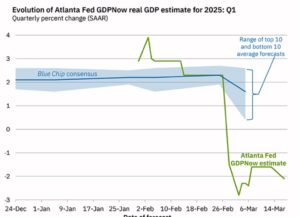
Atlanta Fed's GDP Tracker
Atlanta Fed’s GDP Tracker

Additionally, the Atlanta Fed’s GDP tracker for real GDP growth also was revised downward today to -2.1% for the first quarter of 2025 indicating a possible recession in the first half of this year.

These forecasts highlight both the immediate and long term decline in global economies, as well as the severe impacts to the US economy due to Trump’s economic policies.

Ironically, a sharp decline in the U.S. economy could help counteract the ‘drill, baby, drill’ policy and slow fossil fuel consumption, which would be beneficial for the environment. An economic slowdown typically leads to reduced demand for oil and fossil fuels, resulting in lower emissions. This decreased demand often causes oil prices to fall. When the price of a barrel of oil drops below certain thresholds, drilling new wells can become unprofitable. For instance, in 2022, the average breakeven price to profitably drill a new well in the United States was approximately $56 per barrel, with regional variations ranging from $48 to $69 per barrel.  Therefore, sustained oil prices below these breakeven points can discourage new drilling activities.

Explanation of the ‘Drill, Baby, Drill’ Policy:
The phrase “drill, baby, drill” emerged as a political slogan advocating for increased domestic oil and gas production in the United States. It gained prominence during the 2008 Republican National Convention and has been associated with policies aiming to boost fossil fuel extraction to achieve energy independence and economic growth. In recent years, this slogan has been revitalized to support expansive fossil fuel production initiatives. Proponents argue that such measures can lead to lower energy prices and reduced reliance on foreign oil. However, critics express concerns that this approach undermines efforts to combat climate change by perpetuating dependence on carbon-intensive energy sources.

President Donald Trump’s stance on climate change has been characterized by skepticism and policy actions that deprioritize environmental concerns in favor of economic and energy interests.

Public Statements:

  • Historically, Trump has referred to climate change as a “hoax.”
  • More recently, he has dismissed concerns about rising sea levels, stating, “That is not our problem,” and has emphasized “nuclear warming” as a more pressing threat.
  • Trump has repeatedly referred to the climate crisis as the Green New Scam.

Policy Actions:

  • Upon his inauguration in January 2025, President Trump withdrew the United States from the Paris Agreement and pledged to roll back executive orders and policies from the previous administration aimed at addressing climate change.

  • He issued an executive order titled “Promoting Energy Independence and Economic Growth,” aiming to dismantle many federal actions addressing climate change.

  • The administration has proposed cuts to agencies like FEMA, which could significantly impact disaster response capabilities in states vulnerable to climate-related events, such as California.

Impact on Environmental Policies:

  • The administration’s stance has led to reduced funding for clean energy projects and transportation initiatives. Major financial institutions have withdrawn from net-zero alliances, and the Securities and Exchange Commission (SEC) has implemented rules making it more challenging for investors to address environmental, social, and governance (ESG) issues within companies.

Trumpenomics: The Decline of the US

The Human Induced Climate Change Experiment

bookmark_borderTrumpenomics: How Tariffs, Policy Cuts, and Labor Shortages Are Devastating American Farmers

by Daniel Brouse
March 13, 2025

Recent policies enacted by the President have had significant financial repercussions on American farmers, leading to substantial economic losses.​

1. Impact of Tariffs and Retaliatory Measures

The Trump 2.0 administration’s imposition of tariffs, particularly on steel and aluminum, has triggered retaliatory tariffs from major trading partners such as China, Canada, and the European Union. These countermeasures have significantly reduced demand for U.S. agricultural exports, exacerbating existing challenges like droughts, supply chain disruptions, and low commodity prices. Texas farmers, many of whom have historically supported the President, are now voicing concerns over the mounting economic pressures caused by these policies.

The precedent for these economic consequences was set during Trump’s first administration. The 1.0 tariffs, particularly those targeting steel and aluminum, prompted severe retaliatory measures, notably from China. The impact on U.S. agriculture was devastating:

  • Soybean Exports: In 2018, U.S. soybean exports to China plummeted by $9.4 billion. While some alternative markets were found, they only recovered $4.7 billion in lost revenue, leaving a net loss of $4.7 billion for American soybean farmers.
  • Regional Losses: Major agricultural states like Iowa, Illinois, and Kansas saw significant financial hits. Iowa farmers alone lost $1.46 billion, Illinois suffered $1.41 billion in losses, and Kansas endured a $955 million decline in revenue.
  • Federal Bailouts: In an attempt to compensate for the damages, the U.S. Department of Agriculture (USDA) issued $23 billion in direct payments to farmers between 2018 and 2020. However, these subsidies often fell short, leaving many farmers struggling with long-term economic setbacks.

The Trump 2.0 tariffs are broader in scope, applying to more countries at higher rates, making the expected economic fallout far more devastating than before. With supply chain disruptions, climate-related hardships, and rising input costs already squeezing farmers, these new tariffs threaten to push many agricultural operations to the brink of collapse.

So far in 2025, several countries and trading blocs imposed retaliatory tariffs on U.S. agricultural imports in response to the current administration’s tariffs on steel, aluminum, and other goods. The European Union (EU) announced €26 billion in countermeasures against U.S. products, including agricultural goods. The first phase, effective April 1, targets €4.5 billion worth of U.S. consumer goods such as bourbon whiskey, jeans, and Harley-Davidson motorcycles. The second phase, set for mid-April, will impose tariffs on €18 billion worth of U.S. steel and agricultural products. Canada followed suit, imposing 25% tariffs on $21 billion worth of U.S. imports, including steel, aluminum, and various other goods. This action builds on earlier tariffs of $30 billion enacted on March 4. Meanwhile, China announced 10-15% tariffs on U.S. meat and agricultural products, suspended imports of U.S. lumber, and revoked soybean import licenses for three major U.S. firms.

Important to note, the bulk of the Trump tariffs have not yet been announced and are expected to be implemented on April 2, 2025. The President has stated that these tariffs will be applied to all countries and may be as high as 250%.

2. Cancellation of USAID’s Programs

The recent termination of local food programs, including USAID’s “Food for Peace,” has further strained farmers:

  • Loss of Funding: Since 2021, local school lunch programs have provided over $2 billion to various states, supporting local food purchases for schools and food banks. Their cancellation removes a critical revenue stream for farmers, exacerbating financial challenges.

  • Food for Peace: The USAID “Food for Peace” program, which operated with an annual budget of approximately $1.7 billion, has been terminated as part of the broader dismantling of USAID. This program purchased U.S.-grown commodities, such as rice, wheat, lentils, and peas, for distribution to populations facing food insecurity worldwide. Its cancellation not only impacts global hunger relief efforts but also removes a significant market for American farmers.

These program cancellations have disrupted supply chains, leading to financial instability for farmers who previously relied on these initiatives. The sudden loss of funding has left many agricultural producers without alternative markets, intensifying the economic challenges within the farming community.

3. Labor Shortages Due to Immigration Policies

Stricter immigration policies have led to a shortage of immigrant workers, who are essential to the agricultural workforce. This scarcity has resulted in increased labor costs and challenges in harvesting crops, thereby reducing overall productivity and profitability for farmers.​

4. Economic Uncertainty and Market Instability

The combination of trade tensions, program cancellations, and labor shortages has created an environment of economic uncertainty. Farmers are facing volatile market conditions, making it difficult to plan for the future and invest in their operations. This instability threatens the sustainability of the agricultural sector and the rural communities that depend on it.​

In summary, the current administration’s policies have introduced significant challenges for American farmers, affecting export markets, domestic program support, labor availability, and overall economic stability.

ALSO SEE:

Trumpenomics: The Decline of the US