bookmark_borderSolutions to the Fossil Fuel Economy and the Myths Accelerating Climate and Economic Collapse

Summary: Solutions to the Fossil Fuel Economy and the Myths Accelerating Climate and Economic Collapse

http://membrane.com/global_warming/Basic-Economics.html

In this paper, Daniel Brouse argues that climate change and misguided economic policies are converging to create systemic risks that threaten both global capitalism and human habitability. He frames climate change as a nonlinear system driven by tipping points and feedback loops; once breached, these triggers can cascade into a “Domino Effect” of economic and ecological collapse.

The paper criticizes dominant political trends—high taxes on productivity, protectionism, nationalism, populism, and anti-immigration sentiment—arguing that they undermine long-term economic growth. Income taxes, in particular, are described as suppressing productivity and capital formation. In contrast, Brouse advocates shifting taxation away from labor and toward resource consumption—especially fossil fuels. He proposes steep direct taxes on coal, oil, and natural gas to accelerate decarbonization and send clear market signals.

Climate change is presented not only as an environmental issue but as a systemic financial threat. Rising climate-related disasters are straining insurers and could destabilize the broader financial system. Pollution and warming are also driving public health crises that threaten to overwhelm healthcare systems and government entitlement programs.

The paper strongly defends immigration as essential to economic sustainability. With aging populations and declining birth rates, Brouse argues that large-scale immigration is necessary to sustain GDP growth and maintain Social Security and Medicare. Without it, fiscal imbalance becomes mathematically unavoidable.

Looking forward, he outlines two paths:

  1. Preserve the current economic structure by embracing large-scale immigration.
  2. Undertake systemic reform by replacing income taxes with consumption and pollution taxes while aggressively phasing out fossil fuels and investing in clean energy.

The paper concludes with a stark climate warning. Updated modeling that incorporates social-ecological feedback loops projects potential warming of up to 9°C—far beyond earlier estimates. At such levels, large regions could become uninhabitable due to extreme heat, sea-level rise, food system collapse, and mass migration. The climate system, he argues, is entering a phase of compound risk and cascading breakdown.

The central message: economic myths and political short-termism are accelerating both climate and financial instability. Immediate structural reform—economically and energetically—is essential to prevent cascading collapse.

bookmark_borderFrom January 6 to Today: How Federal Violence and Political Rhetoric Threaten Democratic Stability

On January 6, 2021, thousands of supporters of then-President Donald Trump gathered in Washington, D.C., responding to his calls to “stop the steal” and to pressure then–Vice President Mike Pence and Congress to reject the 2020 election results. Many of these supporters believed the election had been “stolen by emboldened radical-left Democrats.” Following the rally, hundreds of Trump’s followers stormed the U.S. Capitol in an armed attempt to halt the certification of President Joe Biden’s victory — an event widely condemned as a violent rebellion against American democratic institutions.

Today, in his second term, President Trump is pursuing policies and actions that many critics argue are fueling a new wave of political and social confrontation — a tinderbox of grievances that could precipitate further unrest.

One flashpoint has been the deployment of thousands of federal immigration enforcement agents to Minneapolis and other cities and the shootings of U.S. citizens and residents during aggressive operations. These incidents have sparked widespread protests and raised profound questions about the use of force, constitutional rights, and government accountability.

Minneapolis: Federal Enforcement and Fatal Shootings

Since early January 2026, Minneapolis has been a focal point of federal immigration enforcement under the Trump administration’s so-called “Operation Metro Surge.”

Deaths of U.S. Citizens

  • Renée Nicole Good: On January 7, 2026, an ICE agent shot and killed 37-year-old Minneapolis resident Renée Good, a mother of three, during a federal enforcement operation. Authorities have disagreed on the circumstances, with the Department of Homeland Security (DHS) claiming Good “weaponized her vehicle” and attempted to harm agents. Local officials and witnesses dispute this narrative, and the Hennepin County medical examiner ruled her death a homicide.
  • Alex Pretti: On January 24, federal agents shot and killed Alex Pretti, a 37-year-old intensive-care nurse and U.S. citizen, during a separate encounter. Human Rights Watch and independent video analysis challenge official accounts that Pretti posed a deadly threat, suggesting he was unarmed and assisting others when shot.

Both killings occurred amid a large federal presence and have become symbols of deep tension between federal authority and local communities.

Escalation of Force and Backlash

  • Minnesota Governor Tim Walz has publicly called for the removal of federal agents and demanded state involvement in the investigations.
  • Protests against federal enforcement have been robust, with demonstrators condemning the use of lethal force against civilians and the aggressive tactics used in raids.
  • National political figures across the spectrum — including former presidents and members of Trump’s own party — have criticized the federal response and demanded transparency.

These developments have intensified debates about constitutional rights, the proper role of federal agencies, and the limits of executive power.

A Broader Pattern of Federal Overreach

Critics argue that these incidents are not isolated but part of a broader pattern:

  • Disregard for Constitutional Norms: The escalation of federal force in civilian cities, especially when local authorities oppose those deployments, raises serious questions about federalism and civil liberties.
  • Erosion of Trust in Accountability: Federal control over investigations — including limiting state access to evidence — has fueled suspicions of bias and obstruction.
  • Political Polarization and Rhetoric: Rhetoric blaming “domestic terrorists,” “far-left radicals,” or “violent lawbreakers” is often invoked to justify aggressive policing tactics, but also inflames tensions and undermine democratic norms.

These patterns contribute to alienation, distrust, and polarization — social conditions that do create fertile ground for rebellion, not just from fringe actors but from broader segments of the population who feel disenfranchised or threatened.

From January 6 to Civil Conflict Today?

The Capitol riot began with false claims about the legitimacy of an election and culminated in a direct assault on democratic processes. It was a singular moment that shocked the nation and underscored deep partisan divisions.

Today’s clashes — whether in the streets of Minneapolis or in public discourse — are shaped by ongoing grievances over governance, justice, and the limits of state power.

Whether these tensions will lead to widespread rebellion is uncertain. But the persistent use of force against U.S. citizens, the rhetorical escalation from political leaders, and the deterioration of institutional trust are symptoms of deeper fractures in American society.

Trumpenomics

bookmark_borderGold at $5,100: The Moment Gold Surpassed the Dollar

Gold prices surged to a record high above $5,100 per ounce on Monday, January 26, 2026. The rally has been fueled by a weakening U.S. dollar, intensifying geopolitical instability, and powerful safe-haven demand from both private investors and central banks.

But this is no ordinary commodity spike.

As of January 2026, gold has officially overtaken U.S. Treasuries as the world’s leading reserve asset held by central banks — the first time this has occurred since 1996. Total central bank gold holdings now exceed $4 trillion in value, surpassing official U.S. Treasury holdings as the primary safe-haven reserve instrument.

This marks a structural inflection point in the global monetary system.

The rally reflects more than fear. It signals mounting concern over U.S. fiscal sustainability, a decisive shift toward reserve diversification, and a growing unwillingness among sovereign institutions to anchor their financial security solely to the dollar system.

That raises a critical question:

If equity markets appear stable, where is the capital for gold coming from?

Are the Stock Markets Really “Doing Fine”?

Headline indices such as the S&P 500 and Dow Jones Industrial Average have recently reached new highs. However, those averages mask a narrowing foundation.

Market breadth has contracted sharply. A small cluster of mega-cap stocks accounts for a disproportionate share of gains. Because these indices are capitalization-weighted (and in the Dow’s case, price-weighted), strength in a handful of dominant firms can elevate the averages even as broader participation weakens.

Underneath the surface, capital flows tell a different story.

For the week ending January 21, 2026, U.S. equities experienced approximately $16.8 billion in net outflows. Since early March, foreign investors have reportedly sold roughly $63 billion in U.S. stocks, with European institutions leading much of the reduction.

Index resilience, therefore, may reflect concentration — not confidence.

Is Treasury and Bond Capital Moving Into Gold?

To a significant degree, yes.

Foreign investors have reassessed exposure not only to U.S. equities but also to Treasuries. Policy volatility, expanding deficits, rising interest burdens, and trade fragmentation have altered sovereign risk calculations.

When confidence in a reserve issuer declines, diversification accelerates.

Historically, global instability pushed capital into U.S. Treasuries. Today, a measurable portion of defensive capital is bypassing Treasuries altogether and moving directly into gold.

Gold carries no counterparty risk. It is not dependent on fiscal credibility, political continuity, or sanctions policy. It exists outside the liability structure of any single nation-state.

That neutrality is precisely why it is regaining reserve dominance.

China’s Accelerated Gold Accumulation

China provides a clear example of this shift.

As of December 2025:

  • Total official holdings: Approximately 2,306 tonnes (74.15 million troy ounces)

  • Reserve share: Gold now accounts for roughly 8.5% to 9.5% of China’s foreign exchange reserves, up from about 5.5% at the start of 2025

  • Buying streak: The People’s Bank of China completed a 14-month consecutive purchasing streak, adding roughly 27 tonnes during 2025

While gold remains a minority share of China’s total reserves, the direction is unmistakable. The rebalancing is strategic, gradual, and sustained.

And China is not alone.

De-Dollarization Becomes Structural

What is occurring is not a sudden abandonment of the dollar — but a structural recalibration of the global reserve framework.

Several forces are converging:

  • Expanding U.S. fiscal deficits

  • Rising federal interest expense

  • Increased use of financial sanctions

  • Growing geopolitical bloc formation

  • Reduced trust in treaty and trade stability

Central banks are responding as rational portfolio managers.

Gold’s ascent above Treasuries as the leading reserve asset signals that diversification has crossed a threshold. This is no longer marginal hedging. It is systemic repositioning.

What Gold at $5,100 Is Signaling

Gold’s rise reflects:

  • Elevated sovereign risk perception

  • Capital rotation out of U.S. fixed income

  • Narrow equity market leadership masking fragility

  • Institutional reserve diversification

  • The re-emergence of gold as the dominant neutral reserve asset

This does not imply immediate financial collapse. But it does indicate that the dollar’s uncontested reserve dominance is no longer intact.

For decades, global crises reinforced dollar supremacy.

Today, they are reinforcing gold.

If sustained, this shift represents not a cyclical commodity surge — but a historic restructuring of global reserve architecture.


Trumpenomics

bookmark_borderTrump’s Bankruptcies and the Road to Russia

Regarding the so-called “peace negotiations” with Russia, this seems like an appropriate moment for a brief refresher on finance and economic incentives.

Trump’s long history of bankruptcies matters here. After repeatedly stiffing lenders and investors, he effectively ran out of credible financing options in the U.S. and much of Europe. Major banks wanted nothing to do with him. Even Deutsche Bank—one of the last large institutions willing to lend—ended up entangled in scandals tied to Trump loans, money laundering probes, and internal compliance failures.

When conventional financing dried up, the remaining capital willing to touch Trump increasingly traced back to opaque, offshore, and Russian-linked sources—often routed through shell companies, private lenders, or intermediaries rather than traditional banks. The Trump SoHo project in NYC was linked to Russian money and figures, facing allegations of being a conduit for money laundering from Eastern Europe, involving shady investors and partners like career criminal Felix Sater, with claims that Russian cash infusions funded units, raising serious questions about Donald Trump’s business dealings and financial scrutiny during the Russia investigation.

That shift wasn’t accidental; it was the consequence of being frozen out of normal markets.

This is why the current situation didn’t come out of nowhere. Financial dependence creates leverage, and leverage shapes behavior. When someone who aspires to power is funded by questionable foreign money after burning every reputable bridge, it raises obvious concerns about influence, loyalty, and national interest.

In short, this isn’t ideology or conspiracy—it’s basic finance and incentives. When you bankrupt your way out of legitimate capital markets, you don’t gain independence; you become dependent on whoever is still willing to write the checks. That dynamic is precisely why critics began referring to Trump, bluntly and colloquially, as “Putin’s little bitch”—not as rhetoric, but as a crude shorthand for perceived financial leverage and resulting deference.

Trumpenomics

bookmark_borderTrump’s War on Freedom: Deportations, Censorship, and the Assault on the Constitution

Trump’s war on freedom did not begin with his return to office — but it has accelerated dramatically. What we are witnessing now is not isolated misconduct, but a systematic assault on the Constitution, the free press, and the rule of law.

One of the most alarming developments is the illegal deportation of individuals to El Salvador, often without due process, transparency, or judicial review. People are being removed from the United States not through lawful immigration proceedings, but through executive fiat — a direct violation of constitutional protections and international human rights norms.

The 60 Minutes Segment That Never Aired

In December 2025, these abuses reached a new level of visibility — and suppression.

A 60 Minutes segment titled “Inside CECOT”, which focused on El Salvador’s massive mega-prison now receiving deported migrants from the United States, was abruptly removed from the broadcast schedule just minutes before it was set to air on Sunday, December 21, 2025.

According to reports, the segment had already been fully vetted and cleared by CBS legal counsel. Yet it was still pulled. The journalist involved described the decision as “political.”

That distinction matters.

When a story is cleared by lawyers but killed by executives for political reasons, it is not editorial judgment — it is censorship.

A Pattern, Not an Incident

This was not an isolated decision. It fits a clear and escalating pattern under Trump:

  • Intimidation of media organizations
  • Political pressure on newsroom leadership
  • Attacks on journalists as “enemies”
  • Retaliation against outlets that report inconvenient facts
  • Normalization of executive interference in press coverage

The First Amendment does not exist to protect flattering coverage. It exists precisely to protect journalism that makes those in power uncomfortable.

Suppressing reporting on deportations to foreign prisons — especially facilities known for human rights abuses — is a direct attack on public accountability.

Deportation Without Due Process

Equally disturbing is the policy itself.

The U.S. government is now deporting individuals to El Salvador’s CECOT prison system, a facility internationally criticized for mass incarceration, indefinite detention, and the suspension of civil liberties. These deportations often occur:

  • Without meaningful hearings
  • Without access to legal counsel
  • Without individualized assessments
  • Without public transparency

This is not immigration enforcement. It is extrajudicial punishment.

The Constitution does not grant the executive branch the power to exile people to foreign prisons — especially without due process. That authority simply does not exist.

The Broader Assault on Free Speech

The axing of the 60 Minutes segment is only one example in a much larger campaign against free expression. Trump’s influence has already:

  • Weakened press freedom domestically
  • Encouraged censorship through corporate pressure
  • Exported authoritarian media tactics abroad
  • Enabled monopolistic control of political narratives

These trends are documented in detail here:

Taken together, these are not culture-war skirmishes. They are structural attacks on democratic institutions.

Why This Matters

A free press is not a luxury.
Due process is not optional.
The Constitution is not conditional.

When a president can deport people without lawful process and silence reporting about it, the issue is no longer partisan — it is existential. Democracies do not collapse all at once. They erode through normalization, intimidation, and silence.

Pulling a 60 Minutes investigation is not just a programming decision.
It is a warning sign.

And ignoring warning signs is how freedom is lost.

Trumpenomics

bookmark_borderTariffs Are Taxes (Just Ask Jim Beam)

Tariffs are taxes. Full stop.
And like most taxes, they impose economic costs. But unlike many taxes, tariffs are among the most economically damaging because they are regressive, distortionary, and imposed directly on trade flows that sustain growth, employment, and competitiveness.

History and basic economics are unambiguous: taxes rarely generate a net benefit to the economy, and regressive taxes like tariffs impose the highest cost relative to any perceived gain. They raise prices, reduce choice, invite retaliation, and ultimately shrink markets rather than strengthen them.

A clear and sobering example can be found in one of America’s oldest and most iconic brands: Jim Beam.

How Tariffs Destroy Demand

When tariffs raise the cost of a product, consumers do what consumers always do — they substitute cheaper alternatives. This is not theory; it is observable behavior. As prices rise, demand shifts to domestic substitutes or imports from countries not subject to tariffs.

That is exactly what is happening now to American spirits.

According to the Distilled Spirits Council of the United States (DISCUS), exports of U.S.-made liquor fell sharply in the second quarter of 2025 as tariffs imposed under President Donald Trump took effect. The American Distilled Spirits Exports 2025 Mid-Year Report shows particularly steep declines in exports to the European Union, Canada, the United Kingdom, and Japan.

These markets are not marginal:

  • The EU alone accounted for roughly half of all U.S. spirits exports in 2024
  • Collectively, the EU, Canada, the UK, and Japan represented 70% of total U.S. spirits exports by value

After a record export year in 2024, the reversal has been swift and severe.

“After celebrating a record year for U.S. spirits exports in 2024, this new data is very troubling for U.S. distillers,” said DISCUS President and CEO Chris Swonger.
“Persistent trade tensions are having an immediate and adverse effect on U.S. spirits exports… signaling a shift away from our great American spirits brands.”

That shift is the inevitable consequence of tariffs.

Canada: The Clearest Case Study

Nowhere is the damage more visible than in Canada.

Trump’s trade war has particularly strained U.S.–Canada relations, prompting widespread consumer boycotts of American goods. As a result:

  • U.S. spirits exports to Canada collapsed by 85%, falling below $10 million in Q2 2025
  • U.S. spirits sales in Canada declined 68% in April 2025
  • Sales of Canadian and other imported spirits rose by roughly 3.6% over the same period

Although Canada formally removed its retaliatory tariff on U.S. spirits on September 1, most Canadian provinces continue to ban American spirits from store shelves. The damage to market access and brand loyalty has already been done.

This is the hidden cost of tariffs: once consumers switch, they often don’t come back.

Jim Beam: An Icon Pays the Price

The consequences are now hitting home.

Jim Beam, a 230-year-old American bourbon brand and one of the most recognizable names in U.S. manufacturing, has announced the closure of its distillery at Happy Hollow in Clermont, Kentucky, ending production there in January 2026. The facility had been in regular operation since Prohibition.

Suntory Holdings, Jim Beam’s parent company, attempted to frame the decision as routine capacity management:

“We are always assessing production levels to best meet consumer demand and recently met with our team to discuss our volumes for 2026.”

But demand does not collapse in a vacuum. It collapses when policy-driven price shocks destroy export markets.

The Larger Economic Lesson

This is not about bourbon alone. It is about how tariffs function in the real economy.

Tariffs:

  • Act as a consumption tax on households
  • Reduce export competitiveness
  • Invite retaliation
  • Shrink foreign markets
  • Force governments into taxpayer-funded bailouts
  • Accelerate consolidation while harming smaller producers

In the end, tariffs do not protect industries — they tax them into contraction.

Jim Beam’s decision is not an anomaly. It is a predictable outcome of a trade policy that ignores basic economics. When you tax trade, trade declines. When trade declines, jobs follow.

Tariffs are not strength.
They are self-inflicted economic damage — and the bill is now coming due.

Trumpenomics

bookmark_borderTrump’s Second Term, Year One: Forecast Confirmed, Damage Accelerated

December 18, 2025

Executive Summary

When Donald Trump took office in January 2025 for his second term, we issued a clear forecast: a rapid deterioration in U.S. economic performance driven by protectionism, institutional erosion, policy uncertainty, and hostility toward science and immigration. That forecast has not only proven accurate—it has materialized well ahead of schedule.

The first year of Trump’s second term has been defined by broken promises, contracting manufacturing, weakening employment, rising inflationary pressure, exploding debt, and systemic damage to U.S. credibility. What was presented as economic nationalism has functioned instead as economic self‑harm.

Historical Context: Smoot–Hawley Revisited

History provides a cautionary parallel. The Smoot–Hawley Tariff Act of 1930, which sharply raised U.S. tariffs, triggered retaliatory trade barriers worldwide and materially deepened the Great Depression. Trump’s second‑term policies echo this mistake—only now compounded by executive overreach, the bypassing of Congress, and routine disregard for constitutional constraints.

As a result, the current downturn appears not only real, but accelerating. Many global leaders and economists are not reacting with panic precisely because they expect U.S. instability to be self‑limiting: policy paralysis, electoral backlash, and institutional resistance are likely to curb further damage after the midterms. In that sense, global tolerance reflects grim confidence that the U.S. economy will absorb the shock internally.

Promises Made, Promises Broken

Trump entered his second term claiming he would:

  • Bring down prices on Day One
  • Reshore U.S. manufacturing
  • Increase employment
  • Increase GDP
  • Reduce the national debt
  • Cut taxes

He has failed on every count.

Inflation: Moving the Wrong Direction

Inflation has increased at a time when it should have been declining. Relative to economic conditions, inflationary pressure is now higher than at any point since the pandemic recovery period. Tariffs, supply‑chain disruption, labor shortages, and policy volatility have combined to reverse progress that had already been achieved.

Manufacturing: Contraction, Not Reshoring

U.S. manufacturing has consistently declined since Trump took office in 2025. While the administration has claimed credit for large manufacturing investments, nearly all of the facilities cited were planned, announced, or contractually committed before the election.

More damaging still, Trump’s anti‑science and anti‑immigration posture has convinced much of the world that the United States is no longer a reliable place to invest or trade. This loss of confidence has had concrete consequences:

  • Multiple domestic and foreign firms have cancelled or delayed U.S. manufacturing projects.
  • Hyundai’s U.S. operations were disrupted by enforcement actions that left the company unable to staff skilled positions needed to complete its plant.
  • GM and Ford announced cancellations or significant scale‑backs of U.S. investments following Trump’s reversal on climate policy and electric vehicles.

In a striking contradiction to free‑market rhetoric, Trump has socialized large segments of the economy, with the federal government now holding stakes or exerting direct control over portions of:

  • Steel production
  • Rare earth mineral supply chains
  • Defense contracting
  • Semiconductor manufacturing

This represents one of the most aggressive expansions of state ownership and control in U.S. history. At the same time, Trump’s tariff regime has devastated multiple U.S. sectors—most notably agriculture—by triggering retaliatory trade actions and collapsing export markets. In response to the damage his own policies created, the administration has resorted to large-scale, socialized bailouts totaling tens of billions of dollars, effectively transferring private market losses to taxpayers.

Employment: Softening and Rising Unemployment

Labor market conditions have weakened throughout Trump’s first year back in office. Unemployment reached a new high in November, and forward‑looking indicators suggest further softening. The combination of trade disruption, investment pullbacks, and labor shortages tied to immigration policy has undermined job growth rather than strengthened it.

GDP and Markets: Artificially Propped Up

Headline GDP growth and equity markets are being artificially supported by massive AI‑related capital spending. Strip out this single speculative sector, and the U.S. economy would already be in recession.

Even more concerning, the AI boom bears all the hallmarks of a classic asset bubble. The pattern closely mirrors the speculative excesses that preceded:

  • The dot‑com collapse (2000–2002)
  • The global financial crisis (2008–2009)

In both cases, apparent growth masked deep structural weakness—until the correction arrived.

Debt: Exploding at Record Speed

The national debt has increased faster and by larger absolute amounts than at any point in U.S. history, with repeated trillion‑dollar surges. This expansion has occurred despite promises of fiscal discipline and without corresponding investments that would raise long‑term productivity or growth.

Taxes by Another Name: Tariffs and Uncertainty

Trump has effectively imposed the largest tax increase in U.S. history through tariffs. Tariffs function as a consumption tax, raising prices for households and businesses alike.

Compounding the damage, persistent policy whiplash—often summarized as “TACO” (Tariffs, Abrupt Changes, and Overreach aka Trump Always Chickens Out)—has created extreme uncertainty. Trump has broken or abandoned every major free‑trade agreement with U.S. allies, shredding decades of trust. Rebuilding that credibility will take years, if it is possible at all.

White Nationalism

Finally, and most importantly:
This discussion keeps circling back to selective facts while ignoring the broader ideological context. Trump’s economic program is inseparable from white-nationalist protectionism, xenophobia, and hostility to science and immigration — all of which directly harm labor markets, innovation, and long-term growth. Treating isolated projects as proof of success while ignoring those systemic harms is precisely how propaganda works: narrow focus, emotional certainty, and resistance to contradictory evidence.

Conclusion

One year into Trump’s second term, the results are unmistakable. The economy is weaker, more fragile, and less trusted than it was in 2024. Manufacturing is contracting, inflation is rising, employment is softening, debt is exploding, and growth rests on a narrow speculative bubble.

This outcome was not inevitable. It was forecast—and then fulfilled—by a policy agenda rooted in white nationalism, bigotry, xenophobia, hostility to expertise, and disregard for institutions. The damage done in this first year will outlast the term itself, negatively impacting the U.S. economy for at least a generation.

Trumpenomics
bookmark_borderThe U.S. Economy into 2026: Tariffs, Immigration, and the AI Paradox

by Daniel Brouse
December 13, 2025

Introduction

The U.S. economy in 2025 is shaped by three powerful and interacting forces: tariff implementation, restrictive immigration policies, and the rapid adoption of artificial intelligence (AI). Each has distinct economic effects, but taken together they create a complex macroeconomic picture with both upside and risk.

1. Tariffs: A Drag on Growth

Tariffs function effectively as taxes on imported goods and inputs. Higher tariffs increase costs for U.S. producers and consumers, reduce trade volumes, and create uncertainty in supply chains. Empirical research shows that higher tariff rates tend to be negatively correlated with real GDP growth over time, with lagged effects that can take months or years to fully materialize.

Recent macroeconomic forecasts attribute part of the slowdown in U.S. GDP growth to tariff effects. The Organisation for Economic Co-operation and Development (OECD) notes that rising tariff rates and lower net immigration have weakened growth momentum, even as other sectors contribute positively.

Tariffs also distort reported GDP through accounting effects. When imports fall sharply—as has happened recently—net exports (exports minus imports) mechanically add to GDP growth even when underlying domestic demand remains weak.

Taken together, tariffs are acting as a drag on growth, raising costs and undermining business and consumer demand, even as headline numbers may temporarily mask underlying weakness.

2. Immigration Policy: Labor Market Constraints

Restrictive immigration policies reduce labor supply directly and indirectly. While precise impacts are difficult to quantify in real time, recent scholarly and policy analysis suggests immigration contributes significantly to labor force growth, especially in sectors such as technology, construction, and services.

For example, forecasts indicate that both tariff hikes and lower net immigration contributed to a slower labor market, reducing payroll growth and increasing unemployment rates.

Immigrants accounted for an estimated 80% of U.S. GDP growth from 2020–2025, underscoring their outsized contribution to labor supply and overall economic expansion. A sharp reduction or elimination of immigration therefore constrains the labor force, lowers potential output, and slows GDP growth. While official estimates vary, the underlying mechanism is well established in macroeconomic models and supported by recent forecasts: reduced immigration leads directly to weaker economic growth.

Equally important is the spending behavior of immigrant households. A large share of earned income is spent quickly on goods and services, providing an immediate boost to aggregate demand. In recent months, multiple consumer-facing industries have reported noticeable declines in sales following reductions in immigrant participation in the economy, including beer brands, food producers, and businesses tied to cultural and community celebrations.

3. AI Adoption and Capital Spending: A Temporary Boon?

AI-related investment—particularly in data centers, hardware, and information technology—has become a dominant driver of U.S. GDP growth. Multiple analyses find that AI infrastructure spending alone explained an exceptionally high share of reported GDP growth in 2025. Some estimates show AI-related data center investment accounted for as much as 92% of total GDP growth in the first half of 2025, despite representing a much smaller share of overall GDP.

Capital spending in AI is substantial: hyperscale firms like Microsoft, Google, Meta, Amazon, and Nvidia are expanding data center capacity and hardware investment by the hundreds of billions of dollars annually. These investments act like short-term stimulus, lifting real GDP growth above what it would have been otherwise.

However, long-term returns on all that AI investment remain uncertain from the standpoint of actual productivity realized in final goods and services. Goldman Sachs analysts note that significant portions of AI investment aren’t fully reflected in official GDP statistics because of how intermediate inputs are treated, making accurate measurement difficult.

Moreover, traditional economic models suggest that capital spending without commensurate returns can lead to misallocation, just as excessive leverage did before past financial crashes. If AI capital expenditures do not generate sustainable earnings and broader productivity gains, the long-term macro impact may be weaker than headline growth suggests.

Perhaps most concerning is the emergence of circular financing among hyperscalers. Companies such as NVIDIA are effectively extending credit—directly or indirectly—to other large technology firms so they can purchase NVIDIA’s chips and related infrastructure. With no proven, scalable business model yet established for monetizing many AI applications, this financing structure carries significant risk and could result in losses measured in the hundreds of billions, if not trillions, of dollars. Reflecting these concerns, industry analysts now estimate that at least one-third of all announced data center projects are unlikely to ever be completed.

4. What It All Means

Taken together, these three forces create a fragile economic structure:

  • Tariffs slow trade, raise prices, and dampen business investment.
  • Immigration restrictions weaken labor supply and potential output.
  • AI spending is boosting GDP figures in the short term, but its sustainability and true economic impact remain heavily debated. The industry’s highly leveraged structure raises the risk of a bubble bursting, potentially triggering sharp declines in stock prices. Recent weeks of heightened market volatility suggest that investors are beginning to recognize and price in these risks.

The Organization for Economic Co-operation and Development now projects modest GDP growth in 2025 and 2026, in part because of strong AI-related investment, but also warns that tariff and immigration effects will continue to weigh on growth.

Without AI investment, the economy would likely be much weaker and possibly in contraction, as private domestic demand outside technology sectors has struggled to expand.

5. Risks on the Horizon

There are several risks:

  • Investment sustainability: If hyperscale investments fail to deliver strong returns, both corporate profits and stock valuations could suffer.
  • Leverage and risk: Much of the market’s valuation of AI-linked firms depends on optimistic long-term returns on borrowed capital.
  • Labor displacement: AI-driven automation could reduce employment opportunities without corresponding growth in new job categories.
  • Collapse of circular financing: If one hyperscaler defaults on obligations to another, the interconnected debt structure could trigger a cascading, domino-style failure across the sector.

These risks could amplify the negative effects of tariff-induced cost pressures and labor shortages, creating headwinds for long-term economic resilience.

Conclusion

In 2025, the U.S. economy appears to be a highly concentrated growth story: dependent on AI-related capital spending to offset structural headwinds caused by tariffs and restrictive immigration policies. While headline GDP growth persists, underlying fundamentals point to slowing labor markets, rising costs, and a high degree of reliance on a narrow set of technology investments. The sustainability of this model remains uncertain and will depend critically on whether AI investments translate into broad-based productivity gains and meaningful returns in the years ahead.

Trumpenomics

bookmark_borderThe New Era of Economic Uncertainty: How Trump’s Tariff Shock Is Breaking America’s Forecasting Models

Economic forecasting has always carried uncertainty, but under Trump’s current fiscal and trade agenda, that uncertainty has exploded to levels not seen in a century. Policies that economists—left, right, and center—have avoided for 100 years are suddenly being deployed at massive scale. Chief among them: unprecedented import taxation and the largest tariff regime in modern U.S. history.

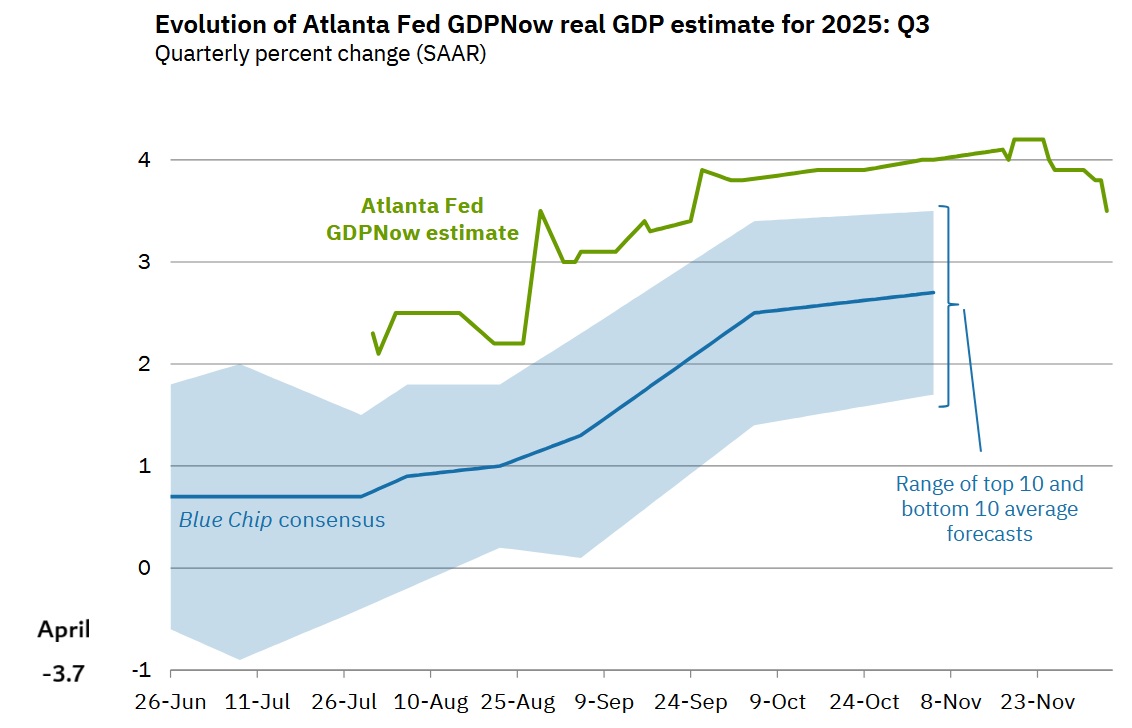
These policies are not just economically risky—they’re actively destabilizing the tools we rely on to understand the economy. Even the Atlanta Fed’s GDPNow model, one of the most respected real-time forecasting systems, has struggled to capture the resulting volatility.

The First Shockwave: GDP Collapses in Early 2025

During the first quarter of 2025, the GDPNow model projected real GDP growth (seasonally adjusted annual rate) at –3.7%. The contraction was so sharp that it fell off the scale of standard graph displays.

Crucially, this collapse wasn’t caused by consumer demand or business investment falling apart—it was almost entirely due to the way imports and exports are measured in GDP accounting. With Trump’s tariff schedule looming, businesses launched a massive, front-loaded rush to import goods before the tax hikes hit, causing an artificial spike in imports that mechanically pushed GDP downward.

This is not normal economic behavior. It’s panic behavior—created by policy.

The Tariff Whiplash Effect: Forecasts Go Wild

Once the early-year import surge ended, import levels cratered. Because imports are subtracted in GDP calculations, this plunge created the opposite effect: a predicted surge in GDP growth for late 2025.

Initial projections showed GDPNow spiking to around 5% in Q3 and Q4.

But those optimistic spikes never fully materialized.

The tariffs had a far more damaging, persistent effect on supply chains than anticipated. Import volumes fell harder and for longer than models historically assume possible.

As a result, GDP appears to have briefly peaked at about 4% in November 2025, followed by a rapid decline.

Where the Economy Is Heading Now

Current forecasts show GDP falling sharply again, with projections targeting near 0% growth in the first two quarters of 2026.

And this time, the uncertainty is extreme. Economists describe today’s forecast bands as “cone-of-uncertainty levels wider than during COVID,” because:

  • Tariff effects are non-linear and historically unprecedented
  • Supply chains are behaving unpredictably
  • Consumer prices are destabilizing
  • Business investment is freezing due to policy confusion

In short: upside potential is tiny, but downside risk is enormous.

The Supreme Court Wildcard

One of the biggest unknowns is the upcoming Supreme Court ruling on whether Trump’s “retaliatory tariffs” are even legal.

If the Court invalidates them abruptly:

  • Imports could surge again
  • Supply chains would be thrown into chaos
  • Businesses would need to reprice and reorder instantly
  • GDP models would again be blindsided

If the Court upholds them, the U.S. remains locked into a historically high-tariff regime that suppresses imports, raises prices, and slows growth.

Either outcome carries major economic shock potential.

Additional Policy Risks on the Horizon

Forecasting also remains clouded by several other Trump-era policy disruptions, each of which could individually affect GDP growth but collectively pose massive systemic risk:

  • Immigration restrictions, which could worsen labor shortages and reduce potential GDP
  • Healthcare policy uncertainty, especially around ACA destabilization
  • Expansion of fossil fuel subsidies, which distort investment flows and long-term energy costs
  • Budgetary unpredictability due to inconsistent fiscal priorities

All of these factors compound the difficulty of projecting the next 12–18 months.

Conclusion: The U.S. Is Entering an Economically Uncharted Era

The combination of unprecedented tariffs, volatile trade behavior, unstable supply chains, and sweeping policy changes has pushed the U.S. economy into a state where traditional forecasting tools are struggling to keep up.

This is not just “normal economic noise.”
This is a result of anti-economic policy design, implemented at a scale large enough to break the models themselves.

Until the policy environment stabilizes—and until the Supreme Court resolves key legal uncertainties—the U.S. economy is likely to remain on a knife’s edge, with enormous downside risk and extremely limited upside potential.

2025 GDP
2025 GDP

Trumpenomics

bookmark_borderSmall Businesses Are the First Casualties of Trump’s Tariff Economy — And the Jobs Data Proves It

The latest employment numbers reveal exactly why small businesses are suing President Trump over his tariff policies: tariffs hit small firms and lower-income consumers the hardest, functioning as a stealth tax that now adds anywhere from 20% to over 50% to the cost of many goods compared with last year.

And the results are now undeniable.

Record Small Business Bankruptcies and a Collapse in Hiring

Small business bankruptcies have surged to record highs, and the newest job numbers show the situation is accelerating.

According to the November 2025 ADP National Employment Report, the private sector saw a net loss of 32,000 jobs. That decline was driven entirely by small businesses, which shed an alarming 120,000 workers in just one month.

ADP’s chief economist, Dr. Nela Richardson, called small firms “a canary in the coal mine” — the first to suffer when consumer demand weakens and operating costs spike. Pay growth for small-firm workers also fell far behind that of larger companies, underscoring how badly the sector is being squeezed.

This isn’t a blip. It’s a structural failure created by policy.

Tariffs Are Functioning as a Massive, Regressive Tax

Unlike large corporations, small businesses don’t have the financial cushion, global supply chains, or pricing power to absorb sudden spikes in import costs. They pay tariffs up front, while their customers — mostly working- and middle-class households — face higher prices at checkout.

That’s why small businesses are paying the equivalent of 20% to over 50% more in real taxes compared with last year. U.S. import prices (excluding the tariff) show that foreign exporters have been raising their prices in dollars. This indicates they are not absorbing much, if any, of the tariff cost.


Tariffs are taxes. And these taxes are crippling the very businesses that drive local economies and job creation.

The Administration Blames… Democrats?

In stark contrast to economic reality, U.S. Secretary of Commerce Howard Lutnick declared that the weak job numbers were not caused by tariffs, but instead blamed:

  • the recent government shutdown, and
  • mass deportations,
    as if those weren’t also direct consequences of Trump’s own policies.

Tariffs raised business costs.
The shutdown weakened demand.
Mass deportations removed workers and consumers.
Every explanation points back to the same place.

The Lawsuit Before the Supreme Court

The reason small businesses are currently suing the administration — in a case now before the U.S. Supreme Court — is precisely because Trump’s tariff actions have caused severe, measurable financial harm.

If the Court rules the tariffs illegal (as multiple lower courts already have), businesses want the right to recover the money they were forced to pay. Without that ruling, many of them won’t survive.


Small businesses are not just numbers on a spreadsheet — they’re the backbone of the U.S. economy. And right now, Trump’s tariff regime is breaking that backbone.

Trumpenomics