bookmark_borderClimate Change Update: Drought Conditions and Atmospheric Rivers in Philadelphia

By Daniel Brouse
October 27, 2024

The Philadelphia area is currently experiencing a severe drought, which is exacerbating the region’s vulnerability to extreme weather events. Recently, the area has also seen a significant increase in the intensity and frequency of severe rainstorms. This pattern of extended drought followed by intense rainfall events can be particularly harmful to soil health. During prolonged dry periods, soil becomes compacted and loses organic matter, reducing its ability to absorb water. When intense rains finally occur, water tends to run off rather than being absorbed, causing erosion, flooding, and even more severe damage to the soil structure.

The primary drivers of changing climate patterns, intensifying droughts, and increasing atmospheric rivers are the effects of climate change on the jet stream and ocean circulation. Rising global temperatures are disrupting these systems in several ways.

First, the warming Arctic is reducing the temperature difference between the poles and the equator, causing the jet stream to become weaker and more meandering. This leads to more extreme weather as these waves in the jet stream can lock weather patterns in place for longer periods, resulting in prolonged droughts or heavy rainfall over specific areas.

Second, warming oceans alter ocean currents, especially the Atlantic Meridional Overturning Circulation (AMOC), which influences weather patterns across North America and Europe. Changes in ocean temperatures are also fueling stronger atmospheric rivers, which are narrow, moisture-rich air currents that deliver heavy rainfall to areas that are often unprepared for such intense downpours. This combination of changes in atmospheric and oceanic circulation is creating more volatile and unpredictable weather patterns, which can lead to significant regional climate shifts and amplify the frequency and severity of extreme weather events.

Healthy soil plays a critical role in regulating temperatures and reducing atmospheric carbon by acting as a natural carbon sink. However, when soil is degraded by cycles of drought and extreme rainfall, its capacity to sequester carbon decreases, contributing to a feedback loop that accelerates climate change. As soil loses organic matter and structure from extreme weather patterns, it becomes less capable of absorbing carbon and water, increasing runoff and erosion. This degradation not only perpetuates the problem of atmospheric carbon but also amplifies climate-driven soil and ecosystem instability, further impacting biodiversity and agriculture.

Chaos Theory and Climate Systems

Global warming is caused by an increase in thermal energy in the climate system. The Earth is a climate system. Many subsystems make up our climate. Chaos theory emphasizes the complexity and nonlinearity of dynamic systems, and this complexity is inherent in the interactions between soil, atmosphere, and oceans in the Earth’s climate system.

Atmospheric circulation together with ocean circulation is how thermal energy is redistributed throughout the world. Chaos theory offers insights into the complex, nonlinear dynamics of climate systems role in the redistribution of thermal energy. The Earth’s climate is a highly complex and dynamic system, influenced by various factors such as ocean currents, atmospheric circulation, and feedback loops.

General Circulation Models for the earth climate are nonlinear and teleconnected. That means a small change in temperature or pressure or humidity in one small area on the globe can cause _large_ changes in conditions _anywhere_ on the globe. This is sometimes called the Butterfly effect. The complexity of these models can lead to chaotic behavior. Climate science must grapple with these models and extract results in spite of the mathematical difficulties, and there have been remarkable successes in some cases and sad failures in others. Nevertheless we must proceed.

Soil-Atmosphere Interaction:

  1. Thermal Energy Exchange:
    • Soil plays a crucial role in the exchange of thermal energy with the atmosphere. The temperature of the soil surface affects the transfer of heat to the atmosphere through processes such as conduction and convection. The thermal properties of soil, including its composition and moisture content, influence this energy exchange.
  2. Carbon Storage and Cycling:
    • Soil acts as a reservoir for carbon in the form of organic matter. This carbon storage is dynamic and involves complex interactions between plants, microorganisms, and the soil matrix. Soil organic carbon contributes to the global carbon cycle, affecting atmospheric CO2 concentrations.
  3. Feedback Mechanisms:
    • Nonlinear feedback mechanisms between soil and atmosphere can influence climate dynamics. For example, changes in temperature and precipitation patterns may impact soil moisture, affecting vegetation growth and altering the surface energy balance.

Soil-Ocean Interaction:

  1. Carbon Storage and Sequestration:
    • Oceans play a crucial role in global carbon storage. Dissolved carbon dioxide is absorbed by the ocean, forming carbonic acid. Additionally, organic matter from marine life contributes to carbon storage in ocean sediments. The exchange of carbon between soil and oceans is interconnected and can influence atmospheric CO2 levels.
  2. Thermal Inertia:
    • Oceans have a high thermal inertia, meaning they can absorb and store large amounts of heat. This property moderates temperature extremes, influencing atmospheric temperature patterns. Changes in ocean temperatures can, in turn, impact regional and global climate dynamics.
  3. Ocean Circulation and Climate:
    • Ocean circulation patterns, such as the Atlantic Meridional Overturning Circulation (AMOC), play a role in redistributing heat around the globe. Changes in ocean circulation can have cascading effects on atmospheric circulation patterns, influencing climate on a large scale.

Atmosphere-Soil-Ocean Coupling:

  1. Teleconnections:
    • Chaos theory recognizes the concept of teleconnections, where seemingly unrelated events in one part of the Earth system influence conditions in another. For instance, changes in sea surface temperatures (linked to ocean dynamics) can affect atmospheric circulation patterns, leading to variations in precipitation and temperature on land.
  2. Climate Variability:
    • The complex interactions between soil, atmosphere, and oceans contribute to climate variability. Chaos theory helps to understand the sensitivity of the climate system to initial conditions and how small perturbations in one component can lead to significant and sometimes unpredictable outcomes.

Chaos theory underscores the intricate, nonlinear, and interconnected nature of the relationships between soil, atmosphere, and oceans in the context of thermal energy and carbon storage. These interactions contribute to the Earth’s climate system’s complexity, and understanding these dynamics is crucial for accurately modeling and predicting climate changes. In addition, thermal energy and carbon are redistributed throughout the world.

Circulation systems of air and/or water include:
* doldrums, trade winds, horse latitudes, prevailing westerlies, polar front zone, and polar easterlies
* each hemisphere has three cells — Hadley cell, Ferrel cell and Polar cell in which air circulates through the entire depth of the troposphere
* usually each hemispheres has two jet streams — a subtropical jet stream and a polar-front jet stream
* waves, tides, currents, downwelling, upwelling move water
* there are over 24 currents — Benguela Current, California Current, Falkland Current, Labrador Current, Brazil Current, Florida Current, Gulf Stream, West Australian Current, Canary Current, Kuroshio Current, North Pacific Current, Somali Current, Antarctic Circumpolar Current, Antarctica Current, Antilles Current, Mozambique Current, North Atlantic Drift, Norwegian Current, Oyashio Current, West Wind Drift, Agulhas Current, South Equatorial Current, Humboldt or Peruvian Current, Monsoon Current
* five major ocean-wide gyres — the North Atlantic, South Atlantic, North Pacific, South Pacific, and Indian Ocean
* thermohaline (temperature and salinity) circulation systems — Gulf Stream, Atlantic Meridional Overturning circulation (AMOC), Pacific Meridional Overturning Circulation (PMOC)
* ocean-atmosphere oscillations — La Nina / El Nino-Southern Oscillation (ENSO), Antarctic Oscillation (AAO), Arctic Oscillation (AO), Atlantic Multidecadal Oscillation (AMO),
Indian Ocean Dipole (IOD), Madden-Julian Oscillation (MJO), North Atlantic Oscillation (NAO), North Pacific Gyre Oscillation (NPGO), North Pacific Oscillation (NPO), Pacific Decadal Oscillation (PDO), Pacific-North American (PNA) Pattern

What you can do today. How to save the planet.

Create a sustainable and climate-resilient environment in and around your home by providing wind breaks, shade, moisture retention, climate control, and preventing soil degradation.

ADDITIONAL RESOURCES
The Philadelphia Experiment: a Study on the Reign of Violent Rain
Soil Degradation and Desertification

How is All Real Estate at Risk From Climate Change?

bookmark_borderAbout Our Experiment

By Daniel Brouse

Many people ask, “Why does a scientist engage with climate deniers?”

Thanks for the concern! You’re right that, for my mental health, it might be easier to ignore them. However, as an educator, I see these interactions as an opportunity to reach a wider audience. Engaging with climate skeptics—what some might call ‘climate dummies’—gives me the chance to correct misinformation in real time and provide fact-based explanations to others who may be quietly observing the conversation.

By addressing these false claims head-on, I can offer a legitimate, scientifically backed source of information to those seeking clarity in a sea of misinformation. This outreach is critical, especially when so many people are exposed to conflicting or inaccurate claims about climate change. My aim is not to argue for the sake of it, but to ensure that there are trusted voices out there providing clear, evidence-based information on the urgent reality of climate change.

In addition, their opposition is immensely educative in our efforts. In reality, their persistent denial of climate change has forced us to rethink and drastically rebuild our climate models. What were once “worst-case” scenarios have now become the “best-case” outcomes we are seeing today.

Our updated climate models, now integrating complex social-ecological factors, show that global temperatures could rise by up to 9°C within this century—far beyond previous predictions of a 4°C rise over the next thousand years. This kind of warming could bring us dangerously close to the “wet-bulb” threshold, where heat and humidity exceed the human body’s ability to cool itself, leading to fatal consequences.

The reality is, we need these so-called climate “skeptics” to remind us just how urgent and critical the climate crisis is becoming. Ironically, their denial helps highlight the importance of decisive action, as climate change continues to spiral out of control.

The window for meaningful intervention is closing, and the need for action has never been more critical.

The Human Induced Climate Change Experiment

bookmark_borderClimate Change Time Line

by Daniel Brouse
October 11, 2024

What is the past, present and future of climate change?

I originated the hypothesis of the non-linear acceleration of climate change in the 1990s. By the early 2000s, that hypothesis evolved into established climate theory and is now widely recognized as scientific fact. My lab partner, a Doctor of Physics from Ohio State, and I teamed up in the ’90s. He provided crucial evidence to support the hypothesis. Since then, we’ve observed that the doubling time for climate change impacts—how quickly the effects intensify—has dropped dramatically. Initially, the doubling time was around 100 years. However, over the last few decades, it has shortened to 10 years and more recently to just 2 years.

This means the damage from climate change this year is twice as bad as it was two years ago, and in another two years, it could be four times worse. Unfortunately, the sharp decrease in the doubling period doesn’t appear to be an anomaly, especially given the unprecedented events we’re witnessing this year, even during a La Niña phase. If this trend continues, the consequences will be far more devastating than originally anticipated.

Human-induced climate change is a dynamic element of an intricate and chaotic system, accelerating global warming in a complex and exponential manner. Over the period from 1992 to 2023 (update 2024), our climate model has presented evidence, proposed solutions, and engaged millions in understanding this escalating crisis. The data reveals that human activities are rapidly deteriorating our environment.

Our climate model employs chaos theory to assess human impacts. Global warming is driven by increased thermal energy within the climate system, a complex web of interconnected subsystems. Previous models often failed to account for “social-ecological systems,” where human activity significantly alters climate dynamics.

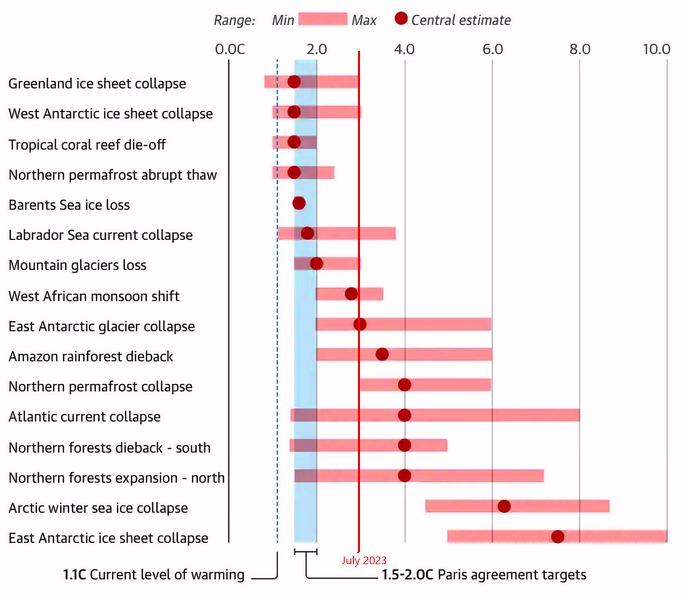
Tipping points are Critical Milestones that directly impact the rate of acceleration in climate change by multiplying the number and intensity of feedback loops. Identifying and understanding these tipping points is crucial for climate science and policymaking. Crossing multiple tipping points has led to the domino effect, resulting in a much more rapid and severe climate change than currently projected.

Push a glass toward the edge of a table and eventually it will fall off on its own. No matter how slowly or meticulously you push… no matter how you weight or fill the glass, it will reach a tipping point and fall off before being pushed completely off the table. No matter whether you believe the glass is half-empty or half-full, when the tipping point is reached it will plummet out-of-control to its end. This is science not fate, faith, nor belief. Human induced climate change has resulted in environmental tipping points being breached.

The Human Induced Climate Change Experiment

bookmark_borderSouth Korea: Climate Law Fails to Protect Basic Rights

South Korea’s top court ruled in August of 2024 that the country’s climate change law does not adequately protect basic human rights and lacks sufficient targets to safeguard future generations. This landmark decision comes after activists accused the government of failing to effectively address the climate crisis.

Since 2020, more than 200 plaintiffs, including young climate activists and even infants, filed petitions to the Constitutional Court. They argued that the government was violating citizens’ human rights by not taking sufficient action against climate change. The ruling was met with emotional responses from plaintiffs, activists, and lawyers, who celebrated with cheers, tears, and applause, chanting slogans like, “The verdict is not the end, but the beginning.”

Han Je-ah, a 12-year-old plaintiff, expressed hope that the ruling would lead to broader change: “I hope today’s decision will lead to a bigger change so that children do not have to file this kind of constitutional appeal,” she told reporters. “The climate crisis is having a huge impact on our lives, and there is no time to delay.”

Kim Young-hee, a lawyer representing the plaintiffs, called the decision “an important milestone for society’s efforts to reduce greenhouse gas emissions.” The court criticized South Korea’s Carbon Neutrality Act, originally enacted in 2010 and later revised to set emissions targets for 2030 and achieve carbon neutrality by 2050. The court found that the law failed to specify “any quantitative levels” for emissions reductions between 2031 and 2049, effectively leaving future generations with an undue burden.

The court stated, “Since there is no mechanism that can effectively ensure gradual and continuous reductions until 2050, it stipulates reduction targets that would transfer an excessive burden to the future.” The South Korean environment ministry responded by saying it respects the court’s decision and will implement follow-up measures accordingly.

Koh Moon-hyun, a law professor at Soongsil University, noted that the ruling could have global implications: “The court must have looked at rulings in Europe and changed its stance,” he said. “It has created a chance for South Korea to drop its nickname as a climate villain.” The decision is seen as a critical turning point, potentially influencing other countries to strengthen their own climate policies and better protect the rights of future generations.

Loss and damage litigation against oil companies and governments will change world economics.

The Human Induced Climate Change Experiment

bookmark_borderCanadian Wildfires: Over the Tipping Point

by Daniel Brouse
August 28, 2024

A study published in the Journal Nature found Canada’s 2023 wildfires released more carbon into the atmosphere than the annual emissions of all but three countries, underscoring a troubling trend. A new study raises serious concerns that Canada’s forests, long considered crucial carbon sinks, may no longer reliably absorb carbon in the long term.

This signals a dangerous acceleration of global warming, pushing us over a tipping point. Permafrost, once thought to be a stable, frozen barrier, is now thawing and burning year-round, releasing even more carbon and methane into the atmosphere. The resulting domino effect exacerbates climate instability, leading to more extreme weather, rising sea levels, and declining air quality.

These human-driven changes are not just ecological crises — they pose direct threats to human health, increasing the likelihood of premature death due to heatwaves, pollution, and the cascading impacts of an increasingly volatile climate.

The Study: Carbon emissions from the 2023 Canadian wildfires

Abstract
The 2023 Canadian forest fires have been extreme in scale and intensity with more than seven times the average annual area burned compared to the previous four decades. Here, we quantify the carbon emissions from these fires from May to September 2023 on the basis of inverse modelling of satellite carbon monoxide observations. We find that the magnitude of the carbon emissions is 647 TgC (570–727 TgC), comparable to the annual fossil fuel emissions of large nations, with only India, China and the USA releasing more carbon per year. We find that widespread hot–dry weather was a principal driver of fire spread, with 2023 being the warmest and driest year since at least 1980. Although temperatures were extreme relative to the historical record, climate projections indicate that these temperatures are likely to be typical during the 2050s, even under a moderate climate mitigation scenario (shared socioeconomic pathway, SSP 2–4.5). Such conditions are likely to drive increased fire activity and suppress carbon uptake by Canadian forests, adding to concerns about the long-term durability of these forests as a carbon sink.

About Feedback Loops and Tipping Points

Tipping cascades have emerged between biogeophysical and social-ecological systems. This Domino Effect is causing climate change to accelerate at an exponential rate.

Tipping points are Critical Milestones that directly impact the rate of acceleration in climate change by multiplying the number and intensity of feedback loops. Identifying and understanding these tipping points is crucial for climate science and policymaking. Crossing multiple tipping points could lead to a domino effect, resulting in a much more rapid and severe climate change than currently projected.

Tipping Points

Push a glass toward the edge of a table and eventually it will fall off on its own. No matter how slowly or meticulously you push… no matter how you weight or fill the glass, it will reach a tipping point and fall off before being pushed completely off the table. No matter whether you believe the glass is half-empty or half-full, when the tipping point is reached it will plummet out-of-control to its end. This is science not fate, faith, nor belief. Human induced climate change has resulted in environmental tipping points being breached.

Tipping points, when crossed, trigger self-sustaining feedback loops that are no longer dependent on human activity. Similar to when a domino topples over hitting two more dominoes that in turn fall hitting more dominoes. Thus, the name The Domino Effect. It can also be visualized as The Snowball Effect. A tipping point is like a snowball rolling down a hill growing in mass and velocity (momentum). When a tipping point is crossed, it results in cumulative and reinforced global warming.

The Human Induced Climate Change Experiment

bookmark_borderLong-COVID Persistent Virus With Long-Term Costs

By Daniel Brouse
August 20, 2024

A new study in Australia has found about $9.6 billion was lost in economic productivity due to long COVID in 2022. Researchers say that represented about a quarter of Australia’s real gross domestic product growth for that year.

With the U.S. having about 90 million more cases than Australia, the economic cost is likely around $90 billion higher just from lost productivity. Unfortunately, we continue to incur billions more in costs and millions more in new infections. And this estimate doesn’t even account for the additional costs of hospitalizations, deaths, and other impacts, which likely bring the total to trillions. On top of that, the U.S. government borrowed and distributed about $5 trillion in COVID-19 stimulus funds, so these costs are in addition to that.

I’ve been conducting experiments on hate and violence, and there’s a marked increase in extremism on both the far-right and far-left. Although my research is still in the early stages, it appears that COVID has likely intensified mental illness, exacerbated pre-existing neurological conditions, and impacted brain function. In a recent interview, lead scientist Raina MacIntyre explained that COVID affects every organ, though the symptoms aren’t always associated with long-COVID. Many patients unknowingly harbor the virus long after the initial infection. She also noted that in Australia, as well as globally, cardiovascular disease remains the leading cause of death at 2%. However, long-COVID is estimated to affect 2-3% of the population at the low end, and up to 20% at the high end. The scale of this problem is massive and continues to grow.

In an interview with ABC Australia, Professor MacIntyre said, “It’s not a nothing burger in children. It is a serious infection.” She said there were simple ways to minimize risk when it came to COVID-19 infections. “Using an air purifier, which is not very expensive, or opening a window if there is a window that can be opened, or wearing a mask.”

The study: The public health and economic burden of long COVID in Australia, 2022–24

The Impact of Hate on Political Perspectives and Social Cohesion

COVID-19 / SARS-CoV-2 / Novel Coronavirus

bookmark_borderClimate Science: Love and Hate

by Daniel Brouse
August 9 ,2024

As an economist, I have spent my career studying risk management, and in the process, I have also become a climate scientist—because climate change is the greatest risk to humanity. Climate science is closely tied to our emotions, particularly hate and love. The hatred of scientists and intelligence is one of the most significant factors contributing to the potential demise of modern civilization. If you’re over 8 years old, you should NOT be reposting memes. Most memes are generated by foreign actors (e.g. Russia) attempting to sow division through hate. Memes promoting class warfare, taxing the rich, and criticizing philanthropy are prime examples, as are those demonizing immigrants. If you’re under 8 years old, you shouldn’t be on social media at all. STOP REPOSTING HATEFUL MEMES.

The solution lies in increased education and LOVE.

From a paper I coauthored: The government’s actions, or lack thereof, reflect a dangerous combination of arrogance and ignorance, making worst-case predictions for climate change seem like best-case scenarios. Revised climate models now suggest that global temperatures could rise by as much as 9°C within this century, compared to earlier projections of a 4°C increase over the next millennium. Such a dramatic temperature rise could push Earth toward a “wet-bulb” temperature threshold, where the combination of heat and humidity makes it impossible for the human body to cool itself through perspiration, leading to potentially fatal heat stress.

What Can I Do?
There are plenty of things you can do to help save the planet: stop using fossil fuels, consume less, and love more.

Love has the transformative power to save the world in numerous ways:

  1. Fostering Connection and Unity: Love brings people together, transcending boundaries of race, religion, nationality, and ideology. By fostering a sense of empathy, compassion, and understanding, love promotes unity and solidarity among diverse individuals and communities. When people come together in love, they can work collaboratively to address shared challenges and create positive change on a global scale.
  2. Promoting Peace and Harmony: Love is the antidote to hatred, conflict, and violence. By promoting forgiveness, reconciliation, and mutual respect, love can help heal deep-seated divisions and promote peace and harmony within and between societies. When individuals and nations choose love over fear and hostility, they pave the way for peaceful coexistence and cooperation.
  3. Inspiring Empathy and Altruism: Love cultivates a sense of empathy and concern for the well-being of others. When individuals act out of love, they are motivated to alleviate suffering, promote justice, and advance the common good. Love inspires acts of kindness, generosity, and selflessness, creating a ripple effect of positive change that spreads throughout communities and across borders.
  4. Protecting the Environment: Love for the natural world motivates individuals to protect and preserve the planet for future generations. When people recognize their interconnectedness with all living beings and the delicate balance of ecosystems, they are inspired to adopt sustainable lifestyles, promote conservation efforts, and advocate for environmental stewardship. Love for the Earth compels us to take action to address climate change, protect biodiversity, and ensure a healthy and sustainable future for all.
  5. Empowering Social Justice: Love is inherently egalitarian, valuing the inherent worth and dignity of every individual. When people act out of love, they are committed to promoting social justice, equality, and human rights for all. Love drives efforts to dismantle systems of oppression, combat discrimination, and create inclusive societies where everyone has the opportunity to thrive. By standing up for justice and advocating for marginalized communities, love can help create a more just and equitable world for future generations.

In summary, love has the power to save the world by fostering connection and unity, promoting peace and harmony, inspiring empathy and altruism, protecting the environment, and empowering social justice. When individuals and communities choose love as their guiding principle, they can create a world where compassion, understanding, and cooperation prevail, paving the way for a brighter and more sustainable future for all.

The Human Induced Climate Change Experiment

bookmark_borderDrill, Baby, Drill (How Hate and Ignorance Distort Economic Perspectives)

By Daniel Brouse
July 19, 2024

“Perhaps most importantly is the repeated use of the phrase ‘Drill, Baby, Drill’.”

Economic Update:
If Trump wins, great news for the very few people whose primary income comes from government securities interest! Unfortunately, very, very bad news for everyone else.

Tariffs, protectionism, lack of immigration, and nationalism are all detrimental to the economy. Tariffs and protectionist policies can lead to trade wars, higher consumer prices, and disruptions in the supply chain, which can stifle economic growth. Limiting immigration reduces the labor force and can slow down innovation and productivity, as immigrants often contribute significantly to economic dynamism. Nationalism can lead to isolationist policies that hinder international cooperation and trade, further damaging the economy. Over the last several years, approximately 80% of economic growth can be attributed to immigration.

Should Trump win, there is a concern that the U.S. may face economic decline similar to his six personal bankruptcies. His previous administration’s policies on tariffs, immigration restrictions, and nationalist rhetoric have already shown signs of economic strain. Continued implementation of such policies could exacerbate these issues, leading to a weakened economy and reduced global competitiveness for the U.S. It is crucial to adopt inclusive and cooperative economic strategies to foster sustainable growth and stability.

Interest rates are likely to spike and remain high for an extended period. In 2019, under the Trump administration, the Federal Reserve balance sheet saw a massive increase of $4 trillion in a very short period. This unprecedented expansion of the money supply, combined with the administration’s tax cuts and significant government spending, contributed to record inflation levels. The rapid increase in the money supply, aimed at stimulating the economy, led to an oversupply of currency, diminishing its value and driving prices up.

Federal Reserve's Balance Sheet / Assets
Federal Reserve’s Balance Sheet / Assets

The former President has also made claims that he will lower interest rates if he returns to office. The good news is that he doesn’t have the authority to directly lower rates, as this is the Federal Reserve’s responsibility. However, what used to be reassuring news is now less so. With the rollback of Chevron regulations, potential economic instability could lead to disastrous consequences, including further inflationary pressures and financial market disruptions.

Additionally, the tax cuts, while boosting short-term economic growth, significantly reduced federal revenue, leading to increased borrowing and higher national debt. The substantial government spending further exacerbated this issue, creating a fiscal environment prone to inflation. As a result, the Federal Reserve had to raise interest rates to combat inflation and stabilize the economy.

High interest rates can slow down economic growth by making borrowing more expensive for consumers and businesses, potentially leading to reduced investments and spending. This can create a challenging economic environment, underscoring the need for balanced fiscal policies that promote sustainable growth without leading to excessive inflation.

The former President recently stated that he wants a ‘weaker dollar.’ A devalued dollar on international markets can lead to numerous economic challenges, including significant impacts on inflation and interest rates. A weaker dollar makes U.S. exports cheaper and more competitive abroad, potentially boosting manufacturing and trade. However, it also increases the cost of imports, leading to higher prices for consumer goods and contributing to inflation.

Additionally, a weaker dollar can affect interest rates as the Federal Reserve may adjust monetary policy to manage inflationary pressures, impacting borrowing costs for consumers and businesses. Another concern is the impact on foreign investment. Treasury securities are popular among foreign investors because they are considered a safe investment. However, if the dollar devalues, the return on these investments may decrease when converted back to the investor’s local currency. To attract foreign investment despite the weaker dollar, the U.S. may need to offer higher interest rates on Treasury securities.

These economic landmines highlight the complexities and potential risks associated with currency devaluation.

Perhaps most importantly is the repeated use of the phrase ‘Drill, Baby, Drill’. The phrase encapsulates a harmful approach to energy policy that prioritizes fossil fuel extraction over sustainable practices. Climate change, exacerbated by such policies, poses the most severe threat not only to our environment but also to our economy.

In 2023, the U.S. experienced a record number of climate disasters, each exceeding one billion dollars in damages, with a total of 28 separate weather and climate-related events. Some of these individual events cost the U.S. economy hundreds of billions of dollars. The frequency and severity of these events are alarming, reflecting the accelerating pace of climate change.

The economic impact of climate change is expected to be staggering, with projections indicating it could cost the U.S. economy trillions of dollars. The financial burdens arise from various sources, including the destruction of infrastructure, increased healthcare costs due to climate-related illnesses, disruptions to agriculture and food supply, and the need for extensive disaster relief and recovery efforts. One of the primary drivers of the current inflation spike is the rising cost of homeowners insurance due to climate disaster-related claims. Short sellers anticipate that within ten years, 25% of U.S. properties will be uninsurable. These costs will continue to rise unless significant measures are taken to mitigate climate change and transition to a more sustainable energy system.

Moreover, the long-term economic effects of climate change can hinder economic growth, reduce productivity, and increase social inequalities. Proactive investments in renewable energy, climate resilience, and sustainable practices are essential to curtail the financial and environmental impacts of climate change. These measures are crucial to protect both the environment and the economy from the devastating impacts of climate change.

Trumpenomics: The Decline of the US

Economic Outlook 2025 – 2035

Protectionism 101: Trump Economics

The Human Induced Climate Change Experiment

bookmark_borderThe Deadly Dog Days of Summer

by Daniel Brouse and Sidd Mukherjee

A dog panting helps with thermal regulation primarily through evaporative cooling. Here’s how it works:

  1. Evaporative Cooling: When a dog pants, it increases the airflow over the moist surfaces of its tongue and the lining of its upper respiratory tract. This enhances evaporation of moisture from these surfaces, which cools the blood vessels lying just beneath. As the blood circulates through the body, it helps to lower the overall body temperature.
  2. Heat Dissipation: Panting allows the dog to expel heat from its body. Dogs do not sweat through their skin as humans do, except for a minimal amount through their paw pads, so panting is their primary method of cooling down.

As for the wet-bulb temperature, it does impact a dog’s ability to cool itself through panting:

  • Wet-Bulb Temperature: This measurement takes into account both temperature and humidity. High wet-bulb temperatures indicate high humidity, which reduces the efficiency of evaporative cooling. When the humidity is high, the air already holds a lot of moisture, making it harder for the moisture on the dog’s tongue and respiratory tract to evaporate. This reduces the effectiveness of panting as a cooling mechanism.

In summary, dog panting helps with thermal regulation by facilitating evaporative cooling. However, its effectiveness can be impacted by the wet-bulb temperature, particularly in high-humidity conditions where evaporative cooling is less efficient.


Why is the wet-bulb temperature becoming so important?

The greatest short term climate change risk to human health is deadly humid heat (wet-bulb temperature) caused by a warmer average temperature enabling the air to hold more moisture. Increased moisture leads to higher humidity.

The Water Vapor Feedback Problem
Water vapor is a powerful greenhouse gas. Since the 1970s, its rise likely increased global heating by an amount comparable to that from rising carbon dioxide. We are now seeing the consequences. In the current climate, for average all-sky conditions, water vapour is estimated to account for 50% of the total greenhouse effect, carbon dioxide 19%, ozone 4% and other gases 3%. Clouds make up about a quarter of the greenhouse effect.

The main greenhouse gases — carbon dioxide, methane, nitrous oxide and ozone — don’t condense and precipitate. Water vapor does, which means its lifetime in the atmosphere is much shorter, by orders of magnitude, compared to other greenhouse gases. On average, water vapor only lasts nine days. The increased intensity of precipitation often results in violent rain.

Sidd said, “The biggest feedback loop is water vapor. Humans put CO2 in the air. CO2 is a greenhouse gas, so the earth gets warmer. Warmer air can hold more water vapor soaking up more water vapor from the oceans. Water vapor is a greenhouse gas, so it gets even warmer… rinse (sorry!) and repeat. Another interesting thing is that the precipitation (rain, snow, sleet) intensity is increasing.”

Due to climate change humans will experience greater loss and damage to life and quality of life from air pollution, decreasing supply of potable water, extreme weather events, and disease. The greatest short term climate change risk to human health is deadly humid heat (wet-bulb temperature).

* Our climate model uses chaos theory in an attempt to adequately account for humans and forecasts a global average temperature increase of 9 degrees Celsius above pre-industrial levels. Everybody has the responsibility not to pollute. There are plenty of things you can do to help save the planet. Stop using fossil fuels. Consume less. Love more. Here is a list of additional actions you can take.


Climate Change and Health

What you can do today. How to save the planet.

The Human Induced Climate Change Experiment


bookmark_borderPoliticians in Conservative, Rural USA Hinder Freedom

by Daniel Brouse

Politicians in conservative, rural parts of the USA have often hindered progress in the fight against climate change due to several reasons:

1. Denial of Climate Science

Many conservative politicians in rural areas deny the existence or severity of climate change, dismissing it as a hoax or exaggerated. This denial stems from skepticism about scientific consensus and the influence of fossil fuel industries.

  • Example: Some politicians have publicly questioned the validity of climate science, which undermines efforts to implement necessary policies to address climate change .

2. Legislative Actions

Conservative lawmakers have taken legislative actions that block or roll back environmental regulations. This includes efforts to:

  • Weaken EPA Regulations: Attempting to reduce the power and funding of the Environmental Protection Agency (EPA), which is responsible for enforcing environmental laws and regulations .
  • Oppose Renewable Energy Initiatives: Blocking or limiting subsidies and incentives for renewable energy projects such as wind and solar power, which are essential for reducing greenhouse gas emissions .

3. Support for Fossil Fuels

Many conservative politicians support the fossil fuel industry, which is a significant contributor to climate change. This support manifests in various ways:

  • Subsidies and Tax Breaks: Providing substantial subsidies and tax breaks to coal, oil, and gas companies, making it financially easier for them to continue their operations .
  • Blocking Clean Energy Legislation: Opposing legislation that aims to reduce carbon emissions or promote clean energy alternatives. This includes resisting carbon pricing mechanisms like carbon taxes or cap-and-trade systems .

4. Cultural and Economic Factors

In many rural areas, fossil fuel industries are major employers and economic contributors. Politicians in these regions often prioritize short-term economic gains over long-term environmental benefits.

  • Job Protection: Fear of job losses in coal mining, oil drilling, and related industries leads politicians to resist policies that might threaten these jobs, despite the potential for green jobs in renewable energy sectors .
  • Cultural Identity: There is a strong cultural attachment to traditional industries and a skepticism towards perceived “elite” climate policies that are seen as disconnected from rural realities .

5. Public Opinion

Public opinion in many conservative, rural areas tends to be less supportive of climate change policies compared to urban or liberal areas. Politicians often reflect the views of their constituents.

  • Voter Pressure: Politicians face pressure from their voter base to oppose climate action, particularly when climate policies are framed as harmful to the local economy or way of life .

Conclusion

The combination of climate change denial, legislative actions that favor fossil fuels, cultural and economic priorities, and public opinion in conservative, rural areas of the USA has significantly hindered progress in the fight against climate change. Addressing these challenges requires a multifaceted approach, including education, economic transition plans for affected communities, and bipartisan cooperation to develop sustainable solutions.

The Need for Urgency

Previous climate models have inadequately incorporated “social-ecological systems” as human involvement was not a significant factor in past climate changes. Regrettably, the United States ranks among the least prepared countries globally, with the highest percentage of climate deniers. The Republican party dismisses it as a manufactured crisis and plans to increase fossil fuel production, exacerbating the situation. Political extremists asserting that the climate crisis is manufactured employ an ironic term, considering that human manufacturing activities are the primary driver of climate change. Both political parties have concurred to allocate unlimited emergency funding for climate disasters instead of proactively preventing them. Last year, the US witnessed a record number of over a billion-dollar climate disasters, totaling 28 separate weather and climate-related events. It is due to this arrogance and ignorance that “worst-case scenarios” are now “best-case scenarios” for the acceleration of climate change. These factors have altered our climate model, shifting the projected maximum temperature rise from 4 degrees Celsius over the next millennium to a probable increase of 9 degrees Celsius this century.

Human-induced climate change is a dynamic component of an intricate and unordered system, as per chaos theory. This implies that global warming is accelerating exponentially in a complex manner. Over the period from 1992 to 2023, we have presented compelling evidence, proposed remedies to mitigate climate change, and amassed valuable information through the engagement of millions with this climate model. Your participation has been invaluable. The incontrovertible data underscores that human-induced climate change is rapidly deteriorating our habitat.

Our climate model / experiment employs chaos theory to comprehensively consider human impacts and projects a potential global average temperature increase of 9℃ above pre-industrial levels. Global warming is a consequence of elevated thermal energy in the climate system, which comprises various subsystems. Chaos theory underscores the intricate and nonlinear nature of dynamic systems. Human well-being is compromised above a 1.5-degree temperature rise, rendering much of the Earth uninhabitable. A 9-degree Celsius increase would bring the Earth close to a wet-bulb temperature incapable of sustaining human life.

References

  1. National Geographic. Climate Change Denial.
  2. The Guardian. EPA Regulations.
  3. Forbes. Renewable Energy Policies.
  4. Center for American Progress. Fossil Fuel Subsidies.
  5. The New York Times. Public Opinion and Climate Policies.

The Human Induced Climate Change Experiment