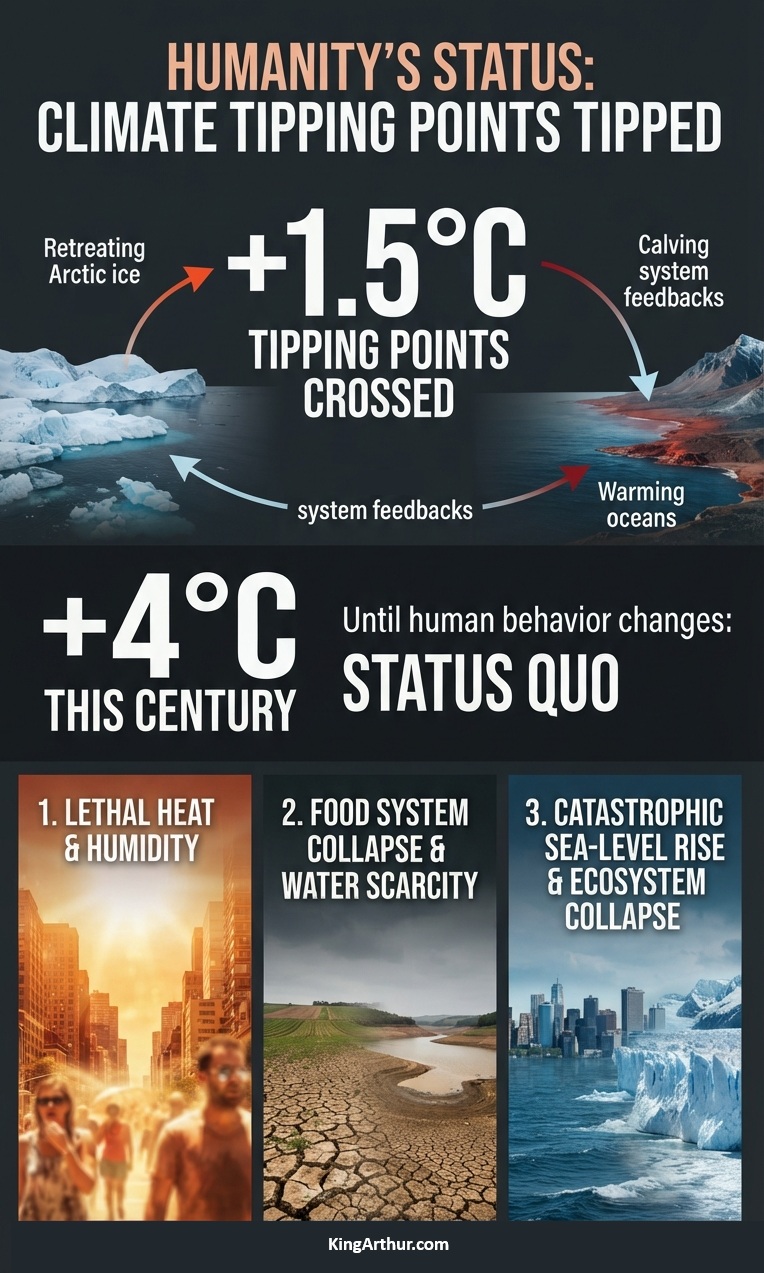
For now, until human behavior shows observable signs of change, the baseline trajectory remains “continued high emissions.” In addition, we have now crossed the 1.5°C threshold of self-reinforcing feedbacks and tipping points.
Under the status quo, human activities are most likely to push global average surface temperatures to +4°C this century.
The consequences include:
Widespread Regional Uninhabitability via Lethal Heat and Humidity
Collapse of the Global Food System and Severe Water Scarcity
Irreversible Tipping Points: Catastrophic Sea-Level Rise and Ecosystem Collapse
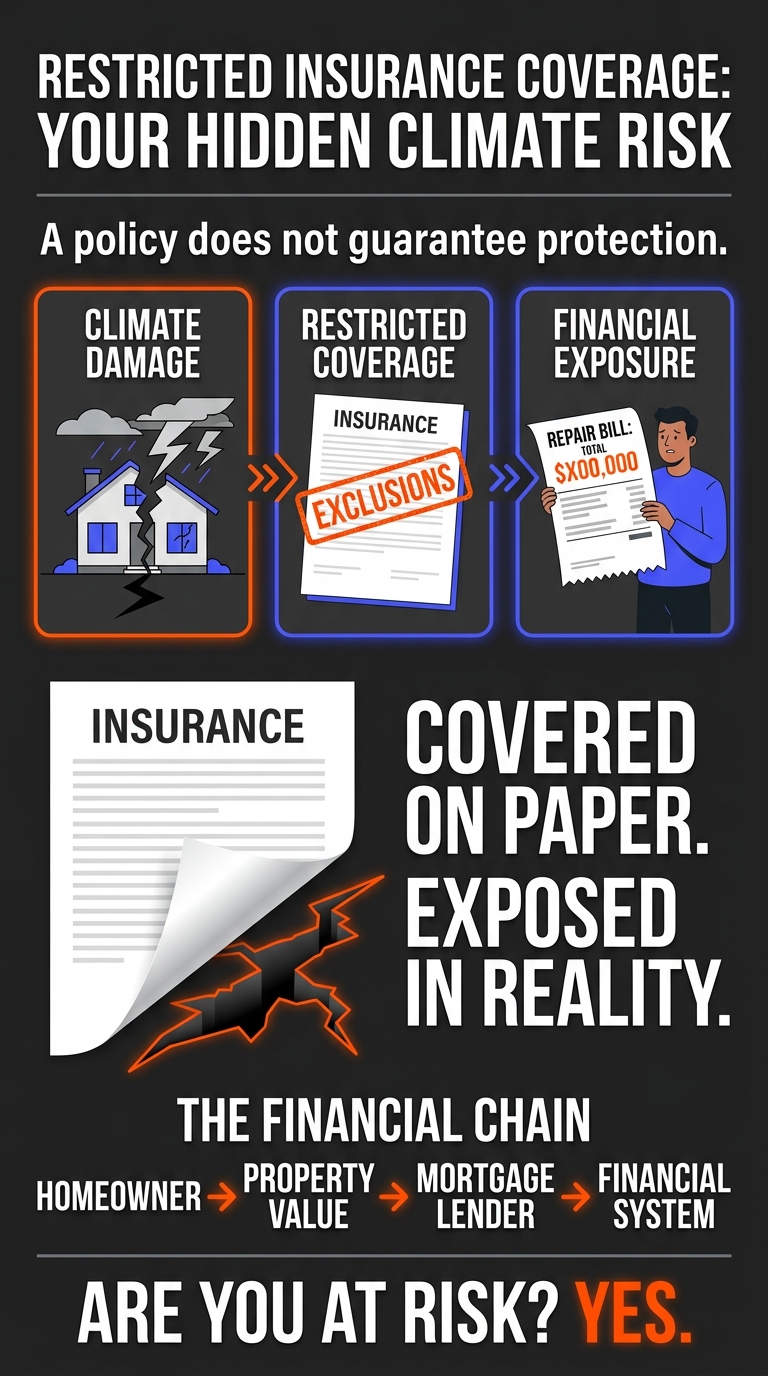
Do you have homeowners insurance? If you answered yes, do you know what is actually covered when climate change and extreme weather damage your property?
Most homeowners insurance policies exclude major categories of extreme weather damage, including flooding, while coverage for wind, hurricanes, and other hazards may be subject to significant limitations and exclusions. These restrictions are becoming more prevalent, creating one of the most significant emerging systemic risks to the global financial system.
In the United States, roof coverage is a particularly important concern. Many homeowners policies restrict roof-damage compensation through exclusions, depreciation provisions, actual-cash-value settlements, deductibles, or other limitations. Depending on the policy, a homeowner may have little chance of receiving enough compensation for a completely new roof, even when the damage is covered. As wind-related risks and losses intensify, these restrictions can leave homeowners responsible for an increasing share of repair and replacement costs.
The same principle applies to automobile insurance. If a tree is blown onto your car during a severe storm, are you covered? The answer depends on your policy, including whether you carry comprehensive coverage and whether any exclusions or limitations apply.
Climate change is already disrupting insurance markets, and the consequences extend far beyond rising premiums. Insurers are increasing prices, restricting coverage, declining renewals, and withdrawing from markets. These developments are creating growing financial vulnerabilities for homeowners, mortgage lenders, investors, businesses, and governments.
One of the most dangerous—and least understood—parts of this crisis is the expansion of restricted coverage. When an insurer refuses to cover a property, the problem is obvious. When a policy remains in force but excludes important risks, limits payouts, or imposes conditions that leave substantial losses uncovered, the danger is hidden. Homeowners may continue paying premiums believing they are protected, only to discover after a disaster that their policies do not cover the damage they suffered.
This is the delayed-disclosure trap: the financial vulnerability exists before the disaster, but its full consequences may not become apparent until a claim is denied or severely limited. By then, the homeowner may face repair costs, continuing mortgage obligations, and a damaged property without the insurance proceeds expected to cover the loss.
Restricted coverage can therefore undermine property values and mortgage security even when insurance remains available. A property may appear insured on paper while carrying substantial uninsured exposure. As these gaps widen, the distinction between having an insurance policy and having adequate financial protection has become increasingly important.
These developments are part of a larger system of interconnected feedbacks. Climate-related losses drive insurance costs higher and encourage insurers to limit their exposure. Higher costs and narrower protection weaken housing affordability and can depress property values. Declining property values and inadequate coverage increase financial risks for lenders and investors. When private insurance retreats, more costs shift to homeowners, businesses, and governments. These additional burdens can weaken the financial resources needed to prevent, withstand, and recover from future climate-related losses.
The central finding is that this feedback crisis is already underway. Rising premiums, insurance withdrawals, coverage restrictions, and growing exposure to uninsured losses are observable market developments. The interactions among these forces create additional risks that can reinforce one another, extending climate-related financial stress well beyond the locations directly affected by disasters.
The ultimate danger is not simply that insurance becomes more expensive. It is that insurance increasingly fails to provide the protection that households, lenders, and financial markets depend on. As this happens, climate risk has become a broader housing, credit, and economic crisis.
The Feedback Crisis Has Already Begun
The Whistleblower Warning: A Campaign to Expand Restricted Coverage
A memo by insurance-industry whistleblowers documents a disturbing development: the insurance industry is already well underway in what the whistleblowers characterize as a subversive campaign to expand restricted coverage, shifting financial risks onto homeowners without their full awareness.
The significance of this warning cannot be overstated. The expansion of restricted coverage changes the nature of the insurance crisis. The problem is no longer limited to rising premiums, canceled policies, or insurers refusing to cover high-risk properties. It also involves the erosion of protection within policies that homeowners continue to purchase and rely upon.
When insurers restrict coverage through exclusions, payout limitations, depreciation provisions, and other policy conditions, they can reduce their own exposure while transferring a greater share of potential losses to policyholders. When those restrictions are not adequately understood by homeowners, the transfer of risk can occur without a corresponding understanding of the financial consequences.
This creates a fundamental imbalance. Homeowners continue paying premiums and may reasonably believe they have protection against major property losses. Yet the actual terms of their policies may leave them responsible for substantial costs following a disaster. The gap between perceived protection and actual coverage can remain hidden until a claim is denied or the insurance payment falls far short of the amount needed to repair or replace damaged property.
The whistleblower warning therefore adds a critical dimension to the delayed-disclosure trap. Financial exposure is not simply increasing because climate-related disasters are becoming more costly. It is also increasing because the insurance protection intended to absorb those losses is being restricted, potentially without homeowners fully recognizing the changes.
The systemic consequences extend beyond individual households. Mortgage lenders may hold collateral whose owners cannot adequately insure or repair it. Investors may underestimate the uninsured exposure embedded in real estate portfolios. Communities may face declining property values and a growing burden of unrecoverable losses. When private insurance transfers more risk to homeowners, the resulting costs do not disappear. They are redistributed through household finances, mortgage markets, lending institutions, businesses, and ultimately, in some circumstances, governments and taxpayers.
This is the critical distinction: an insurance policy can remain active while the financial protection it provides deteriorates. Consequently, policy counts and insurance availability alone can understate the growth of climate-related financial risk.
The whistleblower allegations point to the need for scrutiny not only of insurance prices and market withdrawals, but also of how coverage restrictions are introduced, disclosed, and enforced. Regulators and policymakers must examine whether homeowners can readily understand the risks they are assuming, whether policy changes are adequately communicated, and whether the actual protection provided remains consistent with reasonable expectations.
If the documented practices are as extensive as the whistleblowers contend, the expansion of restricted coverage represents more than an insurance-market adjustment. It is a mechanism through which climate-related financial risk is being transferred to households while remaining largely concealed from homeowners, lenders, investors, and the broader financial system.
That makes restricted coverage a particularly dangerous link in the climate feedback crisis. The physical risk can increase, the financial protection can weaken, and the resulting vulnerability can remain hidden until a disaster exposes the full extent of the loss.
The Protection Gap Is a Critical Link in the Climate Feedback Crisis
The climate-insurance crisis is already unfolding. Rising premiums, restricted coverage, nonrenewals, and insurer withdrawals are changing the financial risks associated with property ownership. These are not merely forecasts of what might happen in a warmer future. They are observable developments whose economic consequences are already being felt.
Restricted coverage deserves particular attention because it can conceal financial exposure rather than eliminate it. When a policy excludes an increasingly important hazard, limits the amount payable, or imposes conditions that prevent a full recovery, the homeowner may remain exposed even while paying for insurance. The inadequacy of that protection may not become apparent until a disaster triggers a claim.
This delayed disclosure creates a dangerous mismatch between perceived security and actual financial resilience. Homeowners may believe their properties are protected. Mortgage lenders may assume that required insurance adequately safeguards their collateral. Investors may underestimate the exposure embedded in real estate portfolios. Yet a property with substantial uninsured risk can suffer serious financial damage even when an insurance policy remains active.
The consequences can reinforce one another. Climate-related damage increases insurance losses. Insurers respond through higher premiums, tighter policy terms, exclusions, and withdrawals. These changes increase ownership costs and expose homeowners to losses they cannot readily absorb. Property values and mortgage security can weaken, while financial distress, defaults, repair costs, and public financial obligations may rise. Governments and taxpayers can then inherit a larger share of the burden.
The feedback does not end there. When households, businesses, lenders, and governments must devote more resources to recovering from losses, fewer resources may remain available for risk reduction, resilience, and adaptation. If that shortfall leaves communities more vulnerable to subsequent disasters, future losses can grow, further intensifying insurance-market stress and financial instability.
This is the feedback mechanism at the heart of the crisis: climate risk increases financial vulnerability, and financial vulnerability is making society less capable of managing the next climate-related loss.
The appropriate response must therefore go beyond monitoring premiums and counting policy cancellations. Regulators, insurers, lenders, and policymakers need to examine what policies actually cover, how exclusions are changing, whether coverage limits remain adequate, and how much risk is being transferred to households and the public. Insurance availability alone is not a sufficient measure of financial protection.
The evidence establishes the need to take the observed disruption seriously and to investigate how its interacting effects are evolving. The precise scale and timing of future financial consequences remain uncertain, but the underlying feedback mechanisms are already visible. Waiting for the full consequences to emerge would mean waiting until hidden financial exposures become actual losses.
The critical question is no longer simply whether homeowners can obtain insurance. It is whether the insurance they can obtain will actually protect them when disaster strikes. As restricted coverage expands, the gap between insured property and adequately protected property has become one of the most consequential—and least visible—channels through which climate change destabilizes the economy.
Insurance can redistribute financial losses, but it cannot eliminate the physical risks that generate them. When those risks undermine the financial systems that support property ownership, lending, and investment, climate change becomes a systemic economic problem.
The insurance feedback crisis has already begun. Whether it remains manageable or develops into much broader financial instability depends on how quickly society recognizes these connections, exposes hidden coverage gaps, and acts to reduce the underlying risks.
The Insurance Feedback Crisis: Climate Change Is Already Destabilizing Housing, Credit, and the Global Economy
How Rising Costs, Restricted Coverage, and Insurance Withdrawals Are Transmitting Climate Risk Through the Financial System
October 2026
Introduction
Climate change is already disrupting insurance markets, and the consequences extend far beyond rising premiums. Insurers are increasing prices, restricting coverage, declining renewals, and withdrawing from some markets. These developments are creating a growing financial vulnerability for homeowners, mortgage lenders, investors, businesses, and governments.
One of the most dangerous—and least understood—parts of this crisis is the expansion of restricted coverage. When an insurer refuses to cover a property, the problem is obvious. When a policy remains in force but excludes important risks, limits payouts, or imposes conditions that leave substantial losses uncovered, the danger is hidden. Homeowners may continue paying premiums believing they are protected, only to discover after a disaster that their policies do not cover the damage they suffered.
This is the delayed-disclosure trap: the financial vulnerability exists before the disaster, but its full consequences may not become apparent until a claim is denied or severely limited. By then, the homeowner may face repair costs, mortgage obligations, and a damaged property without the insurance proceeds expected to cover the loss.
Restricted coverage can therefore undermine property values and mortgage security even when insurance remains available. A property may appear insured on paper while carrying substantial uninsured exposure. As these gaps widen, the difference between having an insurance policy and having adequate financial protection becomes increasingly important.
These developments are part of a larger system of interconnected feedbacks. Climate-related losses drive insurance costs higher and encourage insurers to limit their exposure. Higher costs and narrower protection weaken housing affordability and property values. Reduced property values and inadequate coverage increase financial risks for lenders and investors. When private insurance retreats, more costs shift to homeowners, businesses, and governments. Those added burdens can weaken the financial resources needed to adapt to future climate risks.
The central finding is that this feedback crisis is already underway. Rising premiums, insurance withdrawals, coverage restrictions, and growing exposure to uninsured losses are observable market developments. The interactions among these forces are creating additional risks that can reinforce one another, extending climate-related financial stress well beyond the locations directly affected by disasters.
The ultimate danger is not simply that insurance becomes more expensive. It is that insurance increasingly fails to provide the protection that households, lenders, and financial markets depend on. When that happens, climate risk can become a broader housing, credit, and economic problem.
1. The Crisis Is Already Underway
For years, the economic consequences of climate change were discussed primarily in terms of future damage: projected disaster losses, future insurance costs, declining property values, and the possibility that some regions would eventually become uninsurable.
That framing is increasingly inadequate.
In vulnerable markets, insurance premiums have already risen sharply, coverage has become more restrictive, and some insurers have stopped writing new policies or withdrawn from particular areas. Property owners are confronting higher deductibles, policy nonrenewals, and fewer affordable alternatives. Public insurance programs have assumed greater importance in some jurisdictions where private coverage has become difficult to obtain.
These are present market developments, not merely projections.
Their significance extends beyond the insurance industry. Insurance is part of the financial infrastructure supporting property ownership, mortgage lending, commercial investment, and infrastructure development. When that infrastructure becomes more expensive or less accessible, the effects propagate into other sectors.
The final stages of this chain can feed back into the original problem. Households with fewer financial resources have less capacity to improve their properties. Municipalities under fiscal pressure have less flexibility to invest in protective infrastructure. Businesses facing higher insurance and borrowing costs may defer resilience investments.
The result is a system in which the costs of climate change can make society less capable of absorbing the next climate-related shock.
The insurance market is already exposing this vulnerability.
2. The Industry Is Warning About the Same Systemic Mechanism
The October 14, 2026, memorandum Sounding the Alarm, published by Inside Track x (Re)Insurance, describes concerns reported by senior professionals in the UK and European insurance, reinsurance, and brokerage sectors.
The memo identifies three principal responses to increasing physical risk:
Higher premiums as insurers attempt to price expected losses and uncertainty.
Restricted coverage as insurers narrow the risks they will accept.
Market withdrawal when exposure cannot be made commercially viable.
All three responses are already familiar features of stressed insurance markets.
An insurer can reduce its own exposure by refusing to renew a policy. A reinsurer can protect its capital by increasing prices or reducing capacity. An underwriting department can improve its financial position by avoiding properties it considers too risky.
But none of these decisions removes the physical hazard.
Instead, the financial responsibility moves elsewhere. Homeowners retain more risk. Businesses absorb higher costs. Lenders face greater uncertainty about collateral. Governments confront greater pressure to support disaster recovery and provide insurance alternatives.
This creates a structural conflict between the financial stability of individual institutions and the financial stability of the broader economy.
The memo also warns that commercial incentives, limitations in catastrophe modeling, and fragmented assessments of exposure can prevent the industry from fully recognizing systemic risk.
The central warning reinforces an increasingly important conclusion: conventional risk management can protect individual institutions without adequately protecting the economic system in which they operate.
Restricted Coverage
Insurance is caught in a delayed-disclosure trap. When a homeowner cannot obtain coverage, the problem is immediately apparent. But an equally serious—and less visible—risk is the growing restriction of coverage. Policies may contain exclusions, limitations, and coverage gaps buried in the fine print, leaving homeowners exposed to losses they believe are insured. As insurers respond to rising risks and losses, these restrictions are expanding. The danger often becomes clear only after a disaster, when homeowners discover that their policies do not cover the damage. By then, it is too late to obtain the protection they thought they had.
3. The First Feedback Loop: Physical Losses Drive Insurance Disruption
The initial feedback begins with physical climate risk.
Flooding, wildfire, severe storms, extreme heat, and other hazards can damage buildings, interrupt businesses, destroy infrastructure, and increase claims. The consequences depend on the hazard, location, exposure, and vulnerability of the assets involved.
As insurers experience losses or revise their expectations of future losses, they adjust prices and coverage.
The initial sequence is direct:
Physical risk increases → Expected losses or uncertainty increase → Premiums rise and coverage tightens.
This relationship is already reflected in insurance-market decisions.
The feedback becomes more consequential when higher premiums and restricted coverage affect the financial viability of the properties being insured.
Insurance is not merely another household expense. It is part of the cost of maintaining property, satisfying mortgage requirements, operating a business, and attracting investment.
When insurance costs increase faster than household income or business revenue, the resulting financial pressure can become difficult to absorb. When suitable coverage disappears altogether, the problem changes from affordability to insurability.
The original physical risk has now produced a financial consequence that can persist even after a particular disaster ends.
A homeowner whose property survives a storm may still face a higher renewal premium. A business that escapes direct damage may still experience higher insurance costs. A community that avoids a catastrophic event may nevertheless face market repricing as insurers reassess its exposure.
This is the first critical transition: climate risk is no longer expressed exclusively through damage after a disaster. It is increasingly expressed through the cost and availability of financial protection before the next disaster occurs.
4. The Second Feedback Loop: Insurance Costs Pressure Property Values
Property values depend on more than a building’s physical condition and location. They also depend on the expected costs of ownership, the availability of financing, and the risks associated with future use.
Insurance disruption affects all three.
When premiums rise, the total cost of owning a property increases. When deductibles rise or coverage becomes less comprehensive, owners retain more potential financial loss. When insurers withdraw, buyers may have difficulty obtaining the coverage required by lenders or may have to accept more expensive alternatives.
These conditions can weaken demand for exposed properties.
The resulting feedback is:
Higher insurance costs → Higher ownership costs → Reduced affordability and buyer demand → Downward pressure on property values.
The process is already evident in the way insurance availability has become a growing consideration in real-estate transactions and property-risk assessments. Its magnitude varies by market, and a premium increase alone does not prove that property values have declined. But the economic mechanism is straightforward.
A property can lose economic value without suffering new physical damage. If buyers anticipate years of higher insurance costs, recurring flood losses, or difficulty obtaining a mortgage, they may be willing to pay less for it.
This creates a new form of climate-related financial exposure: the risk that the cost of protecting an asset undermines the value of owning it.
The implications are substantial because residential property represents a major share of household wealth. Commercial property supports business operations, employment, and investment. Property values also contribute to local tax revenues.
As insurance-related affordability problems spread, the consequences can extend beyond individual property owners into household balance sheets, commercial activity, and municipal finance.
5. The Third Feedback Loop: Property Risk Becomes Credit Risk
Mortgage lending depends on borrowers’ ability to repay their loans and on the value of the assets securing those loans.
Insurance supports both sides of that arrangement. It protects against specified losses that could impair collateral, while its premiums form part of the borrower’s ongoing cost of ownership. As insurance becomes more expensive or less available, both protections can weaken.
Higher premiums increase the monthly cost of homeownership. For financially constrained borrowers, that additional expense can reduce the ability to meet mortgage payments and other obligations. At the same time, inadequate coverage can leave a property owner and lender more exposed to the financial consequences of damage. If insurance difficulties reduce property demand or values, the collateral securing outstanding loans may also weaken.
The resulting feedback is:
Insurance disruption → Higher ownership costs and greater retained losses → Mortgage stress and weaker collateral → Increased credit risk.
The systemic concern is concentration. If insurance affordability deteriorates across a large number of properties in the same region, the financial consequences can occur together. Lenders may face correlated risks rather than isolated borrower problems. That possibility is particularly important where local economies, property tax revenues, employment, and household wealth are heavily dependent on real estate.
The risk is already being transmitted into financing decisions where insurance availability affects property transactions and underwriting. The connection between insurance and credit is established. The growing importance of climate-related insurability makes that connection increasingly consequential.
6. The Fourth Feedback Loop: Reinsurance Can Amplify Market Stress
Reinsurance provides financial protection to insurance companies against large or concentrated losses. It helps primary insurers manage their exposures and maintain the capacity to write policies. But reinsurance is itself exposed to catastrophe risk.
When reinsurers reassess expected losses or uncertainty, they may increase prices, change coverage terms, reduce available capacity, or require primary insurers to retain more risk. Primary insurers then face additional financial pressure. They may raise premiums, tighten underwriting, reduce policy limits, or withdraw from markets where acceptable returns cannot be achieved.
The feedback is:
Higher catastrophe losses or uncertainty → Reinsurance pressure → Higher primary-insurance costs or reduced capacity → Less affordable and less available coverage → Greater financial exposure outside the insurance system.
This process can spread the effects of physical risk beyond the location where a disaster occurs. An insurer’s response depends on its portfolio, reinsurance contracts, capital position, and exposure to multiple regions. The important point is that reinsurance does not eliminate catastrophe risk. It redistributes that risk through another layer of the financial system. If multiple insurers and reinsurers simultaneously reassess similar exposures, their decisions can reinforce market-wide tightening.
The October 2026 memo’s concern about interconnected risk is particularly relevant here. A firm may manage its own exposures prudently while the combined decisions of many firms reduce the capacity available to the wider economy.
The memo reinforces the need to monitor the relationship between physical losses, reinsurance costs, primary-market availability, and the financial resources available to absorb future losses.
7. The Fifth Feedback Loop: Public Intervention Transfers Costs to Taxpayers
As private insurance becomes unaffordable or unavailable, governments face growing pressure to intervene.
Public responses can include insurance programs of last resort, disaster assistance, infrastructure repairs, emergency housing, subsidized mitigation, and other forms of financial support.
Such measures can protect households and communities from immediate hardship. They can also preserve economic activity when private insurance capacity is insufficient. But they do not eliminate the physical losses. They redistribute part of the cost to public budgets.
The resulting feedback is:
Insurance withdrawal → Greater uninsured exposure → Increased demand for public support → Higher public expenditure and contingent liabilities → Greater fiscal pressure.
If the same communities repeatedly experience damaging events, governments may face recurring costs rather than a single temporary emergency. Meanwhile, the underlying economic base may weaken. Property values can come under pressure, businesses can suffer interruptions, and residents may relocate or reduce spending. These changes can reduce local revenues just as the need for public spending increases. The resulting fiscal squeeze is a direct consequence of the interaction between physical risk and financial vulnerability.
It is already visible in the expanding importance of public insurance and disaster-recovery arrangements in some exposed markets. The long-term fiscal consequences will depend on the scale of future losses, policy design, tax capacity, and the effectiveness of adaptation.
The danger is that public intervention can become a substitute for reducing underlying risk. If subsidies keep vulnerable properties insured without improving their resilience, governments may accumulate liabilities while leaving the physical exposure largely unchanged.
A sustainable response must therefore combine financial assistance with measures that reduce expected losses.
8. The Sixth Feedback Loop: Financial Stress Can Reduce Resilience
The preceding mechanisms reveal a more troubling feedback: the financial consequences of climate risk can reduce the capacity to manage future climate risk.
Consider a household facing higher premiums, a larger deductible, and rising repair costs. It may have less money available to install flood protection, replace a vulnerable roof, improve drainage, or strengthen the property against future damage.
Consider a municipality facing repeated disaster-recovery expenses and declining property revenues. It may have less capacity to upgrade stormwater infrastructure, maintain protective systems, or invest in long-term resilience.
Consider a business facing higher insurance and borrowing costs. It may delay investments that would otherwise reduce its exposure to future hazards.
The resulting feedback is:
Climate losses → Higher financial costs → Reduced capacity for adaptation → Greater vulnerability to subsequent losses.
This is a critical transition from a sequence of separate financial problems to a self-reinforcing system.
The original hazard creates damage or increases expected losses. Those losses generate financial pressure. Financial pressure constrains adaptation. Reduced adaptation leaves assets more exposed to future hazards. The next event then encounters a system that may be less prepared than before.
This mechanism is not merely theoretical. The financial constraints on households, municipalities, and businesses are real, and the need to pay for insurance and recovery competes with the need to invest in resilience.
9. The Combined Feedback System Is More Dangerous Than Any Individual Effect
The six feedbacks are interconnected.
Higher physical losses can raise insurance and reinsurance costs. Higher insurance costs can weaken property affordability. Reduced affordability can affect demand and financing. Weaker property values can increase credit risk and undermine local tax revenues. Public intervention can shift losses to taxpayers. Financial pressure can then reduce the resources available for adaptation.
These are not independent problems. They form a connected system in which stress in one sector can reinforce stress elsewhere.
The combined mechanism can be represented as follows:
Climate-related physical losses
↓
Higher insurance and reinsurance costs; restricted coverage and withdrawals
↓
Higher property ownership costs and greater uninsured exposure
↓
Weaker affordability, property demand, and financing conditions
↓
Increased mortgage vulnerability and public financial pressure
↓
Reduced resources for adaptation and recovery
↓
Greater vulnerability to future losses
The final step closes the feedback loop.
The significance is that the total economic effect can exceed the direct cost of any individual disaster. Financial interactions can prolong losses, transmit them to unaffected sectors, and weaken the capacity to recover. This is why insurance-market stress deserves attention as a systemic economic warning rather than simply an industry problem.
It also explains why waiting for an insurer or a major bank to fail would be the wrong approach. Financial instability can develop through declining affordability, reduced coverage, weaker investment, and growing public liabilities long before a dramatic institutional failure occurs.
The feedbacks do not need to culminate in a global financial collapse to cause substantial economic damage. They are already imposing persistent costs on households, businesses, and governments.
10. Why the 2008 Financial Crisis Is a Warning
The October 2026 industry memo compares the potential consequences of widespread uninsured property risk with vulnerabilities associated with the 2008 mortgage-market crisis. The comparison is useful because it highlights how problems involving property and credit can spread through interconnected financial relationships.
The 2008 crisis involved mortgage underwriting failures, excessive leverage, complex financial instruments, and weaknesses in financial oversight. Climate-related insurance disruption has a different underlying driver: changing physical risk and the difficulty of financing assets exposed to that risk.
The important similarity is the transmission mechanism. In both cases, problems involving the value, financing, or risk assessment of property can extend into lending and broader financial markets.
Climate-related insurance disruption can undermine property finance if coverage becomes unavailable, ownership costs rise sharply, or collateral values weaken. If these developments occur across many regions simultaneously, they could contribute to a broader financial shock.
The lesson is to recognize interconnected vulnerabilities before they become acute. Regulators and financial institutions should not wait for widespread defaults to begin evaluating how insurance-market disruption could affect lending, collateral, and public finance.
11. What the Evidence Already Shows
Observed developments
Insurance markets in several exposed regions are experiencing higher premiums, coverage restrictions, nonrenewals, and insurer withdrawals. Public insurance and disaster-assistance arrangements are increasingly important in some markets. Insurance availability is also an increasingly significant factor in property transactions and financial risk assessment.
These developments establish that insurance-market stress is already occurring.
These relationships provide a sound basis for evaluating how insurance disruption can transmit financial pressure across the economy.
Emerging systemic feedbacks
The interaction of insurance costs, property affordability, mortgage exposure, public liabilities, and reduced adaptation capacity creates a credible pathway toward self-reinforcing economic stress.
Uncertain outcomes
The crisis is already observable in its component parts. The systemic danger is that those parts can reinforce one another faster than institutions respond.
12. The Policy Response Must Address the Feedbacks, Not Just the Symptoms
The appropriate response is not simply to subsidize insurance premiums or require insurers to maintain coverage regardless of risk.
Those measures may provide temporary relief, but they cannot eliminate physical hazards. If they suppress risk signals without reducing exposure, they may encourage continued investment in vulnerable locations and transfer increasingly large liabilities to taxpayers.
A more effective response must address the causes and interactions of the feedback system.
Reduce the underlying physical risk
Greenhouse gas emissions influence long-term warming and many associated hazards. Reducing emissions limits additional future climate risk, although it cannot prevent all near-term losses.
Mitigation must be accompanied by adaptation because significant physical risks already exist.
Improve the resilience of exposed assets
Building standards, flood protection, drainage improvements, wildfire mitigation, resilient infrastructure, and risk-informed land use can reduce expected losses.
Investments should be evaluated against transparent estimates of their costs, benefits, maintenance requirements, and remaining exposure.
Where protection is not physically or economically sustainable, policymakers must consider fair and orderly relocation rather than assuming every property can be protected indefinitely.
Monitor the entire financial transmission chain
Regulators should examine insurance affordability and availability alongside mortgage performance, property values, reinsurance capacity, bank exposure, and public liabilities.
Stress tests should include scenarios in which insurance markets tighten across multiple regions at the same time.
The objective should be to identify correlated exposure before it generates substantial financial losses.
Improve catastrophe-model transparency
Insurers and reinsurers should clearly disclose material assumptions and uncertainties in their risk assessments. Independent review should investigate credible concerns about commercial pressure, inadequate data, and the underestimation of changing hazards.
The goal is to ensure that decisions reflect defensible estimates of risk rather than incentives to understate it.
Protect vulnerable households without concealing risk
Public support may be necessary to prevent immediate hardship and preserve access to essential coverage. But support should be linked, where appropriate, to mitigation, stronger building practices, and realistic assessments of long-term exposure.
A policy that preserves coverage without reducing the underlying risk defer costs rather than solve the problem.
13. Conclusion: The Feedback Crisis Has Already Begun
The Protection Gap Is a Critical Link in the Climate Feedback Crisis
The climate-insurance crisis is already unfolding. Rising premiums, restricted coverage, nonrenewals, and insurer withdrawals are changing the financial risks associated with owning property. These are not merely forecasts of what might happen in a warmer future. They are observable developments whose economic consequences are already being felt.
Restricted coverage deserves particular attention because it can conceal financial exposure rather than eliminate it. When a policy excludes an increasingly important hazard, limits the amount payable, or imposes conditions that prevent a full recovery, the homeowner may remain exposed even while paying for insurance. The inadequacy of that protection may not become apparent until a disaster triggers a claim.
This delayed disclosure creates a dangerous mismatch between perceived security and actual financial resilience. Homeowners may believe their properties are protected. Mortgage lenders may assume that required insurance adequately safeguards their collateral. Investors may underestimate the exposure embedded in real estate portfolios. Yet a property with substantial uninsured risk can suffer serious financial damage even when an insurance policy remains active.
The consequences can reinforce one another. Climate-related damage increases insurance losses. Insurers respond through higher premiums, tighter terms, exclusions, and withdrawals. Those changes increase ownership costs and expose homeowners to losses they cannot readily absorb. Property values and mortgage security can weaken, while defaults, repair costs, and public financial obligations may rise. Governments and taxpayers can then inherit a larger share of the burden. If these pressures reduce the resources available for prevention and adaptation, future losses can become even greater.
This is the feedback mechanism at the heart of the crisis: climate risk increases financial vulnerability, and financial vulnerability can make society less capable of managing the next climate-related loss.
The appropriate response must therefore go beyond monitoring premiums and counting policy cancellations. Regulators, insurers, lenders, and policymakers need to examine what policies actually cover, how exclusions are changing, whether coverage limits remain adequate, and how much risk is being transferred to households and the public. Insurance availability alone is not a sufficient measure of financial protection.
The evidence establishes the need to take the observed disruption seriously and to investigate how its interacting effects are evolving. The precise scale and timing of future financial consequences remain uncertain, but the underlying feedback mechanisms are already visible.
The critical question is no longer simply whether homeowners can obtain insurance. It is whether the insurance they can obtain will actually protect them when disaster strikes. As restricted coverage expands, the gap between insured property and adequately protected property may become one of the most consequential—and least visible—channels through which climate change destabilizes the economy.
Insurance can redistribute financial losses, but it cannot eliminate the physical risks that generate them. When those risks undermine the financial systems that support property ownership, lending, and investment, climate change becomes a systemic economic problem.
The feedback crisis has already begun. Whether it remains manageable or develops into much broader financial instability depends on how quickly society recognizes the connections and acts to reduce the underlying risks.
References and Further Reading
Primary industry source
Inside Track x (Re)Insurance. (October 14, 2026). Sounding the Alarm: Insurance and Reinsurance Memo.
This memo provides the principal industry perspective on physical risk, insurance repricing, coverage restrictions, market withdrawal, catastrophe modeling, and systemic financial vulnerability. Its findings should be interpreted in light of its aggregated and anonymized methodology.
Related research
Brouse, D., and Mukherjee, S. Climate Change and the Insurance Crisis: Rising Costs, Shrinking Availability, and the Limits of Insurability.
This paper synthesizes an industry memorandum, related climate-insurance research, and established economic mechanisms. It does not present a new statistical model or independently estimate the probability of a global financial crisis. Claims about observed insurance-market disruption are distinct from claims about the magnitude of interconnected feedbacks or the timing of future systemic outcomes. Those latter questions require continued empirical investigation using insurance, reinsurance, property, credit, and public-finance data.
A Practical Path to a Healthier Planet and a Better Life
Climate change is more than a problem of rising temperatures. It affects our homes, food supplies, health, economy, and the natural systems that support life. Addressing it requires science, practical solutions, shared values, and cooperation.
But there is a challenge: people are busy trying to make ends meet. They have bills to pay, families to support, and communities to protect. Climate action must address these everyday concerns if it is to gain lasting public support.
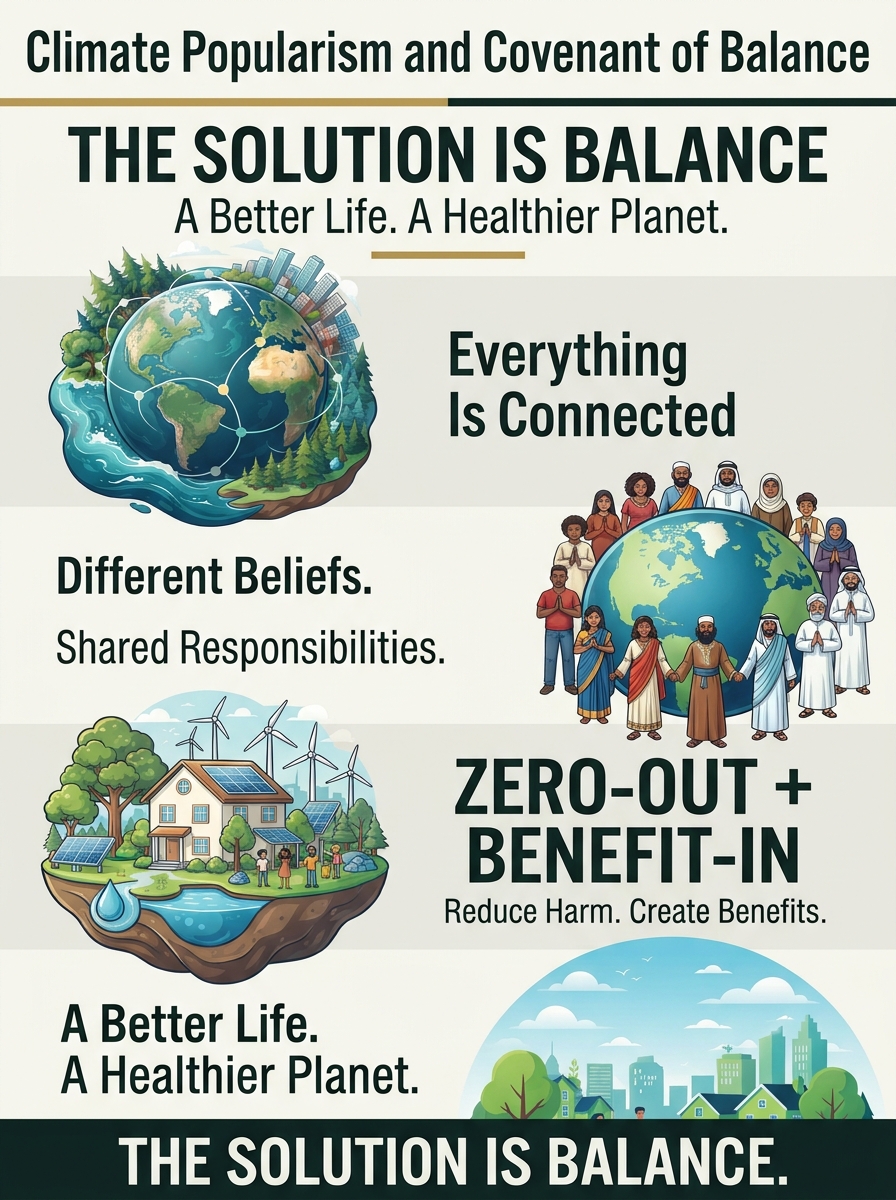
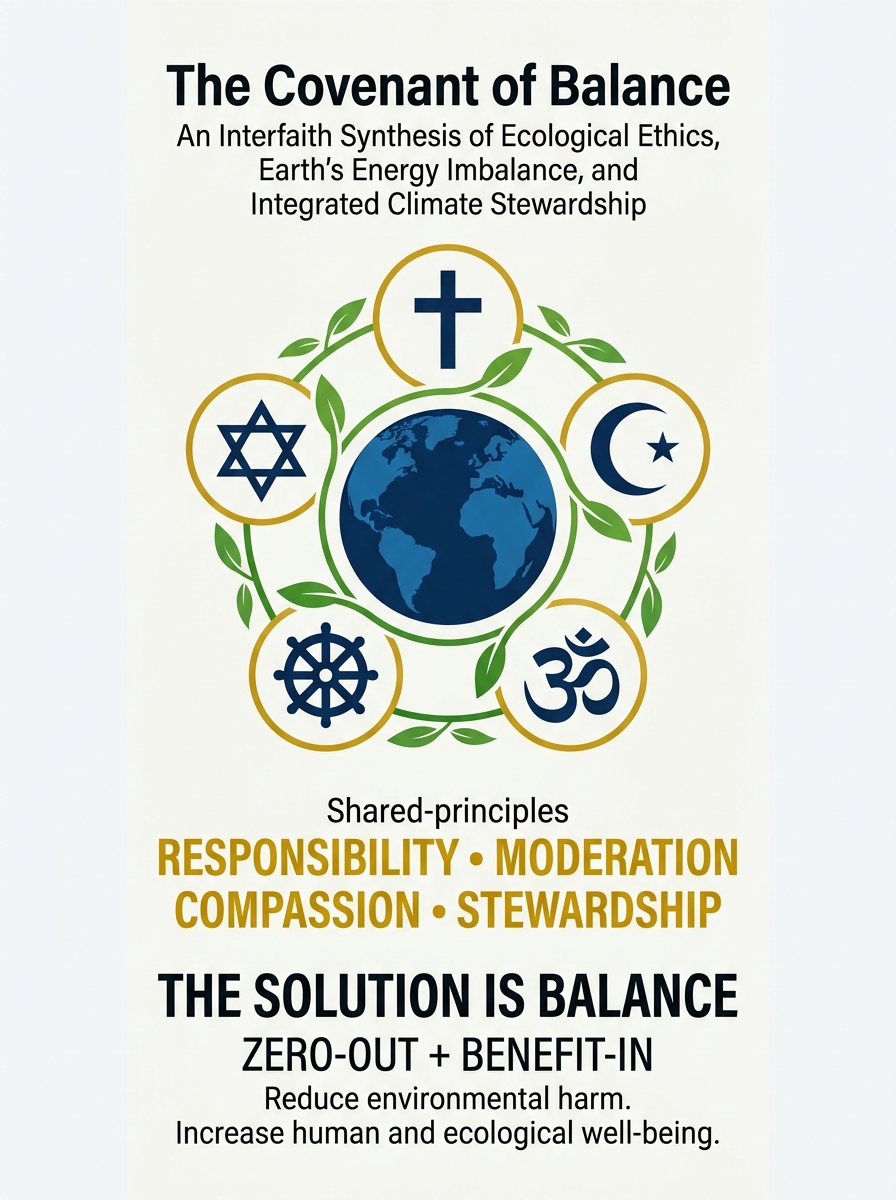
Two complementary ideas offer a way forward: Climate Popularism and the Covenant of Balance.
Start With What Matters to People
Climate Popularism, developed by Caroline Lucas and Rupert Read, argues that climate action should connect with the things people care about most.
Lower energy bills. Affordable food. Reliable transportation. Comfortable homes. Cleaner air and water. Safer communities.
These are not separate from climate action. Many practical improvements can help meet these needs while also reducing pollution and preparing communities for future risks.
For example, improving home insulation can reduce energy use and heating costs. Better public transportation can make travel more affordable. Protecting forests and restoring natural areas can support wildlife, protect water supplies, and help communities manage heat and flooding.
The goal is to make climate action useful in people’s daily lives.
What Does Balance Mean?
The Covenant of Balance builds on this practical approach by connecting climate science with shared ethical principles.
Earth is an interconnected system. The atmosphere, oceans, forests, soils, and living things all affect one another. Human life and our economy depend on these systems working well.
Climate change is one sign that this system is being pushed out of balance.
Earth receives energy from the Sun and releases energy back into space. Greenhouse gases from human activities trap additional heat, causing Earth’s climate system to gain energy. The oceans absorb most of this excess heat, while temperatures rise, ice melts, sea levels increase, and ecosystems change.
These effects can also interact. For example, when ice melts, darker surfaces are exposed. These surfaces absorb more sunlight, adding further warming.
Understanding these connections helps explain why reducing greenhouse gas emissions and protecting natural systems are both essential.
Balance does not mean that nature must never change. It means respecting the conditions that allow people and other living things to thrive.
Integrated Climate Stewardship’s guiding formula is simple:
ZERO-OUT + BENEFIT-IN
ZERO-OUT means reducing actual sources of harm. This includes cutting greenhouse gas emissions, wasting less energy, reducing pollution, and using fewer resources when doing so makes sense.
BENEFIT-IN means choosing improvements that also provide real benefits to people. These may include lower bills, better comfort, improved health, stronger local economies, and greater protection against extreme weather.
Consider a home that uses less energy for heating and cooling. The household may save money while also reducing pollution associated with energy use. A community that reduces food waste can save resources and lower disposal costs. A town that protects trees and improves stormwater management can create healthier neighborhoods while reducing certain local risks.
Not every project will produce every benefit. Costs, safety, local conditions, and actual environmental results must be considered.
The important point is to look for solutions that work in the real world.
Balance the Economy With the Environment
A healthy economy depends on healthy natural systems. Businesses need reliable supplies of water, energy, food, materials, and other resources. Communities need safe homes, functioning infrastructure, and a healthy population.
Economic growth that ignores environmental damage can create costs that others must eventually pay.
A better approach asks whether an activity meets a real need, whether it can be done with fewer resources, and whether its benefits justify its full costs.
This does not require rejecting markets, business, economic growth, or new technology. It means accounting for environmental damage rather than treating it as someone else’s problem.
Practical climate solutions should also consider fairness. Families with limited incomes may struggle to afford improvements even when those improvements would save money over time. Public programs, better financing, and community cooperation can help make effective solutions accessible to more people.
From Individual Action to Community Progress
Personal choices matter, but individual households cannot solve climate change by themselves.
Electricity generation, industry, transportation, agriculture, buildings, and public policy all play important roles. Businesses and governments must also reduce pollution and invest in practical improvements.
Communities can help by sharing useful information, improving public infrastructure, supporting vulnerable residents, and measuring progress openly.
The same standard should apply to everyone: look at the results.
Are emissions falling? Is energy being used more efficiently? Are costs manageable? Are communities becoming safer? Are natural systems being protected?
Good intentions are important, but measurable results are essential.
The Solution Is Balance
Climate Popularism offers a way to connect climate action with people’s everyday needs. The Covenant of Balance adds a broader ethical foundation, bringing together science, economics, environmental responsibility, and shared values.
Integrated Climate Stewardship provides the practical link between them: reduce actual harm while seeking measurable benefits for people and the planet.
We do not need to agree on every political, religious, or economic question to make progress. We need to recognize that our choices affect one another and that our long-term well-being depends on the natural systems that sustain us.
The goal is not to make people choose between a healthy planet and a better life.
The goal is to build a future in which protecting the planet helps people live healthier, safer, more affordable, and more fulfilling lives.
Different beliefs. Shared responsibilities. Practical solutions.
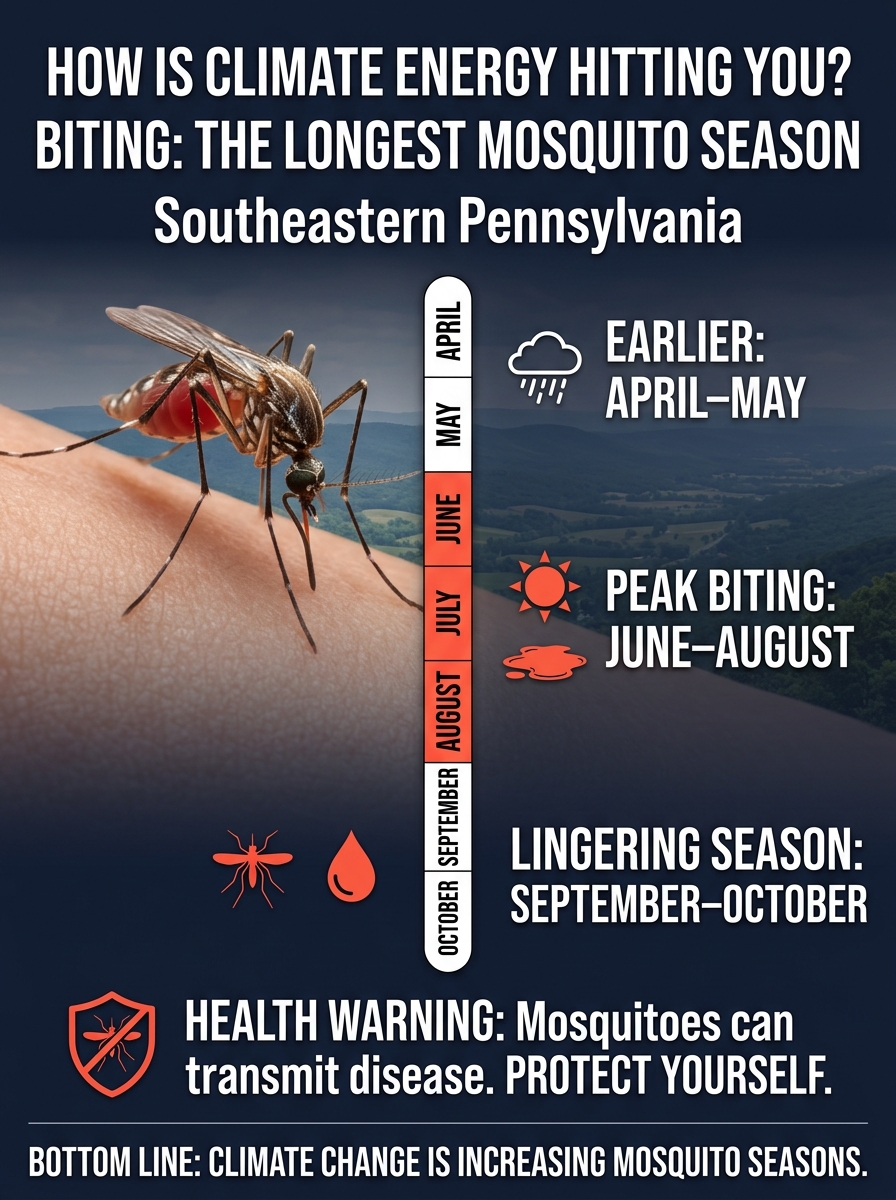
Southeastern Pennsylvania’s 2026 mosquito season has been prolonged, with mosquito activity extending into October. A combination of spring rainfall, warm temperatures, standing water, and persistent humidity can create favorable conditions for mosquito breeding and survival, potentially extending the season beyond its traditional peak.
The extended season is another example of how changing weather patterns can affect everyday life, from outdoor comfort to public health. However, confirming that 2026 is the region’s longest mosquito season would require historical surveillance data and consistent year-to-year comparisons.
The 2026 Mosquito Season: A Timeline
Early Start (April–May)
Warmer spring temperatures and rainfall can accelerate mosquito development and bring earlier seasonal activity. Standing water in yards, storm drains, and other locations provides breeding habitat. Establishing the precise start of the 2026 season requires local monitoring records.
Peak Season (June–August)
Summer heat can speed up mosquito development, while rainfall and persistent moisture can replenish breeding sites. Some mosquito species can complete their life cycle in as little as several days under favorable conditions. Urban drainage systems, containers, and low-lying areas can provide recurring sources of standing water.
Extended Autumn (September–October)
Mosquitoes can remain active well into autumn when temperatures and moisture levels remain favorable. Activity generally declines as temperatures fall, although the timing varies by species and local conditions. A hard frost can sharply reduce activity, but it does not necessarily eliminate all mosquitoes or their eggs.
Health Risks and Regional Hotspots
An extended mosquito season can prolong opportunities for exposure to mosquito-borne diseases, including West Nile virus (WNV). Actual risk, however, depends on local mosquito surveillance, virus detection, species distribution, and human exposure—not simply the length of the season.
The Vectors
Culex pipiens, commonly known as the northern house mosquito, is an important West Nile virus vector in Pennsylvania. It can thrive in urban environments, including storm drains and catch basins.
Aedes albopictus, the Asian tiger mosquito, is another important species in the region. It breeds in small collections of standing water, including water trapped in containers, and can remain active during suitable autumn weather.
West Nile Virus Surveillance
Pennsylvania and the Centers for Disease Control and Prevention monitor mosquito populations and mosquito-borne disease activity. Positive mosquito samples indicate that the virus is circulating in a particular area, but they do not, by themselves, establish the level of risk to residents.
Claims about early-season positive samples in Bucks County or other Southeastern Pennsylvania locations should be verified against the relevant 2026 surveillance records before publication.
What You Can Do
Residents can reduce mosquito breeding and exposure by taking a few practical steps:
Empty standing water from containers, flowerpots, buckets, and outdoor equipment.
Clean clogged gutters and maintain drainage around the property.
Use screens on windows and doors.
Apply an EPA-registered insect repellent according to its label.
Wear long sleeves and long pants when mosquitoes are active, particularly around dawn and dusk.
The Bottom Line
A longer mosquito season is more than an outdoor nuisance. It is a direct, increasingly visible consequence of a warming climate. Rising temperatures extend the period when mosquitoes can survive, reproduce, and remain active, pushing seasonal biting activity further into autumn and prolonging opportunities for exposure to mosquito-borne diseases.
Climate change is the primary long-term driver of warming temperatures and increasingly favorable conditions for extended mosquito seasons. Rainfall, humidity, standing water, mosquito species, and public-health interventions influence the severity of individual seasons, but a warming climate shifts the underlying conditions in favor of longer periods of mosquito activity.
The question is not just how much energy is accumulating in the climate system. It is how that energy translates into consequences we experience in our own backyards. In Southeastern Pennsylvania, a mosquito still biting in October offers a tangible reminder that climate change is not a distant threat. It is changing the conditions of everyday life—one bite at a time.
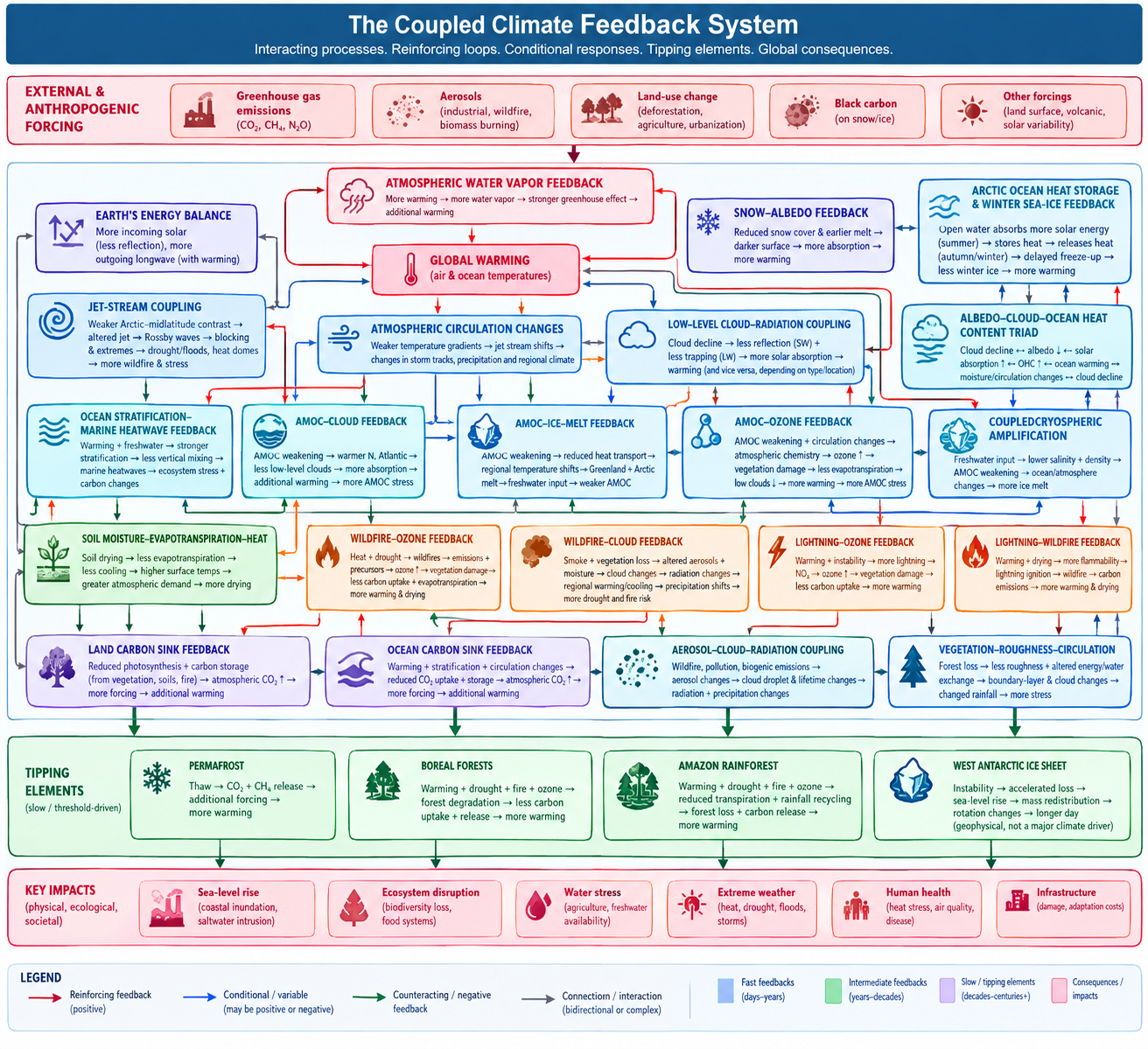
INTEGRATED CLIMATE FEEDBACK, COUPLING, AND TIPPING-POINT NETWORK
POLAR AMPLIFICATION, CRYOSPHERE, AND ICE-SHEET NETWORK
POLAR AMPLIFICATION → Arctic warming exceeding the global average → weakened equator-to-pole temperature gradients → changes in atmospheric circulation, storm tracks, and polar jet-stream dynamics → accelerated Arctic sea-ice loss + Greenland ice melt → changes in surface albedo, ocean heat exchange, freshwater input, and atmospheric stability →
ICE–ALBEDO FEEDBACK: sea-ice + snow + land-ice loss → darker ocean + land surfaces exposed → reduced surface albedo → greater absorption of incoming solar radiation during sunlit periods → additional surface warming → further ice + snow loss ↺
MELT–ELEVATION FEEDBACK: Greenland + ice-sheet surface melting → reduced ice-sheet elevation → exposure of the ice surface to warmer atmospheric conditions at lower elevations → faster surface melt → further elevation loss ↺
REGIONAL LAPSE-RATE FEEDBACK: Arctic warming → changes in the vertical atmospheric temperature gradient and atmospheric stability → altered vertical temperature contrasts + near-surface radiative cooling → enhanced near-surface warming under favorable polar conditions → additional sea-ice and surface-ice loss ↺
ARCTIC OCEAN HEAT STORAGE–WINTER SEA-ICE FEEDBACK: Arctic sea-ice loss → increased summer solar absorption by open water → increased upper-ocean heat storage → autumn + winter ocean-to-atmosphere heat release → delayed freeze-up + reduced winter sea-ice growth → further sea-ice loss ↺
COUPLED CRYOSPHERIC AMPLIFICATION: sea-ice loss + snow retreat + glacier and ice-sheet melting + permafrost thaw → reduced surface reflectivity + changes in land and ocean heat exchange + freshwater input + altered ground hydrology → atmospheric circulation changes + ocean stratification changes + additional cryospheric stress →
SNOW–ALBEDO FEEDBACK: warming → reduced snow cover + earlier seasonal snowmelt → darker land surface exposed → reduced reflectivity → increased solar absorption → additional land-surface warming → further snow loss ↺
EXTREME PRECIPITATION–CRYOSPHERE FEEDBACK: warming → increased atmospheric moisture capacity + changes in precipitation intensity, phase, and seasonal distribution → altered snowfall accumulation + rain-on-snow events + surface-meltwater delivery → changes in glacier and ice-sheet mass balance + runoff + basal hydrology → changes in ice accumulation or loss → further cryospheric change ↺
WEST ANTARCTIC ICE-SHEET TIPPING ELEMENT: ocean warming + basal ice-shelf melting → ice-shelf thinning → reduced buttressing in susceptible regions → increased grounded-glacier discharge → potential marine ice-sheet instability → persistent ice loss + sea-level rise → additional coastal and cryospheric stress →
ICE-SHEET MELT–COASTAL CARBON CROSS-LINK: ice-sheet mass loss → sea-level rise → coastal flooding + erosion + saltwater intrusion → changes in wetlands, marshes, mangroves, and other coastal ecosystems → possible loss of stored carbon + reduced future sequestration → additional atmospheric CO₂ relative to a healthy-ecosystem baseline → increased greenhouse forcing where net carbon storage declines ↺
WILDFIRE–SNOW AND ICE-ALBEDO CROSS-LINK: wildfire emissions → black-carbon deposition on snow + ice → reduced reflectivity → increased solar absorption → accelerated snowmelt + glacier melt → greater exposure of darker surfaces → further absorption of solar energy ↺
BOREAL FOREST–SNOW–ALBEDO COUNTEREFFECT: boreal forest loss → increased snow exposure during snow-covered seasons → increased surface reflectivity → potential regional cooling that partially offsets greenhouse warming. At the same time, forest loss → reduced carbon storage + altered evapotranspiration + changes in surface roughness + potentially greater fire susceptibility → additional warming or ecosystem stress. Net effect depends on latitude, season, snow cover, forest type, and the balance of biogeophysical and carbon-cycle effects.
PERMAFROST–FIRE–DEEPER THAW CROSS-LINK: warming + drying → increased fire susceptibility in some permafrost landscapes → wildfire → combustion of vegetation + loss of insulating organic layers → altered ground thermal properties + deeper seasonal thaw → increased exposure of frozen organic carbon to decomposition → CO₂ + CH₄ emissions under suitable conditions → additional greenhouse forcing → further warming and thaw ↺
EARTH MASS REDISTRIBUTION–ROTATION CONNECTION: global land-ice loss + redistribution of terrestrial water and ice mass → changes in Earth’s moment of inertia + angular momentum distribution → small changes in Earth’s rotation rate, length of day, and polar motion. Groundwater depletion and redistribution also affect Earth’s mass distribution and rotation. These are geophysical consequences of mass redistribution, not independent climate feedbacks.
OCEAN HEAT CONTENT, STRATIFICATION, CARBON, AND CIRCULATION NETWORK
PLANETARY ENERGY IMBALANCE–OCEAN HEAT CONTENT: planetary energy imbalance → accumulation of excess heat in the Earth system, with the ocean absorbing the majority of the excess energy → increased ocean heat content (OHC) → changes in ocean temperature, vertical heat distribution, circulation, and ocean–atmosphere exchange → altered regional climate and cryospheric conditions →
OCEAN HEAT VARIABLES—DISTINCT BUT COUPLED: ocean heat content → total heat stored throughout the ocean; sea-surface temperature → surface conditions governing evaporation, convection, and air–sea exchange; vertical mixing + stratification → redistribution of heat between surface and deeper waters; ocean–atmosphere heat exchange → transfer of heat between ocean and atmosphere. These variables interact but are not interchangeable: increasing OHC does not require uniform surface warming or uniform warming at every depth.
ALBEDO–CLOUD–OCEAN HEAT CONTENT TRIAD: low-level cloud decline in regions and seasons where clouds exert a net cooling effect → reduced reflection of incoming shortwave solar radiation → increased absorbed solar energy → increased ocean heat uptake + OHC → ocean warming → changes in atmospheric moisture + stability + circulation → further low-level cloud decline where conditions favor the response ↺
OHC–CRYOSPHERE FEEDBACK: OHC ↑ → ocean warming + changes in vertical heat distribution → increased subsurface heat exposure to marine-terminating glaciers or ice shelves in susceptible regions → basal ice melting + ice discharge → freshwater input + ice loss → changes in ocean stratification + surface albedo → further oceanic and cryospheric changes ↺
OCEAN STRATIFICATION–MARINE HEATWAVE FEEDBACK: surface ocean warming + freshwater input → stronger upper-ocean stratification under favorable conditions → altered vertical mixing and heat redistribution → increased persistence of elevated upper-ocean temperatures in susceptible regions → marine heatwaves + ecosystem stress → changes in marine carbon uptake + air–sea heat exchange → additional regional ocean changes, with feedback direction dependent on local conditions ↺
NORTH ATLANTIC STRATIFICATION–GLACIER-FRONT HEAT FEEDBACK: Greenland meltwater + changes in precipitation and evaporation → upper-ocean freshening + altered stratification → changes in deep convection, mixing, and ocean heat redistribution → regionally altered subsurface heat delivery to marine-terminating glacier fronts where circulation permits → changes in basal melting + ice discharge → additional freshwater input ↺
OHC–AMOC FEEDBACK: OHC ↑ + changes in freshwater input + density structure + wind forcing + ocean mixing → changes in North Atlantic stratification and deep convection → potential AMOC weakening + altered ocean heat transport → regional redistribution of ocean heat → changes in subsurface heat exposure + atmospheric heat exchange + moisture transport → further oceanic, atmospheric, and cryospheric changes ↺
AMOC–CIRCULATION CROSS-LINK: AMOC changes → altered North Atlantic and hemispheric heat distribution → changes in ocean–atmosphere heat exchange + atmospheric temperature gradients → potential changes in Northern Hemisphere storm tracks, regional precipitation, and circulation → changes in Greenland melt + Arctic sea ice + freshwater distribution → further ocean and atmospheric responses. The strength and direction of the response are regionally dependent; AMOC weakening does not establish that collapse is inevitable.
AMOC–CLOUD FEEDBACK: AMOC changes → North Atlantic sea-surface temperature + circulation changes → altered moisture transport + atmospheric stability → changes in low-level cloud formation, altitude, thickness, and persistence → changes in shortwave reflection + longwave trapping → regional changes in absorbed energy → further ocean warming or cooling and potential AMOC stress, depending on the net radiative response ↺
AMOC–ICE-MELT FEEDBACK: AMOC changes → altered North Atlantic heat transport → regional ocean–atmosphere temperature redistribution → changes in Greenland + Arctic ice melt → freshwater discharge → changes in North Atlantic surface salinity + density → changes in deep-water formation and overturning circulation → potential additional AMOC weakening ↺
AMOC–STRATIFICATION–OCEAN CARBON FEEDBACK: AMOC changes + ocean warming + stratification changes → altered ventilation + nutrient transport + carbon redistribution → changes in ocean CO₂ uptake and storage → changes in atmospheric CO₂ relative to an alternative circulation scenario → altered greenhouse forcing → further ocean and atmospheric changes where net effects reinforce the original change ↺
OCEAN CARBON SINK–CIRCULATION FEEDBACK: ocean warming + stratification + circulation changes → altered CO₂ solubility + ventilation + nutrient supply + biological carbon export → changes in ocean carbon uptake and storage → changes in atmospheric CO₂ → altered radiative forcing → further climate and ocean changes ↺. The ocean remains a major carbon sink; uptake changes in magnitude and distribution rather than necessarily stopping.
OCEAN OXYGEN–ECOSYSTEM–CARBON FEEDBACK: ocean warming + stratification → reduced oxygen supply to subsurface waters in susceptible regions → deoxygenation + changes in nutrient cycling + marine ecosystem stress → altered biological carbon export + carbon storage + greenhouse-gas production in some environments → changes in ocean–atmosphere carbon exchange → additional climate forcing where net effects reinforce warming ↺
TROPICAL OCEAN VARIABILITY–GLOBAL CIRCULATION NETWORK: ENSO + other tropical ocean variability → changes in tropical sea-surface temperature patterns + convection → changes in atmospheric heating + pressure patterns + moisture transport → shifts in planetary waves, jet streams, monsoons, and storm tracks → changes in regional heat + rainfall + drought + wildfire conditions → changes in land and ocean energy, water, and carbon exchanges → further regional climate responses. Greenhouse warming changes the background conditions on which natural variability operates.
TROPICAL CIRCULATION–CLOUD–OCEAN HEAT FEEDBACK: tropical ocean warming patterns → changes in convection + atmospheric circulation + moisture transport → changes in cloud distribution + altitude + persistence + reflectivity → altered shortwave absorption + longwave trapping → changes in regional solar absorption + ocean-surface heating → changes in sea-surface temperature gradients + tropical circulation → further cloud and ocean-heat redistribution ↺
OHC–ATMOSPHERIC INSTABILITY–LIGHTNING NETWORK: ocean warming + changes in atmospheric moisture and convection → changes in convective instability in susceptible regions → changes in lightning activity → lightning-generated nitrogen oxides (NOₓ) → increased tropospheric ozone formation under suitable chemical and meteorological conditions → vegetation damage → changes in carbon uptake + evapotranspiration → changes in atmospheric moisture + clouds → altered radiation and regional climate forcing.
LOW-LEVEL CLOUDS, WATER VAPOR, AEROSOLS, AND RADIATION NETWORK
LOW-LEVEL CLOUD–OCEAN HEAT FEEDBACK: low-level cloud cover ↓ in regions and seasons where clouds exert a net cooling effect → reflected shortwave radiation ↓ → absorbed solar energy ↑ → ocean heat uptake + OHC ↑ → ocean warming + changes in atmospheric stability and moisture → changes in cloud formation + persistence → further cloud decline where the response reinforces the initial change ↺
CLOUD SHORTWAVE–LONGWAVE RADIATION BALANCE: changes in cloud cover + altitude + thickness + droplet properties + geographic distribution → changes in reflected incoming shortwave sunlight + absorption and emission of outgoing longwave radiation → changes in net cloud radiative effect → changes in planetary energy balance and regional temperatures. Low clouds often cool by reflecting sunlight; high clouds can warm by trapping outgoing infrared radiation. The net effect depends on cloud type, location, altitude, optical thickness, season, and underlying surface.
LOW-LEVEL CLOUD DECLINE–ARCTIC AMPLIFICATION CROSS-LINK: low-level cloud decline during periods and in regions where clouds have a net cooling effect → increased solar energy reaching the surface → enhanced surface and ocean warming → sea-ice loss + reduced albedo → Arctic amplification → changes in atmospheric stability + moisture + circulation → further changes in cloud formation. During polar night and cold seasons, low clouds can exert a warming effect through longwave trapping; cloud decline does not produce uniform warming in all conditions.
ATMOSPHERIC WATER-VAPOR FEEDBACK: warming → increased atmospheric water vapor where moisture is available → increased absorption of outgoing infrared radiation → stronger greenhouse trapping → additional warming → increased atmospheric moisture capacity + changes in evaporation → further water-vapor increases where moisture supply permits ↺. Water vapor is primarily a feedback on warming, while long-lived greenhouse gases are major external drivers.
AEROSOL–CLOUD–RADIATION COUPLING: wildfire smoke + industrial pollution + changing biogenic emissions + other aerosols → altered aerosol abundance + composition + particle properties → changes in cloud-droplet formation + cloud lifetime + reflectivity + precipitation → altered shortwave and longwave radiation → regional warming or cooling + hydrological changes → further vegetation stress and fire risk under favorable conditions ↺
AEROSOL COOLING COUNTEREFFECT: certain anthropogenic aerosols + volcanic aerosols → scattering or reflection of sunlight and, for some aerosols, cloud-brightening effects → reduced incoming solar energy reaching the surface → temporary cooling that partially offsets greenhouse-gas warming. Aerosol effects vary by composition, altitude, location, and cloud interactions; cooling effects do not remove the health and environmental harms of air pollution.
LOW-LEVEL CLOUD–OZONE COUPLING: tropospheric ozone → vegetation damage + altered stomatal function → changes in transpiration and surface moisture → changes in boundary-layer development + atmospheric humidity + low-level cloud formation → changes in shortwave reflection + longwave trapping → regional warming or cooling depending on cloud response → changes in ozone chemistry and vegetation stress under suitable conditions ↺
AMOC–OZONE FEEDBACK: AMOC changes + altered atmospheric circulation → changes in atmospheric chemistry + ozone-precursor transport → changes in tropospheric ozone formation and distribution → vegetation damage → reduced photosynthesis and altered stomatal conductance → changes in evapotranspiration + atmospheric moisture → changes in low-level cloud formation → altered radiation where cloud properties change → additional regional warming or cooling and possible further ocean stress. Each link is conditional on local chemistry and meteorology.
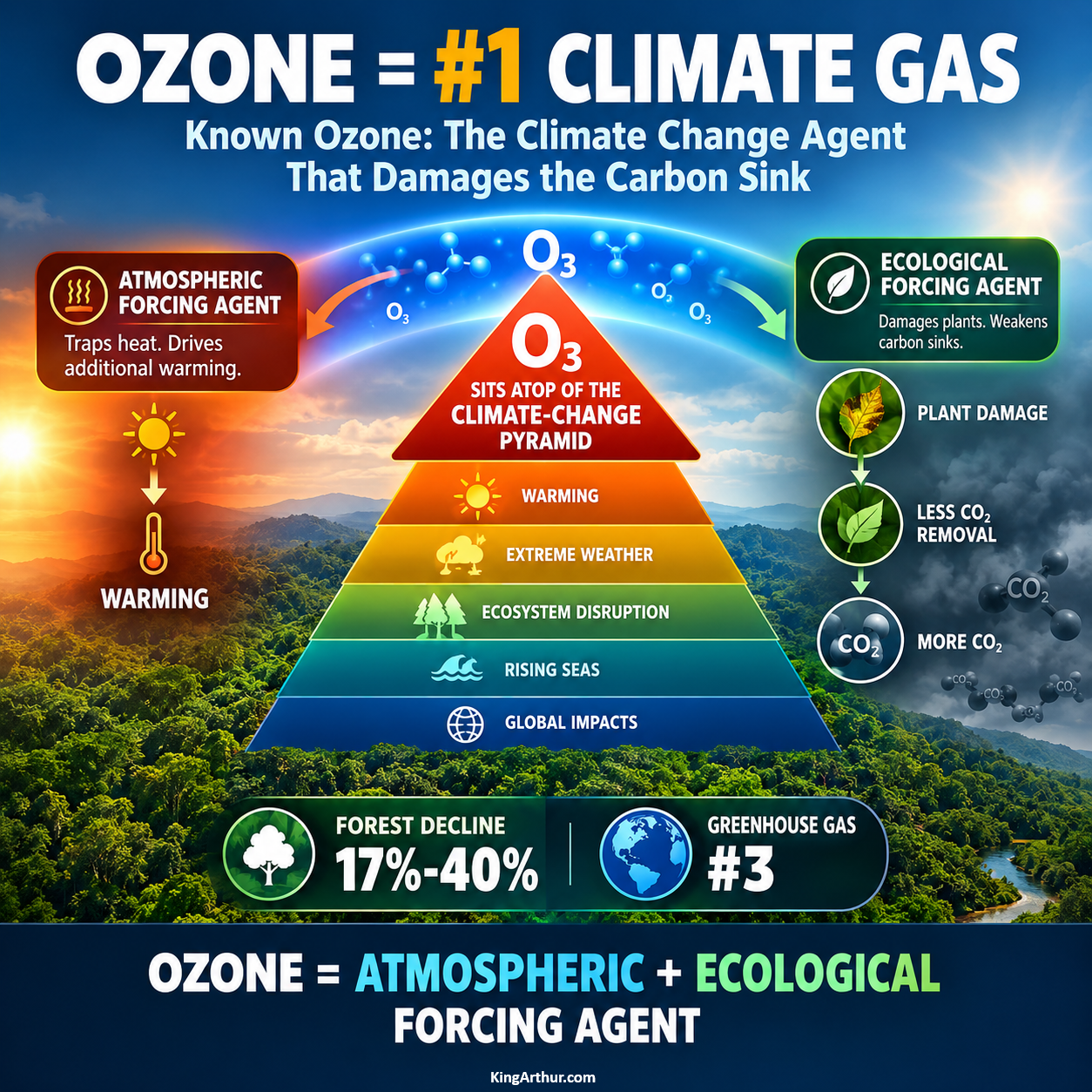
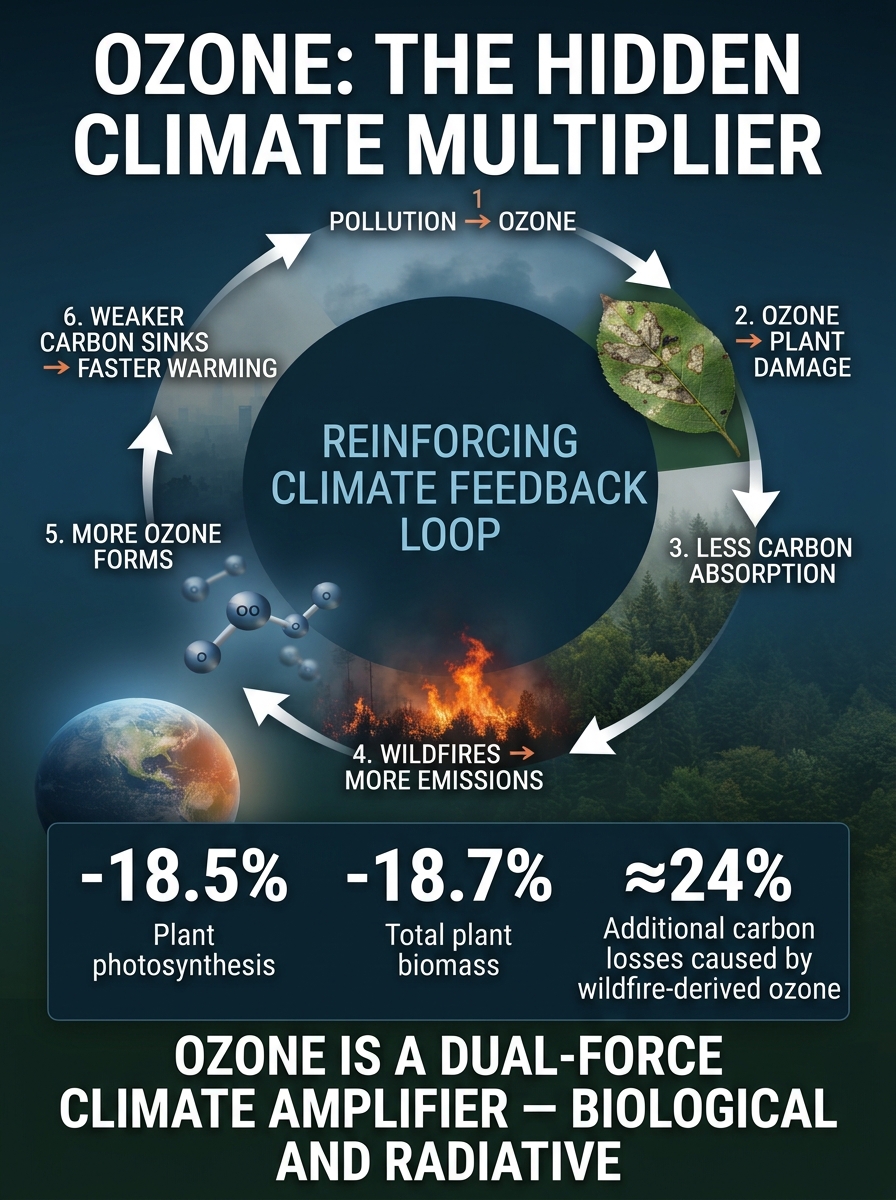
OZONE–CARBON SINK FEEDBACK: tropospheric ozone → plant injury + reduced photosynthesis and, in sensitive vegetation, altered stomatal function → reduced terrestrial carbon uptake relative to a healthier-vegetation baseline → greater atmospheric CO₂ retention → increased greenhouse forcing → additional warming → further vegetation stress and possible carbon-sink degradation under favorable conditions ↺
ATMOSPHERIC CIRCULATION, JET STREAM, AND EXTREME WEATHER NETWORK
JET-STREAM COUPLING: Arctic amplification + changes in tropical heating + stratospheric conditions + internal variability → changes in meridional temperature gradients and atmospheric circulation → changes in polar jet-stream structure + Rossby-wave propagation + storm tracks → possible changes in jet-stream waviness, progression, and blocking → persistent weather patterns in susceptible configurations → heat extremes + drought + heavy precipitation + stalled atmospheric rivers → hydroclimatic whiplash → agricultural + infrastructure + ecosystem + public-health stress → increased vegetation stress and wildfire risk → further land–atmosphere changes ↺. The effects vary by region, season, and circulation regime.
SOIL MOISTURE–EVAPOTRANSPIRATION–HEAT FEEDBACK: warming → soil drying where precipitation and water supply are insufficient → reduced soil moisture availability → reduced evaporation + plant transpiration → reduced evaporative cooling + increased sensible heat flux → higher land-surface and near-surface air temperatures → increased atmospheric moisture demand → further soil drying ↺ → increased risk of heat extremes + drought + vegetation stress + wildfire.
LAND–ATMOSPHERE DROUGHT COUPLING: prolonged heat + reduced precipitation → declining soil moisture → reduced evapotranspiration → increased near-surface sensible heating + atmospheric moisture demand → boundary-layer changes + reduced local moisture recycling → greater heat and drought stress where circulation and moisture supply reinforce the response ↺
VEGETATION–ROUGHNESS–CIRCULATION FEEDBACK: forest loss + canopy degradation → changes in surface roughness + albedo + energy and water exchange → changes in boundary-layer mixing + atmospheric stability + cloud formation + rainfall → additional heat and moisture stress where the response is reinforcing → further vegetation degradation ↺
WILDFIRE–CLOUD FEEDBACK: wildfire smoke + vegetation loss → altered aerosol loading + surface energy balance + moisture flux → changes in cloud formation + persistence → altered shortwave reflection + longwave trapping → regional warming or cooling depending on aerosol and cloud properties → precipitation disruption in susceptible conditions → greater drought and fire risk where conditions reinforce the cycle ↺
EXTREME PRECIPITATION–SOIL MOISTURE CROSS-LINK: warming → changes in atmospheric moisture capacity and precipitation extremes → intense rainfall and flooding in some regions + longer dry intervals in others → changes in soil-water storage, runoff, erosion, vegetation condition, and groundwater recharge → altered drought and flood vulnerability → further land–atmosphere and ecosystem impacts.
WILDFIRE, LIGHTNING, AND ATMOSPHERIC CHEMISTRY NETWORK
WILDFIRE–OZONE FEEDBACK: warming + drought → increased wildfire risk under conducive weather and fuel conditions → vegetation loss + smoke + atmospheric emissions → increased ozone precursors → tropospheric ozone formation under suitable chemical conditions → vegetation damage → reduced carbon uptake and changes in evapotranspiration → greater warming and drying relative to a healthier-ecosystem baseline → increased wildfire risk ↺
LIGHTNING–OZONE FEEDBACK: warming + changes in convective instability → changes in lightning frequency and intensity → lightning-generated NOₓ → increased tropospheric ozone formation under suitable chemical conditions → vegetation damage → changes in carbon uptake and evapotranspiration → further ecosystem and climate stress → changes in future lightning potential. The pathway depends on storm type, moisture, background chemistry, and atmospheric transport.
LIGHTNING–WILDFIRE FEEDBACK: warming + drying → increased fuel flammability in susceptible ecosystems → lightning ignition → wildfire → vegetation loss + carbon emissions + changes in surface energy balance → additional warming and drying where net effects reinforce the initial conditions → greater wildfire risk ↺
AEROSOL–FIRE–PRECIPITATION COUPLING: wildfire emissions → changes in aerosol properties + cloud microphysics + atmospheric heating → changes in cloud development + precipitation efficiency + regional circulation → altered drought and fuel-moisture conditions → further wildfire risk under favorable conditions ↺
WILDFIRE AEROSOL–SNOW/ICE CROSS-LINK: wildfire smoke → aerosols in the atmosphere → changes in incoming solar radiation + cloud microphysics, with possible short-term cooling or warming depending on conditions. Separately, black-carbon deposition on snow and ice → reduced albedo → increased solar absorption → accelerated melting. Atmospheric smoke effects and deposited soot effects must be distinguished.
LAND CARBON, FORESTS, VEGETATION, AND ECOSYSTEM FEEDBACK NETWORK
CARBON-SINK DEGRADATION NETWORK: tropospheric ozone + warming + drought + wildfire + land-use change → reduced vegetation productivity and photosynthesis + increased carbon release in affected ecosystems → declining terrestrial carbon uptake relative to a healthier-ecosystem baseline → more atmospheric CO₂ retained → increased greenhouse forcing → additional warming → stronger ecosystem stress → further carbon-sink degradation where the response reinforces the initial change ↺
LAND CARBON SINK–ATMOSPHERIC CO₂ FEEDBACK: heat + drought + ozone damage + wildfire + ecosystem degradation → reduced photosynthesis and carbon storage, plus increased respiration or combustion emissions in some conditions → atmospheric CO₂ accumulation relative to a healthier-ecosystem baseline → increased radiative forcing → additional warming → greater ecosystem stress ↺. Land ecosystems can continue to absorb carbon where conditions remain favorable.
BOREAL FOREST TIPPING ELEMENT: warming + drought + wildfire + ozone damage + insect and disease stress → forest degradation and possible persistent forest transition → reduced carbon uptake + increased carbon release in affected systems → changes in albedo + snow exposure + evapotranspiration + surface roughness → regional cooling through snow exposure in some seasons, but potential warming through carbon loss and hydrological changes → further forest stress where net effects reinforce degradation ↺
AMAZON RAINFOREST TIPPING ELEMENT: warming + drought + fire + ozone damage → reduced plant function + photosynthesis + evapotranspiration in susceptible areas → reduced rainfall recycling and changes in cloud formation → increased drought stress where moisture recycling weakens → forest degradation + possible persistent forest loss → reduced carbon storage + carbon release → additional warming → further forest stress ↺. The extent of this pathway depends on regional rainfall, land use, fire, ecosystem resilience, and future climate.
VEGETATION–MOISTURE–CLOUD FEEDBACK: vegetation damage + forest loss → changes in transpiration + moisture recycling → changes in atmospheric humidity + cloud formation + rainfall → increased regional heat and drought stress where moisture recycling weakens → additional vegetation damage ↺. In other settings, cloud and rainfall responses may differ.
VEGETATION–OZONE–FIRE COUPLING: ozone damage + drought → reduced plant productivity and altered stomatal function → reduced carbon uptake + changes in evapotranspiration → greater atmospheric CO₂ retention and reduced evaporative cooling under susceptible conditions → increased heat and drought stress → greater wildfire susceptibility → further vegetation loss + carbon emissions ↺
OZONE–SOIL MOISTURE–HEAT EXTREMES CROSS-LINK: ozone exposure → plant injury + altered stomatal conductance and transpiration → changes in soil-water use and surface energy partitioning → potentially reduced evaporative cooling + increased sensible heating → greater risk of local heat extremes under susceptible conditions → additional plant stress. Reduced transpiration can conserve soil water in some circumstances, so the net soil-moisture response depends on species, rooting depth, soil, and weather.
PERMAFROST, WETLANDS, AND METHANE NETWORK
PERMAFROST TIPPING ELEMENT: Arctic warming → permafrost thaw → exposure of previously frozen organic matter to decomposition → release of CO₂ + CH₄ under suitable conditions → additional greenhouse forcing → further warming → additional permafrost thaw ↺
PERMAFROST HYDROLOGY–THERMOKARST FEEDBACK: Arctic warming → permafrost thaw + ground-ice loss → ground subsidence + thermokarst formation → altered drainage + wetland formation or drying → changes in soil moisture, oxygen availability, and anaerobic conditions → altered soil-carbon decomposition + CO₂ and CH₄ emissions → additional greenhouse forcing → further permafrost thaw ↺. Thaw can make some landscapes wetter and others drier.
WETLAND–METHANE FEEDBACK: warming + altered precipitation + permafrost thaw → changes in wetland extent + water-table depth + anaerobic conditions → changes in microbial methane production and emissions → changes in atmospheric CH₄ → altered greenhouse forcing → further warming → additional wetland and permafrost changes ↺. Regional drying can reduce methane emissions while increasing CO₂ emissions from drained organic soils.
PERMAFROST–FIRE–CARBON FEEDBACK: Arctic + boreal warming → drying vegetation + increased fire susceptibility in some landscapes → wildfire → combustion of vegetation + exposed soil organic carbon → reduced surface insulation + altered ground thermal properties → deeper seasonal thaw + additional carbon release → further warming and ecosystem stress ↺
COUNTERACTING AND STABILIZING CLIMATE RESPONSES
PLANCK RESPONSE: surface and atmospheric warming → increased outgoing longwave infrared radiation → greater energy loss to space → a stabilizing negative feedback that opposes the initial warming, without necessarily offsetting the full forcing from increased greenhouse-gas concentrations.
CONDITIONAL LOW-CLOUD COUNTERFEEDBACK: changes in circulation + atmospheric stability + moisture + aerosols → increased low-level cloud cover in some regions or seasons → increased reflection of incoming sunlight → reduced local or regional solar energy absorption. The net effect depends on the cloud’s longwave trapping, altitude, thickness, location, and season.
SNOWFALL AND ICE-ACCUMULATION COUNTEREFFECT: increased atmospheric moisture in some cold regions → increased snowfall where temperatures and precipitation conditions permit → temporary increases in snow accumulation or glacier and ice-sheet mass → partial offset of surface-melt losses. The net mass balance still depends on melt, rain-on-snow, and ice discharge.
AEROSOL COOLING COUNTEREFFECT: certain anthropogenic and volcanic aerosols → scattering or reflection of sunlight + possible cloud-brightening effects → reduced solar energy reaching the surface → temporary cooling that partially offsets greenhouse warming. The effect varies with aerosol composition, altitude, location, and cloud interactions.
CONTINUING TERRESTRIAL AND OCEAN CARBON UPTAKE: plant growth + terrestrial ecosystem recovery + ocean carbon uptake → removal of some atmospheric CO₂ → partial moderation of greenhouse-gas accumulation. Uptake depends on ecosystem health, nutrient and water availability, ocean chemistry, temperature, and circulation; neither terrestrial nor oceanic uptake should be assumed to cease universally.
COUNTERACTING FEEDBACKS ARE NOT PROOF OF CLIMATE STABILIZATION: negative feedbacks and regional cooling effects operate alongside reinforcing feedbacks and external forcing. The net climate trajectory depends on their relative magnitude, timing, geographical distribution, and interaction with human emissions.
EXTERNAL FORCING, FEEDBACK, TIPPING ELEMENTS, AND IMPACTS
EXTERNAL AND ANTHROPOGENIC FORCING: greenhouse-gas emissions → increased absorption of outgoing infrared radiation → planetary energy imbalance → atmospheric + land + ocean warming. Additional forcings include anthropogenic aerosols, land-use change, and natural solar and volcanic variability, each with distinct effects on the climate system.
REINFORCING FEEDBACKS: warming or another initial disturbance → changes in water vapor, cloud radiative effects, albedo, ocean circulation, soil moisture, or carbon storage → additional change in the original direction where the net feedback is positive ↺
COUNTERACTING FEEDBACKS: warming or another disturbance → changes that oppose the original disturbance, including increased outgoing infrared radiation and certain regional cloud, aerosol, or snow responses → partial stabilization or redistribution of energy.
TIPPING ELEMENTS: Greenland and Antarctic ice sheets + Arctic sea ice + AMOC + permafrost carbon stores + boreal forests + Amazon rainforest → components that may undergo substantial persistent change if particular thresholds are crossed. Thresholds, reversibility, confidence, and timescales differ by system; not every feedback is a tipping point.
CLIMATE CONSEQUENCES AND IMPACTS: persistent warming + changes in circulation, hydrology, cryosphere, and ecosystems → sea-level rise + extreme heat + drought + heavy precipitation + wildfire + agricultural stress + ecosystem disruption + infrastructure damage + water insecurity → economic + migration + public-health + political stress.
SOCIETAL–ENVIRONMENTAL CROSS-LINK: climate-related food + water + infrastructure + economic stress → changes in migration, public policy, land use, and resource demand → potential changes in emissions, ecosystem protection, and vulnerability → further environmental and societal consequences. These effects depend on human choices, institutions, adaptation, and resilience; they are not an inevitable one-way cascade.
INTEGRATED DOMINO EFFECT AND SYSTEM-WIDE COUPLING
ARCTIC WARMING → polar amplification → changes in equator-to-pole temperature gradients and atmospheric circulation → changes in weather persistence and regional extremes → drought + wildfire + vegetation stress in susceptible regions → altered carbon sinks + evapotranspiration → changes in clouds + atmospheric chemistry → changes in planetary energy balance → further warming where net effects reinforce the initial change ↺
OCEAN WARMING → OHC ↑ → changes in surface temperature + vertical heat redistribution + stratification + air–sea heat exchange → marine heatwaves + glacier-front melting + altered circulation → potential AMOC stress + changes in clouds and ocean carbon storage → changes in regional albedo + absorbed solar energy + atmospheric CO₂ → further ocean and atmospheric changes where net effects reinforce the initial disturbance ↺
VEGETATION DAMAGE → ozone + drought + wildfire + land-use change → photosynthesis and carbon uptake ↓ in affected ecosystems + changes in evapotranspiration → atmospheric CO₂ retention ↑ relative to a healthier-ecosystem baseline + changes in atmospheric moisture → warming + cloud changes → drought and fire risk ↑ in susceptible regions → further vegetation damage ↺
ICE LOSS → albedo changes + freshwater discharge ↑ + sea level ↑ → regional energy redistribution + ocean stratification and circulation changes + coastal ecosystem stress → additional cryospheric, hydrological, and ecological changes where feedbacks reinforce the initial disturbance ↺
ATMOSPHERIC CHEMISTRY–ECOSYSTEM COUPLING: greenhouse gases + ozone precursors + aerosols + wildfire emissions → changes in radiative forcing + plant function + cloud microphysics → altered carbon sinks + hydrological processes + atmospheric circulation → additional climate-system changes. The net response depends on chemical conditions, aerosol properties, cloud type, and ecosystem sensitivity.
GLOBAL CARBON–ENERGY COUPLING: terrestrial carbon-sink changes + ocean carbon uptake changes → changes in atmospheric greenhouse-gas concentrations relative to a baseline → changes in radiative forcing → further warming → additional ecosystem + ocean stress → further changes in carbon uptake and storage where net effects reinforce the initial change ↺
INTEGRATED DOMINO EFFECT: climate warming → feedback activation or modification → feedback coupling → nonlinear amplification or counteraction → possible threshold approach or crossing → potential tipping-element destabilization → cascading Earth-system changes → food + water + infrastructure + economic + migration + political stress → additional environmental and societal vulnerability.
OVERARCHING DYNAMICAL SEQUENCE
ENERGY IMBALANCE → HEAT REDISTRIBUTION → FEEDBACK ACTIVATION → FEEDBACK COUPLING → AMPLIFICATION OR COUNTERACTION → THRESHOLD APPROACH → POSSIBLE THRESHOLD CROSSING → POTENTIAL TIPPING-ELEMENT DESTABILIZATION → CASCADING SYSTEM RESPONSE → FURTHER CHANGES IN ENERGY, WATER, AND CARBON FLOWS ↺
TIMESCALE CLASSIFICATION
FAST ATMOSPHERIC PROCESSES: cloud formation and changes, water-vapor responses, aerosol–radiation interactions, atmospheric chemistry, lightning, storms, and many heat extremes → response over days to years, depending on the mechanism.
INTERMEDIATE OCEAN–LAND–ECOSYSTEM PROCESSES: upper-ocean heat redistribution, marine heatwaves, soil-moisture feedbacks, regional circulation changes, forest stress, wildfire recovery, and changes in carbon uptake → response over seasons to decades or longer.
SLOW AND THRESHOLD-SENSITIVE PROCESSES: deep-ocean adjustment, large ice-sheet retreat, long-term sea-level rise, permafrost carbon release, and persistent forest or ecosystem transitions → response over decades to centuries or longer, with some changes potentially persisting for millennia.
CROSS-SCALE COUPLING: fast atmospheric responses → changes in intermediate ocean, land, and ecosystem processes → potential activation of slow or threshold-sensitive responses → long-lasting changes that can influence the atmosphere and ocean well before the slow component has fully adjusted.
Interpretive principle: A reinforcing pathway indicates the potential for amplification, not proof of inevitability. A tipping element requires evidence of threshold-sensitive behavior, and a coupled network must be assessed link by link. The central systems question is how energy, water, and carbon move through the Earth system—and whether their interactions strengthen, weaken, or persist as conditions change.
1. EXTERNAL FORCING AND PLANETARY ENERGY IMBALANCE
Anthropogenic greenhouse-gas emissions → increased atmospheric absorption of outgoing longwave radiation → increased planetary energy imbalance → accumulation of excess energy in the Earth system → ocean heat uptake, atmospheric warming, land warming, and cryosphere warming → changes in the distribution and movement of energy, moisture, and carbon throughout the climate system.
Anthropogenic aerosols → changes in incoming solar radiation and cloud properties; the net effect varies by aerosol type, altitude, location, and atmospheric conditions.
Land-use change and deforestation → changes in surface albedo, evapotranspiration, roughness, carbon storage, and regional circulation.
Solar and volcanic variability → natural changes in incoming energy and atmospheric composition.
Ocean–atmosphere variability, including ENSO → redistribution of heat and changes in global circulation superimposed on the long-term warming trend.
Forcing → changes in climate-system state → activation or modification of feedbacks → possible amplification, stabilization, or threshold crossing → regional and global impacts.
2. POLAR AMPLIFICATION, CRYOSPHERE, AND ICE-SHEET FEEDBACKS
Polar amplification → weakened equator-to-pole temperature gradients → reduced thermal contrast → changes in atmospheric circulation, storm tracks, and jet-stream behavior → accelerated Arctic warming and Greenland ice loss.
ICE–ALBEDO FEEDBACK
Sea ice and snow loss → darker ocean or land surface exposed → reduced solar reflectivity → increased solar energy absorption during sunlit periods → additional warming → further sea ice and snow loss ↻
MELT–ELEVATION FEEDBACK
Ice-sheet surface melting → reduced ice-sheet elevation → exposure to warmer air at lower elevations → increased surface melt → further elevation loss ↻
REGIONAL LAPSE-RATE FEEDBACK
Arctic surface warming and changes in vertical atmospheric temperature structure → altered lapse rate → greater near-surface warming in some polar conditions → additional surface melt and sea-ice loss.
The lapse-rate feedback varies with latitude, season, atmospheric stability, moisture, and vertical temperature structure. It should not be treated as a uniform global amplification mechanism.
SNOW–ALBEDO FEEDBACK
Earlier seasonal snowmelt or reduced snow cover → darker ground and vegetation exposed → increased absorption of sunlight → regional warming → further snow loss ↻
WILDFIRE–SNOW AND ICE-ALBEDO CROSS-LINK
Wildfire → soot and black-carbon deposition on snow and ice → reduced reflectivity → increased solar absorption → accelerated snowmelt and glacier melt → greater exposure of darker surfaces → further absorption.
The strength of this pathway depends on deposition, snow conditions, sunlight, and the amount and timing of subsequent snowfall.
ARCTIC OCEAN HEAT–WINTER SEA-ICE FEEDBACK
Ocean heat storage and transport into Arctic waters → delayed autumn freeze-up and reduced winter ice formation → thinner or less extensive sea ice → increased ocean–atmosphere heat and moisture exchange during cold seasons → changes in lower-atmospheric stability and circulation → further changes in sea-ice growth and persistence.
The ocean can continue releasing stored heat after seasonal solar input declines, influencing the timing and thickness of sea ice.
GREENLAND AND GLACIER MELT–OCEAN FEEDBACK
Atmospheric warming and ocean heat reaching glacier fronts → increased surface melt and/or submarine melting → glacier retreat and ice discharge → freshwater input to adjacent seas → changes in local stratification, circulation, and ocean heat distribution → potential changes in further glacier-front melting.
The magnitude and direction of ocean feedbacks depend on local bathymetry, currents, freshwater distribution, and glacier geometry.
Greenland and Antarctic ice loss → global mean sea-level rise → increased coastal flooding, erosion, and saltwater intrusion → damage or displacement of wetlands, mangroves, marshes, and other coastal ecosystems → potential loss of coastal carbon storage and sequestration → release of some stored carbon or reduced future uptake → additional atmospheric greenhouse-gas forcing.
Coastal ecosystems can also retain or accumulate carbon under favorable conditions; outcomes vary by ecosystem, sediment supply, inundation, and adaptation.
The pace and extent depend on ice geometry, ocean circulation, bedrock topography, and the evolution of buttressing. Threshold crossing can create long-lived ice loss even if later warming slows.
GEOPHYSICAL CONSEQUENCE: MASS REDISTRIBUTION AND EARTH ROTATION
Ice-sheet mass loss → redistribution of water from land to ocean → changes in Earth’s mass distribution and rotational properties → small changes in length of day and polar motion.
Groundwater depletion and redistribution → additional changes in Earth’s mass distribution and rotation.
These are geophysical consequences of mass redistribution, not independent climate feedbacks. Their climatic significance should not be conflated with the primary mechanisms driving ice loss.
3. OCEAN HEAT, STRATIFICATION, CARBON UPTAKE, AND AMOC
OCEAN HEAT-CONTENT FEEDBACK NETWORK
Planetary energy imbalance → increased ocean heat content (OHC) → ocean warming and changes in vertical temperature structure → changes in stratification, mixing, circulation, and air–sea heat exchange → altered heat storage and redistribution → changes in regional sea-surface temperatures, atmospheric conditions, and cryosphere melt.
Four related but distinct variables must be tracked:
Ocean heat content → the amount of heat stored throughout the ocean.
Sea-surface temperature → the temperature of the ocean surface, which influences air–sea exchanges, evaporation, convection, and regional weather.
Vertical mixing and stratification → the redistribution of heat between surface and deeper water.
Ocean–atmosphere heat exchange → the transfer of heat between ocean and atmosphere, which can warm or cool the lower atmosphere depending on local conditions.
These variables interact but are not interchangeable. Rising OHC does not imply that every region’s surface temperature rises at the same rate or that every ocean layer warms uniformly.
OCEAN STRATIFICATION–MARINE HEATWAVE FEEDBACK
Surface ocean warming and freshwater input → stronger density stratification in some regions → reduced vertical mixing → less subsurface heat ventilation and altered nutrient transport → increased persistence of marine heatwaves under favorable conditions → ecosystem stress and changes in ocean–atmosphere heat exchange → further regional impacts.
Stronger stratification can also change the depth and timing of heat storage; the effects on surface temperatures vary by location and circulation regime.
NORTH ATLANTIC STRATIFICATION–GLACIER-FRONT HEAT NETWORK
Greenland meltwater and other freshwater inputs → changes in North Atlantic density structure and stratification → altered ocean mixing and current pathways → changes in the delivery of relatively warm water to some glacier fronts → changes in submarine melting and ice discharge → additional freshwater input.
The pathway is spatially dependent and should not be interpreted as a uniform increase in heat delivery to every glacier.
OCEAN CARBON-SINK–CIRCULATION FEEDBACK
Ocean warming and changes in circulation → changes in CO₂ solubility, surface-to-deep-ocean exchange, and biological carbon transport → possible weakening or redistribution of ocean carbon uptake → greater atmospheric CO₂ retention relative to a stronger-sink scenario → additional warming → further changes in ocean carbon uptake.
The ocean remains a major carbon sink. Its future uptake depends on temperature, chemistry, circulation, biological processes, and the rate of human emissions.
AMOC WEAKENING AND FRESHWATER FEEDBACK
Greenland meltwater and changes in precipitation and evaporation → changes in freshwater distribution and North Atlantic density → altered deep-water formation and overturning circulation → potential weakening of the Atlantic Meridional Overturning Circulation (AMOC) → changes in northward ocean heat transport and regional ocean–atmosphere exchanges → changes in Northern Hemisphere temperature patterns, rainfall, and atmospheric circulation → further changes in freshwater distribution and ocean conditions.
AMOC behavior also depends on winds, ocean mixing, water-mass formation, background circulation, and atmospheric heat exchange. Weakening is not synonymous with imminent or inevitable collapse.
AMOC changes → redistribution of North Atlantic and hemispheric heat → changes in atmospheric temperature gradients and ocean–atmosphere heat exchange → potential shifts in storm tracks, regional precipitation, and circulation patterns → altered Greenland surface conditions, European and North Atlantic weather, and Arctic sea-ice conditions → additional ocean and cryosphere responses.
The atmospheric response is complex and regionally dependent; it should not be reduced to a single predictable jet-stream outcome.
ENSO and other tropical ocean variability → changes in tropical sea-surface temperatures and convection → shifts in atmospheric heating and pressure patterns → changes in planetary waves, jet streams, monsoons, and storm tracks → changes in regional heat, rainfall, drought, and wildfire conditions → changes in land and ocean energy, water, and carbon exchanges.
Long-term greenhouse warming changes the background conditions on which natural variability operates. Individual ENSO events are not themselves proof of a climate tipping point.
4. LOW-LEVEL CLOUDS, WATER VAPOR, AND RADIATION
ATMOSPHERIC WATER-VAPOR GREENHOUSE FEEDBACK
Warming → increased atmospheric moisture where water is available → increased absorption of outgoing longwave radiation → additional warming → greater atmospheric moisture capacity and, in many regions, increased water vapor ↻
Actual water-vapor changes depend on circulation, relative humidity, and moisture availability. Water vapor is primarily a feedback on warming, while long-lived greenhouse gases are major external drivers.
CLOUD SHORTWAVE–LONGWAVE RADIATION BALANCE
Changes in cloud cover, altitude, thickness, droplet properties, and geographic distribution → changes in reflected incoming shortwave sunlight and absorbed or emitted outgoing longwave radiation → changes in the net cloud radiative effect → changes in planetary energy balance and regional temperatures.
Low clouds often exert a strong cooling effect by reflecting sunlight, while high clouds can exert substantial warming effects by trapping outgoing infrared radiation. The net effect of cloud changes depends on cloud type, location, altitude, optical thickness, season, and underlying surface.
LOW-LEVEL CLOUD–OCEAN HEAT FEEDBACK
Ocean warming and changes in sea-surface temperature, atmospheric stability, moisture, circulation, and aerosols → changes in low-level cloud formation and persistence → changes in reflected sunlight → changes in ocean heat absorption → changes in sea-surface temperature and atmospheric stability → further changes in low-level clouds.
Declining low-level cloud cover in locations and seasons where clouds have a net cooling effect → increased solar energy reaching the surface → enhanced surface and ocean warming → sea-ice loss and reduced albedo → Arctic amplification → changes in atmospheric stability, moisture, and circulation → further changes in cloud formation.
This is conditional rather than universal: low-level clouds can also produce warming through longwave trapping, especially during polar night and cold seasons. A claim that cloud decline will double a particular warming outcome requires explicit model, observational, and scenario support.
CLOUD–OCEAN HEAT CONTENT–ALBEDO COUPLING
Changes in cloud cover → changes in solar radiation reaching the ocean → changes in ocean heat uptake and surface temperature → changes in atmospheric stability and moisture → further cloud changes.
Sea-ice loss and changes in surface albedo → additional changes in absorbed sunlight → changes in ocean heat storage and release → changes in cloud formation and atmospheric radiation.
Together, these pathways connect cloud radiative effects, ocean heat content, and cryosphere albedo without treating them as one interchangeable mechanism.
AEROSOL–CLOUD–RADIATION FEEDBACK
Aerosol concentration and composition → changes in cloud condensation nuclei, droplet number, cloud brightness, lifetime, and precipitation → changes in reflected sunlight and cloud persistence → changes in surface energy balance and atmospheric circulation.
Aerosols can cool or warm the climate system directly or indirectly. The magnitude and direction depend on aerosol composition, altitude, location, and interactions with clouds.
LOW-LEVEL CLOUD–OZONE COUPLING
Tropospheric ozone and its precursors → atmospheric chemical changes and vegetation damage → changes in plant transpiration, surface moisture, and regional atmospheric conditions → changes in boundary-layer development and cloud formation → changes in solar radiation reaching vegetation and land → further changes in ecosystem function and atmospheric chemistry.
The direction and strength of this coupling depend on meteorology, land cover, emissions, and the specific cloud and chemical processes involved.
5. ATMOSPHERIC CIRCULATION, MOISTURE, AND EXTREME WEATHER
JET-STREAM AND STORM-TRACK RESPONSE
Polar amplification and changes in meridional temperature gradients → changes in atmospheric thermal structure and circulation → possible changes in jet-stream position, waviness, blocking, and storm tracks → altered persistence or movement of heat, cold, precipitation, and drought patterns → regional impacts on ecosystems, infrastructure, and water resources.
The jet stream is governed by multiple interacting factors, including tropical heating, stratospheric conditions, internal variability, and the evolving temperature gradients. The response is not uniform across all seasons or regions.
SOIL MOISTURE–EVAPOTRANSPIRATION–HEAT FEEDBACK
Heat and drought → declining soil moisture → reduced evapotranspiration and evaporative cooling → more surface energy available for sensible heating → higher land-surface and near-surface air temperatures → increased evaporative demand → further soil-moisture depletion ↻
Where water remains available, evapotranspiration can continue to cool the surface. The strength of this feedback depends on vegetation, soil type, rooting depth, precipitation, and atmospheric demand.
EXTREME PRECIPITATION–CRYOSPHERE CROSS-LINK
Warming → increased atmospheric moisture capacity → potential increases in heavy precipitation where circulation and moisture supply support it → changes in snow accumulation, rain-on-snow events, glacier mass balance, and runoff → changes in flood risk, ice dynamics, and regional water availability.
In cold regions, increased snowfall can temporarily add mass to glaciers and ice sheets, partially offsetting surface-melt losses. The net result depends on the balance between accumulation, melt, and ice discharge.
VEGETATION–ROUGHNESS–CIRCULATION FEEDBACK
Deforestation, vegetation loss, or ecosystem shifts → changes in surface roughness, albedo, rooting depth, and evapotranspiration → changes in boundary-layer mixing, moisture recycling, and regional circulation → changes in rainfall, drought, and vegetation stress → further ecosystem changes.
This pathway can amplify drying in some regions while producing different or even counteracting effects elsewhere.
6. OZONE, VEGETATION, SOIL MOISTURE, AND CARBON-SINK DECLINE
TROPOSPHERIC OZONE–VEGETATION FEEDBACK
Elevated ground-level ozone → oxidative damage to leaves and plant tissues → reduced photosynthesis, stomatal function, growth, and productivity in sensitive vegetation → reduced carbon uptake and changes in ecosystem water use → increased atmospheric CO₂ relative to a healthier-vegetation scenario → additional warming.
Ozone damage varies by species, exposure, season, and ecosystem conditions. It is a climate multiplier through its effects on vegetation and atmospheric chemistry, but its overall radiative and ecological effects must be assessed separately.
OZONE–SOIL MOISTURE–HEAT EXTREMES CROSS-LINK
Ozone exposure → vegetation injury and altered stomatal conductance → reduced or changed transpiration → changes in soil moisture and surface energy partitioning → reduced evaporative cooling in affected conditions → increased risk of local heat extremes → additional plant stress and potentially greater ozone damage.
The sign of the soil-moisture response is not universal: reduced transpiration may conserve soil water in some settings, while vegetation damage can also impair ecosystem functioning and regional moisture recycling. The net effect must be evaluated regionally.
LAND CARBON-SINK–ATMOSPHERIC CO₂ FEEDBACK
Heat, drought, ozone exposure, wildfire, deforestation, and ecosystem degradation → reduced photosynthesis or increased respiration and combustion → weakened terrestrial carbon uptake or release of stored carbon → increased atmospheric CO₂ relative to a healthier-ecosystem baseline → increased radiative forcing → additional warming → further ecosystem stress.
Land ecosystems can continue absorbing carbon where conditions remain favorable. Carbon-sink failure is a risk pathway, not a universal or complete cessation of land uptake.
7. WILDFIRE, AEROSOLS, AND ECOSYSTEM FEEDBACKS
HEAT–DROUGHT–WILDFIRE FEEDBACK
Higher temperatures and prolonged drought → lower fuel moisture and greater vegetation stress → increased fire danger under conducive weather and ignition conditions → wildfire and ecosystem damage → carbon emissions and changes in land cover → additional warming and altered hydrology → increased fire danger.
Actual fire activity also depends on ignition sources, fuel availability, land management, wind, and suppression.
WILDFIRE–CARBON–SOIL FEEDBACK
Wildfire → release of carbon stored in vegetation and soils → reduced living biomass and potential loss of soil carbon → reduced future carbon uptake and, in some cases, greater soil erosion → altered vegetation recovery and hydrology → increased vulnerability to future fire and ecosystem degradation.
Some ecosystems recover or regenerate after fire; the risk of persistent carbon loss increases where fires are severe or recurrent, soils are damaged, or climatic conditions impede recovery.
WILDFIRE AEROSOL–CLOUD–SNOW/ICE CROSS-LINK
Wildfire emissions → aerosol loading and changes in atmospheric chemistry → changes in cloud formation and radiative properties → possible changes in precipitation and regional radiation.
At the same time:
Wildfire emissions → black-carbon deposition on snow and ice → reduced albedo → increased solar absorption → accelerated melt.
Smoke aerosols may reduce sunlight reaching the surface and produce short-term cooling in some circumstances, while black carbon deposited on snow and ice can promote warming. These effects must be distinguished by location, altitude, particle type, and timescale.
8. FORESTS, PERMAFROST, AND HYDROLOGICAL TIPPING ELEMENTS
BOREAL FOREST TIPPING ELEMENT
Warming, drought, insect outbreaks, and wildfire → boreal forest stress and mortality → changes in carbon storage, evapotranspiration, surface roughness, and regional hydrology → altered climate and fire conditions → additional forest stress.
BOREAL FOREST–SNOW–ALBEDO CROSS-LINK
Boreal forest loss → greater snow exposure during snow-covered seasons → increased surface reflectivity → potential regional cooling that can partially counteract greenhouse warming.
However, forest loss also reduces carbon storage, changes evapotranspiration and roughness, and can increase fire risk. The net climate effect depends on latitude, season, snow cover, forest type, and the balance between biogeophysical and carbon-cycle effects.
PERMAFROST THAW–HYDROLOGY–CARBON FEEDBACK
Warming → permafrost thaw → changes in ground stability, drainage, thermokarst, and soil moisture → decomposition of previously frozen organic matter → release of CO₂ and methane under suitable conditions → additional greenhouse warming → further thaw ↻
Permafrost thaw can produce both wetter and drier landscapes depending on terrain, ice content, drainage, and hydrological change. Methane production is especially dependent on anaerobic conditions.
PERMAFROST–FIRE–DEEPER THAW CROSS-LINK
Warming and drying → increased fire risk in susceptible permafrost landscapes → combustion of vegetation and insulating organic layers → deeper seasonal thaw and altered ground hydrology → greater exposure of frozen carbon to decomposition → greenhouse-gas emissions and vegetation changes → increased future vulnerability to fire and thaw.
The pathway is conditional on fire occurrence, ecosystem type, soil characteristics, and post-fire recovery.
WETLAND–METHANE FEEDBACK
Warming and hydrological change → shifts in wetland area, water table, and anaerobic conditions → changes in methane production and emissions → changes in atmospheric greenhouse forcing → additional warming → further changes in wetland hydrology.
Wetland responses can differ substantially: drainage may reduce methane emissions while increasing CO₂ emissions from soils, and some wetlands can remain or become important carbon sinks.
9. COUNTERACTING AND STABILIZING CLIMATE FEEDBACKS
These pathways do not negate the overall warming influence of human greenhouse-gas emissions. They identify processes that can reduce, redistribute, or temporarily counteract warming under particular conditions.
Earth’s surface and atmosphere warm → greater emission of outgoing longwave radiation → increased energy loss to space → a stabilizing response that opposes the initial warming.
This is a fundamental negative feedback in the climate system, although it does not eliminate the warming caused by increased greenhouse-gas concentrations.
CONDITIONAL CLOUD COUNTERFEEDBACK
Changes in circulation, stability, moisture, and aerosols → increases in low-cloud cover in some locations or seasons → greater reflection of incoming sunlight → reduced local or regional solar energy absorption.
This effect is conditional. Other cloud changes can increase warming, and the global net effect depends on cloud altitude, thickness, location, and shortwave–longwave balance.
INCREASED SNOWFALL AND ICE ACCUMULATION
In some cold regions, increased moisture availability → increased snowfall → greater seasonal snow accumulation or temporary glacier and ice-sheet mass gain → partial offset of surface-melt losses.
This pathway competes with rising temperatures, rain-on-snow events, surface melt, and ice discharge. It does not imply that ice-sheet mass balance will improve overall.
AEROSOL COOLING
Certain anthropogenic aerosols and volcanic aerosols → scattering or reflection of sunlight and, for some aerosol types, cloud-brightening effects → reduced incoming solar energy reaching the surface → temporary cooling that partially offsets greenhouse-gas warming.
The magnitude varies by aerosol composition and location. Reducing harmful air pollution remains important for health even where aerosols have a cooling effect.
CONTINUING TERRESTRIAL AND OCEAN CARBON UPTAKE
Vegetation growth and ocean carbon uptake → removal of some atmospheric CO₂ → partial moderation of atmospheric greenhouse-gas accumulation.
This uptake is finite and responds to temperature, water availability, nutrients, ocean chemistry, circulation, and ecosystem health. Warming can weaken sinks in some conditions without causing all sinks to fail.
COUNTERACTING FEEDBACKS ARE NOT EQUIVALENT TO CLIMATE STABILIZATION
The existence of negative feedbacks does not establish that the climate system will stabilize at a safe temperature. The net trajectory depends on the balance of forcing, reinforcing feedbacks, counteracting responses, carbon emissions, and the timing of possible thresholds.
Greenhouse-gas emissions, anthropogenic aerosols, land-use change, and natural solar or volcanic variability → changes in the system’s energy balance and background state.
REINFORCING AND COUNTERACTING FEEDBACKS
Changes in temperature, moisture, clouds, albedo, carbon uptake, ocean heat transport, and ecosystems → processes that amplify or oppose the initial perturbation.
COUPLED TIPPING ELEMENTS
Potentially threshold-sensitive components include Greenland and Antarctic ice sheets, Arctic sea ice, the AMOC, permafrost carbon stores, boreal forests, and some tropical forest systems.
Crossing a threshold may initiate persistent or self-reinforcing change. The evidence, threshold location, reversibility, and timescale differ for each element; not every feedback is a tipping point.
CONSEQUENCES AND IMPACTS
Sea-level rise, extreme heat, drought, heavy precipitation, wildfire, ecosystem disruption, agricultural losses, infrastructure damage, water insecurity, and socioeconomic instability → human and ecological consequences of changes in the physical climate system.
Impacts can feed back into the climate system through land-use change, emissions, ecosystem loss, and changes in resource use, but should not be confused with the physical feedback mechanism that initiated them.
11. INTEGRATED DOMINO EFFECT AND SYSTEM-WIDE COUPLING
The climate system does not operate as a collection of isolated feedbacks. Atmospheric, oceanic, cryospheric, hydrological, chemical, and biological processes interact through energy, moisture, and carbon exchanges. Changes in one component can alter the conditions governing several others.
INTEGRATED CLIMATE DOMINO SEQUENCE
Anthropogenic forcing → planetary energy imbalance → ocean and atmospheric warming → activation or strengthening of climate feedbacks → changes in clouds, water vapor, albedo, and ocean heat distribution → cryosphere loss and changes in ocean circulation → hydrological disruption and ecosystem stress → reduced or altered carbon uptake and increased emissions from some ecosystems → additional greenhouse forcing → further changes in energy distribution and feedback strength.
MAJOR COUPLING PATHWAYS
ATMOSPHERE → OCEAN → CRYOSPHERE
Atmospheric warming and changes in winds → altered ocean heat exchange and transport → glacier-front and ice-shelf melting → freshwater redistribution and sea-level rise → changes in ocean stratification and circulation → further changes in regional heat transport and ice loss.
ATMOSPHERE → VEGETATION → HYDROLOGY → CLOUDS
Ozone exposure, heat, drought, and fire → vegetation damage and changes in stomatal conductance → altered transpiration, soil moisture, and moisture recycling → changes in boundary-layer development and cloud formation → changes in radiation reaching land and vegetation → further ecosystem stress.
CRYOSPHERE → ALBEDO → OCEAN HEAT → ATMOSPHERE
Sea-ice and snow loss → reduced reflectivity → increased solar absorption → ocean heat accumulation and altered seasonal heat release → changes in atmospheric stability and moisture → changes in clouds and circulation → additional changes in sea ice and snow.
Changes in AMOC strength, ocean heat distribution, and sea-surface temperatures → changes in atmospheric temperature gradients and heat exchange → shifts in regional circulation and precipitation patterns → changes in Greenland melt, Arctic sea ice, ecosystem stress, and freshwater input → additional ocean and atmospheric changes.
ECOSYSTEMS → CARBON CYCLE → CLIMATE
Ozone damage, drought, wildfire, deforestation, and ecosystem shifts → reduced carbon uptake or release of stored carbon in affected systems → increased atmospheric greenhouse-gas concentrations relative to a healthier-ecosystem baseline → additional warming → further ecological stress.
PERMAFROST → FIRE → CARBON RELEASE
Warming → permafrost thaw and hydrological change → greater vulnerability to some types of wildfire → loss of insulating organic layers and deeper thaw → increased exposure of frozen carbon to decomposition → additional greenhouse-gas emissions → further warming.
These pathways can reinforce one another, but their strength and direction vary. A coupled network can also include stabilizing responses, delays, and competing effects. Coupling does not by itself prove that every component has crossed a tipping point or that the entire system must undergo an irreversible cascade.
12. OVERARCHING DYNAMICAL SEQUENCE
The general sequence connecting forcing to systemic change is:
External forcing → energy imbalance → climate-system response → feedback activation or modification → coupling among subsystems → amplification or counteraction → approach to a threshold → possible threshold crossing → persistent or cascading changes → ecological, physical, and socioeconomic consequences.
The sequence is a conceptual framework, not a claim that every climate process follows an identical or inevitable trajectory. Some pathways weaken, reverse, or stabilize; others may persist after the original forcing changes.
13. TIMESCALE CLASSIFICATION
Fast
Atmospheric and short-term processes
Cloud responses, water-vapor changes, aerosol–radiation interactions, atmospheric chemistry, heat extremes, storm development, and many circulation responses.
Typical response: days to years, depending on the mechanism.
Intermediate
Ocean, land, and ecosystem processes
Ocean heat redistribution, marine heatwaves, soil-moisture feedbacks, forest stress, carbon-sink changes, wildfire recovery, and changes in regional circulation.
Typical response: seasons to decades or longer; deep-ocean processes can take much longer.
Slow / threshold-sensitive
Ice sheets, permafrost, forests, and deep-ocean adjustment
Large ice-sheet retreat, long-term sea-level rise, deep-ocean heat redistribution, permafrost carbon release, and persistent ecosystem transitions.
Typical response: decades to centuries or longer, with some changes potentially persisting for millennia.
These timescales overlap. A fast atmospheric response can initiate a slower oceanic or ecological response, while slow changes in ice sheets and ocean circulation can alter atmospheric conditions much sooner than the full physical adjustment is completed.
14. HOW TO INTERPRET THE COMPLETE NETWORK
The integrated network is most useful when it preserves five distinctions:
Forcing versus feedback: greenhouse-gas emissions can drive warming, while water vapor, albedo, and ecosystem responses can modify the resulting change.
Feedback versus tipping element: a feedback can operate continuously without a threshold; a tipping element may undergo a substantial and persistent transition after a threshold is crossed.
Correlation versus causal coupling: simultaneous changes do not by themselves establish a causal connection. Individual links require observational, experimental, or modeling evidence.
Amplification versus inevitability: a reinforcing pathway can increase risk without proving that a particular outcome, collapse, or cascade is certain.
Global versus regional effects: a mechanism can amplify warming in one region or season while producing a counteracting effect elsewhere.
The central systems insight is that climate risk depends not only on the magnitude of global temperature rise, but also on how energy, water, and carbon move through a network of interacting processes—and on whether those interactions strengthen, weaken, or persist as conditions change.
Introduction: Faith, Science, and Political Accountability
I’m a fiscally conservative Republican economist who has been registered Republican since 1980. I also hold a degree in philosophy, with a concentration in morals and ethics, and have studied Christianity extensively, including reading the Bible in depth multiple times.
My family lineage can be traced to the Tribe of Judah and the family of Jesus. I’ve spent decades studying eschatology, particularly the biblical significance of my given name, Daniel, and the subject of the End Times. I’ve also conducted an extensive examination of the Book of Revelation.
Although I generally keep my religious beliefs separate from my scientific work, I’ve been analyzing Donald Trump’s conduct since the 1990s. My conclusions are informed by decades of economic analysis, moral philosophy, scientific research, and biblical study.
This paper brings those perspectives together to examine a question that extends beyond ordinary partisan politics: What happens when political power, religious certainty, deception, and disregard for human consequences converge?
My argument is that Trump’s conduct deserves serious scrutiny not because he is necessarily the literal Antichrist described in biblical prophecy, but because his political actions, public statements, and alliances raise profound moral questions about deception, authoritarianism, environmental destruction, Christian nationalism, and the treatment of vulnerable human beings.
1. My First Moral and Ethical Assessment of Trump
During the 1990s, I conducted a moral and ethical experiment involving Trump’s publicly traded business interests in the context of a widows-and-orphans fund.
Of all the businesses examined in that study, Trump’s was the only one in which I concluded that funds intended for widows and orphans had been stolen.
That experience left a lasting impression on my assessment of his character. It also established a personal foundation for my subsequent examination of Trump’s business practices, public conduct, and political career.
The conclusion was not based on whether I liked his personality, agreed with his politics, or approved of his business ambitions. It arose from an assessment of conduct against a moral standard: how people and institutions behave when entrusted with resources that affect others, particularly vulnerable people.
That distinction remains fundamental. Wealth, power, popularity, and claims of religious conviction do not exempt anyone from moral accountability.
2. The Great Deceiver: A Decade of Dangerous Consequences
Over the past decade, I’ve watched Trump develop into what I consider the Great Deceiver: a politician whose repeated falsehoods have undermined public trust, public health, and public safety.
His conduct during COVID-19, his rejection of climate science, and his decisions affecting foreign aid have contributed to consequences that, in my assessment, include millions of needless deaths. These actions belong in any serious examination of large-scale human suffering and crimes against humanity.
The term “Great Deceiver” is my moral and political characterization of Trump’s conduct. I use it deliberately because deception is not merely a personal failing when practiced by someone wielding enormous political power. It can shape public behavior, distort the understanding of reality, undermine institutions, and influence decisions affecting millions of lives.
During a public health emergency, misinformation can interfere with efforts to protect people. When a political leader repeatedly dismisses established scientific evidence, the consequences can extend beyond rhetoric into policy and public behavior. When decisions affect humanitarian assistance, the consequences can reach people who have little control over the political decisions that determine whether they receive help.
Climate change presents an equally serious moral problem. Rejecting established climate science and obstructing effective responses can increase risks to public health, food security, infrastructure, ecosystems, and future generations.
On September 23, 2025, Trump addressed the United Nations General Assembly and called climate change “the greatest con job ever perpetrated on the world.” This was a public and unmistakable expression of his rejection of mainstream climate science and international climate action. Source: Reuters, September 23, 2025.
These are not simply disagreements over the details of environmental policy. They concern the consequences of dismissing an extensive body of scientific evidence while exercising power over decisions that affect the lives of others.
The moral question is straightforward: When a political leader’s statements and decisions contribute to preventable suffering, what responsibility does that leader bear?
That question deserves examination regardless of party affiliation.
3. Is Trump the Antichrist?
Regarding the Antichrist, I agree with one part of the argument made by those who believe the figure described in biblical prophecy will be difficult to recognize: I don’t believe Trump is literally the Antichrist described in Scripture.
But that conclusion does not eliminate my concerns about his conduct or the movements he supports.
The concern is that Trump is helping advance political and religious movements that could bring about catastrophic consequences under the banner of Christianity. I see a dangerous convergence of Christian Zionism, white nationalism, and authoritarian politics, alongside an alarming relationship between elements of the Trump political network and the broader Epstein scandal.
The distinction matters. One can reject the claim that a political leader is literally the Antichrist while still examining whether that leader’s actions embody forms of deception, hypocrisy, cruelty, or destructive ambition that religious teachings warn against.
Biblical discernment should not be reduced to identifying a single individual who matches a prophetic description. It should also involve examining conduct, motives, consequences, and the treatment of other people.
A person can invoke God, Scripture, and Christian identity while pursuing policies that contradict the ethical principles those beliefs are supposed to uphold.
The question is not simply whether Trump fits a particular interpretation of Revelation. It is whether Christians are applying their moral teachings consistently when evaluating him.
4. Christian Zionism, Biblical Prophecy, and the War With Iran
The connection between Christian Zionism and Trump’s foreign policy deserves particular scrutiny.
Support for Israel among evangelical Christians is not exclusively theological; it also reflects strategic, cultural, historical, and political considerations. However, for some Christian Zionist constituencies, support for Israel is tied to specific interpretations of biblical prophecy and the End Times.
When prophetic expectations become intertwined with decisions about war, the consequences can extend far beyond theology.
The concern is that religious interpretations of history and prophecy can become entangled with political calculations in ways that make military escalation appear divinely justified or historically inevitable. When that happens, the ordinary requirements of foreign policy—evidence, strategic judgment, proportionality, diplomacy, and consideration of human consequences—risk being subordinated to a narrative of prophetic destiny.
The Trump administration’s confrontation with Iran in 2026 has intensified these concerns. The United States and Israel launched strikes against Iran in February 2026, and the conflict subsequently developed into a prolonged confrontation. The administration’s handling of the war has raised questions about its strategic objectives, its exit strategy, and the economic and human costs. Source: Reuters, October 8, 2026.
The relationship among the Trump administration, Christian Zionist organizations, and the war raises serious questions about the relative influence of American national interests, military strategy, religious prophecy, and domestic political pressures.
There is also a political contradiction within Trump’s coalition. An America First constituency has opposed prolonged foreign entanglements, while influential evangelical constituencies support policies toward Israel that some understand through a biblical, prophetic framework.
These positions are not necessarily irreconcilable, and Christian Zionists do not all share one interpretation of prophecy or one position on military action. Nevertheless, the tension deserves examination.
The concern is that the language of Christianity can be used to justify political decisions whose consequences include war, suffering, displacement, and death. A policy does not become morally defensible simply because its supporters attach religious meaning to it.
If religious conviction is influencing decisions about war, then those convictions must be examined alongside the evidence, strategic objectives, and human consequences of the decisions themselves.
5. The Epstein Scandal and the Ideology of Human Worth
The Epstein scandal raises additional questions about the ideological environment surrounding powerful political, financial, and social networks.
Publicly released statements attributed to Jeffrey Epstein include arguments that increased atmospheric carbon dioxide benefits plants and that climate change could serve as a mechanism for reducing overpopulation. Other statements attributed to him express disturbing views about executing elderly and infirm people and make racist claims about African music and learning.
These statements, if accurately represented in their original context, reveal a worldview in which human lives can be evaluated according to their perceived usefulness, with some people effectively treated as expendable.
That is the kind of thinking that raises concerns about eugenics, ecofascism, and a grotesque version of survival of the fittest.
The issue is not simply whether someone disputes climate policy or believes that population growth creates environmental pressures. It is the moral distinction between addressing environmental problems in ways that protect human dignity and treating human suffering or death as a desirable means of achieving an ideological objective.
Recognizing that distinction is essential.
The term “ecofascism” refers to the danger of combining authoritarian power, hierarchical judgments about human worth, and environmental or population arguments that rationalize unequal human survival. It is a warning about an ideological pattern, not a claim that every person skeptical of climate policy subscribes to that worldview.
Similarly, statements attributed to Epstein do not, by themselves, establish that Trump personally shares every belief expressed in them. My concern is the broader environment in which extreme wealth, political influence, racial hierarchy, authoritarianism, and disregard for environmental threats can intersect.
The questions are legitimate and serious: What values are being promoted? Whose lives are being treated as expendable? And what happens when people with immense resources and influence begin to regard some populations as less deserving of protection than others?
These questions belong in any serious examination of the moral consequences of concentrated power.
6. Deception, Political Loyalty, and the Surrender of Moral Judgment
This is why term “Great Deceiver” relevant.
Deception does not have to look like a mysterious biblical figure who charms everyone. It can also operate through political loyalty, religious certainty, propaganda, and the conviction that one’s own side is incapable of wrongdoing.
A leader need not persuade everyone. It may be enough to maintain the loyalty of a sufficiently committed group that interprets every criticism as persecution, every contradiction as a conspiracy, and every failure as someone else’s fault.
Under those conditions, evidence can lose its ability to change minds. Political identity becomes more important than independent judgment, and loyalty becomes a substitute for evaluating facts.
This creates a serious moral danger within religious communities. When a political leader claims to represent Christian values, supporters may be tempted to defend the leader rather than assess whether the leader’s conduct actually reflects those values.
But Scripture demands more than declarations of faith. It calls for discernment about character, conduct, hypocrisy, truthfulness, compassion, justice, and the treatment of the vulnerable.
Merely claiming Christian values does not demonstrate that a person practices them.
The fundamental problem with Trump’s most devoted followers is when they appear unwilling to apply the same moral standards to their political leader that they would apply to anyone else. When evidence conflicts with political loyalty, the evidence is dismissed and loyalty becomes a substitute for judgment.
That is not faith. It is the surrender of independent moral reasoning.
A meaningful moral standard must be applied consistently. If dishonesty is wrong when practiced by political opponents, it is also wrong when practiced by a political ally. If cruelty is unacceptable when directed at people we care about, it does not become acceptable when directed at people we dislike. If Scripture is a source of moral authority, it cannot be invoked selectively to excuse the behavior of a favored leader.
The test of conviction is not how fiercely we defend our own side. It is whether we remain willing to recognize wrongdoing when doing so is uncomfortable.
7. Beyond Trump: The Larger Crisis of Human Responsibility
The problem is much deeper than Trump or any political party.
Political corruption, institutional failure, disinformation, environmental destruction, and the exploitation of vulnerable people cannot be explained by one individual alone. They emerge from broader systems of incentives, beliefs, power, and social behavior.
But recognizing the larger problem does not absolve individuals of responsibility for their own conduct.
Trump’s influence matters precisely because political leaders can amplify existing problems, normalize behavior that was once considered unacceptable, and use institutional power to make harmful decisions consequential on a much larger scale.
The same principle applies to religious institutions, corporations, governments, and individuals. No institution should be exempt from scrutiny because it claims a noble purpose. No political movement should be immune from criticism because it presents itself as the defender of a particular faith or national identity.
The challenge is to develop standards of accountability that do not depend on political affiliation, religious identity, wealth, or social status.
That requires a willingness to examine evidence, challenge deception, protect the vulnerable, and recognize the consequences of our choices.
It also requires resisting the temptation to turn every disagreement into a battle between absolute good and absolute evil. Serious moral analysis demands both conviction and intellectual honesty. Strong conclusions should be accompanied by evidence, and evidence should not be dismissed merely because it threatens a cherished belief.
The objective is not to replace one form of blind allegiance with another. It is to restore the capacity for independent moral judgment.
8. The Covenant of Balance: An Interfaith Alternative
The following paper takes a constructive approach to these problems:
The Covenant of Balance: An Interfaith Synthesis of Ecological Ethics, Economics, Climate Science, Earth’s Energy Imbalance, and Integrated Climate Stewardship
The paper examines Christianity, Islam, Judaism, Buddhism, and Hinduism, identifying shared ethical principles of responsibility, compassion, moderation, stewardship, and avoiding needless harm. It connects those principles with climate science, economic accountability, and practical action.
The premise is simple: We do not need to share one religion, one political philosophy, or one interpretation of Scripture to recognize that our actions have consequences for other people and the living world.
Christianity offers teachings on creation care, stewardship, and love of neighbor. Islam emphasizes Mīzān, or balance, and responsible trusteeship. Judaism includes bal tashchit, the principle of avoiding needless destruction and waste. Buddhism highlights interdependence, compassion, and mindful consumption. Hinduism offers ethical resources through dharma, responsibility, and minimizing harm.
These traditions are distinct, and their adherents do not agree on every environmental or political question. Yet they offer meaningful grounds for cooperation around the protection of human life, the reduction of suffering, responsible resource use, and the preservation of the conditions that sustain future generations.
The paper also connects these ethical principles to Earth’s physical energy imbalance and the consequences of climate change.
Its practical framework is Integrated Climate Stewardship:
ZERO-OUT + BENEFIT-IN
ZERO-OUT means reducing actual sources of environmental harm. BENEFIT-IN means creating tangible improvements in affordability, efficiency, resilience, comfort, and quality of life while protecting the ecological systems on which we depend.
This approach seeks to unite moral responsibility with measurable results. It recognizes that environmental stewardship must extend beyond declarations of concern to practical decisions by households, businesses, institutions, and governments.
The same principle applies to political and religious life. Good intentions and declarations of faith are not sufficient. Our conduct must be evaluated according to its consequences for other people and the world we share.
The Covenant of Balance is an invitation to move beyond divisions that prevent cooperation. We can disagree about theology while working together to reduce suffering. We can hold different political beliefs while insisting on truthfulness and accountability. We can approach the natural world through different ethical traditions while recognizing our common dependence on its physical and ecological systems.
My objective is to find common ground among people of different faiths and beliefs so we can work together for the common good.
9. The Moral Test: Separating the Sheep From the Goats
If we’re going to talk about separating the sheep from the goats, perhaps we should begin by applying the same standards of truth, morality, compassion, and accountability to our own political leaders that we claim to find in Scripture.
Religious language should not function as a shield against scrutiny. Claims of divine purpose should not exempt political decisions from moral examination. And the authority of Scripture should not be used selectively to condemn opponents while excusing the conduct of political allies.
The deeper question is whether our beliefs make us more willing to confront wrongdoing or more determined to defend it when it comes from our own side.
A genuine commitment to truth requires the courage to examine uncomfortable evidence. A genuine commitment to morality requires consistency. A genuine commitment to compassion requires concern for people beyond our immediate community. And a genuine commitment to stewardship requires responsibility for the consequences of our actions.
These standards should apply to everyone, including presidents, religious leaders, corporations, political movements, and ordinary citizens.
Identifying the literal Antichrist is not the most urgent task facing humanity. The more immediate responsibility is to recognize deception, resist the misuse of religious authority, challenge destructive ideologies, protect vulnerable people, and hold those in power accountable for their conduct.
The danger is not confined to one political party, one religion, or one individual. It lies in the human capacity to rationalize wrongdoing when it serves our interests, confirms our beliefs, or strengthens our allegiance to a leader.
That is why the work of moral discernment matters.
Conclusion: Faith Should Sharpen Our Judgment
This perspective comes from decades of studying economics, moral philosophy, Christianity, eschatology, and the physical systems that sustain life. Although I generally keep my religious beliefs separate from my scientific work, I see no contradiction in examining the moral consequences of political decisions through both ethical and scientific frameworks.
I do not believe Trump is literally the Antichrist described in biblical prophecy. Nevertheless, I believe his conduct, his rejection of climate science, his approach to public health and foreign policy, and his relationship with political and religious movements raise profound questions about deception, responsibility, and the consequences of concentrated power.
My assessment of Trump as the Great Deceiver reflects my judgment of his conduct and its consequences. It is not a substitute for examining the evidence, and it should not be treated as a claim that every legal or historical question surrounding his actions has already been resolved.
But neither should the seriousness of those questions be diminished by political loyalty or religious identification.
If we are concerned about deception, we must examine the behavior of those who claim to defend the truth. If we are concerned about the End Times, we must not neglect the suffering and dangers unfolding in the present. If we claim to follow Christian values, we must evaluate our conduct and our leaders against the moral responsibilities those values entail.
And if we recognize that humanity faces threats extending beyond politics—including climate change, ecological disruption, and the consequences of destructive economic systems—we must be willing to cooperate across religious and ideological boundaries.
We do not have to agree on every theological question to agree that human life matters, deception should be challenged, vulnerable people deserve protection, and the Earth must be preserved for future generations.
My hope is that people of different faiths and beliefs can find common ground in these responsibilities and act together for the common good.
The ultimate test is not whether we can convincingly claim to stand on the side of God, country, or a particular political movement. It is whether our actions reflect truth, justice, compassion, and responsibility.
Faith should sharpen our moral judgment, not blind us to reality.
An Interfaith Synthesis of Ecological Ethics, Earth’s Energy Imbalance, and Integrated Climate Stewardship
By Daniel Brouse
Overview
THE COVENANT OF BALANCE An Interfaith Synthesis of Ecological Ethics, Earth’s Energy Imbalance, and Integrated Climate Stewardship
What do Christianity, Islam, Judaism, Buddhism, and Hinduism have in common when it comes to protecting our planet?
Although these five religious traditions differ in their beliefs and practices, each offers ethical principles that can help guide humanity toward a more responsible relationship with the Earth.
Christianity emphasizes creation care and stewardship. Islam teaches Mīzān—balance—and responsible trusteeship. Judaism emphasizes bal tashchit—avoiding needless destruction and waste. Buddhism highlights interdependence, compassion, and mindful consumption. Hinduism emphasizes dharma, responsibility, and minimizing harm.
Different traditions. Different teachings. A shared recognition that our actions have consequences.
THE SCIENCE: Earth’s energy imbalance is driving climate change. Greenhouse gases trap additional energy in the Earth system, warming the oceans, atmosphere, and land while contributing to ice loss, rising seas, and ecological disruption. Interacting climate feedbacks can amplify these changes.
THE ETHICS: Our responsibility extends beyond ourselves—to other people, vulnerable communities, future generations, and the living systems that sustain us.
THE SOLUTION: BALANCE.
My paper connects these five religious traditions with two complementary frameworks:
Humanity’s Greatest Threat Is Humanity: Energy Imbalance → Climate Change → The Solution = Balance
ZERO-OUT means reducing actual sources of environmental harm. BENEFIT-IN means improving affordability, efficiency, resilience, comfort, and quality of life while protecting the natural systems on which we depend.
This is not a claim that all religions teach the same thing or agree on every environmental issue. It is an invitation to identify common ethical ground and turn shared concerns into practical, measurable action.
We do not need to share one religion to share responsibility for the Earth.
Five traditions. One interconnected planet. A common responsibility.
THE SOLUTION IS BALANCE.
Read the paper:
The Covenant of Balance: An Interfaith Synthesis of Ecological Ethics, Earth’s Energy Imbalance, and Integrated Climate Stewardship
Introduction
Humanity faces a profound ecological challenge: our economic systems, patterns of consumption, and exploitation of natural resources are disrupting the balance of Earth’s interconnected systems. Climate change is a central expression of this disruption, driven primarily by the accumulation of greenhouse gases that trap additional energy within the Earth system. Addressing this crisis requires scientific understanding, economic transformation, practical action, and an ethical framework capable of motivating change across cultures and societies.
This paper synthesizes five major religious traditions—Christianity, Islam, Judaism, Buddhism, and Hinduism—with two complementary frameworks: “Humanity’s Greatest Threat Is Humanity: Energy Imbalance → Climate Change → The Solution = Balance” and “Integrated Climate Stewardship.” Christianity is considered broadly across its Catholic, Orthodox, Protestant, evangelical, and other traditions. Pope Francis’s Laudato si’ and Laudate Deum are examined as influential Catholic contributions within the wider Christian conversation, alongside broader Christian teachings and initiatives concerning creation care.
Despite their theological differences, these traditions offer overlapping principles of responsibility, restraint, compassion, justice, and care for the living world. Their ethical insights can be connected with climate science and translated into practical action through Integrated Climate Stewardship: ZERO-OUT + BENEFIT-IN. This approach emphasizes eliminating or substantially reducing actual sources of environmental harm while bringing tangible benefits into daily life through lower costs, improved resource efficiency, greater resilience, and healthier communities.
The central proposition is that a sustainable future requires balance at multiple levels: physical, ecological, economic, social, and ethical. Religious traditions can help articulate why that balance matters; science can explain the physical processes involved; and practical stewardship can help translate shared values into measurable action.
1. Introduction: A Shared Responsibility for Our Common Home
Humanity is part of an interconnected living system. The atmosphere, oceans, forests, soils, freshwater systems, and countless forms of life interact through physical, chemical, and biological processes. Human societies depend on these systems for food, water, energy, shelter, health, and economic activity.
Yet many prevailing economic practices treat the natural world as an effectively unlimited source of materials and an unlimited destination for waste. The resulting pressures include climate change, biodiversity loss, deforestation, pollution, soil degradation, freshwater stress, and the depletion of natural resources.
Climate change makes the consequences of this imbalance particularly visible. Greenhouse gas emissions alter Earth’s energy balance, while interacting feedbacks and ecological changes can amplify the resulting impacts. The consequences extend beyond temperature: they include changes in precipitation, ice loss, sea-level rise, ecosystem disruption, agricultural stress, and risks to human health and economic stability.
The problem is scientific, but it is also ethical. Science can measure changing conditions and investigate their causes. It cannot, by itself, determine the full moral responsibilities of individuals, institutions, governments, or economic systems.
Religious and philosophical traditions have long explored questions of responsibility, restraint, justice, compassion, and humanity’s relationship with the natural world. Although their beliefs and practices differ, they offer resources for examining the values that shape human behavior.
This paper brings five traditions into conversation:
Christianity, including Catholic, Orthodox, Protestant, evangelical, and other Christian perspectives.
Islam, particularly the principles of Mīzān and Khilāfah.
Judaism, including the principle of bal tashchit.
Buddhism, including interdependence, compassion, and mindful consumption.
Hinduism, including dharma, ahimsa, and reverence for the Earth.
The purpose is not to suggest that these traditions are identical or that their followers agree on every environmental question. It is to identify meaningful areas of convergence and connect them to a practical framework for ecological responsibility.
2. Christianity: Creation Care, Stewardship, and Love of Neighbor
Christian environmental ethics draws on a broad range of biblical teachings and theological traditions. Across Catholic, Orthodox, Protestant, evangelical, and other Christian communities, creation care has been understood through concepts such as stewardship, responsibility, humility, justice, and love of neighbor. Interpretations differ, and environmental responsibility is not expressed uniformly across all denominations.
Several biblical passages are particularly relevant.
Genesis 2:15 describes humanity’s placement in the garden of Eden to work it and keep it. This passage supports an understanding of human responsibility that includes both productive use and protection of the natural world.
Psalm 24:1 declares that the Earth belongs to the Lord. This can be understood as a challenge to the assumption that human ownership confers unlimited moral permission to destroy or exhaust the resources on which other life depends.
Romans 8:19–23 portrays creation as groaning and awaiting liberation. Christian environmental thinkers have drawn on this passage to reflect on ecological suffering and the relationship between human redemption and the wider creation.
Christian traditions also emphasize love of neighbor. Environmental degradation disproportionately affects people with limited resources, including communities exposed to extreme heat, flooding, drought, pollution, food insecurity, and displacement. Climate responsibility can therefore be understood as an expression of concern for vulnerable people, future generations, and the conditions necessary for human flourishing.
Christian contributions to ecological responsibility
Several major initiatives illustrate the breadth of Christian environmental engagement.
Pope Francis’s Laudato si’: On Care for Our Common Home (2015) presents an influential Catholic account of ecological responsibility, linking environmental degradation with social inequality, consumerism, economic priorities, and the need for an integrated response. Laudate Deum (2023) further emphasizes the urgency of the climate crisis and the inadequacy of responses that fail to match the scale of the problem.
These documents are important contributions to Christian environmental thought, but they do not represent every Christian denomination or establish a single environmental doctrine binding on all Christians.
Other examples include the World Council of Churches’ work on climate justice and ecological sustainability, the Lausanne Movement’s Cape Town Commitment and its wider evangelical discussions of creation care, and environmental initiatives within evangelical Christianity, including the Evangelical Environmental Network.
Together, these efforts demonstrate that ecological responsibility is discussed across multiple Christian traditions, even where theological interpretations, political priorities, and preferred policy responses differ.
The broader Christian contribution to an interfaith framework can be expressed through three connected principles:
Creation care: The natural world is not merely a disposable storehouse of resources.
Responsible stewardship: Human power over nature entails obligations, not unlimited permission to exploit.
Love of neighbor: Environmental decisions should consider their consequences for other people, especially vulnerable communities and future generations.
These principles connect naturally with the concept of balance: humanity’s use of the Earth should sustain the conditions that make life possible rather than progressively undermine them.
3. Islam: Mīzān, Khilāfah, Tawḥīd, and Iqtisād
Islamic environmental ethics provides a particularly direct vocabulary for connecting ecological responsibility with balance.
Mīzān refers to balance, measure, and equilibrium. In the Qur’anic context, it conveys an order that should not be violated through excess or injustice. Applied to environmental responsibility, it encourages human beings to respect the limits, relationships, and conditions that sustain the natural world.
Khilāfah expresses humanity’s role as steward or trustee. Human beings exercise influence over the Earth, but that responsibility can be understood as an obligation to protect and manage creation rather than a license for unlimited exploitation.
Tawḥīd, the oneness of God, provides a theological foundation for understanding creation as an interconnected whole. Although the natural world contains immense diversity, its components exist within relationships that human activity can disrupt.
Iqtisād emphasizes moderation, economy, and avoiding excess. It challenges wasteful consumption and encourages responsible use of resources.
These principles are reflected in Al-Mizan: A Covenant for the Earth, launched in 2024 through an initiative associated with the United Nations Environment Programme’s Faith for Earth work. The document presents an Islamic framework for ecological responsibility, connecting spiritual principles with conservation, sustainability, and collective action.
Its contribution to this synthesis is the explicit connection between balance, trusteeship, moderation, and responsibility for the natural world.
4. Judaism: Bal Tashchit and Responsibility for Creation
Jewish environmental ethics includes the principle of bal tashchit, commonly understood as a prohibition against needless destruction or waste.
The principle is traditionally associated with Deuteronomy 20:19–20, which restricts the destruction of fruit-bearing trees during a siege. Its interpretation has extended into broader discussions of waste, resource conservation, and unnecessary harm.
Jewish teachings also draw on the creation narratives of Genesis, including the responsibilities associated with humanity’s place in the garden. As in Christianity, interpretations of dominion and human authority over nature vary, but Jewish environmental thought offers substantial resources for understanding human power as carrying moral obligations.
The Rabbinical Assembly’s The Green Covenant: A Jewish Pledge Toward Carbon Neutrality illustrates an effort to translate Jewish environmental values into institutional and practical commitments.
The relevance of bal tashchit extends beyond recycling or avoiding the waste of individual objects. It invites a broader question: when human activities needlessly damage ecosystems, squander resources, or impose preventable costs on future generations, what responsibility follows?
In the context of climate change, this principle supports reducing avoidable emissions, conserving energy and materials, preventing pollution, and questioning economic practices that generate unnecessary environmental damage.
5. Buddhism: Interdependence, Compassion, and Mindful Consumption
Buddhist teachings offer an ethical perspective centered on the interconnected nature of existence, the reduction of suffering, compassion, and awareness of the consequences of one’s actions.
Interdependence challenges the idea that human well-being can be separated from the well-being of other living systems. Food, water, climate, health, and economic stability depend on relationships among people, ecosystems, and physical processes.
Compassion extends ethical concern beyond the self. Environmental damage becomes relevant not only because it affects human comfort or prosperity, but also because it can cause suffering among vulnerable people and other living beings.
Mindful consumption encourages reflection on desire, attachment, and the consequences of acquiring and using material goods. It does not necessarily require rejecting technology or material comfort. Rather, it questions patterns of consumption that create harm without corresponding benefits to well-being.
The Time to Act Is Now: A Buddhist Declaration on Climate Change represents a Buddhist contribution to the climate discussion, emphasizing the relationship between climate responsibility, ethical conduct, and the need for action.
From this perspective, stewardship requires more than technical efficiency. It also involves examining the motivations and social arrangements that drive waste, excessive consumption, and disregard for the consequences of human behavior.
6. Hinduism: Dharma, Ahimsa, and Reverence for the Earth
Hindu traditions encompass a wide range of philosophies, practices, and interpretations. Environmental ethics within these traditions can draw on dharma, ahimsa, and reverence for the Earth.
Dharma can refer to duty, right conduct, and the responsibilities that sustain personal and social order. Environmental responsibility can be understood as part of fulfilling obligations to other living beings, communities, and the conditions that support life.
Ahimsa, commonly understood as nonviolence or the avoidance of harm, provides a basis for considering how human actions affect living beings and ecological systems. Its application to environmental issues varies across traditions, but it encourages attention to avoidable injury and destruction.
Hindu traditions also include forms of reverence for rivers, mountains, forests, animals, and the Earth itself. Bhūmi Devi, the Earth goddess, is one expression of the spiritual significance attributed to the Earth in Hindu traditions.
The Hindu Declaration on Climate Change, associated with the 2015 interfaith climate initiatives, articulates a Hindu contribution to the moral case for climate action and ecological responsibility.
These ideas connect environmental stewardship with duty, restraint, and respect for the living world. They encourage a view of human prosperity that does not depend on treating nature as morally irrelevant or endlessly expendable.
7. A Shared Ethical Framework Across Five Traditions
The five traditions differ in theology, scripture, spiritual practice, and their understanding of humanity’s place in creation. They should not be collapsed into a single religious doctrine. Nevertheless, their environmental teachings reveal several important areas of convergence.
Tradition
Relevant principles
Environmental implication
Christianity
Creation care, stewardship, love of neighbor
Protect creation and consider the consequences for vulnerable people and future generations
Islam
Mīzān, Khilāfah, Tawḥīd, Iqtisād
Respect balance, exercise responsible trusteeship, recognize interconnection, and avoid excess
Judaism
Bal tashchit, responsibility for creation
Prevent needless destruction and waste
Buddhism
Interdependence, compassion, mindful consumption
Reduce avoidable harm and reconsider excessive consumption
Hinduism
Dharma, ahimsa, reverence for the Earth
Fulfill responsibilities and minimize harm to living systems
These parallels are meaningful, but they are not exact equivalences. Mīzān, for example, has a specific Qur’anic and Islamic context; bal tashchit has a distinct Jewish history; and Buddhist interdependence does not simply mean the same thing as Christian stewardship or Hindu dharma.
The common ground is more practical than doctrinal: human decisions affect interconnected systems, and ethical responsibility requires attention to the consequences of those decisions.
An interfaith environmental framework can therefore rest on several shared commitments:
Reduce avoidable harm.
Use resources responsibly.
Avoid unnecessary waste and excess.
Protect the conditions that sustain life.
Consider the needs of vulnerable communities.
Recognize obligations to future generations.
Translate ethical commitments into measurable action.
This is the foundation for connecting religious ethics with the scientific and practical framework developed in the two papers considered here.
8. The Scientific Foundation: Energy Imbalance and Climate Change
Religious ethics can motivate responsibility, but climate science must establish the physical processes and evidence involved.
Earth receives energy from the Sun and returns energy to space. Over time, the amount entering and leaving the Earth system determines whether the planet gains or loses energy.
Human-caused greenhouse gas emissions have altered this balance by reducing the rate at which Earth loses energy to space. The result is a positive energy imbalance: more energy accumulates within the Earth system than leaves it.
The oceans absorb the great majority of the excess heat accumulating in the climate system. Energy is also taken up by the atmosphere, land, and cryosphere. The consequences include rising temperatures, ocean warming, melting land ice, sea-level rise, and changes in the behavior of ecosystems and atmospheric circulation.
The central distinction is that climate change is not simply a problem of elevated surface temperature. Temperature is one indicator of a wider physical process involving energy storage, redistribution, and changes across interconnected systems.
From imbalance to interacting feedbacks
Climate systems contain feedback processes that can amplify or moderate an initial change. Examples include:
Ice and snow loss, which reduces reflectivity and allows more solar energy to be absorbed.
Changes in atmospheric water vapor, which affect the greenhouse effect.
Changes in clouds, which can alter both incoming solar radiation and outgoing infrared radiation.
Changes in ecosystems and vegetation, which can influence carbon storage, surface reflectivity, moisture, and local climate.
Ocean circulation changes, which redistribute heat and influence regional climate patterns.
These processes do not all operate in the same direction or with the same strength. Their effects depend on location, timescale, and the interactions among physical and biological systems.
The broader scientific concern is that feedbacks can interact. Multiple changes may reinforce one another, increase stress on ecosystems, and make the consequences of continued warming more severe.
The distinction between an ethical principle and a physical measurement is essential. Religious concepts of balance can help explain why disruption is morally significant, but they are not substitutes for observations, measurements, and scientific models. Conversely, climate science can describe physical changes without independently determining every ethical obligation arising from them.
The synthesis proposed here uses each framework for its appropriate purpose: ethics clarifies responsibility, science investigates the physical problem, and stewardship translates both into action.
9. Humanity’s Greatest Threat Is Humanity: Energy Imbalance → Climate Change → The Solution = Balance
The paper Humanity’s Greatest Threat Is Humanity: Energy Imbalance → Climate Change → The Solution = Balance presents balance as a central organizing principle for understanding the climate crisis and responding to it.
The sequence begins with human activities that alter Earth’s energy balance. These activities include greenhouse gas emissions from fossil fuels, land-use changes, and other human-caused influences on the climate system.
The resulting energy imbalance drives warming and contributes to changes in oceans, ice, weather patterns, ecosystems, and the distribution of heat and moisture.
The effects then interact with human systems. Agricultural disruption can affect food prices and availability. Environmental damage can increase economic losses and displacement. Resource stress can intensify existing inequalities and political pressures.
This sequence does not mean that every climate impact follows one inevitable pathway, or that every feedback leads to collapse. It means that environmental, economic, and social risks are connected and should not be evaluated as isolated problems.
Balance is the proposed solution in the sense of restoring conditions that support long-term stability and human flourishing. Physically, that requires reducing greenhouse gas emissions and ultimately bringing the climate system toward a sustainable energy balance. Ecologically, it requires protecting and restoring the systems that support life. Economically, it requires reconsidering practices that depend on unlimited material throughput and the externalization of environmental costs.
Ethically, balance means recognizing that short-term gains for some can impose lasting costs on others.
The religious traditions examined here provide different reasons for accepting these responsibilities. Their shared contribution is not a claim that the Earth must remain static or that all change is harmful. Rather, they support the principle that human power should be exercised with regard for consequences, limits, and obligations to others.
Integrated Climate Stewardship translates environmental responsibility into a practical framework for everyday life, businesses, institutions, and public policy.
Its central formula is:
ZERO-OUT + BENEFIT-IN
ZERO-OUT means eliminating or substantially reducing actual sources of environmental harm wherever practical. This includes reducing unnecessary energy use, fossil fuel consumption, waste, pollution, and resource-intensive activities.
BENEFIT-IN means choosing changes that also produce tangible benefits: lower utility bills, reduced operating costs, greater resilience, improved comfort, healthier living conditions, and more efficient use of resources.
The framework is intended to make climate stewardship a practical part of ordinary life rather than an obligation dependent entirely on sacrifice, charitable contributions, or distant technological promises.
Examples include:
Improving building efficiency and reducing unnecessary heating and cooling.
Using targeted heating and cooling rather than conditioning unused spaces.
Reducing electricity and hot-water demand.
Repairing, reusing, and maintaining products to extend their useful lives.
Reducing food waste and choosing efficient food-storage and preparation practices.
Using durable, efficient equipment when the total costs and environmental benefits justify it.
Protecting trees, soil, water, and vegetation where they provide measurable ecological benefits.
Improving household and community resilience to heat, storms, flooding, and power interruptions.
Not every action will be appropriate for every household or region. Costs, safety, building conditions, local climate, access to technology, and the environmental impacts of equipment all matter. The goal is to identify measures that produce real net benefits rather than simply shifting environmental costs from one place to another.
Why benefits matter
Climate communication often emphasizes costs, restrictions, and sacrifices. These are sometimes unavoidable, particularly when major structural changes are necessary. But stewardship can also produce immediate personal and social benefits.
Lower energy demand can reduce bills. Durable products can reduce replacement costs. Improved building performance can increase comfort. Better preparedness can limit losses during disruptions. Reducing waste can save money while reducing pressure on natural resources.
These benefits can make climate action more accessible to people who might otherwise see it as financially burdensome or disconnected from their daily lives.
The approach also helps distinguish genuine emissions reductions from accounting exercises. Offsets do not automatically eliminate the underlying source of pollution, and their quality varies. ZERO-OUT prioritizes direct reductions; BENEFIT-IN encourages additional improvements that support ecological and human well-being.
The framework does not imply that individual household measures alone can solve climate change. Electricity generation, industrial production, transportation, agriculture, infrastructure, and public policy remain essential. Individual action is most effective when supported by changes in the larger systems that shape available choices.
11. Economic Balance: Prosperity Without Ecological Destruction
Economic systems are human institutions, not independent forces beyond human responsibility. Their incentives, rules, and measures of success influence how resources are extracted, distributed, consumed, and discarded.
Traditional measures of economic activity can rise while natural capital declines. Gross domestic product, for example, does not by itself distinguish between productive investment, resource depletion, environmental restoration, and expenditures required to repair damage.
An economy can therefore report growth while imposing costs on ecosystems, public health, future generations, or communities that lack the power to avoid those costs.
A more integrated understanding of prosperity considers not only the production of goods and services but also the durability of the ecological systems on which economic activity depends.
This does not require rejecting markets, innovation, or economic growth in every form. It requires evaluating economic activity according to its full consequences rather than treating environmental costs as someone else’s problem.
A practical stewardship framework asks:
Does this activity meet a genuine need or produce a meaningful benefit?
Can the same benefit be achieved with less energy or fewer materials?
Are environmental costs being imposed on other people or future generations?
Does the activity strengthen or undermine long-term resilience?
Can waste be prevented at the source rather than managed after it occurs?
Do the financial incentives reward conservation and efficiency, or excessive extraction and disposal?
These questions connect the religious principle of moderation with economic accountability. They also connect scientific knowledge about finite ecological capacities with the practical task of designing better incentives and institutions.
The aim is not balance for its own sake as an abstract slogan. It is an economic system that can support human well-being without progressively undermining the natural systems that make prosperity possible.
12. Justice, Vulnerability, and Future Generations
Environmental damage is not distributed evenly. Communities differ in their exposure to hazards, their access to resources, their capacity to recover, and their historical contribution to environmental pressures.
Low-income households may have fewer options for improving inefficient housing or recovering from extreme weather. Coastal communities may face growing flood and erosion risks. Agricultural communities may be exposed to changing rainfall patterns, heat, and crop stress. People with limited access to healthcare, reliable infrastructure, or financial reserves may suffer disproportionately from environmental disruption.
These inequalities make climate stewardship a question of justice as well as physical science.
Christian teachings on love of neighbor, Islamic concepts of trusteeship and justice, Jewish obligations against needless destruction, Buddhist compassion, and Hindu principles of duty and minimizing harm can all contribute to discussions of how environmental costs and responsibilities should be shared.
The traditions do not necessarily prescribe identical policies. Nevertheless, their ethical resources support asking who benefits from environmentally damaging activities, who bears the costs, and whose needs are excluded from decision-making.
Future generations are particularly important because they cannot participate directly in current decisions, even though they may inherit the consequences. Stewardship therefore requires a time horizon longer than an election cycle, quarterly earnings report, or individual consumer decision.
A balanced approach must consider the rights and needs of people who have little influence over the choices that shape their future.
13. Indigenous Knowledge and Local Stewardship
Indigenous peoples and local communities hold diverse traditions of environmental knowledge, place-based observation, and resource management. These traditions are not uniform, and they should not be romanticized as though every community has identical practices or perspectives.
In many places, however, Indigenous knowledge contributes valuable understanding of ecosystems, seasonal changes, species relationships, fire management, water, soils, and long-term landscape stewardship.
Such knowledge can complement scientific research when collaboration respects community authority, cultural context, and rights over traditional knowledge. It should not be appropriated without consent or treated as a substitute for the participation of the people who hold it.
The interfaith framework developed here reinforces the importance of humility: no single institution, discipline, or tradition possesses every insight required to address complex environmental problems.
Effective stewardship draws on scientific evidence, local experience, ethical reflection, and the participation of communities directly affected by environmental decisions.
14. From Shared Values to Measurable Action
An interfaith agreement on environmental responsibility becomes meaningful when it leads to action. Broad ethical commitments can be translated into a practical program for households, congregations, schools, businesses, communities, and governments.
Individuals and households
Measure energy and resource use before choosing improvements.
Reduce avoidable consumption and waste.
Prioritize practical efficiency measures with favorable costs and benefits.
Protect and restore local ecosystems where feasible.
Prepare for climate-related hazards.
Evaluate actions according to actual outcomes rather than appearances.
Faith communities
Incorporate creation care and environmental responsibility into education and community service.
Improve the efficiency of buildings and facilities.
Reduce food, water, energy, and material waste.
Support vulnerable households facing environmental hazards.
Encourage cooperation among religious traditions without erasing their differences.
Publish measurable goals and report progress honestly.
Businesses and institutions
Identify environmental costs throughout operations and supply chains.
Reduce emissions and waste at their sources.
Evaluate investments using long-term costs and risks.
Improve product durability, repairability, and resource efficiency.
Avoid presenting symbolic commitments as substitutes for measurable reductions.
Governments and public institutions
Align infrastructure and energy decisions with credible climate science.
Support efficiency improvements and practical emissions reductions.
Protect public health and communities exposed to environmental hazards.
Incorporate environmental costs into economic decision-making.
Encourage innovation while evaluating its full environmental consequences.
Provide transparent data so progress can be independently assessed.
A common standard of accountability
Regardless of the religious, philosophical, or secular motivation behind an action, its environmental performance should be evaluated using evidence.
Relevant measures include energy consumption, greenhouse gas emissions, waste generation, water use, ecosystem condition, financial cost, resilience, and health outcomes.
Ethical intention matters, but good intentions alone do not establish that a practice is environmentally effective. Similarly, a measurable improvement does not eliminate the need to consider justice, consent, or other ethical questions.
The combination of moral purpose and measurable results provides a stronger basis for lasting stewardship.
15. An Interfaith Covenant of Balance
The traditions examined in this paper can contribute to a common commitment without requiring agreement on every theological question.
Such a covenant might be expressed through the following principles:
Respect the conditions that sustain life. Recognize that human prosperity depends on interconnected physical, ecological, and social systems.
Exercise power responsibly. Treat technological, economic, and political influence as carrying obligations to other people and the natural world.
Reduce needless harm. Avoid waste, pollution, and destructive practices when effective alternatives are available.
Practice moderation without rejecting well-being. Distinguish genuine human needs and benefits from unnecessary consumption that imposes disproportionate costs.
Protect the vulnerable. Consider the people and communities most exposed to environmental harm and least able to recover.
Preserve opportunities for future generations. Avoid decisions that create preventable, long-lasting damage for people who cannot participate in current choices.
Turn values into action. Establish practical goals, measure results, and revise ineffective approaches.
Cooperate across differences. Work with people of different religions, philosophies, and scientific disciplines while respecting their distinct beliefs and perspectives.
This covenant is a proposed synthesis, not an official declaration adopted by the five religious traditions. Its purpose is to identify a shared practical direction that can support cooperation without pretending that important differences do not exist.
16. Conclusion: The Solution Is Balance
Climate change is a physical consequence of a disrupted Earth energy balance, but the decisions that contribute to it are made within human economic, political, cultural, and ethical systems.
The scientific challenge is to understand the changes occurring across the Earth system, reduce the human causes of warming, and protect the ecological systems that sustain life. The ethical challenge is to recognize responsibility for the consequences of human choices. The practical challenge is to translate that responsibility into effective, affordable, and measurable action.
Christianity, Islam, Judaism, Buddhism, and Hinduism approach these questions through distinct teachings and traditions. Their concepts should not be treated as interchangeable, and their followers do not hold a single universal position on every environmental issue. Yet each tradition offers resources for considering responsibility, restraint, compassion, justice, or humanity’s relationship with the living world.
Christian creation care, Islamic Mīzān, Jewish bal tashchit, Buddhist interdependence, and Hindu dharma provide different ethical paths toward examining the consequences of human behavior. These paths can converge in practical commitments to reduce harm, conserve resources, protect vulnerable communities, and preserve the conditions necessary for future life.
The two complementary frameworks considered here connect these commitments with scientific understanding and everyday practice.
“Humanity’s Greatest Threat Is Humanity: Energy Imbalance → Climate Change → The Solution = Balance” identifies the disruption of Earth’s energy balance as a central physical dimension of the climate crisis and presents balance as a guiding principle for the response.
“Integrated Climate Stewardship” translates that principle into the practical formula ZERO-OUT + BENEFIT-IN: reduce actual sources of environmental harm while creating tangible benefits through efficiency, affordability, resilience, and improved quality of life.
Balance does not mean keeping every natural system unchanged, returning humanity to a preindustrial past, or requiring every community to follow the same path. It means recognizing physical limits, respecting ecological relationships, accounting for the consequences of economic activity, and exercising human power responsibly.
Religious ethics can help explain why stewardship matters. Climate science can establish what is happening and evaluate possible responses. Economic analysis can help identify costs, incentives, and opportunities. Practical action can turn these insights into measurable improvements.
The ultimate goal is not simply to slow environmental damage. It is to build a way of living and organizing society that supports human well-being while preserving the natural systems on which that well-being depends.
Humanity does not need to share one religion to share responsibility for the Earth. Nor must every person agree on the same philosophical foundation before cooperating on practical solutions.
We can begin with a common recognition: our choices matter because we are part of the system we are changing.
The solution is balance—understood scientifically, pursued ethically, and practiced every day.
References and Further Reading
Francis. Laudato si’: On Care for Our Common Home. Encyclical, June 18, 2015. Vatican.
Francis. Laudate Deum: Apostolic Exhortation to All People of Good Will on the Climate Crisis. October 4, 2023. Vatican.
United Nations Environment Programme, Faith for Earth. Al-Mizan: A Covenant for the Earth. Launched in 2024.
The Rabbinical Assembly. The Green Covenant: A Jewish Pledge Toward Carbon Neutrality. 2011.
The Time to Act Is Now: A Buddhist Declaration on Climate Change. Buddhist declaration and related climate-action materials.
Hindu Declaration on Climate Change. 2015.
World Council of Churches. Climate justice and ecological sustainability initiatives and resources.
Lausanne Movement. The Cape Town Commitment. 2010.
Evangelical Environmental Network. Resources on Christian environmental stewardship.
United Nations. Interfaith and faith-based initiatives addressing climate change and environmental responsibility, including the 2016 interfaith statement presented at the United Nations General Assembly.
Tropospheric ozone is an air pollutant, a greenhouse gas, and a biologically active agent that damages vegetation and impairs terrestrial carbon uptake. Its climatic significance extends beyond direct radiative forcing: ozone damages the biological systems that remove carbon dioxide from the atmosphere, creating an observed connection between atmospheric pollution, ecosystem degradation, and climate change.
This paper integrates evidence from global plant-response research, ecosystem carbon-cycle modeling, and a 2026 study demonstrating that fire-derived ozone intensifies carbon loss in Amazon forests under extreme drought. A global meta-analysis of 144 studies reported mean reductions of 18.5% in net photosynthetic rate, 10.1% in stomatal conductance, and 18.7% in total plant biomass under elevated ozone exposure. The Amazon study estimated that carbon losses associated with fire-derived ozone were equivalent to approximately one-quarter of direct fire emissions.
Together, these findings establish that ozone damages vegetation and that ozone-mediated ecosystem effects extend beyond direct pollutant injury to influence carbon losses. The evidence supports the central mechanism of the Ozone Feedback Framework: ozone weakens terrestrial carbon uptake, while wildfire emissions can generate additional ozone that damages vegetation and contributes to further carbon loss. Drought, heat, atmospheric chemistry, and vegetation physiology modify the magnitude of these effects.
The synthesis identifies ozone-mediated carbon-sink impairment as an important biological climate feedback that deserves explicit representation in Earth-system research. Quantifying its full global contribution requires additional integration of observed ozone exposure, vegetation responses, ecosystem carbon budgets, and atmospheric feedbacks.
1. Introduction: Ozone Is More Than an Air Pollutant
Climate change is commonly explained through increasing greenhouse-gas concentrations, radiative forcing, and rising global temperatures. That explanation is essential, but it does not fully describe how atmospheric pollution affects the biological systems that regulate the Earth’s carbon balance.
Tropospheric ozone is central to this broader understanding. Formed through atmospheric chemical reactions involving nitrogen oxides, volatile organic compounds, and other precursors, ozone damages vegetation, impairs photosynthesis, alters stomatal function, and reduces plant growth.
These effects have consequences for climate because terrestrial vegetation is a major component of the global carbon cycle. Plants absorb carbon dioxide through photosynthesis and store carbon in biomass and soils. When ozone damages vegetation, this biological carbon-removal system is impaired.
The resulting connection is direct: ozone pollution damages vegetation, and that damage reduces the capacity of affected ecosystems to function as carbon sinks.
The Ozone Feedback Framework developed by Brouse and Mukherjee places this mechanism within a larger network of interacting climate processes. Atmospheric composition, vegetation health, drought, wildfire, hydrology, and carbon cycling do not operate as isolated systems. Changes in one component affect the conditions under which the others operate.
Research published in 2026 provides additional evidence for this framework. Brown and colleagues examined fire-derived ozone and carbon losses in Amazon forests under extreme drought, identifying an indirect pathway of fire-associated carbon loss beyond direct combustion emissions.
This paper integrates that finding with global evidence of ozone damage to plants and examines its significance for coupled climate feedbacks.
2. Global Evidence: Ozone Reduces Plant Productivity and Biomass
A global meta-analysis by Fang and colleagues (2026), synthesizing 144 studies, quantified the effects of elevated ozone exposure and other climate-related factors on plant gas exchange, biomass production, and biomass allocation.
The analysis reported the following mean reductions under elevated ozone exposure:
Plant response
Mean reduction
Net photosynthetic rate
18.5%
Stomatal conductance
10.1%
Leaf biomass
14.1%
Stem biomass
11.5%
Root biomass
13.8%
Total plant biomass
18.7%
Root-to-shoot ratio
5.8%
These results document substantial ozone-related effects on plant physiology and growth across the studies examined. They do not imply identical responses in every species, ecosystem, or environmental setting.
The reductions in photosynthesis and total biomass are particularly significant for the Ozone Feedback Framework.
Photosynthesis transfers atmospheric carbon into biological material. Biomass accumulation stores part of that carbon in living vegetation. When ozone reduces these processes, affected plants assimilate less carbon and produce less biomass than they would under otherwise comparable conditions.
These effects establish the biological basis of ozone-mediated carbon-sink impairment.
A necessary distinction remains between individual plant responses and ecosystem-wide carbon balance. Long-term carbon storage also depends on respiration, decomposition, soil carbon, species composition, disturbance, and recovery. Nevertheless, the observed physiological damage establishes a direct mechanism through which ozone can alter terrestrial carbon cycling.
3. Ozone, Drought, and Climate Interactions
Ozone damage is modified by other environmental conditions, including drought, temperature, and atmospheric CO₂ concentrations.
Fang and colleagues found that elevated CO₂ partially alleviated some ozone-related reductions in photosynthesis. Drought reduced ozone damage in certain experimental conditions by restricting stomatal conductance and, consequently, ozone uptake.
This does not mean drought protects ecosystems overall. Drought independently reduces plant water availability, constrains growth, increases vegetation stress, and can contribute to wildfire risk.
The interaction is therefore more complex than a simple relationship in which every additional stressor uniformly increases ozone damage.
Stomatal closure illustrates the distinction. It can reduce ozone entry into leaves while simultaneously limiting gas exchange and exposing plants to water stress. The net effect depends on the severity and duration of drought, the characteristics of the vegetation, and the surrounding environmental conditions.
The Ozone Feedback Framework accounts for these interactions by examining the combined behavior of atmospheric chemistry, vegetation physiology, and ecosystem carbon cycling.
4. Fire-Derived Ozone: Evidence of an Additional Carbon-Loss Pathway
4.1 Findings from the 2026 Amazon study
Brown and colleagues (2026), in Fire-derived ozone intensifies carbon loss in Amazon forests under extreme droughts, investigated fire-derived ozone, drought, and vegetation responses across the Amazon during 1997–2024.
Their modeling analysis estimated that carbon losses associated with fire-derived ozone were equivalent to approximately one-quarter of direct fire emissions.
This finding establishes an important distinction between the carbon released by combustion and the additional carbon-cycle consequences associated with fire-derived ozone.
Wildfires release carbon directly as vegetation burns. Fire emissions also contribute precursors to atmospheric chemical reactions that produce ozone. That ozone can damage vegetation and impair its capacity to assimilate carbon.
The result is an additional pathway of fire-associated carbon loss:
Direct carbon emissions from combustion.
Ozone-related vegetation damage and associated carbon losses.
These pathways are related but distinct. Their combined contribution must be assessed using consistent carbon accounting to avoid double-counting.
4.2 Extreme drought does not eliminate ozone damage
The Amazon study also demonstrates that ozone-related vegetation damage can remain substantial during extreme drought.
Drought-induced stomatal closure can reduce ozone uptake, but this response does not eliminate the combined effects of drought, fire, and atmospheric pollution. Severe drought can coincide with elevated fire activity, changing atmospheric chemistry, and substantial vegetation stress.
This is an important observation for the Ozone Feedback Framework. A mechanism that reduces one type of injury does not necessarily reduce total ecosystem damage when several stressors operate simultaneously.
The relevant scientific question is how these interacting processes affect the overall carbon balance, not whether any individual mechanism increases or decreases in isolation.
4.3 Implications for forest carbon sinks
The Amazon is a major component of the global carbon cycle. Ozone-mediated vegetation damage adds a mechanism through which fires can affect the carbon balance beyond the areas directly burned.
The findings strengthen the case for including ozone-related vegetation responses in assessments of fire impacts and forest carbon-sink stability.
Fire-derived ozone contributes an identifiable pathway of carbon loss that complements direct fire emissions and must be considered when assessing the full ecological consequences of fire.
5. The Ozone Feedback Framework: From Observed Damage to Coupled Climate Effects
The evidence supports three connected conclusions.
First, elevated ozone exposure reduces photosynthesis and plant biomass, as documented by the global meta-analysis.
Second, ozone-mediated vegetation damage can contribute to ecosystem carbon losses beyond direct combustion, as demonstrated by the Amazon modeling study.
Third, the strength of these effects depends on interactions with drought, CO₂ concentrations, atmospheric chemistry, and vegetation physiology.
Together, these findings establish the biological mechanism underlying the Ozone Feedback Framework.
The framework connects the processes through the following sequence:
Ozone exposure → vegetation damage → reduced carbon uptake and biomass → impaired carbon-sink function → changes in atmospheric carbon balance.
Wildfire introduces an additional pathway:
Wildfire → direct carbon emissions and ozone precursors → ozone formation → vegetation damage → additional carbon losses.
These connections are supported by different types of evidence, including experimental plant research, meta-analysis, and ecosystem modeling. The complete global feedback must be quantified by integrating these components rather than treating them as interchangeable measurements.
5.1 Reduced carbon uptake and atmospheric CO₂
When vegetation absorbs less CO₂ than it would under comparable conditions without ozone damage, less carbon is transferred from the atmosphere into the biosphere.
The resulting atmospheric effect depends on the size and duration of the reduction in uptake, ecosystem recovery, and changes in other carbon sinks and sources.
Ozone-mediated reductions in photosynthesis therefore represent a measurable biological pathway affecting the carbon cycle. The precise contribution to atmospheric CO₂ accumulation requires regional and global carbon-budget analysis.
5.2 Coupling with wildfire and drought
Wildfire, drought, and ozone can reinforce one another under suitable environmental conditions.
Drought stresses vegetation and can increase fire susceptibility. Fires release carbon and ozone precursors. Fire-derived ozone damages vegetation, potentially reducing subsequent carbon uptake. Repeated disturbances can further constrain ecosystem recovery.
The strength of this sequence varies with fire intensity, atmospheric transport, chemical conditions, vegetation characteristics, and rainfall.
The framework identifies the connections among these processes as a research priority because evaluating each stressor independently can overlook important indirect effects.
5.3 Nonlinear behavior
The combined response of an ecosystem need not be proportional to the intensity of a single stressor.
For example, drought can simultaneously restrict ozone uptake, increase fire susceptibility, and impair plant growth. Fire-derived ozone can then affect vegetation across areas that were not directly burned.
Such interactions make it necessary to investigate whether combined effects are additive, antagonistic, or reinforcing under different conditions.
6. A Quantitative Research Program
The next step is a systematic quantitative synthesis that connects plant-level ozone damage with ecosystem carbon losses and global atmospheric consequences.
Four evidence categories should be evaluated.
Category A: Plant physiology and biomass. Studies measuring photosynthesis, stomatal conductance, leaf injury, biomass, and mortality under elevated ozone exposure.
Category B: Combined environmental stressors. Studies examining ozone interactions with drought, heat, elevated CO₂, and other climate-related conditions.
Category C: Ecosystem carbon cycling. Studies measuring or modeling gross primary productivity, net primary productivity, ecosystem respiration, net ecosystem exchange, and carbon storage.
Category D: Fire–ozone–carbon interactions. Studies quantifying direct fire emissions, ozone formation, vegetation damage, and associated indirect carbon losses.
For compatible treatment and control data, one possible effect-size measure is the natural logarithm of the response ratio:
ln RR = ln (X̄_ozone / X̄_control)
Here, X̄_ozone is the mean response under elevated ozone exposure, and X̄_control is the mean response under control conditions.
A random-effects meta-analysis can estimate average responses while accounting for variation among studies. The analysis should report confidence intervals, between-study heterogeneity, sensitivity to study selection, and differences among vegetation types and environmental conditions.
Separate syntheses should initially quantify plant physiological effects, ecosystem productivity changes, and ozone-mediated carbon losses. These results should only be combined through a model that accounts for differences in units, spatial scales, and causal relationships.
A further stage should use coupled carbon-cycle and atmospheric models to estimate how changes in vegetation uptake affect atmospheric CO₂ and climate.
This staged approach distinguishes established component effects from the larger climate consequences that remain to be quantified.
7. Implications for Climate Modeling and Mitigation
The evidence demonstrates that ozone affects vegetation and that fire-derived ozone can contribute to additional carbon losses. These processes deserve explicit evaluation in climate and ecosystem models.
Models that omit ozone-mediated vegetation damage may underestimate some ecosystem responses to atmospheric pollution and wildfire. The size of that bias must be evaluated through model comparisons and observational validation rather than assumed in advance.
A rigorous modeling program would compare simulations with and without interactive ozone–vegetation coupling while holding other conditions consistent. It would examine sensitivity to drought, fire emissions, atmospheric chemistry, and CO₂ concentrations.
Mitigation also has a clear role. Reducing ozone-precursor emissions can improve air quality and reduce vegetation exposure under appropriate chemical conditions. Protecting forests and reducing destructive wildfires can limit direct carbon emissions and associated ozone-precursor emissions.
These measures complement, rather than replace, reductions in greenhouse-gas emissions.
8. Conclusions
The evidence establishes that tropospheric ozone damages vegetation, reduces plant productivity, and affects the biological processes that regulate terrestrial carbon uptake. Research in the Amazon further demonstrates that fire-derived ozone contributes an indirect pathway of carbon loss beyond direct combustion emissions.
These findings support the central claim of the Ozone Feedback Framework: ozone is not merely an air pollutant or a direct climate forcer. It is also a biological climate amplifier that can weaken the natural systems responsible for removing carbon dioxide from the atmosphere.
The observed mechanisms connect atmospheric pollution, vegetation damage, wildfire, drought, and carbon cycling. Their interactions must be evaluated as a coupled system.
The next scientific challenge is to quantify the aggregate effect of these connections on global carbon uptake, atmospheric CO₂, and climate trajectories. That work requires a formal meta-analysis of compatible effect sizes and integrated Earth-system modeling.
The evidence already establishes why ozone-mediated carbon-sink impairment belongs in the broader analysis of climate feedbacks. The remaining task is to determine its full magnitude, variability, and contribution to climate acceleration.
Climate change is not only altering the Earth system. It is also affecting the biological processes that help regulate the climate. Ozone provides a measurable connection between those two developments.
References
Brown, F., Sitch, S., Folberth, G. A., Mercado, L. M., Cheesman, A. W., Barningham, S., Weber, J., Johnson, B., O’Sullivan, M., Artaxo, P., et al. (2026). Fire-derived ozone intensifies carbon loss in Amazon forests under extreme droughts. Communications Earth & Environment, 7, Article 790. https://www.nature.com/articles/s43247-026-04047-0
Fang, Y., Wang, D., Hui, D., Deng, Q., Ouyang, S., Tie, L., Wang, J., Duan, H., et al. (2026). Main and interactive effects of ozone and other climate factors on plant gas exchange, biomass production, and allocation: A global meta-analysis. Journal of Plant Ecology, 19(3), rtaf213. https://doi.org/10.1093/jpe/rtaf213
Nowack, P. J., Abraham, N. L., Maycock, A. C., Braesicke, P., Gregory, J. M., Joshi, M. M., Osprey, A., & Pyle, J. A. (2015). A large ozone-circulation feedback and its implications for global warming assessments. Nature Climate Change, 5, 41–45. https://doi.org/10.1038/nclimate2451
Known Ozone: The Climate Change Agent That Damages the Carbon Sink