by Daniel Brouse and Sidd Mukherjee
How Three Interacting Climate Processes Amplify Mega Heatwaves, Displace Jet Streams, and Intensify Atmospheric Extremes
Simplified Overview
🌎🔥 NEW RESEARCH: ANOTHER CLIMATE FEEDBACK MECHANISM IDENTIFIED
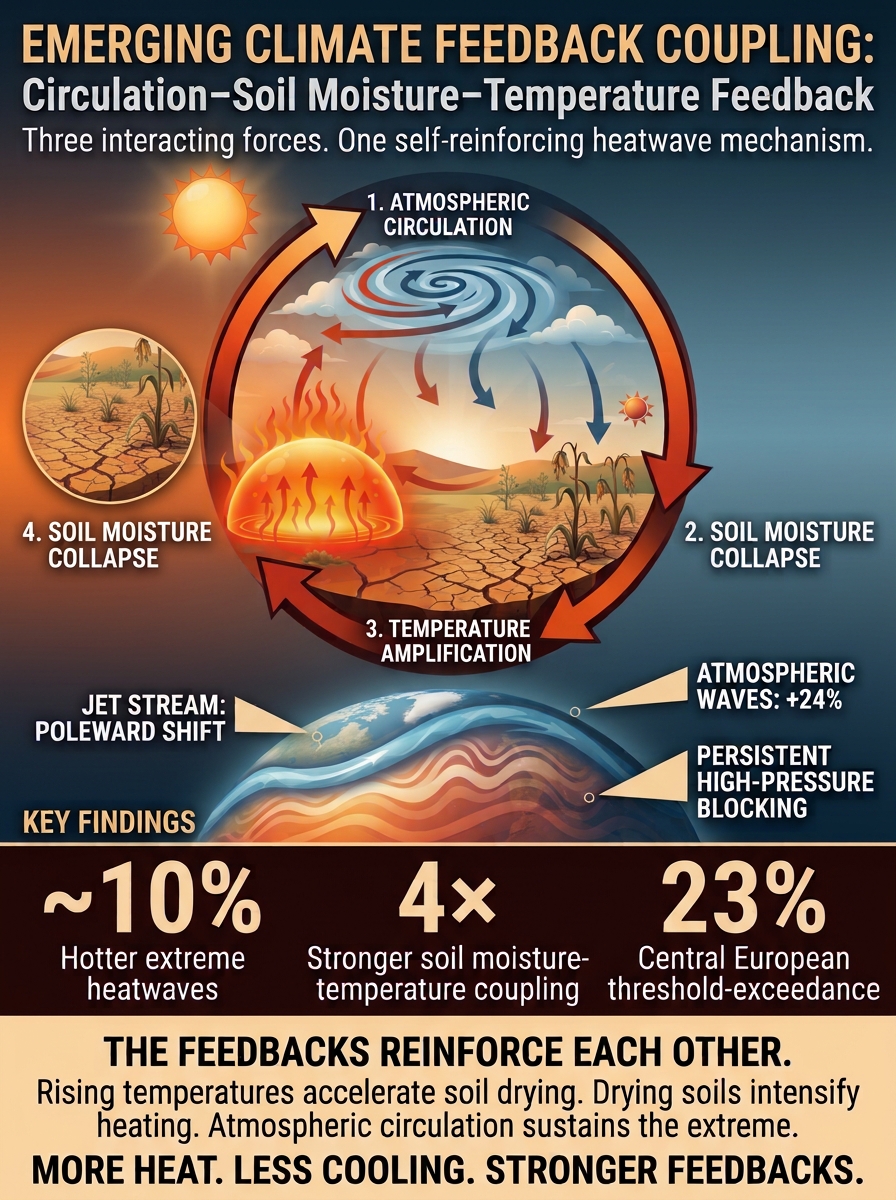
Three interacting forces. One self-reinforcing heatwave mechanism.
New research published in Science Advances identifies a three-way climate feedback connecting atmospheric circulation, soil moisture, and temperature.
Here’s how it works:
🔥 Persistent high-pressure systems intensify surface heating.
🌵 Drying soils lose their natural evaporative cooling capacity.
🌡️ Rising temperatures amplify the interaction, reinforcing extreme heat.
The consequences extend beyond the ground:
- Approximately 10% hotter extreme heatwaves
- 4× stronger soil moisture–temperature coupling
- 24% atmospheric wave amplification reported in the modeling
- Poleward displacement of subtropical jet streams
As temperatures rise, the thresholds activating these feedbacks become increasingly likely to be crossed.
This is another example of climate feedback coupling: atmospheric and terrestrial processes interacting to amplify extreme events.
MORE HEAT. LESS COOLING. STRONGER FEEDBACKS.
Explore the latest additions to the Emerging Climate Feedback Coupling series:
Feedback Loop and Tipping-Point Network
#ClimateChange #ClimateScience #ExtremeHeat #Heatwaves #ClimateFeedbacks #JetStream #SoilMoisture #GlobalWarming #ClimateTippingPoints
Introduction: A Newly Identified Three-Way Climate Feedback
The Three-Way Circulation–Soil Moisture–Temperature Feedback is a newly identified self-reinforcing climate mechanism that intensifies extreme mid-latitude heatwaves, making the most severe events approximately 10% hotter than conventional meteorological models predict.
While the two-way relationship between drying soils and rising temperatures has been understood for decades, recent research identifies a compounding third variable: large-scale atmospheric circulation.
The interaction fundamentally changes how extreme heat develops. Atmospheric circulation initiates and sustains the heating, declining soil moisture eliminates an important natural cooling mechanism, and rising temperatures amplify the entire process.
Once critical temperature thresholds are breached, these three forces interact in a self-reinforcing feedback loop. The result is a more intense, persistent, and difficult-to-predict extreme heat event.
1. The Mechanics of the Three-Way Feedback Loop
The mechanism involves three interconnected processes:
Atmospheric circulation → Soil moisture depletion → Temperature amplification → Atmospheric circulation intensification
1. Atmospheric Circulation — The Driver
Persistent high-pressure weather systems, known as anticyclones, establish atmospheric conditions favorable to extreme heating.
These systems produce several reinforcing effects:
- Reduced cloud cover allows increased incoming solar radiation to reach the Earth’s surface.
- Descending air, known as atmospheric subsidence, compresses and warms through adiabatic heating.
- Persistent atmospheric blocking limits the arrival of cooler air masses and maintains prolonged heating.
- Sustained high-pressure conditions accelerate surface drying and increase atmospheric demand for moisture.
The resulting combination of increased solar heating, subsidence, and persistent weather patterns creates the initial conditions for extreme heat amplification.
2. Soil Moisture — The Cooling Buffer Fails
Under normal conditions, moist soil moderates surface temperatures by partitioning available solar energy into latent heat through evaporation and plant transpiration.
However, persistent high-pressure systems accelerate soil moisture depletion. As soils dry, evapotranspiration declines and the natural evaporative cooling mechanism progressively breaks down.
Instead of being used to evaporate water, a greater proportion of available surface energy is converted into sensible heat, directly warming the ground and the atmosphere immediately above it.
The consequences are substantial:
- Surface temperatures rise more rapidly.
- Near-surface atmospheric temperatures increase.
- Vegetation experiences greater water stress.
- Evaporative cooling becomes increasingly ineffective.
- The surrounding atmosphere becomes more susceptible to extreme heating.
The land effectively loses an important natural temperature-regulation mechanism.
3. Temperature — The Amplifier
The combined effects of increased solar radiation, atmospheric subsidence, and declining evaporative cooling drive temperatures to extraordinary levels.
Crucially, once a critical thermal threshold is crossed, the resulting land-surface heating begins influencing the surrounding atmosphere and large-scale circulation patterns.
Temperature is no longer simply responding to atmospheric conditions. It becomes an active participant in the feedback mechanism.
This interaction creates a self-reinforcing cycle in which atmospheric circulation accelerates soil drying, soil drying intensifies surface heating, and rising temperatures strengthen the coupled response.
2. How Soil Moisture Shifts Global Wind Currents
One of the most important findings is that interactive soil moisture does more than influence local surface temperatures. It can also alter large-scale atmospheric circulation and the position of planetary wind systems.
Recent climate modeling demonstrates that extensive soil drying changes the land-atmosphere energy balance, influencing atmospheric temperature gradients and circulation patterns.
During major summer heatwaves, widespread land drying can produce:
- Poleward displacement of subtropical jet streams.
- Amplification of atmospheric wave patterns over land by approximately 24%.
- Changes in the positioning and persistence of atmospheric ridges.
- Increased persistence of high-pressure weather systems.
- Reduced opportunities for cooler marine air to penetrate affected regions.
These changes create a powerful connection between local land-surface conditions and large-scale atmospheric dynamics.
Essentially, soil moisture becomes an active component of atmospheric circulation rather than simply a passive response to weather.
As the circulation pattern persists, it further accelerates soil drying and reinforces the original heating mechanism.
The resulting feedback can lock extreme weather patterns into place, prolonging heatwaves and trapping affected regions beneath persistent heat domes.
3. Case Studies in Recent History
2023 North China Heatwave
The 2023 North China heatwave provides a particularly revealing example of the interaction between atmospheric circulation and soil moisture.
An intense three-day heatwave produced a daily maximum temperature anomaly of approximately 8.6°C.
Research published in Earth’s Future found that:
- Atmospheric circulation accounted for approximately 69.8% of the temperature anomaly.
- Extreme soil dryness contributed approximately 39.5% of the anomaly in the study’s attribution analysis.
- Soil moisture–temperature coupling increased to approximately four times its normal intensity.
- Regional rainfall preceding the event was exceptionally low, with precipitation reaching its lowest level since 1979.
The attribution percentages overlap and should not be interpreted as independent contributions.
The findings demonstrate how atmospheric circulation and soil moisture interact to produce extreme temperatures substantially beyond the effects of either mechanism considered independently.
2021 U.S. Pacific Northwest Heatwave
The June 2021 Pacific Northwest heatwave demonstrated the extraordinary heating potential of persistent atmospheric blocking.
Temperatures shattered previous regional records, with the most extreme readings exceeding historical records by several degrees.
The event highlighted the importance of interactions among persistent high-pressure systems, land-surface conditions, and extreme atmospheric heating.
2022 European Heatwaves
The 2022 European heatwaves provided another important example of the increasingly dangerous interaction between atmospheric circulation, soil moisture depletion, and extreme temperatures.
Persistent high-pressure conditions and widespread drought contributed to extraordinary surface heating.
The United Kingdom exceeded 40°C for the first time in recorded history, demonstrating the severity of the emerging extreme-heat environment.
These events illustrate why extreme heat cannot be adequately understood by examining atmospheric circulation, soil moisture, or temperature independently.
4. Implications for Climate Feedback Coupling
The discovery of this three-way feedback has implications extending well beyond individual heatwaves.
It demonstrates how atmospheric and terrestrial climate processes interact to produce nonlinear amplification.
Several consequences deserve particular attention.
Extreme Heat Amplification
The interaction makes the most extreme mid-latitude heatwaves approximately 10% hotter than they would otherwise be.
Atmospheric Circulation Changes
Soil moisture depletion influences large-scale circulation, including jet-stream positioning and atmospheric wave amplification.
Persistent Heat Domes
The interaction reinforces atmospheric blocking and reduces the likelihood of cooler air breaking prolonged extreme-heat patterns.
Increasing Threshold Exposure
As background temperatures rise, the thermal thresholds necessary to activate the three-way feedback become increasingly likely to be crossed.
Climate Model Limitations
Models that inadequately represent interactive soil moisture and atmospheric circulation risk underestimating the intensity and persistence of the most extreme heatwaves.
Compound Climate Extremes
The feedback intensifies the interconnected risks of drought, extreme heat, agricultural losses, ecosystem degradation, water shortages, and heat-related mortality.
Conclusion: Another Mechanism in the Emerging Climate Feedback Network
The Circulation–Soil Moisture–Temperature Feedback represents an important addition to our understanding of climate feedback coupling.
The established relationship between drying soils and rising temperatures is only part of the mechanism. Atmospheric circulation provides a third interacting force that transforms extreme heating into a self-reinforcing process.
The consequences extend from local land-surface heating to large-scale atmospheric dynamics, including changes in jet-stream positioning, atmospheric wave amplification, and persistent high-pressure systems.
The approximately 10% additional heating identified by researchers demonstrates that these interactions have measurable consequences for the severity of extreme heatwaves.
As global warming increases the likelihood of crossing critical temperature thresholds, the conditions necessary to activate this feedback become increasingly common.
This is another example of the interconnected nature of Earth’s climate system: individual feedback mechanisms do not operate in isolation. They interact, reinforce one another, and create additional pathways for climate amplification.
The emerging climate feedback network is becoming increasingly interconnected. Atmospheric circulation, soil moisture, and temperature are no longer simply responding to one another. Under extreme conditions, they become mutually reinforcing drivers of increasingly severe climate extremes.
Primary Research
Three-way circulation–soil moisture–temperature feedbacks amplify the most extreme mid-latitudinal heat waves
Science Advances
https://www.science.org/doi/10.1126/sciadv.aeh9111
Related Soil and Climate Feedback Research
Soil–Insect Climate Feedback Collapse: How Climate Change Is Triggering a Downward Spiral in Earth’s Hidden Ecosystems
https://www.kingarthur.com/global_warming/Soil-Insect-Feedback-Collapse.html
Soil’s Crucial Role, Soil Degradation and Desertification
https://www.kingarthur.com/global_warming/Soil-and-Climate-Change.html
Soiled Soil: Climate Change and What Is Happening to the Dirt Beneath Your Feet?
https://www.kingarthur.com/global_warming/Soiled-Soil-Basics.html