bookmark_borderThe Polar Feedback Engine: Arctic Heat, Wildfires, and the Accelerating Loss of Earth’s Ice

by Daniel Brouse

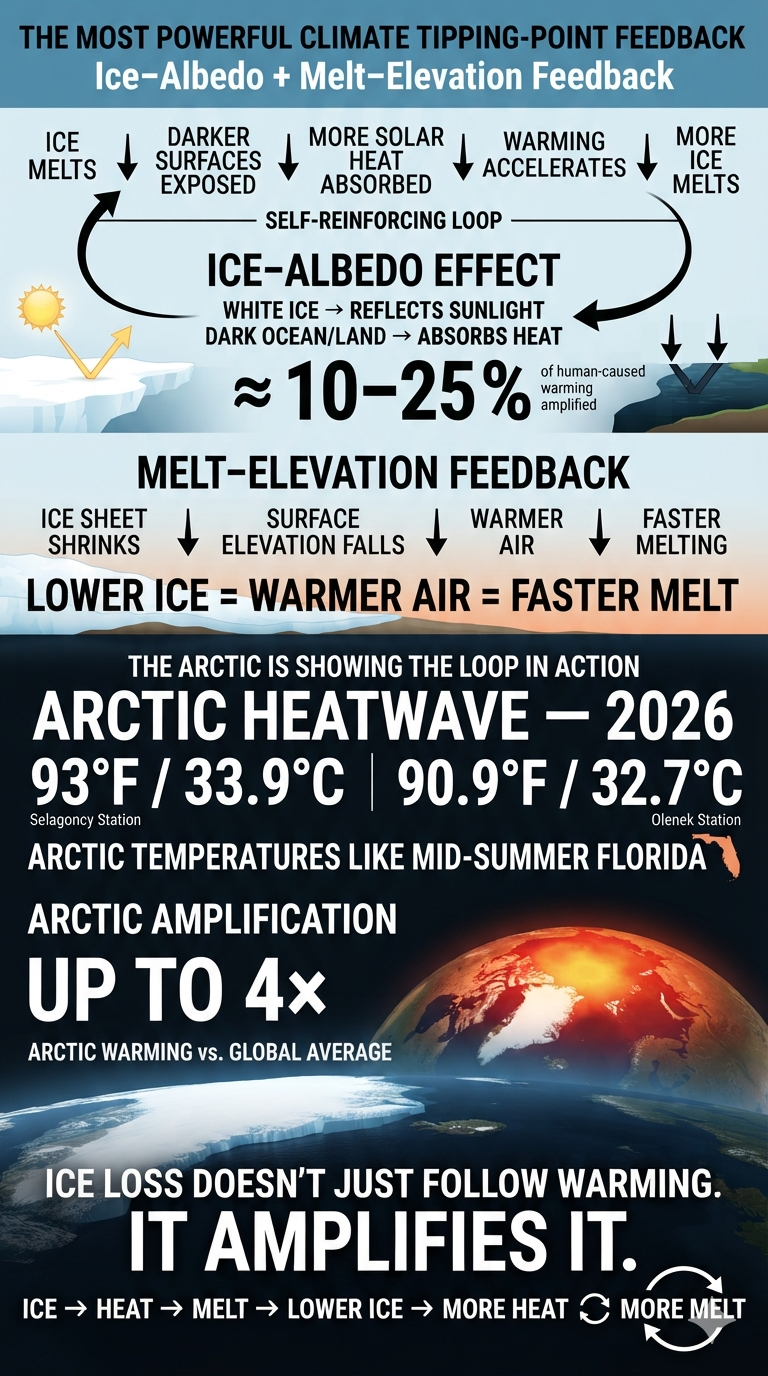
The astonishing Arctic heatwave of 2026 is a stark illustration of how rapidly the polar climate is changing. Freshly published data highlighted by Scientific American confirm that temperatures in northern Russia have routinely surpassed 90°F (32.2°C)—temperatures more characteristic of midsummer in places far to the south.

These extraordinary readings are not simply isolated temperature records. They are occurring within a broader system of Arctic amplification, in which the Arctic is warming up to four times faster than the global average. That accelerated warming is interacting with snow and ice loss, permafrost thaw, atmospheric circulation, forest drying, and wildfire behavior to create increasingly powerful feedback loops.

Arctic Heatwave: Temperatures More Typical of Florida

Several remote northern stations have recorded extraordinary heat.

  • Selagoncy Station: Located near the Arctic Circle, this remote meteorological station registered a blistering 93.0°F (33.9°C).
  • Olenek Station: Another notoriously cold northern outpost reached an extreme high of 90.9°F (32.7°C).
  • The comparison: According to climate data compiled by weather information service Ogimet and analyzed by climatologist Maximiliano Herrera, these temperatures are comparable to midsummer conditions in Orlando, Florida.

The significance of these temperatures becomes clearer when they are placed within the larger Arctic climate system.


Arctic Amplification: A Self-Reinforcing Feedback System

Meteorologists and climate scientists identify Arctic amplification as a major reason the polar region is warming so rapidly. The Arctic can warm at up to four times the rate of the global average because several reinforcing processes operate simultaneously.

The Loss of Reflective Surfaces

Snow and sea ice are highly reflective. They return a substantial portion of incoming solar radiation back into space.

As warming removes that reflective white surface, darker land and ocean surfaces are exposed. These surfaces absorb significantly more solar radiation.

The feedback becomes:

warming → snow and sea-ice loss → darker surfaces → greater solar absorption → additional warming

This is the classic ice-albedo feedback, and it helps explain why warming in the Arctic can accelerate faster than the global average.

The Ice–Albedo Effect, combined with the Melt–Elevation Feedback, represents the most powerful and consequential tipping-point mechanisms in the climate system. Together, these feedbacks create a self-reinforcing cycle in which warming causes ice loss, ice loss increases heat absorption, and shrinking ice exposes the remaining ice to progressively warmer atmospheric conditions. The Ice–Albedo Effect alone is estimated to account for roughly 10% to 25% of the total warming associated with human greenhouse-gas emissions.

Permafrost Thaw

Extreme Arctic heat also threatens to accelerate the thawing of ancient permafrost.

Frozen soils contain enormous quantities of carbon accumulated over thousands of years. As permafrost thaws, previously trapped organic material becomes available for decomposition, potentially releasing massive quantities of methane and carbon dioxide back into the atmosphere.

The resulting feedback is:

warming → permafrost thaw → greenhouse-gas release → additional warming

The Arctic therefore contains the potential for multiple reinforcing mechanisms to operate simultaneously.


From Arctic Heat to Canadian Wildfires

The extreme Arctic heatwave—including the 93.0°F (33.9°C) reading at Selagoncy and absolute records reaching 100.4°F (38°C)—creates a cascading climate feedback system that can directly supercharge the conditions driving Canadian wildfires.

Because Canada’s Arctic is warming up to four times faster than the global average, this extraordinary polar heat can dramatically reshape atmospheric circulation and fuel conditions across North America.

The critical connection occurs through the atmosphere.

The Atmospheric Link: Jet Stream Disruption

The jet stream is strongly influenced by the temperature difference between the warm equator and the frigid polar regions.

As the Arctic overheats, that temperature contrast shrinks.

The result can be a slower, more meandering, increasingly “wobbly” jet stream.

Instead of rapidly transporting weather systems from west to east, the altered circulation can allow large-scale atmospheric patterns to become persistent.

Atmospheric Blocking and Heat Domes

A sluggish, highly meandering jet stream can contribute to massive, stagnant areas of high pressure known as heat domes.

Rather than moving along normally, these high-pressure systems can become parked over regions such as the Northwest Territories and Alberta.

The result is prolonged exposure to:

  • extreme heat,
  • clear skies,
  • suppressed precipitation,
  • intense evaporation,
  • soil-moisture loss,
  • and increasingly severe drought.

The feedback becomes:

Arctic warming → reduced equator-to-pole temperature contrast → altered jet-stream behavior → atmospheric blocking → persistent heat dome → prolonged drought and drying

This atmospheric connection helps transform an episode of extreme Arctic heat into a much broader continental climate hazard.


The Boreal Fuel Link: Vapor Pressure Deficit

Once extreme heat reaches Canada’s vast northern boreal forests, another physical feedback becomes increasingly important: vapor pressure deficit (VPD).

Warm air can hold significantly more water vapor than cold air.

When temperatures rise without a corresponding increase in atmospheric moisture, the difference between the atmosphere’s moisture-holding capacity and its actual moisture content increases.

This produces a high vapor pressure deficit, meaning the atmosphere becomes increasingly aggressive in drawing moisture from the landscape.

It effectively begins sucking moisture out of the soil, trees, vegetation, and forest floor.

Turning the Forest Into a Tinderbox

As VPD increases:

warm air → greater atmospheric moisture demand → increased evaporation and plant water loss → drying vegetation and soils → highly flammable fuels

Lichen, moss, pine needles, grasses, deadwood, and other organic materials can rapidly dry into volatile wildfire fuel.

Once dried by Arctic-driven heatwaves and persistent atmospheric blocking, the boreal landscape can require very little additional energy to ignite.

This creates another reinforcing chain:

heat → high VPD → drying → greater fuel flammability → wildfire


When Wildfires Create Their Own Weather

The feedback does not necessarily stop once a fire begins.

Under sufficiently intense conditions, the wildfire itself can begin modifying the atmosphere.

Pyrocumulonimbus Clouds: Firestorms in the Sky

The immense heat generated by large Canadian wildfires can force towering columns of hot air and smoke miles into the atmosphere.

These columns can develop into pyrocumulonimbus clouds, often called firestorms.

These fire-generated thunderstorms can produce extreme atmospheric turbulence, powerful wind shifts, and lightning.

More Lightning, More Fires

The resulting storms can generate intense lightning, including dry lightning that occurs with little or no meaningful rainfall.

That creates a dangerous secondary feedback.

Lightning strikes can hit already-parched forests surrounding the original fire and ignite entirely new fire fronts.

The process becomes:

extreme heat and drought → dry vegetation → wildfire → enormous heat column → pyrocumulonimbus formation → lightning and wind shifts → new ignitions → more wildfires

The fire is therefore no longer simply responding to weather.

Under extreme conditions, it can begin creating its own weather, which can then generate additional fires.


The Long-Range Result: Smoke Across North America

The consequences of these interconnected feedbacks extend far beyond the original fire zones.

Canada’s burned area has surged past its 10-year average, while enormous plumes of smoke from northern Canada have been observed by NASA traveling thousands of miles.

These smoke plumes can blanket the U.S. East Coast and continue outward over the Atlantic Ocean, triggering hazardous air-quality alerts for millions of people.

A climate disturbance originating in the Arctic and northern Canadian boreal forest can therefore propagate through the atmosphere across an entire continent.

The chain is increasingly interconnected:

Arctic warming → atmospheric disruption → heat dome → drought → high VPD → dry forests → wildfire → pyrocumulonimbus → lightning → additional fires → massive smoke transport

Each individual link has its own physical mechanism, but together they form a much larger climate feedback system.


The Cryosphere Is Also Under Accelerating Stress

The atmosphere and biosphere are not the only components undergoing severe disruption.

The cryosphere—the Earth’s frozen zones—has also experienced severe and accelerated changes.

Both mountain glaciers and the Antarctic continent are setting alarming physical records.

These changes matter because the cryosphere is not simply a passive indicator of climate change. Ice and snow actively influence Earth’s energy balance, freshwater systems, and global sea level.


Mountain Glaciers: An Extreme Summer Ice Deficit

The world’s mountain glaciers are experiencing increasingly severe mass loss.

The Protective Blanket Vanished Early

In July 2026, Switzerland’s glacier monitoring network, GLAMOS, reported that the entire winter snowpack over the Swiss Alps had completely melted.

This occurred nearly a month ahead of schedule.

The loss of the reflective snowpack is particularly significant because the snow acts as a protective, high-albedo blanket over the underlying glacier.

Once the white snow disappears, darker glacier ice is exposed directly to solar radiation.

That creates another albedo feedback:

snow loss → dark glacier ice exposed → greater solar absorption → accelerated surface melting

Under these extreme conditions, glacier surface loss can reach up to a meter in just 10 days.


A 400-Billion-Ton Annual Glacier Deficit

According to the World Glacier Monitoring Service (WGMS), the world’s mountain glaciers are experiencing a net loss of more than 400 billion tonnes of ice mass annually.

That represents an extraordinary physical transfer of water from glaciers into the world’s oceans.

The loss contributes approximately 1.1 millimeters directly to global sea-level rise each year, outpacing the direct contribution from the Antarctic Ice Sheet.

The significance extends beyond sea-level rise.

Mountain glaciers function as enormous natural freshwater reservoirs. Their continued loss threatens to alter water availability for ecosystems, agriculture, communities, and river systems dependent upon seasonal meltwater.


The Mid-Century Glacier Disappearance Timeline

A newly published comprehensive model in Nature Climate Change projects that global mountain glacier mass loss will peak by mid-century.

Under current high-emission trajectories, the subtropical Andes and European Alpine glacier networks face near-total structural collapse.

The implications are profound.

Glaciers that have persisted for centuries or millennia can disappear within a matter of decades once warming pushes the system beyond its ability to maintain a stable ice mass.

The process can therefore shift from gradual retreat toward increasingly rapid structural loss.


Antarctica: Melting From Below

Antarctica represents a different but equally alarming component of the cryosphere crisis.

The continent’s ice loss is strongly influenced not only by atmospheric warming but also by ocean-driven melting beneath floating ice shelves.

The Human Greenhouse-Gas Signature

A study published in The Cryosphere provided physical evidence that human-caused greenhouse-gas emissions have accelerated the retreat of Pine Island Glacier—the fastest-melting glacier in West Antarctica—by up to 20% since the 1940s.

Pine Island Glacier is one of the major drainage systems of the West Antarctic Ice Sheet and is an important contributor to global sea-level rise.

The finding is significant because it demonstrates how human greenhouse-gas emissions can alter the trajectory of an already vulnerable Antarctic ice system.


Melting From Below

Oceanographic measurements collected through deep drilling into Antarctic ice shelves have revealed that major ice margins can melt rapidly from below.

The mechanism involves upwelling warm ocean currents reaching the underside of floating ice shelves.

Because these shelves extend from grounded ice into the ocean, they provide an important structural restraint on the flow of inland ice toward the sea.

When warm ocean water melts them from below:

warm ocean currents → basal melting → ice-shelf thinning → weakened structural restraint → increased ice discharge → rising sea levels

The process is particularly dangerous because the atmosphere does not have to become dramatically warmer at the surface for ocean-driven melting to continue.

The ocean can effectively attack the Antarctic ice system from underneath.


A 135-Billion-Ton Annual Antarctic Ice Deficit

Satellite monitoring conducted by NASA confirms that Antarctica is shedding an average of approximately 135 billion metric tons of ice into the ocean every year.

That enormous annual loss represents another major contribution to global sea-level rise.

And unlike seasonal snow, this is primarily the loss of land-based ice. When grounded Antarctic ice enters the ocean, it adds water to the global ocean system.

The implications extend far beyond Antarctica itself.

Continued Antarctic mass loss contributes to long-term sea-level rise, increasing risks for coastal communities, infrastructure, ecosystems, ports, and low-lying regions around the world.


One Connected Climate System

The Arctic heatwave, Canadian wildfires, melting mountain glaciers, and accelerating Antarctic ice loss may appear to be separate stories.

They are not.

They are different manifestations of an interconnected Earth system in which the atmosphere, ocean, cryosphere, land surface, and biosphere continuously interact.

The Arctic heatwave demonstrates how polar amplification can intensify warming through the loss of reflective snow and ice and through the thawing of carbon-rich permafrost.

Atmospheric circulation changes can influence the persistence of heat domes and drought across Canada.

High temperatures and high vapor pressure deficits can dry boreal forests into highly combustible fuel.

Wildfires can then generate pyrocumulonimbus storms capable of producing lightning and new fires.

Meanwhile, the same warming system is removing mountain glacier mass and contributing to the destabilization of Antarctic ice.

The feedback chains can be summarized as:

Arctic warming
↓
snow and sea-ice loss
↓
darker surfaces
↓
greater solar absorption
↓
additional warming

At the same time:

Arctic warming
↓
jet-stream disruption and atmospheric blocking
↓
persistent heat domes
↓
drought and high VPD
↓
boreal forest drying
↓
wildfire
↓
pyrocumulonimbus storms
↓
lightning and new fires
↓
massive smoke transport

And across the cryosphere:

warming
↓
snowpack loss and glacier melting
↓
glacier mass loss
↓
sea-level rise

While in Antarctica:

warming ocean
↓
sub-surface ice-shelf melting
↓
ice-shelf thinning
↓
reduced restraint on grounded ice
↓
accelerated ice discharge
↓
sea-level rise

These are not isolated linear changes.

They are interacting components of a climate system in which feedbacks can reinforce one another, amplify existing warming, and increase the speed and severity of downstream impacts.

The significance of the current Arctic heatwave therefore extends far beyond a few extraordinary temperature readings.

A 93°F Arctic temperature, a 100.4°F absolute record, rapidly drying Canadian forests, fire-generated thunderstorms, 400 billion tons of annual mountain-glacier loss, and 135 billion tons of annual Antarctic ice loss are all physical measurements of a planet undergoing profound change.

The critical issue is not any single record.

It is the growing evidence that the climate system is becoming increasingly dominated by interacting feedbacks—processes in which warming changes the physical environment in ways that can produce still more warming, more extreme conditions, and more rapid disruption across interconnected Earth systems.
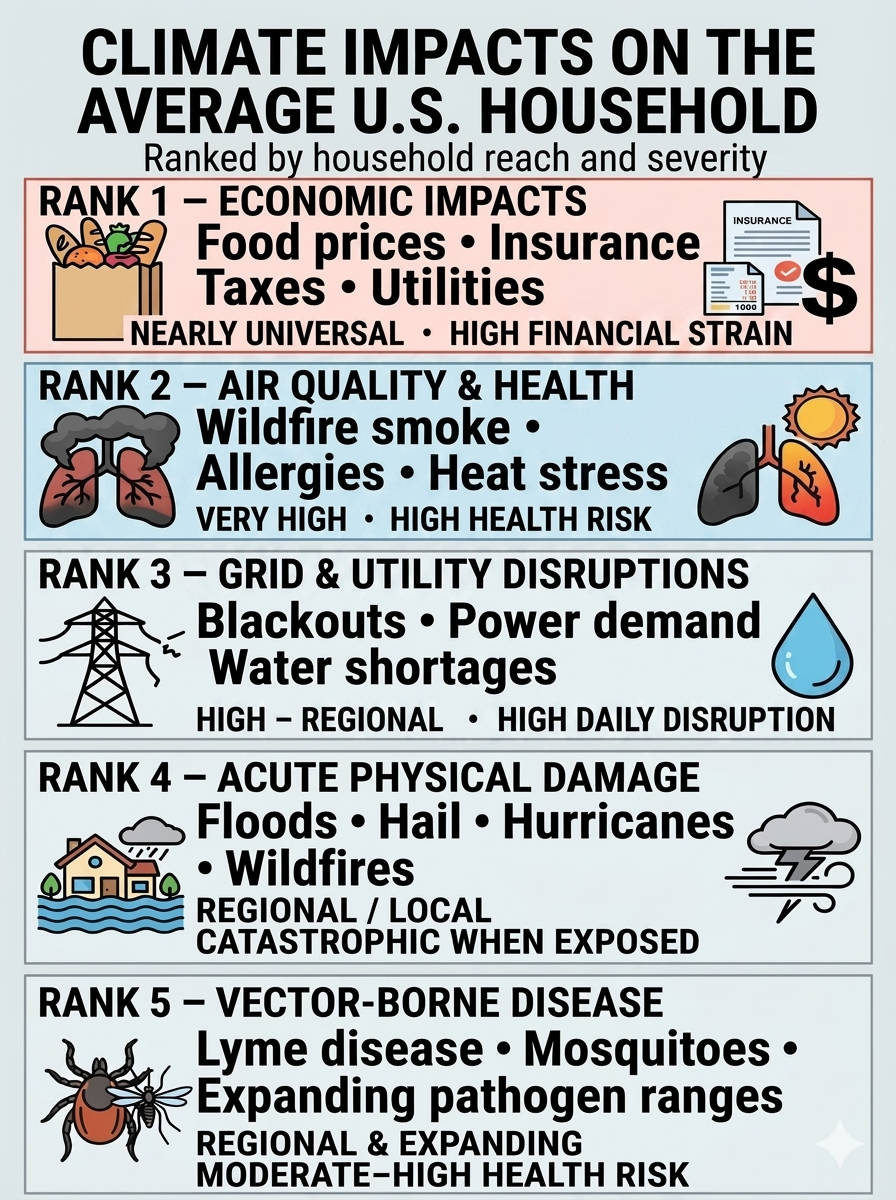
bookmark_borderClimate Change Impacts and You: The Rising Cost of a Changing Climate

by Daniel Brouse

Introduction

Climate change is no longer simply a future environmental threat. It is increasingly affecting American households through higher costs, declining air quality, extreme heat, infrastructure disruptions, property damage, and changing patterns of disease.

Although catastrophic floods, hurricanes, wildfires, and other disasters dominate the headlines, the most widespread climate impact may be less dramatic: the steady financial pressure climate change places on everyday household budgets. Food prices, insurance premiums, utility bills, and the costs of maintaining homes and communities are all increasingly influenced by a changing climate.

The impacts are not distributed equally. Some are nearly universal, while others are concentrated in particular regions or communities. The ranking below therefore considers two factors: how widely households are exposed and how severely the impact can disrupt everyday life.

Ranking of Climate Impacts on the Average U.S. Household

RankImpact CategoryPrimary Household ThreatsUbiquitySeverity
1Economic ImpactsFood inflation, insurance premiums, taxes, utility costsNearly universalHigh financial strain
2Air Quality & Chronic HealthWildfire smoke, longer allergy seasons, heat stressVery highHigh health risk
3Grid & Utility DisruptionsBlackouts, heat-related demand, water shortagesHigh, but regionalHigh daily disruption
4Acute Physical DamageFloods, hail, hurricanes, wildfiresRegional/localCatastrophic when exposed
5Vector-Borne DiseasesLyme disease, mosquitoes, expanding pathogen rangesRegional and expandingModerate to high health risk

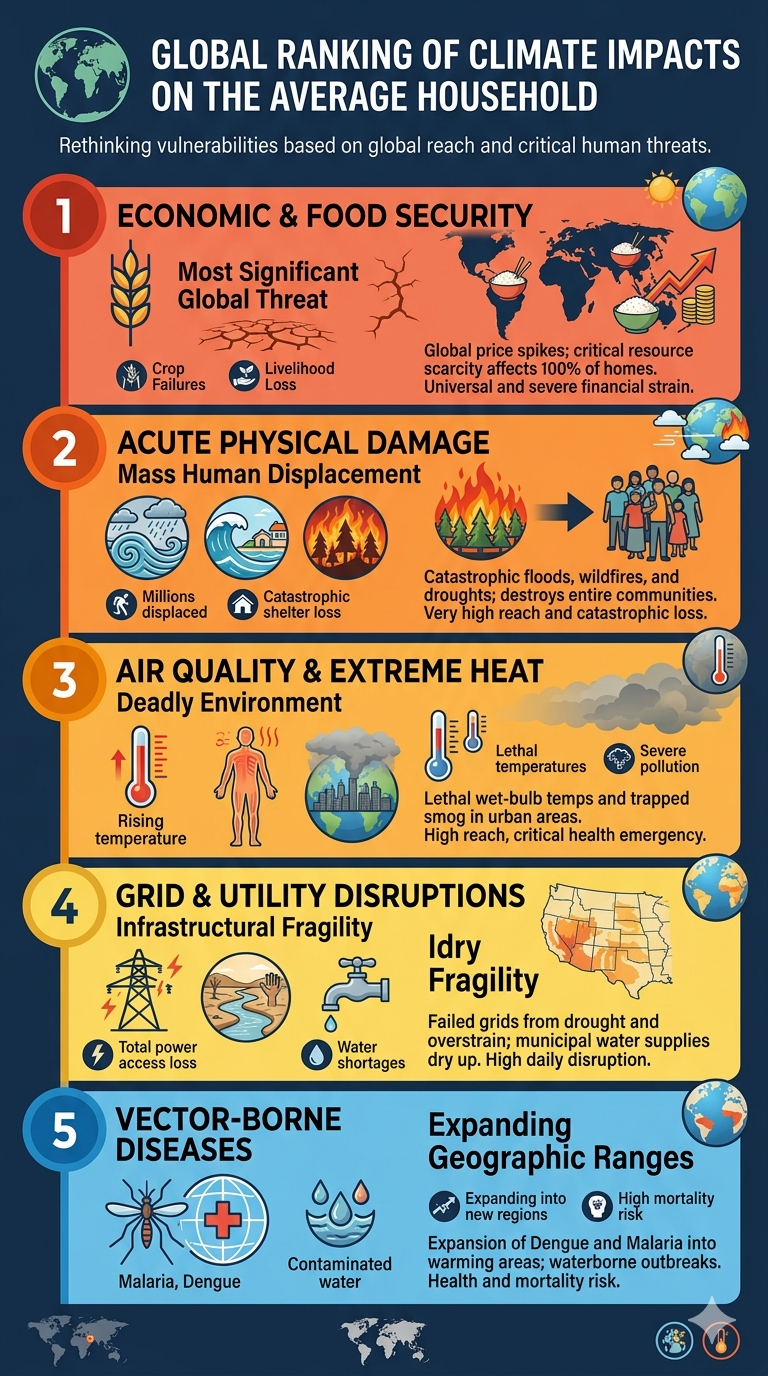
Global Ranking of Climate Impacts on the Average Household

The ranking below shifts the order of impacts based on global reach and the immediate threat to human life and livelihoods across developing and developed nations alike.

RankImpact CategoryPrimary Global Household ThreatsUbiquitySeverity
1Economic & Food SecurityGlobal food price spikes, crop failures, loss of agricultural livelihoodsUniversal (100% of homes)Extreme financial/survival strain
2Acute Physical DamageCatastrophic monsoon flooding, sea-level rise, mega-wildfires, historic droughtsVery High (Millions displaced)Catastrophic loss of shelter
3Air Quality & Extreme HeatLethal wet-bulb temperatures, severe dust/smoke pollution, urban heat islandsHigh (Equatorial & Urban zones)Critical health emergency
4Grid & Utility DisruptionsTotal lack of power access, severe municipal water shortages, drying river basinsHigh (Varies by infrastructure)High daily survival disruption
5Vector-Borne DiseasesMalaria, Dengue fever expansion, waterborne cholera outbreaksExpanding (Sub-tropical regions)High health and mortality risk

1. Economic Impacts: The Most Universal Climate Burden

Economic impacts rank first because households do not have to live in a flood zone, wildfire corridor, or hurricane-prone region to pay the economic costs of climate change. Climate-related costs increasingly reach Americans through food prices, insurance premiums, utility bills, taxes, public fees, and the rising cost of maintaining homes and infrastructure.

Climate change can therefore function as a cost multiplier, increasing expenses both directly and indirectly.

Climate-Driven Food Inflation

Drought, extreme heat, excessive rainfall, and other weather disruptions can reduce agricultural yields and interfere with food production and supply chains. Because food markets are interconnected, production losses in one region can influence prices far beyond the location of the original climate event.

The effects can reach everyday staples and commodities such as coffee, wheat, corn, beef, fruits, and vegetables.

The result is a climate-related cost that can reach virtually every household through the grocery bill—even when the household is hundreds or thousands of miles from the drought, flood, or heatwave affecting agricultural production.

The Insurance Crisis

Insurance is one of the clearest mechanisms through which climate risk is transferred directly to households.

As floods, hurricanes, wildfires, severe storms, and other disasters generate increasingly costly losses, insurers may respond by raising premiums, increasing deductibles, restricting coverage, or withdrawing from particularly high-risk markets.

For homeowners, climate risk can therefore produce a double financial burden:

higher insurance costs + higher uninsured exposure.

In some locations, the problem extends beyond affordability. Homeowners may find that certain types of coverage are difficult or impossible to obtain through conventional private insurance markets.

Rising Utility Costs

Hotter summers increase demand for air conditioning. As temperatures remain elevated for longer periods, households may need to run cooling systems more frequently and for longer durations.

That increases electricity consumption while simultaneously placing additional stress on the power grid.

Climate change can therefore affect household budgets through both higher energy consumption and the cost of maintaining a more resilient electrical system.

Water systems can face similar pressures. Drought, declining water supplies, flooding, and changing precipitation patterns may require communities to invest in new reservoirs, treatment capacity, pipelines, drainage systems, and other infrastructure.

Those investments ultimately have to be paid for.

Taxes, Assessments, and Public Costs

One of the least visible climate costs is the portion that reaches households through government budgets rather than private markets.

When climate-related disasters become more costly, governments must spend more on emergency response, disaster recovery, infrastructure repair, flood protection, stormwater management, wildfire preparedness, water systems, coastal protection, and long-term climate adaptation.

Those expenses can eventually reach households through:

  • Property taxes used to finance infrastructure repairs and resilience projects.
  • Special assessments and municipal fees for stormwater, drainage, flood control, and other local projects.
  • Higher utility rates needed to upgrade vulnerable water and electrical systems.
  • State and federal taxes that help finance disaster recovery, emergency response, agricultural assistance, infrastructure rebuilding, and resilience programs.
  • Public insurance and disaster programs when private insurance markets cannot absorb the full cost of catastrophic losses.

This creates an important economic chain:

Climate hazard → physical damage → insurance losses → government response → infrastructure spending → taxes, fees, and utility costs.

The household may never experience the original flood, wildfire, hurricane, or drought, yet it can still participate in paying the bill.

Rising Property and Maintenance Costs

Climate stress can also increase the cost of owning and maintaining a home.

More intense rainfall can require improved drainage. Stronger storms can increase demand for roofing and exterior repairs. Heat can accelerate deterioration of infrastructure and building materials. Flooding and wildfire risk can require additional mitigation measures.

At the same time, widespread disasters can create temporary shortages of construction materials, contractors, equipment, and skilled labor, increasing repair costs.

The Hidden Climate Cost

Taken together, these effects mean that climate change does not have to destroy your home to affect your household finances.

A household can experience climate-related costs through:

  • Higher grocery prices
  • Higher insurance premiums
  • Higher electricity and water bills
  • Higher taxes and public fees
  • Higher repair and maintenance costs

Together, these expenses create a growing household climate burden—even when a family never experiences a major climate disaster firsthand.

The important point is that climate change is not simply a collection of isolated disasters. It is increasingly an economic force that propagates through markets, insurance systems, government budgets, and household expenses.

For the average American household, this may ultimately be the most widespread way climate change is experienced: not as one catastrophic event, but as a persistent accumulation of additional costs.

2. Air Quality & Chronic Health: A Widespread Physical Exposure

Climate change also affects the quality of the air people breathe.

Wildfire Smoke

Wildfire smoke can travel hundreds or even thousands of miles, carrying fine particulate matter such as PM₂.₅ into communities far from the original fire.

These particles can penetrate deep into the respiratory system and aggravate existing respiratory and cardiovascular problems. As wildfire activity and smoke exposure increase in some regions, air-quality impacts are no longer limited to communities immediately adjacent to fires.

Longer Allergy Seasons

Warmer temperatures can alter plant growing seasons and extend periods of pollen production.

For people with asthma or seasonal allergies, longer or more intense pollen seasons can mean more days of symptoms, greater medication use, and reduced quality of life.

Heat Stress

Rising baseline temperatures also increase the frequency and duration of dangerous heat.

Homes without adequate cooling, outdoor workplaces, and communities with limited access to cooling resources can be particularly vulnerable. Extreme heat is not merely uncomfortable—it can place substantial physiological stress on the human body.


3. Grid & Utility Disruptions: Climate Stress on Essential Infrastructure

Modern households depend on electricity, water, transportation, telecommunications, and other infrastructure every day.

Climate extremes can place additional stress on these systems.

Power Grid Failures

Extreme heat can push electricity demand toward peak levels as households and businesses increase air-conditioning use.

At the same time, extreme weather can damage transmission lines, substations, transformers, and other infrastructure.

The consequences can range from higher electricity costs to localized outages and, under severe conditions, prolonged disruptions to essential services.

Water Scarcity

Drought can reduce reservoir levels, groundwater availability, and other sources of municipal water.

Communities may respond with conservation requirements, watering restrictions, infrastructure investments, or higher water costs.

Water stress can therefore become both an environmental problem and a household financial problem.


4. Acute Physical Damage: Catastrophic Where It Strikes

Floods, hurricanes, wildfires, severe thunderstorms, hail, and high winds can cause enormous damage to homes, vehicles, businesses, and infrastructure.

This category ranks fourth not because the damage is minor, but because exposure is geographically concentrated.

A household directly hit by a major disaster can experience losses vastly greater than those associated with ordinary climate-related inflation.

Floods and Flash Floods

Intense rainfall can overwhelm drainage systems and produce rapid flooding in locations that may not have traditionally been considered high-risk.

Coastal communities also face storm surge and rising sea levels that can increase the consequences of major storms.

Severe Hail and Wind

Severe convective storms can produce damaging hail and straight-line or tornadic winds.

Roofing, siding, windows, vehicles, and other property can be damaged within minutes, creating repair costs that are often compounded by rising construction and insurance expenses.

Wildfires

Wildfires can destroy homes and communities directly while also creating secondary effects through smoke, evacuation, infrastructure disruption, and insurance losses.


5. Vector-Borne Diseases: A Smaller but Expanding Risk

Climate change can also alter the geographic range and seasonal activity of disease-carrying organisms.

Tick-Borne Illnesses

Changes in temperature and seasonal conditions can affect the distribution and activity of ticks and their hosts.

In some regions, this may increase opportunities for exposure to Lyme disease and other tick-borne illnesses.

Mosquito-Borne Diseases

Changing temperature and precipitation patterns can also influence mosquito populations and the geographic conditions suitable for certain mosquito-borne diseases.

The importance of this category varies considerably by region, but changing environmental conditions can alter the boundaries of disease risk over time.

Other Pathogens

Environmental changes can also affect exposure to less common infectious diseases, including tularemia (rabbit fever), which can be transmitted through several pathways involving ticks, biting flies, infected animals, or contaminated environments.


The Basics: How Climate Change Reaches Your Household

Climate change may seem like a global-scale phenomenon, but its consequences increasingly arrive through very ordinary parts of daily life.

Your Wallet: A Rising Cost of Living

Climate change can function like a hidden cost multiplier, increasing expenses directly and indirectly.

  • Higher grocery bills: Weather extremes can disrupt agricultural production and food supply chains.
  • Higher insurance premiums: Increasing disaster losses can raise premiums, deductibles, and coverage costs.
  • Higher utility bills: Hotter temperatures increase cooling demand and electricity consumption.
  • Higher repair costs: Disasters can increase demand for construction materials, contractors, and replacement vehicles.
  • Higher infrastructure costs and taxes: Communities may need to spend more on flood protection, stormwater systems, water supplies, roads, and electrical infrastructure.

The result is that climate change does not need to destroy your house to affect your household finances.


Your Health: New Physical Strains

A warmer climate can change the environmental conditions in which people live.

Extended Allergy Seasons

Longer growing seasons and changing pollen patterns can increase exposure for people with seasonal allergies and asthma.

Heat Stress

More frequent and intense heat events increase risks of heat exhaustion, heatstroke, dehydration, and other heat-related illnesses.

Air Pollution

Wildfire smoke and other climate-related air-quality problems can expose people to unhealthy concentrations of fine particulate matter.

Vector-Borne Disease

Changing environmental conditions can alter the geographic and seasonal ranges of ticks, mosquitoes, and other disease vectors.


Your Environment: Infrastructure and Safety

Climate change also affects the physical systems surrounding your home.

Property Damage

Flooding, severe storms, wildfires, hail, and high winds can damage homes, vehicles, and personal property.

Travel Disruptions

Flooded roads, damaged bridges, severe storms, wildfire smoke, and extreme heat can disrupt transportation and cause delays.

Power and Water Reliability

Extreme heat, drought, storms, and other hazards can put additional pressure on electricity and water systems.

These disruptions can affect people even when their own property escapes direct physical damage.


What You Can Do

Climate change is a global problem, but households can take practical steps to reduce both personal vulnerability and unnecessary expense.

Audit Home Energy

Improve insulation, use efficient lighting and appliances, and manage heating and cooling more efficiently.

Prepare for Emergencies

Maintain a basic emergency kit, understand local flood and wildfire risks, and have a plan for prolonged power outages.

Protect Your Property

Keep gutters and drainage systems clear, maintain trees and vegetation around structures, and understand your property’s exposure to flooding, wind, wildfire, and other hazards.

Reduce Waste

Reducing food waste, conserving water, and using energy efficiently can lower household costs while reducing resource demand.

Know Your Insurance

Review deductibles, exclusions, flood coverage, and other policies before disaster strikes. Standard homeowners insurance does not necessarily cover every major climate-related hazard.


The Bottom Line

Climate change is often discussed in terms of distant environmental consequences, but for American households, the most immediate effects are increasingly personal and financial.

You may encounter climate change as:

a higher grocery bill,
a larger insurance premium,
a higher electric bill,
a smoky summer afternoon,
a longer allergy season,
a power outage,
a flooded road,
a damaged roof,
or a greater risk of heat stress.

The most dramatic climate disasters will continue to make the headlines. But the deeper transformation may be quieter: climate change is becoming embedded in the ordinary economics and infrastructure of everyday life.

The question is no longer simply what will climate change do to the planet?

It is increasingly:

What will climate change cost you?

bookmark_borderCore Climate Tipping Points and Their Feedback Power

by Daniel Brouse

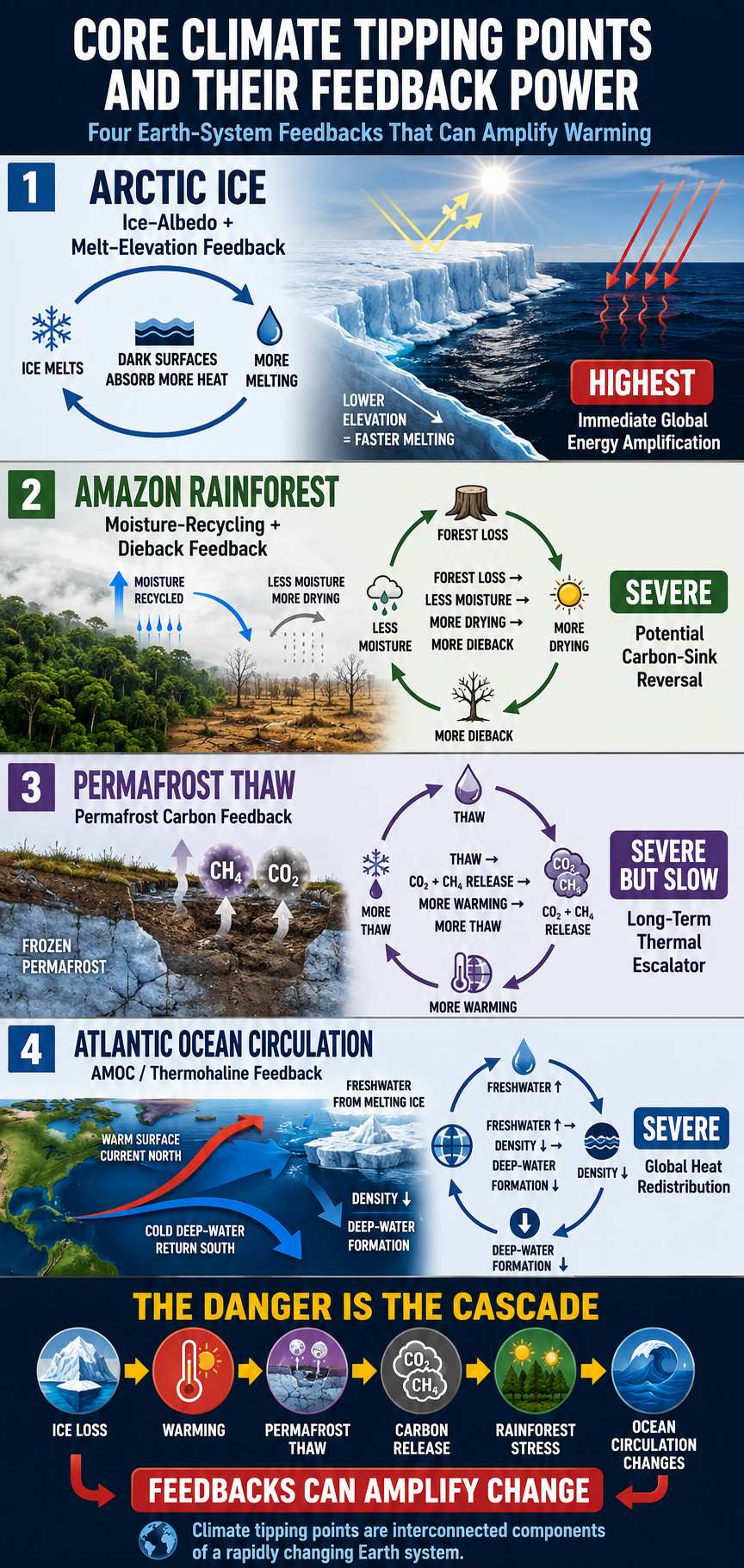
Climate tipping points are components of the Earth system that can shift abruptly once critical thresholds are crossed. Their importance is determined not only by the likelihood of crossing those thresholds, but also by the strength of the feedback mechanisms that can amplify warming and destabilize other parts of the climate system.

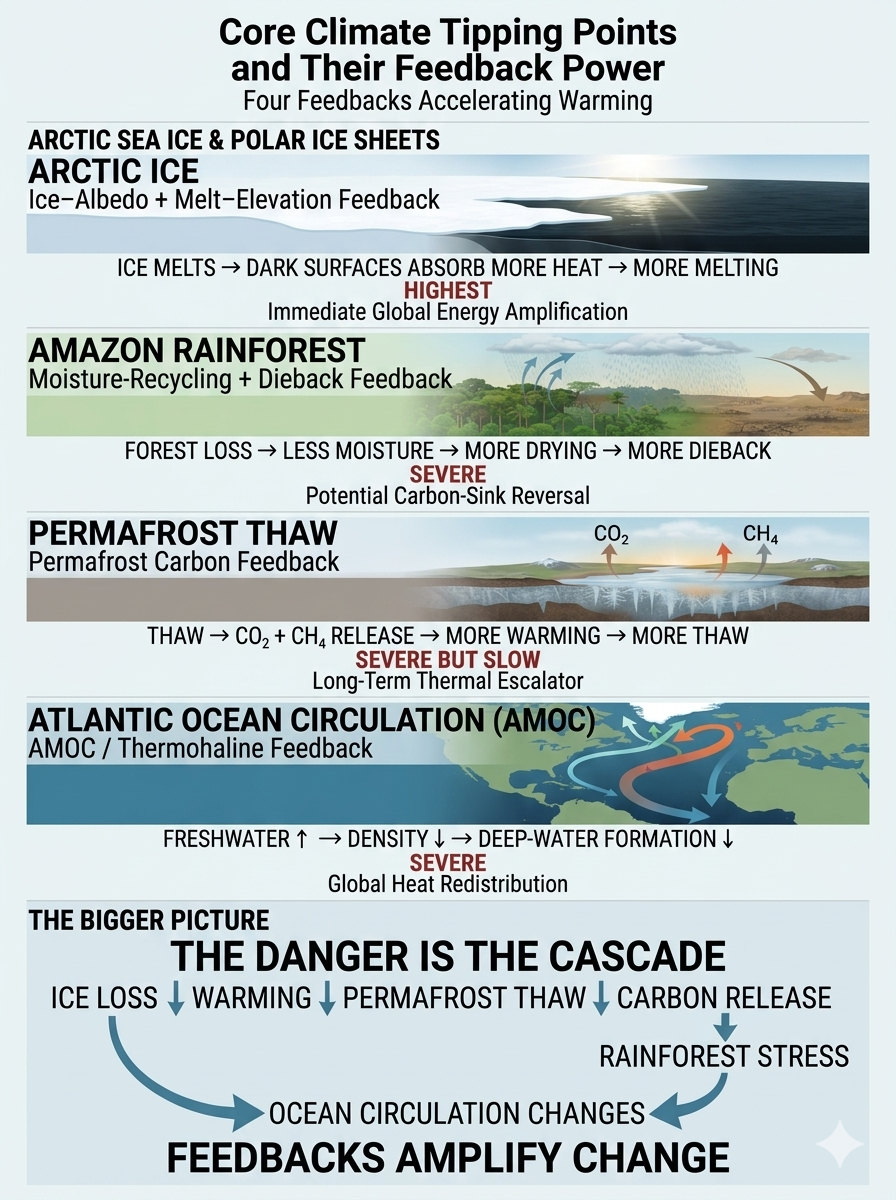
The following comparison highlights four major tipping elements, their core feedback mechanisms, how those feedbacks amplify climate change, and their broader global significance.

Tipping ElementCore Feedback MechanismAmplification DynamicGlobal Threat Level
Arctic Sea Ice & Polar Ice SheetsIce–Albedo Effect & Melt–Elevation FeedbackMelting reflective ice exposes darker ocean water or land, which absorbs more solar energy and accelerates further warming and ice loss. As ice sheets lose elevation, warmer air at lower elevations can further accelerate melting.Highest — Immediate Global Energy Amplification
Amazon RainforestMoisture Recycling & Dieback FeedbackWarming, deforestation, and reduced rainfall can weaken the rainforest’s ability to recycle moisture. Progressive forest loss can shift portions of the Amazon toward drier ecosystems while releasing stored carbon and reducing a major terrestrial carbon sink.Severe — Potential Carbon-Sink Reversal
Permafrost ThawPermafrost Carbon FeedbackThawing permafrost exposes previously frozen organic matter to decomposition, releasing carbon dioxide and methane. These greenhouse gases increase atmospheric heat retention, contributing to additional warming and further thaw.Severe but Slow — Long-Term Thermal Escalator
Atlantic Meridional Overturning Circulation (AMOC)Thermohaline Circulation FeedbackFreshwater entering the North Atlantic from melting ice and increased precipitation can reduce seawater density and weaken deep-water formation. A weakening AMOC can redistribute heat, alter precipitation patterns, and produce cascading effects across regional and global climate systems.Severe — Global Heat Redistribution

Why Feedback Power Matters

These tipping elements do not operate independently. They are components of an interconnected Earth system in which changes in one subsystem can alter the stability of others.

For example, warming can accelerate sea-ice loss, which reduces planetary reflectivity and increases solar heat absorption. At the same time, warming can accelerate permafrost thaw, releasing additional greenhouse gases. Changes in precipitation and atmospheric circulation can place additional stress on the Amazon rainforest, while freshwater input from melting ice can affect the AMOC.

The key danger is therefore not simply that individual tipping points may be crossed. It is that positive feedbacks can interact, creating cascading changes that amplify climate disruption beyond the initial forcing.

The Central Climate Risk

The most consequential feature of tipping points is their potential to transform gradual warming into self-reinforcing Earth-system change.

Once sufficiently strong feedbacks become active, reducing the original climate forcing may no longer immediately restore the system to its previous state. This creates the possibility of irreversibility, hysteresis, and cascading tipping behavior across multiple interconnected components of the climate system.

In this sense, climate tipping points represent more than isolated environmental thresholds. They are potential amplifiers of planetary change.

bookmark_borderCoral Reefs Under Climate Change: Threats, Impacts, and Global Conservation

by Daniel Brouse

Climate change is among the greatest global threats to coral reef ecosystems. Rising ocean temperatures, ocean acidification, marine heatwaves, and increasingly severe disturbances are driving widespread coral bleaching, disease, mortality, and the degradation of reef structures.

Key Threats to Coral Reefs

Thermal Stress: Warmer ocean temperatures disrupt the symbiotic relationship between corals and the microscopic photosynthetic algae that provide much of their energy.

Coral Bleaching: When subjected to prolonged heat stress, corals expel their symbiotic algae, causing them to turn white. Bleached corals can survive temporarily, but prolonged or repeated bleaching can lead to starvation and death.

Ocean Acidification: Excess atmospheric carbon dioxide is absorbed by the ocean, lowering seawater pH and reducing the availability of carbonate ions needed by corals to build their calcium-carbonate skeletons.

Weakened Reef Structures: Acidification and warming can reduce coral growth and calcification, slowing the construction and repair of reef frameworks and making damaged structures increasingly vulnerable to erosion.

Intense Storms: Powerful tropical cyclones and other severe storms can physically break corals apart and destroy portions of already weakened reef structures.

Sea-Level Rise: Rising seas can alter the depth and light environment experienced by shallow-water corals. Rapid sea-level rise can become a serious problem when reefs cannot grow vertically fast enough to maintain their position within the sunlit zone.

Altered Ocean Currents: Changes in ocean circulation can disrupt the transport of coral larvae, nutrients, heat, and other materials essential to reef ecosystems.

Ecological and Human Impacts

Biodiversity Loss: Coral reefs occupy less than 1% of the ocean floor but provide habitat for roughly 25% of marine species, making them among the planet’s most biologically diverse ecosystems.

Food Insecurity: Millions of people, particularly in tropical coastal and island communities, depend on reef-associated fisheries for food and protein.

Coastal Vulnerability: Healthy coral reefs can dissipate most incoming wave energy before it reaches shore, reducing coastal erosion, flooding, and storm damage.

Economic Losses: Reef degradation threatens tourism, recreation, fisheries, and other industries that depend on healthy coastal ecosystems.

Global Conservation Strategies

Emission Reductions: Rapid reductions in greenhouse-gas emissions are essential to limit further ocean warming and acidification. Local conservation cannot fully compensate for continued global climate change.

Marine Protected Areas: Reducing overfishing, destructive fishing practices, and local pollution can strengthen reef resilience and improve recovery following disturbances.

Selective Breeding: Scientists are investigating heat-tolerant coral populations and breeding approaches that could increase the resilience of corals to rising temperatures.

Larval Seeding: Collecting, cultivating, and releasing coral larvae can help accelerate the restoration of damaged reef areas and increase the genetic diversity of recovering populations.

Major Reef Regions

The Indo-Pacific

The Indo-Pacific contains the world’s greatest concentration of coral reef biodiversity. The region stretches from the Red Sea and East Africa across the Indian Ocean and Southeast Asia to the central Pacific.

Within it lies the Coral Triangle, encompassing waters around Indonesia, the Philippines, Papua New Guinea, Malaysia, Timor-Leste, and the Solomon Islands. The Coral Triangle is the global center of marine biodiversity and contains an extraordinary diversity of coral and reef-associated species.

The Western Atlantic and Caribbean

The Western Atlantic and Caribbean region includes major reef systems surrounding Florida, the Bahamas, Belize, Mexico, and numerous Caribbean islands. These reefs support important fisheries, tourism economies, and coastal communities but have experienced severe coral decline from warming, disease, storms, pollution, and other pressures.

Notable Coral Reef Systems

Great Barrier Reef — Australia

The Great Barrier Reef is the world’s largest coral reef system, extending for more than 2,300 kilometers along the northeastern coast of Queensland. It contains thousands of individual reefs and hundreds of islands and is one of Earth’s most extensive marine ecosystems.

Mesoamerican Barrier Reef — Caribbean

The Mesoamerican Barrier Reef System is the largest barrier reef system in the Western Hemisphere. It extends for roughly 1,000 kilometers from the Yucatán Peninsula through Belize and along the coasts of Guatemala and Honduras.

New Caledonia Barrier Reef — South Pacific

The New Caledonia Barrier Reef forms an extensive double-barrier reef system surrounding New Caledonia in the South Pacific. It is among the world’s longest continuous barrier reef systems and encloses a large lagoon ecosystem.

Red Sea Coral Reefs

The Red Sea contains some of the world’s most distinctive coral reef ecosystems. Certain Red Sea corals exhibit remarkable tolerance to high temperatures, making the region an important focus of research into coral resilience and potential adaptation to future ocean warming.

A Reef System Under Pressure

Coral reefs are not simply threatened by one environmental change. They are being subjected to multiple interacting stresses—including marine heatwaves, ocean acidification, disease, pollution, overfishing, severe storms, and coastal development.

Climate change is increasingly amplifying these pressures. Repeated bleaching events can leave corals with less time to recover between disturbances, while warming and acidification simultaneously undermine the growth and structural integrity of reef ecosystems.

The result is a dangerous feedback: as coral mortality increases, reefs lose their ability to grow, recover, protect coastlines, support fisheries, and sustain the extraordinary biodiversity they have accumulated over thousands of years.

Protecting coral reefs therefore requires action on two fronts: rapidly reducing greenhouse-gas emissions while strengthening local reef resilience and restoration.

bookmark_borderAccelerating Earth-System Tipping Points

by Daniel Brouse

Coral Reefs, Permafrost, Ocean Circulation, the Amazon, and the Polar Ice Sheets

Earth’s climate system is not responding to warming at a uniform or constant rate. As global temperatures rise, several interconnected Earth systems are experiencing increasingly severe stress, with some showing evidence of accelerating change and self-reinforcing feedbacks.

Warm-water coral reefs provide one of the clearest examples. Repeated marine heatwaves are producing unprecedented global bleaching and mortality, leaving many reefs with insufficient time to recover between successive events. At the same time, other major Earth systems—including permafrost, Atlantic Ocean circulation, the Amazon rainforest, and the Greenland and West Antarctic ice sheets—are approaching or exhibiting characteristics associated with potential tipping behavior.

The critical issue is not simply whether an individual system crosses a single temperature threshold. It is whether warming pushes natural systems into feedback loops that make further deterioration increasingly difficult to stop.

The 1.5°C Threshold Is Becoming a Critical Near-Term Boundary

Global warming is now occurring at an exceptionally rapid rate, with recent warming trends estimated at roughly 0.35°C to 0.41°C per decade. If this rate persists, sustained warming above 1.5°C could arrive much sooner than a gradual warming trajectory would suggest.

The significance of 1.5°C is not that the climate suddenly changes at one precise temperature. Rather, continued warming increases the probability that multiple vulnerable systems will enter dangerous states of persistent or self-reinforcing change.

Several of the most consequential systems are already showing warning signals.

1. Warm-Water Coral Reefs — Rapid Ecological Collapse

Coral reefs are among the fastest-moving examples of climate-driven ecological disruption.

Marine heatwaves are becoming more frequent, intense, and widespread as the oceans absorb the overwhelming majority of the excess heat generated by greenhouse-gas emissions. Extreme ocean temperatures cause corals to expel the symbiotic algae that provide much of their energy, producing mass bleaching.

When severe heat stress persists, corals die.

The problem is increasingly one of recovery time. Historically, reefs could recover from individual bleaching events when sufficiently long intervals occurred between episodes of extreme heat. Repeated marine heatwaves can instead produce a cycle of:

warming → bleaching → mortality → reduced recovery → ecosystem degradation → greater vulnerability

As this cycle intensifies, coral reefs can lose structural complexity, biodiversity, fisheries productivity, coastal protection, and their capacity to function as resilient ecosystems.

This makes warm-water coral reefs a particularly visible indicator of an Earth system being pushed beyond its historical range.

2. Permafrost — The Slow-Burn Multiplier

Permafrost does not behave like a conventional tipping point with one sudden trigger. It is better understood as a slow-burn climate multiplier.

Arctic warming causes previously frozen soils to thaw. Microbial decomposition then becomes possible, releasing carbon dioxide and methane that have accumulated in frozen organic material over thousands of years.

The feedback is straightforward:

warming → permafrost thaw → greenhouse-gas release → additional warming → further thaw

Unlike an emissions source that can be turned off immediately, permafrost carbon release is distributed across enormous areas and can continue as thaw progresses.

Accelerating permafrost degradation therefore represents more than a symptom of climate change. It can become an increasingly important additional source of greenhouse gases, making it harder to slow atmospheric warming even if human emissions are reduced.

3. Atlantic Meridional Overturning Circulation — A Potential Circulation Tipping Point

The Atlantic Meridional Overturning Circulation (AMOC) is a major component of the global ocean circulation system. It transports heat northward and helps redistribute energy, freshwater, nutrients, and carbon throughout the Atlantic and beyond.

Warming and increasing freshwater input from melting land ice can reduce seawater density in regions where cold, dense water normally sinks, potentially weakening the circulation.

A weakened AMOC could produce profound regional and global consequences, including changes in:

  • European and North Atlantic climate
  • precipitation patterns
  • tropical rainfall
  • ocean ecosystems
  • sea level along parts of the Atlantic coast
  • agricultural conditions

The possibility of a substantial weakening—and ultimately a collapse—has therefore become one of the most consequential concerns in climate-system research.

The important distinction is that AMOC weakening is not equivalent to an imminent collapse. The exact magnitude, timing, and probability of a tipping transition remain uncertain. But uncertainty does not mean the risk is negligible. A low-probability, high-consequence circulation transition is precisely the kind of systemic risk that warrants close monitoring.

4. Amazon Rainforest — From Carbon Sink Toward Carbon Source

The Amazon rainforest has historically absorbed substantial quantities of atmospheric carbon dioxide. But that function is under increasing pressure from multiple interacting stresses.

Global warming is increasing heat stress while regional droughts, fires, and deforestation further weaken forest resilience.

The resulting feedback can become self-reinforcing:

warming → drought and heat stress → forest degradation and fires → reduced carbon uptake → increased atmospheric CO₂ → additional warming

As forest degradation expands, portions of the Amazon could shift from functioning as a net carbon sink toward becoming a net carbon source.

The danger is particularly acute because the Amazon generates its own moisture through the recycling of water between vegetation, soil, and atmosphere. Extensive forest loss can therefore disrupt the hydrological processes that help sustain the forest itself.

A sufficiently large disruption could push portions of the ecosystem toward a degraded, more savanna-like state.

The frequently cited 1.5°C–2°C range should not be interpreted as a precise global thermostat setting at which the Amazon suddenly collapses. Instead, increasing warming raises the risk that interacting heat, drought, deforestation, and fire pressures could drive portions of the system across regional ecological thresholds.

5. Greenland and West Antarctica — Accelerating Ice Loss

The Greenland and West Antarctic ice sheets represent another class of potentially self-reinforcing Earth-system change.

Ice loss contributes directly to sea-level rise, but the feedbacks can extend beyond simple melting.

As ice sheets lose mass:

  • darker surfaces may replace reflective snow and ice;
  • surface elevation can decline, exposing ice to warmer air;
  • warming ocean water can increase melting at vulnerable marine ice margins;
  • retreat can alter ice dynamics and increase instability.

Some processes can therefore amplify the initial warming-driven disturbance.

The timescale is especially important. A tipping transition in an ice sheet does not necessarily mean that all of its ice disappears immediately. Instead, crossing a critical threshold can commit the system to long-term, potentially irreversible ice loss, with the resulting sea-level rise unfolding over decades to centuries.

The Common Mechanism: Positive Feedback

These systems appear very different—coral reefs, frozen soils, ocean circulation, tropical forests, and polar ice sheets—but they share an important characteristic.

They contain feedback mechanisms capable of amplifying an initial disturbance.

A simplified representation is:

warming → system stress → physical or ecological change → feedback → additional warming or system stress

In some systems, the feedback is primarily biological. In others, it is physical or chemical.

For coral reefs, repeated heat stress reduces ecological resilience.

For permafrost, thaw releases additional greenhouse gases.

For the AMOC, freshwater and warming can alter the density structure that drives deep-water formation.

For the Amazon, heat, drought, fire, and forest loss can undermine the hydrological system sustaining the forest.

For ice sheets, warming can initiate feedbacks that accelerate mass loss and retreat.

The systems can also interact.

From Individual Tipping Points to Cascading Risk

The greatest danger may not come from one tipping system in isolation.

Earth’s climate and ecological systems are interconnected. A destabilized system can alter the conditions experienced by another.

For example, additional greenhouse gases released by thawing permafrost can contribute to further atmospheric warming. Continued warming can increase stress on tropical forests, coral reefs, and ice sheets. Changes in ocean circulation can alter regional temperatures and precipitation, potentially affecting ecosystems and agriculture far beyond the North Atlantic.

This creates the possibility of tipping cascades:

warming → tipping-system disruption → feedback amplification → additional warming or circulation change → stress on other tipping systems

That is fundamentally different from a simple linear model in which each additional degree of warming produces a predictable increment of damage.

The Race Against the Thresholds

The central climate risk is therefore not simply reaching a particular temperature on a thermometer.

It is reaching temperatures at which multiple natural systems begin losing resilience faster than human societies can adapt.

Coral reefs are already demonstrating what rapid ecological deterioration can look like. Permafrost is functioning as a growing climate feedback. Ocean circulation is showing signs of vulnerability. The Amazon is under increasing pressure from interacting climatic and human disturbances. Greenland and West Antarctica are losing ice at rates that contribute to accelerating sea-level rise.

Some of these systems may already be undergoing irreversible changes at human timescales. Others remain uncertain and could still avoid catastrophic transitions if warming is limited.

That distinction matters.

Uncertainty is not safety.

The precise timing and magnitude of individual tipping points remain subjects of active scientific research. But the broader signal is increasingly clear: continued warming is increasing the number, severity, and potential interaction of Earth-system stresses.

The danger is not a single cliff at 1.5°C.

The danger is a landscape of increasingly unstable systems—some slow, some fast, some reversible, and some potentially irreversible—whose feedbacks can reinforce one another as global warming continues.

The closer the planet moves beyond 1.5°C, the greater the risk that Earth-system change will become not merely more severe, but increasingly self-reinforcing.

bookmark_borderEarth-System Tipping Points Are Accelerating

by Daniel Brouse

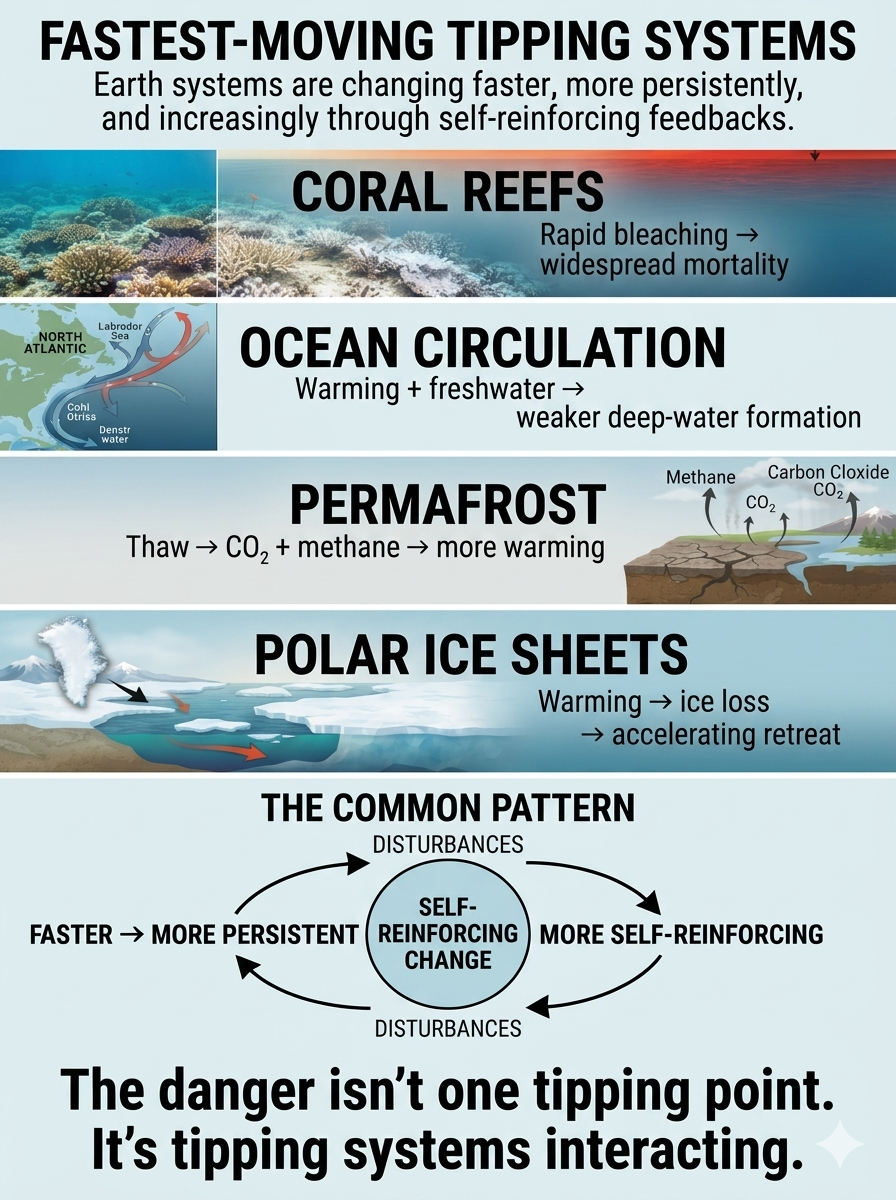
Fastest-Moving Tipping Systems

Coral Reef Die-Offs

Warm-water coral reef dieback is widely recognized as one of the clearest examples of an Earth-system tipping point now being actively crossed—and among the major ecological tipping systems, it is showing some of the fastest rates of deterioration. Driven by record-breaking marine heatwaves associated with global temperatures approaching 1.4°C above pre-industrial levels, widespread coral mortality is unfolding across the world’s tropical oceans. The scale and speed of reef degradation are exceeding many earlier projections.

Repeated mass-bleaching events are causing widespread coral mortality and ecological degradation. As heat stress becomes more frequent and severe, many reefs are losing their ability to recover between bleaching events, making warm-water coral ecosystems one of the fastest-collapsing major ecological systems on Earth.

Subpolar Ocean Circulation

Deep-water formation in the Labrador Sea and North Atlantic is showing signs of increasing instability as warming and freshwater influx from melting ice alter ocean density and circulation. Continued weakening could disrupt regional and global climate patterns.

Permafrost Thaw

Arctic permafrost is degrading as temperatures rise, releasing carbon dioxide and methane that have accumulated in frozen soils over thousands of years. Accelerating thaw creates a potentially self-reinforcing feedback: warming increases permafrost loss, which releases additional greenhouse gases and contributes to further warming.

Polar Ice Sheets

Parts of the Greenland and West Antarctic ice sheets are experiencing accelerating mass loss. As ice sheets retreat, feedbacks involving surface elevation, ocean heat, ice dynamics, and albedo can increase instability and make further ice loss increasingly difficult to reverse.

The Common Pattern

These systems differ in their physical mechanisms, but they share a critical characteristic: change is becoming faster, more persistent, and increasingly self-reinforcing.

The danger is not simply that individual tipping systems may cross thresholds. It is that multiple systems can interact, creating cascading feedbacks that accelerate Earth-system change beyond the rate suggested by any single process alone.

bookmark_borderClimate Change and the Global Insurance Crisis: Rising Losses, Retreating Insurers, and the Growing Protection Gap

by Daniel Brouse

Climate change is fundamentally destabilizing insurance markets by driving increasingly severe financial losses, pushing premiums sharply higher, and causing insurers to reduce or withdraw coverage in some high-risk regions. As extreme weather events become more frequent and, in many cases, more intense, traditional underwriting models are being challenged by rapidly changing risk. The result is a growing transfer of financial risk from private insurers to consumers, businesses, lenders, and governments.

The Protection Gap Crisis

One of the clearest signs of growing insurance instability is the widening protection gap—the difference between total economic losses from disasters and the portion covered by insurance.

In many climate-vulnerable regions, the majority of disaster losses remain uninsured. The gap can be particularly severe in developing economies, where insurance penetration is low and households, businesses, and governments may lack the financial resources to recover from catastrophic events.

This creates a dangerous feedback loop:

More extreme losses → higher insurance costs → reduced coverage → greater uninsured losses → greater financial vulnerability

The protection gap is therefore not simply an insurance problem. It is increasingly a problem of household financial security, economic resilience, infrastructure recovery, and public finance.

Corporate Pullbacks From High-Risk Regions

Insurers are increasingly reassessing their exposure to regions where climate-related risks are becoming more difficult to price and manage.

In some high-risk markets, major insurers have stopped writing certain types of new business, declined to renew policies, restricted coverage, increased deductibles, or imposed substantially higher premiums. These trends have been especially visible in wildfire-prone areas of California and hurricane- and flood-exposed coastal regions.

When private carriers retreat, governments and state-sponsored insurance programs often become insurers of last resort. This can concentrate risk in public or quasi-public systems while leaving taxpayers increasingly exposed to catastrophic losses.

Systemic Financial Risks

Mortgage Market Threats

Property insurance is closely connected to the housing and banking systems because mortgage lenders generally require borrowers to maintain adequate insurance on the underlying property.

As premiums rise and coverage becomes more difficult to obtain, homeowners can face rapidly increasing housing costs even when their mortgage payment remains unchanged. In the most exposed markets, some properties may become effectively uninsurable or prohibitively expensive to insure.

This creates a potential chain reaction:

Climate risk → higher insurance costs → declining property affordability → falling property values → mortgage stress → increased financial-system risk

The burden can fall disproportionately on lower-income homeowners, who have less capacity to absorb sudden increases in insurance and other climate-related costs.

Macroeconomic Volatility

Rising insurance premiums can also contribute to broader economic volatility. Insurance is an input into housing, transportation, agriculture, construction, business operations, and investment.

When insurers raise premiums to reflect increased catastrophe risk, those costs can eventually be passed through to consumers in the form of higher rents, housing costs, food prices, transportation costs, and prices for other goods and services.

In particularly vulnerable areas, insurance costs can also influence where people are willing and able to live. If housing becomes prohibitively expensive to insure—or insurance becomes unavailable altogether—households and businesses may begin relocating toward less exposed regions.

Climate change can therefore contribute to climate-driven migration within countries and across regions, even before an area becomes physically uninhabitable.

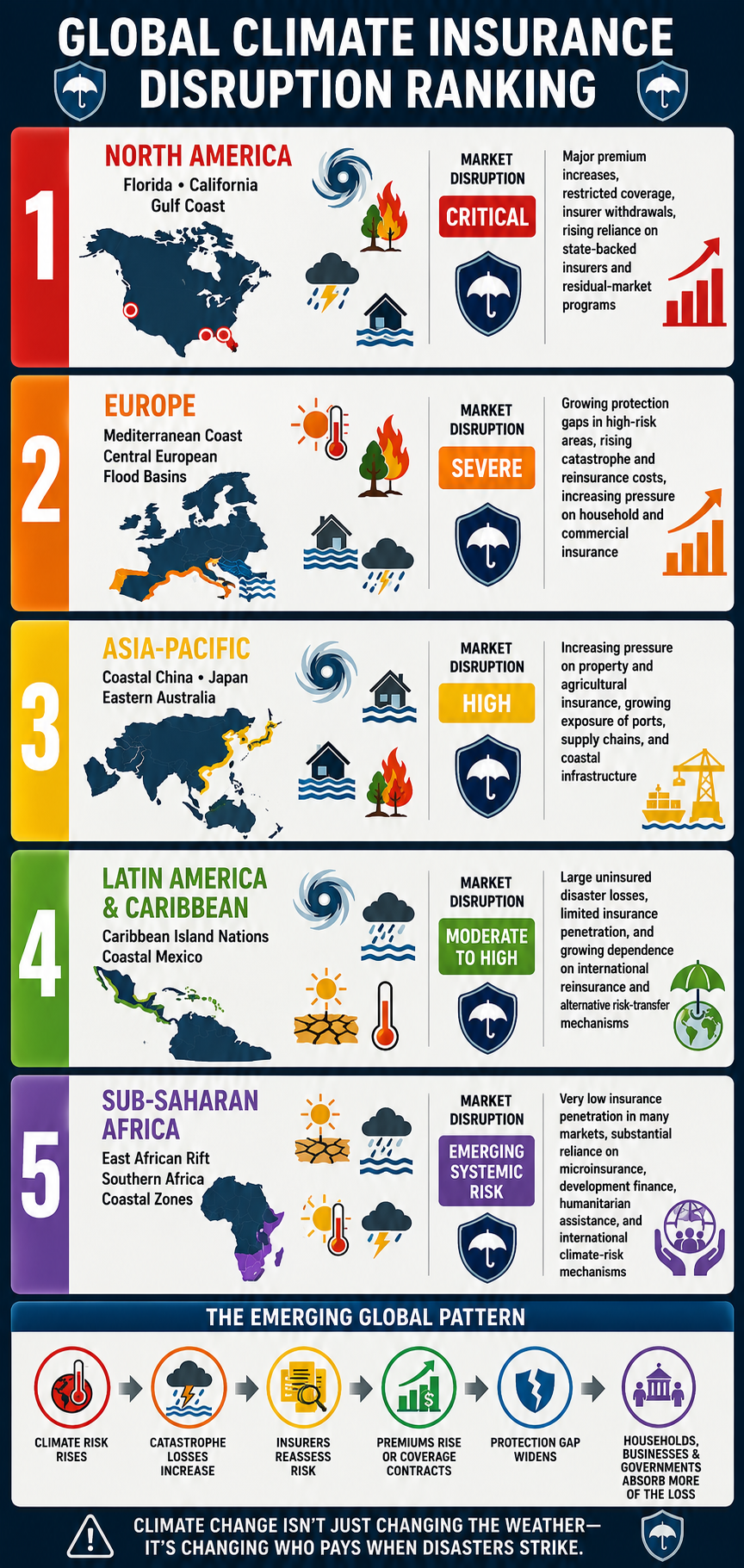
Global Climate Insurance Disruption Ranking

The global property and casualty (P&C) insurance market is experiencing very different levels of stress depending on regional climate hazards, catastrophe exposure, insurance penetration, regulatory frameworks, and the capacity of governments to absorb residual risk.

The following ranking identifies major regions experiencing significant climate-driven insurance disruption, moving from the most acute and visible market stress toward regions where systemic pressures are emerging or are likely to intensify.

Global RankVulnerable RegionKey Impacted AreasPrimary Climate PerilsMarket Disruption LevelKey Insurance Market Impact
1North AmericaFlorida; California; Gulf CoastHurricanes, wildfires, severe convective storms, floodingCriticalMajor premium increases, restricted coverage, insurer withdrawals from selected markets, rising reliance on state-backed insurers and residual-market programs
2EuropeMediterranean coast; Central European flood basinsExtreme heat, wildfires, flooding, severe stormsSevereGrowing protection gaps in high-risk areas, rising catastrophe and reinsurance costs, increasing pressure on household and commercial insurance
3Asia-PacificCoastal China; Japan; eastern AustraliaTyphoons, sea-level rise, flooding, bushfiresHighIncreasing pressure on property and agricultural insurance, growing exposure of ports, supply chains, and coastal infrastructure
4Latin America & CaribbeanCaribbean island nations; coastal MexicoHurricanes, flooding, drought, extreme heatModerate to HighLarge uninsured disaster losses, limited insurance penetration, and growing dependence on international reinsurance and alternative risk-transfer mechanisms
5Sub-Saharan AfricaEast African Rift; southern African coastal zonesMulti-year droughts, flooding, extreme heat, severe stormsEmerging Systemic RiskVery low insurance penetration in many markets, substantial reliance on microinsurance, development finance, humanitarian assistance, and international climate-risk mechanisms

The Emerging Global Pattern

The geographic details differ, but the underlying pattern is increasingly similar:

Climate risk rises → catastrophe losses increase → insurers reassess risk → premiums rise or coverage contracts → the protection gap widens → households, businesses, and governments absorb more of the loss.

This represents a fundamental challenge to the traditional concept of insurability.

Insurance works most effectively when risks are sufficiently predictable, geographically diversified, and economically manageable. Climate change can undermine all three conditions simultaneously. When catastrophic risks become correlated across large geographic areas, historical loss data become less reliable as a guide to future exposure, and the cost of transferring risk through reinsurance increases.

The consequences extend well beyond the insurance industry.

A property that cannot be affordably insured can become difficult to finance. A home that cannot be financed can lose market value. A business that cannot obtain affordable coverage can become less competitive or relocate. A community facing repeated disasters can experience declining tax revenues while public recovery costs rise.

The insurance market is therefore becoming an increasingly important early-warning indicator of climate-driven financial stress.

What begins as a change in weather risk can ultimately become a problem involving housing, banking, inflation, public budgets, infrastructure, migration, and regional economic stability.

The question is no longer simply whether climate change is generating larger physical losses.

It is whether the global financial system can continue to price, distribute, and absorb those losses at a sustainable cost.

bookmark_borderThe Water Cycle’s Extreme Energy Transfer

Latent Heat and You

By Daniel Brouse

You probably think of the water cycle as a simple process:

Evaporation → clouds → rain

But there is something hidden inside that cycle: energy.

Every time water evaporates, enormous amounts of energy move from one place to another. As climate change warms the oceans and atmosphere, this energy-transfer system is becoming more powerful—and you may see the consequences right outside your back door.


The Invisible Energy Transfer

When sunlight warms the ocean, some of that energy becomes heat stored in the water.

But the ocean also has a powerful way to get rid of heat: evaporation.

When a water molecule changes from liquid to vapor, it takes energy with it. That energy is called latent heat.

Approximately:

1 kilogram of evaporated water = about 2.45 megajoules of energy transported into the atmosphere.

That is energy you cannot see.

The water vapor can then travel hundreds or thousands of miles before it condenses into clouds and rain.

When condensation occurs, the stored energy is released back into the atmosphere as heat.

So the basic process is:

Ocean heat → evaporation → water vapor → atmospheric transport → condensation → heat released into the atmosphere

The water cycle is therefore also an energy-transfer system.


Why Does Climate Change Matter?

A warmer planet changes both sides of this process.

Warmer ocean water provides more energy for evaporation.

At the same time, warmer air can contain more water vapor. The Clausius-Clapeyron relationship tells us that the atmosphere’s capacity to hold water vapor increases by roughly 7% for every 1°C (1.8°F) of warming.

That does not mean rainfall increases everywhere by 7%. Weather patterns, circulation, geography, and seasonal conditions still determine where and when rain occurs.

But it does mean that when the atmosphere has access to additional moisture, there is more water—and therefore more latent energy—available to move through the weather system.

Think of the atmosphere as carrying an invisible reservoir of water and stored energy.

As that reservoir grows, some weather events can become more intense.


The Same Energy Can Help Produce Drought AND Flooding

This is where things become especially important.

During a hot, dry period, increased evaporation can pull moisture out of:

Soil → vegetation → lakes → streams

That can accelerate drying.

The sequence can look like:

Heat → increased evaporation → soil moisture loss → stressed vegetation → flash drought → wildfire risk

Then the weather pattern changes.

Moisture that has accumulated over warm oceans can be transported into the region. When that moisture rises and condenses, its stored latent heat is released into the atmosphere.

The sequence can become:

Warm ocean → evaporation → water vapor → moisture transport → rising air → condensation → latent heat release → stronger convection → heavier rainfall

The result can be a rapid transition from extreme dryness to extreme rainfall.

This is one component of what scientists call hydroclimatic whiplash.


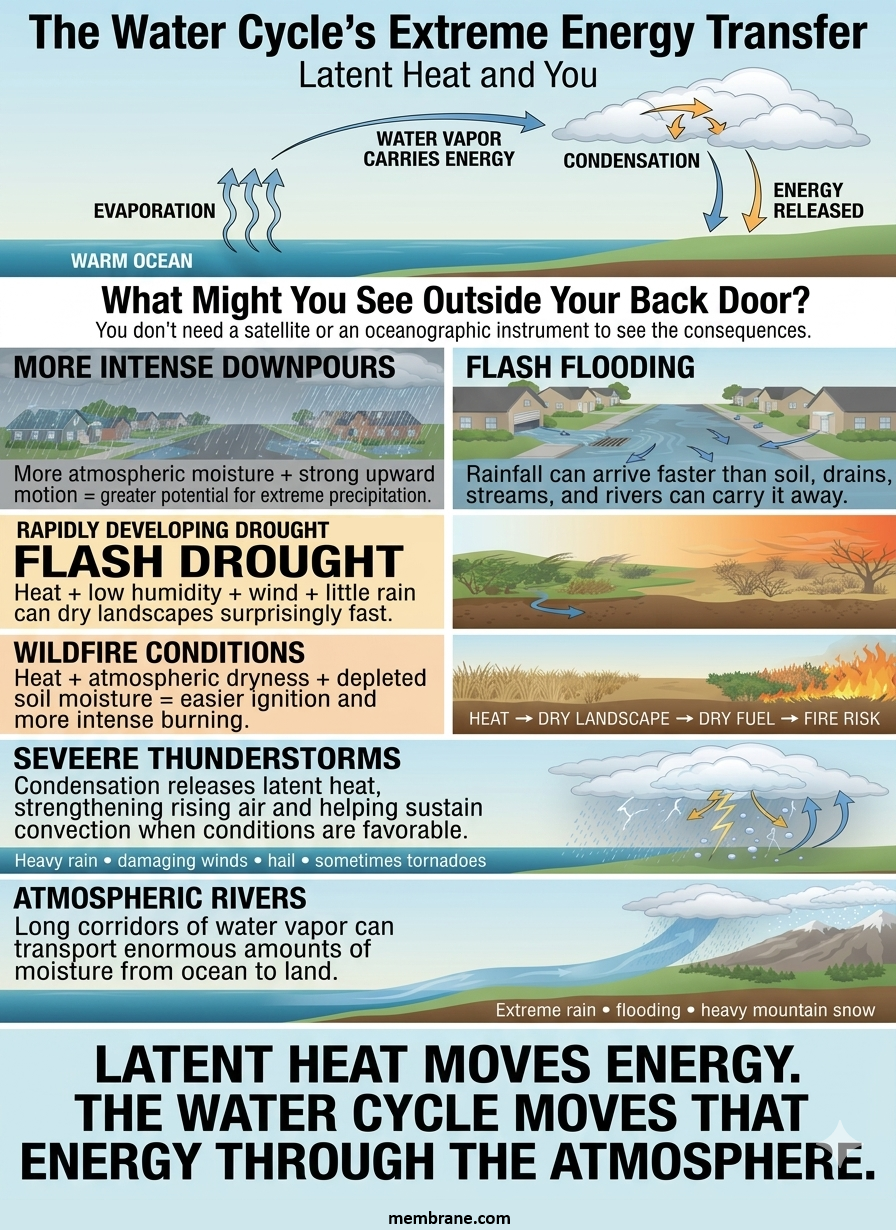
What Might You See Outside Your Back Door?

You don’t need a satellite or an oceanographic instrument to see the consequences.

You may notice:

More intense downpours

Instead of a steady, moderate rain, you may experience rainfall that dumps a large amount of water in a short period.

More atmospheric moisture + strong upward motion = greater potential for extreme precipitation.

Flash flooding

When rainfall arrives faster than soil, storm drains, streams, and rivers can absorb or carry it away, water rapidly accumulates.

A few hours of extreme rainfall can overwhelm systems designed for older precipitation patterns.

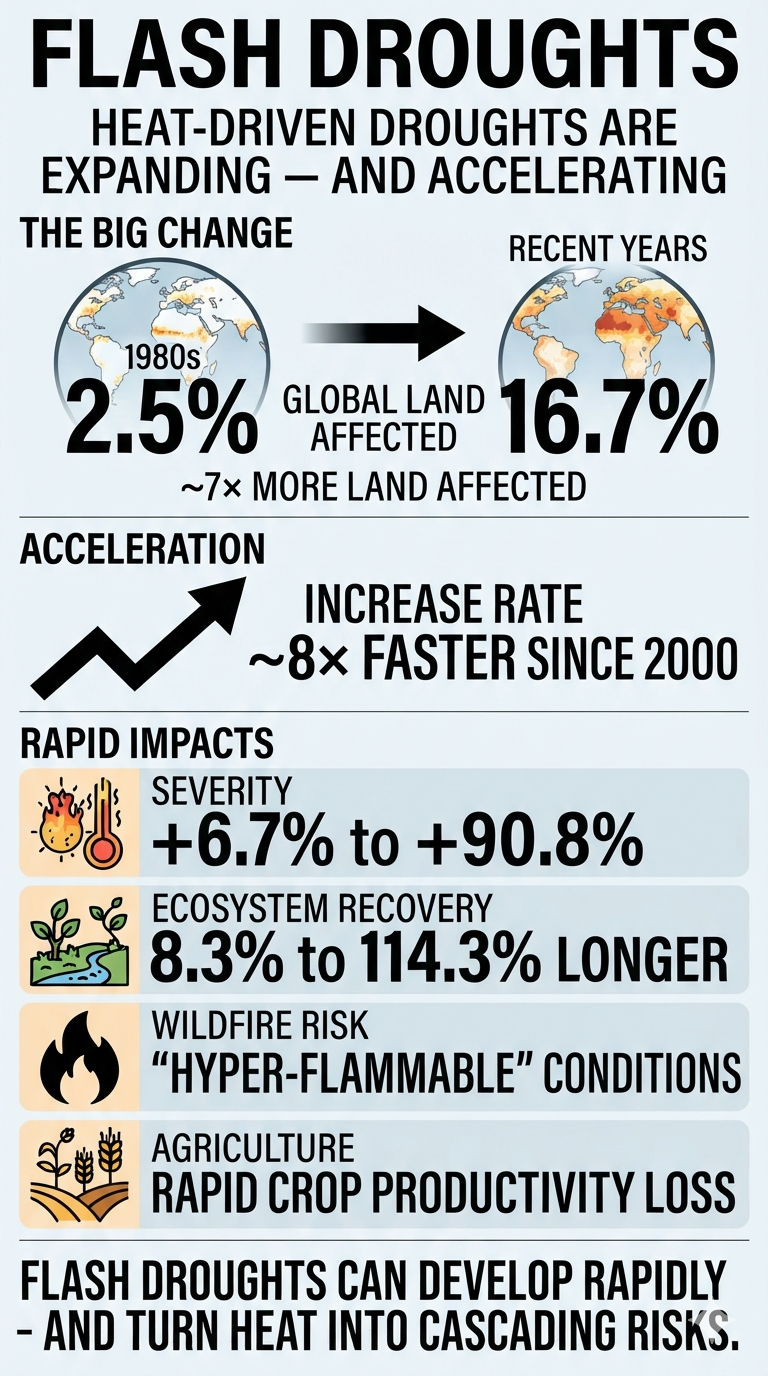
Rapidly developing drought

A landscape can dry surprisingly quickly when high temperatures combine with low humidity, wind, and a lack of rainfall.

This can produce flash droughts that develop much faster than traditional droughts.

Wildfire conditions

Dry vegetation becomes fuel.

Heat + atmospheric dryness + depleted soil moisture can create landscapes that ignite more easily and burn more intensely.

Severe thunderstorms

Condensation releases latent heat into storm clouds. That energy can strengthen rising air and help sustain convection when other atmospheric conditions are favorable.

The result can include stronger thunderstorms, torrential rain, damaging winds, hail, and sometimes tornadoes.

Atmospheric rivers

Long corridors of moisture can transport enormous quantities of water vapor from the ocean toward land.

When those moisture streams encounter favorable atmospheric conditions, they can produce extreme rainfall, flooding, and—in mountainous regions—heavy snowfall.


The Climate Change Connection

The important point is not that climate change “causes every storm.”

It doesn’t.

Weather is still controlled by many interacting factors, including atmospheric pressure, temperature gradients, moisture gradients, winds, fronts, topography, and natural climate variability.

Climate change changes the background conditions in which those weather systems operate.

A warmer atmosphere can hold more moisture.

A warmer ocean can provide more moisture through evaporation.

A warmer climate can increase evaporative demand over land.

And when abundant moisture eventually condenses, the release of latent heat can add energy to developing storms.

The result is a climate system with the potential for more extreme swings:

Heat → drying → drought → wildfire

followed by:

Moisture transport → intense rainfall → flooding → erosion

And sometimes the cycle can repeat.


The Hidden Energy in a Raindrop

The next time you watch a heavy rainstorm from your back door, consider what you are actually seeing.

That rain began as water somewhere else—often over an ocean.

Energy from the Earth’s climate system helped evaporate it.

Atmospheric circulation transported it.

The water vapor eventually rose, cooled, and condensed.

And when it condensed, the energy stored during evaporation was released into the atmosphere.

What looks like “just rain” is actually the final visible stage of a massive planetary energy-transfer process.

The water cycle moves water.

The latent heat cycle moves energy.

And climate change is altering both.


The Bottom Line

The most important idea is simple:

Warm oceans → more evaporation → more atmospheric moisture → more latent energy available to weather systems.

At the same time:

Hotter land → greater evaporative demand → faster drying → greater drought and wildfire risk.

Those two pathways can collide when atmospheric circulation transports moisture into a region that has just experienced prolonged heat and dryness.

That is the essence of hydroclimatic whiplash:

Drought can be followed by flooding.

Wildfire conditions can be followed by extreme rainfall.

A warming climate can produce both more intense drying and more intense precipitation.

The water cycle is not just about where the water goes.

It is about where the energy goes.

And as the planet warms, understanding that hidden energy transfer is increasingly important to understanding the extreme weather we can see right outside our own back doors.

bookmark_borderThe Latent Heat Engine: Ocean Evaporation, Water Vapor Feedback, and the Acceleration of Hydroclimatic Whiplash

By Daniel Brouse

Abstract

The ocean is Earth’s largest reservoir of stored thermal energy and a central component of the climate system’s energy redistribution machinery. One of the most important pathways by which the ocean transfers energy to the atmosphere is latent heat flux associated with evaporation.

When liquid water evaporates, energy is removed from the ocean surface and stored as latent heat in atmospheric water vapor. When that vapor subsequently condenses, the stored energy is released as heat into the atmosphere.

This phase-change process does far more than move energy from one location to another. It couples ocean warming, atmospheric moisture, radiative forcing, atmospheric circulation, precipitation intensity, drought, wildfire risk, flooding, and other components of the climate system.

As greenhouse-gas-driven warming increases atmospheric moisture capacity and raises ocean temperatures, the hydrological cycle intensifies. The result is a climate system capable of moving greater quantities of energy and water through the atmosphere while increasing the potential for rapid transitions between extreme dryness and extreme precipitation.

This paper examines the latent heat engine as a mechanism linking ocean warming to atmospheric energy redistribution and explores how water-vapor feedback, moisture transport, precipitation intensification, soil-moisture depletion, wildfire risk, and hydroclimatic whiplash can interact to amplify the impacts of global warming.


1. The Ocean as a Planetary Energy Reservoir

The ocean absorbs the overwhelming majority of the excess energy accumulating in Earth’s climate system as a result of greenhouse-gas forcing. Much of this energy is stored as sensible heat—the thermal energy associated with the temperature of seawater.

The ocean, however, does not simply store this energy indefinitely. It continuously exchanges energy with the atmosphere and space through several pathways:

• Latent heat flux: energy transferred through evaporation.

• Longwave radiation: thermal infrared energy emitted by the ocean surface.

• Sensible heat flux: direct transfer of thermal energy between the ocean and atmosphere.

• Other fluxes: including energy associated with ocean currents and other processes.

Of these pathways, latent heat transfer through evaporation is the largest single component of the ocean’s surface energy loss under typical global-mean conditions.

Evaporation therefore functions as a planetary-scale cooling mechanism. The ocean supplies the energy required to convert liquid water into water vapor, transferring energy from the ocean into the atmosphere in a form that can subsequently be transported over enormous distances.

The approximate latent heat of vaporization of water is:

Lv ≈ 2.45 × 10⁶ J/kg

Thus, evaporation of one kilogram of water requires roughly 2.45 megajoules of energy under ordinary surface conditions.

That energy does not disappear. It is stored temporarily as latent heat in the water vapor.


2. The Ocean-Atmosphere Refrigeration Loop

The process can be conceptualized as a planetary refrigeration loop:

OCEAN ENERGY RESERVOIR
↓
Warm ocean water
↓
EVAPORATION AT THE SURFACE
↓
Latent heat removed from the ocean
↓
WATER VAPOR FORMED
↓
Transported by atmospheric circulation
↓
CONDENSATION IN THE ATMOSPHERE
↓
Latent heat released
↓
ATMOSPHERIC HEATING
↓
Convection and circulation
↓
CLOUDS • STORMS • PRECIPITATION

The critical point is that evaporation and condensation occur in different places and often at different times.

Evaporation extracts energy from the ocean surface. Atmospheric circulation can then transport the water vapor—and the latent energy associated with it—hundreds or thousands of kilometers before condensation releases that energy.

This creates a profound spatial separation between where energy is extracted and where energy is released.

A tropical ocean can therefore function as the energy source for atmospheric processes whose consequences occur far away, including over continents, midlatitude storm tracks, mountain ranges, and polar regions.


3. Evaporation: Extracting Energy From the Ocean

Evaporation occurs at the air-sea interface and is strongly influenced by sea-surface temperature, atmospheric humidity, wind speed, and the moisture gradient between the ocean and atmosphere.

When water molecules escape from the liquid surface into the atmosphere, they carry away latent energy.

The immediate effect is cooling of the evaporating surface.

Evaporation also preferentially removes water rather than dissolved salts, so sustained evaporation increases the salinity of the remaining surface water unless offset by precipitation, river discharge, or mixing.

The fundamental energy transfer can therefore be expressed as:

Ocean sensible heat → latent heat stored in atmospheric water vapor

The ocean has effectively converted thermal energy into a mobile atmospheric energy reservoir.


4. Condensation: Releasing the Stored Energy

When moist air rises and cools, it can reach saturation. Water vapor then condenses into cloud droplets or deposits as ice.

The reverse phase change releases approximately the same latent energy that evaporation consumed:

Water vapor → liquid water or ice + latent heat released

That released energy becomes thermal energy within the surrounding atmosphere.

This is known as latent heating.

Latent heating is fundamental to atmospheric convection. When condensation releases heat inside a rising air column, it can increase buoyancy and alter pressure gradients and circulation. In sufficiently favorable environments, this can intensify thunderstorms, tropical cyclones, mesoscale convective systems, and other weather phenomena.

The atmosphere therefore functions not merely as a passive recipient of ocean heat, but as a dynamic energy-transfer system.


5. The Spatial Mismatch: Moving Energy Across the Planet

One of the most consequential characteristics of latent heat transfer is its ability to transport energy far from its source.

The sequence is:

Warm ocean
→ Evaporation
→ Latent energy stored in water vapor
→ Atmospheric moisture transport
→ Rising and cooling air
→ Condensation
→ Latent heat release
→ Atmospheric circulation and precipitation

Energy extracted from a tropical ocean may therefore ultimately be released over a distant continent or at higher latitudes.

This creates a connection between ocean heat, atmospheric moisture transport, and extreme precipitation.

The hydrological cycle is therefore also an energy-transport cycle.


6. Climate Warming Supercharges the Hydrological Cycle

Greenhouse-gas warming alters this system in two important ways.

First, warmer oceans provide greater opportunity for evaporation.

Second, a warmer atmosphere can contain substantially more water vapor before reaching saturation. The Clausius-Clapeyron relationship indicates that the saturation vapor pressure of air increases by approximately 7% per °C of warming near Earth’s surface under typical conditions.

This does not mean that global atmospheric water vapor automatically increases by exactly 7% for every degree of warming. Actual atmospheric moisture depends on circulation, relative humidity, surface conditions, and moisture availability.

Nevertheless, the thermodynamic relationship creates a powerful constraint:

Warmer air
→ Greater moisture-holding capacity

This contributes to:

Warmer ocean
→ Greater evaporation
→ More atmospheric moisture
→ Greater latent energy reservoir

The result is an increasingly energetic hydrological cycle.


7. The Water-Vapor Feedback

Water vapor is itself a powerful greenhouse gas.

As the atmosphere warms, its capacity to contain water vapor increases. Increased atmospheric water vapor enhances absorption and re-emission of outgoing longwave radiation, contributing additional warming.

This creates a positive feedback:

Greenhouse-gas forcing
→ Atmospheric warming
→ Greater atmospheric moisture capacity
→ More water vapor
→ Greater greenhouse trapping
→ Additional warming
→ Further moisture increase

Water vapor therefore acts primarily as a feedback rather than the initial forcing in the present anthropogenic warming problem.

Carbon dioxide and other long-lived greenhouse gases initiate and sustain the radiative forcing. Water vapor responds rapidly to temperature changes and amplifies the resulting warming.

The water-vapor feedback is consequently one of the major mechanisms through which an initial forcing becomes a larger climate response.


8. From Water Vapor to Hydroclimatic Whiplash

The most consequential feature of an intensified hydrological cycle may not simply be greater average precipitation.

It is the potential for greater variability and more intense precipitation occurring alongside accelerated drying between events.

This creates the conditions for hydroclimatic whiplash:

HYDROCLIMATIC WHIPLASH

Warming + high evaporative demand
↓
Rapid moisture loss from the land surface
↓
Flash drought
↓
Vegetation stress and wildfire risk

At the same time:

Greater atmospheric moisture capacity
↓
Increased moisture transport
↓
Moisture convergence and atmospheric ascent
↓
Condensation
↓
Latent heating
↓
Stronger convection
↓
Extreme precipitation
↓
Flooding

The same warming that increases atmospheric moisture capacity can therefore contribute to both drying and flooding extremes, depending on atmospheric circulation, surface conditions, and moisture availability.


9. The Dry Phase: Accelerated Evaporation

During periods without sufficient precipitation, increased evaporative demand can rapidly remove water from soils, vegetation, and surface reservoirs.

The sequence can become:

Warming
→ Higher evaporative demand
→ Soil-moisture loss
→ Vegetation stress
→ Flash drought
→ Wildfire vulnerability

This process is especially important when high temperatures, low relative humidity, strong winds, and persistent atmospheric ridging occur simultaneously.

The landscape can therefore transition rapidly from merely dry to extremely flammable.

Loss of vegetation and soil moisture can then produce secondary consequences, including reduced evaporative cooling, increased surface temperatures, ecological stress, agricultural losses, and increased wildfire potential.


10. The Wet Phase: Atmospheric Moisture as Stored Energy

The opposite phase occurs when moisture-rich air encounters atmospheric conditions capable of producing large-scale ascent and condensation.

A warmer atmosphere can transport more water vapor, and when that moisture converges and rises, the resulting condensation can release substantial latent heat.

The process can become:

Warm ocean
→ Enhanced evaporation
→ Greater atmospheric moisture
→ Moisture transport
→ Moisture convergence
→ Atmospheric ascent
→ Condensation
→ Latent heating
→ Stronger convection

This does not mean every heavy precipitation event is directly caused by latent heat release. Atmospheric dynamics, instability, moisture convergence, topography, fronts, and storm-scale processes all matter.

However, latent heating can provide an important positive dynamical feedback within convective systems.


11. The Atmospheric Pump

Condensation releases latent heat into the rising air column.

That heating can increase buoyancy and sustain or strengthen upward motion. Stronger ascent can promote additional condensation, which releases additional latent heat.

The simplified feedback is:

Moisture
→ Condensation
→ Latent heating
→ Increased buoyancy
→ Atmospheric ascent
→ More condensation

This is one reason latent heating is so important to intense convective weather.

In tropical cyclones, for example, condensation within deep convection is a major energy source supporting the storm’s circulation. Similar thermodynamic processes operate in severe thunderstorms and other convective systems.


12. From Atmospheric Rivers to Hydroclimatic Whiplash

An atmosphere carrying greater quantities of water vapor can transport larger moisture fluxes when circulation patterns are favorable.

When this moisture converges over land, particularly against mountains or along strong frontal boundaries, precipitation can become extreme.

This produces a potentially damaging sequence:

Ocean warming
→ Greater evaporation
→ Greater atmospheric moisture
→ Long-distance moisture transport
→ Moisture convergence
→ Extreme precipitation

If this occurs after a prolonged dry period, the consequences can be amplified.

A landscape already stressed by drought may suddenly receive enormous rainfall volumes. Much of that water may run off rather than infiltrate efficiently, especially where soils are hardened, vegetation has been damaged, or wildfire has altered the surface.

Thus:

Drought
→ Wildfire / vegetation loss
→ Reduced infiltration
→ Extreme rainfall
→ Runoff
→ Flooding and erosion

The resulting cycle is not simply drought followed by rain.

It is a hydroclimatic whiplash regime in which the physical consequences of one extreme can increase vulnerability to the next.


13. Secondary Feedbacks

The intensified water and energy cycle interacts with several additional climate feedbacks.

13.1 Cloud Feedback

Clouds exert competing radiative effects.

Low, thick clouds can reflect incoming solar radiation and produce cooling, while high, thin clouds can allow much of incoming sunlight to pass through while efficiently absorbing outgoing infrared radiation.

Cloud responses to warming are therefore complex and regionally variable. They should not be reduced to a simple assumption that “more clouds equals warming.”

Nevertheless, changes in cloud amount, altitude, optical properties, and lifetime can alter Earth’s radiation budget and therefore interact with the broader climate feedback system.

13.2 Land-Surface Feedback

Evaporation normally consumes energy and cools the land surface.

When soil moisture becomes depleted, less energy can be transferred through evapotranspiration. More incoming energy therefore remains available for sensible heating.

The feedback can become:

Soil drying
→ Less evapotranspiration
→ Less evaporative cooling
→ Higher surface temperature
→ Greater atmospheric dryness / evaporative demand
→ Further soil drying

This is particularly important during heat waves and drought.

13.3 Cryosphere Feedbacks

Moisture transported toward high latitudes can contribute to precipitation over ice sheets and glaciers. The climate effect depends on whether precipitation falls as snow or rain and on the season, elevation, and surface energy balance.

Meanwhile, warming itself can reduce snow and ice cover, lowering surface albedo and increasing absorption of solar radiation.

Thus, moisture transport interacts with the cryosphere in ways that can either temporarily increase mass accumulation or accelerate surface melting, depending on conditions.


14. The Central Feedback Architecture

The complete system is best understood not as a single feedback loop, but as an interconnected network:

GREENHOUSE-GAS FORCING
↓
GLOBAL WARMING
↓
┌───────────────────────────────┐
↓ ↓
WARMER OCEANS WARMER ATMOSPHERE
↓ ↓
MORE EVAPORATION GREATER MOISTURE CAPACITY
↓ ↓
└──────────────┬────────────────┘
↓
MORE WATER VAPOR
↓
┌────────┴─────────┐
↓ ↓
WATER-VAPOR MOISTURE TRANSPORT
GREENHOUSE ↓
FEEDBACK MOISTURE CONVERGENCE
↓ ↓
MORE WARMING ┌──────┴───────┐
↓ ↓
HEAVY RAINFALL LATENT HEATING
↓ ↓
FLOODING CONVECTIVE ENERGY
↓
STRONGER CONVECTION

Meanwhile:

WARMING + EVAPORATIVE DEMAND
↓
SOIL-MOISTURE LOSS
↓
FLASH DROUGHT
↓
VEGETATION STRESS
↓
WILDFIRE RISK
↓
LANDSCAPE DEGRADATION
↓
REDUCED INFILTRATION
↓
EXTREME RAINFALL
↓
RUNOFF / EROSION
↓
HYDROCLIMATIC WHIPLASH

The important point is that these are coupled processes, not independent events.

Ocean warming changes evaporation. Evaporation changes atmospheric moisture. Atmospheric moisture changes radiative forcing and precipitation potential. Precipitation changes soil moisture. Soil moisture changes surface temperature and wildfire risk. Wildfire and vegetation loss change runoff and infiltration. Extreme rainfall then interacts with the altered landscape.

The system contains multiple reinforcing pathways.


15. Why This Matters for Climate Acceleration

Climate change is often described as a gradual increase in global mean temperature.

That description is mathematically useful but physically incomplete.

The impacts experienced by societies are produced by the interaction of temperature with:

• atmospheric moisture
• ocean heat
• evaporation
• precipitation
• soil moisture
• atmospheric circulation
• wildfire
• snow and ice
• flooding
• drought
• ecosystems
• agriculture
• infrastructure
• human vulnerability

Consequently, the consequences of warming can increase faster than the mean temperature itself.

A relatively small change in global mean temperature can alter the probability, intensity, and interaction of multiple extremes.

This is one reason climate impacts can appear increasingly nonlinear.


16. The Latent Heat Engine as an Accelerator of Climate Impacts

The fundamental physical relationship is straightforward:

Ocean heat
→ Evaporation
→ Atmospheric water vapor
→ Latent energy transport
→ Condensation
→ Atmospheric heating

But the consequences extend well beyond this basic energy transfer.

The intensified cycle can simultaneously produce:

More evaporation
+
More water vapor
+
Greater moisture transport
+
Greater latent heating
+
Greater precipitation potential
+
Greater evaporative demand

This creates the thermodynamic foundation for a climate capable of greater swings between extreme wetness and extreme dryness.

Hydroclimatic whiplash is therefore not an independent phenomenon disconnected from global warming. It can emerge from the interaction between a warmer atmosphere, a warmer ocean, intensified moisture transport, changing circulation, and the land surface’s declining ability to buffer extreme moisture losses and gains.


17. Final Assessment

Latent heat transfer through evaporation is a fundamental component of the ocean-atmosphere energy budget and the largest single mechanism of ocean surface energy loss under typical global-mean conditions.

Its significance extends far beyond cooling the ocean.

Evaporation transfers energy from the ocean into atmospheric water vapor. Atmospheric circulation transports that moisture and its associated latent energy across large distances. Condensation subsequently releases the stored energy as latent heat, helping power atmospheric convection and precipitation.

Anthropogenic warming intensifies the conditions under which this system operates. Warmer oceans increase evaporation potential, while warmer air can support substantially more water vapor. Water vapor then strengthens the greenhouse effect, while increased atmospheric moisture can increase the potential for extreme precipitation when moisture converges and air rises.

At the land surface, increased evaporative demand can accelerate soil-moisture depletion, flash drought, vegetation stress, and wildfire risk. When moisture-rich air subsequently arrives and precipitation becomes extreme, the same climate system can shift abruptly from drought to flooding.

The resulting system can be summarized as:

Warming
→ Evaporation
→ Water vapor
→ Latent energy transport
→ Condensation
→ Atmospheric heating
→ Extreme precipitation

while simultaneously:

Warming
→ Evaporative demand
→ Soil-moisture loss
→ Flash drought
→ Wildfire risk

The two pathways ultimately intersect through hydroclimatic whiplash.

The central conclusion is therefore not simply that a warmer planet contains more water vapor. It is that warming is altering the planet’s energy-and-water transport machinery.

The hydrological cycle is also a thermodynamic engine.

As the climate warms, that engine can move greater quantities of water and latent energy through the atmosphere, increasing the potential for rapid transitions among heat, drought, wildfire, extreme precipitation, flooding, and other cascading impacts.

Understanding this latent heat engine is therefore essential to understanding why the consequences of global warming can become increasingly interconnected, nonlinear, and disruptive even when changes in global mean temperature appear comparatively gradual.

bookmark_borderHeat-Triggered Flash Droughts: The Rapid Intensification of Heat, Drought, and Wildfire Risk

by Daniel Brouse

The Trend

Flash droughts are one of the three fastest-accelerating climate extremes. The share of global land affected by heat-driven drought has expanded dramatically—from approximately 2.5% in the 1980s to 16.7% in recent years. The rate of increase has also accelerated, rising roughly eightfold since 2000.

This shift is important because heat-triggered droughts behave differently from conventional droughts. Rather than developing gradually over months or years, they can emerge within weeks, leaving agriculture, ecosystems, water managers, and communities with far less time to respond.

The Impact

Heat-triggered flash droughts are rapid-onset, severe moisture deficits initiated or intensified by extreme heat and unusually high atmospheric dryness, rather than simply by a prolonged lack of precipitation.

Think of the process as a high-powered hair dryer aimed at the landscape. Extreme heat and dry air rapidly pull moisture from vegetation and soils. As available moisture disappears, plants become stressed, agricultural productivity declines, wildfire danger rises, and water supplies can deteriorate—all on a timescale far shorter than that of conventional drought.

The result is a compound climate hazard in which heat and drought reinforce one another, producing impacts that can escalate rapidly.

The Mechanics of “Hair Dryer” Droughts

Conventional droughts often develop gradually, giving ecosystems and communities more time to adjust. Flash droughts can materialize within weeks, particularly when extreme heat coincides with atmospheric dryness.

1. Evapotranspiration Spike

Extreme temperatures combined with a high vapor pressure deficit (VPD) increase the atmosphere’s demand for moisture. Water is transferred from soil and vegetation into the atmosphere at an unsustainable rate.

This accelerated evapotranspiration rapidly depletes soil moisture and places plants under severe water stress.

2. Soil Overheating

Normally, evaporation of soil moisture helps cool the land surface. As soil moisture disappears, that evaporative cooling weakens.

The ground therefore heats more intensely, creating a feedback loop:

Less soil moisture → less evaporative cooling → hotter soil → greater plant stress → greater moisture loss

The result can be intense soil-temperature extremes that further damage vegetation and agricultural productivity.

3. Regional Differences

The development of heat-triggered flash droughts varies with regional climate and ecosystem characteristics.

In high-latitude and relatively wet regions, extreme heat can rapidly accelerate moisture extraction because vegetation and soils initially contain substantial amounts of water.

In subtropical regions, plants may respond by closing their stomata to conserve water. This can slow immediate moisture loss but also restrict photosynthesis and carbon uptake, increasing longer-term ecosystem stress.

Cascading Ecological Impacts

The combination of extreme heat and rapidly developing dryness can produce impacts substantially greater than those associated with conventional flash droughts.

MetricHeat-Triggered Flash DroughtConventional Flash Drought
Severity6.7%–90.8% higher severityBaseline severity
Ecosystem Recovery8.3%–114.3% longer recovery timesNormal recovery trajectory
Wildfire RiskCan create “hyper-flammable” conditionsElevated baseline fire risk
Primary Agricultural ImpactCan rapidly devastate cropland productivityGeneral agricultural stress

These differences matter because ecosystems may not simply experience a more severe drought—they may experience a faster and more damaging transition from normal conditions to extreme environmental stress.

The Hyper-Flammability Multiplier

One of the most dangerous consequences occurs when a heat-triggered flash drought overlaps an existing conventional drought.

The slow drought has already depleted vegetation and soil moisture. The sudden arrival of extreme heat and atmospheric dryness then accelerates the drying process, pushing vegetation toward an exceptionally flammable state.

This creates a hyper-flammability multiplier:

Existing drought → Extreme heat + dry atmosphere → Rapid vegetation and soil drying → Loss of natural moisture + evaporative cooling → Hyper-flammable landscape → Faster-spreading, more intense wildfires

Once ignited, fires in these conditions can spread more rapidly, burn with greater intensity, and become substantially more difficult to contain.

A Rapidly Escalating Compound Hazard

Heat-triggered flash droughts demonstrate why temperature, atmospheric moisture, soil moisture, drought, and wildfire cannot always be treated as independent hazards.

Extreme heat can accelerate moisture loss. Moisture loss can increase land-surface temperatures. Hotter, drier vegetation becomes more flammable. Wildfires then add another layer of ecological and economic damage.

What once might have been a gradual drought can therefore become a rapidly escalating compound disaster—one capable of overwhelming agricultural, ecological, and emergency-response systems before communities have sufficient time to adapt.

The Four Main Types of Drought—and Where Flash Droughts Fit

Drought is not a single phenomenon. It can be classified according to where the water deficit occurs and how it affects the environment and society. Meteorological drought occurs when a region receives substantially less precipitation than its historical average over a defined period. Agricultural drought occurs when soil moisture falls below levels needed to support healthy plant growth, often intensified by high temperatures and accelerated evapotranspiration. Hydrological drought develops as prolonged water shortages reduce streamflow, river levels, reservoirs, lakes, and groundwater supplies. Socioeconomic drought occurs when limited water supplies begin affecting society, including drinking water, agriculture, energy production, industry, food prices, and other economic systems.

Where Do Flash Droughts Fit?

Flash drought is different from these four categories because it describes the speed and mechanism of drought development, rather than simply the sector or water reservoir being affected.

A flash drought can develop rapidly—often within weeks—when unusually high temperatures, atmospheric dryness, and accelerated evapotranspiration rapidly deplete soil moisture.

In other words, flash drought is best understood as a rapid-onset pathway into agricultural and potentially hydrological drought, rather than a completely separate fifth category.

Meteorological drought → reduced precipitation
Heat-triggered flash drought → extreme heat + atmospheric dryness → rapid moisture loss
Agricultural drought → depleted soil moisture → crop and vegetation stress
Hydrological drought → depleted streams, reservoirs, and groundwater
Socioeconomic drought → water shortages → impacts on people and the economy

Importantly, these pathways do not always occur in sequence. A flash drought can develop with little initial precipitation deficit when extreme heat and high atmospheric moisture demand rapidly extract water from soils and vegetation.

This is what makes heat-triggered flash droughts particularly dangerous: the landscape can transition from relatively normal conditions to severe agricultural and wildfire stress in a matter of weeks, leaving considerably less time for detection, adaptation, and response.