If you’re wondering why rain-related severe weather events are becoming more frequent and intense, it’s due to climate change. Rising temperatures increase the amount of humidity in the atmosphere, as warmer air holds more moisture. The Clausius-Clapeyron equation shows that for every 1°C (1.8°F) increase in temperature, the air can hold about 7% more water vapor.
Many areas in the U.S. are experiencing average temperature increases of up to 10°C, extending over more weeks during both spring and fall. This increase allows the atmosphere to hold about 70% more water vapor, leading to significantly more rainfall. Additionally, raindrops are becoming larger and falling faster, which increases their momentum. Using the formula p=mv (momentum = mass × velocity), larger and faster raindrops carry more energy.
Moreover, the number of raindrops is also increasing. A higher concentration of raindrops in a given time and area further boosts momentum. For example, if N raindrops, each with mass m and velocity v, hit a surface area A per second, the total momentum impacting the surface is Nmv per second. This contributes to increased force and damage during rainstorms.
The end result is an increase not only in the frequency and intensity of storms but also in the momentum of falling rain, which intensifies their impact.
Violent Rain
What turns these severe weather events into ‘violent rain events’ is the application of the drag equation and flow dynamics.
Mass and velocity are just part of the equation; density also plays a key role. The combination of these variables increases the intensity of flow forces. Wind and water forces scale with the square of velocity, meaning that as flow speeds increase — due to more intense heating or heavier rainfall — the damage scales accordingly. According to drag physics, force is proportional to density times the square of velocity.
For example, a 20-mile-an-hour wind exerts four times the force of a 10-mile-an-hour wind, while a 40-mile-an-hour wind exerts 16 times the force of a 10-mile-an-hour wind. At 50 miles an hour, the force is 25 times greater, and at 60 miles an hour, it’s 36 times greater than at 10 miles an hour. Now, add the density factor: water is about 800 times denser than air, so a 10-mile-an-hour water flow exerts 800 times the force of a 10-mile-an-hour wind.
As flow velocities increase due to climate change, the forces — and thus the damage — scale with the square of the velocities. While we may not know precisely how much velocities will rise with climate change, we’re already seeing the effects: overwhelmed flood and sewage systems, collapsing hillsides, and more.
A seismic event, triggered by climate change, shook the Earth for nine days following a 650-foot tsunami in Greenland. As permafrost and glaciers melt, the ground becomes unstable. In this case, melting in East Greenland caused the collapse of a mountain, leading to a landslide that impacted the ocean and resulted in a massive tsunami. The reverberations from this event traveled from the Arctic to Antarctica within an hour.
The report, “A rockslide-generated tsunami in a Greenland fjord rang Earth for 9 days,” was published in the journal Science. One of the report’s authors, Kristian Svennevig from the Geological Survey of Denmark and Greenland, said, “The completely unique thing about this event is how long the seismic signal lasted and how constant the frequency was. Other landslides and tsunamis have produced seismic signals, but only for a couple of hours and very locally. This one was observed globally, all the way to the Antarctic.”
In September 2023, 882 million cubic feet of rock and ice—a volume equivalent to 25 Empire State Buildings—fell into a fjord in a remote, uninhabited area about 124 miles from the ocean. The landslide triggered a 200-meter-high mega-tsunami at its epicenter, which became “trapped” in the narrow fjord, oscillating back and forth for nine days and generating persistent vibrations.
“We’ve never seen such a large-scale movement of water over such a long period,” said Dr. Stephen Hicks from UCL, one of the scientists involved. “That glacier was supporting the mountain, but it got so thin that it just stopped holding it up. It shows how climate change is now impacting these regions.”
South Korea’s top court ruled in August of 2024 that the country’s climate change law does not adequately protect basic human rights and lacks sufficient targets to safeguard future generations. This landmark decision comes after activists accused the government of failing to effectively address the climate crisis.
Since 2020, more than 200 plaintiffs, including young climate activists and even infants, filed petitions to the Constitutional Court. They argued that the government was violating citizens’ human rights by not taking sufficient action against climate change. The ruling was met with emotional responses from plaintiffs, activists, and lawyers, who celebrated with cheers, tears, and applause, chanting slogans like, “The verdict is not the end, but the beginning.”
Han Je-ah, a 12-year-old plaintiff, expressed hope that the ruling would lead to broader change: “I hope today’s decision will lead to a bigger change so that children do not have to file this kind of constitutional appeal,” she told reporters. “The climate crisis is having a huge impact on our lives, and there is no time to delay.”
Kim Young-hee, a lawyer representing the plaintiffs, called the decision “an important milestone for society’s efforts to reduce greenhouse gas emissions.” The court criticized South Korea’s Carbon Neutrality Act, originally enacted in 2010 and later revised to set emissions targets for 2030 and achieve carbon neutrality by 2050. The court found that the law failed to specify “any quantitative levels” for emissions reductions between 2031 and 2049, effectively leaving future generations with an undue burden.
The court stated, “Since there is no mechanism that can effectively ensure gradual and continuous reductions until 2050, it stipulates reduction targets that would transfer an excessive burden to the future.” The South Korean environment ministry responded by saying it respects the court’s decision and will implement follow-up measures accordingly.
Koh Moon-hyun, a law professor at Soongsil University, noted that the ruling could have global implications: “The court must have looked at rulings in Europe and changed its stance,” he said. “It has created a chance for South Korea to drop its nickname as a climate villain.” The decision is seen as a critical turning point, potentially influencing other countries to strengthen their own climate policies and better protect the rights of future generations.
A study published in the Journal Nature found Canada’s 2023 wildfires released more carbon into the atmosphere than the annual emissions of all but three countries, underscoring a troubling trend. A new study raises serious concerns that Canada’s forests, long considered crucial carbon sinks, may no longer reliably absorb carbon in the long term.
This signals a dangerous acceleration of global warming, pushing us over a tipping point. Permafrost, once thought to be a stable, frozen barrier, is now thawing and burning year-round, releasing even more carbon and methane into the atmosphere. The resulting domino effect exacerbates climate instability, leading to more extreme weather, rising sea levels, and declining air quality.
These human-driven changes are not just ecological crises — they pose direct threats to human health, increasing the likelihood of premature death due to heatwaves, pollution, and the cascading impacts of an increasingly volatile climate.
Abstract
The 2023 Canadian forest fires have been extreme in scale and intensity with more than seven times the average annual area burned compared to the previous four decades. Here, we quantify the carbon emissions from these fires from May to September 2023 on the basis of inverse modelling of satellite carbon monoxide observations. We find that the magnitude of the carbon emissions is 647 TgC (570–727 TgC), comparable to the annual fossil fuel emissions of large nations, with only India, China and the USA releasing more carbon per year. We find that widespread hot–dry weather was a principal driver of fire spread, with 2023 being the warmest and driest year since at least 1980. Although temperatures were extreme relative to the historical record, climate projections indicate that these temperatures are likely to be typical during the 2050s, even under a moderate climate mitigation scenario (shared socioeconomic pathway, SSP 2–4.5). Such conditions are likely to drive increased fire activity and suppress carbon uptake by Canadian forests, adding to concerns about the long-term durability of these forests as a carbon sink.
About Feedback Loops and Tipping Points
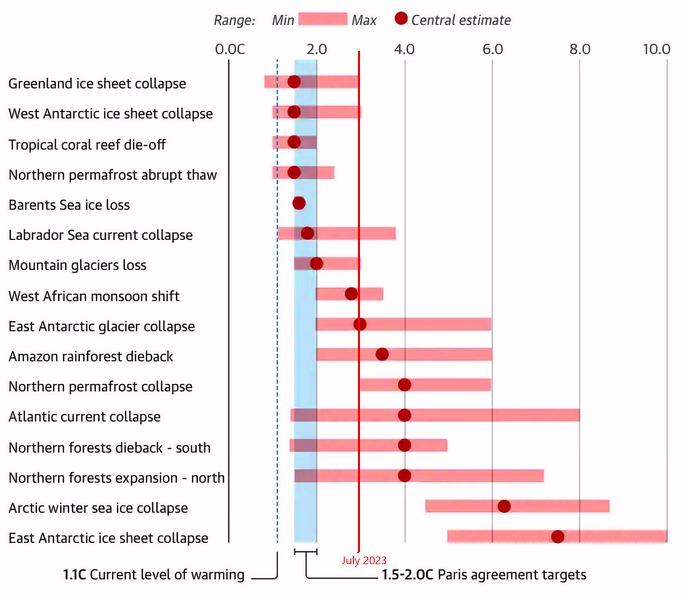
Tipping cascades have emerged between biogeophysical and social-ecological systems. This Domino Effect is causing climate change to accelerate at an exponential rate.
Tipping points are Critical Milestones that directly impact the rate of acceleration in climate change by multiplying the number and intensity of feedback loops. Identifying and understanding these tipping points is crucial for climate science and policymaking. Crossing multiple tipping points could lead to a domino effect, resulting in a much more rapid and severe climate change than currently projected.
Push a glass toward the edge of a table and eventually it will fall off on its own. No matter how slowly or meticulously you push… no matter how you weight or fill the glass, it will reach a tipping point and fall off before being pushed completely off the table. No matter whether you believe the glass is half-empty or half-full, when the tipping point is reached it will plummet out-of-control to its end. This is science not fate, faith, nor belief. Human induced climate change has resulted in environmental tipping points being breached.
Tipping points, when crossed, trigger self-sustaining feedback loops that are no longer dependent on human activity. Similar to when a domino topples over hitting two more dominoes that in turn fall hitting more dominoes. Thus, the name The Domino Effect. It can also be visualized as The Snowball Effect. A tipping point is like a snowball rolling down a hill growing in mass and velocity (momentum). When a tipping point is crossed, it results in cumulative and reinforced global warming.
As a climate scientist, I have studied the impact of politics on the climate for decades, and the United States ranks among the least prepared countries globally. It also has one of the highest percentages of climate change deniers. Politicians exacerbate this issue by obstructing necessary efforts to combat climate change. The Republican Party, in particular, often dismisses climate change as a manufactured crisis and advocates for increased fossil fuel production. This stance is ironic, as human industrial activities, which are heavily dependent on fossil fuels, are a primary driver of climate change.
Despite some efforts under President Biden to address these issues, the U.S. continues to be the world’s largest producer of oil, including crude oil, natural gas liquids, and other petroleum products. Both political parties have largely opted to provide unlimited emergency funding for climate disasters rather than investing in preventive measures. In 2023, the United States experienced an unprecedented number of climate-related disasters, with 28 major weather and climate events, each causing over a billion dollars in damages. These ranged from hurricanes and wildfires to severe storms and flooding, with some events costing hundreds of billions of dollars individually.
In June 2024, a significant Supreme Court decision severely restricted the Environmental Protection Agency’s (EPA) authority, limiting its ability to enforce environmental protection laws. This ruling marked a drastic shift, undermining decades of regulatory progress aimed at mitigating environmental damage and climate change. It effectively nullified the EPA’s power to regulate emissions and enforce environmental standards, which is a critical setback in the fight against climate change.
The government’s actions, or lack thereof, reflect a dangerous combination of arrogance and ignorance. This situation makes the worst-case predictions for climate change seem like optimistic scenarios. Revised climate models now suggest that global temperatures could rise by as much as 9°C within this century, compared to earlier projections of a 4°C increase over the next millennium. Such a dramatic temperature rise could push Earth toward a “wet-bulb” temperature threshold, where the combination of heat and humidity makes it impossible for the human body to cool itself through perspiration, leading to potentially fatal heat stress.
*Our climate model uses chaos theory in an attempt to adequately account for humans and forecasts a global average temperature increase of 9 degrees Celsius above pre-industrial levels. Everybody has the responsibility not to pollute. There are plenty of things you can do to help save the planet. Stop using fossil fuels. Consume less. Love more.Here is a list of additional actions you can take.
“Perhaps most importantly is the repeated use of the phrase ‘Drill, Baby, Drill’.”
Economic Update:
If Trump wins, great news for the very few people whose primary income comes from government securities interest! Unfortunately, very, very bad news for everyone else.
Tariffs, protectionism, lack of immigration, and nationalism are all detrimental to the economy. Tariffs and protectionist policies can lead to trade wars, higher consumer prices, and disruptions in the supply chain, which can stifle economic growth. Limiting immigration reduces the labor force and can slow down innovation and productivity, as immigrants often contribute significantly to economic dynamism. Nationalism can lead to isolationist policies that hinder international cooperation and trade, further damaging the economy. Over the last several years, approximately 80% of economic growth can be attributed to immigration.
Should Trump win, there is a concern that the U.S. may face economic decline similar to his six personal bankruptcies. His previous administration’s policies on tariffs, immigration restrictions, and nationalist rhetoric have already shown signs of economic strain. Continued implementation of such policies could exacerbate these issues, leading to a weakened economy and reduced global competitiveness for the U.S. It is crucial to adopt inclusive and cooperative economic strategies to foster sustainable growth and stability.
Interest rates are likely to spike and remain high for an extended period. In 2019, under the Trump administration, the Federal Reserve balance sheet saw a massive increase of $4 trillion in a very short period. This unprecedented expansion of the money supply, combined with the administration’s tax cuts and significant government spending, contributed to record inflation levels. The rapid increase in the money supply, aimed at stimulating the economy, led to an oversupply of currency, diminishing its value and driving prices up.
Federal Reserve’s Balance Sheet / Assets
The former President has also made claims that he will lower interest rates if he returns to office. The good news is that he doesn’t have the authority to directly lower rates, as this is the Federal Reserve’s responsibility. However, what used to be reassuring news is now less so. With the rollback of Chevron regulations, potential economic instability could lead to disastrous consequences, including further inflationary pressures and financial market disruptions.
Additionally, the tax cuts, while boosting short-term economic growth, significantly reduced federal revenue, leading to increased borrowing and higher national debt. The substantial government spending further exacerbated this issue, creating a fiscal environment prone to inflation. As a result, the Federal Reserve had to raise interest rates to combat inflation and stabilize the economy.
High interest rates can slow down economic growth by making borrowing more expensive for consumers and businesses, potentially leading to reduced investments and spending. This can create a challenging economic environment, underscoring the need for balanced fiscal policies that promote sustainable growth without leading to excessive inflation.
The former President recently stated that he wants a ‘weaker dollar.’ A devalued dollar on international markets can lead to numerous economic challenges, including significant impacts on inflation and interest rates. A weaker dollar makes U.S. exports cheaper and more competitive abroad, potentially boosting manufacturing and trade. However, it also increases the cost of imports, leading to higher prices for consumer goods and contributing to inflation.
Additionally, a weaker dollar can affect interest rates as the Federal Reserve may adjust monetary policy to manage inflationary pressures, impacting borrowing costs for consumers and businesses. Another concern is the impact on foreign investment. Treasury securities are popular among foreign investors because they are considered a safe investment. However, if the dollar devalues, the return on these investments may decrease when converted back to the investor’s local currency. To attract foreign investment despite the weaker dollar, the U.S. may need to offer higher interest rates on Treasury securities.
These economic landmines highlight the complexities and potential risks associated with currency devaluation.
Perhaps most importantly is the repeated use of the phrase ‘Drill, Baby, Drill’. The phrase encapsulates a harmful approach to energy policy that prioritizes fossil fuel extraction over sustainable practices. Climate change, exacerbated by such policies, poses the most severe threat not only to our environment but also to our economy.
In 2023, the U.S. experienced a record number of climate disasters, each exceeding one billion dollars in damages, with a total of 28 separate weather and climate-related events. Some of these individual events cost the U.S. economy hundreds of billions of dollars. The frequency and severity of these events are alarming, reflecting the accelerating pace of climate change.
The economic impact of climate change is expected to be staggering, with projections indicating it could cost the U.S. economy trillions of dollars. The financial burdens arise from various sources, including the destruction of infrastructure, increased healthcare costs due to climate-related illnesses, disruptions to agriculture and food supply, and the need for extensive disaster relief and recovery efforts. One of the primary drivers of the current inflation spike is the rising cost of homeowners insurance due to climate disaster-related claims. Short sellers anticipate that within ten years, 25% of U.S. properties will be uninsurable. These costs will continue to rise unless significant measures are taken to mitigate climate change and transition to a more sustainable energy system.
Moreover, the long-term economic effects of climate change can hinder economic growth, reduce productivity, and increase social inequalities. Proactive investments in renewable energy, climate resilience, and sustainable practices are essential to curtail the financial and environmental impacts of climate change. These measures are crucial to protect both the environment and the economy from the devastating impacts of climate change.
Climate change has profound effects on both climax and succession forests, altering their composition, structure, and ecological dynamics. Here’s how these impacts unfold:
Climax Forests
Climax forests are stable, mature ecosystems that have reached a late stage of ecological succession. They are characterized by a stable species composition and structure that persists until disrupted by a disturbance. Climate change impacts these forests in several ways:
Temperature Increases: Warmer temperatures can stress species that are adapted to cooler climates, leading to shifts in species composition. For example, in boreal climax forests, species like spruce and fir may decline, while more temperate species like maple and oak may increase .
Altered Precipitation Patterns: Changes in precipitation can affect soil moisture levels, influencing tree growth and survival. In areas experiencing increased drought, such as some temperate and Mediterranean forests, species that are less drought-tolerant may decline, altering the forest structure and function .
Increased Frequency of Disturbances: Climate change can lead to more frequent and intense disturbances, such as wildfires, storms, and pest outbreaks. These disturbances can reset succession processes, pushing climax forests back to earlier successional stages and altering their long-term stability .
Pest and Disease Proliferation: Warmer temperatures can facilitate the spread of pests and diseases. For instance, the mountain pine beetle has devastated large areas of climax forests in North America, leading to widespread tree mortality and changes in forest composition .
Succession Forests
Succession forests are in various stages of recovery following a disturbance. Climate change affects these forests by altering the rates and trajectories of succession:
Altered Growth Rates: Changes in temperature and CO2 levels can influence the growth rates of different species. Some pioneer species may grow faster under higher CO2 concentrations, potentially accelerating early successional stages but also potentially leading to different competitive dynamics later on .
Species Shifts: Climate change can influence which species dominate during different successional stages. For example, increased temperatures and altered moisture regimes can favor different sets of pioneer and mid-successional species, leading to novel successional pathways .
Disturbance Regimes: More frequent disturbances can prevent succession forests from reaching climax stages, maintaining them in earlier stages of succession for longer periods. This can alter the landscape mosaic and the biodiversity it supports .
Seed Dispersal and Establishment: Climate change can affect seed dispersal mechanisms and the establishment success of seedlings. Changes in wind patterns, animal behaviors, and soil conditions can influence which species successfully establish in succession forests .
Ecological and Management Implications
Biodiversity: Changes in species composition and structure can affect biodiversity at multiple levels. Some species may thrive while others decline, potentially leading to losses in overall biodiversity.
Ecosystem Services: The ability of forests to provide ecosystem services, such as carbon sequestration, water regulation, and habitat provision, can be altered. For example, changes in species composition can influence the carbon storage capacity of forests.
Conservation and Management: Adaptive management strategies are needed to address the impacts of climate change on both climax and succession forests. This includes monitoring changes, facilitating species migration, and managing disturbances to maintain forest health and resilience.
These impacts underscore the complex and dynamic nature of forest ecosystems in the face of climate change, highlighting the need for adaptive management and conservation strategies.
by Daniel Brouse
June 25, 2024
Trees “move” through a process of gradual migration, which occurs over generations through the dispersal of seeds. This migration is driven by environmental changes, such as climate change, and can be observed in the expansion of greenery into new areas, such as the tundra, and the invasion of southern species into regions like the Mid-Atlantic USA. Here’s how these processes work:
Expansion into the Tundra
In Arctic and sub-Arctic regions, warming temperatures have led to the expansion of tree lines into previously barren tundra areas. This process involves several steps:
Seed Dispersal: Trees like spruce and birch produce seeds that are dispersed by wind, animals, or water. As temperatures rise, seeds can survive and germinate in areas further north where they previously could not.
Seedling Establishment: Once seeds land in a suitable area, they must germinate and grow. Warmer temperatures and a longer growing season improve the chances for seedlings to establish.
Growth and Maturation: As seedlings grow, they gradually form new tree stands, expanding the forested area northward. This process is slow but cumulative, leading to noticeable changes over decades.
Ecosystem Changes: The establishment of trees in the tundra brings changes to the local ecosystem. Trees provide shade, alter soil composition, and affect the local microclimate, making it more suitable for additional plant and animal species.
Studies and observations have documented this greening effect in regions like Alaska and Siberia, where satellite imagery shows an increase in vegetation cover in the tundra over recent decades (ExelonCorp) (Exelon Corporation).
Invasion of Southern Species in the Mid-Atlantic USA
In the Mid-Atlantic USA, climate change has facilitated the northward movement of species traditionally found in more southern regions. This invasion is marked by several factors:
Temperature Increase: Warmer temperatures allow species that thrive in warmer climates to survive and reproduce in more northern areas.
Seed Dispersal Mechanisms: Southern species, such as the loblolly pine or the southern pine beetle, spread through natural dispersal mechanisms. Birds, wind, and animals carry seeds northward.
Competitive Advantage: These southern species often have competitive advantages in warmer conditions, allowing them to outcompete native species. For example, the southern pine beetle has expanded its range northward, affecting forests in New Jersey and Pennsylvania.
Changes in Phenology: Warmer temperatures can change the timing of life cycle events. For example, earlier springs can favor the growth of southern species over native species, giving them a head start in the growing season.
Research has shown that the ranges of many tree species are shifting northward in response to climate change. For instance, the U.S. Forest Service has observed that species like the sweetgum and the live oak are becoming more common in areas where they were previously rare or absent (ExelonCorp) (Exelon Corporation).
These examples illustrate how trees migrate by gradually expanding their range into new areas as environmental conditions change, driven by factors such as temperature increases, changes in precipitation patterns, and altered ecosystems.
Invasive Tree Species in North America
Several southern tree species have migrated northward in North America due to the impacts of climate change. Here are some notable examples:
1. Loblolly Pine (Pinus taeda)
Description: Native to the southeastern United States, the loblolly pine has been observed moving into more northern regions.
Migration Evidence: Studies have documented its establishment in areas like the Mid-Atlantic and even parts of the northeastern U.S., driven by warmer temperatures and changing precipitation patterns.
Description: Traditionally found in the southeastern U.S., this tree is known for its large, fragrant flowers and evergreen leaves.
Migration Evidence: Its range is expanding northward, and it is increasingly found in areas like the Mid-Atlantic due to milder winters and warmer growing seasons.
Description: Native to the southeastern U.S., sweetgum trees are known for their star-shaped leaves and spiky fruit.
Migration Evidence: They are moving into the northern parts of their range, such as the Mid-Atlantic and even parts of New England, as temperatures rise.
Description: Native to the southeastern coastal plains, live oaks are known for their sprawling branches and long lifespan.
Migration Evidence: There are reports of live oaks being planted and surviving in areas further north than their traditional range, reflecting milder winters.
Warmer Temperatures: As global temperatures rise, the climates of northern regions become more suitable for these southern species.
Changing Precipitation Patterns: Altered rainfall patterns can create conditions more favorable to southern species in northern areas.
Extended Growing Seasons: Longer growing seasons in northern regions due to climate change allow southern species more time to establish and grow.
Ecological Implications
Competition with Native Species: The migration of southern species can lead to increased competition with native northern species, potentially altering local ecosystems.
Biodiversity Changes: The influx of new species can change the composition of forests, affecting biodiversity and ecosystem services.
These examples illustrate the dynamic nature of forest ecosystems in response to climate change, with southern tree species moving into new territories as they seek suitable habitats.
The migration of tree species in temperate zones is significantly impacted by climate change through several mechanisms:
Shifts in Suitable Habitats: As temperatures rise, the suitable habitats for many tree species are moving poleward and to higher elevations. Trees that thrive in cooler climates are finding their current habitats increasingly inhospitable, pushing them to migrate towards cooler areas. However, the speed of climate change often outpaces the natural migration capabilities of many tree species, leading to potential mismatches between trees and their optimal environments.
Changes in Phenology: Climate change alters the timing of biological events such as leaf-out, flowering, and seed dispersal. These changes can affect the success of tree species in establishing themselves in new areas. For instance, if spring arrives earlier, trees that cannot adjust their growth cycles might struggle to compete with species that can, impacting their ability to migrate successfully.
Barrier to Movement: Physical barriers such as mountains, rivers, and human-made structures like roads and urban areas can impede the migration of tree species. Even without these barriers, the fragmented nature of modern landscapes often means that contiguous suitable habitats are rare, complicating the migration process.
Soil and Ecosystem Interactions: Tree species are part of complex ecosystems and their successful migration depends on the migration of associated species like soil microbes, fungi (mycorrhizae), and pollinators. If these organisms do not migrate at the same rate or to the same new areas, tree species may struggle to establish in new habitats.
Competition and Predation: As tree species migrate, they encounter new competitors and predators. These interactions can affect their ability to establish and thrive in new areas. For example, a migrating tree species might be less competitive in its new habitat or might face predation from herbivores that it did not encounter in its original range.
Genetic Diversity: The genetic diversity of tree populations affects their ability to adapt to new conditions. Populations with high genetic diversity are more likely to have individuals that can survive and reproduce in changing conditions. However, many tree species have low rates of natural genetic mutation and long lifespans, which can slow their adaptive responses to rapid climate changes.
Examples and Studies
North American Forests: In North America, studies have shown that tree species such as sugar maple and American beech are migrating northward as temperatures increase. However, this migration is often slower than needed to keep pace with climate change predictions (ExelonCorp).
European Forests: European beech and Norway spruce are also showing signs of northward migration and moving to higher elevations in response to warming climates (Exelon Corporation).
Modeling and Predictions: Various climate models predict significant shifts in tree species distributions. For instance, a study using the Species Distribution Model (SDM) predicts that suitable habitats for many European tree species will shift northwards and upwards by several hundred kilometers over the next century (Exelon Corporation).
These impacts demonstrate the complex interplay between climate change and the migration of tree species, highlighting the challenges and uncertainties faced by forests in temperate zones.
A dog panting helps with thermal regulation primarily through evaporative cooling. Here’s how it works:
Evaporative Cooling: When a dog pants, it increases the airflow over the moist surfaces of its tongue and the lining of its upper respiratory tract. This enhances evaporation of moisture from these surfaces, which cools the blood vessels lying just beneath. As the blood circulates through the body, it helps to lower the overall body temperature.
Heat Dissipation: Panting allows the dog to expel heat from its body. Dogs do not sweat through their skin as humans do, except for a minimal amount through their paw pads, so panting is their primary method of cooling down.
As for the wet-bulb temperature, it does impact a dog’s ability to cool itself through panting:
Wet-Bulb Temperature: This measurement takes into account both temperature and humidity. High wet-bulb temperatures indicate high humidity, which reduces the efficiency of evaporative cooling. When the humidity is high, the air already holds a lot of moisture, making it harder for the moisture on the dog’s tongue and respiratory tract to evaporate. This reduces the effectiveness of panting as a cooling mechanism.
In summary, dog panting helps with thermal regulation by facilitating evaporative cooling. However, its effectiveness can be impacted by the wet-bulb temperature, particularly in high-humidity conditions where evaporative cooling is less efficient.
Why is the wet-bulb temperature becoming so important?
The greatest short term climate change risk to human health is deadly humid heat (wet-bulb temperature) caused by a warmer average temperature enabling the air to hold more moisture. Increased moisture leads to higher humidity.
The Water Vapor Feedback Problem
Water vapor is a powerful greenhouse gas. Since the 1970s, its rise likely increased global heating by an amount comparable to that from rising carbon dioxide. We are now seeing the consequences. In the current climate, for average all-sky conditions, water vapour is estimated to account for 50% of the total greenhouse effect, carbon dioxide 19%, ozone 4% and other gases 3%. Clouds make up about a quarter of the greenhouse effect.
The main greenhouse gases — carbon dioxide, methane, nitrous oxide and ozone — don’t condense and precipitate. Water vapor does, which means its lifetime in the atmosphere is much shorter, by orders of magnitude, compared to other greenhouse gases. On average, water vapor only lasts nine days. The increased intensity of precipitation often results in violent rain.
Sidd said, “The biggest feedback loop is water vapor. Humans put CO2 in the air. CO2 is a greenhouse gas, so the earth gets warmer. Warmer air can hold more water vapor soaking up more water vapor from the oceans. Water vapor is a greenhouse gas, so it gets even warmer… rinse (sorry!) and repeat. Another interesting thing is that the precipitation (rain, snow, sleet) intensity is increasing.”
*Our climate model uses chaos theory in an attempt to adequately account for humans and forecasts a global average temperature increase of 9 degrees Celsius above pre-industrial levels. Everybody has the responsibility not to pollute. There are plenty of things you can do to help save the planet. Stop using fossil fuels. Consume less. Love more.Here is a list of additional actions you can take.