bookmark_border2026: Confirmation of Nonlinear Climate Acceleration in the Arctic–North Atlantic System

Daniel Brouse and Sidd Mukherjee
Ongoing Study

Abstract

Recent observational evidence from the Arctic–North Atlantic system indicates that climate change is not proceeding linearly but is accelerating through interacting feedback mechanisms. Arctic amplification has intensified beyond earlier projections, coinciding with destabilization of large-scale atmospheric circulation patterns, increased Greenland Ice Sheet mass loss, nonlinear cryospheric events, and measurable geophysical responses such as rapid isostatic rebound. This paper synthesizes multi-decadal satellite, atmospheric, oceanographic, and cryospheric observations through early 2026, arguing that the collapse of doubling times across key indicators—Arctic temperature anomalies, sea-ice loss, ice mass balance, and circulation variability—confirms a regime shift toward accelerated climate disruption.

1. Introduction

Three decades ago, we proposed that anthropogenic climate forcing would manifest through nonlinear acceleration rather than gradual linear warming. Increasing greenhouse gas concentrations alter Earth’s radiative balance, while feedback loops—albedo loss, water vapor amplification, permafrost carbon release, ocean circulation shifts—compress the “doubling time” of key climate indicators.

As of early 2026, the Arctic provides the clearest confirmation of this hypothesis. Observations demonstrate extreme amplification, destabilized jet stream dynamics, Greenland hydrological disruption, and geophysical rebound occurring at rates inconsistent with linear change.

2. Arctic Amplification and Circulation Destabilization

2.1 Arctic Warming Rates

Arctic amplification has long been observed at approximately three to four times the global mean warming rate (Serreze & Barry, 2011; IPCC AR6, 2021). Since 2006, some Arctic regions have exhibited warming exceeding double the global rate, with episodic winter anomalies reaching 10–20× the hemispheric average during extreme events.

This amplification accelerates:

  • Sea-ice loss, reducing albedo and enhancing ocean heat absorption.
  • Permafrost thaw, increasing methane and CO₂ release.
  • Ocean–atmosphere heat exchange, destabilizing circulation patterns.

The Arctic is transitioning toward a warmer, seasonally ice-diminished state (Overland et al., 2019).

2.2 Jet Stream, Rossby Waves, and SSW Events

As the equator-to-pole temperature gradient weakens, the polar jet stream slows and becomes more meridional (Francis & Vavrus, 2012; Mann et al., 2017). Amplified Rossby waves lead to “stuck” weather regimes—persistent droughts, floods, and cold-air outbreaks.

Sudden Stratospheric Warming (SSW) events—rapid stratospheric temperature increases of up to 50°C within days—disrupt the polar vortex (Baldwin et al., 2021). When displaced, Arctic air masses surge southward while anomalous warmth intrudes northward.

In early 2026, Utqiaġvik (Barrow), Alaska—within the polar night—recorded January temperatures above 40°F, exceeding the previous 36°F January record set in 2017. Concurrently, mid-latitude regions such as the northeastern United States experienced record cold outbreaks. These extremes exemplify circulation destabilization rather than contradiction of warming.

3. Greenland Ice Sheet: Nonlinear Dynamics

3.1 Mass Loss and Sea-Level Contribution

Greenland has lost approximately 169 ± 12 gigatons of ice per year since 2002 (IMBIE Team, 2020), contributing ~14 mm to global mean sea-level rise (SLR). Roughly half of this loss arises from surface melt and runoff, which are projected to intensify under continued Arctic warming.

Recent satellite data show global SLR rates accelerating from ~1.5 mm/yr (1990s) to over 5 mm/yr in 2024–2025 (NASA, 2025), consistent with collapsing doubling times in cryospheric contribution.

3.2 Subglacial Outburst Flood (2025)

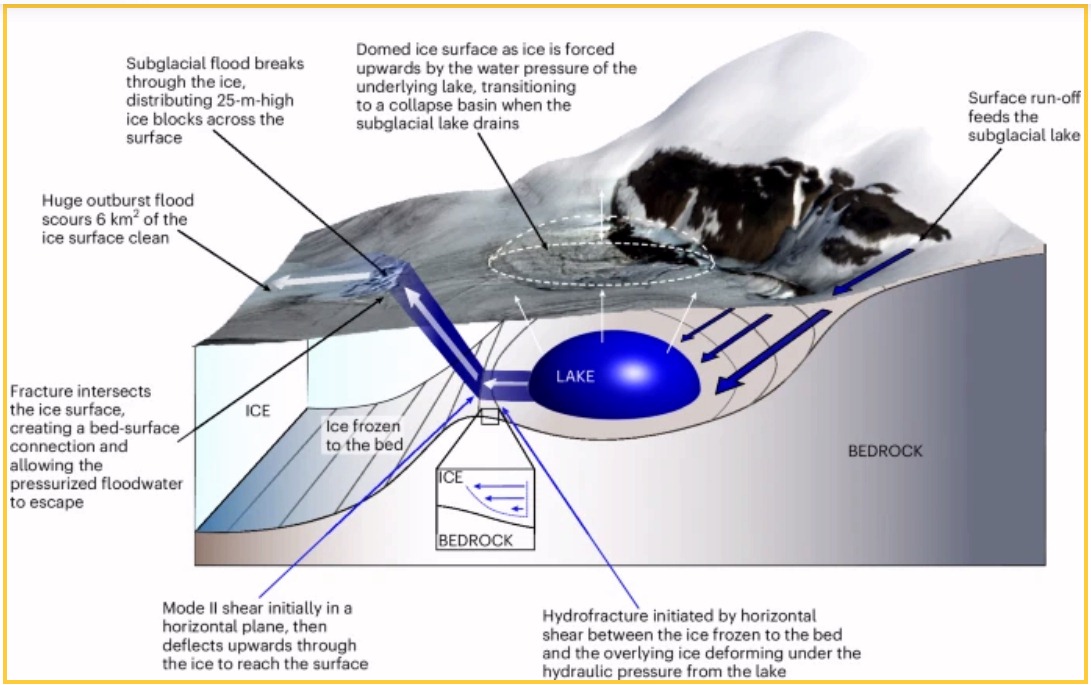
The 2025 study Outburst of a Subglacial Flood from the Surface of the Greenland Ice Sheet documented a ~90 million m³ upward-draining flood through ice previously assumed frozen to bedrock. The event fractured the ice sheet and altered downstream glacier flow, demonstrating two-way coupling between basal hydrology and surface melt processes—dynamics not fully represented in current models.

Such nonlinear hydrological feedbacks accelerate ice-sheet instability.

3.3 Dickson Fjord Mega-Tsunami (2023)

In September 2023, a glacier-destabilized landslide in Greenland’s Dickson Fjord triggered a 200-meter mega-tsunami. The resulting seiche generated a global seismic signal lasting nine days, initially classified as an unidentified seismic object (Svennevig et al., 2023; Global Seismology Network data).

The landslide was attributed to glacier retreat destabilizing mountain slopes—an example of cryosphere–lithosphere coupling under warming conditions.

4. Isostatic Rebound and Regional Sea-Level Effects

Greenland’s ice sheet depresses the lithosphere. As ice mass decreases, elastic and viscoelastic rebound occurs. GPS measurements indicate uplift rates exceeding 8 mm/yr in southeastern Greenland (Khan et al., 2016).

Key implications:

  • Local relative sea level may fall, despite global SLR.
  • Crustal stress redistribution may influence seismicity.
  • Peripheral glacier melt contributes up to ~30% of elastic rebound in some regions.

While rebound offsets local sea level temporarily, global redistribution of meltwater increases coastal risk worldwide.

5. Feedback Loop Convergence

The Arctic–Greenland system now exhibits interacting feedback loops:

  • Ice-albedo feedback
  • Ocean stratification and AMOC weakening (Caesar et al., 2021)
  • Permafrost carbon release
  • Jet stream destabilization
  • Subglacial hydrological acceleration

These processes reduce doubling times of climate indicators. Nonlinear acceleration is evident not only in temperature trends but in circulation extremes, cryospheric fracture events, and geophysical responses.

6. Conclusion

The evidence through early 2026 supports the conclusion that climate change is accelerating via interconnected feedback loops rather than progressing linearly. Arctic amplification, destabilized atmospheric circulation, nonlinear Greenland hydrology, accelerating sea-level rise, and rapid isostatic rebound collectively indicate regime-level transition.

The compression of doubling times across these indicators confirms a shift toward exponential intensification. Future projections must incorporate coupled nonlinear dynamics and tipping elements to avoid systematic underestimation of risk.


References

Greenland Slip Sliding Away Mukherjee (2001)
SLR Exponential Fit Mukherjee (2004)
Greenland If the Ice Were Gone Mukherjee (2013)
Sea-Level Rise: Greenland and the Collapse of the East Antarctic Ice Sheet Brouse and Mukherjee (2022)
Baldwin, M. P., et al. (2021). Sudden stratospheric warmings. Reviews of Geophysics.
Caesar, L., et al. (2021). Current Atlantic Meridional Overturning Circulation weakest in a millennium. Nature Geoscience.
Francis, J. A., & Vavrus, S. J. (2012). Evidence linking Arctic amplification to extreme weather. Geophysical Research Letters.
IMBIE Team (2020). Mass balance of the Greenland Ice Sheet from 1992–2018. Nature.
IPCC (2021). AR6 Working Group I Report.
Khan, S. A., et al. (2016). Greenland ice mass loss and crustal uplift. Science Advances.
Mann, M. E., et al. (2017). Influence of anthropogenic warming on planetary waves. Scientific Reports.
NASA (2025). Global Mean Sea Level from Satellite Altimetry.
Overland, J. E., et al. (2019). The urgency of Arctic change. Nature Climate Change.
Serreze, M. C., & Barry, R. G. (2011). Processes and impacts of Arctic amplification. Global and Planetary Change.
Svennevig, K., et al. (2023). Seismic signature of Greenland fjord landslide and seiche event. Geophysical Research Letters.
The Human Induced Climate Change Experiment

bookmark_borderSea Level Denial vs. Climate Reality: The Accelerating Collapse of Ice Sheets and Ocean Circulation

by Daniel Brouse
August 29, 2025

Here’s an example response you can use when confronting a climate denier—this one addresses the accelerating rise in sea levels and the collapse of the AMOC.

The climate denier said to me: “What an absolute load of BS. Sea level hasn’t changed to ANY verifiable degree in 2,000 years. Sit down, and STFU.”

I replied:
Wrong. Sea level rise has already accelerated far beyond your denialist talking point. For most of the past 2,000 years, sea levels were relatively stable. But since the industrial revolution, we’ve seen an exponential shift. Sea level rise was doubling at a rate of about every 100 years. A decade ago, that doubling time dropped to every 10 years. Now, it is doubling every two years. And that still doesn’t account for the compounding feedback loops currently destabilizing the system.

For example, the collapse of the Atlantic Meridional Overturning Circulation (AMOC) is slowing ocean circulation, heating the tropics, warming the Arctic, and accelerating polar ice melt—all of which cause faster sea level rise. Melting Greenland and Antarctic ice also inject massive volumes of freshwater into the North Atlantic, further destabilizing the AMOC in a reinforcing loop.

The same disrupted system drives Amazon drought and dieback, reducing its ability to recycle rainfall and store carbon. That adds more greenhouse gases to the atmosphere, which further accelerates warming, ice melt, and sea level rise. Meanwhile, the albedo effect from melting ice, brown carbon from megafires, and permafrost methane releases are amplifying the chaos.

To put numbers on it:

  • Greenland alone holds enough ice to raise sea levels by ~20 feet, much of which is already destabilizing.

  • West Antarctica could add another 10 feet within decades.

  • Sudden “cork release” pulses of 1–3 feet per year are possible once key ice sheet thresholds break.

  • The East Antarctic Ice Sheet, the true wildcard, holds ~170 feet of potential rise.

This isn’t speculation—it’s backed by observational data, paleoclimate records, and validated climate models. My own work, alongside colleagues, uses a probabilistic, ensemble-based climate model that integrates complex socio-economic and ecological feedback loops within a dynamic, nonlinear system. Our projections indicate global temperatures could rise up to 9°C this century—far exceeding earlier estimates. That level of warming virtually guarantees catastrophic sea level rise.

You can yell “BS” all you want, but physics doesn’t care about emojis and denial. The evidence is overwhelming, and if you’d like to attempt literacy, here’s a starting point:
👉 http://membrane.com/global_warming/Ignite-a-Domino-Effect.html

The Human Induced Climate Change Experiment

bookmark_borderAntarctica, Inevitable Sea-Level Rise, and the Cascading Impacts of Climate Change

By Daniel Brouse and Sidd Mukherjee
August 21, 2025

Introduction

The destabilization of Antarctica represents the single greatest existential threat to humanity. What was once viewed as a slow-moving process unfolding over millennia is now accelerating at a pace that outstrips scientific projections. The August 2025 paper,“Emerging Evidence of Abrupt Changes in the Antarctic Environment,” confirms that Antarctica is destabilizing far faster than anticipated, with abrupt and potentially irreversible shifts already underway.

This is not a distant warning—it is a present reality. Antarctica’s collapse threatens to unleash catastrophic sea-level rise, disrupt global ocean circulation, amplify planetary warming, and destabilize ecosystems on which billions of people depend. Its fate is intertwined with the fate of every coastal city, every agricultural system, and every human community on Earth.

For decades, scientists warned of tipping points in the Antarctic system. Today, evidence shows those tipping points have been crossed. What follows is not a gradual decline, but a cascade of rapid, nonlinear changes: collapsing ice shelves, accelerating glacial outflows, and the weakening of the Antarctic Overturning Circulation that regulates Earth’s climate balance.

The conclusion is unavoidable: the destabilization of Antarctica is not only the largest existential threat to humanity—it is the defining crisis of our time.

The Inevitable

For decades, Sidd Mukherjee has regarded Antarctica as the single greatest threat posed by climate change. As he often says, “Antarctica is the big one.”

If history is our guide, he’s right. During past warming periods, sea levels have risen episodically—long stretches of stability punctuated by sudden, dramatic surges. In the fastest episodes, sea levels rose as much as three feet every twenty years for five hundred years straight.

The Long View: 270 Feet of Sea-Level Rise

Scientific consensus expects that sea level rise will ultimately total around 270 feet over the next several millennia. This estimate accounts not only for the melting of Greenland and Antarctica but also for thermal expansion of the oceans.

Back in 1998, the State of New Jersey published Sea Level Rise in New Jersey, which depicted the Statue of Liberty partially submerged under 270 feet of water. The message was clear: coastal civilization as we know it cannot endure.

When the last Ice Age ended, the Earth experienced “Meltwater Pulse 1A”—a dramatic period roughly 14,500 years ago when sea levels surged upward by about 66 feet in just 500 years. Data from Barbados, Tahiti, and Sunda confirm that the ocean rose at astonishing rates—sometimes more than 40 mm per year. We should expect similar patterns again.

Why 270 Feet Is “The Safe Minimum”

Our estimate of 270 feet as the “safe” elevation to live is conservative. High tides, waves, storm surge, and coastal flooding make it unsafe to live anywhere below that elevation in the long run. Even at 270 feet, hazards persist:

  • Biohazards: As the waters overtake sewage plants, landfills, farms, and industrial sites, contamination will make coastal waters toxic.

  • Soil Salinization: Saltwater intrusion will sterilize farmland, destroying food supplies.

  • Islandization: Communities below ~800 feet elevation risk being cut off, effectively becoming islands. This raises issues of food, water, healthcare, and security. History suggests piracy and lawlessness could accompany widespread displacement.

For these reasons, our recommendation is blunt: managed retreat must begin now. Florida, for example, has already seen storm surges of 14–20 feet in recent years, with projections of temporary surges reaching 20–40 feet this century. Billions spent rebuilding after Hurricane Ida and other storms will ultimately be lost. It is irresponsible to continue building where retreat is the only rational option.

The Antarctic “Regime Shift”

Recent research published in Nature confirms that Antarctica is already undergoing abrupt and potentially irreversible changes:

  • Regime Shift: The continent is moving into a new climate state, characterized by drastically reduced sea ice.

  • Accelerated Melting: Glacial outflow from Thwaites and others has doubled since the 1990s.

  • Tipping Point: The West Antarctic Ice Sheet may soon pass the point of no return for unstoppable collapse.

  • Ocean Circulation Slowdown: The Antarctic Overturning Circulation—which regulates heat transport and CO₂ absorption—is weakening, undermining a key planetary stabilizer.

  • Wildlife Collapse: Emperor penguins and other species face extinction as their habitats vanish.

Planetary Consequences

  • Amplified Warming: With less ice, the Antarctic reflects less sunlight, accelerating global warming.

  • Rapid Sea-Level Rise: Even temporary pulses of 20–40 feet this century will devastate coasts. The long-term inevitability is hundreds of feet.

  • Ecosystem Disruption: Warming and acidifying Southern Ocean waters threaten krill, penguins, whales, and entire food webs.

The Driving Force

At the heart of all this is human-caused climate change. Fossil fuel emissions continue to trap heat, warming both atmosphere and ocean. Unlike the Arctic, the Antarctic is responding with alarming speed, its feedback loops less understood and far harder to predict.

The Bottom Line

The Earth has crossed tipping points that make extreme sea-level rise both inevitable and irreversible within our lifetimes. The exact timing and scale will vary by location due to gravity, isostatic rebound, and thermal expansion. But the direction is clear:

  • Coastal communities must plan for retreat.

  • Governments must end fossil fuel dependency immediately.

  • Planners must recognize that rebuilding low-lying infrastructure is wasted effort.

The world is entering a new geological epoch shaped by rising seas. The only question left is whether we plan for it—or drown in denial.

The Future Is Now

Melting ice, rising seas, and intensifying climate impacts are not distant possibilities—they are unfolding before our eyes. Each impact amplifies others, pushing the climate system into dangerous new territory.

In October 2023, Sidd Mukherjee remarked, “Now I am thinking the violent rain will be a bigger problem before we die.” His words have proven prophetic. By 2025, the world is experiencing a record-shattering year of violent rain events, marked by atmospheric rivers, catastrophic flash floods, and rainfall extremes that overwhelm infrastructure, agriculture, and human safety.

Cascading Failures, Not Gradual Change

The climate system does not degrade in a smooth, linear way. Instead, it behaves like a network of interconnected subsystems—when one falters, it destabilizes others. These interactions create cascading feedback loops that accelerate collapse.

For instance:

  • AMOC Collapse Loop: Melting at the poles injects massive amounts of freshwater into the North Atlantic, lowering salinity and density. This slows the Atlantic Meridional Overturning Circulation (AMOC), reducing the ocean’s ability to transport heat and regulate the climate. A weaker AMOC intensifies warming in the tropics and Arctic, which then accelerates ice melt, further destabilizing the system.

  • Jet Stream & Weather Extremes: Polar warming reduces the temperature gradient between the poles and the equator. This weakens and destabilizes the jet stream, causing it to meander. Stalled or “stuck” jet streams lead to prolonged droughts, heat domes, atmospheric rivers, or weeks of torrential rainfall in the same region.

  • Albedo Feedback: As reflective ice vanishes, darker land and ocean surfaces absorb more solar radiation, amplifying warming. This in turn accelerates ice melt and further reduces albedo—a reinforcing loop with no natural brake.

  • Rossby & Polar Vortex Disruptions: These shifts send frigid Arctic air southward and lock extreme weather in place, producing events like the deadly Texas freeze, followed months later by record-breaking heat waves in the same region.

The Violent Rain Era

The hydrological cycle itself is now destabilizing. A warmer atmosphere holds more moisture, and when that water is released, it falls with unprecedented intensity. We are entering what might be called the Violent Rain Era:

  • Cities flood in hours from rainfall amounts once considered “1,000-year events.”

  • Agricultural systems collapse under alternating extremes—parching droughts followed by soil-eroding floods.

  • Infrastructure built for the 20th century fails under the weight of 21st-century storms.

2025 stands as a stark marker: atmospheric rivers in California, monsoon extremes in South Asia, and deluge-level storms in Europe have all set records in rainfall intensity, duration, and damage.

From Stability to Chaos

This is only one example in a larger mosaic. Each subsystem—cryosphere, ocean, atmosphere, biosphere—feeds into the others. Their breakdown is already shifting Earth from a relatively stable climate state into a chaotic, self-reinforcing collapse.

The future is not centuries away—it is here now, arriving in the form of violent rain, collapsing coastlines, failing crops, and shattered infrastructure. The challenge is no longer about preventing climate change, but about surviving the acceleration already underway.

Ignite a Domino Effect: Albedo, Brown Carbon, AMOC, Permafrost, Amazon Rainforest Dieback, Sea Level Rise Pulses, Hydroclimate Whiplash, and Arctic Sea Ice

The Human Induced Climate Change Experiment

bookmark_borderAlaska’s Mendenhall Glacier Outburst: A Glacial Flood Emergency

by Daniel Brouse
August 13, 2025

A massive upstream basin of rainwater and snowmelt, dammed by Alaska’s Mendenhall Glacier, began releasing on Tuesday, prompting officials to urge residents in parts of Juneau to evacuate ahead of a potentially dangerous surge of floodwater.

The National Weather Service (NWS) Juneau office issued a flood warning for areas along the Mendenhall River near Auke Bay. The released water from this glacial outburst is flowing downstream, putting riverside homes and properties at immediate risk.

As of Tuesday afternoon local time, river levels were measured at 9.85 feet, with major flooding classified at 14 feet. Officials expect the river to crest Wednesday afternoon at near-record levels of 16.3 to 16.8 feet, setting a new historic high. NWS meteorologist Nicole Ferrin stated, “This will be a new record, based on all of the information that we have.”

The City and Borough of Juneau issued a public advisory confirming that the glacial outburst originated from Suicide Basin. Flooding is expected to continue along Mendenhall Lake and River from late Tuesday through Wednesday. Residents in areas at risk are strongly encouraged to evacuate immediately. A Red Cross shelter is open at Floyd Dryden Gymnasium (3800 Mendenhall Loop Road). Important notices for pet owners: The Red Cross shelter cannot accommodate pets. Evacuated animals should be taken to Juneau Animal Rescue at (907) 789-6997. Safety warning: Do not approach the river. Floodwaters are extremely dangerous, and entering the area endangers both residents and first responders. Stay away from the river to allow safe evacuations and emergency response efforts.

Ignite a Domino Effect: Albedo, Brown Carbon, AMOC, Permafrost, Amazon Rainforest Dieback, Sea Level Rise Pulses, Hydroclimate Whiplash, and Arctic Sea Ice 

Tipping points and feedback loops drive the acceleration of climate change. When one tipping point is toppled and triggers others, the cascading collapse is known as the Domino Effect.

bookmark_borderSudden Sea Level Pulses: How “Cork Release” Events Could Rapidly Reshape Coastlines

by Daniel Brouse
August 9, 2025

Greenland Subglacial Flood Sheds Light on a Dangerous Climate Feedback

The Earth’s climate system is a tightly woven network of interdependent processes. Disturb one, and you risk setting off a cascade of reinforcing feedback loops. Consider just one example: the potential collapse of the Atlantic Meridional Overturning Circulation (AMOC).

When the AMOC slows, tropical waters grow hotter while the Arctic warms even faster. This accelerates polar ice melt, raising global sea levels more quickly and injecting vast amounts of freshwater into the North Atlantic. The added freshwater disrupts ocean salinity and density, further weakening the AMOC in a dangerous feedback cycle.

Meanwhile, elsewhere in the system, Amazon droughts intensify under the altered climate, pushing the rainforest toward dieback and eventual desertification. This reduces the Amazon’s ability to recycle rainfall and sequester carbon, further amplifying global warming—and thus accelerating ice melt, sea level rise, and AMOC destabilization.

The Albedo Effect and Ice Melt

One of the most powerful feedbacks in the polar regions is the albedo effect. As bright, reflective ice melts, it reveals darker land or ocean surfaces that absorb far more solar energy. This speeds up further melting. While melting sea ice mainly changes heat balance without directly raising sea levels, the melting of land-based ice—especially from Greenland and Antarctica—not only raises global seas but also changes ocean salinity and temperature, further destabilizing circulation systems like the AMOC.

These ice sheets hold vast “corks” of land ice restraining enormous reservoirs of meltwater. When these corks break, sudden sea level rise pulses—sometimes 1–3 feet per year for multiple consecutive years—could occur. The impacts on coastlines, global weather, and ocean currents would be both severe and unpredictable.

The Greenland Ice Sheet Outburst Flood

Recent research has identified a startling example of this process. In the paper Outburst of a subglacial flood from the surface of the Greenland Ice Sheet (2025), scientists documented a 90-million-cubic-meter flood that forced its way upward through the ice sheet, bursting out at the surface. This was caused by the rapid drainage of a subglacial lake in a region where the bed was thought to be frozen solid—an event that current ice sheet models do not account for.

The flood’s upward path fractured the ice sheet, disrupting the downstream marine-terminating glacier and altering its flow. This bi-directional coupling between surface and basal hydrology highlights just how complex—and poorly understood—ice sheet dynamics truly are.

Over the last three decades, Greenland has lost roughly 169 billion tons of ice per year on average, contributing about 14 mm to global sea level rise. Roughly half of this loss comes from surface melting and runoff, which are projected to increase sharply as Arctic warming intensifies.

Why This Matters

If hydrofracture events like this outburst become more frequent, the world could face abrupt, multi-foot-per-year sea level jumps—not the gradual rise most models currently project. This would leave little time for adaptation in coastal cities and could unleash profound economic, humanitarian, and ecological consequences.

Current ice sheet models typically treat meltwater movement as predictable and gradual. The Greenland event shows that under certain conditions, trapped subglacial water can build enough pressure to fracture ice and erupt at the surface—what could be called a “cork release” event. These sudden failures are not fully understood, but they could represent one of the most dangerous tipping points in the cryosphere.

Understanding and integrating these processes into predictive models is urgent. The more we learn, the more it becomes clear that the climate system is capable of abrupt, nonlinear shifts—far faster than human infrastructure, economies, or governance can adapt.

Ignite a Domino Effect: Albedo, Brown Carbon, AMOC, Permafrost, Amazon Rainforest Dieback, Sea Level Rise Pulses, Hydroclimate Whiplash, and Arctic Sea Ice Brouse and Mukherjee (2025)

The Human Induced Climate Change Experiment

bookmark_borderCoastal Real Estate Financial Crisis

The rising sea level is putting a trillion dollars of real estate at high risk.

“The question is no longer if rising seas will erode coastal home values, but who will get stuck with the devalued assets when the markets turn,” reported Dee Gill.

“Alarmingly, more than half of that (at-risk property) exposure is estimated to lie outside FEMA flood zones. That means those properties are at higher risk of being underinsured, and, therefore, the loans attached to them are at higher risk of impairment, with increased risk for the value of the related CMBS (securities).” —CFTC

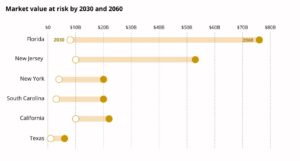
Market Value at Risk of Flooding

“Fannie and Freddie carry about $5.6 trillion in assets, mainly home mortgages and related securities. Ultimately, taxpayers backstop the payments on loans under the agencies’ control, UCLA’s Yu explains. Their regulator, the Federal Housing Finance Agency, issued a request for information in January, in part to assess flood risks. The entities require flood insurance that might mitigate their losses only on properties inside FEMA’s poorly drawn flood zones. Coverage limits imposed by NFIP — $250,000 for the structure and $100,000 for personal property — mean many coastal homes that have coverage are grossly underinsured.” — UCLA / Is the $1 Trillion Coastal Housing Market a Future Financial Crisis?

BlackRock, the G20-backed Financial Stability Board and the U.S. Commodity Futures Trading Commission are voicing concerns about unflagged flood risks squirreled away in mortgage-backed securities, bond markets and other real estate-backed investments. Common themes: The exact size of exposure is elusive but big; markets don’t currently price for it; these assets pose a threat to the stability of the global financial system.

More on Flood Insurance and Real Estate Risk

bookmark_borderFlood Insurance Risk

From

https://urbanland.uli.org/sustainability/investors-and-bond-rating-analysts-are-working-to-quantify-risks-from-climate-change/

Bonds, insurance, climate risk: “a cataclysmic issue”

“Going forward, cities that lack the resources to invest in climate remediation may see their credit ratings decline as result”

“Those longer-term risks “are not priced into the market today,”

He cited the difficulty of evaluating the flood risk for a regional mall that sits atop a hill. Whereas the mall itself might not be at risk for flooding, “how do people get to you? Your inventory will be fine, but nobody will be there to buy it,” he said. “It’s more of an issue than just your physical building.”

“damage from rare extreme weather events did not have a significant effect on value because buildings almost always could be repaired. But with catastrophic storms and floods becoming more frequent in some areas, the value of the underlying land will be at risk as well. Insurers are not going to protect property owners against the risk that they will not be able to find a future buyer, he said.”

“By the third flood, prospective buyers know you have a waterlogged building,” Glendon said. “And you lose land value.”

“The rising threat to value from climate change will not be borne by insurance companies because they can re-price coverage, Glendon said. “The risk is for the people who hold the mortgages.”

bookmark_borderVolumetric or Cubical Expansion Coefficients of Water?

I asked:
I’ve been trying to consider the
Volumetric or Cubical Expansion Coefficients of Liquids
and how it relates to water and climate change

It’s hard to wrap my head around… especially when you add melting sea ice to the equation

What do you think?

Will warmer water increase sea level rise even greater… the warmer the water the higher the rise? If the ocean temperature rises from from 62 to 68 will the increase temperature cause the sea level to rise due to expansion?

And, does it matter if ice starts as sea ice or ice on land?
How about the salinity? I’m guessing salinity will decrease as we add fresh water?

I found a tool box app. but I don’t think it takes any of these factors into account:
https://www.engineeringtoolbox.com/volumetric-temperature-expansion-d_315.html

Sidd replied:
ya, warming causes about a third to a half of current sea level rise but the other 2/3 is melting land based ice

the warming of the surface ocean (0-couple hundred meters) is not that important, it is the deep ocean that holds most of the water and it is warming much slower than the surface, but the expansion of the deep ocean causes most of the sea level rise

deep warming is very small compared to surface, a few thousandths to a hundredth of a degree, but there is a lot of deep ocean

90-95% of the warming due to CO2 goes into the oceans. There is better data now on where that heat is going in the ocean from the Argo floats.

theres a buncha papers on it, Cazenave is a good author to look for.

sidd

The Human Induced Climate Change Experiment

bookmark_borderReal Estate Value and Rising Sea Level

“A very simple way of thinking about it is that it will be tens of thousands of dollars per resident in places that may not have a large tax base”

“Globally, the question of equity is even more acute, with cities in developed nations far better able to fund climate change adaptation projects than in developing countries.”

“Miami Forever Bond”

“The problem with investing in resilience is where is the cash flow ? What we’re doing is protecting against future damage, but there’s not a new positive cash flow. You’re not creating new value. You’re protecting against the loss of existing value. One way or another we’ve got to pay for this …”

https://e360.yale.edu/features/who-will-pay-for-the-huge-costs-of-holding-back-rising-seas

[ Comment: “Miami Forever Bond” ?!! Sell that sucker short.]

https://insideclimatenews.org/news/04082019/climate-change-ratings-agencies-financial-risk-cities-companies

https://www.theguardian.com/us-news/2019/aug/06/california-collapsing-beach-deaths-highlight-climate-fueled-erosion-crisis

http://climatechangepsychology.blogspot.com/2019/04/science-oceans-tallest-waves-are.html

https://www.fastcompany.com/90391923/the-east-coast-is-sinking-under-water-this-photographer-is-documenting-it-as-it-disappears

https://www.thestar.com/opinion/contributors/2019/08/19/washed-out-family-bike-ride-a-climate-change-harbinger-for-all.html

https://www.climatecentral.org/news/ocean-at-the-door-new-homes-in-harms-way-zillow-analysis-21953

That last link has a zillow study that is quite limited in that it looks only at homes built since 2009, but is useful. That first Yale link has a link to another study as well.

sidd

bookmark_borderDo You Need Flood Insurance?

by Daniel Brouse and Sidd Mukherjee

There’s a thing about climate change and a rising sea level that took me a while to grasp… a lot of the water isn’t actually in the sea. As more water accumulates in the sea and the temperature rises, more energy is also being stored in the sea. Now, we are seeing more of that sea and energy transferred to the land.

More energy is being stored in the sea. One of the results is higher sea level. But another is more intense rain on land, the water comes inland through the air as well. As you may have noticed, the rising sea level is causing flooding in Pennsylvania, as well as, sinking the shore.

“Climate change is in general increasing the frequency and intensity of heavy rainfall storms,” said Andreas Prein, a project scientist with the National Center for Atmospheric Research. “If you look at the records, mostly it’s the water that kills most people.”

“The ingredients are there for a real catastrophe if the flood control infrastructure simply gets overwhelmed,” he said.

The New York Times reported: In recent years, researchers have found that hurricanes have lingered longer, as Barry is expected to do, and dumped more rainfall — a sign of climate change, said Christina Patricola, a research scientist at Lawrence Berkeley National Laboratory, and a co-author of a study that found that climate change is making tropical cyclones wetter.

Though storms can form at any time, the Atlantic hurricane season stretches from June 1 through Nov. 30 because that is typically when the Atlantic Ocean’s waters are warm enough to sustain storms. But the oceans are now warmer than ever: They have absorbed more than 90 percent of the heat caused by human-released greenhouse gas emissions.

Do you need flood insurance?

  • Homeowners insurance does NOT cover flooding
  • Flood insurance is obtained through the government’s flood insurance program
  • Flood insurance does not cover the basement of a house
  • Flood insurance covers a lifetime maximum of $250,000 in coverage
    This means if you make a claim for $150,000 the maximum coverage for the life of the property drops to $100,000.

The Human Induced Climate Change Experiment