bookmark_borderYou Can Not Fight the Rising Tide

aA “Built atop spongy marsh and old tidal creeks filled with sawdust”
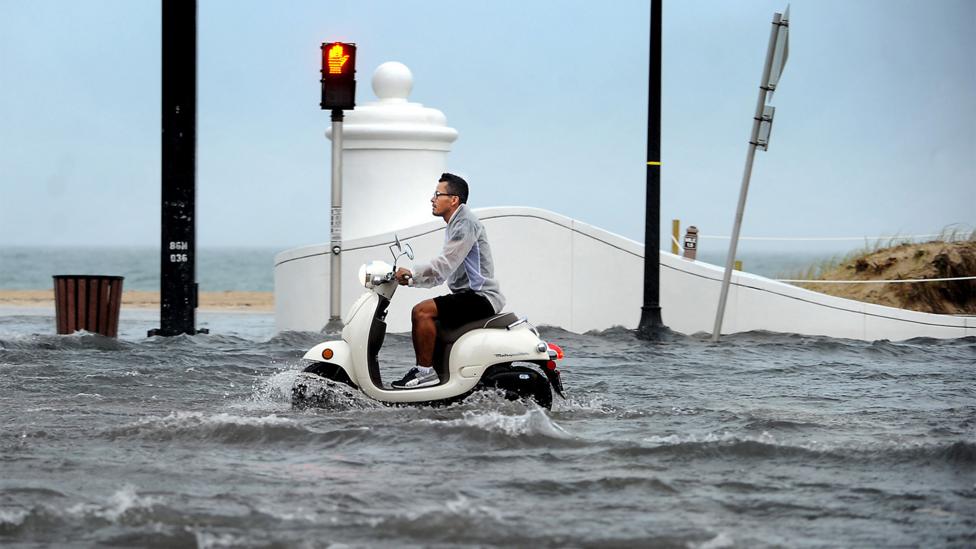
A report by Yale School of the Environment found cities are going to lose the costly battle to hold back the sea.

“It’s a nightmare,” says Ana Zimmerman, who moved her family to higher ground after her James Island home flooded twice.

“wall-off the historic downtown with an 8-mile-long seawall that would cost nearly $2 billion. ”

“In Miami, the Army Corps is studying a 13-foot-high flood wall … Most of the estimated $8 billion price tag would be covered by federal taxpayers … ”

“In Galveston, Texas, the Corps has proposed placing a massive Dutch-style surge gate … estimated cost has ballooned from $2 billion to $37 billion ”

“In New Jersey, the Corps last year published a preliminary plan … Cost estimates range from several billion dollars up to $15 billion.”

“In New York, the Corps proposed building a huge seawall across Lower Manhattan … somewhere between $62 billion and $119 billion”

“In America, we have yet to come to terms with the fact that climate change tells us there are some places where growth is no longer possible.”

“a big wall of distraction”

“Miamians seem to have this horrible concept of permanence of place, even though Miami has only been around a hundred years ”

” the National Flood Insurance Program, which is $20 billion in debt”

“Americans keep flocking to the coast, and builders keep accommodating them. ”

“We’re continuing with more building on a peninsula that’s sinking”

More articles on Flood Insurance, Rising Sea Levels and Global Warming.

bookmark_borderSea Level Rise and Real Estate

In the research paper, Sea level rise and coastal flooding threaten affordable housing, the authors explain how vast sections of real estate will become uninhabitable in the near future.

Sea Level Rise Impact on Housing

About Flood Insurance

Do I Need Flood Insurance?
Flood Risks Across the USA Seriously Underestimated
Climate Change: Suspension Of Belief
Climate Denial and Climate Change Change
Underwater: Sea Level Rise
Disaster on the Horizon: The Price Effect of Sea Level Rise
Climate Change And Credit
Real Estate and the Rising Sea Level


bookmark_borderResidential Real Estate Flood Risk Information

Do you know if you need flood insurance? Do you know if you have flood insurance? What happens when your house gets flooded?

Flood risk information has not been readily available to the average consumer. Climate change is making your flood risk drastically increase.

Now, one of the major real estate databases (Realtor.com) is making flood information available to the public.

In the NPR story, Major Real Estate Website Now Shows Flood Risk. Should They All?, experts explain the trend.

“People are buying property with little knowledge of whether it’s going to flood or not,” says Harriet Festing, co-founder of the advocacy group Higher Ground, which connects people across the country who have survived floods. “It ruins lives.”

Millions of buyers risk overpaying for homes likely to be hit with a natural disaster over the course of a 30-year mortgage. But representatives for other realty sites say home sellers are reluctant to publish flood risk information, since it could decrease their home’s value.

What you need to know about flood insurance and your home.

bookmark_borderGreenland Ice Sheet: largest single contributor to rising sea levels.

Dynamic ice loss from the Greenland Ice Sheetdriven by sustained glacier retreat

by Michalea D. King, Ian M. Howat, Salvatore G. Candela, Myoung J. Noh, Seonsgu Jeong, Brice P. Y. Noël, Michiel R. van den Broeke3, Bert Wouters, Adelaide Negrete

Greenland-Ice-Sheet.pdf

The Greenland Ice Sheet is losing mass at accelerated rates in the 21st century, making it thelargest single contributor to rising sea levels. Fasterflow of outlet glaciers has substantiallycontributed to this loss, with the cause of speedup, and potential for future change, uncertain.

“The ice sheet is now in this new dynamic state, where even if we went back to a climate that was more like what we had 20 or 30 years ago, we would still be pretty quickly losing mass,” Ian Howat, co-author of the study and a professor at Ohio State University, said.

CNN reports, “Sea levels are projected to rise by more than 3 feet by the end of the century, wiping away beaches and coastal properties. Coastal states like Florida, and low-lying island nations are particularly vulnerable. Just 3 feet of sea level rise could put large areas of coastline underwater. Forty percent of the US population resides in coastal areas that are vulnerable to sea level rise.”

“There’s a lot of places, like in Florida especially, where one meter alone would cover a lot of existing land areas,” King said. “And that’s exacerbated when you get storms and hurricanes and things like that, that then cause extra surge on top of a higher baseline.”

“We’ve passed the point of no return but there’s obviously more to come,” Howat said. “Rather than being a single tipping point in which we’ve gone from a happy ice sheet to a rapidly collapsing ice sheet, it’s more of a staircase where we’ve fallen off the first step but there’s many more steps to go down into the pit.”

More articles on Flood Insurance, Rising Sea Levels and Global Warming.

Greenland: Slip Sliding Away

bookmark_borderFar More Properties At Risk: Flood Insurance Exposure

The last link is a map that lets you find flood risk exposed properties by zipcode

Far more properties at flood risk than estimated:

” far more U.S. homes — an estimated 14.6 million — face flooding conditions on par with those in FEMA’s 100-year floodplain. In contrast, FEMA’s maps classify 8.7 million homes as carrying substantial risk.”

“The true figure climbs to 16.2 million homes by 2050 when the effects of climate change are included”

“21 states have no requirements for sellers to disclose flood risk”

https://www.politico.com/news/2020/06/29/study-flood-risks-federal-estimates-344442

“Everyone is exposed ”

Fannie:”exposure to flooding-related risk may not be fully captured under NFIP insurance coverage”

Freddie: “Some of the varied impacts of climate change — rising sea levels, changing rainfall and flooding patterns, increasing temperatures — may not be insurable”

NBER: “homes in flood plains are overvalued by $34 billion”

“Homebuilding and mortgage originations in floodplains have risen steadily over the years even as the number of flood insurance policies has fallen”

” where the risk of flooding is highest, the number of policies held has shrunk even faster, according to FEMA. In 2008, there were 2.5 million residential structures in floodplains insured by the NFIP. By the end of 2019, that number had fallen to fewer than 1.8 million.”

“While Fannie and Freddie don’t screen loans for disaster risk, the mortgage lenders who sell them loans do, a dynamic that could be pushing even more risky loans onto the companies’ books.”

https://www.politico.com/news/2020/06/08/borrowed-time-climate-changemortgage-market-304130
https://prod.nber.org/papers/w26807
https://www.politico.com/f/?id=00000172-86b3-d4f1-adf3-87b7f1300000

https://www.vice.com/en_us/article/9353dv/this-map-shows-which-us-homes-will-flood-over-the-next-30-years-due-to-climate-change

https://floodfactor.com

More articles on Flood Insurance, Rising Sea Levels and Global Warming.

bookmark_borderClimate Change and Mortgage Change

New York Times
By Christopher Flavelle
June 19, 2020

Rising Seas Threaten an American Institution: The 30-Year Mortgage

Climate change is starting to transform the classic home loan, a fixture of the American experience and financial system that dates back generations.

WASHINGTON — Up and down the coastline, rising seas and climate change are transforming a fixture of American homeownership that dates back generations: the classic 30-year mortgage.

Home buyers are increasingly using mortgages that make it easier for them to stop making their monthly payments and walk away from the loan if the home floods or becomes unsellable or unlivable. More banks are getting buyers in coastal areas to make bigger down payments — often as much as 40 percent of the purchase price, up from the traditional 20 percent — a sign that lenders have awakened to climate dangers and want to put less of their own money at risk.

And in one of the clearest signs that banks are worried about global warming, they are increasingly getting these mortgages off their own books by selling them to government-backed buyers like Fannie Mae, where taxpayers would be on the hook financially if any of the loans fail.

“Conventional mortgages have survived many financial crises, but they may not survive the climate crisis,” said Jesse Keenan, an associate professor at Tulane University. “This trend also reflects a systematic financial risk for banks and the U.S. taxpayers who ultimately foot the bill.”

The trends foreshadow a broader reckoning. The question that matters, according to researchers, isn’t whether the effects of climate change will start to ripple through the housing market. Rather, it’s how fast those effects will occur and what they will look like.

The change has already begun. It’s not only along the nation’s rivers and coasts where climate-induced risk has started to push down home prices. In parts of the West, the growing danger of wildfires is already making it harder for homeowners to get insurance.

But the threat that climate change poses to the 30-year mortgage is different, striking at an American social institution that dates from the Great Depression. Before that, many home loans required owners to pay lenders back just a few years after buying a house, which led to waves of defaults and homelessness, according to Andrew Caplin, a professor of economics at New York University.

In response, the federal government created the Federal Housing Administration, which in turn standardized the way Americans finance their homes.

There was nothing magical about a period of 30 years, Dr. Caplin said; it simply proved useful, making payments predictable and affordable by stretching them out over decades. “It was designed from a viewpoint of a consumer, who wouldn’t find it too hard to understand exactly what they had committed to,” Dr. Caplin said.

But now, as the world warms, that long-term nature of conventional mortgages might not be as desirable as it once was, as rising seas and worsening storms threaten to make some land uninhabitable. A retreat from the 30-year mortgage could also put homeownership out of reach for more Americans.

Changes to the housing market are just one of myriad ways global warming is disrupting American life, including spreading disease and threatening the food supply. It could also be one of the most economically significant. During the 2008 financial crisis, a decline in home values helped cripple the financial system and pushed almost nine million Americans out of work.

But increased flooding nationwide could have more far-reaching consequences on financial housing markets. In 2016, Freddie Mac’s chief economist at the time, Sean Becketti, warned that losses from flooding both inland and along the coasts are “likely to be greater in total than those experienced in the housing crisis and the Great Recession.”

If climate change makes coastal homes uninsurable, Dr. Becketti wrote, their value could fall to nothing, and unlike the 2008 financial crisis, “homeowners will have no expectation that the values of their homes will ever recover.”

In 30 years from now, if global-warming emissions follow their current trajectory, almost half a million existing homes will be on land that floods at least once a year, according to data from Climate Central, a research organization. Those homes are valued at $241 billion.

Currently, new research shows banks rapidly shifting mortgages with flood risk off their books and over to organizations like Fannie Mae and Freddie Mac, government-sponsored entities whose debts are backed by taxpayers. In a paper this month in the journal Climactic Change, Dr. Keenan and Jacob T. Bradt, a doctoral student at Harvard University, described the activity, which suggests growing awareness among banks that climate change could cause defaults.

Tellingly, the lenders selling off coastal mortgages the fastest are smaller local banks, which are more likely than large national banks to know which neighborhoods face the greatest climate risk. “They have their ears to the ground,” Dr. Keenan said.

In 2009, local banks sold off 43 percent of their mortgages in vulnerable zones, Dr. Keenan and Mr. Bradt found, about the same share as other areas. But by 2017, the share had jumped by one-third, to 57 percent, despite staying flat in less vulnerable neighborhoods.

If coastal mortgages defaulted on those loans, it could cause losses for Fannie and Freddie. That pain could spread to taxpayers: In 2008, the two firms required $187 billion in public aid to stay solvent. They later repaid the money.

In a separate working paper with Marco Tedesco and Carolynne Hultquist of Columbia University’s Lamont-Doherty Earth Observatory, Dr. Keenan found banks protecting themselves in other ways, such as lending less money to home buyers in vulnerable areas, relative to the value of the homes.

Typically, a bank will lend about 80 percent of the cost of a house, with the buyer putting down the other 20 percent. But examining several counties particularly exposed to rising seas, the researchers found that a growing share of mortgages had required down payments between 21 percent and 40 percent — what Dr. Keenan called nonconventional loans.

In coastal Carteret County, N.C., the share of nonconventional mortgages increased by 14 percent between 2006 and 2017 in the areas most exposed to sea-level rise. That change can’t be explained by the general trend there: In the rest of Carteret County, nonconventional loans became less common during the same period.

Similarly in St. Johns County, Fla., south of Jacksonville, between 2006 and 2017, the share of nonconventional loans in the most vulnerable areas increased by 6 percent, while falling 22 percent in the rest of the county. “You’re seeing a statistically significant trend,” Dr. Keenan said.

The Mortgage Bankers Association, a trade group, declined to comment directly on the findings. Pete Mills, the association’s senior vice president of residential policy, cited the requirement for homeowners to buy insurance.

“Lenders make sure all properties are properly insured,” Mr. Mills said in a statement. “For loans in Special Flood Hazard Areas, flood insurance is required,” he added, referring to areas the Federal Emergency Management Agency has determined have a high flood risk.

Fannie Mae and Freddie Mac said, “Any loan located in FEMA-designated Special Flood Hazard Areas must have flood insurance in order for the loan to be purchased by Freddie Mac or Fannie Mae.”

But flood insurance isn’t likely to address the problem, Dr. Keenan said, because it doesn’t protect against the risk of a house losing value and ultimately becoming unsellable.

Lenders aren’t the only ones who seem to be inching away from traditional 30-year mortgages in risky areas. More homeowners are also taking out a type of mortgage that is less financially painful for a borrower to walk away from if a home becomes uninhabitable because of rising seas. These are known as interest-only mortgages — the monthly payment covers only the interest on the loan, and doesn’t reduce the principal owed.

Under normal circumstances, this kind of loan sounds like a bad deal: It’s a loan you can never pay off with the regular monthly payments. However, it also means buyers aren’t sinking any more of their own money into the property beyond a down payment. That’s an advantage if you think the property may become unlivable.

“A household that expects the house will be flooded within a decade, say, is unlikely to value the accumulation of equity in this house,” said Amine Ouazad, an associate professor of real estate economics at HEC Montreal who has researched the practice. “The ability to walk away from a mortgage in case of major floods or sea-level rise is a feature.”

In new research this month, Dr. Ouazad found that, since the housing crash, the share of homes with fixed-rate, 30-year mortgages has declined sharply — to less than 80 percent, as of 2016 — in areas most exposed to storm surges. In the rest of the country, the rate has stayed constant, at about 90 percent of home loans.

Part of the difference was the interest-only loans, Dr. Ouazad found. More than 10 percent of homeowners in those areas had interest-only loans in 2016, compared with just 2.3 percent in other ZIP Codes. The work hasn’t been peer-reviewed, and more research is needed, Dr. Ouazad said. But he said there’s reason to think climate risks are part of the explanation.

The tougher question, according Carolyn Kousky, executive director of the Wharton Risk Center at the University of Pennsylvania, is what happens after that, when people quite simply no longer want to live in homes that keep flooding. “What happens when the water starts lapping at these properties, and they get abandoned?” she said.

More about Flood Insurance and Real Estate

More articles on Flood Insurance, Rising Sea Levels and Global Warming.

bookmark_borderClimate Change 2020

Our Infrastructure Is Being Built for a Climate That’s Already Gone
Our drain pipes, reservoirs, power lines, roads, sewage systems, and more are all designed based on past climate data. But with the climate crisis comes the uncomfortable realization that the past can’t predict what we’ll need in the future.
by Shayla Love
Jun 2 2020, 1:05pm

In 1979, the Army Corps of Engineers predicted that by 2014, Optima Lake, in the panhandle of Oklahoma, would have 600,000 visitors a year camping, fishing, boating, and swimming. Instead, the lake sat empty, a dry expanse of land about three miles long. Today, it is still abandoned.

The Optima Lake and Dam was originally intended to control flooding from Beaver Creek and the North Canadian River. After $45 million was spent on its construction, though, the lake never filled up, and it has never reached more than 5 percent of its capacity.

Ed Rossman, a planning branch chief for the Corps of Engineers’ Tulsa District, told a local NPR station in 2013 that the project had been led astray because planners used historical climate data to pick the spot where the dam would be built. That data was wrong by the time construction was completed, and the water no longer flowed there. “We know that the historic record may not be a good snapshot for the future,” Rossman said.

In other parts of the world, the opposite problem has occurred. A flooding barrier put up in the 1990s in the Netherlands to protect Rotterdam will likely fail 25 years sooner than was predicted when it was first built in the 1990s. Replacing the barrier will cost around a billion euros, 10 million of which would be just the cost for taking it down.

The issue here, in its different guises, is one that engineers and city planners continue to face, and which reveals an inherent problem with how we’ve planned, designed, built, and made predictions around all of our infrastructure. At its core, this problem revolves around a concept called stationarity.

The tropics lost 11.9 million hectares (46,000 square miles) of tree cover, the study found, 3.8 million in older, primary forest areas – the third highest loss of primary trees since 2000 and a slight increase on 2018.

“The level of forest loss that we saw in 2019 is unacceptable,” Frances Seymour, from the World Resources Institute, said.

“And one of the reasons that it’s unacceptable is that we actually already know how to turn it around.

“If governments put into place good policies and enforce the law, forest loss goes down.

“But if governments relax restrictions on burning, or [are] signalling that they intend to open up indigenous territories for commercial exploration, forest loss goes up.”


Miami’s fight against rising seas
By Amanda Ruggeri
22nd May 2020

Just down the coast from Donald Trump’s weekend retreat, the residents and businesses of south Florida are experiencing regular episodes of water in the streets. In the battle against rising seas, the region – which has more to lose than almost anywhere else in the world – is becoming ground zero.

Stationarity is the idea that, statistically, the past can help you predict and plan for the future—that the variations in climate, water flow, temperature, and storm severity have remained and will remain stationary, or constant.

Nearly all the infrastructure decisions with which we live have been made with the assumption of stationarity. Engineers make choices about stormwater drainage pipes based on past data of inches of rain. Bridge engineers design foundations that can withstand a certain intensity of water flow based on the severity a certain location has experienced in the past. Reservoirs are designed to hold water based on historical information about water flow, and the historical water needs of a community.


Climate change: older trees loss continue around the world
By Matt McGrath Environment correspondent

In 2019, an area of primary forest the size of a football pitch was lost every six seconds, the University of Maryland study of trees more than 5 metres says.

Brazil accounted for a third of it, its worst loss in 13 years apart from huge spikes in 2016 and 2017 from fires.

However, Indonesia and the Democratic Republic of Congo both managed to reduce tree loss.

Meanwhile, Australia saw a sixfold rise in total tree loss, following dramatic wildfires late in 2019, .

As well as storing massive amounts of carbon, primary, tropical rainforests, where trees can be hundreds or even thousands of years old, are home to species such as orangutans and tigers.

The first time my father’s basement flooded, it was shortly after he moved in. The building was an ocean-front high-rise in a small city north of Miami called Sunny Isles Beach. The marble lobby had a waterfall that never stopped running; crisp-shirted valets parked your car for you. For the residents who lived in the more lavish flats, these cars were often BMWs and Mercedes. But no matter their value, the cars all wound up in the same place: the basement.

When I called, I’d ask my dad how the building was doing. “The basement flooded again a couple weeks ago,” he’d sometimes say. Or: “It’s getting worse.” It’s not only his building: he’s also driven through a foot of water on a main road a couple of towns over and is used to tiptoeing around pools in the local supermarket’s car park.

Ask nearly anyone in the Miami area about flooding and they’ll have an anecdote to share. Many will also tell you that it’s happening more and more frequently. The data backs them up.

It’s easy to think that the only communities suffering from sea level rise are far-flung and remote. And while places like the Solomon Islands and Kiribati are indeed facing particularly dramatic challenges, they aren’t the only ones being forced to grapple with the issue. Sea levels are rising around the world, and in the US, south Florida is ground zero – as much for the adaptation strategies it is attempting as for the risk that it bears.

Florida State Road A1A runs the entire length of Florida along the ocean, making it vulnerable to flooding – as shown here in Fort Lauderdale in 2013 (Credit: Alamy)

Florida State Road A1A runs the entire length of Florida along the ocean, making it vulnerable to flooding – as shown here in Fort Lauderdale in 2013 (Credit: Alamy)

One reason is that water levels here are rising especially quickly. The most frequently-used range of estimates puts the likely range between 15-25cm (6-10in) above 1992 levels by 2030, and 79-155cm (31-61in) by 2100. With tides higher than they have been in decades – and far higher than when this swampy, tropical corner of the US began to be drained and built on a century ago – many of south Florida’s drainage systems and seawalls are no longer enough. That means not only more flooding, but challenges for the infrastructure that residents depend on every day, from septic tanks to wells. “The consequences of sea level rise are going to occur way before the high tide reaches your doorstep,” says William Sweet, an oceanographer at the National Oceanic and Atmospheric Administration (NOAA).

The flooding would be a challenge for any community, but it poses particular risks here. One recent report estimated that Miami has the most to lose in terms of financial assets of any coastal city in the world, just above Guangzhou, China and New York City. This 120-mile (193km) corridor running up the coast from Homestead to Jupiter – taking in major cities like Miami, Fort Lauderdale and West Palm Beach – is the eighth most populous metropolitan area in the US. It’s also booming. In 2015, the US Census Bureau found that the population of all three counties here was growing – along with the rest of Florida – at around 8%, roughly twice the pace of the US average. Recent studies have shown that Florida has more residents at risk from climate change than any other US state.

* extreme weather events
* flood insurance
* feedback loops
* tree deaths and deforestation
* The Human Induced Climate Change Experiment

bookmark_borderNew Jersey Requires Climate Change Risk Analysis for Building Permits

The New York Times reports, “With 130-Mile Coast, New Jersey Marks a First in Climate Change Fight

New Jersey will become the first state to require that builders take into account the impact of climate change, including rising sea levels, in order to win government approval for projects, Gov. Philip D. Murphy announced on Monday.

The move by Mr. Murphy, a Democrat, is part of a widening effort by states to use regulations to address worsening climate conditions and to aggressively counteract the Trump administration’s push to roll back environmental regulations.

“This is not abstract for us,” Mr. Murphy said in an interview. “This is real. The dangers are there.”

New Jersey’s initiative is believed to be the broadest, and most specific, attempt to leverage land-use rules to control where and what developers can build, and to limit the volume of emissions that are spewed into the air.

“It gives us the ability to say no, or to say, ‘You have to do it differently,’” said Kathleen Frangione, the governor’s chief policy adviser.

Mr. Murphy, through executive order, will require the state Department of Environmental Protection to begin the process of drafting new regulations to be adopted by January 2022. The changes do not require legislative approval, but could face legal and political challenges.

Do you need flood insurance?

  • Homeowners insurance does NOT cover flooding
  • Flood insurance is obtained through the government’s flood insurance program
  • Flood insurance does not cover the basement of a house
  • Flood insurance covers a lifetime maximum of $250,000 in coverage
    This means if you make a claim for $150,000 the maximum coverage for the life of the property drops to $100,000.

The Human Induced Climate Change Experiment

bookmark_borderSea-level Rise: Not Just for the Coasts Anymore

“Their results suggest that coastal regions will be far from the only ones affected by sea-level rise. A huge number of counties far from the coast—some deep in the US interior—will see dramatic changes in the number of people relocating there.”

ARS Technica reports, As sea levels rise, little of the United States will be unaffected. “If you’re not near the coast, get ready for lots of new neighbors.

The United States is rich enough, industrialized enough, and far enough from the tropics that the rising temperatures of our changing climate aren’t going to make any place uninhabitable. But a side effect of those rising temperatures—rising oceans—most certainly will. Already, an ever-growing list of places is facing what’s called “nuisance flooding,” in which even a high tide can leave streets underwater. Major storms just make matters worse. And, by the end of this century, the expected rise of the oceans may be over five times what we saw last century.

As a result of this, many areas of the country will simply become uninhabitable, lost to the sea. Well over a third of the United States’ population lives in counties that are currently on the coast, and over 10 million currently live on land that will be lost to a sea-level rise of 1.8 meters. They’ll have to go somewhere—and people who might otherwise move to the coast will have to find some place else to relocate. All of which will change the dynamics of the typical relocation of people within the US.

A new study released in PLOS ONE tries to estimate what that will mean for the rest of the country. Their results suggest that coastal regions will be far from the only ones affected by sea-level rise. A huge number of counties far from the coast—some deep in the US interior—will see dramatic changes in the number of people relocating there.”

PLOS ONE reports, Modeling migration patterns in the USA under sea level rise. “Sea level rise in the United States will lead to large scale migration in the future. We propose a framework to examine future climate migration patterns using models of human migration. Our framework requires that we distinguish between historical versus climate driven migration and recognizes how the impacts of climate change can extend beyond the affected area. We apply our framework to simulate how migration, driven by sea level rise, differs from baseline migration patterns. Specifically, we couple a sea level rise model with a data-driven model of human migration and future population projections, creating a generalized joint model of climate driven migration that can be used to simulate population distributions under potential future sea level rise scenarios. The results of our case study suggest that the effects of sea level rise are pervasive, expanding beyond coastal areas via increased migration, and disproportionately affecting some areas of the United States.”

Areas Impacted by Rising Sea Level

Do you need flood insurance?

  • Homeowners insurance does NOT cover flooding
  • Flood insurance is obtained through the government’s flood insurance program
  • Flood insurance does not cover the basement of a house
  • Flood insurance covers a lifetime maximum of $250,000 in coverage
    This means if you make a claim for $150,000 the maximum coverage for the life of the property drops to $100,000.

The Human Induced Climate Change Experiment

bookmark_borderThe True Costs (and Benefitlessness) of a Trump Economy

January 23, 2020

What are the costs and benefits to the United States under a Trump economy?

Financial Analysis: Current State of Affairs
First, start with a financial analysis — a snapshot of the current economic health of the nation. What would a financial analysis that is similar to an individual applying for a bank loan, or a married couple visiting a financial planner for their retirement plan, look like? What are the assets and liabilities? What type of assets and liabilities are in your portfolio? What are your saving patterns? Did you get a large gift from your parents or have you been showing a strong pattern of saving over time? What is your income? Have you made dubious loans to yourself? Where does your income come from? What is your credit history?

A financial analysis of the U.S.A. results in a failing grade.

Impacts of Fiscal and Monetary Policy
After examining the current state of affairs, examine the fiscal policies of the Executive Branch and the monetary policies pushed onto the Federal Reserve. The Trump administration has taken extremely negative positions with free-trade, as well as, jeopardized the standing of the world reserve currency.

Tariffs
The Trump administration has destroyed the United States leadership in free-trade. Huge taxes were placed upon the American public through the use of tariffs. The tariffs were put on goods and services from around the world and paid for by the American consumer. The placement of tariffs have circumvented congress’ oversight and consumer protection considerations. Not only do tariffs introduce new taxes on the population, they also destroy trade relationships with other countries. That is to say, tariffs and retaliatory tariffs cause foreign countries to look elsewhere for their imports. For example, China’s retaliatory tariffs on agriculture resulted in China developing new trade partnerships that do not include the USA.

Here is a partial list of Trump Tariffs:
Solar panels: 15 – 30%
Washing machines: 16 – 50%
Steel and aluminum: 10 – 25%
Chinese products: 15 – 50%
South Korean products: 25%

More tariffs were placed on India, Canada, Mexico, the European Union and others.

Tariffs not only have a direct impact on U.S. current affairs, but they will leave everlasting damage.

Inflation
The overall Trump economic policy has put the economy at risk of high inflation and interest rates.

Inflation Update: Immigration and the Wage Inflation Spiral (June 12, 2022)
An important factor in the 2022 record inflation situation can be traced back to the Trump immigration policy.

The US has stagnant population growth (as does the UK, EU, etc. Japan has a declining population.)

During the Trump administration, the US drastically curtailed immigration. The Biden administration continues to do so today.

The result has been wage inflation. The wage inflation that started in 2018 began the overall inflation spiral that continues today. A wage inflation spiral happens when the initial wage inflation is canceled out by the price inflation requiring further wage inflation to keep up with the price inflation… the increase prices require more wage inflation for employees to keep pace with the cost of living… the subsequent rise in wages results in the need to raise prices to pay the workers… and round and round we go.

The solutions are to either increase our population (through immigration) and/or increase our productivity by eliminating the need for humans.

How the Inflation Spiral Started: Immigration
The Trump administration’s policy on immigration and building The Wall have a devastating impact on the economy. The U.S. economy is a capitalistic system based on population growth. The birth rate in America is close to zero percent. In order to maintain the standard of living, the country needs to gain millions of people through immigration. The Trump policies have attempted to eliminate immigration.
— Daniel Brouse (2020)

* “Over the course of four years, the Trump administration set an unprecedented pace for executive action on immigration, enacting 472 administrative changes that dismantled and reconstructed many elements of the U.S. immigration system. Humanitarian protections were severely diminished. The U.S.-Mexico border became more closed off. Immigration enforcement appeared more random. And legal immigration became out of reach for many. All of this was accomplished nearly exclusively by the executive branch, with sweeping presidential proclamations and executive orders, departmental policy guidance, and hundreds of small, technical adjustments.” — Migration Policy Institute’s Four Years of Profound Change (2022>

* “After years of wage stagnation, we are finally seeing rising wages,” Donald Trump (State of the Union 2018)
“The Employment Cost Index, a measure of salary and benefit costs, registered a 2.6 percent gain for the full year, tied for the best since 2007.” — CNBC (January 31, 2018)

* From December of 2020 through January of 2022, nominal wages and salaries were up 4.5 percent, the fastest increase since 1983. — Bureau of Labor Statistics (BLS)

World Reserve Currency
“A nation that prints its own currency, and that currency is the world reserve currency, is not threatened by deficits. Until that currency stops being the reserve currency,” said Sidd Mukherjee.

The U.S. dollar as the world reserve currency has given the United States an unfair economic advantage. The U.S. has been able to “print” and borrow money in ways that break the rules of economics; however, the Trump administration has jeopardized the standing of the dollar as the world reserve currency.

The major economic powers of the world entered into a nuclear arms deal with Iran called the Joint Comprehensive Plan of Action (JCPOA). In October of 2017, Trump began pulling out of the agreement. On May 8, 2018, Trump announced the United States withdrawal from JCPOA and declared economic warfare on Iran. The warfare included “tough new sanctions” on Iran. The other countries to the treaty attempted to maintain the JCPOA by developing a new system to by-pass the world reserve currency.

Germany, France and Britain officially set up a European mechanism to facilitate non-dollar trade with Iran, the Instrument in Support of Trade Exchanges (Instex). Russia and other countries have since joined Instex.

Risk Management
The future of the nation is dependent on current risk management. “On the High Risk List; the fragmentation, overlap, and duplication annual report; natural disasters and climate change; and other topics,” reports the General Accounting Office of the USA. Pollution, in particular air pollution, is also a substantial risk. CO2, methane and other greenhouse gases have all increased under the Trump plan. Trump has withdrawn from the Paris Agreement and has consistently called climate change a hoax.

It’s never a good idea to say “never”… but, risk-management-denial always increases the probability of a worse case scenario.

Not only is our nation’s current cash-flow severely hemorrhaging due to extreme weather events (and other costs associated with climate change), but this is just the tip of the iceberg. Climate change denial is risk-management-denial.

Pollution and Climate Change Costs Unsustainable

Trump recently stated, “We have the cleanest air.” This is a boldfaced lie. Air pollution in the form of particulates and ozone are a severe health emergency in the United States.

“According to a 2009 report, around ’60 percent of Americans live in areas where air pollution has reached unhealthy levels that can make people sick.’ Air pollution can cause a variety of health problems including, but not limited to infections, behavioral changes, cancer, organ failure, and even premature death.” (Wikipedia) Air pollution is the number one cause of illness in the world and the second leading cause of death. The cost of air pollution can not be contained by one country — pollution knows no borders. It is estimated 8 million people a year die from air pollution.

A report by Stanford and Carnegie Mellon University states, “Air pollution negatively impacts the U.S. economy, costing the U.S. roughly 5 percent of its yearly gross domestic product (GDP) in damages ($790 billion in 2014). The highest costs come from early deaths, attributable to exposure to fine particulate matter (PM2.5).” The number had been falling up to 2016, but Trump has dramatically undermined clean air laws. As of December 2019, Trump had rolled back 95 environmental protection laws.

Air pollution also contributes to the climate change crisis, and in an exponential feedback loop, climate change contributes to air pollution. For instance, the wildfires in California and Australia were made more severe due to human induced climate change. The wildfires resulted in air pollution that costs billions of dollars in damages, illness and death. The wildfires also contributed to greenhouse gases and climate change that will result in more wildfires.

Though a huge cost, the climate change / air pollution feedback loop is just a small cost of climate change. Not only has the Trump administration not properly assessed the risk of climate change, the administration has undermined efforts to mitigate climate change. Even more brazen, the administration has enacted policies that hasten the devastation of global warming.

The costs of climate change are huge. The Hamilton Project and the Stanford Institute for Economic Policy Research reports, “Damages to the U.S. economy grow with temperature change at an increasing rate.” The Washington Post reports, “Climate change could cost the U.S. economy up to 10.5% of GDP by 2100.” The cost of not adapting to climate change will likely cripple the American economy.

The current costs, the costs of not adapting, and the costs of not preventing climate change are overwhelming to calculate. Take flood insurance as an example. Sea level rise and extreme weather events have redrawn floodmaps and bankrupted the National Flood Insurance Program. What flood insurance that is still available has started a series of exponential increases in premiums. Real estate along the coasts and flood prone areas will become worthless in the coming years.

The other costs associated with the Trump administration’s climate change policy is too long to list.  Fossil fuel elimination and climate change mitigation our essential for risk management.

Immigration and the Acquisition Of Private Property
The Trump administration’s policy on immigration and building The Wall have a devastating impact on the economy. First, the U.S. economy is a capitalistic system based on population growth. The birth rate in America is close to zero percent. In order to maintain the standard of living, the country needs to gain millions of people through immigration. The Trump policies have attempted to eliminate immigration.

Also of a long-term negative impact is the building of The Wall. Funds to build the wall were diverted against the will of congress. The funds were then used to seize private land. The land seizures and The Wall have had a major impact on nature preserves and indigenous sacred grounds. Just as detrimental are the eminent domain acquisitions of individuals’ land. Socialization of private property is an attack on the economic system. The costs to the economy and freedom are not quantifiable.

Income Inequality
The Trump administration’s policies have widened the economic divide and income inequality in the United States.  Trump said, “inequality is down.” The next day federal data was released and the Washington Post reported, “The separation between rich and poor from 2017 and 2018 was greater than it has ever been.”

“Wages are up, and inequality is down. Something that people don’t like writing about.” Trump said during a press conference following the United Nations General Assembly meeting in New York. Again, this is not true. The Economic Policy Institute reports, “Slow wage growth is a key sign of how far the U.S. economy remains from a full recovery. Nominal wage growth since the recovery officially began in mid-2009 has been low and flat.”

BENEFITS
There have not been any real benefits from Trump policies. Some people try to point to employment and tax cuts.

Employment
Employment and unemployment numbers became irrelevant as an economic indicator in the 1990’s. The internet and the worldwide web transformed the definition of employment. In addition, you would need to deduct all the jobs lost through the elimination of most temporary work visas. Many of these jobs have not been filled, especially in agriculture, horticulture and hospitality. Billions of dollars in wages and taxes have been eliminated through the Trump immigration policy. These numbers are not included in employment figures.

During the fourth quarter of 2016, 7.6 million people were unemployed. At the end of 2018, 9.0 million people remained unemployed. Yet, Trump claims to have created 5 million new jobs. Do the math.

In January 2020, Trump boasted at a campaign rally in Wildwood, NJ that “factory jobs were the best ever in the history of the United States.” Reuters reported, U.S. factory sector in deepest slump in more than 10 years. “The U.S. manufacturing sector fell into its deepest slump in more than a decade in December as the U.S.-China trade war kept a lid on factory output, orders and employment…. The Institute for Supply Management (ISM) said its index of national factory activity fell to 47.2 last month from 48.1 in November. It was the lowest reading since June 2009 and, coupled with readings for both new orders and factory employment at multi-year lows, thwarted expectations for a leveling off in the pace of decline in a sector buffeted by trade tensions. ”

Tax Cuts
The only beneficial tax cut that has been made by the administration was to lower corporate taxes. Corporate profits are already taxed as income to shareholders. The corporate tax is double taxation. A fair tax policy would not have corporate taxation. However, the other Trump trade and tax policies’ negative impacts far outweigh the positive impact of a reduction in corporate tax rates.

But, What About Obama?
Obama increased the national debt by about $1 trillion/year. Trump is increasing the national debt by about $1 trillion/year. What makes Trump worse than Obama — Trump is suppose to be a fiscally conservative Republican. Obama wasn’t suppose to be. So, for that reason, Trump’s deceit makes it worse than Obama. Trump is not stopping the problem. Worse yet, he is contributing to the problem at the same rate as Obama, as well as, putting the future economy at risk through bad trade and environmental policies. Trump is trying to con the American public into a false narrative on the economy.  In fact, this is not “the best economy ever. Rather, it is the worst economy ever.

Morning Brew reported, U.S. Budget Deficit to Exceed $1 Trillion in 2020. “The U.S. budget deficit will top $1 trillion this year, according to a new report from the nonpartisan Congressional Budget Office (CBO). What that means: The government will spend $1.02 trillion more than it collects in 2020. The widening deficit is a result of the 2017 tax cuts and an increase in spending on federal programs.”

By 2020, the debt to GDP ratio hit its highest level ever at 125%.

Conclusion
The national debt is unsustainable. The debt, risk-management-denial, deceit, nationalism, and greed will sink our ship.


ABOUT THE AUTHOR
The responsibility an economist accepts is to determine the “costs and benefits of our actions on society.” Then, attempt to convert the difference into dollars. Is economics opinion? That depends on your value of the costs and benefits of your actions on society.