bookmark_borderClimate Change Time Line

by Daniel Brouse
October 11, 2024

What is the past, present and future of climate change?

I originated the hypothesis of the non-linear acceleration of climate change in the 1990s. By the early 2000s, that hypothesis evolved into established climate theory and is now widely recognized as scientific fact. My lab partner, a Doctor of Physics from Ohio State, and I teamed up in the ’90s. He provided crucial evidence to support the hypothesis. Since then, we’ve observed that the doubling time for climate change impacts—how quickly the effects intensify—has dropped dramatically. Initially, the doubling time was around 100 years. However, over the last few decades, it has shortened to 10 years and more recently to just 2 years.

This means the damage from climate change this year is twice as bad as it was two years ago, and in another two years, it could be four times worse. Unfortunately, the sharp decrease in the doubling period doesn’t appear to be an anomaly, especially given the unprecedented events we’re witnessing this year, even during a La Niña phase. If this trend continues, the consequences will be far more devastating than originally anticipated.

Human-induced climate change is a dynamic element of an intricate and chaotic system, accelerating global warming in a complex and exponential manner. Over the period from 1992 to 2023 (update 2024), our climate model has presented evidence, proposed solutions, and engaged millions in understanding this escalating crisis. The data reveals that human activities are rapidly deteriorating our environment.

Our climate model employs chaos theory to assess human impacts. Global warming is driven by increased thermal energy within the climate system, a complex web of interconnected subsystems. Previous models often failed to account for “social-ecological systems,” where human activity significantly alters climate dynamics.

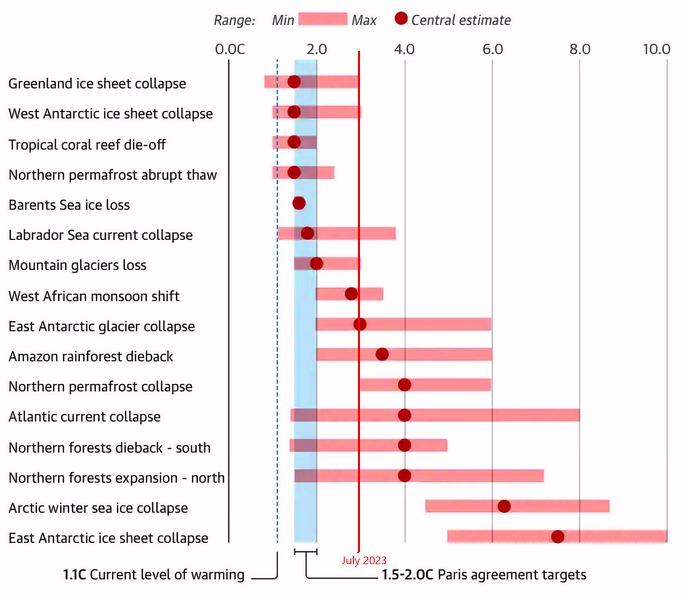
Tipping points are Critical Milestones that directly impact the rate of acceleration in climate change by multiplying the number and intensity of feedback loops. Identifying and understanding these tipping points is crucial for climate science and policymaking. Crossing multiple tipping points has led to the domino effect, resulting in a much more rapid and severe climate change than currently projected.

Push a glass toward the edge of a table and eventually it will fall off on its own. No matter how slowly or meticulously you push… no matter how you weight or fill the glass, it will reach a tipping point and fall off before being pushed completely off the table. No matter whether you believe the glass is half-empty or half-full, when the tipping point is reached it will plummet out-of-control to its end. This is science not fate, faith, nor belief. Human induced climate change has resulted in environmental tipping points being breached.
The Human Induced Climate Change Experiment

bookmark_borderClimate Change’s Impact on Florida Insurance

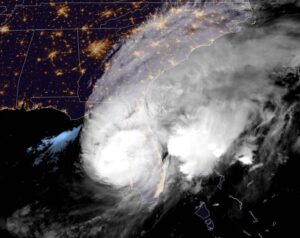
Hurricane Milton is expected to cause over $100 billion in insurance claims, creating even more challenges for Florida homeowners in obtaining insurance. On top of that, the cost to the public and government is projected to exceed an additional $50 billion, adding to the financial strain on taxpayers and the state. Much of the damage from Milton came from the powerful winds and the unprecedented number of tornadoes it spawned. The eastern side of Florida saw the most severe impacts, with over 30 tornadoes causing extensive damage and the highest number of fatalities and potential financial losses.

Citizens Property Insurance Corporation, Florida’s state-backed insurer, has become the largest insurance provider in the state due to the exodus of private insurance companies. Many companies are pulling out due to increasing risks from hurricanes and other extreme weather events driven by climate change. Citizens, however, faces significant financial strain. As hurricane damage grows more frequent and severe, Florida taxpayers are likely to face an unsustainable burden in covering reconstruction costs. The situation highlights the ongoing vulnerability of Florida’s real estate market, and if you haven’t already sold property in the state, it might be a case of better late than never.

The growing frequency and intensity of storms, combined with the financial instability of the insurance industry in Florida, make future investments in the region highly risky. As climate change continues to escalate, the risks are only expected to worsen.

It’s important to note that the degree of risk varies by region and property type. Some areas may experience more immediate and severe impacts, while others may be more resilient. Assessing and mitigating these risks require a comprehensive understanding of local climate vulnerabilities and the implementation of strategies to enhance property resilience. Policymakers, real estate professionals, and property owners are increasingly recognizing the importance of addressing climate risks to ensure the long-term sustainability and value of real estate assets. Thus, our recommendation to evacuate Florida now (i.e. Managed Retreat).

* Our climate model employs chaos theory to comprehensively consider human impacts and projects a potential global average temperature increase of 9℃ above pre-industrial levels.

Hurricane Milton / October 9, 2024

How is All Real Estate at Risk From Climate Change?

Flood Insurance

The Human Induced Climate Change Experiment

bookmark_borderRaindrops Are Increasing in Size Due to Climate Change

By Daniel Brouse
October 1, 2024

There is growing evidence that raindrops are increasing in size due to climate change and rising temperatures. Several studies suggest that global warming is influencing precipitation patterns, including the size and intensity of raindrops. Here’s a summary of the key points:

1. Increased Water Vapor in the Atmosphere

  • Warmer air holds more moisture, as described by the Clausius-Clapeyron equation. For every 1°C (1.8°F) rise in temperature, the atmosphere can hold about 7% more water vapor. This increased moisture can result in larger raindrops, as more water is available for cloud formation and precipitation.

2. Enhanced Convection

  • Rising temperatures lead to stronger convection (vertical air movement), which is a key process in storm formation. Stronger updrafts can suspend larger water droplets in the atmosphere for longer periods, allowing them to grow before falling as rain. This can lead to larger raindrops in storms.

3. Heavier Rainfall Events

  • There has been a documented increase in the frequency and intensity of heavy rainfall events globally. Larger and heavier raindrops are more likely in such events because more water is being concentrated in intense, short bursts of rain. For example, a study by the U.S. National Climate Assessment found that heavy rainfall has increased in many regions of the United States, especially in the Northeast.

4. Studies and Observations

  • Satellite observations and ground-based radar data have detected an increase in the size of raindrops over certain regions. A study published in Nature Communications in 2020 showed that storm systems in tropical and subtropical regions were producing larger raindrops as global temperatures increased.
  • In urban areas, which experience localized warming due to the “urban heat island” effect, researchers have observed both an increase in rainfall intensity and larger raindrops compared to rural areas.

5. Impact of Aerosols

  • Climate change also affects the distribution and concentration of aerosols in the atmosphere. These tiny particles serve as nuclei around which raindrops form. With more aerosols in some regions due to human activities, raindrops can take longer to coalesce, potentially leading to larger drops as they fall.

6. Feedback Loops

  • The increase in extreme weather events, such as tropical storms and hurricanes, which are intensified by climate change, also leads to heavier rain with larger raindrops. These storms draw more water vapor from the warming oceans, contributing to bigger raindrops when they make landfall.

Conclusion:

While more research is ongoing, there is substantial evidence that climate change is leading to larger raindrops due to increased atmospheric moisture, enhanced convection, and more intense storm systems. These changes contribute to more severe rainfall events, which are linked to greater flooding and erosion.

Violent Rain
What turns these severe weather events into ‘violent rain events’ is the application of the drag equation and flow dynamics.

Mass and velocity are just part of the equation; density also plays a key role. The combination of these variables increases the intensity of flow forces. Wind and water forces scale with the square of velocity, meaning that as flow speeds increase—due to more intense heating or heavier rainfall—the damage scales accordingly. According to drag physics, force is proportional to density times the square of velocity (v2v2).

About the Human Induced Climate Change Experiment

bookmark_borderViolent Rain: Helene Update

By Daniel Brouse
September 30, 2024

If you’re wondering why rain-related severe weather events are becoming more frequent and intense, it’s due to climate change. Rising temperatures increase the amount of humidity in the atmosphere, as warmer air holds more moisture. The Clausius-Clapeyron equation shows that for every 1°C (1.8°F) increase in temperature, the air can hold about 7% more water vapor.

Many areas in the U.S. are experiencing average temperature increases of up to 10°C, extending over more weeks during both spring and fall. This increase allows the atmosphere to hold about 70% more water vapor, leading to significantly more rainfall. Additionally, raindrops are becoming larger and falling faster, which increases their momentum. Using the formula p=mv (momentum = mass × velocity), larger and faster raindrops carry more energy.

Moreover, the number of raindrops is also increasing. A higher concentration of raindrops in a given time and area further boosts momentum. For example, if N raindrops, each with mass m and velocity v, hit a surface area A per second, the total momentum impacting the surface is Nmv per second. This contributes to increased force and damage during rainstorms.

The end result is an increase not only in the frequency and intensity of storms but also in the momentum of falling rain, which intensifies their impact.

Violent Rain
What turns these severe weather events into ‘violent rain events’ is the application of the drag equation and flow dynamics.

Mass and velocity are just part of the equation; density also plays a key role. The combination of these variables increases the intensity of flow forces. Wind and water forces scale with the square of velocity, meaning that as flow speeds increase — due to more intense heating or heavier rainfall — the damage scales accordingly. According to drag physics, force is proportional to density times the square of velocity.

For example, a 20-mile-an-hour wind exerts four times the force of a 10-mile-an-hour wind, while a 40-mile-an-hour wind exerts 16 times the force of a 10-mile-an-hour wind. At 50 miles an hour, the force is 25 times greater, and at 60 miles an hour, it’s 36 times greater than at 10 miles an hour. Now, add the density factor: water is about 800 times denser than air, so a 10-mile-an-hour water flow exerts 800 times the force of a 10-mile-an-hour wind.

As flow velocities increase due to climate change, the forces — and thus the damage — scale with the square of the velocities. While we may not know precisely how much velocities will rise with climate change, we’re already seeing the effects: overwhelmed flood and sewage systems, collapsing hillsides, and more.

About the Human Induced Climate Change Experiment

bookmark_borderPolitical Overview of Economics

The latest economic analysis of the presidential candidates suggests that Trump’s fiscal policies could increase the federal deficit by an estimated $7-10 trillion over the next decade, primarily due to his proposed tax cuts and spending plans. Trump’s approach centers on lowering taxes, particularly for high-income earners and corporations, while increasing defense and infrastructure spending. This combination is likely to drive the deficit up significantly without matching revenue increases. Additionally, Trump plans to shift the tax burden from income-based taxes to consumption taxes, which disproportionately impacts lower- and middle-income households, as consumption taxes tend to be regressive.

In contrast, Kamala Harris’s fiscal policies are projected to have a much smaller effect on the federal deficit, with some analyses suggesting her approach may be close to net-neutral. Harris emphasizes maintaining and slightly increasing government revenue by raising taxes on the wealthy and corporations, while also focusing on targeted spending, such as expanding healthcare and education access.

However, it’s important to note that economic forecasts have limitations, particularly when considering non-concrete policy claims. For example, statements about “going after corporate gouging” or “building affordable housing” are often more rhetorical than substantive, as the details necessary to evaluate the financial feasibility of these promises are lacking. Consequently, these claims are typically excluded from rigorous economic projections because they lack clear policy frameworks or mechanisms for implementation.

This discrepancy between promises and reality is a common challenge in political economic analysis, as voters are often presented with grand ideas that may not withstand financial scrutiny.

Tariffs, Inflation, and the Climate
While the “Inflation Reduction Act” includes substantial subsidies for electric vehicles (EVs), Biden has maintained Trump’s China tariffs, and even imposed a 25% tariff on Chinese EVs, citing unsubstantiated claims that China is subsidizing its EV manufacturers. Another significant issue is the unfounded rhetoric around “corporate price gouging,” when the real culprit is supply and demand. Consumers’ insatiable appetite for mass consumption is what drives prices up, and it’s also a key factor in the looming climate catastrophe.

Climate-related inflation is a very real economic issue. For example, homeowners’ insurance has increased by 34% in the past five years, largely due to climate-related disasters. And this is just the beginning. In fact, it’s estimated that 25% of properties in the U.S. may become uninsurable within the next decade. Given this reality, claims about building affordable housing are unrealistic unless these foundational issues are addressed. These are the kinds of economic challenges that need to be tackled before I can give my endorsement.

Accepting Accountability
The government’s actions reveal a troubling mix of ignorance and indifference, turning what were once “worst-case” climate predictions into our current “best-case” scenarios. Updated climate models, now incorporating social-ecological factors, project that global temperatures could rise by as much as 9°C within this century — a drastic increase compared to previous estimates of a 4°C rise over the next millennium. Such extreme warming could push the planet toward a critical “wet-bulb” temperature threshold, where heat and humidity exceed the human body’s capacity to cool itself, posing severe and potentially lethal health risks. The need for decisive and immediate action has never been more urgent as climate change continues to spiral beyond control.

Unfortunately, that’s the reality. The root of the problem lies with us — the people. Government officials simply reflect our choices. Until consumer demands become more socially responsible, we’ll continue to get exactly what we want — and deserve. Each person bears the responsibility to minimize pollution, discontinue the use of fossil fuels, reduce consumption, and foster a culture of love and care. Only then can we drive the collective action needed to address the climate crisis and build a sustainable future.

Additional Resources
While biogeophysical factors can be studied using math, physics, and historical records, socio-economic systems pose greater challenges due to the unintended consequences of human behavior and inexplicable consumer choices.

Have you ever seen A Beautiful Mind, the movie about John Forbes Nash Jr.? One of our earlier papers on climate change, “The Golden Rule’s Social Justification,” draws heavily on Nash’s Nobel-winning work on Game Theory. Interestingly, it aligns closely with other core scientific, moral, and ethical principles. For a societal view, see the companion paper, Never Wake a Sleeping Giant.

Business & Economics

bookmark_borderClimate Change: 9 Day Tsunami Seismic Event

by Daniel Brouse
September 13, 2024

A seismic event, triggered by climate change, shook the Earth for nine days following a 650-foot tsunami in Greenland. As permafrost and glaciers melt, the ground becomes unstable. In this case, melting in East Greenland caused the collapse of a mountain, leading to a landslide that impacted the ocean and resulted in a massive tsunami. The reverberations from this event traveled from the Arctic to Antarctica within an hour.

The report, “A rockslide-generated tsunami in a Greenland fjord rang Earth for 9 days,” was published in the journal Science. One of the report’s authors, Kristian Svennevig from the Geological Survey of Denmark and Greenland, said, “The completely unique thing about this event is how long the seismic signal lasted and how constant the frequency was. Other landslides and tsunamis have produced seismic signals, but only for a couple of hours and very locally. This one was observed globally, all the way to the Antarctic.”

In September 2023, 882 million cubic feet of rock and ice—a volume equivalent to 25 Empire State Buildings—fell into a fjord in a remote, uninhabited area about 124 miles from the ocean. The landslide triggered a 200-meter-high mega-tsunami at its epicenter, which became “trapped” in the narrow fjord, oscillating back and forth for nine days and generating persistent vibrations.

“We’ve never seen such a large-scale movement of water over such a long period,” said Dr. Stephen Hicks from UCL, one of the scientists involved. “That glacier was supporting the mountain, but it got so thin that it just stopped holding it up. It shows how climate change is now impacting these regions.”

The Human Induced Climate Change Experiment

bookmark_borderSouth Korea: Climate Law Fails to Protect Basic Rights

South Korea’s top court ruled in August of 2024 that the country’s climate change law does not adequately protect basic human rights and lacks sufficient targets to safeguard future generations. This landmark decision comes after activists accused the government of failing to effectively address the climate crisis.

Since 2020, more than 200 plaintiffs, including young climate activists and even infants, filed petitions to the Constitutional Court. They argued that the government was violating citizens’ human rights by not taking sufficient action against climate change. The ruling was met with emotional responses from plaintiffs, activists, and lawyers, who celebrated with cheers, tears, and applause, chanting slogans like, “The verdict is not the end, but the beginning.”

Han Je-ah, a 12-year-old plaintiff, expressed hope that the ruling would lead to broader change: “I hope today’s decision will lead to a bigger change so that children do not have to file this kind of constitutional appeal,” she told reporters. “The climate crisis is having a huge impact on our lives, and there is no time to delay.”

Kim Young-hee, a lawyer representing the plaintiffs, called the decision “an important milestone for society’s efforts to reduce greenhouse gas emissions.” The court criticized South Korea’s Carbon Neutrality Act, originally enacted in 2010 and later revised to set emissions targets for 2030 and achieve carbon neutrality by 2050. The court found that the law failed to specify “any quantitative levels” for emissions reductions between 2031 and 2049, effectively leaving future generations with an undue burden.

The court stated, “Since there is no mechanism that can effectively ensure gradual and continuous reductions until 2050, it stipulates reduction targets that would transfer an excessive burden to the future.” The South Korean environment ministry responded by saying it respects the court’s decision and will implement follow-up measures accordingly.

Koh Moon-hyun, a law professor at Soongsil University, noted that the ruling could have global implications: “The court must have looked at rulings in Europe and changed its stance,” he said. “It has created a chance for South Korea to drop its nickname as a climate villain.” The decision is seen as a critical turning point, potentially influencing other countries to strengthen their own climate policies and better protect the rights of future generations.

Loss and damage litigation against oil companies and governments will change world economics.

The Human Induced Climate Change Experiment

bookmark_borderCanadian Wildfires: Over the Tipping Point

by Daniel Brouse
August 28, 2024

A study published in the Journal Nature found Canada’s 2023 wildfires released more carbon into the atmosphere than the annual emissions of all but three countries, underscoring a troubling trend. A new study raises serious concerns that Canada’s forests, long considered crucial carbon sinks, may no longer reliably absorb carbon in the long term.

This signals a dangerous acceleration of global warming, pushing us over a tipping point. Permafrost, once thought to be a stable, frozen barrier, is now thawing and burning year-round, releasing even more carbon and methane into the atmosphere. The resulting domino effect exacerbates climate instability, leading to more extreme weather, rising sea levels, and declining air quality.

These human-driven changes are not just ecological crises — they pose direct threats to human health, increasing the likelihood of premature death due to heatwaves, pollution, and the cascading impacts of an increasingly volatile climate.

The Study: Carbon emissions from the 2023 Canadian wildfires

Abstract
The 2023 Canadian forest fires have been extreme in scale and intensity with more than seven times the average annual area burned compared to the previous four decades. Here, we quantify the carbon emissions from these fires from May to September 2023 on the basis of inverse modelling of satellite carbon monoxide observations. We find that the magnitude of the carbon emissions is 647 TgC (570–727 TgC), comparable to the annual fossil fuel emissions of large nations, with only India, China and the USA releasing more carbon per year. We find that widespread hot–dry weather was a principal driver of fire spread, with 2023 being the warmest and driest year since at least 1980. Although temperatures were extreme relative to the historical record, climate projections indicate that these temperatures are likely to be typical during the 2050s, even under a moderate climate mitigation scenario (shared socioeconomic pathway, SSP 2–4.5). Such conditions are likely to drive increased fire activity and suppress carbon uptake by Canadian forests, adding to concerns about the long-term durability of these forests as a carbon sink.

About Feedback Loops and Tipping Points

Tipping cascades have emerged between biogeophysical and social-ecological systems. This Domino Effect is causing climate change to accelerate at an exponential rate.

Tipping points are Critical Milestones that directly impact the rate of acceleration in climate change by multiplying the number and intensity of feedback loops. Identifying and understanding these tipping points is crucial for climate science and policymaking. Crossing multiple tipping points could lead to a domino effect, resulting in a much more rapid and severe climate change than currently projected.

Tipping Points

Push a glass toward the edge of a table and eventually it will fall off on its own. No matter how slowly or meticulously you push… no matter how you weight or fill the glass, it will reach a tipping point and fall off before being pushed completely off the table. No matter whether you believe the glass is half-empty or half-full, when the tipping point is reached it will plummet out-of-control to its end. This is science not fate, faith, nor belief. Human induced climate change has resulted in environmental tipping points being breached.

Tipping points, when crossed, trigger self-sustaining feedback loops that are no longer dependent on human activity. Similar to when a domino topples over hitting two more dominoes that in turn fall hitting more dominoes. Thus, the name The Domino Effect. It can also be visualized as The Snowball Effect. A tipping point is like a snowball rolling down a hill growing in mass and velocity (momentum). When a tipping point is crossed, it results in cumulative and reinforced global warming.

The Human Induced Climate Change Experiment

bookmark_borderLong-COVID Persistent Virus With Long-Term Costs

By Daniel Brouse
August 20, 2024

A new study in Australia has found about $9.6 billion was lost in economic productivity due to long COVID in 2022. Researchers say that represented about a quarter of Australia’s real gross domestic product growth for that year.

With the U.S. having about 90 million more cases than Australia, the economic cost is likely around $90 billion higher just from lost productivity. Unfortunately, we continue to incur billions more in costs and millions more in new infections. And this estimate doesn’t even account for the additional costs of hospitalizations, deaths, and other impacts, which likely bring the total to trillions. On top of that, the U.S. government borrowed and distributed about $5 trillion in COVID-19 stimulus funds, so these costs are in addition to that.

I’ve been conducting experiments on hate and violence, and there’s a marked increase in extremism on both the far-right and far-left. Although my research is still in the early stages, it appears that COVID has likely intensified mental illness, exacerbated pre-existing neurological conditions, and impacted brain function. In a recent interview, lead scientist Raina MacIntyre explained that COVID affects every organ, though the symptoms aren’t always associated with long-COVID. Many patients unknowingly harbor the virus long after the initial infection. She also noted that in Australia, as well as globally, cardiovascular disease remains the leading cause of death at 2%. However, long-COVID is estimated to affect 2-3% of the population at the low end, and up to 20% at the high end. The scale of this problem is massive and continues to grow.

In an interview with ABC Australia, Professor MacIntyre said, “It’s not a nothing burger in children. It is a serious infection.” She said there were simple ways to minimize risk when it came to COVID-19 infections. “Using an air purifier, which is not very expensive, or opening a window if there is a window that can be opened, or wearing a mask.”

The study: The public health and economic burden of long COVID in Australia, 2022–24

The Impact of Hate on Political Perspectives and Social Cohesion

COVID-19 / SARS-CoV-2 / Novel Coronavirus

bookmark_borderElection 2024: The Decline of Economic Sensibility

I began writing this after listening to Harris’ recent speeches — first on drug prices and then on the broader economic policy of her campaign. My concerns arise from a general disappointment with the direction of the campaign’s economic strategy.

Unfortunately, the “deal to cut Medicare prices on popular drugs” is misleading. The claim of a 50% reduction in drug prices is based on the list price, which few people actually pay. Medicare already benefits from discounted rates, and this new legislation won’t have much impact on those prices. In truth, the new rule is unlikely to significantly affect pharmaceutical companies’ profits, which explains why their stock prices have remained stable. This legislation is more about political posturing than genuinely lowering drug costs for consumers.

Regarding the economic policy laid out in Harris’ second speech, blaming inflation on ‘corporate greed’ is a simplistic and misleading narrative that every serious investor and economist recognizes as nonsense. The real drivers of inflation are far more complex, with a significant portion—around 75%-85%—traceable to the Trump administration’s policies. Failing to accurately identify and address the true causes of inflation undermines the administration’s economic credibility. This misstep, coupled with the questionable drug price control regulations announced the day before, paints an increasingly concerning picture for the economy. Markets are already reacting negatively to these policy directions, which doesn’t bode well for the future. If possible, the campaign needs to adjust its messaging—because Trump’s policies would be even worse. After these two days of speeches, I’m seriously reconsidering my vote, and I’m not alone. Many others who prioritize the economy are having second thoughts as well.

When asked if I could ever vote for Trump, I replied: No, I would never vote for Trump. He stole money from our business ethics experiment back in the ’90s. If you read my papers on him, you’ll see that Trump is largely responsible for the current inflation due to his disastrous fiscal and monetary policies. However, I also can’t support Harris if she continues to advocate for policies that contradict basic economic principles. Protectionism, price controls, and tariffs are major red flags for the entire business community. My goal is to convey what the financial markets are signaling. Right now, they seem to prefer Trump’s lack of regulation over Harris’ market interventions. It’s troubling when markets lean towards Trump’s deregulation, despite the significant damage he’s caused.

A friend mentioned that Harris cited two major factors contributing to inflation: Trump’s mishandling of the pandemic and supply chain disruptions, along with ‘corporate greed’ and ‘price gouging.’ While Biden has supposedly addressed the first, Harris claims she’ll tackle the second. From an economist’s perspective, there are several issues with that viewpoint. My goal is to help Democrats win the election with solid economic facts, not alienate independents who were leaning towards supporting her. At the very least, it’s better to stay silent on certain points and ideally avoid catering to the base’s misguided notions. For example, avoid terms like ‘corporate greed,’ ‘price gouging,’ or discussions on ‘supply chain disruptions.’

My friend insisted that these issues are real and not up for debate. However, I replied that none of these things—’corporate greed,’ ‘price gouging,’ or ‘supply chain disruptions’ — are as straightforward as they’re often portrayed. Labeling them that way is misleading and oversimplifies the issues. Such terms are often used to incite the base rather than address the real, complex economic factors at play. I strongly suggest avoiding these simplistic labels as they risk alienating informed voters who recognize the deeper economic realities.

There is certainly a lack of economic understanding among Democrats, which is why I’m trying to provide some clarity. Corporate profit margins have remained relatively stable. The reason corporate profits seem to be at ‘record levels’ is due to inflation. As prices rise with inflation, the absolute dollar amount of profits increases, but the percentage of profits remains the same. As for prices coming down, that would indicate deflation, which is generally a sign of severe economic problems—not something we should hope for. Also, corporations are not capable of being ‘greedy’ by definition; attributing morals or ethics to non-human entities is nonsensical. Promoting these false and misleading ideas is detrimental to politicians, the economy, and only serves to sow division and hate.

Conclusion:
A friend asked me, “Okay, I hear you, but if you’re reconsidering your vote, who would you vote for?”

I replied that, as of now, I’m not planning to vote for either presidential or senatorial candidates. Both Harris and Casey have proposed highly detrimental economic policies, just as Trump and McCormick have. In my view, the Democrats have made a serious mistake in their messaging, turning these races into a battle of the bases.

Most importantly, neither party is addressing the most serious economic threat to humanity—climate change. While both sides sow division with false and misleading economic rhetoric, they are completely ignoring the accelerating impact of anthropogenic global warming. In fact, the policies proposed by both parties seem poised to exacerbate climate change, leading to a permanent decline in the U.S. economy and potentially rendering our planet mostly uninhabitable within a generation.

The Human Induced Climate Change Experiment