bookmark_borderConstitutional Crisis Brews as President Trump Deploys National Guard Over ICE Protests in California

by Daniel Brouse
June 8, 2025

In a volatile and potentially unconstitutional series of events, President Donald Trump has ordered the deployment of the National Guard in California in response to growing protests against controversial Immigration and Customs Enforcement (ICE) operations on U.S. soil.

The protests erupted after reports surfaced of military-style ICE raids targeting immigrant communities, sparking public outrage and civil unrest in several California cities, including Los Angeles, San Francisco, and Sacramento. Critics argue that the ICE actions—described by some as resembling military occupation tactics—violate both civil liberties and the separation of federal and state powers.

Governor Gavin Newsom has strongly condemned both the raids and the federal response, stating, “California will not stand by while its residents are terrorized by federal agencies acting outside the bounds of constitutional authority.” Legal experts and civil rights groups have also raised alarms, suggesting the President’s use of the National Guard to quell protests could breach the Posse Comitatus Act, which restricts the use of the U.S. military for domestic law enforcement.

“This is not just about immigration anymore,” said ACLU legal director Maya Walker. “This is about whether the President can use federal force to suppress dissent in a state that disagrees with his policy.”

The Trump administration, however, maintains that the actions are necessary to maintain public order and enforce immigration laws, with the President tweeting, “We will not allow lawlessness and anarchy to take over our cities. ICE is doing a great job protecting our borders.” Meanwhile, the Secretary of Defense has confirmed that the Marines are on standby.

Constitutional scholars warn this confrontation could lead to a historic legal battle between state and federal authority. With tensions escalating and the legality of Trump’s actions being called into question, the situation represents one of the most significant challenges to American federalism in recent memory.

As protests continue and legal challenges mount, the nation watches closely to see whether the courts—or Congress—will intervene in what may become a defining constitutional moment of the Trump presidency. Yes, this is deeply troubling. Many political observers have long warned about the potential for such outcomes. The use of the military to suppress protests represents an extreme and dangerous escalation. Additionally, actions such as sanctioning Harvard, deporting activists, and filing lawsuits against ABC and CBS News — along with punitive measures against the Associated Press — raise serious concerns about the erosion of democratic norms and press freedom. These tactics bear disturbing similarities to authoritarian regimes of the past.
Trumpenomics: The Decline of the US

bookmark_borderClimate Denial at the Helm: How Trump’s Legacy Endangers Public Safety and Freedom

by Daniel Brouse
June 5, 2025

The Trump administration’s ongoing denial of climate science and persistent spread of misinformation continues to pose a grave threat to public safety, national preparedness, and democratic freedoms. This threat is vividly illustrated by a recent incident involving David Richardson, the newly appointed head of the Federal Emergency Management Agency (FEMA), who reportedly tells staff during a Monday morning briefing that he was previously unaware the United States has a hurricane season—despite the 2025 season officially beginning on Sunday.

Richardson, appointed by President Trump in May, is expected to lead the nation’s emergency response as extreme weather events grow more frequent and destructive. Yet his lack of even the most basic understanding of the seasonal climate cycle reflects a deeper, systemic failure within the administration—one rooted in contempt for science and expertise.

Under Trump’s leadership, scientific consensus on climate change is dismissed as a political inconvenience. Federal agencies that once relied on climate data and risk models are now steered by loyalists who often lack relevant experience or actively reject environmental realities. Trump continues to dismantle regulations meant to address the climate crisis, suppresses climate research within government agencies, and attacks scientists who raise alarms about worsening environmental threats.

This willful ignorance is not just incompetent—it’s dangerous. When those in charge of disaster response do not understand the threats they are supposed to manage, the consequences are deadly. Hurricanes, wildfires, floods, and heatwaves are increasing in both frequency and intensity due to global warming, yet the federal government under Trump appears more committed to preserving a narrative of denial than to protecting lives.

The broader implications go beyond emergency management. When scientific truth is undermined at the highest levels of government, public trust in institutions erodes. Disinformation fills the void. Citizens are left confused, divided, and vulnerable—not just to climate disasters, but to the decay of democratic norms that depend on transparency, accountability, and fact-based governance.

President Trump’s pattern of appointing unqualified individuals to critical agencies reflects a broader strategy: control the narrative, ignore the data, and punish dissent. But the climate does not wait for politics. Nature operates on physical laws, not political spin.

The revelation about Richardson should alarm every American. It’s not merely a bureaucratic blunder—it’s a symptom of an administration that is deliberately sidelining science in favor of ideology. And in the era of climate crisis, that kind of leadership is not just negligent. It’s catastrophic.

Trumpenomics: The Decline of the US

The Human Induced Climate Change Experiment

bookmark_borderThe War on Science and Education: How Conspiracy Politics Are Undermining America’s Future

by Daniel Brouse
June 4, 2025

For years, the Republican Party wages a systematic campaign to undermine science and dismantle the foundations of public education. This effort is most prominently led by Donald Trump, whose presidency marks a dramatic escalation in anti-scientific rhetoric and policy.

Trump’s denial of climate science is blatant and persistent. In 2012, he tweets: “The concept of global warming was created by and for the Chinese in order to make U.S. manufacturing non-competitive.” In 2015, he tells the press, “I’m not a big believer in man-made climate change.” By 2016, he goes further, calling climate science “bullshit.” These aren’t just offhand comments—they translate directly into federal policy. As president, Trump withdraws the U.S. from the Paris Climate Agreement, guts the Environmental Protection Agency, and rolls back more than 100 environmental protections. His administration actively censors scientific findings, buries federal climate assessments, and elevates fossil fuel expansion as a central economic strategy, regardless of long-term environmental costs.

But Trump isn’t the only figure promoting science denial. Robert F. Kennedy Jr., despite his environmental roots, becomes a leading voice in spreading misinformation about vaccines and public health. His misleading and often debunked claims about vaccine safety fuel vaccine hesitancy and undermine trust in medical institutions.

Meanwhile, former WWE executive Linda McMahon—an influential Republican donor and Trump administration official—aligns with broader GOP efforts to weaken the Department of Education. These moves reflect a long-term strategy to defund public education, delegitimize academic expertise, and promote private and religious schooling over secular, science-based curricula.

Perhaps most emblematic of the broader problem is a bill recently passed by the Louisiana House of Representatives. The bill seeks to outlaw “chemtrails”—a conspiracy theory that falsely claims the government or secret organizations are dispersing chemicals or metals into the atmosphere using aircraft. Proponents of this myth suggest these so-called “chemtrails” are part of covert operations for mind control, population control, or weather manipulation. In reality, the white streaks seen behind planes are contrails—harmless trails of condensed water vapor formed at high altitudes, often appearing as cirrus clouds.

That such a bill can pass a state legislature underscores the growing influence of conspiracy theories and pseudoscience in mainstream politics. Instead of addressing real, evidence-based challenges like climate change, air pollution, and the collapse of biodiversity, lawmakers chase fantasies fueled by internet disinformation and distrust of expertise.

The consequences of this war on science and education are profound. As the planet warms, storms intensify, and ecosystems unravel, the U.S. faces mounting climate threats. Ignoring or denying these problems doesn’t make them go away—it only delays action, deepens inequality, and increases human suffering.

Science is not a partisan issue. It is a foundation of progress, resilience, and public well-being. Undermining it for short-term political gain isn’t just reckless—it is a betrayal of future generations.

Trumpenomics: The Decline of the US

The Human Induced Climate Change Experiment

bookmark_borderTrump’s Steel Tariff Déjà Vu: Doubling Down on Economic Damage

by Daniel Brouse
June 1, 2025

On May 30, 2025, Donald Trump announced that he would raise tariffs on imported steel and aluminum from 25% to 50%. The announcement took place in Pittsburgh, Pennsylvania—ironically, at the headquarters of U.S. Steel, a company now under foreign ownership after being acquired by Japan-based Nippon Steel.

Despite Trump’s attempts to frame the acquisition as something other than a foreign takeover, his administration supported the deal—effectively relinquishing one of the last iconic symbols of American industrial independence. The political optics of standing in front of a foreign-owned U.S. Steel to promote tariffs supposedly aimed at protecting American manufacturing highlight the contradictions at the core of Trump’s economic strategy.

Trump’s Tariff Folly: Round One

Trump’s earlier imposition of steel tariffs in 2018 under his “America First” policy was marketed as a way to revive domestic industry. But in reality, it delivered a net blow to the broader U.S. economy. Here’s what happened:

  • Net Loss of 75,000 U.S. Manufacturing Jobs
    While a small number of domestic steel jobs were created, the broader manufacturing sector was hit hard. Industries like automotive, construction, and appliances faced soaring input costs, resulting in layoffs, reduced investment, and production slowdowns.

  • $900,000 Cost Per Job Saved
    According to independent economic analyses, each job preserved by the steel tariffs cost American taxpayers nearly $900,000, making it one of the least cost-effective job protection strategies in recent memory.

  • Higher Prices Across the Economy
    U.S. firms paid 15–20% more for steel and aluminum than their international competitors. These increased costs rippled across industries, raising prices on everything from cars to washing machines to public infrastructure projects.

  • Retaliatory Tariffs and Export Declines
    Countries like Canada, China, and the EU responded with their own tariffs, particularly targeting U.S. agricultural exports. Farmers, already struggling from shifting global markets, saw billions in lost revenue.

  • Increased Market Volatility and Business Uncertainty
    The erratic nature of Trump’s trade policies created uncertainty that dampened business investment and contributed to increased market instability.

Why Trump’s 2025 Tariffs Could Be Even More Destructive

Trump’s new 50% tariff—double the rate from 2018—comes at a time when the global economy is more interconnected than ever and inflationary pressures remain sensitive to supply chain disruptions. The risks are even greater now:

  • More Global Retaliation: Other countries may once again hit back with tariffs of their own—this time potentially broader and more aggressive. The U.S. could face compounded export losses, especially in tech, energy, and agriculture.

  • Greater Downstream Harm: U.S. manufacturers are already competing on thin margins and globalized supply chains. A 50% tariff will push many over the edge, leading to offshoring, layoffs, and consolidation.

  • Foreign Ownership Undermines the Premise: Supporting a foreign takeover of U.S. Steel while implementing protectionist tariffs is not just contradictory—it’s economically incoherent. Tariffs that raise domestic prices now benefit a Japanese-owned firm at the expense of U.S. manufacturers and consumers.

  • Inflationary Effects at the Worst Possible Time: Adding significant cost pressures to critical materials like steel and aluminum may worsen inflation at a time when the Federal Reserve is trying to stabilize prices.

Conclusion: America Last, Not First

Rather than revitalizing American industry, Trump’s steel tariffs have proven to be an expensive exercise in economic nationalism. They harm the very sectors they aim to protect, misallocate resources, and isolate the U.S. from global trade benefits.

Trump’s doubling down on tariffs in 2025—combined with a tacit approval of foreign acquisitions—only magnifies the disconnect between his rhetoric and reality. In doing so, he’s not making America great again—he’s making it less competitive, more isolated, and economically unstable.

Trumpenomics: The Decline of the US

bookmark_borderWhen AI Attacks Itself: The Strange New World of Automated Copyright Warfare

by Daniel Brouse
May 25, 2025

In our last R&D and A&R deep dive, “AI, Copyrights, and the Music Industry: A Glimpse into the Future of Intellectual Property,” we explored the growing legal and ethical complexities facing artists who use artificial intelligence in their creative workflows. But as complicated as things were then, the latest development pushes us even further into absurdity: welcome to the era of automated and self-inflicted copyright enforcement.

In that previous case, my digital music distributor had flagged one of my own AI-generated releases, questioning whether I owned the rights. That was odd enough—essentially, my distribution partner was getting into a dispute with my AI assistant over something I had created. But now, the situation has taken a new turn.

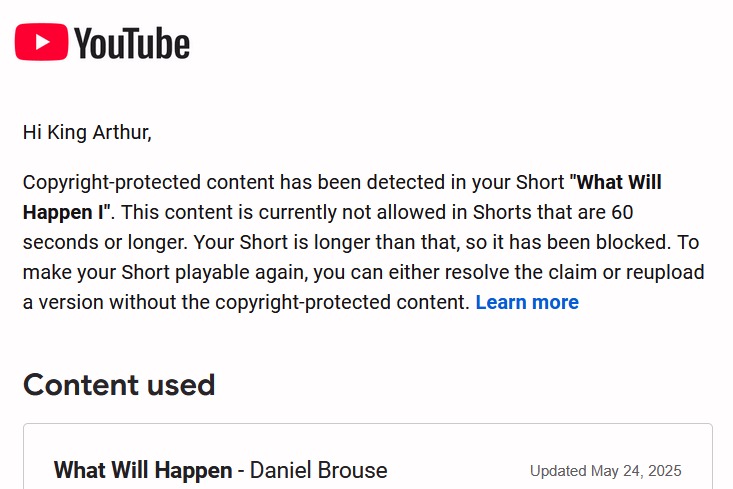
This week, I was notified that my YouTube channel removed one of my own videos—because the background music in the video was “owned” by me through my digital distributor. Yes, you read that correctly: my distributor triggered a Content ID claim against me, on behalf of me.

To restore the video, YouTube now requires that I “submit a dispute to the content owner if you have the rights to the content.” The process continues: “When you dispute a Content ID claim, the person that claimed your video (the claimant) is notified. The claimant has 30 days to respond.”

So now I must formally dispute myself to restore a song that I composed, performed, and uploaded.

The track in question, “What Will Happen Pt. 1,” was created with the help of my AI assistant, trained with my own musical data over the course of a year. That means I now have three virtual agents—my AI assistant, my distributor’s AI system, and YouTube’s Content ID—all fighting each other over a song that I indisputably own.

This is no longer a legal or technical nuance. It’s an existential glitch in the new digital music ecosystem. None of these systems were designed to resolve ownership at this level of nuance or context—and certainly not to understand when they are attacking their own creator.

I never instructed any of these tools to act against me. But the automation is now operating independently, enforcing policies that treat creators as potential infringers, even when there is no infringement. This is more than inconvenient; it’s reputational damage, business disruption, and the beginning of a deeply flawed feedback loop.

What we’re seeing is the early chaos of a system that’s automating enforcement faster than it’s developing the intelligence to understand context. As AI becomes more entrenched in content creation, content distribution, and content policing, the potential for misfires like this will only grow.

It raises urgent questions:

  • Who is ultimately responsible when automated systems attack legitimate creators?

  • What recourse do independent artists have when the enforcement tools are in conflict with each other—and themselves?

  • And most fundamentally, how can we create digital ecosystems where creators aren’t penalized by their own tools?

One thing is clear: we need new protocols for authorship, ownership, and automated enforcement—before the machines get too far ahead of the musicians.

When AI Attacks Itself

KingArthur.com

bookmark_borderMarket Volatility Intensifies as Bond Market Sends Clear Warning

by Daniel Brouse
May 21, 2025

As anticipated, the stock market is experiencing extreme volatility. This is precisely why I recommended dramatically reducing exposure to equities. The emotional and financial toll of riding this rollercoaster isn’t just unsettling—it’s unsustainable over the long run. Historically, chasing equity rallies in an unstable environment is a losing strategy.

Instead, my advice has been to watch the bond market closely. It’s been the more rational barometer, and far less volatile. While stocks have been erratic, bond yields have been steadily climbing, reflecting deeper systemic issues. As we’ve discussed for months, several converging factors are driving this shift: rising tariffs, inconsistent climate and foreign policy, unsustainable levels of federal debt, and reckless fiscal policy.

If you recall our analysis from earlier this year, we projected that these pressures would eventually trigger a full-blown budget crisis. That scenario is now unfolding. We are witnessing a key political stress test—particularly for the Republican Party and its ongoing alignment with Donald Trump. The question isn’t just economic anymore; it’s political and structural.

Today’s sharp market decline appears to be a delayed response to a major red flag from the bond market. The 20-year Treasury auction had an extremely poor showing, with a historically wide spread between the market rate and the issuance rate. This kind of spread signals deep investor unease, and today, the equity markets finally took notice.
The auction resulted in a high yield of 5.047%, the highest since 2020, reflecting tepid demand and necessitating higher yields to attract buyers.

This significant spread indicates that investors required a premium to compensate for perceived risks associated with the U.S. government’s fiscal policies, including proposed tax cuts and increasing national debt. The poor auction performance contributed to a sharp decline in stock markets, with major indexes like the S&P 500 and Dow Jones Industrial Average experiencing substantial losses.

The bond market’s reaction underscores the importance of monitoring Treasury yields as a barometer for investor sentiment regarding fiscal sustainability.

Bottom Line:
Keep your eye on the bond market. It’s sending signals that equities have ignored for too long. While headlines may focus on stock index swings, the real story—and the real risk—is unfolding in the bond market’s quiet but decisive movements.

Trumpenomics: The Decline of the US

bookmark_borderChina Quietly Retreats from U.S. Debt Market Amid Trade War Volatility

by Daniel Brouse
May 14, 2025

Cash flows and foreign treasury holdings in and out of the United States have grown increasingly volatile under the Trump administration’s ongoing trade war. One of the most consequential—and largely underreported—developments is China’s quiet withdrawal from the U.S. Treasury market.

Unlike an overt selloff that would signal immediate economic tension, China’s retreat is more subtle: the Chinese government has not been dumping U.S. Treasuries, but it has stopped buying them. This marks a significant policy shift with long-term implications for global capital flows and U.S. debt sustainability.

While private Chinese firms continue to purchase U.S. debt, the state’s declining participation reflects a broader recalibration of strategy. Beijing is gradually reducing its exposure to American financial instruments—particularly long-term Treasuries—as part of a diversification effort and geopolitical hedge against growing economic friction with Washington.

China, historically one of the largest foreign holders of U.S. government debt alongside the European Union (EU), has grown increasingly wary of its overexposure to the U.S. capital markets. Similarly, several EU member states—facing economic headwinds, internal fiscal pressures, and strategic concerns—have also begun to reconsider their heavily weighted positions in U.S. debt.

This pullback could have significant consequences for the United States. Reduced demand from two of its top foreign creditors places upward pressure on U.S. interest rates and increases the Treasury’s reliance on domestic buyers and other foreign entities less inclined to absorb American debt at current yields.

Moreover, in the context of rising federal deficits and elevated government spending—partly driven by the economic fallout of trade tensions—the loss of steadfast foreign buyers could exacerbate fiscal vulnerabilities. If these trends continue, they may erode investor confidence and potentially undermine the dollar’s long-standing dominance as the world’s reserve currency.

In sum, China’s silent retreat from the U.S. debt market—paired with a cooling appetite from the EU—is more than a passive policy decision. It’s a signal. As the geopolitical and economic rift between the U.S. and its key trade partners deepens, global capital is beginning to realign. For Washington, this serves as a wake-up call: trade wars may have broader, more lasting effects on financial stability than previously acknowledged.

China’s Subtle Retreat from U.S. Treasuries Tests Market Resilience Amid Upcoming Auctions

China’s role as a major purchaser of U.S. Treasury securities has been pivotal in financing the U.S. government’s debt. As of January 2025, China’s holdings stood at approximately $760.8 billion, a decrease from its peak of $1.3 trillion in 2013. This reduction reflects a strategic shift, with the Chinese government ceasing new purchases while maintaining existing holdings.

This change in China’s investment behavior comes at a critical juncture for the U.S. Treasury market. The Treasury Department has scheduled significant auctions to manage its debt obligations. In February 2025, for instance, the Treasury offered $42 billion in 10-year notes and $69 billion in 2-year notes. These auctions are essential for refinancing maturing securities and raising new funds.

The upcoming auctions will test the market’s capacity to absorb large volumes of debt without the usual level of participation from traditional foreign buyers like China. A decline in demand could lead to higher yields, increasing borrowing costs for the U.S. government. This scenario underscores the importance of monitoring foreign investment trends and their implications for domestic fiscal policy.

In summary, China’s gradual withdrawal from purchasing U.S. Treasuries introduces new dynamics into the bond market. The forthcoming Treasury auctions will serve as a barometer for investor confidence and the market’s ability to adapt to shifts in foreign investment patterns.

Trumpenomics: The Decline of the US

bookmark_borderTariffs on Trial: Court Case Could Rein in Executive Trade Powers and Stabilize U.S. Economy

by Daniel Brouse
May 13, 2025

If the Trump-era tariffs are struck down by the courts, the United States could see a return to more stable and predictable economic conditions. Such a ruling would likely reduce inflationary pressures, ease supply chain disruptions, and reopen channels of global trade—fostering stronger international partnerships and lowering costs for American consumers and businesses.

At the heart of the issue is a high-stakes legal challenge currently before a three-judge panel at the U.S. Court of International Trade. The case examines whether Trump exceeded his constitutional and statutory authority when he imposed sweeping new tariffs last month on imports from more than 180 countries and territories. These tariffs were part of an aggressive and unilateral expansion of executive power in the realm of trade policy.

The plaintiffs argue that the executive branch overstepped its legal boundaries, bypassing congressional oversight and established trade laws. Specifically, the case questions whether the president can unilaterally implement such broad and punitive tariffs without clear and immediate justification under existing statutory frameworks like the Trade Act of 1974 or Section 232 of the Trade Expansion Act of 1962.

If the court rules in favor of the plaintiffs, it could set a major precedent—limiting the executive branch’s authority to impose tariffs without legislative approval. This would mark a significant shift away from the trade practices of the Trump administration, which often used tariffs as blunt-force tools to exert pressure on foreign governments and reshape global commerce.

A ruling against Trump’s tariffs would not only affect the current legal status of these trade measures but also reinforce the role of Congress in shaping economic and trade policy, restoring a more balanced separation of powers. In practical terms, this could help reestablish long-term certainty in global markets, which have been rattled by unpredictable tariff regimes in recent years.

Ultimately, the court’s decision could have far-reaching implications—not just for U.S. trade policy, but for the broader scope of presidential power in economic governance. A ruling that reins in unilateral tariff actions could pave the way for a more collaborative, rules-based approach to global trade in the post-pandemic era.

Trumpenomics: The Decline of the US

bookmark_borderCurb the Enthusiasm: U.S.–China ‘Trade Deal’ Is Just a Temporary Pause in a Costly Tariff War

by Daniel Brouse
May 12, 2025

A much-publicized “trade deal” between the United States and China was announced over the weekend, sparking an immediate rally in the futures markets. Investors initially interpreted the announcement as a sign of easing tensions between the world’s two largest economies. However, a closer look reveals the agreement is far more limited in scope than the headlines suggest.

In contrast, the bond market remains notably cautious, showing little of the exuberance seen in equities. Interest rates have stayed elevated, reflecting persistent concerns about inflation, fiscal sustainability, and geopolitical instability. Bond investors appear unconvinced that the 90-day tariff pause will yield meaningful or lasting economic relief. The continued pressure in yields signals expectations of ongoing volatility and fiscal strain—deepening the divide between short-term market sentiment and long-term economic fundamentals.

Rather than a sweeping resolution, the deal amounts to a 90-day pause on the implementation of the full 145% tariff rate previously threatened by the U.S. administration. During this temporary window, tariffs remain at historically high levels: a 30% rate on all goods, 50% on most goods, and more than 100% on electric vehicles (EVs) imported from China. While slightly less draconian than a full embargo, these rates still represent one of the largest tax burdens on American consumers and businesses in modern history.

While the temporary easing may seem like progress, these levels still represent some of the most protectionist policies in modern U.S. history, and they function as a substantial tax burden on American consumers and businesses. For context, even the lowest of these rates—30%—is far above the average U.S. import tariff of recent decades, and for many product categories, the costs are being passed directly onto end users.

Economists warn that calling this a “deal” may be misleading. It is more accurately described as a ceasefire, not a resolution. Without structural changes to tariff policy or a rollback of these rates, the economic drag from higher input costs and reduced trade efficiency will persist. Small and mid-sized businesses, in particular, are expected to bear the brunt of these taxes, while consumers face higher prices on everything from electronics to everyday household goods.

Unless further progress is made, this 90-day pause may merely delay—not avoid—the full brunt of a trade war whose costs are already being felt. Any sustainable improvement will require deeper policy shifts, not temporary reprieves wrapped in celebratory headlines.

Trumpenomics: The Decline of the US

bookmark_borderMisleading Claims on Gas Prices, Inflation, and the Economy: A Closer Look at the Facts

by Daniel Brouse
May 10, 2025

“‘Too Late’ Jerome Powell is a FOOL, who doesn’t have a clue. Other than that, I like him very much! Oil and Energy way down, almost all costs (groceries and ‘eggs’) down, virtually NO INFLATION, Tariff Money Pouring Into the U.S. — THE EXACT OPPOSITE OF ‘TOO LATE!’ ENJOY!”
— Donald Trump, May 8, 2025

This statement makes multiple false and misleading claims.

1. “Virtually NO INFLATION” — False

  • Reality: As of early to mid-2025, the U.S. still experiences persistent inflation above the Federal Reserve’s 2% target. While it has moderated from its 2022 peak, core inflation remains elevated, especially in services (e.g., housing, insurance).

  • Misleading: Even if energy or eggs are down in price short term, overall consumer price levels remain significantly higher than in 2019. “Virtually no inflation” misrepresents the lived experience of most Americans.

2. “Oil and Energy way down” — Misleading

  • Reality: Energy prices fluctuate, but they are still volatile and subject to geopolitical pressures (e.g., OPEC+ cuts, Middle East instability, climate-driven supply disruptions).

  • A decline in oil prices due to a slowing global economy is a negative signal, not a reason for celebration. Historically, sustained oil price drops (when not due to supply surges) often precede or coincide with economic slowdowns or recessions.

  • Gasoline prices remain relatively high compared to pre-COVID levels. Donald Trump has falsely claimed that gas prices are below two dollars per gallon in many states, which is not supported by current data. Both Trump and some White House spokespeople have confused oil futures contracts with actual retail gasoline prices. If gas prices do fall due to lower oil prices and a slowing global economy, the benefit to consumers may be minimal—especially if unemployment rises and people are driving less. Additionally, if lower gasoline prices spur increased demand, this could exacerbate climate-related inflation, particularly in sectors like insurance. In the end, the net cost to consumers may still rise, despite cheaper fuel.

3. “Almost all costs (groceries and ‘eggs’) down” — False

  • Reality: Food prices have risen substantially since 2020. Even if eggs or specific items dropped after a spike (e.g., due to avian flu), the overall grocery bill remains much higher than a few years ago.

  • The USDA and BLS data show food inflation continues to burden consumers.

4. “Tariff money pouring into the U.S.” — Misleading and Economically Illiterate

  • Reality: Tariffs are taxes paid by U.S. importers, not foreign governments. Any money collected goes into the Treasury from American businesses, not “from China.”

  • Tariffs often lead to higher prices for consumers and reduced competitiveness for U.S. firms. There is no evidence that tariffs have “poured” beneficial money into the U.S. in a net economic sense.

5. Jerome Powell is a “fool” who is “too late” — False framing

  • Reality: Powell raised interest rates aggressively beginning in 2022, faster than in any cycle since the 1980s, specifically to combat inflation.

  • While one could debate timing or magnitude, he acted decisively. The Fed’s moves helped slow inflation, albeit with some lag.

  • Calling him “too late” while simultaneously claiming there’s “no inflation” is contradictory.

Summary:

The statement is riddled with falsehoods, contradictions, and economic misconceptions, such as:

  • Ignoring persistent inflation trends.

  • Misrepresenting the role and effect of tariffs.

  • Cherry-picking price data.

  • Criticizing Powell for being “too late” while celebrating current inflation as “virtually zero.”

Trumpenomics: The Decline of the US

The Human Induced Climate Change Experiment