bookmark_borderThe Inflationary Impact of Trump Tariffs and the Decline of the Dollar

by Daniel Brouse
March 18, 2025

According to the U.S. Bureau of Labor Statistics, import prices rose 0.4% in February 2025, following a 0.6% increase in January. This marks the largest two-month advance since mid-2022. The February increase was primarily driven by higher fuel prices, which advanced 1.7% after a 2.9% rise in January. Nonfuel import prices also edged up 0.3% in February, continuing the upward trend from the previous month.

Over the past year, import prices have increased by 3.4%, reflecting ongoing inflationary pressures in the economy.

These rising import prices are contributing to broader inflation concerns, as higher costs for imported goods can lead to increased prices for consumers and businesses alike. This trend underscores the importance of monitoring trade policies and global economic conditions that influence import costs.

The decline in the U.S. dollar is contributing to import inflation in several key ways:

  1. Higher Costs for Foreign Goods – A weaker dollar means it takes more U.S. dollars to buy the same amount of foreign currency. Since imports are priced in the currency of the exporting country, the cost of these goods rises when converted into dollars.

  2. Increased Raw Material Prices – Many imported raw materials, such as oil and industrial metals, are priced in dollars on global markets. When the dollar weakens, foreign suppliers may demand higher prices to maintain their profit margins, driving up costs for U.S. buyers.

  3. Supply Chain Price Pass-Through – Foreign manufacturers that rely on U.S. demand may pass higher exchange-rate-related costs onto American consumers. If businesses cannot absorb the additional costs, they raise prices on imported goods, fueling inflation.

  4. Reduced Purchasing Power – A weaker dollar diminishes the real value of American incomes when purchasing imported goods. This limits the ability of businesses and consumers to shop for lower-cost alternatives abroad, reinforcing inflationary pressures.

  5. Higher Transportation and Logistics Costs – Since global trade often involves transactions in multiple currencies, a depreciating dollar can increase the cost of shipping and logistics, further raising the final price of imported products.

As import prices rise due to the weaker dollar, businesses either absorb the costs (reducing profit margins) or pass them on to consumers, contributing to overall inflation in the U.S. economy.

Stagflation

In addition, U.S. steel manufacturers raised their prices last week to match the tariffs on imported steel, reducing any cost advantage for domestic buyers. This increase in steel prices had ripple effects throughout the economy, driving up costs for industries that rely on steel, such as construction, automotive, and manufacturing. Higher material costs forced businesses to either absorb the added expenses, reducing profit margins, or pass them on to consumers, contributing to broader inflation. Additionally, retaliatory tariffs from trading partners further disrupted supply chains, increasing costs for raw materials and intermediate goods, exacerbating inflationary pressures across multiple sectors.

These developments highlight the growing likelihood of a slowing economy coupled with persistent inflation, a condition known as “stagflation,” which is one of the worst-case scenarios for economic stability.

Trumpenomics: The Decline of the US
 

bookmark_borderGlobal Economic Outlook Dims Amid Rising Trade Barriers and Geopolitical Tensions

by Daniel Brouse
March 17, 2025

On March 17, 2025, the Organization for Economic Co-operation and Development (OECD) released its latest Interim Economic Outlook, revising downward its global economic growth forecasts. This worldwide slowdown is attributed to higher trade barriers in several G20 economies, which are expected to dampen global growth and contribute to inflationary pressures, elevated geopolitical tensions and policy uncertainties. For the United States, the OECD has notably reduced its GDP growth forecasts, anticipating a multiyear decline with a meager 1.6% growth rate in 2026.

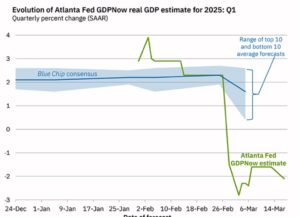
Atlanta Fed's GDP Tracker
Atlanta Fed’s GDP Tracker

Additionally, the Atlanta Fed’s GDP tracker for real GDP growth also was revised downward today to -2.1% for the first quarter of 2025 indicating a possible recession in the first half of this year.

These forecasts highlight both the immediate and long term decline in global economies, as well as the severe impacts to the US economy due to Trump’s economic policies.

Ironically, a sharp decline in the U.S. economy could help counteract the ‘drill, baby, drill’ policy and slow fossil fuel consumption, which would be beneficial for the environment. An economic slowdown typically leads to reduced demand for oil and fossil fuels, resulting in lower emissions. This decreased demand often causes oil prices to fall. When the price of a barrel of oil drops below certain thresholds, drilling new wells can become unprofitable. For instance, in 2022, the average breakeven price to profitably drill a new well in the United States was approximately $56 per barrel, with regional variations ranging from $48 to $69 per barrel.  Therefore, sustained oil prices below these breakeven points can discourage new drilling activities.

Explanation of the ‘Drill, Baby, Drill’ Policy:
The phrase “drill, baby, drill” emerged as a political slogan advocating for increased domestic oil and gas production in the United States. It gained prominence during the 2008 Republican National Convention and has been associated with policies aiming to boost fossil fuel extraction to achieve energy independence and economic growth. In recent years, this slogan has been revitalized to support expansive fossil fuel production initiatives. Proponents argue that such measures can lead to lower energy prices and reduced reliance on foreign oil. However, critics express concerns that this approach undermines efforts to combat climate change by perpetuating dependence on carbon-intensive energy sources.

President Donald Trump’s stance on climate change has been characterized by skepticism and policy actions that deprioritize environmental concerns in favor of economic and energy interests.

Public Statements:

  • Historically, Trump has referred to climate change as a “hoax.”
  • More recently, he has dismissed concerns about rising sea levels, stating, “That is not our problem,” and has emphasized “nuclear warming” as a more pressing threat.
  • Trump has repeatedly referred to the climate crisis as the Green New Scam.

Policy Actions:

  • Upon his inauguration in January 2025, President Trump withdrew the United States from the Paris Agreement and pledged to roll back executive orders and policies from the previous administration aimed at addressing climate change.

  • He issued an executive order titled “Promoting Energy Independence and Economic Growth,” aiming to dismantle many federal actions addressing climate change.

  • The administration has proposed cuts to agencies like FEMA, which could significantly impact disaster response capabilities in states vulnerable to climate-related events, such as California.

Impact on Environmental Policies:

  • The administration’s stance has led to reduced funding for clean energy projects and transportation initiatives. Major financial institutions have withdrawn from net-zero alliances, and the Securities and Exchange Commission (SEC) has implemented rules making it more challenging for investors to address environmental, social, and governance (ESG) issues within companies.

Trumpenomics: The Decline of the US

The Human Induced Climate Change Experiment

bookmark_borderTrumpenomics: How Tariffs, Policy Cuts, and Labor Shortages Are Devastating American Farmers

by Daniel Brouse
March 13, 2025

Recent policies enacted by the President have had significant financial repercussions on American farmers, leading to substantial economic losses.​

1. Impact of Tariffs and Retaliatory Measures

The Trump 2.0 administration’s imposition of tariffs, particularly on steel and aluminum, has triggered retaliatory tariffs from major trading partners such as China, Canada, and the European Union. These countermeasures have significantly reduced demand for U.S. agricultural exports, exacerbating existing challenges like droughts, supply chain disruptions, and low commodity prices. Texas farmers, many of whom have historically supported the President, are now voicing concerns over the mounting economic pressures caused by these policies.

The precedent for these economic consequences was set during Trump’s first administration. The 1.0 tariffs, particularly those targeting steel and aluminum, prompted severe retaliatory measures, notably from China. The impact on U.S. agriculture was devastating:

  • Soybean Exports: In 2018, U.S. soybean exports to China plummeted by $9.4 billion. While some alternative markets were found, they only recovered $4.7 billion in lost revenue, leaving a net loss of $4.7 billion for American soybean farmers.
  • Regional Losses: Major agricultural states like Iowa, Illinois, and Kansas saw significant financial hits. Iowa farmers alone lost $1.46 billion, Illinois suffered $1.41 billion in losses, and Kansas endured a $955 million decline in revenue.
  • Federal Bailouts: In an attempt to compensate for the damages, the U.S. Department of Agriculture (USDA) issued $23 billion in direct payments to farmers between 2018 and 2020. However, these subsidies often fell short, leaving many farmers struggling with long-term economic setbacks.

The Trump 2.0 tariffs are broader in scope, applying to more countries at higher rates, making the expected economic fallout far more devastating than before. With supply chain disruptions, climate-related hardships, and rising input costs already squeezing farmers, these new tariffs threaten to push many agricultural operations to the brink of collapse.

So far in 2025, several countries and trading blocs imposed retaliatory tariffs on U.S. agricultural imports in response to the current administration’s tariffs on steel, aluminum, and other goods. The European Union (EU) announced €26 billion in countermeasures against U.S. products, including agricultural goods. The first phase, effective April 1, targets €4.5 billion worth of U.S. consumer goods such as bourbon whiskey, jeans, and Harley-Davidson motorcycles. The second phase, set for mid-April, will impose tariffs on €18 billion worth of U.S. steel and agricultural products. Canada followed suit, imposing 25% tariffs on $21 billion worth of U.S. imports, including steel, aluminum, and various other goods. This action builds on earlier tariffs of $30 billion enacted on March 4. Meanwhile, China announced 10-15% tariffs on U.S. meat and agricultural products, suspended imports of U.S. lumber, and revoked soybean import licenses for three major U.S. firms.

Important to note, the bulk of the Trump tariffs have not yet been announced and are expected to be implemented on April 2, 2025. The President has stated that these tariffs will be applied to all countries and may be as high as 250%.

2. Cancellation of USAID’s Programs

The recent termination of local food programs, including USAID’s “Food for Peace,” has further strained farmers:

  • Loss of Funding: Since 2021, local school lunch programs have provided over $2 billion to various states, supporting local food purchases for schools and food banks. Their cancellation removes a critical revenue stream for farmers, exacerbating financial challenges.

  • Food for Peace: The USAID “Food for Peace” program, which operated with an annual budget of approximately $1.7 billion, has been terminated as part of the broader dismantling of USAID. This program purchased U.S.-grown commodities, such as rice, wheat, lentils, and peas, for distribution to populations facing food insecurity worldwide. Its cancellation not only impacts global hunger relief efforts but also removes a significant market for American farmers.

These program cancellations have disrupted supply chains, leading to financial instability for farmers who previously relied on these initiatives. The sudden loss of funding has left many agricultural producers without alternative markets, intensifying the economic challenges within the farming community.

3. Labor Shortages Due to Immigration Policies

Stricter immigration policies have led to a shortage of immigrant workers, who are essential to the agricultural workforce. This scarcity has resulted in increased labor costs and challenges in harvesting crops, thereby reducing overall productivity and profitability for farmers.​

4. Economic Uncertainty and Market Instability

The combination of trade tensions, program cancellations, and labor shortages has created an environment of economic uncertainty. Farmers are facing volatile market conditions, making it difficult to plan for the future and invest in their operations. This instability threatens the sustainability of the agricultural sector and the rural communities that depend on it.​

In summary, the current administration’s policies have introduced significant challenges for American farmers, affecting export markets, domestic program support, labor availability, and overall economic stability.

ALSO SEE:

Trumpenomics: The Decline of the US

bookmark_borderA Storm Brewing in Global Trade

by Daniel Brouse
March 12, 2025

Daily Market Update: A Storm Brewing in Global Trade

While domestic markets remained relatively calm, international markets reacted with volatility to the latest round of tariffs, escalating trade tensions worldwide.

In Trump 1.0, steel and aluminum tariffs were introduced at 25% on steel and 10% on aluminum, selectively targeting a handful of nations. Today, those tariffs have returned—but this time, they are 25% across the board, applying to all steel and aluminum imports, regardless of their origin. This marks a significant escalation in protectionist policies, with the potential to destabilize supply chains and increase costs for U.S. manufacturers and consumers alike.

The global response has been swift. Retaliatory tariffs are already being discussed, with several key trading partners preparing countermeasures. Even Australia, a long-standing U.S. ally that was previously exempt, is now expressing frustration, with one prominent economist summing up the sentiment as: “What the fuck?”

The Impact: Higher Costs, Fewer Jobs, and Economic Instability

Historically, tariffs of this nature have had disastrous economic consequences. The last round of steel and aluminum tariffs under Trump led to a net loss of 75,000 U.S. manufacturing jobs, and each job “saved” cost taxpayers nearly $900,000. Prices on everything from automobiles to canned goods surged, making life more expensive for American families.

This time, the impact is likely to be even worse. A broad, across-the-board tariff will strain international relations, drive inflation, and trigger widespread retaliation. U.S. companies reliant on imported metals will face higher costs, leading to job cuts, reduced investment, and lower economic growth.

The Markets React: Uncertainty Takes Hold

While the full effects will take time to unfold, the immediate market reaction has been one of caution and concern. The tariffs add another layer of economic uncertainty at a time when global markets are already grappling with inflation, geopolitical instability, and rising interest rates. Investors are wary, and market volatility is expected to increase in the coming weeks.

Final Thoughts: Repeating History’s Mistakes

Despite clear evidence from his first term that tariffs did more harm than good, Trump is doubling down on failed economic policies that increase costs, eliminate jobs, and weaken the U.S. economy. The previous steel and aluminum tariffs were an economic disaster, and this round—hitting more industries, more countries, and more supply chains—will only accelerate the damage.

As trade partners prepare their countermeasures, the question is no longer if the U.S. economy will suffer, but how badly.

… and oh, yeah… these aren’t the real tariffs, yet. They come April 2.

bookmark_borderThe Devastating Impact of Trump’s Steel and Aluminum Tariffs

By Daniel Brouse
March 12, 2025

The Perterson Report released an analysis of the Trump steel and aluminum tariffs imposed during his first term that are very similar to the tariffs that went into effect today. In his last term, the result was a net loss of 75,000 manufacturing jobs and each job ‘saved’ cost taxpayers $900,000.

Key Findings: The Failure of Trump’s Previous Tariffs

During Trump’s first term, the administration imposed 25% tariffs on steel and 10% on aluminum under the justification of protecting American jobs and reducing reliance on foreign imports. However, the Peterson Report found that the policy was a net negative for the economy.

The Economic Damage of Trump’s First Tariffs:

  • Net Loss of 75,000 U.S. Manufacturing Jobs – While a handful of domestic steel jobs were temporarily created, the broader manufacturing sector suffered significantly. Industries that rely on steel and aluminum, such as automotive production, construction, and appliance manufacturing, faced higher input costs, leading to layoffs and production cuts.
  • Each Job Saved Cost Taxpayers $900,000 – The few jobs that were protected by tariffs came at an extraordinarily high cost, making it one of the least efficient job protection policies in U.S. history.
  • Higher Prices for American Businesses and Consumers – U.S. companies had to pay 15-20% more for steel and aluminum compared to international competitors, leading to price increases for consumer goods, vehicles, and infrastructure projects.
  • Decline in U.S. Exports Due to Retaliatory Tariffs – In response to Trump’s tariffs, major trading partners—including Canada, China, and the European Union—imposed their own retaliatory tariffs on U.S. goods. This particularly hurt the agriculture sector, leading to billions in lost revenue for American farmers.
  • Stock Market and Business Uncertainty – The tariffs increased economic volatility, with markets reacting negatively to heightened trade tensions and uncertainty in key manufacturing industries.

Why the 2025 Tariffs Will Have an Even Worse Outcome

With Trump’s new 25% tariff on steel and aluminum, the economic consequences could be far worse than in 2018. Several key factors make the U.S. even more vulnerable to economic disruption today:

  1. Inflationary Pressures Are Already High – Unlike in 2018, inflation remains a major issue in the U.S. economy. These tariffs will further drive up prices for raw materials, worsening inflation for consumers and businesses.
  2. Global Supply Chains Are Still Recovering – Politics has already disrupted global trade, and adding tariffs now will further destabilize supply chains, making it harder for manufacturers to secure essential materials.
  3. Retaliation Will Hit Key U.S. Industries – The world has already signaled they will retaliate aggressively, likely targeting U.S. agricultural exports, manufacturing goods, and other key industries.
  4. Increased Risk of Economic Contraction – Economists warn that steep protectionist policies could push the U.S. into a manufacturing downturn, reducing GDP growth and weakening global investor confidence in the U.S. economy.

Final Thoughts: A Policy Repeating History’s Mistakes

Despite clear evidence from his first term that tariffs caused more harm than good, Trump is once again pursuing failed economic policies that drive up costs, eliminate jobs, and weaken the U.S. economy. The previous 25% steel and 10% aluminum tariffs proved to be a costly mistake, resulting in net job losses and higher consumer prices. Now, with new 25% tariffs on both, history is poised to repeat itself—only this time, the consequences could be even more severe.

If history is any indication, these tariffs won’t protect American jobs—they will destroy them.


bookmark_borderThe Great Depression vs. The Climate Crisis: Why the Stock Market May Never Recover

by Daniel Brouse
March 10, 2025

Stock Market Recovery After the Great Depression

The Great Depression, which began with the stock market crash of October 1929, led to an unprecedented economic collapse. The Dow Jones Industrial Average (DJIA) plummeted from a peak of 381 in September 1929 to a low of 41 in July 1932—an almost 90% decline.

Recovery was slow and uneven. While there were periods of growth, the market didn’t return to its 1929 high until November 1954—about 25 years later. The recovery was influenced by various factors, including the New Deal policies, World War II spending, and the post-war economic boom. Even then, the financial scars of the Depression lasted for decades, with unemployment and social instability persisting well into the 1940s.

Why the Climate Crisis May Prevent Market Recovery

Unlike the Great Depression, which had a primarily financial cause and a subsequent recovery, the ongoing climate crisis presents an existential threat to economic stability. Climate-related disasters—hurricanes, wildfires, droughts, and floods—are increasing in frequency, intensity, and economic cost. Entire industries, from insurance to agriculture, are being destabilized.

Several factors suggest the market may never fully recover from climate-driven economic collapse:

  1. Infrastructure Damage – As sea levels rise and extreme weather intensifies, cities and economic hubs will suffer irreversible damage. The cost of rebuilding will outpace economic growth.

  2. Uninsurability of Assets – Many properties in high-risk areas are becoming uninsurable. As insurance costs skyrocket, real estate values plummet, leading to a long-term decline in wealth.

  3. Resource Scarcity and Inflation – Water shortages, crop failures, and supply chain disruptions will drive persistent inflation, making economic stability impossible.

  4. Mass Displacement – Climate refugees fleeing uninhabitable regions will place immense strain on governments and economies, leading to political instability and loss of productivity.

  5. Declining Investor Confidence – Unlike past recessions or depressions, which had clear recovery paths, investors may lose faith in the long-term viability of markets in a world where economic and environmental risks are unmanageable.

Unlike historical economic downturns, where recovery was a matter of policy and time, the climate crisis introduces irreversible disruptions. Without immediate action, the financial system may enter a state of permanent decline, making a full stock market recovery impossible.

Capital Preservation During Trumpenomics

Trumpenomics: The Decline of the US

bookmark_borderCapital Preservation During Trumpenomics

Capital Preservation Strategy: Using High Yield Savings and Treasury Direct Accounts

One of the best methods of preserving capital while earning a reliable return is to leverage a combination of a high-yield savings account and a Treasury Direct account. Here’s how you can effectively use these tools to safeguard and grow your savings.

High-Yield Savings Account

Start by opening a high-yield savings account with a reputable bank, such as Citi. The interest rate on this account will allow your savings to grow steadily, while remaining easily accessible in case of emergencies. This savings account serves as your base for saving money over time.

Treasury Direct Account and T-Bills

Once you have saved up a few hundred dollars in your high-yield savings account, you can take the next step by purchasing 4-week T-Bills through your Treasury Direct account. Treasury Direct is a U.S. government platform where you can buy and hold U.S. Treasury securities, which are one of the safest investments available.

The Treasury auctions for T-Bills occur approximately every two weeks, so once your money is ready, you can place an order for the next available auction. The T-Bills will be purchased at a discount, meaning you’ll pay less than the face value, and the difference represents the interest you will earn. For example, if you buy a $100 T-Bill, you might only pay $90 and change (depending on the interest rate determined at the auction).

This process of buying T-Bills is a great way to earn a predictable, low-risk return on your savings. The discounted nature of the T-Bills means you receive your interest upfront, and your capital is preserved. After the auction, the money used to purchase the T-Bills will be withdrawn automatically from your savings account, making the process seamless.

Important note: Treasury bills, like the 4-week T-Bills, not notes or bonds. Longer-term notes and bonds carry significant risk — especially in this environment. If inflation rises or interest rates move higher, the value of those longer-term bonds can drop substantially, putting your principal at risk. Short-term T-Bills offer much more flexibility and protection since your principal is returned to you every month, allowing you to adjust quickly as conditions change.

Automatic Rollover and Reinvestment

To maximize returns and reduce effort, you can set your Treasury Direct account to automatically roll over your T-Bills for 12 periods or more. This means that each time a 4-week T-Bill matures, the principal (the amount you invested) will be reinvested in a new T-Bill. Any interest earned from the T-Bills will be transferred back to your high-yield savings account, where you can either leave it to grow or reinvest it into more T-Bills.

This auto-rollover strategy allows you to compound interest without needing to manually make reinvestment decisions every month, making it an efficient way to grow your savings over time.

I-Bonds: A Treasury Alternative

In addition to T-Bills, another valuable savings tool to consider is the I-Bond. I-Bonds are Treasury Bonds that are indexed to inflation, meaning they offer interest rates that adjust based on inflation rates. This makes them an excellent hedge against inflation, as they preserve purchasing power over time.

In recent years, I-Bonds have offered rates as high as 8% annually, making them an attractive option for savers looking for protection from rising prices. I-Bonds also have the advantage of being tax-advantaged. The interest is exempt from state and local taxes, and federal taxes can be deferred until the bond is cashed in or matures, making them a tax-efficient savings vehicle. I-Bonds can also be used for long-term goals, such as funding a child’s college education.

Conclusion

By utilizing both a high-yield savings account and a Treasury Direct account for T-Bills and I-Bonds, you can build a reliable, low-risk savings strategy. This combination allows you to preserve capital, earn interest, and protect against inflation—an excellent approach for anyone looking to safeguard their financial future.

If your money is in a restricted account, such as a retirement account, you should opt for an investment that carries no risk to your principal while offering an interest rate comparable to a 4-week T-Bill.

Treasury Direct

WARNING: Tariffs and the Liquidity Crisis in Long U.S. Treasury Bonds

Capital Preservation During Trumpenomics

Trumpenomics: The Decline of the US

bookmark_borderEconomic Update: Should I Panic Yet?

by Daniel Brouse
March 3, 2025

The Atlanta Fed GDP tracker dropped to -2.8 today. That would mean a drop of 5.3% in one quarter. I’ve never seen it drop this fast in a quarter nor overnight like it just did (from +2.5 to -2.8 in one month with -1.3 in one day) Only one other time in the history of the GDP has this occurred. That was the last time Trump was in office, he let COVID get out of control, and the economy shutdown. Other than that, there has never been such a sharp and fast decline in the history of the GDP (1947).

Something I take away from the current conditions is.– most of the fiscal malfeasance have yet to hit the fan. The full impact of recent fiscal policies, such as increased tariffs and restrictive immigration measures, is not yet reflected in these figures. Historically, such policies exert a delayed effect on economic performance, often materializing over subsequent quarters.​

Tariffs: The implementation of substantial tariffs on imports from key trading partners, including Canada, Mexico, and China, is anticipated to elevate consumer prices and disrupt supply chains. These changes can lead to reduced consumer spending and business investment, with the adverse effects on GDP growth potentially unfolding over a 6 to 12-month period. ​

Immigration: Restrictive immigration policies can result in labor shortages, particularly in sectors heavily reliant on immigrant workers. Such shortages may drive up wages and production costs, contributing to inflationary pressures and dampening economic growth. The repercussions of reduced immigration on GDP growth are often observed over an extended timeline, as demographic shifts gradually influence the labor market and productivity. ​

In summary, not only is the immediate GDP contraction concerning, it is deteriorating at a very rapid rate. If you have not already positioned your finances, it may be time to panic.

bookmark_borderTrumponomics and Its Impact on U.S. GDP

As a fiscally conservative economist with 45 years of experience, I have never witnessed a President destroy and devastate an economy so rapidly. GDP is expected to fall by 4% with a spike in inflation during his first quarter in office.

At the outset of 2025, economic projections indicated a steady growth trajectory for the United States. Fannie Mae, for instance, had forecast a 2.5% seasonally adjusted annualized rate (SAAR) for GDP growth in the first quarter, anticipating continued robust consumer spending. ​

Shift in Trade Policies
However, the economic landscape has experienced significant shifts due to recent policy changes under the Trump administration. On February 1, 2025, President Donald Trump imposed tariffs on imports from Canada, Mexico, and China, citing national security concerns under the International Emergency Economic Powers Act (IEEPA). These measures included a 10% tariff on all Chinese imports, effective February 4, with an additional 10% increase announced on February 27, set to commence on March 4. Tariffs on Canadian and Mexican imports were initially suspended for 30 days but are slated to take effect on March 4. ​

Revised Economic Forecasts
In light of these developments, economic forecasts have been adjusted to reflect potential downturns. The Conference Board noted that while the U.S. economy started 2025 on strong footing, the unpredictability of current policies could weigh on growth and elevate inflation as the year progresses. ​The Federal Reserve’s GDPNow tracker of incoming metrics is indicating that gross domestic product is on pace to shrink by 1.5% for the January-through-March period.

Potential Risks Ahead
The trajectory of these economic indicators raises concerns about a possible recession. If current trends persist, the U.S. economy could face a downturn by mid-year, with broader implications for the global economy. Drawing parallels to the Great Depression, protectionist trade policies and strained international relations historically have had severe economic consequences. It is crucial to monitor these developments closely to mitigate potential risks to both domestic and global economic stability.

bookmark_borderWorld Economics 101: The United States and Global Trade Dynamics

by Daniel Brouse
February 28, 2025

World Economics 101: For Dummies
The world is a big place. The USA is a small part of it. Though we have the largest economy, it is only a fraction of the overall world economy. The US is completely dependent on a strong world economy.

The US has been bullying the world since January. We have started a global trade war and alienated every one of our significant trading partners. Not only is our leadership bullying, they are also lying about our closest allies.

Historically, this has not ended well. The last time is known as The Great Depression. Our current trajectory is much worse.


The global economy is an intricate network of interconnected markets, with the United States playing a pivotal yet proportionate role. While the U.S. boasts the world’s largest national economy, it constitutes only a fraction of the overall global economic landscape. This interdependence underscores the necessity for robust international trade relationships to sustain economic health domestically and globally.

Escalation of Trade Tensions

Since January 2025, the U.S. has adopted an assertive trade policy, initiating tariffs that have strained relations with key trading partners. On February 1, President Donald Trump signed executive orders imposing tariffs on imports from Canada, Mexico, and China, citing national security concerns under the International Emergency Economic Powers Act. These measures included a 10% tariff on all Chinese imports, effective February 4, with an additional 10% increase announced on February 27, set to commence on March 4. Tariffs on Canadian and Mexican imports were initially suspended for 30 days but are slated to take effect on March 4.

These actions have prompted retaliatory threats from affected nations. China has vowed to implement necessary countermeasures in response to U.S. tariffs, while Canada and Mexico have also indicated intentions to retaliate if tariffs are enforced.

Historical Parallels and Economic Implications

The current trajectory bears resemblance to protectionist policies of the past, notably those preceding the Great Depression. The Smoot-Hawley Tariff Act of 1930, which imposed high tariffs on numerous imports, led to a significant contraction in international trade. This protectionist stance is widely regarded as a factor that exacerbated the global economic downturn during that era.

Economists express concern that the escalation of trade wars could precipitate adverse outcomes, including inflation, disrupted supply chains, and a slowdown in economic growth. The automotive sector, in particular, faces potential challenges due to increased production costs and diminished export opportunities.

In summary, while the United States maintains a significant position within the global economy, its prosperity is intricately linked to healthy international trade relations. The recent adoption of aggressive trade policies and the ensuing retaliatory measures from key partners may pose substantial risks to both domestic and global economic stability.