bookmark_borderLightning-Generated Tropospheric Ozone and Earth-System Feedbacks

by Daniel Brouse and Sidd Mukherjee

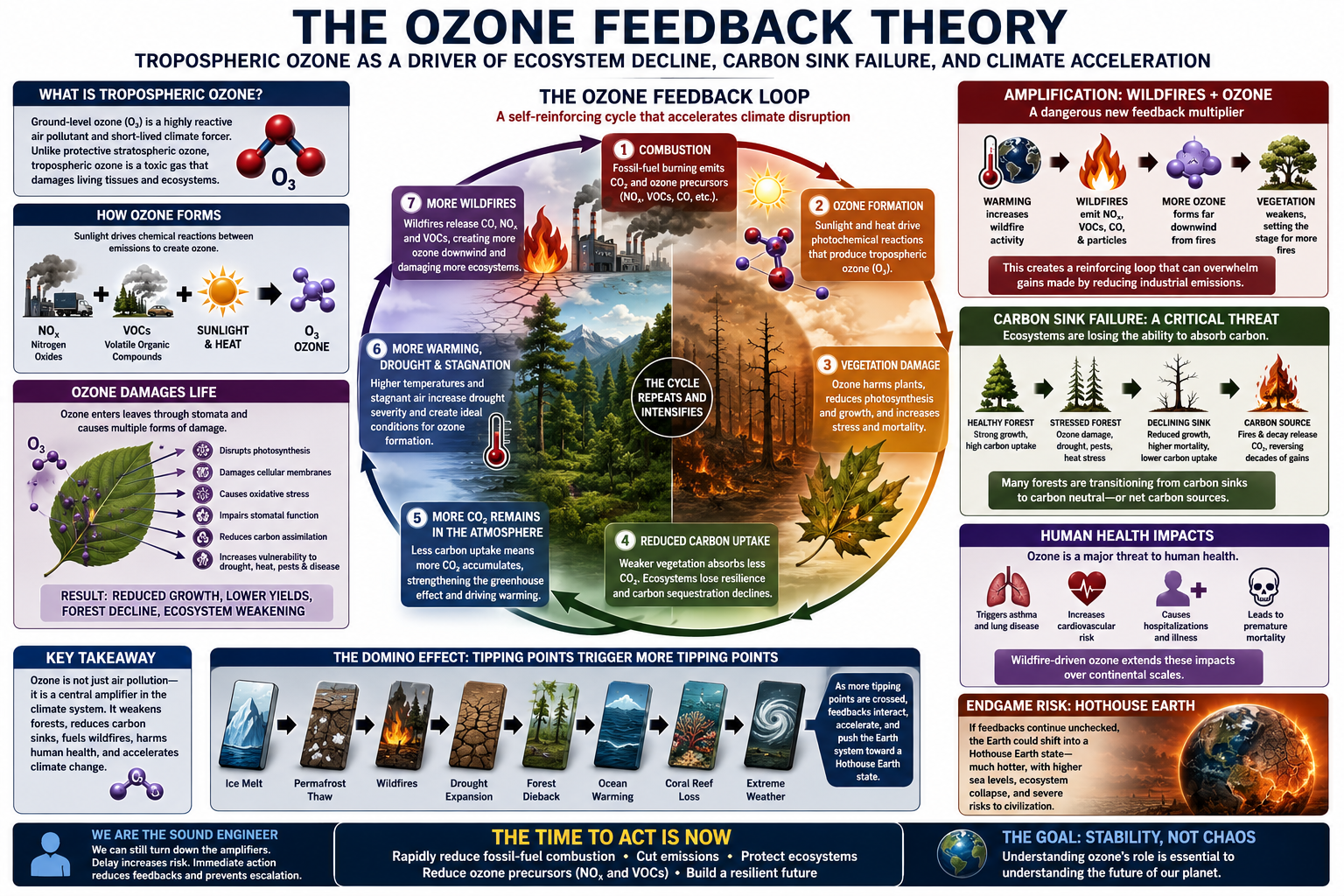
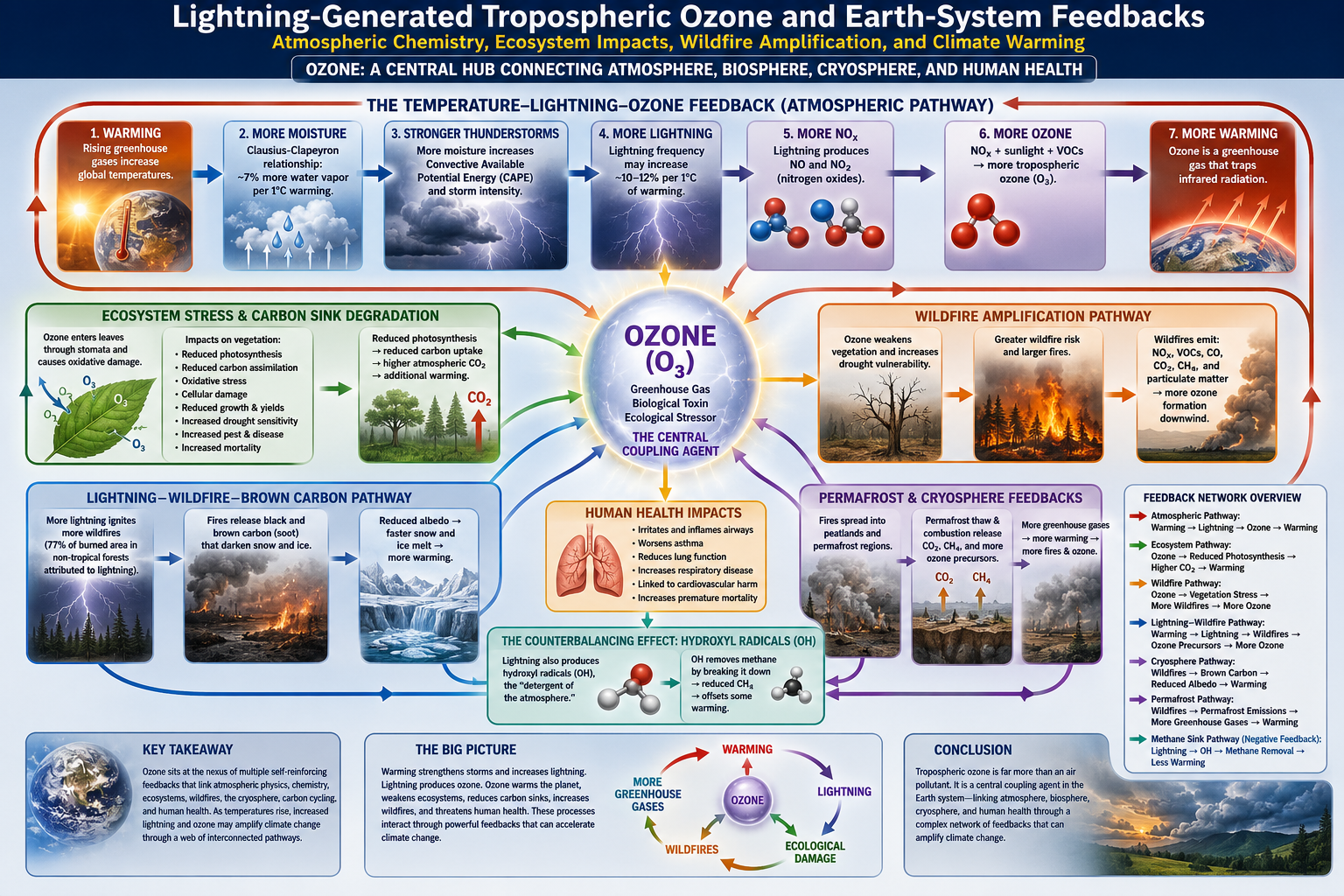
Tropospheric ozone is not merely a byproduct of climate change—it is a critical Earth-system coupling agent that links atmospheric warming, lightning activity, ecosystem health, wildfire dynamics, carbon-cycle disruption, human health, and cryosphere processes into a network of interconnected feedbacks capable of accelerating global warming.

The emerging role of ozone within so many coupled feedback mechanisms illustrates both the extraordinary complexity of atmospheric physics and chemistry and the profound interconnectedness of the Earth’s climate system. Rather than operating through a single pathway, ozone influences climate through multiple atmospheric, biological, ecological, and cryospheric processes simultaneously. It acts as a greenhouse gas that directly contributes to warming, a biological toxin that damages vegetation and weakens carbon sinks, and an ecological stressor that increases vulnerability to drought, disease, and wildfire.

These interactions highlight an important reality of climate change: many of the most consequential feedbacks do not operate in isolation. Instead, they interact, overlap, and reinforce one another across multiple components of the Earth system. As temperatures rise, increases in atmospheric moisture, thunderstorm intensity, lightning frequency, ozone production, ecosystem stress, wildfire activity, and greenhouse-gas emissions can become increasingly coupled, creating cascading feedback loops that amplify climate change beyond what would be expected from any individual mechanism alone.

Understanding these previously underappreciated connections is essential for accurately assessing climate risk. The ozone-lightning-wildfire nexus provides a compelling example of how nonlinear interactions between atmospheric chemistry, ecosystem processes, and climate dynamics may be contributing to the accelerating pace of global warming observed across many Earth-system indicators.

Abstract

Tropospheric ozone (O₃) occupies a unique and underappreciated position within the Earth system. Unlike carbon dioxide, which is primarily discussed as a greenhouse gas, ozone simultaneously functions as a greenhouse gas, a biological toxin, a crop-damaging pollutant, a forest stressor, and a driver of ecosystem degradation. Lightning represents one of the largest natural sources of atmospheric nitrogen oxides (NOₓ), making it a major contributor to ozone formation in the middle and upper troposphere. As global temperatures rise, increasing atmospheric moisture and convective instability are expected to increase lightning activity, potentially creating additional ozone production.

This paper examines the role of lightning-generated ozone within a broader network of interacting climate feedbacks. We argue that ozone serves as a critical coupling mechanism linking atmospheric warming, wildfire activity, carbon-cycle disruption, ecosystem decline, human health impacts, and climate amplification. When ozone-induced vegetation stress, carbon sink degradation, lightning-driven wildfire ignition, brown-carbon deposition, and permafrost emissions are considered together, ozone emerges as a central participant in a complex web of self-reinforcing Earth-system feedbacks.


Introduction

Most discussions of climate change focus on carbon dioxide and methane. Yet another greenhouse gas operates simultaneously as an atmospheric pollutant, a biological poison, and a climate feedback amplifier: tropospheric ozone.

In the stratosphere, ozone shields life from harmful ultraviolet radiation. Near the Earth’s surface and throughout the troposphere, however, ozone becomes one of the most destructive gases in the atmosphere. It damages human lungs, suppresses photosynthesis, weakens forests, reduces agricultural productivity, accelerates ecosystem decline, and contributes directly to planetary warming.

Unlike carbon dioxide, ozone is not emitted directly in large quantities. Instead, it forms through chemical reactions involving nitrogen oxides (NOₓ), volatile organic compounds (VOCs), sunlight, heat, and atmospheric oxidants. While fossil-fuel combustion remains the dominant anthropogenic source of ozone precursors, lightning is among the largest natural producers of atmospheric NOₓ.

Historically, lightning-generated ozone has been viewed primarily as an atmospheric chemistry problem. Increasing evidence suggests that this perspective is incomplete. Ozone may instead represent one of the most important connectors linking climate warming, ecosystem degradation, wildfire activity, carbon-cycle disruption, and human health.


Lightning as a Natural Ozone Generator

Lightning acts as a natural atmospheric plasma reactor.

A single lightning channel can briefly reach temperatures approaching 30,000°C—hotter than the surface of the Sun. These temperatures dissociate atmospheric nitrogen (N₂) and oxygen (O₂), allowing them to recombine into nitric oxide (NO) and nitrogen dioxide (NO₂).

Collectively known as NOₓ, these compounds form the foundation of tropospheric ozone chemistry.

As sunlight interacts with NOₓ and other atmospheric compounds, ozone is produced throughout the hours and days following thunderstorms.

Lightning also generates ozone directly. The electrical discharge can split oxygen molecules into individual oxygen atoms, which rapidly combine with surrounding oxygen molecules to form ozone.

The familiar “clean” smell associated with thunderstorms is, in large part, the scent of ozone itself.

Ironically, the smell many people associate with fresh air is actually the smell of a toxic oxidizing gas.

When inhaled, ozone attacks respiratory tissues, produces oxidative stress, inflames airways, worsens asthma, and contributes to cardiovascular disease. The same oxidative chemistry that damages plant cells also damages human lungs.


Ozone: Greenhouse Gas, Biological Toxin, and Climate Amplifier

Ozone occupies a unique position among greenhouse gases because it operates simultaneously through atmospheric and biological pathways.

Atmospherically, ozone absorbs outgoing infrared radiation and contributes directly to warming. Ozone produced in the upper troposphere is particularly effective because it resides in colder atmospheric layers where radiative trapping is enhanced.

Biologically, ozone functions as a powerful phytotoxin.

When ozone enters leaves through stomata, it initiates oxidative reactions that damage cellular structures and disrupt photosynthesis.

Documented impacts include:

  • Reduced photosynthesis
  • Reduced carbon assimilation
  • Oxidative stress
  • Cellular membrane damage
  • Reduced crop yields
  • Reduced forest productivity
  • Increased drought sensitivity
  • Increased vulnerability to insects and disease
  • Increased tree mortality

Numerous studies have reported reductions in plant productivity ranging from roughly 10% to over 40%, while some highly sensitive ecosystems have experienced substantially larger declines.

Ozone should therefore be viewed not simply as a greenhouse gas, but as a large-scale ecological forcing agent capable of weakening the biological systems that regulate atmospheric carbon.


Ozone and the Weakening of Earth’s Carbon Sinks

Forests, grasslands, wetlands, and agricultural systems remove billions of tons of carbon dioxide from the atmosphere each year.

This natural carbon uptake has historically slowed the pace of climate change.

Ozone directly undermines this process.

As photosynthesis declines, less carbon is removed from the atmosphere and less carbon is stored in vegetation and soils.

The resulting feedback can be summarized as:

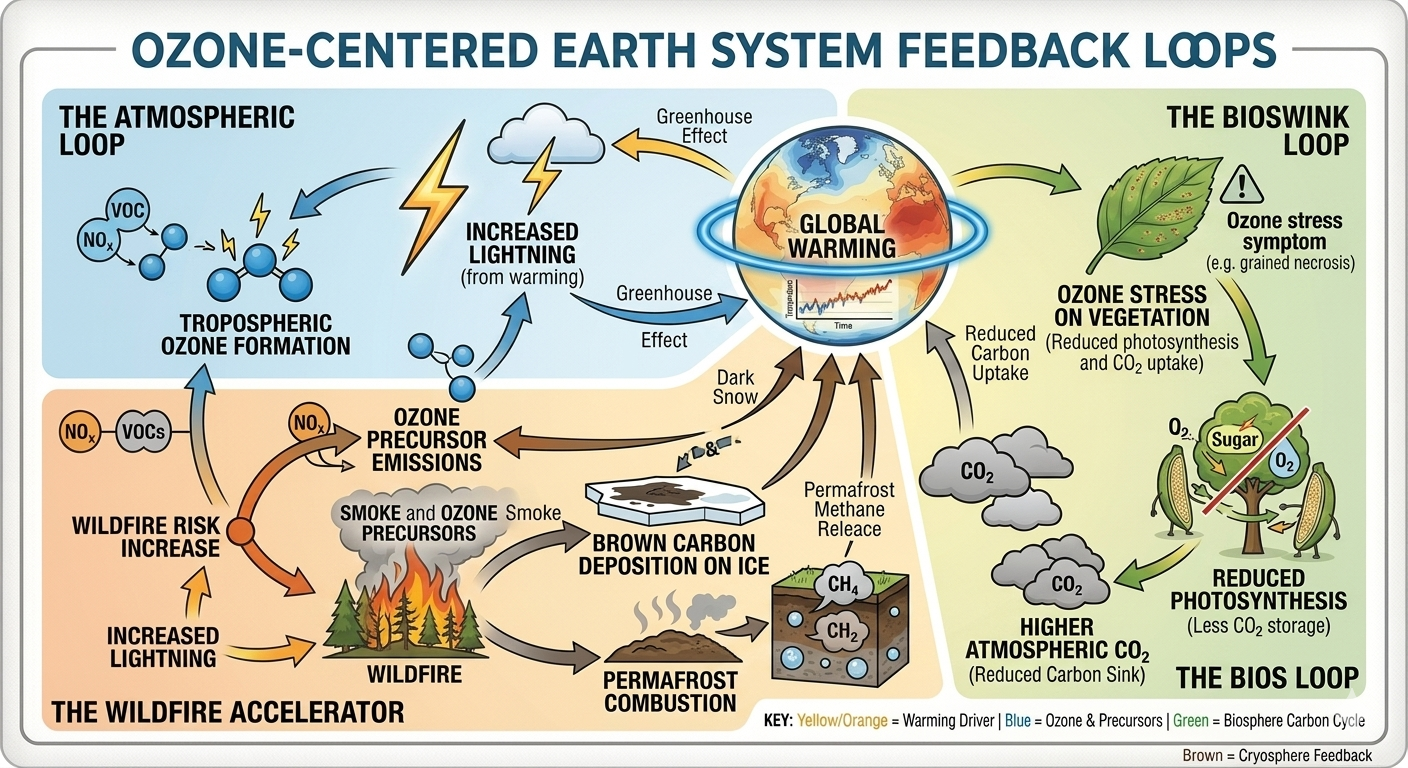
Ozone → Reduced Photosynthesis → Reduced Carbon Uptake → Higher Atmospheric CO₂ → Additional Warming

This pathway is especially important because it converts ozone from a short-lived atmospheric pollutant into a mechanism capable of influencing long-term carbon-cycle dynamics.

In this sense, ozone becomes both a greenhouse gas and a destroyer of greenhouse-gas removal systems.


Ozone as a Wildfire Multiplier

One of the most important—and potentially underestimated—roles of ozone may be its influence on wildfire vulnerability.

Vegetation exposed to chronic ozone stress experiences weakened physiological defenses, reduced water-use efficiency, impaired growth, and increased susceptibility to drought.

As warming intensifies heat waves and water stress, ozone-damaged ecosystems become increasingly vulnerable to combustion.

At the same time, wildfires themselves generate enormous quantities of ozone precursors:

  • Nitrogen oxides (NOₓ)
  • Volatile organic compounds (VOCs)
  • Carbon monoxide (CO)
  • Fine particulate matter

These emissions can generate ozone hundreds or even thousands of kilometers downwind.

This creates a reinforcing cycle:

Climate Warming → More Ozone → Weaker Vegetation → Greater Drought Stress → More Wildfires → More Ozone

The wildfire–ozone connection transforms atmospheric chemistry into an ecosystem-level feedback capable of accelerating climate change.


Lightning, Wildfires, and Brown Carbon

Climate warming is expected to increase lightning frequency by enhancing atmospheric moisture and convective instability.

Multiple studies suggest lightning activity may increase substantially with continued warming.

This has implications far beyond atmospheric chemistry.

Lightning is already the dominant ignition source for many remote boreal and temperate forest fires. In intact non-tropical forests, approximately 77% of burned area has been attributed to lightning-caused fires.

As lightning increases, wildfire ignition is expected to increase.

These fires release:

  • Carbon dioxide
  • Methane
  • Ozone precursors
  • Black carbon
  • Brown carbon

Brown carbon and soot darken snow and ice surfaces, reducing albedo and accelerating melt.

This creates another reinforcing feedback:

Warming → More Lightning → More Wildfires → More Brown Carbon → Faster Ice Melt → More Warming

Ozone sits within this feedback as both a product of wildfire emissions and a contributor to the vegetation stress that makes fires more likely.


Ozone, Permafrost, and Cascading Feedbacks

The wildfire story does not end when forests burn.

Increasingly, fires are spreading into peatlands and permafrost regions.

Permafrost was once assumed to thaw gradually over centuries or millennia. Instead, many regions are now experiencing rapid thaw, combustion, and year-round smoldering fires.

These fires release:

  • Carbon dioxide
  • Methane
  • Additional ozone precursors

The resulting emissions accelerate warming, increasing atmospheric instability and lightning frequency.

This creates a larger cascading feedback network:

Warming → More Lightning → More Wildfires → More Ozone and Greenhouse Gases → More Warming → More Permafrost Fire → More Emissions → More Lightning

The interactions become increasingly nonlinear as multiple feedback loops reinforce one another simultaneously.


The Temperature–Lightning–Ozone Feedback

At the center of this network lies a relatively simple relationship.

Warmer air holds more moisture.

More moisture supports stronger thunderstorms.

Stronger thunderstorms generate more lightning.

More lightning produces more NOₓ.

More NOₓ produces more ozone.

More ozone produces additional warming.

The core feedback can be summarized as:

Warming → More Moisture → More Thunderstorms → More Lightning → More Ozone → More Warming

However, this atmospheric feedback is only the beginning.

Once biological and wildfire effects are incorporated, the system expands dramatically.

The Temperature–Lightning–Ozone Feedback

One of the most significant pathways linking climate change to ozone production arises through the relationship between temperature, atmospheric moisture, thunderstorm development, and lightning frequency.

According to the Clausius-Clapeyron relationship, the atmosphere can hold approximately 7 percent more water vapor for every 1°C increase in temperature. As the atmosphere warms, additional moisture becomes available to fuel convection, increasing the intensity and energy of thunderstorms.

Greater atmospheric moisture contributes to higher levels of Convective Available Potential Energy (CAPE), one of the primary indicators of thunderstorm strength. Higher CAPE environments favor stronger updrafts, deeper convection, more vigorous storm systems, and ultimately greater lightning production.

Multiple studies have suggested that lightning frequency may increase by approximately 10 to 12 percent for every 1°C of global warming, although regional responses may vary. Because lightning is a major natural source of atmospheric NOₓ and ozone production, this relationship creates a potentially important self-reinforcing climate feedback.

The atmospheric pathway can be summarized as:

Warming → More Atmospheric Moisture → More Thunderstorms → More Lightning → More Ozone → More Warming

However, the significance of this feedback extends beyond ozone’s direct greenhouse effect.

Because tropospheric ozone functions simultaneously as a greenhouse gas, a biological toxin, and an ecological stressor, increased ozone production can trigger multiple reinforcing pathways throughout the Earth system. Ozone damages vegetation, reduces photosynthesis, weakens carbon sinks, increases drought sensitivity, elevates wildfire risk, and contributes directly to atmospheric warming. Each of these pathways feeds back into the climate system, potentially creating additional warming that promotes further thunderstorm activity and lightning generation.

Consequently, the temperature-lightning-ozone relationship should not be viewed as a simple atmospheric chemistry feedback. Rather, it represents the entry point into a broader network of interconnected feedbacks linking atmospheric physics, ecosystem productivity, wildfire dynamics, carbon-cycle disruption, and climate change.

In this expanded framework, ozone serves as the critical intermediary connecting warming-induced increases in lightning activity to biological and climatic processes that may further amplify global warming. The resulting feedback network is considerably more complex—and potentially more powerful—than the direct atmospheric warming effect of ozone alone would suggest.


The Expanded Ozone-Centered Feedback Network

The emerging Earth-system framework can be viewed as a series of interconnected feedback loops centered on ozone:

Atmospheric Pathway

Warming → Lightning → Ozone → Warming

Ecosystem Pathway

Ozone → Reduced Photosynthesis → Reduced Carbon Uptake → Higher CO₂ → Warming

Wildfire Pathway

Ozone → Vegetation Stress → Increased Wildfire Risk → More Ozone

Lightning–Wildfire Pathway

Warming → Lightning → Wildfires → Ozone Precursors → More Ozone

Cryosphere Pathway

Wildfires → Brown Carbon → Reduced Albedo → Warming

Permafrost Pathway

Wildfires → Permafrost Combustion → CO₂ and CH₄ Release → Warming

Together these feedbacks form a coupled network connecting atmospheric chemistry, ecosystem productivity, wildfire dynamics, cryosphere stability, and carbon-cycle feedbacks.


The Counterbalancing Role of Hydroxyl Radicals

Not all lightning-driven chemistry promotes warming.

Lightning also generates hydroxyl radicals (OH), often called the “detergent of the atmosphere.”

Hydroxyl radicals react with methane and accelerate its removal from the atmosphere.

This creates an important negative feedback:

Lightning → More OH → More Methane Destruction → Reduced Warming

This methane-removal pathway partially offsets some warming influences associated with ozone production.

The net balance between ozone-driven warming and OH-driven methane removal remains an active area of research.


Conclusion

Lightning is far more than an atmospheric curiosity.

It is a natural engine of ozone production, and ozone is far more than a conventional air pollutant.

Tropospheric ozone acts simultaneously as a greenhouse gas, a biological toxin, a destroyer of carbon sinks, a contributor to wildfire vulnerability, a threat to human health, and a participant in multiple self-reinforcing climate feedbacks.

Viewed through an Earth-system lens, ozone emerges as one of the most important coupling agents linking atmospheric chemistry, ecosystem degradation, wildfire amplification, carbon-cycle disruption, cryosphere change, and climate warming.

The critical scientific challenge is no longer understanding ozone as an isolated pollutant. It is understanding how ozone interacts with the growing network of feedback loops that are increasingly reshaping the Earth system.

The possibility that ozone occupies a central role in these cascading feedbacks deserves far greater attention as climate change accelerates.
bookmark_borderThe Future Is Not Yet Written: Why Human Actions Still Matter in a World of Climate Tipping Points

How hard will our generation make the struggle to thrive become a struggle merely to survive?

by Daniel Brouse and Sidd Mukherjee
June 10, 2026

Introduction

Unfortunately, we have already lost things that cannot be replaced or restored.

One of my favorite questions for people who dismiss the significance of climate change is simple:

How long do you think it takes to make six-million-year-old ice?

The answer, of course, is millions of years.

When ancient glaciers, ice sheets, ecosystems, coral reefs, forests, and species disappear, they do not return on timescales relevant to human civilization. Some losses are effectively permanent from the perspective of any society that will exist over the coming centuries or even millennia.

The reality is that many of the changes now unfolding across the Earth system cannot be reversed within a human lifetime. Yet this does not mean that the future is predetermined or that human actions no longer matter.

In fact, they matter enormously.

The Continued Role of Human Activities

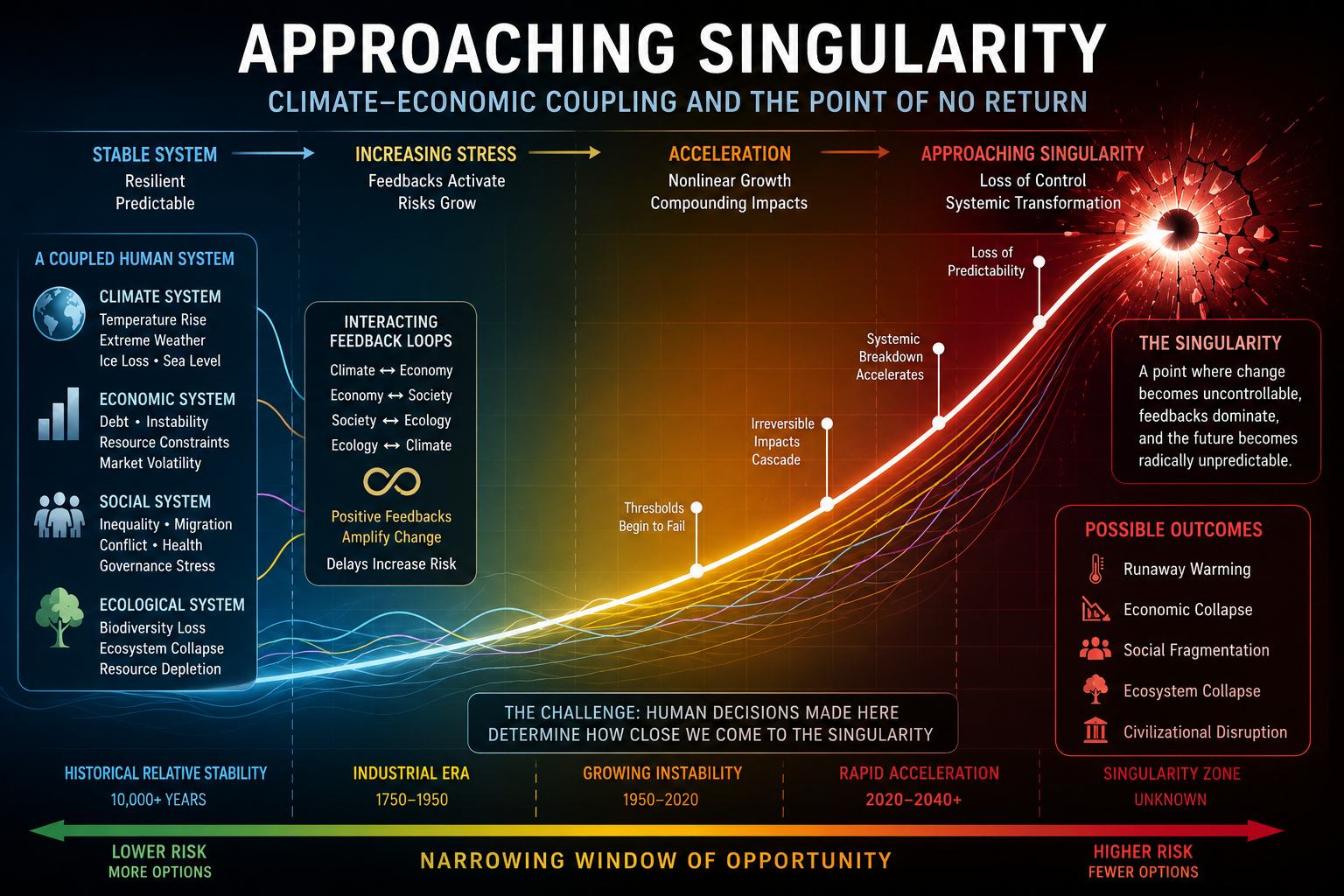
A growing body of evidence suggests that Earth’s major climate systems are increasingly interconnected through a network of reinforcing feedback loops. Sea-level rise, polar amplification, ocean heat content, marine heatwaves, atmospheric rivers, Rossby-wave persistence, AMOC weakening, wildfire feedbacks, permafrost thaw, methane release, ecosystem shifts, and climatic whiplash all appear to be interacting in ways that increase complexity and reduce predictability.

Through our analysis of highly coupled nonlinear systems, we remain convinced that human forcing is still the primary driver and determinant of the ultimate outcome.

Many subsystems appear to be approaching—or perhaps have already crossed—important thresholds. The interactions among these systems make prediction increasingly difficult, and cascading responses are a legitimate concern. In a highly interconnected system, a seemingly modest perturbation can propagate through multiple pathways and produce consequences far larger than the original disturbance.

This possibility is precisely what makes climate change so dangerous.

Has the Climate System Become Autonomous?

An important question is whether humanity has already pushed the climate system beyond a point where it will continue to deteriorate regardless of future actions.

We are not yet convinced that this is the case.

The atmosphere, oceans, cryosphere, and biosphere are all responding to an energy imbalance that human activities continue to create. Greenhouse gas concentrations continue to rise. Fossil fuel combustion, land-use change, industrial processes, and ecosystem degradation continue to alter the balance of incoming and outgoing energy.

In this context, the strength, duration, and trajectory of human forcing still matter enormously.

While some tipping elements may already be in motion, there is little evidence that all future outcomes are now entirely independent of human influence. Rather, current observations suggest that human activities remain one of the most important variables governing how rapidly the climate system changes and how severe the consequences ultimately become.

Will the World Ever Be as It Was?

That does not appear possible.

The climate of the twentieth century is gone.

Many glaciers are retreating beyond recovery. Ancient ice is melting. Species are disappearing. Ecosystems are shifting. Ocean chemistry is changing. Sea levels will continue rising for centuries, and some changes already underway will persist for generations.

The question is no longer whether we can preserve the world exactly as it was.

We cannot.

The more important question is whether we can influence the world that follows.

Can We Influence How Bad It Gets?

The answer remains yes.

This is why continued focus on the acceleration of climate change is so important.

If human activities remain the dominant forcing mechanism, then reducing that forcing can still alter the trajectory of the system, even if we can no longer prevent many of the changes already set in motion.

The difference between a world that warms another degree and one that warms several more degrees is not an academic distinction.

It is the difference between:

  • More manageable versus catastrophic sea-level rise.
  • Regional crop disruptions versus widespread food insecurity.
  • Occasional extreme heat versus chronic heat stress.
  • Increased adaptation costs versus systemic economic disruption.
  • Partial ecosystem loss versus widespread ecological collapse.

Small differences in average temperature translate into enormous differences in impacts because climate risks do not increase linearly. They compound through feedbacks, thresholds, and cascading interactions.

The Moral Question

Ultimately, climate change is not simply an environmental issue. It is a question of human welfare, opportunity, and survival.

The decisions made today will determine the quality of life experienced by many generations to come. They will influence access to food, water, shelter, health, security, and economic stability. They will shape the future of coastal communities, agricultural regions, and ecosystems around the world.

Perhaps the most important question is not whether climate change can be stopped entirely.

It is this:

How hard will our generation make the struggle to thrive become a struggle merely to survive?

The future may no longer be capable of becoming what it once could have been. But it is still capable of becoming far better—or far worse—depending on the choices humanity makes today.

The world as it was may be gone.

The world that will be is still being written.

Feedback Loops → Tipping Points → Domino Effect
Feedback loops amplify climate change and can push interconnected Earth systems past critical tipping points. As tipping points are crossed, they can trigger additional feedback loops and destabilize other climate systems. This cascading “Domino Effect” compresses timescales, accelerates change, and increases the risk of rapid, nonlinear climate transformations.

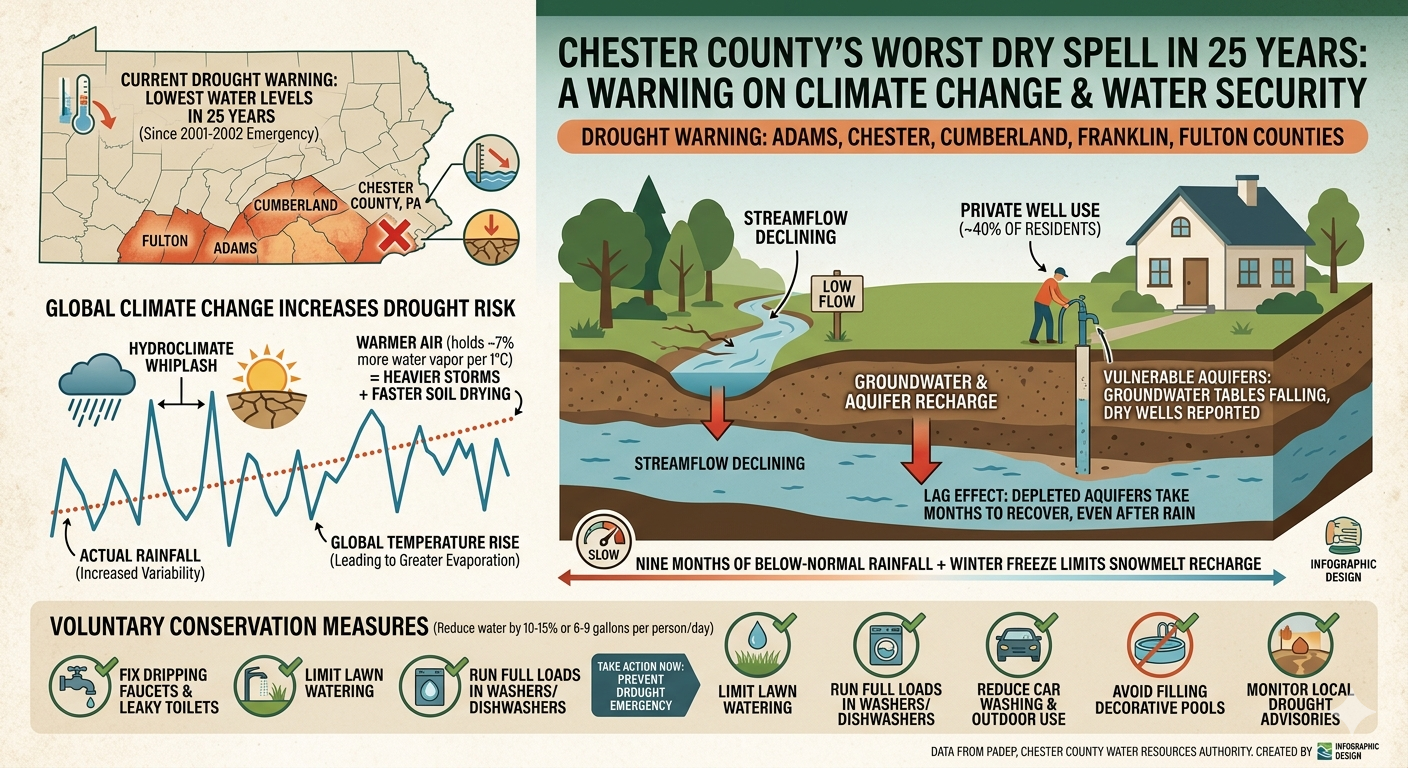
bookmark_borderChester County’s Worst Dry Spell in 25 Years: A Warning About Climate Change and Water Security

A Quarter-Century Drought Milestone

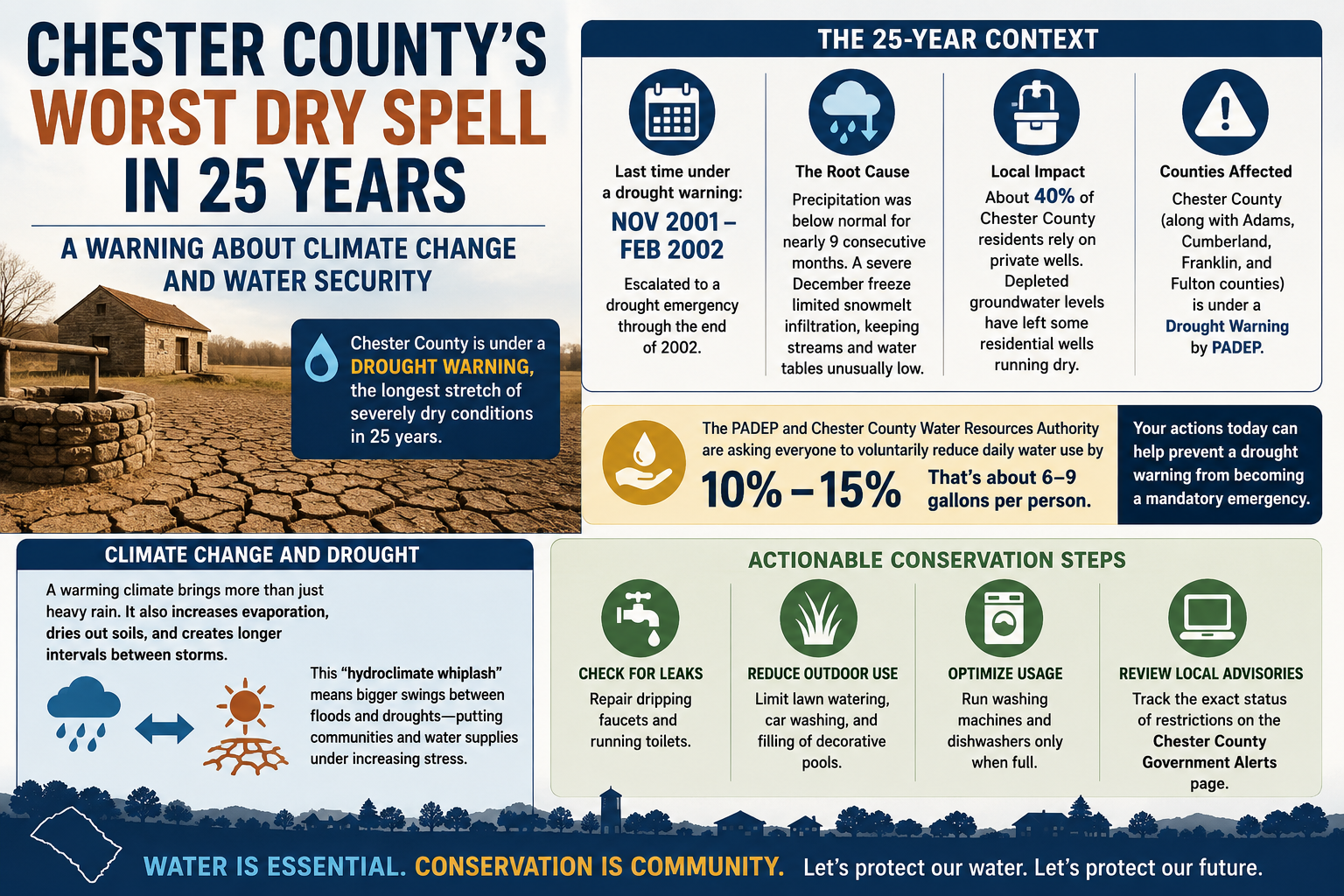
Chester County is currently experiencing its most significant drought conditions in 25 years, prompting the Pennsylvania Department of Environmental Protection (PADEP) to place the county under a Drought Warning. Chester County joins Adams, Cumberland, Franklin, and Fulton counties in the warning designation as groundwater levels, stream flows, and water reserves continue to decline.

The last time Chester County experienced comparable conditions was from November 2001 through February 2002. That drought ultimately intensified into a declared drought emergency that persisted through the end of 2002. Today’s warning serves as a reminder that prolonged water shortages remain a serious threat, even in regions traditionally known for abundant rainfall.

Nine Months of Below-Normal Rainfall

The current drought developed after nearly nine consecutive months of below-average precipitation. Compounding the problem, a severe winter freeze limited snowmelt infiltration into the ground, preventing aquifers from receiving the recharge they normally depend upon during the colder months.

As a result, groundwater levels have steadily declined, stream flows have dropped, and reservoirs have struggled to recover. The impacts are particularly severe for the approximately 40 percent of Chester County residents who rely on private wells for their water supply. Some homeowners have already reported wells running dry as water tables continue to fall.

Climate Change and the Growing Risk of Drought

While droughts are a natural part of Pennsylvania’s climate, climate change is increasing the likelihood of both extreme wet and extreme dry conditions.

A warming atmosphere can hold approximately 7 percent more water vapor for every 1°C increase in temperature. This additional moisture often results in heavier downpours and more intense storms. However, the same warming also increases evaporation from soils, vegetation, streams, and reservoirs. The result is a growing tendency toward what scientists call “hydroclimate whiplash”—rapid swings between flooding and drought.

The Mid-Atlantic region has already experienced a rise in extreme precipitation events, but these periods of intense rainfall are increasingly separated by longer dry intervals. Heavy storms may temporarily replenish rivers and reservoirs, yet much of the water can run off quickly rather than soaking deeply into the ground where it can recharge aquifers.

For groundwater-dependent communities like Chester County, this pattern presents a growing challenge. Even when annual rainfall totals appear near normal, the timing and intensity of precipitation can leave water supplies vulnerable.

Why Groundwater Matters

Groundwater serves as a critical buffer during dry periods. It sustains private wells, supports stream flows, and helps maintain ecosystem health when rainfall is scarce.

When drought persists, groundwater levels decline more slowly than surface water, but they also recover more slowly. This lag effect means that even after rainfall returns, water tables may remain depressed for months or longer.

The current drought demonstrates how vulnerable groundwater systems can become after extended periods of below-normal precipitation.

What Residents Can Do

The PADEP and the Chester County Water Resources Authority are asking residents, businesses, and farmers to voluntarily reduce water consumption by 10 to 15 percent, equivalent to approximately six to nine gallons per person per day.

Simple conservation measures can make a meaningful difference:

  • Repair dripping faucets and running toilets.
  • Limit lawn watering and other outdoor irrigation.
  • Reduce car washing and unnecessary outdoor water use.
  • Avoid filling decorative pools and water features.
  • Run dishwashers and washing machines only when fully loaded.
  • Monitor local drought advisories and conservation recommendations.

These voluntary actions can help prevent conditions from deteriorating into a mandatory drought emergency.

A Glimpse of the Future

The current drought warning is more than a temporary weather event. It offers a glimpse into the challenges communities may increasingly face as climate change alters precipitation patterns and intensifies hydrological extremes.

Chester County’s longest severe dry spell in a quarter century underscores the importance of protecting groundwater resources, improving water conservation, and preparing for a future in which both floods and droughts become more disruptive.

The lesson is clear: climate change is not simply making wet places wetter or dry places drier. It is increasing variability itself, creating larger swings between extremes and placing greater stress on the water systems that communities depend upon every day.

bookmark_borderJerk-Behavior in Earth’s Rotation: Climate Change, the Third Derivative, and Emerging Risks to Precision Navigation

“Climate-driven changes in Earth’s rotation may be contributing to navigational uncertainties that negatively affect battlefield outcomes and increase the risk of civilian casualties in contemporary conflicts.”

by Daniel Brouse and Sidd Mukherjee

Abstract

Climate change is increasingly altering the physical dynamics of Earth itself. Accelerating ice-sheet loss, sea-level rise, and large-scale redistribution of mass are changing the planet’s rotation rate, shifting its axis of rotation, and introducing increasingly nonlinear behavior into Earth system processes. Recent studies indicate that climate-driven ice melt is lengthening Earth’s day by approximately 1.33 milliseconds per century, making climate change a dominant driver of long-term rotational change. Beyond the slowing of rotation, the acceleration and third derivative (“jerk”) of these changes may represent a more significant concern because they reduce predictability within systems that depend on precise measurements of time, position, and motion. The consequences extend beyond geophysics into GPS accuracy, satellite operations, spacecraft navigation, autonomous systems, and potentially military guidance technologies. This paper examines the emerging science of climate-driven rotational change and places it within the broader context of accelerating Earth-system feedback loops and nonlinear climate dynamics.

Introduction

Earth’s rotation has never been perfectly constant. Variations occur naturally through interactions among the atmosphere, oceans, mantle, core, tides, and cryosphere. Historically, these fluctuations have remained within ranges that can be modeled and predicted through established geophysical processes.

Anthropogenic climate change is introducing a new forcing mechanism into this system. Accelerated melting of glaciers and polar ice sheets is redistributing trillions of tons of mass from high latitudes toward the oceans. This redistribution alters Earth’s moment of inertia and changes the speed and orientation of the planet’s rotation.

While changes in rotational velocity have attracted growing scientific attention, the acceleration and higher-order derivatives of those changes may prove even more significant. The third derivative, commonly referred to as “jerk,” measures how rapidly acceleration itself is changing. Increasing jerk-behavior is often a hallmark of nonlinear systems approaching new states of instability or unpredictability.

The significance of these changes extends far beyond the length of the day. Modern civilization depends upon precise timing, positioning, navigation, and reference-frame stability. Small changes in Earth’s rotational behavior can cascade through technologies that form the foundation of the modern world.

Climate Change and Earth’s Rotational Slowdown

In 2024, researchers from ETH Zurich, NASA’s Jet Propulsion Laboratory, and collaborating institutions demonstrated that climate change has become an increasingly dominant influence on Earth’s rotation. Their work showed that melting ice sheets redistribute mass from the poles toward lower latitudes, increasing Earth’s moment of inertia and slowing the planet’s rotation in a manner analogous to a spinning figure skater extending their arms.

A March 2026 analysis published in the Journal of Geophysical Research: Solid Earth quantified the effect, estimating that climate-driven ice melt is lengthening Earth’s day by approximately 1.33 milliseconds per century. While seemingly small, this represents a measurable and accelerating alteration of one of the planet’s most fundamental physical properties.

Researchers further concluded that the climate-driven component of Earth’s rotational slowdown now exceeds many natural long-term influences and may represent the most rapid climate-related rotational change observed in millions of years.

Polar Motion and the Changing Shape of Earth

The effects of ice-sheet loss are not limited to rotational speed.

As glaciers and ice sheets melt, the redistribution of water mass changes Earth’s shape and alters the position of its rotational axis. Research published in Geophysical Research Letters found that global warming has accelerated the movement of Earth’s rotational pole since the 1990s.

Several mechanisms contribute to this phenomenon:

  • Redistribution of meltwater toward lower latitudes.
  • Gravitational migration of ocean mass.
  • Centrifugal redistribution of water toward the equatorial bulge.
  • Glacial Isostatic Adjustment (GIA), in which land previously compressed by massive ice sheets slowly rebounds upward as ice disappears.

Together, these processes alter both Earth’s moment of inertia and the orientation of its spin axis. The result is a planet whose rotational geometry is changing more rapidly than at any point during the modern observational era.

The Third Derivative: Jerk-Behavior in the Earth System

Velocity measures change.

Acceleration measures changing velocity.

Jerk measures changing acceleration.

In engineering, aerospace systems, and control theory, jerk is often more important than velocity because it determines how predictable a system remains under changing conditions.

Earth’s rotational system now appears to be exhibiting measurable jerk-behavior driven by climate-induced mass redistribution. This means that not only is Earth slowing, but the rate at which it is slowing is itself changing.

Such behavior introduces challenges for predictive models because assumptions based upon previous rates of change become increasingly unreliable. Systems must be updated more frequently, and uncertainty grows as the underlying dynamics become increasingly nonlinear.

The emergence of measurable jerk-behavior may represent one of the clearest physical indicators that climate change is influencing fundamental planetary-scale processes.

Earth Orientation Parameters and Navigation Systems

Modern navigation depends on the precise relationship between celestial and terrestrial coordinate systems.

The International Celestial Reference Frame (ICRF) provides a stable astronomical reference framework based on distant quasars. The International Terrestrial Reference Frame (ITRF) defines geographic coordinates fixed to Earth’s surface.

Earth Orientation Parameters (EOPs) connect these systems.

Organizations such as the International Earth Rotation and Reference Systems Service (IERS) continuously monitor changes in:

  • Length of day
  • Polar motion
  • Axial orientation
  • Precession
  • Nutation

As climate-driven changes accelerate, EOP calculations become increasingly important. Even centimeter-scale errors in Earth’s reference frame can propagate into navigation errors measured in hundreds of meters across interplanetary distances.

The growing variability in Earth’s rotation increases the complexity of maintaining accurate coordinate transformations between space-based and Earth-based systems.

GPS, Spacecraft, and Inertial Navigation

Global Positioning System (GPS) satellites rely upon extremely precise timing and rotational models.

Unexpected changes in Earth’s orientation can create discrepancies between modeled and actual positions. These discrepancies must be corrected through continual updates to Earth orientation parameters.

The same challenge affects:

  • Satellite tracking
  • Spacecraft navigation
  • Astronomical observations
  • Geodesy
  • Autonomous transportation systems
  • Long-range communication networks

Inertial Navigation Systems (INS) face an additional challenge because they operate by integrating acceleration and rotational measurements relative to Earth itself.

As Earth’s rotational characteristics evolve, assumptions embedded within inertial guidance algorithms require more frequent recalibration. Small errors can accumulate over long distances and extended operational periods.

Sea-Level Rise Commitments and Long-Term Rotational Change

The rotational changes observed today are unlikely to stabilize quickly.

Research on the Greenland Ice Sheet has demonstrated that substantial future melting is already committed due to past greenhouse gas emissions. A study led by Jason Box and colleagues concluded that even if emissions ceased immediately, Greenland alone is committed to producing at least 27 centimeters of global sea-level rise.

Subsequent analyses suggest that realistic outcomes may substantially exceed this minimum estimate.

This committed melting implies continued redistribution of mass for decades and potentially centuries. As a result, climate-driven changes in Earth’s rotation, polar motion, and reference-frame stability are likely to continue long after greenhouse gas emissions peak.

The rotational consequences therefore represent not merely a current phenomenon but a long-term geophysical response that may unfold over generations.

Climate Feedback Loops and Nonlinear Dynamics

Understanding Earth’s changing rotation requires understanding the broader climate system in which it occurs.

Climate change is not a simple linear process. It is a dynamic system characterized by numerous interacting feedback loops, including:

  • Albedo Feedback Loop
  • Brown Carbon Feedback Loop
  • Permafrost-Methane Feedback Loop
  • Freshwater-AMOC Disruption Loop
  • Arctic Sea Ice Feedback Loop
  • Amazon Rainforest Dieback Feedback Loop
  • Hydroclimate Whiplash
  • Sudden Sea-Level Rise Pulses (“Cork Release” Events)

Each feedback influences the others through interconnected physical, biological, and social systems.

These interactions create nonlinear responses in which relatively small disturbances can trigger disproportionately large outcomes. The accelerating changes observed in Earth’s rotation may therefore be viewed as one manifestation of a broader planetary trend toward increasing systemic instability and complexity.

Defense and Strategic Implications

Modern military and aerospace systems depend heavily on precision navigation.

Long-range missiles, autonomous drones, hypersonic vehicles, spacecraft, and surveillance platforms all rely upon accurate reference frames and rotational models.

As Earth orientation becomes more variable, maintaining precision requires increasingly sophisticated updates and corrections.

Climate-driven changes in Earth’s rotation may be contributing to navigational uncertainties that negatively affect battlefield outcomes and increase the risk of civilian casualties in contemporary conflicts. As rotational variability increases, the growing complexity of Earth orientation modeling presents an emerging strategic challenge for navigation-dependent systems, including long-range guided munitions, autonomous drones, satellite operations, and other precision-targeting technologies.

Further research is needed to quantify these effects under operational conditions.

Conclusion

Climate change is altering not only Earth’s atmosphere, oceans, and ecosystems but also the planet’s physical rotation.

Accelerated melting of glaciers and ice sheets is slowing Earth’s rotation, shifting its axis, changing its shape, and introducing increasing levels of acceleration and jerk-behavior into planetary dynamics.

Recent research suggests that climate-driven rotational changes are now occurring at rates unprecedented in millions of years. These changes are becoming increasingly relevant to GPS systems, spacecraft navigation, Earth orientation modeling, geodesy, and other technologies dependent upon extreme precision.

Viewed within the larger framework of interacting climate feedback loops and nonlinear Earth-system dynamics, the changing rotation of Earth may represent one of the most fundamental indicators that anthropogenic climate change is affecting the physical mechanics of the planet itself.

Also see:

How Fast Is Climate Change Changing? Earth’s Rotation Is Changing More Than at Any Time in 3.6 Million Years 

References

Box, J. E., Colgan, W., et al. (2022). Greenland Ice Sheet Climate Disequilibrium and Committed Sea-Level Rise. Nature Climate Change.

Dill, R., Soja, B., Chen, J., et al. (2024). The Increasingly Dominant Role of Climate Change on Length of Day. Proceedings of the National Academy of Sciences, 121(28).

ETH Zurich Geodesy and Geodynamics Group. Research on Earth Rotation, Climate Change, and Earth Orientation Parameters.

International Earth Rotation and Reference Systems Service (IERS). Earth Orientation Parameters Technical Bulletins.

NASA Jet Propulsion Laboratory (JPL). Climate-Driven Changes in Earth Rotation and Polar Motion.

Wang, J., et al. (2021). Climate-Driven Polar Motion Since the 1990s. Geophysical Research Letters.

Membrane.com. Sea Level Rise: Then and Now. http://membrane.com/global_warming/Sea-Level-Rise-Historic.html

Membrane.com. Ignite a Domino Effect: Climate Feedback Loops and Cascading Tipping Points. http://membrane.com/global_warming/Ignite-a-Domino-Effect.html

Membrane.com. Greenland Melting Inevitable. http://membrane.com/global_warming/notes/Greenland-Melting-Inevitable.html

Journal of Geophysical Research: Solid Earth. (2026). Climate-Driven Lengthening of Day Associated with Ice Melt and Sea-Level Rise.

Lambeck, K. (2005). The Earth’s Variable Rotation: Geophysical Causes and Consequences. Cambridge University Press.

Munk, W. H., & MacDonald, G. J. F. (1960). The Rotation of the Earth: A Geophysical Discussion. Cambridge University Press.

bookmark_borderThe Jersey Shore’s Future: From Floating Casinos to Elevated Beaches

By Daniel Brouse
June 7, 2026

I saw an interesting climate story today about the future of the Jersey Shore and the growing challenges posed by sea-level rise, coastal erosion, and increasingly frequent flooding events.

One of my earliest climate-related case studies dates back to the 1990s and involved the Atlantic City casino industry. At the time, I was examining how major businesses were investing in vulnerable shoreline real estate and whether those investments adequately accounted for long-term climate risks.

Some of the ideas being discussed then were remarkably ambitious. Among them were concepts involving casinos built on stilts or even floating platforms, with visitors ferried back and forth from the mainland. From both a climate science perspective and an economic perspective, I viewed these proposals as problematic. As I was developing one of my first climate-adjusted real estate valuation models, it became increasingly clear that rising seas, stronger coastal storms, and accelerating erosion would create risks that could not be solved simply by elevating structures.

More than three decades later, a recent news story suggests that elements of that future are already emerging.

Elevated Adaptation on a Disappearing Shoreline

The story focuses on Showboat Resort owner Bart Blatstein and his plans to build an elevated beach club on Atlantic City’s historic Garden Pier. The project is intended to provide visitors with a beach experience while avoiding a growing problem that has become increasingly difficult to ignore: the beach itself is disappearing.

The northern section of Atlantic City’s shoreline has experienced severe and persistent erosion. Winter storms, stronger wave action, rising sea levels, and long-term coastal change have repeatedly stripped away sand, leaving sections of the beach narrower and less usable than in previous decades. In some areas, finding enough dry sand to comfortably support traditional beach recreation has become increasingly difficult.

Rather than attempting to restore the traditional beach environment at ground level, the elevated beach club effectively bypasses the problem. Built above the shoreline on the 113-year-old Garden Pier, the facility allows visitors to experience coastal amenities without direct dependence on a stable sand base that is increasingly unreliable.

From a business standpoint, the project represents an adaptive innovation. From a climate perspective, it may also reflect something broader: the early stages of structural redesign in coastal economies that are adjusting to long-term shoreline instability.

Atmospheric Rivers, Storm Surge, and Accelerated Erosion

Coastal adaptation pressures are not occurring in isolation. Extreme precipitation and storm systems are increasingly amplifying shoreline loss.

A documented example from Ocean City, New Jersey, shows how atmospheric rivers combined with storm surge can dramatically accelerate coastal erosion events. When intense moisture-laden systems intersect with high tides and coastal storm conditions, wave energy and flooding impacts compound, leading to rapid beach loss and infrastructure stress.

Atmospheric Rivers and Coastal Erosion

It is important to note that these impacts vary depending on local geography, land use, and coastal defenses. However, the underlying pattern is consistent: increasing atmospheric moisture and storm intensity are contributing to more extreme coastal erosion episodes.

Nuisance Flooding and Chronic Coastal Inundation

Long-term sea-level rise is also reshaping coastal risk profiles in less dramatic but more persistent ways.

According to NOAA analyses, “nuisance flooding” — defined as minor but disruptive flooding events that overwhelm infrastructure, close roads, and damage property — has increased by approximately 300% to 925% along U.S. coastlines since the 1960s.

As documented in Atlantic City, New Jersey, nuisance flooding has increased dramatically, with a reported 682% surge since the mid-20th century. These events are no longer limited to major storms. Instead, they now occur during high tides and moderate weather conditions due to rising baseline sea levels and reduced natural buffering systems.

Atlantic City Going Under

As NOAA oceanographer William Sweet has noted, rising sea levels increase the baseline height of tides and storm surge, meaning that flooding now occurs more frequently even in the absence of extreme weather. These incremental events gradually erode infrastructure resilience and accumulate long-term economic costs.

A Shifting Coastal Economy

Taken together, these trends show that the Jersey Shore is transitioning from a stable recreational coastline into a dynamically changing system where erosion, flooding, and storm impacts are increasingly central to economic planning.

Historically, beaches have been among the most valuable economic assets along the Jersey Shore. Hotels, casinos, restaurants, and boardwalk infrastructure all depend on predictable coastal geography. As that stability declines, communities are forced into continuous cycles of adaptation: replenishing sand, elevating structures, redesigning infrastructure, and relocating assets.

Each adaptation reduces vulnerability temporarily but does not address the underlying driver: a changing coastal baseline shaped by rising seas and intensifying storm systems.

Conclusion: Adaptation Under Constraint

The Garden Pier project may ultimately succeed as a tourism and economic attraction. However, it also serves as a visible marker of a broader transition already underway along vulnerable coastlines.

The central lesson is not that adaptation is failing, but that it is becoming increasingly costly and structurally necessary. Coastal economies are being forced to redesign themselves around environmental conditions that are no longer stable.

Moral of the story: adaptation is increasingly becoming a cost of doing business along vulnerable coastlines, but it does not resolve the underlying drivers of change. As climate impacts accelerate, the cost and complexity of adaptation increase. Mitigation remains the only long-term strategy capable of stabilizing the system.

bookmark_borderHow Fast Is Climate Change Changing? Changes in Earth’s Spinning Are the Most in 3.6 Million Years

How Fast Is Climate Change Changing?
Evidence for Nonlinear Acceleration Across Multiple Earth System Indicators

Earth Rotation Climate Change Rate Unseen in 3.6 Million Years: GPS Precision at Stake

Melting ice is lengthening days at an unmatched rate in 3.6 million years

By Daniel Brouse and Sidd Mukherjee
June 7, 2026

Abstract

Climate change is increasingly characterized not only by rising mean temperatures and sea levels, but by accelerating rates of change across multiple coupled Earth systems. Within the framework of the Nonlinear Acceleration Hypothesis, observational data suggest that the Earth system is not responding linearly to radiative forcing, but instead exhibiting feedback-amplified dynamics consistent with accelerating response timescales.

Early formulations of this hypothesis in the 1990s estimated acceleration behavior on the order of ~2^1-fold per century doubling dynamics. More recent multi-indicator analyses suggest substantially shorter characteristic timescales, consistent with stronger feedback amplification on the order of ~2^6-fold on decadal scales, corresponding to an approximate ~60× increase in effective growth constant or approaching two orders of magnitude acceleration of the entire system.

This paper synthesizes multiple observational indicators—including sea level rise, cryospheric mass loss, and changes in Earth’s rotational dynamics—to evaluate whether climate change is accelerating in a nonlinear, feedback-driven manner.


1. Introduction: From Linear Change to Nonlinear Acceleration

Traditional climate frameworks often describe change as gradual and proportional to forcing. However, an increasing body of observational evidence suggests that key components of the Earth system exhibit nonlinear behavior, where feedbacks amplify initial warming into cascading system responses.

Under the Nonlinear Acceleration Hypothesis, climate change is not only increasing in magnitude but also in rate of change. This implies that the system’s “speed” is itself evolving, driven by reinforcing feedback loops involving ice loss, ocean heat uptake, sea level rise, and changes in planetary angular momentum distribution.


2. Evolution of Observed Acceleration Rates

When the Nonlinear Acceleration Hypothesis was first developed in the 1990s, observed acceleration behavior across climate indicators was consistent with approximately ~2^1-fold per century doubling-type dynamics.

More recent analyses incorporating multiple independent datasets suggest significantly shorter characteristic timescales, consistent with stronger feedback amplification:

  • ~2^6-fold acceleration on a decadal basis
  • ~60× increase in effective growth constant relative to early estimates
  • Nearly two orders of magnitude increase in apparent system response speed

These values represent a convergence of multiple accelerating indicators rather than a single linear trend.


3. Sea Level Rise as a Primary Integrated Signal

Sea level rise (SLR) remains one of the most comprehensive integrative indicators of climate system change, reflecting:

  • Ocean thermal expansion
  • Ice sheet and glacier mass loss
  • Gravitational redistribution
  • Solid Earth deformation and isostatic adjustment

Because SLR integrates multiple processes, it serves as a leading composite metric for evaluating long-term climate acceleration.


4. Cryosphere–Rotation Coupling: Changes in Earth’s Spin

A second independent indicator of large-scale system change is the effect of ice melt on Earth’s rotation.

Recent analyses suggest that melting ice is measurably altering Earth’s angular momentum distribution, producing detectable changes in rotation rate and polar motion. One reported summary states:

“Melting ice is lengthening days at an unmatched rate in 3.6 million years, straining GPS precision.”

Additional geophysical research indicates that:

  • Ice mass redistribution alters Earth’s moment of inertia
  • Conservation of angular momentum drives compensatory rotational changes
  • Glacial isostatic adjustment contributes to long-term deformation of the solid Earth system

A March 2026 study published in the Journal of Geophysical Research: Solid Earth quantifies this effect as:

  • ~1.33 milliseconds per century lengthening of Earth’s day due to climate-driven ice melt

Source: https://www.eurekalert.org/news-releases/1119694

These results are described as unprecedented in the Late Pliocene geological record.

“In our earlier work, we showed that the accelerated melting of polar ice sheets and mountain glaciers in the 21st century is raising sea levels, which slows Earth’s rotation and therefore lengthens the day — similar to a figure skater who spins more slowly once they stretch their arms, and more rapidly once they keep their hands close to their body,” explains Mostafa Kiani Shahvandi of the University of Vienna’s Department of Meteorology and Geophysics. “What remained unclear was whether there were earlier periods when climate increased day length at a similarly rapid pace.”


5. Earth System Geometry and Mass Redistribution

Beyond rotation, climate-driven mass redistribution is altering Earth’s physical structure:

  • Reduction of polar ice load
  • Redistribution of mass toward lower latitudes
  • Ocean basin loading changes due to sea level rise
  • Solid Earth viscoelastic rebound

These processes are coupled through gravity, rotation, and fluid dynamics, forming an integrated Earth system response rather than isolated regional effects.

Sea Level Rise: Then and Now
http://membrane.com/global_warming/Sea-Level-Rise-Historic.html


6. Synthesis: Evidence for System-Wide Acceleration

Across multiple independent indicators, a consistent pattern emerges:

  • Sea level rise is accelerating
  • Ice mass loss is accelerating
  • Earth rotation changes are accelerating
  • Geophysical redistribution processes are intensifying

A March 2026 study synthesis of geodetic and geophysical observations further supports the magnitude of these changes and their unprecedented rate in the modern geologic record:

https://www.eurekalert.org/news-releases/1119694

When viewed collectively, these indicators are consistent with a nonlinear Earth system response in which feedbacks amplify baseline warming into broader systemic change.


7. Conclusion

The available evidence suggests that climate change is increasingly characterized by accelerating rates of system response across multiple Earth domains. Within the framework of the Nonlinear Acceleration Hypothesis, these observations are consistent with a coupled system in which feedback loops govern not only the magnitude of change but the speed at which change unfolds.

Sea level rise, ice mass loss, and measurable changes in Earth’s rotational dynamics collectively suggest that the Earth system is entering a regime of enhanced sensitivity, where relatively small additional forcing may produce disproportionately large and rapidly emerging responses.

Understanding the true rate of climate change therefore requires moving beyond static trend analysis and toward a dynamic framework that accounts for feedback amplification, cross-system coupling, and nonlinear acceleration across the entire Earth system.

bookmark_borderAre Wildfires Decreasing?

No.

Global wildfire trends are more complicated than simply counting the number of fires. Scientists are increasingly concerned about the growth of extreme, high-intensity fires, the amount of carbon released, the length of fire seasons, and the expansion of fires into ecosystems that historically burned less frequently.

Did you know that major Canadian wildfires can generate ozone and ozone precursors that are transported into the United States, degrading air quality and affecting public health hundreds or even thousands of miles away? The smoke doesn’t just contain particulate pollution—it also contributes to the formation of ground-level ozone, a pollutant linked to respiratory disease, climate warming, reduced plant productivity, and diminished CO₂ sequestration. Ozone damages vegetation by impairing photosynthesis and weakening plant health, and prolonged exposure can contribute to forest decline and increased tree mortality.

And then there are the so-called “zombie fires” in parts of Canada and Siberia. These fires can smolder underground in carbon-rich peat and permafrost through the winter, re-emerging when temperatures rise. They release carbon that has been locked away for centuries or even millennia, creating an additional climate feedback that many people are unaware of.

A meaningful discussion isn’t about whether someone can find a statistic showing fewer fires in one dataset or region. It’s about understanding what is actually happening in the Earth system: larger extreme fires, longer fire seasons, increased carbon emissions, long-range ozone pollution, and emerging feedbacks from thawing permafrost. Those are the trends scientists are paying attention to.

bookmark_borderThe Ozone Climate Feedback: Fossil Fuel Combustion, Methane Emissions, Wildfires, and Ecosystem Degradation as Drivers of Self-Reinforcing Global Warming

Tropospheric ozone is one of the most dangerous yet least understood environmental threats facing modern society. Invisible to the eye, it functions simultaneously as an air pollutant, a greenhouse gas, and a climate feedback amplifier. Ozone exposure is associated with millions of illnesses and premature deaths worldwide, while also damaging crops, forests, and other ecosystems that serve as critical carbon sinks. Emerging research suggests that ozone is an important component of several self-reinforcing climate feedback loops involving wildfires, forest decline, methane emissions, permafrost thaw, and so-called “zombie fires” that can smolder underground for months or even years, similar in some respects to the long-burning coal fires of Centralia, Pennsylvania. Because tropospheric ozone is produced through atmospheric reactions involving emissions from fossil fuel combustion, biomass burning, and methane oxidation, it serves as a critical link between atmospheric chemistry, ecosystem health, and climate change. Diesel combustion remains a major contributor to localized ozone formation through its emissions of nitrogen oxides (NOₓ), while natural gas systems, particularly those associated with electric power generation, contribute to a broader global ozone pathway through methane leakage, combustion-related methane slip, and the atmospheric chemical processes that convert methane into tropospheric ozone. Together, these processes position ozone not merely as a consequence of climate change, but as a significant multiplier of its impacts.

Introduction

Discussions about transportation fuels and electricity generation often focus almost exclusively on carbon dioxide (CO₂) emissions. While CO₂ remains the dominant long-lived greenhouse gas produced by human activities, evaluating fuels solely through a carbon dioxide lens overlooks important atmospheric processes that influence climate, air quality, ecosystem health, and public health.

Among these processes, tropospheric ozone (O₃) occupies a unique position. Ozone is both a harmful air pollutant and a significant short-lived climate forcer. It damages crops and forests, impairs human respiratory health, reduces carbon uptake by vegetation, and contributes directly to warming. Because ozone is formed through complex atmospheric chemistry rather than emitted directly, different fuels can produce dramatically different ozone-related impacts even when their carbon dioxide emissions appear similar.

The choice between diesel fuel and natural gas provides a useful example. Diesel and natural gas create distinct atmospheric signatures that influence local air pollution, global atmospheric chemistry, and climate feedbacks through different pathways. Understanding these differences reveals why the true environmental footprint of a fuel extends far beyond the carbon dioxide emitted at the point of combustion.

Ozone: A Secondary Climate Pollutant

Unlike carbon dioxide or methane, ozone is not emitted directly from vehicle tailpipes or power plant stacks. Instead, it is a secondary pollutant formed through photochemical reactions involving two primary ingredients:

  • Nitrogen Oxides (NOₓ)
  • Volatile Organic Compounds (VOCs)

When these compounds interact in the presence of sunlight, they produce ground-level ozone. The amount, location, and persistence of ozone formation depend heavily on the chemical composition of the emissions. As a result, fuel choice can significantly influence both local air quality and broader climate impacts.

Diesel: The NOₓ-Dominated Pathway

Diesel engines operate under extremely high pressures and combustion temperatures. These conditions promote the formation of large quantities of nitrogen oxides.

As a result, diesel exhaust typically contains:

  • High concentrations of NOₓ
  • Complex aromatic VOCs
  • Fine particulate matter
  • Black carbon (soot)

This combination creates highly reactive atmospheric chemistry that efficiently generates local ground-level ozone. In urban and industrial regions, diesel emissions can become a major driver of ozone pollution episodes and smog formation.

The climate impact extends beyond ozone. Diesel engines also emit black carbon, one of the most powerful short-lived climate pollutants. Black carbon absorbs solar radiation directly, warming the atmosphere while accelerating snow and ice melt when deposited on reflective surfaces. Consequently, diesel’s climate footprint includes not only carbon dioxide emissions but also localized ozone production and direct atmospheric heating from soot.

Natural Gas: The Methane Pathway

Natural gas combustion follows a very different atmospheric pathway. In transportation applications, natural gas vehicles generally emit substantially less nitrogen oxide pollution than comparable diesel engines, often reducing NOₓ emissions by 75% to 94%.

This reduction can significantly decrease local ozone formation and improve urban air quality. However, natural gas introduces a different atmospheric challenge.

The primary hydrocarbon associated with natural gas is methane (CH₄). Unlike the highly reactive VOCs commonly associated with diesel exhaust, methane reacts slowly in the atmosphere. Rather than generating immediate local smog, methane can persist for more than a decade, circulating globally before participating in atmospheric reactions that contribute to tropospheric ozone formation.

As a result, natural gas may reduce local ozone pollution while simultaneously contributing to increases in global background ozone concentrations through methane-driven atmospheric chemistry.

Direct Greenhouse Emissions

When only tailpipe or stack emissions are considered, natural gas appears to offer a significant climate advantage.

Diesel is a carbon-dense fuel that produces relatively large quantities of carbon dioxide during combustion. Natural gas, composed primarily of methane, contains a higher hydrogen-to-carbon ratio and therefore releases approximately 20% to 30% less CO₂ per unit of energy produced.

Under a narrow carbon accounting framework, this makes natural gas appear to be the cleaner option.

However, direct combustion emissions represent only part of the overall climate footprint.

The Supply Chain Problem

The greatest climate risk associated with natural gas often occurs before the fuel reaches an engine, turbine, or boiler.

Methane is an extraordinarily potent greenhouse gas, possessing a global warming potential roughly 28 to 36 times greater than carbon dioxide over a 100-year timeframe and substantially higher over shorter periods.

Because natural gas must be extracted, processed, compressed, transported, stored, and distributed through extensive infrastructure networks, leakage can occur at numerous points throughout the supply chain.

Even relatively small leakage rates can have significant climate consequences. Studies have shown that methane losses of only 1% to 2% can substantially reduce—or in some cases eliminate—the greenhouse advantage that natural gas enjoys through lower carbon dioxide emissions.

In effect, a fuel that appears cleaner at the point of combustion may produce a substantially larger overall climate footprint once upstream emissions are included.

The Global Ozone Pathway

An often-overlooked consequence of methane leakage is its contribution to the global background ozone burden.

Methane emissions are not confined to the regions where they are released. Once emitted, methane becomes part of the global atmospheric reservoir and circulates throughout the planet. During its atmospheric lifetime, methane undergoes chemical reactions that contribute to the formation of tropospheric ozone over vast geographic areas.

Unlike nitrogen oxides and highly reactive VOCs, which often generate ozone near their source within hours or days, methane influences atmospheric chemistry over years and across continents. The result is a diffuse but persistent increase in background ozone concentrations throughout much of the world’s atmosphere.

This distinction becomes clear when comparing methane-driven ozone formation with wildfire-related ozone transport. Ozone and ozone precursors generated by major Canadian wildfires can be transported into cities such as Philadelphia, creating measurable air-quality impacts for days or weeks. These events are visible, immediate, and regional.

Methane associated with natural gas used to generate electricity in Philadelphia follows a very different pathway. The methane does not travel directly to the Amazon rainforest as ozone. Instead, it becomes globally mixed in the atmosphere and later participates in chemical reactions that elevate ozone concentrations throughout the troposphere, including over remote ecosystems such as the Amazon Basin.

In this sense, wildfire smoke and methane represent two different forms of atmospheric connectivity. Wildfires transport ozone and ozone precursors directly across regions through smoke plumes and weather systems. Methane transport is slower, less visible, and more diffuse, yet potentially broader in scope. A methane leak in Pennsylvania may eventually contribute, in a small but measurable way, to ozone-related stress on forests in South America, crop productivity in Africa, or ecosystem health in Asia.

The wildfire impact is acute, visible, and episodic. The methane impact is diffuse, persistent, and global.

Ozone and the Climate Multiplier Effect

The distinction between diesel and natural gas is therefore not simply a comparison of carbon dioxide emissions.

Diesel tends to generate:

  • Higher local ozone concentrations
  • Greater NOₓ pollution
  • Significant black carbon emissions

Natural gas tends to generate:

  • Lower local ozone formation
  • Reduced NOₓ emissions
  • Greater dependence on methane management
  • Increased potential for global background ozone formation through methane oxidation

Both fuels contribute to climate warming, but through different mechanisms.

Diesel’s climate multiplier arises primarily from black carbon emissions and localized ozone production. Natural gas’s climate multiplier emerges through methane leakage, long-range atmospheric transport, and the gradual formation of background tropospheric ozone on a global scale.

Conclusion

The choice between diesel and natural gas is often framed as a simple comparison of carbon dioxide emissions. In reality, the decision involves fundamentally different atmospheric pathways that influence air quality, ecosystem health, and climate feedbacks.

Diesel generates substantial nitrogen oxide pollution, localized ozone formation, and black carbon emissions that contribute directly to warming and regional environmental damage. Natural gas reduces many of these local pollutants, but its dependence on methane creates a different set of risks. Methane leakage not only amplifies greenhouse warming directly but also contributes to a global increase in tropospheric ozone, extending the environmental consequences of natural gas use far beyond the point of combustion.

As climate science increasingly recognizes the importance of atmospheric feedbacks, carbon sink degradation, and short-lived climate pollutants, evaluating fuels solely on carbon dioxide emissions becomes increasingly inadequate. The full climate footprint must include methane leakage, ozone chemistry, black carbon emissions, and the broader atmospheric processes that connect local energy choices to global environmental outcomes. Understanding these interconnected pathways is essential for developing energy policies that address not only carbon emissions but the full spectrum of climate-forcing mechanisms operating throughout the Earth system.

Addendum 1: Methane Slip, Combustion Limits, and the Hidden Ozone Pathway

One of the most frequently overlooked aspects of natural gas combustion is that complete combustion is physically unattainable. While modern power plants are remarkably efficient, engineering and thermodynamic constraints ensure that a small fraction of methane always escapes oxidation and enters the atmosphere. This phenomenon, known as methane slip, creates climate consequences that extend well beyond the direct carbon dioxide emissions typically used to evaluate natural gas.

Why Methane Escapes Combustion

Several physical processes limit combustion efficiency even in the most advanced systems:

Boundary Layer Effects (Flame Quenching)

The interior walls of combustion chambers must be actively cooled to prevent structural damage. As methane-air mixtures approach these cooler surfaces, flame temperatures can fall below the threshold required to sustain combustion. This process, known as flame quenching, creates microscopic regions where methane remains unburned and escapes into the exhaust stream.

Incomplete Turbulent Mixing

Efficient combustion requires methane (CH₄) and oxygen (O₂) molecules to mix at extremely small scales. Although modern burners are designed to maximize turbulence, high-velocity flows inevitably create localized pockets where fuel and oxygen concentrations are uneven. Some methane molecules therefore pass through the combustion zone without fully reacting.

Transient Operating Conditions

Methane slip increases substantially during startup, shutdown, load-following operations, and other transient conditions. As electric grids incorporate greater amounts of variable renewable generation, gas-fired plants are increasingly required to ramp output up and down rapidly. These operating conditions often reduce combustion stability and temporarily increase methane emissions.

How Much Methane Escapes?

Methane slip varies considerably depending on technology and operating conditions.

Modern Combined-Cycle Gas Turbines

Large utility-scale combined-cycle plants can achieve combustion efficiencies approaching 99.98% under steady-state operation. Methane slip is typically around 0.02% of fuel input, although rates may increase during startup and load transitions.

Reciprocating Internal Combustion Engines

Smaller gas-fired engines commonly used in peaker plants, compressor stations, and industrial facilities generally exhibit significantly higher methane slip rates. Emissions often range from 1.5% to 3% of fuel input and can be substantially higher under certain operating conditions.

Upstream Leakage

Combustion-related methane slip represents only part of the problem. Additional methane leakage occurs during extraction, processing, storage, transmission, and distribution. When these losses are included, total methane emissions from natural gas systems can become a significant contributor to climate forcing.

Climate and Ozone Implications

Methane is a highly potent greenhouse gas with a warming effect more than 80 times greater than carbon dioxide over a 20-year time horizon. Because methane exerts much of its influence during the critical decades immediately ahead, even relatively small leakage rates can substantially erode the climate advantages often attributed to natural gas.

However, methane’s climate impact extends beyond its direct greenhouse effect.

Once released into the atmosphere, methane becomes globally distributed and persists for approximately a decade before being oxidized through reactions involving hydroxyl radicals (OH). These reactions produce a chain of atmospheric chemical processes that contribute to the formation of tropospheric ozone (O₃).

Unlike ozone generated directly downwind of urban pollution or wildfire smoke, methane-driven ozone formation occurs on a planetary scale. Methane emissions released in one location can influence background ozone concentrations thousands of miles away. Consequently, methane leakage from a natural gas power plant in Pennsylvania can ultimately contribute to ozone formation over the Amazon rainforest, African tropical forests, agricultural regions, or remote ecosystems far removed from the original source.

This distinction is critical because tropospheric ozone is not merely an air pollutant. It is also a greenhouse gas, a phytotoxin, and an increasingly important driver of ecosystem decline.

Elevated ozone concentrations:

• Reduce photosynthesis.
• Damage plant tissues and stomatal function.
• Lower crop yields.
• Reduce forest growth rates.
• Weaken ecosystem resilience to drought, heat, insects, and disease.
• Decrease long-term carbon sequestration.

As ecosystems lose productivity, their ability to absorb atmospheric carbon dioxide declines. The resulting carbon sink failure allows additional greenhouse gases to accumulate in the atmosphere, amplifying warming and creating a reinforcing feedback loop.

In this way, methane slip represents far more than a simple fuel loss. It functions as a delayed, globally distributed climate multiplier that contributes simultaneously to greenhouse warming, tropospheric ozone formation, ecosystem degradation, and the weakening of natural carbon sinks. These interconnected effects illustrate why evaluating fuels solely on direct carbon dioxide emissions can underestimate their true climate impact.

Addendum 2: Wildfires, Ozone, Carbon Sink Failure, and the Climate Feedback Loop

One of the clearest examples of the Ozone Feedback Theory can be observed in the rapidly intensifying wildfire systems of North America and the Arctic.

Major Canadian wildfires routinely generate enormous quantities of smoke containing nitrogen oxides (NOₓ), volatile organic compounds (VOCs), carbon monoxide (CO), methane, and particulate matter. Under sunlight, these emissions participate in complex atmospheric reactions that produce large quantities of ground-level ozone.

Importantly, the impacts of wildfire smoke extend far beyond the visible plume. Atmospheric transport can carry ozone and ozone precursors hundreds or even thousands of miles from their source. Smoke generated in western Canada has repeatedly degraded air quality across the United States, exposing millions of people to elevated ozone concentrations long after the visible smoke has dispersed.

The consequences extend beyond human health.

Tropospheric ozone damages vegetation by impairing photosynthesis, disrupting stomatal regulation, accelerating oxidative stress, and reducing plant productivity. Forests exposed to elevated ozone often exhibit slower growth, increased susceptibility to drought and disease, and higher mortality rates.

As ozone concentrations rise, forests absorb less carbon dioxide from the atmosphere. This reduction in carbon sequestration weakens one of Earth’s most important natural climate-regulating systems.

The feedback loop then begins to accelerate:

Warming temperatures increase wildfire frequency, duration, and intensity.

Wildfires release carbon dioxide, methane, NOₓ, VOCs, and particulate matter.

These emissions generate additional tropospheric ozone.

Ozone damages forests, crops, and other ecosystems.

Reduced ecosystem productivity lowers carbon sequestration.

More carbon dioxide remains in the atmosphere.

Additional warming increases the likelihood of future extreme fires.

The cycle repeats and intensifies.

The Role of Zombie Fires and Permafrost Carbon

An additional and particularly concerning feedback involves so-called “zombie fires” found in portions of Canada, Alaska, and Siberia.

Unlike conventional surface fires, zombie fires can smolder underground within carbon-rich peat soils and thawing permafrost throughout the winter months. Hidden beneath snow cover, these fires may persist for months before re-emerging the following spring.

These systems are especially important because they release carbon that has been stored for centuries, millennia, or even longer.

Permafrost regions contain vast reservoirs of ancient organic carbon accumulated over thousands of years. When thawing and burning occur simultaneously, carbon dioxide and methane that were previously isolated from the atmosphere become available for rapid release.

The resulting emissions contribute to several reinforcing feedbacks:

• Direct greenhouse warming from carbon dioxide and methane.
• Additional methane-driven tropospheric ozone formation.
• Increased wildfire activity through warmer and drier conditions.
• Further ecosystem degradation and carbon sink loss.

A Cascading Climate Multiplier

Viewed collectively, wildfire smoke, ozone formation, forest decline, carbon sink failure, methane emissions, and permafrost degradation are not isolated phenomena. They represent interconnected components of a larger feedback system.

Tropospheric ozone serves as a particularly important coupling mechanism within this system because it links atmospheric chemistry, ecosystem health, carbon cycling, and climate change. By simultaneously acting as a greenhouse gas and a biological stressor, ozone helps transform warming-driven disturbances into broader ecological and climatic consequences.

This cascading interaction illustrates how climate change can become self-reinforcing. The concern is not merely that warming causes more fires. Rather, fires generate atmospheric pollutants and greenhouse gases that weaken natural carbon sinks, accelerate ozone formation, and create conditions that favor even greater warming in the future.

In this framework, wildfire-driven ozone production becomes both a symptom of climate change and a mechanism that contributes to its acceleration.

bookmark_borderThe Ozone Feedback Theory: Tropospheric Ozone as a Driver of Ecosystem Decline, Carbon Sink Failure, and Climate Acceleration

Abstract

Tropospheric ozone is a major air pollutant, a significant short-lived climate forcer, and an increasingly recognized driver of ecosystem decline. While carbon dioxide (CO₂) remains the dominant anthropogenic greenhouse gas, growing evidence demonstrates that ozone plays a critical role in accelerating climate disruption through its impacts on vegetation, carbon cycling, wildfire activity, atmospheric chemistry, and human health. This paper introduces the Ozone Feedback Theory, which describes how fossil-fuel combustion simultaneously increases atmospheric CO₂ concentrations and ozone precursors, creating interconnected feedbacks that weaken terrestrial carbon sinks, reduce ecosystem resilience, increase wildfire risk, and amplify climate change. Recent observations showing widespread declines in forest productivity, increasing wildfire-driven ozone formation, and the emerging transition of forests from net carbon sinks to net carbon sources provide strong support for this framework. The evidence increasingly indicates that ozone is not merely a secondary pollutant but a central amplifier within the Earth system.

1. Introduction

Tropospheric ozone is among the most underestimated drivers of ecological degradation and climate acceleration.

For decades, climate discussions have focused primarily on carbon dioxide, methane, and other greenhouse gases. While these gases remain fundamental to understanding climate change, this emphasis has often obscured the broader consequences of combustion. Fossil-fuel combustion does not simply release CO₂; it also produces the atmospheric precursors that generate ground-level ozone, one of the most biologically destructive pollutants in the modern environment.

Over the past two decades, a growing body of evidence has demonstrated that ozone damages forests, reduces agricultural productivity, weakens ecosystem resilience, increases susceptibility to drought and wildfire, and contributes significantly to human disease and premature mortality. What initially emerged as a working hypothesis has matured into a broader theoretical framework supported by observations from atmospheric chemistry, ecology, forestry, agronomy, public health, and climate science.

This framework, referred to here as the Ozone Feedback Theory, proposes that ozone functions not merely as an environmental pollutant but as an active participant in a network of self-reinforcing climate feedbacks. Through its impacts on vegetation and carbon sequestration, ozone contributes directly to the weakening of natural carbon sinks while simultaneously increasing vulnerability to drought, pests, disease, and wildfire. These processes, in turn, generate additional greenhouse gases and ozone precursors, creating a cascading cycle of environmental degradation.

The significance of this theory has increased dramatically in recent years as evidence accumulates that many of the world’s major forest systems are experiencing declining productivity, increasing mortality, and reduced carbon uptake. The emerging reversal of forests from net carbon sinks to net carbon sources represents one of the most consequential developments in modern climate science.

2. Origins of the Theory

The origins of the Ozone Feedback Theory were rooted in long-term observation.

Beginning in the early 2000s, repeated observations of mature forest canopies revealed a gradual but persistent decline in canopy density and overall forest health. Initially subtle, the changes became increasingly difficult to ignore. Trees that had stood for generations exhibited thinning crowns, reduced foliage, and declining vigor. Over time, measurable reductions in canopy density and height became evident.

Subsequent investigation suggested that these observations could not be adequately explained by a single factor. Instead, they appeared consistent with the combined effects of warming temperatures, drought stress, ecological disruption, and chronic ozone exposure.

What began as a localized observation eventually aligned with a growing body of scientific literature documenting ozone-induced declines in forest productivity, agricultural yields, and ecosystem resilience across multiple continents.

3. Tropospheric Ozone: A Potent Biological Toxin

Ground-level ozone forms through photochemical reactions involving nitrogen oxides (NOₓ), volatile organic compounds (VOCs), sunlight, and heat.

Unlike stratospheric ozone, which shields life from harmful ultraviolet radiation, tropospheric ozone is highly reactive and directly toxic to living tissues.

Ozone damages plants through multiple pathways:

  • Disruption of photosynthesis;
  • Damage to cellular membranes;
  • Oxidative stress;
  • Impairment of stomatal function;
  • Reduction in carbon assimilation;
  • Increased vulnerability to drought, heat, pests, and disease.

The consequences extend far beyond temporary stress. Numerous studies have documented significant reductions in plant growth, crop yields, forest productivity, and net primary productivity (NPP). Depending on species sensitivity and exposure levels, productivity losses ranging from 10% to more than 40% have been observed, with some ecosystems experiencing substantially greater impacts.

Ozone is therefore not simply a pollutant. It is a large-scale ecological forcing agent.

4. The Ozone Feedback Theory

The central premise of the Ozone Feedback Theory is straightforward:

Combustion generates both greenhouse gases and ozone precursors.

Those emissions simultaneously accelerate warming and increase ozone formation.

The resulting ozone damages vegetation, weakening ecosystems and reducing their capacity to absorb atmospheric carbon.

Reduced carbon uptake allows more CO₂ to remain in the atmosphere, contributing to additional warming.

Additional warming increases drought severity, wildfire activity, and atmospheric stagnation events, which further increase ozone formation.

The cycle then repeats.

In simplified form:

Combustion → Ozone Formation → Vegetation Damage → Reduced Carbon Uptake → Increased Atmospheric CO₂ → Additional Warming → Increased Wildfire Activity → Additional Ozone Formation

Unlike traditional climate frameworks that often treat ozone as a secondary pollutant, the Ozone Feedback Theory places ozone near the center of an interconnected network of biological, atmospheric, and climatic feedbacks.

5. Carbon Sink Failure and Ecosystem Destabilization

One of the most important implications of the theory is its relationship to carbon sink stability.

Forests, wetlands, and other ecosystems have historically absorbed a substantial fraction of anthropogenic carbon emissions. This natural buffering capacity has slowed the pace of climate change.

However, growing evidence suggests that this buffering capacity is weakening.

Multiple studies have documented:

  • Declining forest productivity;
  • Increased tree mortality;
  • Reduced carbon sequestration;
  • Expansion of drought stress;
  • Increased wildfire activity;
  • Large-scale ecosystem degradation.

Ozone contributes to each of these processes.

By reducing photosynthetic capacity and weakening plant defenses, ozone lowers ecosystem resilience precisely when climate stress is increasing. The result is a gradual erosion of the natural systems that have historically moderated atmospheric carbon accumulation.

The recent transition of many forest systems from carbon sinks toward carbon neutrality—or even net carbon emissions—represents one of the strongest lines of evidence supporting the theory.

6. Wildfires, Ozone, and Emerging Amplification Loops

Recent research has strengthened the theoretical framework considerably.

The 2026 Science paper, Fires Reverse Progress Toward Ozone Air Quality Standards in the United States, demonstrated that wildfire emissions are increasingly offsetting decades of improvements in ozone pollution achieved through reductions in industrial and transportation emissions.

The study showed that wildfire smoke generates substantial quantities of carbon monoxide, nitrogen oxides, and volatile organic compounds. These emissions undergo photochemical reactions that produce ozone far downwind from the original fire source.

This finding is critically important because it reveals a previously underestimated amplification mechanism:

Climate warming increases wildfire activity.

Wildfires increase ozone formation.

Ozone weakens vegetation.

Weakened vegetation becomes increasingly vulnerable to drought, heat stress, and future fires.

Future fires become more likely and more severe.

The result is a reinforcing feedback system operating across atmospheric, ecological, and climatic domains simultaneously.

7. Human Health Implications

The ozone feedback is not limited to ecosystems.

Tropospheric ozone is a major contributor to respiratory and cardiovascular disease worldwide. Chronic exposure increases the incidence of asthma, chronic obstructive pulmonary disease, cardiovascular stress, hospitalization, and premature mortality.

Wildfire-driven ozone formation extends these impacts over continental scales.

As wildfire activity increases, the health burden associated with ozone exposure is expected to increase as well.

The Ozone Feedback Theory therefore describes a dual crisis:

  • The degradation of natural systems that support life.
  • The deterioration of human health caused by the same atmospheric processes.

8. Conclusion

The evidence increasingly supports the conclusion that tropospheric ozone is not a peripheral component of the climate system. It is a major amplifier operating at the intersection of atmospheric chemistry, ecosystem function, human health, and climate dynamics.

The Ozone Feedback Theory provides a framework for understanding how combustion-driven ozone formation contributes simultaneously to ecosystem decline, carbon sink failure, wildfire amplification, and accelerating climate change.

The critical question is no longer whether these interactions exist. They are now directly observable across forests, agricultural systems, atmospheric measurements, wildfire records, and public-health statistics.

The challenge before climate science is to quantify the strength of these feedbacks, identify emerging tipping points, and determine how rapidly they are reshaping the Earth system.

Understanding ozone’s role in these processes may prove essential to understanding the trajectory of climate change itself.

Sources and References

  1. Runaway Climate Feedbacks and Systemic Collapse
  2. Fires Reverse Progress Toward Ozone Air Quality Standards in the United States Science (2026).
  3. Ozone as a Climate Multiplier: Key Coupling Agent in Chemistry–Climate Feedbacks
  4. Introduction to Ozone and Climate Change
  5. The Decline of Penn’s Sylvania
  6. The Dangers of Tropospheric Ozone: A Silent Threat to Health and the Environment
  7. The Domino Collapse of Earth’s Climate Systems: Amazon Rainforest Dieback and the Ozone Feedback Loop
  8. Ozone Feedbacks From Carbon Combustion: Tropospheric Ozone, Ecosystem Collapse, and the Failure of Biofuel Narratives
  9. Why Models Underestimated Climate Change
  10. Loss of Tropical Moist Broadleaf Forest Has Turned Africa’s Forests from a Carbon Sink into a Source
  11. Reduced Productivity and Carbon Drawdown of Tropical Forests from Ground-Level Ozone Exposure Nature Geoscience (2024).

Additional Reading

The references above collectively examine the role of tropospheric ozone as a climate forcing agent, ecosystem stressor, public-health hazard, and amplifier of climate feedbacks. Particular attention is given to ozone-induced reductions in forest productivity, weakening carbon sinks, wildfire-driven ozone formation, and the interaction between atmospheric chemistry and nonlinear climate-system responses.

bookmark_borderSingularity: Turn Down Your Guitar!

This paper is focused on the definitions of three key concepts: runaway climate change feedbacks, Hothouse Earth, Venus Syndrome, and singularity. Understanding the distinctions between these terms is essential because they describe different stages and mechanisms of large-scale system change.

I think part of the confusion stems from the distinction between runaway climate change feedbacks and the Hothouse Earth framework.

  • Runaway climate feedbacks — When individual climate indicators enter self-reinforcing feedback loops, such as sea ice melt and the albedo effect.
  • Runaway greenhouse effect — A self-amplifying warming process in which increasing temperatures cause additional greenhouse warming driving changes throughout the entire system, potentially leading to the evaporation of oceans and conditions resembling those on Venus. This is the classic “Venus scenario.”
  • Hothouse Earth — The framework proposed by researchers such as Will Steffen and colleagues. It does not describe a true Venus-style runaway greenhouse. Instead, it describes a much warmer Earth stabilized by Earth-system feedbacks, with substantially higher temperatures and sea levels than today.
  • Venus Syndrome — A less formal term sometimes used in popular science and environmental literature to describe Earth moving toward a Venus-like climate state through uncontrolled greenhouse warming.

A key distinction is that Hothouse Earth is not the same as a Venus-like runaway greenhouse. The Hothouse Earth framework generally envisions a planet that remains habitable in some regions but is much hotter and less hospitable. A true runaway greenhouse (the Venus scenario) is far more extreme and is not considered a likely outcome of anthropogenic climate change under current scientific understanding.

Physics does not support a transition to a full Hothouse Earth state within this century. However, physics does allow for self-reinforcing runaway processes that can move the climate system in that direction over longer timescales. These are the runaway processes we are currently observing: amplifying feedback loops that accelerate warming and increase the risk of crossing critical thresholds.

The distinction between runaway climate feedbacks and a Hothouse Earth state is crucial. Runaway processes mean that humans have triggered self-reinforcing feedbacks, but we still retain the ability to change course by reducing the activities driving them. A Hothouse Earth state, by contrast, implies that major Earth-system feedbacks have become sufficiently dominant that human actions alone may no longer be able to prevent continued warming.

If we still have a window of opportunity, it is now. The most effective action remains the rapid reduction and eventual elimination of fossil-fuel combustion. Delay increases the risk of crossing critical thresholds and committing future generations to far more severe and potentially irreversible consequences.

The easiest way for me to understand it is this:

Tipping points and feedback loops drive the acceleration of climate change. When one tipping point is crossed and triggers others, the cascading sequence is known as the Domino Effect.

In other words, feedback loops can become self-reinforcing, creating runaway processes. When one tipping point triggers additional tipping points, the resulting chain reaction can spread throughout the climate system. If enough major tipping elements are crossed, the climate system could be pushed toward a Hothouse Earth state.

A Simplified Framework

Tipping point crossed → feedback loop activated → runaway process

The Domino Effect

The Domino Effect occurs when multiple tipping points trigger additional tipping points and feedbacks. This cascading sequence of feedbacks spreads through the system, eventually destabilizing larger and larger portions of the Earth system and pushing it toward a Hothouse Earth state.

Another way to describe it is:

Tipping points trigger self-reinforcing feedback loops that enter a runaway state. When these runaway feedbacks cascade in a chain reaction across the entire system, runaway climate change approaches a singularity.

Amplifier Feedback Example

One last analogy for musicians.

A band is on stage, and a guitar amp begins to feed back. Left unchecked, the feedback becomes self-reinforcing. As it grows more intense, it triggers feedback in the vocalist’s microphone, which in turn triggers feedback in the stage monitors. The cascading feedbacks spread throughout the sound system, resulting in pure chaos across the entire arena – “approaching” singularity.

So when the sound engineer yells at the guitarist to “turn it down,” that’s essentially where we are today.

The Earth has at least several dozen major tipping points. At present, roughly nine appear to have entered self-reinforcing feedback loops. This is like having a large band with nine guitarists, each trying to hear themselves over the others. As a result, each guitarist turns up their amplifier a little louder. Soon, all nine amps are feeding back.

Humanity is the sound engineer. We must take immediate action because these feedbacks can spill over and trigger additional feedbacks. Those new feedbacks can then amplify the original ones, creating a cascading network of self-reinforcing processes.

A simple real-world example is sea ice melt and the albedo effect. As highly reflective sea ice melts, it exposes darker ocean water that absorbs more solar energy. This is analogous to the first guitarist turning the amplifier up too loud and creating feedback. The darker ocean surface warms more rapidly, accelerating the melting of additional ice and exposing even more dark water.

It is possible that this process has entered a self-reinforcing runaway feedback loop. However, it is important to recognize that not all runaway processes continue indefinitely. Once the sea ice is largely gone, that particular feedback will eventually reach its limit and stabilize. In the meantime, however, it can amplify numerous other feedbacks throughout the climate system, including those that affect carbon storage and carbon dioxide sequestration.

Conclusion

Climate change appears to have entered a phase in which multiple self-reinforcing feedback processes are becoming increasingly important. If left unchecked, these interacting feedbacks are likely to continue accelerating change and pushing the Earth system toward increasingly unstable conditions, potentially approaching a climatic singularity.

Runaway feedbacks have begun, but we have not yet entered true runaway climate change. That’s an important difference. Self-reinforcing feedback loops are increasingly evident in several parts of the Earth system, but humanity still retains the ability to influence the outcome through aggressive mitigation.

That’s why I believe our primary focus must remain on mitigation. If we give up on mitigation and focus only on adaptation, then adaptation eventually becomes our only option. The goal is to prevent that future, not simply prepare for it.

  • The accompanying graphic includes a timeline along the bottom that illustrates the concept. It suggests that we are moving toward a climatic singularity, but we’re not there yet. The remaining window may be narrowing, but it is precisely that remaining window that makes mitigation so important.

Singularity

Advances in technology, modeling, and artificial intelligence have significantly improved our ability to understand and track the accelerating dynamics of climate change. These tools have provided new insight into how quickly complex systems can evolve—and how difficult it may be to keep pace with that acceleration.

Our latest analysis suggests that the climate–economic system is now exhibiting third-derivative behavior, indicating that not only are impacts increasing, and accelerating, but the acceleration itself is increasing. This places the system within a singularity-like regime, characterized by nonlinear amplification, rising instability, and reduced predictability.

Historically, such transitions were assumed to unfold over tens of thousands to millions of years based on paleoclimate evidence. However, current observations indicate that these dynamics may be occurring on dramatically compressed timescales, raising the possibility that singularity-like behavior could emerge within contemporary time horizons.

Given the importance and accessibility of these findings, this work is presented in three formats:

Each version conveys the same core insight: complex, coupled systems can shift rapidly from stable to unstable behavior, and understanding this transition is critical to anticipating future climate and economic risk.