bookmark_borderClimate Update: Sea Level Rise

by Daniel Brouse
February 18, 2025

The rising sea level is a slow process relative to a human life. Well, at least it used to be. The rise in sea level has been doubling. When Sidd and I started our research, the rise in sea level was doubling every 100 years. Then, as climate change accelerated, that time dropped to 10 years by 2020. In the last five years, the doubling time has dropped to 2 years.

Today the impacts are being realized. The Key Largo tree cactus (Pilosocereus millspaughii) is recognized as the first species in the United States to experience local extinction due to sea level rise. This cactus, once native to the Florida Keys, was last observed in the wild in 2018. Researchers attribute its disappearance to factors associated with rising sea levels, such as saltwater intrusion and increased soil salinity, which have degraded its coastal habitat.

While the Key Largo tree cactus remains extant in parts of the Caribbean, including northern Cuba and the Bahamas, its loss in the U.S. underscores the profound impact of climate change on native species and highlights the urgent need for conservation efforts to protect vulnerable habitats.

bookmark_borderMass Federal Layoffs Jeopardize Essential Services and National Security

The recent mass layoffs of tens of thousands of federal employees, including specialized personnel in critical sectors such as nuclear safety, are poised to have significant economic and security repercussions.

Disruption of Essential Services

The termination of specialized personnel can lead to interruptions in critical public services. For instance, the firing of 3,400 U.S. Forest Service workers has raised concerns about the maintenance and safety of national parks, with potential hazards including uncleaned facilities and unattended emergencies.

In an even more alarming development, the dismissal of over 300 employees from the National Nuclear Security Administration (NNSA) has raised significant national security concerns. The NNSA is responsible for overseeing the United States’ nuclear weapons stockpile, and the abrupt termination of its staff has led to fears about the safety and reliability of the nation’s nuclear arsenal. Compounding the issue, efforts to reinstate these critical employees have been hampered by difficulties in reestablishing contact, as their access to official communication channels was revoked upon termination.

Privatization and Automation

The reduction in the federal workforce is expected to pave the way for increased privatization and automation of government services. Private companies, including those owned by influential figures like Elon Musk, may benefit from lucrative contracts to fill the void left by public sector reductions. This shift could lead to concerns about conflicts of interest and the erosion of public accountability.

Economic and Social Consequences

The influx of displaced federal employees into the private job market may increase competition for positions, potentially driving down wages and leading to higher unemployment rates. Additionally, former federal workers facing prolonged unemployment might rely more heavily on public assistance programs, further straining state and local resources.

Minimal Impact on Deficit Reduction

Despite the scale of the layoffs, the anticipated effect on reducing the federal deficit appears limited. The government allocates approximately $270 billion annually for civilian federal employee compensation, and even substantial workforce reductions would not offset a deficit exceeding $1 trillion.

In summary, the mass dismissal of specialized government employees, including those in nuclear safety roles, is likely to disrupt essential services, prompt a shift toward privatization, and exert adverse effects on the broader economy and national security, all while achieving minimal progress in deficit reduction.

bookmark_borderFederal Funding Cuts and the Emerging Republican Backlash

Federal Funding Cuts: Disproportionate Impacts on Red States and Emerging Republican Backlash

Red states, which often receive more in federal funding than they contribute in taxes, are disproportionately impacted by federal fund reductions. This dependency means that cuts in federal funding can significantly affect their budgets and economies.

Federal Funding Dependency in Red States:

  • Higher Federal Aid Reliance: Many red states rely heavily on federal aid to support various programs and services. For instance, in 2021, Montana received 31.8% of its budget from federal funding, while Kentucky received 30.1%.

  • Fiscal Imbalance: On average, red states receive $1.24 for every dollar they contribute to the federal government, indicating a net gain from federal allocations.

Impact of Federal Funding Reductions:

  • Budgetary Strain: Reductions in federal funds can lead to significant budget shortfalls in these states, affecting essential services such as healthcare, education, and infrastructure. For example, proposed cuts to Medicaid expansion funding could result in a 31% decline in federal spending for expansion states, disproportionately affecting states with higher reliance on these funds.

  • Economic Challenges: Federal funding cuts can shift financial burdens onto state governments, many of which already face budget constraints. This shift can lead to reduced public services and increased financial pressure on residents.

Cracks in the Foundation

Recent federal funding cuts have sparked significant backlash from Republican constituencies, particularly in rural farming communities and states heavily reliant on research funding.

1) Rural Farmers Protest the Elimination of USAID’s “Food for Peace” Program

The dismantling of the U.S. Agency for International Development (USAID) has led to the abrupt termination of the “Food for Peace” program, a critical initiative that purchased approximately $2 billion annually in agricultural commodities such as rice, wheat, lentils, and peas from American farmers. This program not only provided food aid to countries in need but also served as a vital market for U.S. agricultural producers.

The sudden cessation of “Food for Peace” has left many rural farmers without a significant buyer, exacerbating existing financial strains caused by low commodity prices and trade uncertainties. In response, farmers have organized protests, voicing their concerns over the loss of this essential program and urging lawmakers to intervene. Senator Jerry Moran of Kansas has introduced legislative proposals to transfer the responsibilities of “Food for Peace” from the defunct USAID to the Department of Agriculture, aiming to preserve the program and protect farmers’ interests.

2) Alabama’s Backlash Due to NIH Funding Cuts Impacting the University of Alabama

In Alabama, the National Institutes of Health (NIH) announced significant reductions in funding, particularly targeting indirect cost reimbursements to research institutions. The University of Alabama at Birmingham (UAB), a leading biomedical research hub and one of the state’s largest employers, relies heavily on NIH grants, with an indirect cost rate previously set at 48.5%.

The proposed cuts, capping indirect cost rates at 15%, threatened to slash UAB’s research funding by hundreds of millions of dollars, jeopardizing ongoing projects and employment. This potential financial blow prompted widespread concern among university officials, researchers, and local communities. In response, a coalition of 22 states filed a lawsuit challenging the legality of the NIH’s funding cuts. A federal judge temporarily blocked the changes, acknowledging the potential “devastating” impact on research institutions. The situation has also led to public demonstrations, including billboards in Birmingham criticizing the funding cuts and urging political leaders to take action to protect the state’s vital research infrastructure.

These instances highlight the unintended consequences of federal funding reductions on Republican-leaning states, prompting backlash from communities that heavily depend on such programs for economic stability and growth.

bookmark_borderReal Estate in the Face of Economic and Environmental Challenges

Real Estate in the Face of Economic and Environmental Challenges: Inflation, Currency Devaluation, and Climate Change Impacts

by Daniel Brouse
February 16, 2025

Real estate has traditionally been viewed as a hedge against inflation and currency devaluation, often maintaining or increasing in value during such periods. However, the escalating impacts of climate change and shifting insurance landscapes are introducing new risks that could lead to significant losses in property values, particularly in high-risk areas.

Inflation:

  • Asset Appreciation: Over time, real estate values tend to rise faster than the general inflation rate. Since 1963, while inflation has increased by 896%, housing prices have surged by more than 2,350%.

  • Rental Income Growth: Inflation often leads to higher rents, boosting cash flow for property owners. This increase in rental income can offset the rising costs associated with inflation.

Currency Devaluation:

  • Increased Foreign Investment: A weaker dollar makes U.S. real estate more affordable for foreign investors, potentially driving up demand and property values.

  • Inflationary Pressures: Currency devaluation can lead to imported inflation, raising the cost of goods and services, which may, in turn, push real estate values higher as replacement costs increase.

Climate Change Impacts
The impact of human-induced climate change is becoming an increasingly critical factor in the residential real estate market. The rising frequency and severity of natural disasters, such as wildfires and floods, have led to heightened insurance premiums and decreased property values in high-risk areas. Recent studies project that climate change could erase approximately $1.47 trillion from U.S. home values over the next 10-30 years.

Moreover, the insurance landscape is shifting dramatically. As climate-related risks escalate, insurance companies are reassessing their coverage policies. In California, for instance, more than 80% of new properties built between 2020 and 2022 are located in high fire-risk areas, leading insurers to reduce coverage offerings in the state. This trend raises concerns that a significant portion of U.S. real estate could become uninsurable in the coming decades, posing substantial challenges for homeowners and investors.

The financial implications extend beyond immediate property devaluation. As insurance costs rise and coverage becomes scarce, homeowners may face increased mortgage defaults, and municipalities could experience shrinking tax bases. These factors contribute to a complex and evolving real estate landscape, where climate change plays a pivotal role in shaping future property values and market stability.

Conclusion
The interplay of fiscal policies and the accelerating climate crisis is poised to significantly impact real estate investments. Certain regions may experience market destabilization or even collapse due to increased climate-related risks, while others could see heightened demand and escalating prices. Investors should carefully assess these evolving factors when making real estate decisions.

bookmark_borderNavigating Economic Uncertainty

Navigating Economic Uncertainty: The Impact of Dollar Valuation and Fiscal Policies on Inflation and Growth

by Daniel Brouse
February 15, 2025

I) Tariffs and the Dollar
The imposition and threats of tariffs by the U.S. government have led to fluctuations in the value of the U.S. dollar relative to other currencies. Initially, the announcement of tariffs often results in a strengthening of the dollar, as investors perceive the U.S. as a safe haven amid global trade uncertainties. For instance, following recent tariff threats, the dollar gained against other currencies, with the euro nearing a two-year low.

However, over time, the economic repercussions of trade wars, such as reduced exports and potential slowdowns in economic growth, can lead to a weakening of the dollar. In early 2025, despite initial expectations of a stronger dollar due to tariffs and tax cuts, the dollar weakened as investors grew concerned about the negative impact of trade conflicts on the U.S. economy.

2) Inflation
The value of the U.S. dollar directly influences your purchasing power, particularly through its impact on inflation. When the dollar weakens, imported goods become more expensive, leading to higher consumer prices. This effect is amplified when tariffs are imposed on imports, further increasing costs and potentially causing a significant rise in inflation.

Economists are currently facing challenges in predicting future inflation trends due to several inflationary fiscal policies, including tariffs, restricted immigration, and a growing budget deficit. As of 2025, the United States is projected to spend approximately $952 billion on interest payments for the national debt, reflecting an 8% increase from the previous year. This substantial interest burden contributes to higher overall spending, which can exacerbate inflationary pressures.

Conversely, there are emerging deflationary pressures. In January 2025, retail sales experienced a 0.9% decline, the most significant drop in nearly two years. This decrease in consumer spending suggests reduced demand, which can lead to deflation. Additionally, ongoing trade tensions and tariffs are expected to slow economic growth and reduce the Gross Domestic Product (GDP), further contributing to deflationary trends.

3) Uncertainty
As the adage goes, “The only certainty is that nothing is certain.” In the current economic climate, businesses and markets are grappling with significant chaos and uncertainty. The unpredictability of policy changes, such as tariffs and immigration restrictions, has led to cautious business investments and hiring practices. This environment of instability poses challenges for companies attempting to navigate the fluctuating economic landscape.

4) The Future
As of January 2025, the United States has spent approximately $392 billion on interest payments for the national debt, accounting for 16% of total federal spending in fiscal year 2025.

Projections indicate that net interest spending will exceed $1 trillion in the next fiscal year.

If inflation rises, it could lead to increased interest rates, further escalating these interest payments. Notably, interest on the national debt is categorized separately from mandatory and discretionary spending, and its growth could significantly impact the federal budget.

The escalating national debt and its associated interest payments could become unsustainable if current fiscal policies remain unchanged. In fiscal year 2024, the United States spent $881 billion on interest payments for the national debt, surpassing most other federal budget components. Projections indicate that net interest payments will exceed $1 trillion in fiscal year 2026 and total $13.8 trillion over the next decade. This trajectory suggests that interest costs will consume an increasingly significant portion of the federal budget, potentially outpacing essential programs and services.

The Government Accountability Office (GAO) warns that this fiscal outlook is unsustainable and could lead to serious economic, security, and social challenges if not addressed.

Similarly, the Congressional Budget Office (CBO) projects that, within five years, interest payments on the debt will exceed the national defense budget.

Addressing this issue would require significant policy changes, including reducing budget deficits through spending cuts, revenue increases, or a combination of both. Without such measures, the national debt and its associated interest payments are on a path to becoming increasingly unmanageable, posing substantial risks to the nation’s economic stability.

bookmark_borderProtectionism 101: Trump Economics

Most of Trump’s policies are based on common misconceptions and in fact contradict established economic principles. To begin with, the U.S. government often subsidizes companies to keep operations domestic. This can make our products more expensive and our businesses less efficient and competitive. A notable example is electric vehicles (EVs). The U.S. heavily subsidizes EVs, yet we claim we are not, instead asserting that China does this without evidence. Consequently, we impose a 100% tariff on Chinese EVs. As a result, the U.S. lacks competitively priced, domestically produced EVs. Our EV industry has become uncompetitive and inefficient, while China has emerged as the powerhouse of EV manufacturing worldwide. This is just one example of how U.S. misunderstandings of trade have led to our own decline while contributing to China’s rise. These policies have been both Republican and Democratic. Trump’s policies, which are even more misguided and are intended to do this to every industry, are set to accelerate our decline rapidly. World economists estimate that our economy will be devastated within 1 year and 9 months.

For more information on this example see “BYD” and NEV sales. For another devastating example of protectionism see “Deep Seek” and large language model AI.

Protectionist policies have significantly influenced the global landscape of artificial intelligence (AI) and electric vehicles (EVs), creating distinct winners and losers across various industries.

Beneficiaries:

  • China:
    • BYD: A leading Chinese EV manufacturer, BYD has capitalized on domestic support and reduced foreign competition due to protectionist measures.
    • DeepSeek: This Hangzhou-based AI startup has emerged as a formidable player, developing advanced AI models like DeepSeek-R1. Notably, DeepSeek achieved these advancements at a fraction of the typical cost and energy consumption, democratizing AI development and enabling smaller firms to compete.

Adversely Affected:

  • United States:
    • Automotive Companies: Major U.S. automakers such as Ford and General Motors face challenges from increased tariffs and restricted access to international markets, impacting their competitiveness in the EV sector.
    • Technology Firms: Leading tech companies, including Nvidia, Intel, IBM, Qualcomm, Cerebras Systems, Graphcore, Tesla, Baidu, OpenAI, SambaNova, Microsoft, and Apple, have encountered setbacks due to protectionist policies. For instance, Nvidia experienced a significant decline in market capitalization following DeepSeek’s announcement of its R1 model, highlighting the disruptive potential of emerging competitors. For an idea of how costly protectionism can be to the US, Nvidia lost $593 billion in market value the day Deep Seek was announced.

The ripple effects of protectionism extend beyond these industries, notably impacting the energy sector—encompassing electricity, natural gas, and nuclear power—due to shifts in production and consumption patterns driven by evolving trade policies.

Beyond economic implications, protectionist measures can lead to significant technological and military consequences, as nations may struggle to access critical innovations or maintain strategic advantages in key sectors.

If you are interested in a historical example, the Smoot-Hawley Tariff Act of 1930 raised tariffs on imports to the United States, which contributed to the Great Depression. In fact, Trump’s policies, combined with bypassing the law and ignoring the Constitution by not having Congress codify legislation, make it appear as though our current economic downturn is accelerating. This is why world leaders and economists are not overly concerned; most agree they will tolerate current U.S. policies creating economic instability and that the collapsing economy will occur before the midterms. After the midterms, he will likely be toothless, if not impeached.

UPDATES: BYD’s Breakthrough Charging Tech Exposes the Pitfalls of U.S. Protectionism in the EV Market

How BYD Surpassed Tesla: The Role of Innovation, Tariffs, and Free Market Dynamics

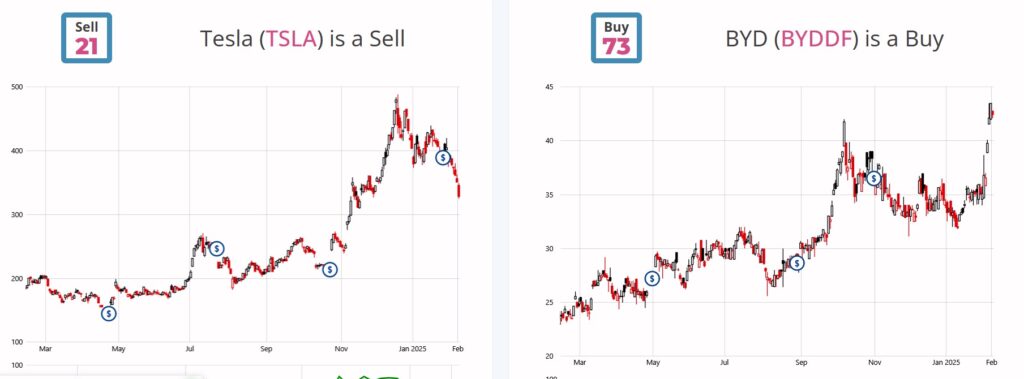
Tesla vs. BYD
Tesla vs. BYD

MORE EDUCATIONAL MATERIALS ON TRUMP TARIFFS

Déjà Vu Economics: How Trump’s Deregulation and Tariff Policies Mirror the Road to the Great Depression

Trumpenomics: How Tariffs, Policy Cuts, and Labor Shortages Are Devastating American Farmers

The Devastating Impact of Trump’s Steel and Aluminum Tariffs

World Economics 101: The United States and Global Trade Dynamics

The Lies Behind Trump’s Terror Economics

Trumpenomics: The Decline of the US

bookmark_borderEconomic Update: The Path to Disaster

The Republican Party is driving the U.S. economy off a cliff, and the consequences are unfolding in real time. The good news? Trump’s team is imploding under the weight of its own reckless and poorly planned policies. The bad news? The so-called “Make America Great Again” agenda is achieving the exact opposite—weakening the country economically, politically, and diplomatically.

One silver lining is that nearly all of Trump’s Executive Orders (EOs) are built on shaky legal ground. Since they lack congressional approval, most will collapse like a house of cards. For example, Trump’s attempt to use tariffs as a revenue source to offset the budget deficit is fundamentally flawed—tariff revenue cannot be used this way unless Congress explicitly authorizes it. Given that the Republican Party has historically opposed taxation, it’s highly unlikely that this EO will ever be codified into law.

Economic Turmoil at Home and Abroad

Both the U.S. and global economies are experiencing unprecedented instability. Stock markets are on edge, interest rates remain high, inflation is still squeezing household budgets, and consumer confidence is plummeting. Meanwhile, Trump’s erratic trade policies—particularly his obsession with tariffs—are adding further uncertainty, disrupting supply chains, and increasing costs for American businesses and consumers.

Internationally, the damage is just as severe. The U.S. has alienated its closest allies through economic bullying and diplomatic incompetence. Relations with Canada and Mexico—our largest trading partners—are deteriorating, and Trump’s isolationist rhetoric has pushed the European Union and other key allies to seek alternative economic partnerships.

And now, in a shocking escalation of global instability, the Trump administration is preparing to seize Gaza—a move so reckless it defies comprehension. This will not only deepen existing geopolitical tensions but also further isolate the U.S. on the world stage.

Climate Policy: The Greatest Threat to Humanity

Of all the Republican Party’s dangerous policies, its stance on climate change is by far the most catastrophic. The continued promotion of fossil fuels, the aggressive rollback of environmental protections, and the outright denial of climate science are accelerating planetary destruction at an unprecedented rate.

If we continue down this path, vast regions of the planet will become uninhabitable within this century. This will lead to mass displacement, food and water shortages, and geopolitical instability on a scale never before seen in human history. The consequences won’t just last for decades or even centuries—climate disruptions and ecological collapse will shape life on Earth for millions of years.

We are already witnessing the devastating effects:

  • Record-breaking temperatures are making entire regions unlivable.
  • Wildfires are more frequent and intense, destroying homes, forests, and livelihoods.
  • Ecosystems are collapsing, with mass extinctions already underway.
  • Storms and flooding are worsening, causing billions in damages and displacing populations.

Despite this overwhelming evidence, Republican leadership continues to double down on climate denial. Instead of investing in renewable energy and sustainable infrastructure, they are working to expand fossil fuel production and dismantle climate policies that were designed to prevent catastrophe.

A Legacy of Destruction

Future generations will look back at this moment in history with disbelief and anger, wondering how a political movement could have been so willfully blind to the destruction it enabled. The question isn’t whether disaster is coming—it’s how much damage will be done before enough people demand change.

How long until the masses wake up and realize that the very policies they were sold as “America First” are actually ensuring America’s downfall?

bookmark_borderThe Lies Behind Trump’s Terror Economics

Article originally published February 4, 2025 in anticipation of tariffs on Mexico and Canada

The primary purpose of Trump’s tariffs is not economic growth or national security—it’s to fund his anti-humanity policies, particularly the billions of dollars required for mass deportation. Unfortunately, both his tariff policies and immigration restrictions have devastating effects on the U.S. economy, creating a dangerous cycle of economic instability and political deception.

Violation of Existing Trade Agreements

One of the most glaring contradictions in Trump’s proposal is that the United States already has a free-trade agreement with Mexico and Canada: the United States-Mexico-Canada Agreement (USMCA). This deal, which was implemented and widely touted as a signature achievement of Trump’s first term, replaced NAFTA and strengthened trade relations between the three nations. Imposing new tariffs would directly violate the terms of the USMCA, undermining the agreement and potentially sparking retaliation or trade disputes.

Circumventing Congressional Authority

Tariffs are a matter that traditionally requires Congressional approval under U.S. law. Trump’s plan to bypass this requirement involves declaring Mexico and Canada as security threats to justify the tariffs through executive action. While this approach exploits legal loopholes, it would almost certainly face challenges in court. Congress has constitutionally enshrined authority over trade, and using national security as a pretext for tariffs risks further eroding trust in executive restraint.

Trump’s Tariff Reversal: A Fake Victory

On February 3, 2025, Trump abruptly suspended the implementation of additional tariffs on Mexico and Canada. While he claimed this as a major negotiating victory, the reality tells a different story. The so-called “concessions” from Mexico and Canada were, in fact, pre-existing agreements that Trump has simply rebranded to appear as new achievements.

For example, in 2019, Trump secured an agreement with Mexico to deploy 15,000 troops to its southern border to curb migration. Now, the recently announced deployment of 10,000 troops is not an increase, but a reduction from that agreement. Similarly, the so-called “deal” with Canada was already announced in December 2024 under President Biden. Trump’s claims of securing new victories are nothing more than political theater designed to mask the damage caused by his reckless policies.

The Economic Damage and Republican Civil War

While the temporary tariff suspension is a win for the economy, common sense, and humanity, it is unlikely to last. Trump still needs to raise revenue to fund his disastrous immigration enforcement plans, and tariffs remain one of his primary tools to do so. These import taxes, however, disproportionately harm American consumers and businesses, leading to higher prices, supply chain disruptions, and reduced economic growth.

This presents a major dilemma for Trump and the Republican Party. Trump was already the largest contributor to the national debt during his first term, and economic forecasts indicate that his current policies could add more to the debt than all Democratic presidents combined throughout U.S. history. Given the Republican Party’s long-standing tradition of advocating for fiscal responsibility, Trump’s reckless spending could spark an all-out civil war within the GOP. The Freedom Caucus, known for its hardline stance on debt and government spending, is likely to lead the charge against Trump’s economic policies.

The Bigger Picture: Trump’s Economic Deception

Trump’s so-called “America First” economic strategy is built on a foundation of deception. His tariffs are nothing more than hidden taxes on the American people, and his immigration policies are not just inhumane—they are economically catastrophic. As his administration scrambles to balance contradictory goals of mass deportation and economic stability, the cracks in his strategy are already showing.

The real question is whether the Republican Party will continue to enable Trump’s reckless economic agenda or whether the internal conflict over fiscal responsibility will finally force a reckoning. One thing is clear: Trump’s terror economics is a losing game—not just for him, but for the entire country.


More Trump Lies and Consequences:

Trump’s Proposed Tariffs on Mexico and Canada: A Policy Analysis

Trumpenomics: How Tariffs, Policy Cuts, and Labor Shortages Are Devastating American Farmers

The Devastating Impact of Trump’s Steel and Aluminum Tariffs

World Economics 101: The United States and Global Trade Dynamics

Protectionism 101: Trump Economics

bookmark_borderThe Economic and Diplomatic Consequences of Trump’s Tariff Expansion

by Daniel Brouse
February 2, 2025

In November 2024, President Trump announced plans to levy new tariffs on Canada and Mexico, while also increasing tariffs on China. This policy shift, formalized through an executive order on February 1, 2025, imposed 25% tariffs on Canadian and Mexican imports and increased tariffs on Chinese goods by an additional 10%, bringing the total to 35% on most products. further escalating trade tensions. Additionally, the administration signaled plans to impose tariffs on the European Union and all oil and gas imports. These aggressive trade policies raise significant economic and diplomatic concerns, with historical precedent suggesting that such measures could have severe long-term consequences.

Economic Ramifications of Tariffs

Tariffs function as taxes on imports, costs that are often passed down to businesses and consumers. The newly imposed 25% tariffs on goods from Mexico and Canada, along with the increased tariffs on Chinese imports, have the following potential consequences:

  • Higher Prices for Consumers: American consumers will face rising costs on everyday necessities such as food, automobiles, electronics, and industrial goods. As businesses absorb these costs, they are likely to pass them on through higher prices.
  • Supply Chain Disruptions: The U.S. economy relies on deeply integrated supply chains with Mexico and Canada, particularly in the automotive, agriculture, and manufacturing sectors. Increased tariffs disrupt cross-border production, making goods more expensive and less competitive in global markets.
  • Retaliatory Tariffs Hurting U.S. Exporters: Canada and Mexico are the United States’ top trading partners, and both countries are expected to retaliate with their own tariffs on American goods. This will make U.S. exports less competitive, leading to declining sales and potential job losses in export-driven industries.
  • Heightened Inflationary Pressures: At a time when inflation remains a concern, higher import costs could exacerbate inflation, reducing consumer purchasing power and slowing economic growth.

Diplomatic and Geopolitical Consequences

Trade policies are not just economic decisions—they have far-reaching diplomatic implications. Implementing tariffs on two of America’s strongest allies and largest trading partners could have several repercussions:

  • Strained Relations with Canada and Mexico: Both countries have been key security and trade allies. Alienating them through aggressive trade measures undermines diplomatic relations and weakens North American economic cooperation at a time when global competition, particularly from China, necessitates stronger regional unity.
  • Reduced Trust in U.S. Trade Agreements: By unilaterally imposing tariffs, the U.S. risks being seen as an unreliable trade partner. This could deter future negotiations and complicate efforts to secure beneficial trade deals.
  • Global Trade Uncertainty: The expansion of tariffs to include the European Union and energy imports could trigger broader trade disputes, further fragmenting global trade networks and slowing economic recovery efforts worldwide.

Historical Parallels: A Dangerous Precedent

The last time the U.S. pursued such aggressive protectionist policies was in the lead-up to the Great Depression. The Smoot-Hawley Tariff Act of 1930, which significantly raised tariffs on foreign goods, triggered retaliatory measures from trading partners, severely reducing global trade and deepening the economic downturn. Economists widely regard these policies as having exacerbated the Depression.

Trump’s 2025 tariff expansion mirrors this historical precedent, increasing the risk of trade wars, economic contraction, and prolonged global instability. At a time when the U.S. economy is facing challenges such as inflation, supply chain vulnerabilities, and international competition, the imposition of widespread tariffs could prove to be an ill-advised economic gamble with far-reaching consequences.

Conclusion

While proponents of protectionist policies argue that tariffs can protect domestic industries, the reality is often far more damaging. Higher costs, disrupted supply chains, diplomatic fallout, and retaliatory measures outweigh any short-term economic gains. History has shown that aggressive tariff policies rarely lead to long-term prosperity—rather, they invite economic hardship and global instability. If history is any guide, these new tariffs may be a prelude to severe economic consequences, echoing the mistakes of the past.

bookmark_borderEvangelical Christianity, Eschatology, and Political Influence

Background

U.S. support for Israel is deeply intertwined with Evangelical Christian beliefs, particularly those concerning the end times. Many Evangelicals subscribe to the idea that they can hasten the “Second Coming of Christ” by setting the stage for an apocalyptic conflict. According to their interpretation of the Bible, this involves Israel reclaiming Jerusalem, Jesus returning, and ultimately eliminating all Jews who do not convert.

For numerous “Christian Zionists,” especially influential evangelists aligned with the Republican Party, support for Israel is less about political strategy and more about its supposed role in biblical prophecy. In this worldview, war is not something to be avoided but embraced as a divine necessity—an inevitable and even celebratory step toward Jesus’ rule from the Temple Mount in Jerusalem. The fate of Jews and Palestinians alike is, at best, collateral damage.
Ironically, the same Evangelical Christians who claim to worship Jesus have developed a near-cult-like devotion to President Donald Trump, seeing him as an instrument of God’s plan. This allegiance has led them to abandon traditional Christian ethics in favor of political power plays, reinforcing their apocalyptic vision.

Eschatology: The Study of the End Times

The theological study of the end times is called eschatology. Derived from the Greek word eschatos, meaning “last” or “final,” eschatology explores the biblical concepts of the Second Coming of Christ, the final judgment, and humanity’s ultimate destiny.

Christian eschatology varies widely across denominations but generally includes key themes such as the Tribulation, the Rapture, the Antichrist, the Millennial Kingdom, and the New Heaven and New Earth. The primary biblical sources for these beliefs include the Book of Revelation, the Book of Daniel, Matthew 24, and 1 Thessalonians 4–5.

The Antichrist and the False Prophet

The Bible describes two primary figures who play a pivotal role in the end times: the Antichrist and the False Prophet.

The Antichrist is portrayed as a powerful world leader who deceives nations, exalts himself above God, and demands worship. According to 2 Thessalonians 2:3-4, he is called the “man of lawlessness” who will oppose everything associated with God and proclaim himself divine. He will use deception and false miracles, as described in 2 Thessalonians 2:9-10, performing signs and wonders to mislead people. Revelation 13:7 further states that he will have authority over all nations, wage war against God’s people, and establish global control while demanding loyalty and worship.

Working alongside the Antichrist is the False Prophet, a religious figure who deceives people into worshiping the Antichrist and enforces his rule. Revelation 13:12-14 states that the False Prophet will perform great signs, even calling down fire from heaven, deceiving the inhabitants of the earth. He will implement the infamous “Mark of the Beast,” which will be required for economic participation (Revelation 13:16-17). Together, they will establish a counterfeit kingdom in opposition to God, using political power, false miracles, and religious influence to lead people astray. However, their reign will ultimately end in their destruction at Christ’s second coming (Revelation 19:20).

The Bible warns believers to remain vigilant, as the spirit of the Antichrist is already present in the world (1 John 4:3). Jesus himself warns in Matthew 24:24 that false messiahs and false prophets will perform great signs to deceive even the elect. Ultimately, the Antichrist and the False Prophet represent a final rebellion against God, but their defeat is assured through Christ’s return and judgment. Believers are urged to remain steadfast in faith and avoid being misled by deception.

False Prophets and Their Modern Influence

The Bible repeatedly warns against false prophets who mislead people for personal gain, political power, or ideological influence. These warnings remain highly relevant today in the context of misinformation, manipulation, and the rise of leaders who claim to have all the answers while deceiving the public.

Examples of modern false prophets can be seen in:

  1. Political and Religious Manipulation – Leaders and influencers use fear, rhetoric, and false promises to manipulate people, often positioning themselves as the only solution to societal problems.
  2. Misinformation and Conspiracy Theories – The internet has allowed false prophets—those who spread lies and propaganda—to reach and deceive even well-educated individuals.
  3. Cult-Like Followings – Some leaders gain unwavering loyalty, convincing their followers to reject facts, critical thinking, and morality in favor of blind allegiance.
  4. False Promises of Salvation – Whether in politics, religion, or business, many claim to offer prosperity, security, or “the truth” while actually leading people into harm.

The warning in Matthew 24:24 serves as a reminder to stay vigilant, question what we are told, and remain rooted in truth, discernment, and ethical reasoning. The willingness of Christian Zionists to embrace war and deception for the sake of an apocalyptic vision highlights the dangers of unchecked religious extremism in shaping political policy. If history teaches us anything, it is that those who seek to manipulate faith for power often lead their followers—and the world—toward destruction.


Evangelical Christianity and Israel

If you’re curious about the driving force behind US support for Israel, it’s ironically rooted in Evangelical Christianity. Many Evangelical Christians believe they can hasten the “second coming of Christ” by bringing about the apocalypse. According to their interpretation of the Bible, this involves Israel reclaiming Jerusalem, Jesus returning, and ultimately eliminating all Jews. For numerous “Christian Zionists,” especially influential evangelists aligned with the Republican Party, support for Israel is less about political strategy and more about its supposed role in biblical prophecy. In this worldview, war is not something to be avoided but embraced as a divine necessity—an inevitable and even celebratory step toward Jesus’ rule from the Temple Mount in Jerusalem.