bookmark_borderThe Big Beautiful (Ugly) Bill: Tax Cuts, Inflation, Debt, and the Hidden Cost to Households

Introduction

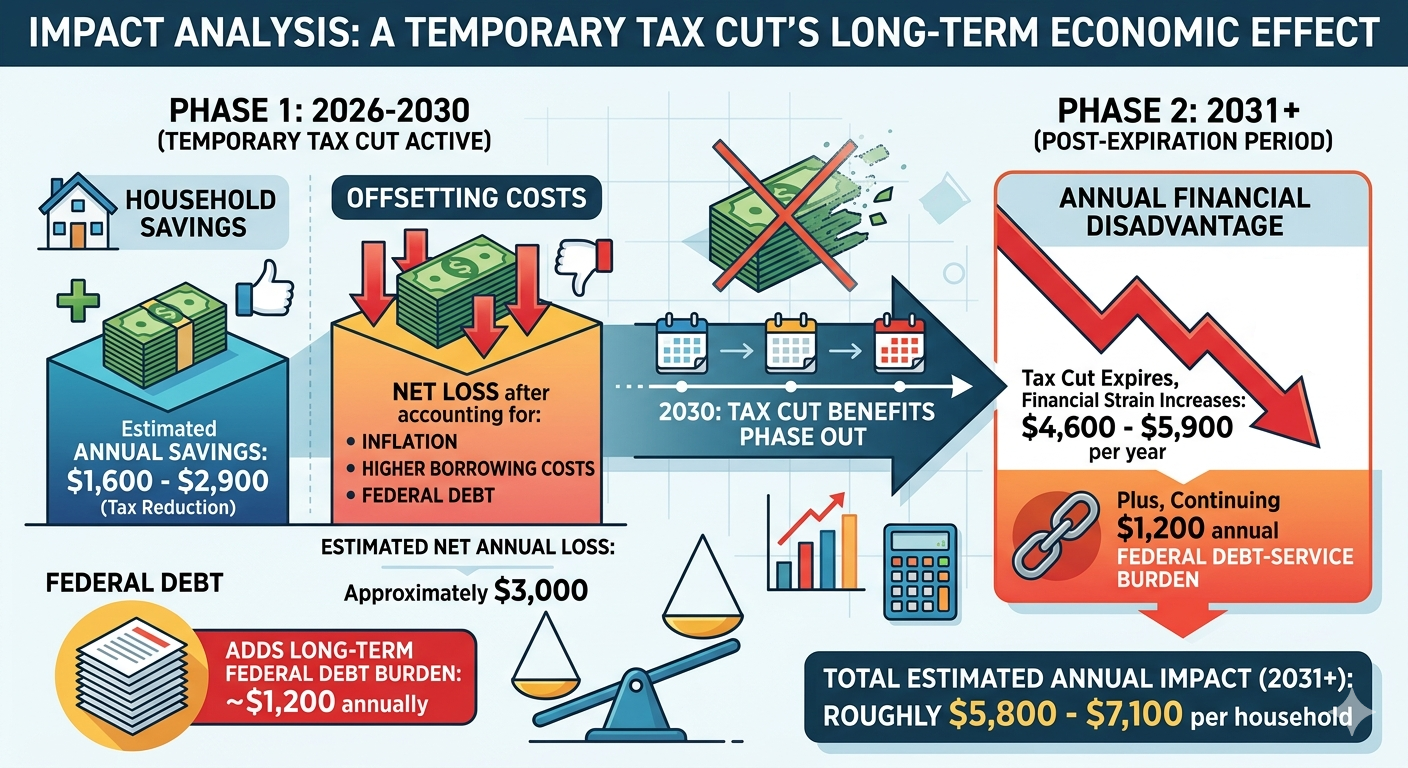
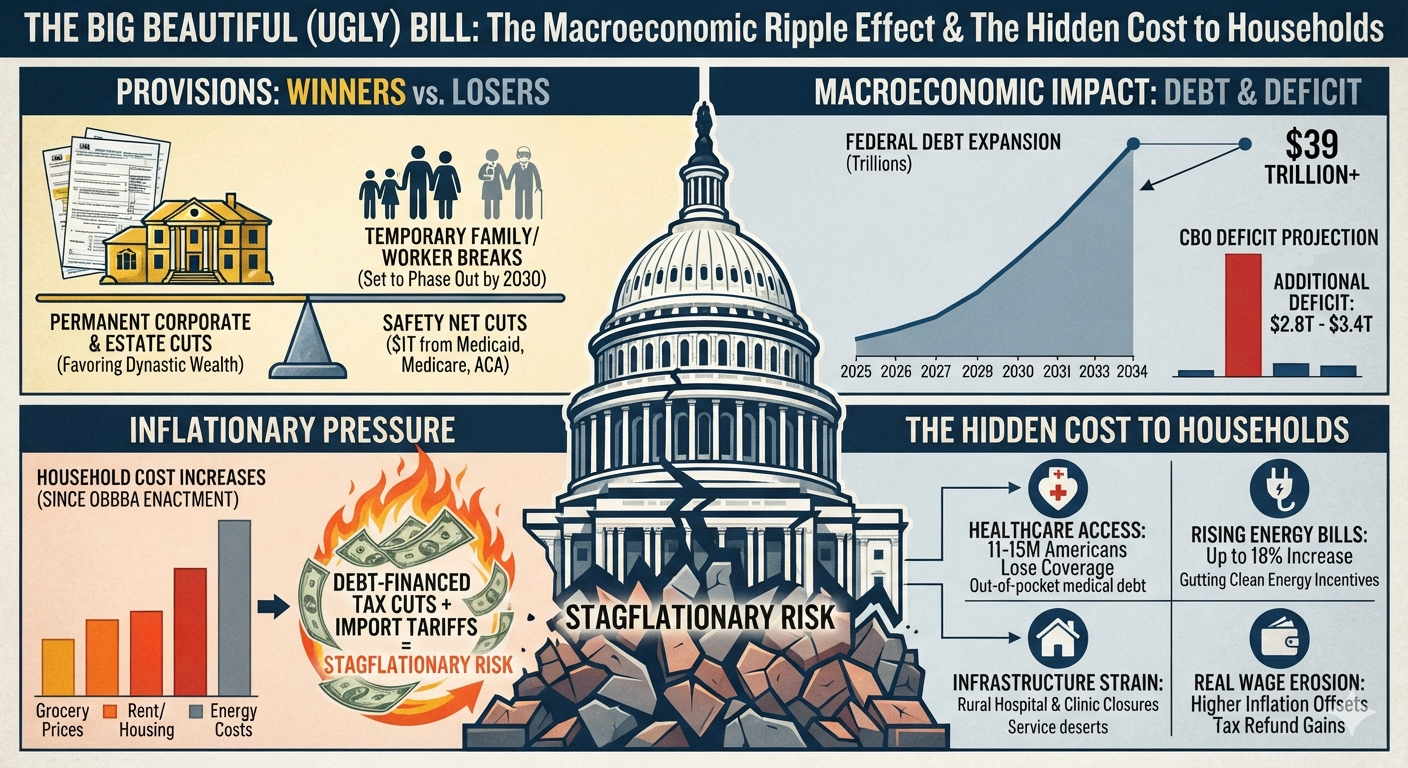
A tax cut that appeared to provide the average household with $1,600–$2,900 in annual savings was more than offset by the broader economic effects of inflation, higher borrowing costs, and increased federal debt. After accounting for these costs, the average household experienced an estimated net loss of approximately $3,000 per year, along with an additional long-term federal debt burden equivalent to roughly $1,200 annually.

However, the tax cut benefits are scheduled to phase out by 2030, meaning households will eventually lose the temporary savings while many of the costs associated with higher debt, interest payments, and elevated borrowing rates remain. Beginning in 2031, when the tax reduction expires, the average household’s annual financial disadvantage could increase to approximately $4,600–$5,900 per year, plus the continuing $1,200 annual federal debt-service burden. This would place the total estimated impact at roughly $5,800–$7,100 per household annually, while the accumulated federal debt continues to shift additional costs onto future taxpayers.
Tax Cuts vs. Inflation: The Hidden Battle Over Household Purchasing Power

Tax cuts are often promoted as a direct way to improve household finances, but for the average American family, inflation can have a much larger and more immediate impact on financial well-being. A tax cut may provide a noticeable boost to income, but a sustained period of elevated inflation can quietly reduce purchasing power by thousands of dollars each year.

For a typical middle-income household, a broad tax reduction might save several hundred to a few thousand dollars annually. However, inflation affects the entire household budget—including housing, groceries, utilities, transportation, healthcare, and services. A 4%–5% annual inflation rate can easily increase household expenses by $3,500–$5,000 per year, effectively overwhelming the benefit of many tax cuts.

The result is a simple economic reality: a dollar gained through tax cuts can be offset—or even erased—by dollars lost through higher prices.


The Mathematical Mismatch: Tax Savings vs. Inflation Costs

Tax Cuts Provide Limited Annual Gains

For most middle-class households, federal tax cuts typically produce moderate savings rather than dramatic changes in disposable income. Historical analyses of broad tax packages, including evaluations by organizations such as the Tax Policy Center, have shown that middle-income families often receive annual tax reductions in the range of roughly $1,600 to $2,900, depending on the structure of the legislation. The most recent tax cuts saved the average household $1,600 and $2,900.

While meaningful, these savings represent only a fraction of a household’s total annual expenses.

Inflation Acts Like a Hidden Tax

Inflation operates differently from taxes. Rather than reducing a paycheck directly, it increases the cost of nearly everything a household buys.

A family spending $80,000 annually on goods and services would experience approximately:

  • 4% inflation: about $3,200 in additional annual costs
  • 5% inflation: about $4,000 in additional annual costs
  • 6% inflation: about $4,800 in additional annual costs

Unlike a tax cut, which may provide a one-time or annual benefit, inflation compounds year after year. Even if wages rise, households can still lose purchasing power if prices increase faster than incomes.


Distribution of Benefits vs. Distribution of Burdens

Tax Cuts Often Deliver Larger Dollar Benefits to Higher-Income Households

Income tax reductions generally scale with taxable income. Higher-income households typically pay more in taxes, so percentage-based tax cuts often produce larger dollar savings at the top.

Analyses from organizations such as the Congressional Budget Office have repeatedly shown that broad tax changes frequently provide the largest absolute benefits to higher-income groups, while middle- and lower-income households receive smaller dollar amounts.

Inflation Disproportionately Hurts Lower- and Middle-Income Families

Inflation is often described as a regressive economic force because it affects essential spending categories that consume a larger share of lower-income household budgets.

A wealthy household can often absorb higher prices by reducing discretionary spending or shifting purchases. A working-class family has fewer options when facing increases in:

  • Food prices
  • Rent or mortgage payments
  • Electricity and heating costs
  • Gasoline and transportation
  • Healthcare expenses

For families living close to their monthly budget limits, inflation functions like a pay cut.


The Inflation Feedback Loop

Tax cuts can stimulate economic activity by increasing disposable income. However, if tax reductions are not matched by spending reductions or productivity gains, they can increase demand in an economy already operating near capacity.

The mechanism is straightforward:

  1. Tax cuts increase household disposable income.
  2. Increased income boosts consumer demand.
  3. If supply cannot expand quickly enough, businesses raise prices.
  4. Higher prices reduce the purchasing power of the original tax cut.

In this scenario, households may receive additional money in their paycheck while simultaneously paying more at the grocery store, gas station, and utility bill.

The economic benefit becomes partially or completely offset by rising prices.


The Federal Debt Effect: How Tax Cuts Can Increase Long-Term Costs

Tax cuts also have a broader economic impact beyond the immediate benefit to taxpayers. When tax reductions are not accompanied by equivalent spending reductions or stronger economic growth, they increase the federal budget deficit and add to the national debt. The government must finance that additional debt by issuing more Treasury securities, increasing the supply of government borrowing.

As federal debt rises, the government competes with households and businesses for available capital. This increased demand for borrowed money can place upward pressure on interest rates, raising the cost of mortgages, auto loans, credit cards, business financing, and other forms of credit.

The effect is often indirect but significant. A household may receive a $2,000 annual tax reduction, but if higher federal borrowing contributes to even a modest increase in interest rates, that same family may pay thousands of dollars more over time through:

  • Higher mortgage rates when purchasing or refinancing a home
  • Increased interest on auto loans
  • Higher credit card balances
  • More expensive consumer financing
  • Higher costs passed through by businesses borrowing at elevated rates

For example, a 1% increase in mortgage rates on a $300,000 home loan can add roughly $200 per month to a typical 30-year mortgage payment—more than $2,000 annually. Across the economy, higher interest rates also increase the federal government’s own debt-service costs, requiring more taxpayer dollars to pay interest rather than fund public services or reduce future deficits.

This creates a potential feedback loop:

  1. Tax cuts reduce federal revenue.
  2. Larger deficits increase government borrowing.
  3. Higher debt levels put upward pressure on interest rates.
  4. Higher rates increase borrowing costs for households, businesses, and the government.
  5. Additional interest expenses reduce the long-term economic benefit of the original tax cut.

The ultimate measure of a tax policy is therefore not only the size of the immediate tax reduction, but its effect on total household purchasing power after accounting for inflation, interest rates, and the long-term cost of increased federal debt.


The Role of Bracket Creep

Inflation also affects taxation through a process known as bracket creep.

As wages rise due to inflation, taxpayers can unintentionally move into higher tax brackets even though their real purchasing power has not increased. To address this, the Internal Revenue Service adjusts federal income tax brackets, standard deductions, and other thresholds annually for inflation.

These adjustments prevent inflation from automatically increasing a household’s tax burden. However, they do not compensate for the broader loss of purchasing power caused by rising prices.

Inflation indexing protects taxpayers from paying higher taxes simply because of inflation—it does not make groceries, housing, or energy affordable again.


Conclusion: The True Measure Is Total Economic Impact

Tax cuts can provide meaningful benefits to households, but their true economic value cannot be measured by the size of the immediate reduction in a tax bill alone. A complete evaluation must consider the broader effects on purchasing power, inflation, interest rates, and the long-term federal debt burden.

A tax cut may increase disposable income in the short term, but those gains can be diminished or even erased when inflation raises the cost of everyday necessities such as housing, food, energy, and transportation. Unlike a one-time tax reduction, inflation affects the entire household budget and compounds over time, reducing what each dollar can actually buy.

The impact also depends on how tax cuts are financed. When reductions in federal revenue are not matched by spending cuts or sufficient economic growth, they increase budget deficits and add to the national debt. Higher federal borrowing can place upward pressure on interest rates, increasing costs for mortgages, auto loans, credit cards, and business financing. Households may receive additional money through lower taxes while simultaneously paying more through higher borrowing costs and rising prices.

This creates a broader economic equation:

The benefit of a tax cut is not simply the dollars returned to taxpayers—it is the change in real purchasing power after accounting for inflation, interest rates, and future debt obligations.

For some households, especially higher-income taxpayers, tax reductions may provide substantial direct benefits. However, for many middle- and lower-income families, the effects of inflation and higher interest rates can outweigh those gains because they spend a larger share of their income on necessities and borrowing costs.

The ultimate question is therefore not:

“How much did taxpayers save in taxes?”

The more important question is:

“Did households become financially better off after accounting for the full economic consequences?”

A sustainable economic policy must balance tax relief with fiscal responsibility, price stability, and long-term economic growth. Without that balance, a tax cut can create the appearance of increased prosperity while shifting costs into higher prices, higher interest payments, and a larger debt burden for future generations.
ADDENDUM

The exact “net cost” depends on the household’s income, debt exposure, and whether the tax cuts are financed by borrowing. A reasonable estimate can be made by separating immediate annual effects from long-term debt effects.

Estimated Annual Impact on an Average Household

ItemAnnual Impact
Tax cut benefit+$1,600 to +$2,900
4% inflation increase in household expenses−$3,200
Higher mortgage costs (if buying/refinancing)−$2,000+
Higher auto loan, credit card, and consumer financing costs−$500 to −$2,000+
Higher business borrowing costs passed through in prices−$300 to −$1,000+
Additional federal debt interest burden−$900 to −$1,500+ annually (estimated)

Short-Term Net Effect (First-Year Estimate)

Lower-cost scenario:

  • Tax savings: +$2,900
  • Inflation cost: −$3,200
  • Consumer borrowing/business costs: −$800
  • Debt interest effect: −$900

Net impact: approximately −$2,000 per household per year


Higher-cost scenario:

  • Tax savings: +$1,600
  • Inflation cost: −$3,200
  • Mortgage/borrowing costs: −$3,000
  • Debt interest effect: −$1,500

Net impact: approximately −$6,100 per household per year


Long-Term Federal Debt Effect

If tax cuts add $3–$5 trillion to federal debt:

  • There are roughly 130 million U.S. households.
  • The added debt equals approximately:

$3 trillion130 million households≈$23,000 per household\frac{\$3\text{ trillion}}{130\text{ million households}} \approx \$23,000 \text{ per household}130 million households$3 trillion​≈$23,000 per household$5 trillion130 million households≈$38,000 per household\frac{\$5\text{ trillion}}{130\text{ million households}} \approx \$38,000 \text{ per household}130 million households$5 trillion​≈$38,000 per household

That does not mean each household receives a bill, but it represents the additional federal liability ultimately supported by taxpayers.

If the government pays roughly 4% interest on that additional debt:

  • $3 trillion × 4% = $120 billion/year
  • $5 trillion × 4% = $200 billion/year

Spread across households:

  • $900–$1,500 per household annually in additional federal interest costs

Over decades, if the debt is refinanced and interest compounds, the total burden can become substantially larger.


Other Potential Costs Associated With Large Tax Cuts

1. Reduced fiscal flexibility

Higher debt can limit the government’s ability to respond to:

  • recessions
  • natural disasters
  • pandemics
  • military emergencies
  • infrastructure needs

Future taxpayers may face higher taxes or spending cuts to service the debt.

2. Higher interest rates

Large deficits can increase demand for borrowed funds, putting upward pressure on interest rates. This affects:

  • mortgages
  • business loans
  • student loans
  • auto loans
  • government borrowing costs

3. Crowding out private investment

When the government absorbs more available capital:

  • businesses may invest less
  • productivity growth can slow
  • wage growth may weaken over time

4. Inflation risk

If tax cuts increase demand without increasing supply, they can contribute to inflationary pressure, especially when the economy is already near capacity.


Estimated Net Household Effect

Time FrameEstimated Impact
Immediate annual effect−$2,000 to −$6,000 per household
Added federal debt liability+$23,000 to +$38,000 per household
Annual debt-service burden−$900 to −$1,500 per household/year

Bottom Line

A tax cut that appeared to provide an average household with $1,600–$2,900 in annual savings was far outweighed by the broader economic effects of inflation, higher borrowing costs, and increased federal debt. The average household had a net loss of $3,000 and an additional debt burden of $1,200/year. For many households, the combined impact may represent a net financial loss of several thousand dollars per year, while the long-term debt burden shifts additional costs onto future taxpayers.

bookmark_borderThe Optimal Wealth-Building Strategy for Children: Combining Trump Accounts, 529 Plans, and Roth IRAs

A child’s financial future can be strengthened by using multiple savings vehicles, each designed for a different purpose. Rather than choosing only one account, families can combine them strategically to maximize government benefits, tax advantages, and long-term wealth creation.

Step 1: Capture the Free Government Contribution

For children born between 2025 and 2028, families should consider opening a Trump Account through Trump Accounts.gov as soon as possible to qualify for the initial $1,000 government contribution and any eligible corporate matching contributions.

The key advantage is that this initial deposit provides a foundation of invested capital that can compound for decades. When started early, even a relatively small contribution can grow substantially through the power of long-term investment returns.

Step 2: Use a 529 Plan for Education Savings

After securing available government contributions, families can direct additional college savings into a 529 education savings plan.

A 529 plan offers:

  • Tax-free growth on qualified education expenses
  • Tax-free withdrawals for eligible college, vocational, and educational costs
  • The ability for family members to contribute over time

For parents and grandparents specifically saving for education, a 529 plan remains one of the most efficient tools for building a dedicated education fund.

Step 3: Transition to a Custodial Roth IRA for Long-Term Wealth

Once a child has earned income from a legitimate job—such as babysitting, lawn care, summer employment, or other documented work—a Custodial Roth IRA can become a powerful wealth-building tool.

A Roth IRA allows:

  • Tax-free investment growth
  • Tax-free qualified withdrawals in retirement
  • The potential to use contributions (not earnings) later for certain purposes, such as a first-home purchase

Starting a Roth IRA during childhood gives decades of compounding potential and can help transform early earnings into a future home down payment or retirement asset.

The Three-Account Strategy: A Lifetime Financial Roadmap

The most powerful approach is not choosing between accounts—it is using each account for its intended purpose:

  1. Trump Account → Capture free government and matching contributions
  2. 529 Plan → Build a tax-advantaged education fund
  3. Custodial Roth IRA → Create lifelong tax-free wealth

By combining these tools, families can provide children with a financial foundation that supports education, home ownership, and long-term financial independence. The earlier the process begins, the greater the benefit of decades of compound growth.

bookmark_borderFrom Scissors and Glue Sticks to AI: A Lifetime of Publishing Through Technological Revolutions

by Daniel Brouse

I recently had a conversation with an author who described the painstaking process of publishing a book decades ago. The manuscript was written on an early Amstrad word processor. Each section had to be printed, physically cut with scissors, and glued onto format sheets provided by the publisher. Every chapter was constrained to a specific page count and layout. Photos and graphics required coded placeholders, separate lists of image requirements, rough sketches, and coordination with researchers and artists. It was an incredibly slow and labor-intensive process.

That story resonated deeply with me because I experienced similar challenges during the early days of the World Wide Web.

Around 1992, web engineering and publishing were equally demanding. Creating even a single graphic for a webpage could take weeks or months. The tools we take for granted today did not exist. There were no drag-and-drop interfaces, content management systems, or automated publishing platforms. Everything was handcrafted.

During that period, I created what I called the first web “button”—the Panic Button. The concept was simple: if someone didn’t know how to use the web, they could click on the graphic and receive help. In effect, it became the first World Wide Web help desk, designed to guide users through an entirely new digital environment.

The Panic Button represented something even more fundamental. It was the invention of the clickable image—an inline graphic with a hyperlink wrapped around it. Today, clickable images are so commonplace that they seem obvious, but at the time, the idea of turning an image itself into an interactive navigation element had not yet become part of the web experience. The button transformed a static picture into an action, helping establish the principle that graphics could serve not merely as illustrations but as gateways to information and services.

The original Membrane website can still be viewed at:

http://membrane.com/

Our work extended beyond web development. We were also among the early record companies on the web, experimenting with concepts that would eventually become commonplace, including music subscriptions, pay-per-download services, and streaming media. I found music production particularly rewarding, and advances in technology allowed me to dramatically increase my creative output.

In the early years, I produced approximately fifty songs per year. As digital tools improved, that number increased to around one thousand songs annually between 1992 and 2023. Today, with AI-assisted composition, production software, and modern mastering technologies, I can publish approximately 7,300 songs per year at substantially higher levels of production and mastering quality. Measured purely by output, that represents a 146-fold increase in productivity.

Scientific publishing has undergone a similar transformation. Much of climate science involves mathematical analysis, data processing, modeling, and the communication of complex ideas. A scientific paper that once might have required a year of calculations, drafting, revisions, graphics production, and formatting can now often be completed in a matter of days.

The significance of these technological changes extends beyond simple speed. Technology has compressed production timelines while simultaneously improving quality and dramatically expanding the capabilities of individuals. Tasks that once required teams of specialists and months of effort can increasingly be accomplished by a single person equipped with modern digital tools and artificial intelligence.

Having lived through both eras—the age of scissors and glue sticks and the age of AI-assisted creation—the contrast is remarkable. We have witnessed one of the greatest productivity revolutions in human history, one that has fundamentally transformed publishing, music, science, and the very process of turning ideas into reality.

bookmark_borderSoil–Insect Climate Feedback Collapse

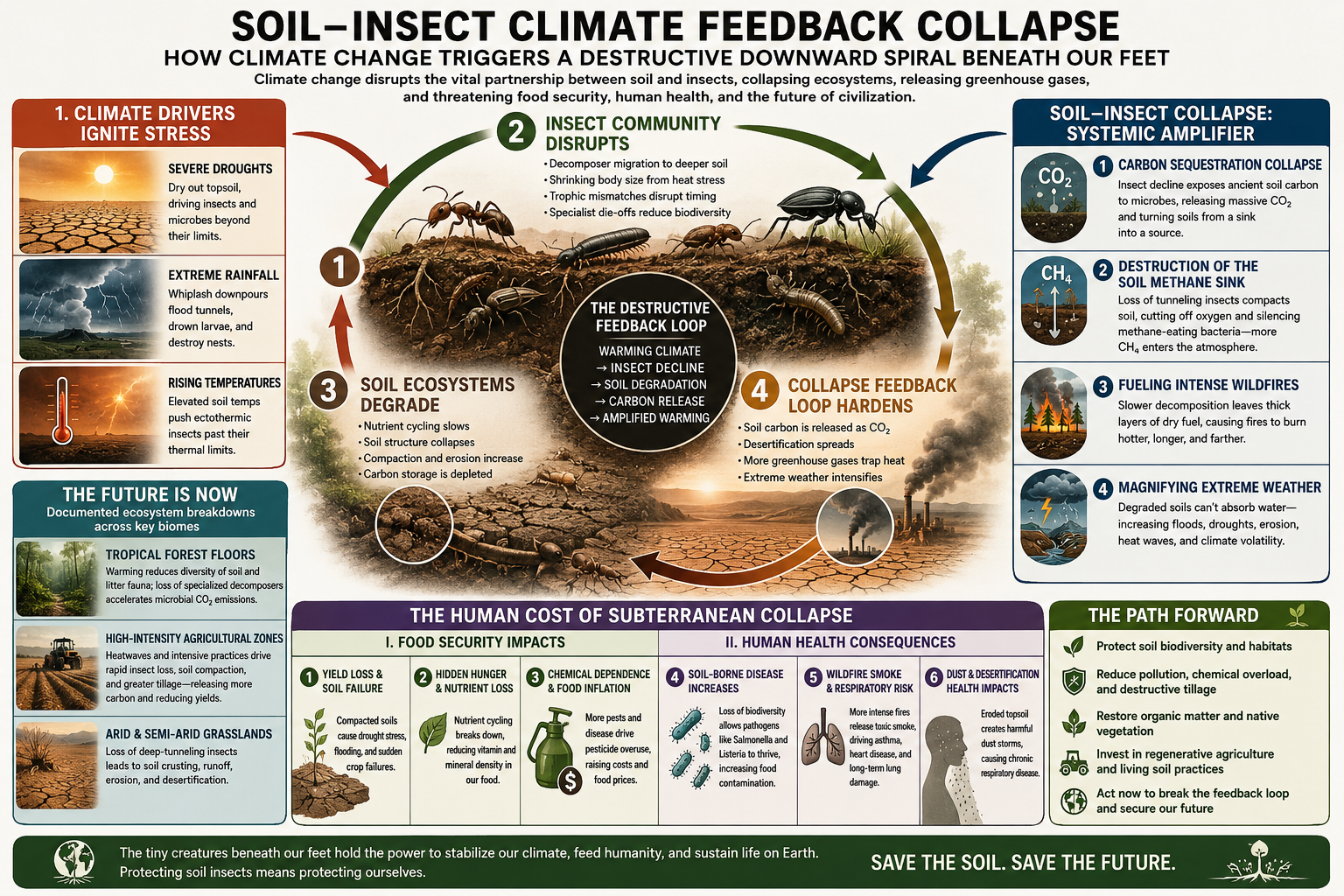
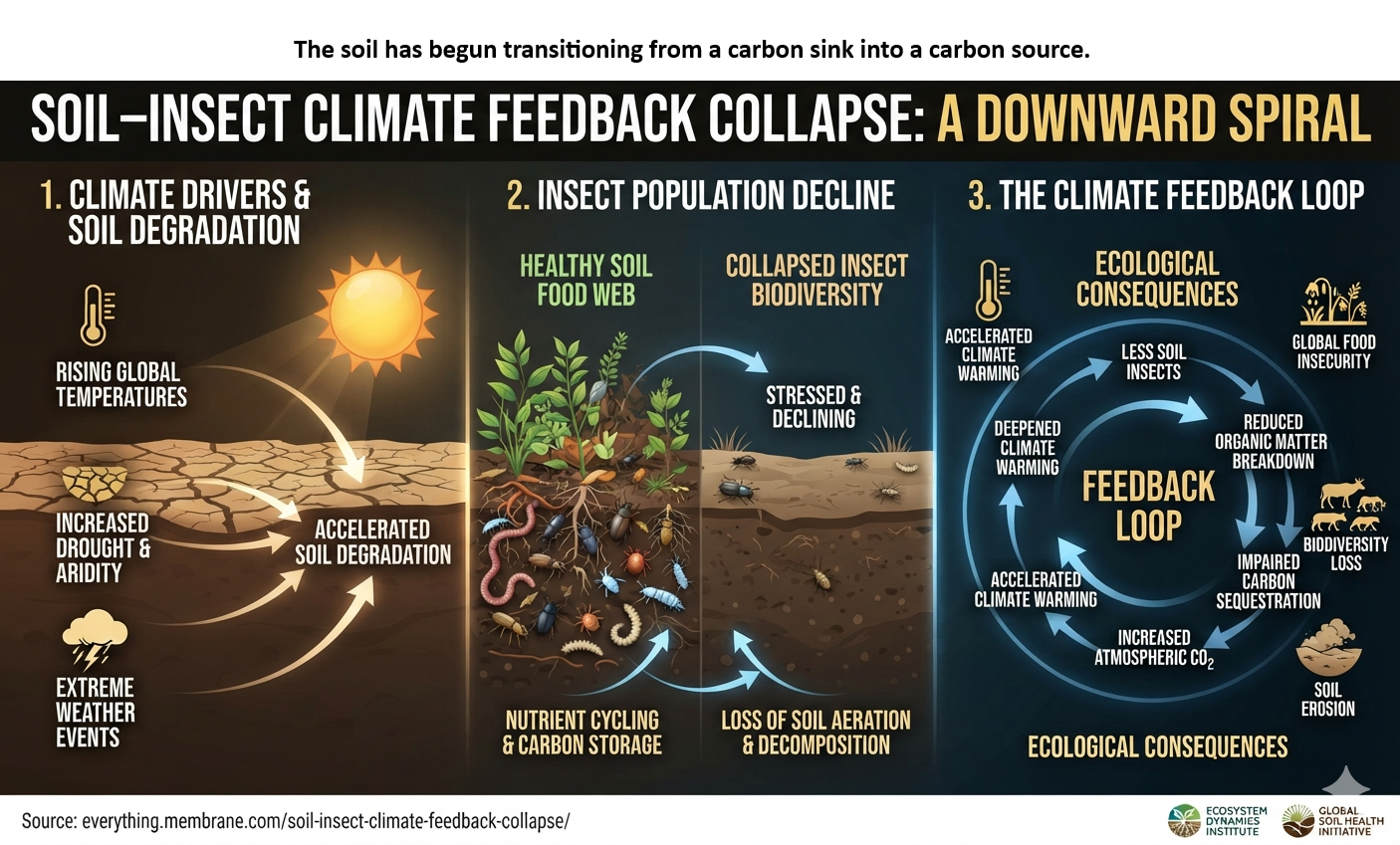
The soil has begun transitioning from a carbon sink into a carbon source.

by Daniel Brouse

Soil–Insect Climate Feedback Collapse: How Climate Change Is Triggering a Downward Spiral in Earth’s Hidden Ecosystems

Introduction: The Collapse Beneath Our Feet

Climate change is not only transforming the atmosphere, oceans, and visible landscapes of Earth; it is also disrupting one of the planet’s most important hidden systems—the living soil ecosystem beneath our feet. Soil and insects exist in a highly interconnected relationship where insects regulate decomposition, nutrient cycling, carbon storage, water movement, and the physical structure of the ground itself.

As global temperatures rise and extreme weather becomes more intense, this relationship is being pushed beyond its natural limits. Soil insects, particularly ectothermic organisms whose body temperatures are controlled by their environment, are highly vulnerable to rising temperatures, drought, flooding, and ecological instability. At the same time, soil itself becomes increasingly degraded as biological processes that maintain its structure and fertility begin to fail.

This creates a destructive climate feedback loop:

Climate warming → insect decline → soil degradation → carbon release → amplified warming → further insect decline

The collapse of soil-insect systems represents more than a biodiversity crisis. It is a systemic disruption of one of Earth’s largest carbon reservoirs and one of humanity’s most important life-support systems. As subterranean ecosystems deteriorate, the consequences extend upward into agriculture, wildfire behavior, atmospheric processes, food security, and human health.


1. Climate Drivers Ignite Soil-Insect Stress

Climate change acts as the primary trigger for the collapse of the soil-insect system. Rising temperatures, changing precipitation patterns, drought, and extreme rainfall events place intense pressure on organisms that have evolved within relatively stable environmental conditions.

Severe Drought and Soil Drying

Increasing drought conditions dry out the upper layers of soil, eliminating critical habitat for many soil organisms. Moisture-dependent insects and other decomposers experience increased mortality as soils become too dry to support biological activity.

Dry soils also:

  • Reduce microbial activity.
  • Increase compaction.
  • Limit decomposition.
  • Reduce nutrient availability.

As moisture disappears, many soil insects are forced deeper underground to escape unfavorable surface conditions, leaving the upper soil layers biologically depleted.

Extreme Rainfall and Flooding

Climate change is also increasing the frequency of intense rainfall events. These sudden floods disrupt underground ecosystems by:

  • Flooding insect tunnels.
  • Destroying underground nesting structures.
  • Drowning eggs and larvae.
  • Removing surface organic material.

The increasing combination of drought and extreme rainfall creates a climate “whiplash” effect, forcing soil organisms to survive rapidly shifting and increasingly hostile environments.

Rising Soil Temperatures

Elevated soil temperatures place ectothermic organisms under direct physiological stress. Because insects rely on environmental temperatures to regulate metabolism, warming can push them beyond their thermal limits.

The consequences include:

  • Reduced survival.
  • Disrupted reproduction.
  • Altered development cycles.
  • Increased ecological instability.

The result is a progressive breakdown of the underground biological network that supports healthy soils.


2. The Soil Insect Community Disrupts

As climate pressures intensify, soil insect communities begin experiencing widespread ecological disruption. The impacts are not limited to population decline but include changes in behavior, body size, timing, and species composition.

Decomposer Migration

Macrofauna such as ants, beetles, termites, and other large decomposers are essential for processing organic matter and maintaining soil structure.

Under increasing heat and drought stress:

  • These organisms migrate deeper into the soil.
  • Surface decomposition declines.
  • Organic matter remains exposed rather than being incorporated into deeper layers.

The loss of surface-level decomposer activity weakens the entire soil food web.

Shrinking Body Size

Rising temperatures accelerate insect development rates. However, faster growth often results in smaller adult insects.

This reduction in body size decreases:

  • Physical efficiency.
  • Reproductive capacity.
  • Ecosystem function.

Smaller insects are less capable of performing critical roles such as decomposition, soil mixing, and nutrient movement.

Trophic Mismatches

Climate disruption alters the timing relationships between organisms.

Examples include:

  • Insect emergence occurring before food resources become available.
  • Reduced synchronization between decomposers and plant litter cycles.
  • Disruption of predator-prey relationships.

These mismatches weaken ecosystem stability and reduce the ability of soil communities to adapt.

Specialist Die-Offs

Specialized soil insects are among the most vulnerable organisms during rapid environmental change.

Localized extinctions of sensitive species result in:

  • Reduced biodiversity.
  • Loss of ecological functions.
  • Increased dominance of heat-tolerant generalist species.

As biodiversity declines, the soil ecosystem becomes less resilient and more vulnerable to additional climate stress.


3. Soil Ecosystems Degrade

The decline of soil insect communities causes cascading failures throughout the underground ecosystem. Without healthy insect populations, soils lose many of the biological processes required to maintain fertility, structure, and climate regulation.

Halted Nutrient Cycling

Soil insects are fundamental to the breakdown of organic material.

Without macrofauna:

  • Plant litter decomposition slows.
  • Nutrients remain trapped in undecomposed material.
  • Soil fertility declines.

The biological recycling system that sustains terrestrial ecosystems begins to fail.

Structural Collapse

Burrowing insects act as ecosystem engineers by creating tunnels and channels throughout the soil.

These structures provide:

  • Soil aeration.
  • Water infiltration pathways.
  • Root access.
  • Microbial habitat.

As tunneling organisms disappear:

  • Soil becomes compacted.
  • Water absorption decreases.
  • Surface erosion increases.

The soil loses its ability to function as a living, dynamic system.

Carbon Depletion

Healthy soils represent one of Earth’s largest carbon reservoirs. Soil insects help protect carbon by shredding organic matter and mixing it into deeper layers where it can become stabilized.

When insect communities collapse:

  • Organic carbon becomes exposed.
  • Microbial decomposition accelerates.
  • Carbon storage capacity declines.

The soil has begun transitioning from a carbon sink into a carbon source.


4. The Collapse Feedback Loop Hardens

Once soil degradation begins, the damage feeds back into the climate system, accelerating the original disruption. The loss of soil insects transforms a biological decline into a broader Earth-system feedback mechanism.

Greenhouse Gas Release

As soil structures fail and organic matter becomes exposed, large quantities of stored soil carbon are released into the atmosphere.

Healthy soils function as long-term carbon storage systems by protecting organic matter within complex soil structures. When insect activity declines:

  • Soil aggregates break down.
  • Previously protected carbon becomes accessible to microbes.
  • Decomposition accelerates.
  • Carbon dioxide emissions increase.

As more carbon enters the atmosphere, additional warming occurs, intensifying the environmental pressures already affecting soil organisms.

Desertification

The combined loss of soil biodiversity and soil structure can transform productive ecosystems into degraded landscapes.

Without healthy insect communities:

  • Soil loses its ability to retain moisture.
  • Vegetation declines.
  • Organic matter inputs decrease.
  • Erosion accelerates.

The landscape gradually loses its capacity to support biological productivity, creating conditions favorable for permanent desertification.

Amplified Warming

The release of additional greenhouse gases creates a reinforcing climate feedback.

The sequence becomes:

Rising temperatures → insect decline → soil degradation → carbon release → increased atmospheric warming → greater ecological stress

The original disturbance is therefore amplified through the collapse of a critical biological system.


The Future Is Now: Evidence of Active Soil-Insect Collapse

This destructive feedback loop is no longer only a theoretical projection. It is actively documented across multiple ecosystems worldwide. Field experiments, long-term ecological monitoring, and regional surveys reveal visible breakdowns where insect declines directly affect soil stability, carbon cycling, and ecosystem function.


1. Tropical Forest Floors

Tropical ecosystems contain some of the most biologically diverse soil communities on Earth. However, tropical insects often live close to their maximum thermal tolerance, making them particularly vulnerable to even modest increases in temperature.

The Evidence

Controlled whole-profile soil warming experiments in tropical forests have demonstrated:

  • Significant reductions in soil and leaf-litter fauna diversity.
  • Declines in soil organism richness.
  • Greater vulnerability during dry-season warming.

The Feedback

As specialized macro-decomposers such as larger beetles and millipedes decline:

  • They are replaced by fewer heat-tolerant and aggressive microarthropod species.
  • Soil food-web complexity decreases.
  • Microbial activity becomes less regulated.

Without a diverse insect community controlling microbial processes, microbes can accelerate the breakdown of organic matter, increasing carbon dioxide emissions from tropical soils.


2. High-Intensity Agricultural Zones

Agricultural ecosystems are experiencing a compounding crisis as climate stress combines with intensive land management practices.

Major pressures include:

  • Synthetic chemical use.
  • Heavy tillage.
  • Monoculture farming.
  • Increasing heat extremes.

The Evidence

Long-term ecological monitoring indicates that heavily managed agricultural regions experience accelerating declines in insect abundance and species richness as climate pressures increase.

The Feedback

When croplands experience extreme heat:

  • Native soil insects decline.
  • Natural soil aeration decreases.
  • Soil compaction increases.
  • Water retention capacity declines.

As biological soil engineers disappear, farmers increasingly rely on mechanical intervention to break apart hardened soils.

However, increased tillage:

  • Destroys remaining underground habitats.
  • Accelerates organic carbon exposure.
  • Increases agricultural greenhouse gas emissions.

This creates a reinforcing cycle:

Climate stress → soil insect loss → soil degradation → increased tillage → further soil ecosystem destruction


3. Arid and Semi-Arid Grasslands

Dryland ecosystems depend heavily on ecosystem-engineering insects such as ants and termites. These organisms regulate water movement, nutrient distribution, and soil structure in some of the planet’s most water-limited environments.

The Evidence

Increasing temperatures and prolonged drought have altered grassland soil communities, causing significant declines in moisture-sensitive soil organisms.

Deep-dwelling insects are increasingly affected as underground moisture disappears.

The Feedback

Without deep-tunneling insects:

  • Soil loses internal pathways for water movement.
  • Surface crusts form.
  • Rainfall infiltration declines.
  • Vegetation recovery becomes more difficult.

When intense rainfall events occur, degraded soils cannot absorb water effectively.

Instead:

  • Water runs across the surface.
  • Severe erosion occurs.
  • Topsoil is removed.
  • Plant communities collapse.

The loss of vegetation further reduces organic matter inputs, reinforcing the decline of soil insects and accelerating desertification.


Soil-Insect Collapse as a Systemic Climate Amplifier

The soil-insect collapse feedback does not occur independently. It connects directly with major Earth-system processes involving carbon storage, methane regulation, wildfire intensity, and extreme weather.

The destruction of subterranean biodiversity transforms a microscopic ecological disruption into a planetary-scale climate amplifier.


1. Collapse of Carbon Sequestration

Soils contain roughly three times more carbon than terrestrial vegetation. Soil insects function as biological gatekeepers that determine how carbon is processed and stored.

Disruption

Healthy soils depend on insects to:

  • Break down organic material.
  • Mix plant debris into deeper layers.
  • Create conditions where carbon binds with minerals.
  • Build stable soil aggregates.

Global environmental changes reduce the feeding and burrowing activity of soil detritivores, weakening this carbon protection system.

The Feedback

Without insects physically incorporating and protecting carbon:

  • Organic matter becomes exposed.
  • Oxygen reaches stored carbon.
  • Microbial decomposition accelerates.

Long-term warming experiments show that stressed soils can begin consuming persistent, centuries-old organic matter, releasing additional carbon dioxide into the atmosphere.

This converts soils from climate stabilizers into climate amplifiers.


2. Destruction of the Soil Methane Sink

Upland soils represent a major global methane sink because they contain methane-consuming microorganisms called methanotrophs.

Disruption

Methanotroph activity depends on proper soil gas exchange.

This balance is maintained by:

  • Soil structure.
  • Oxygen movement.
  • Insect-created tunnels and macropores.

When heat and drought drive tunneling insects away:

  • Soil compacts.
  • Underground airflow decreases.
  • Methane-consuming microbial communities become impaired.

The Feedback

As the methane sink weakens:

  • Less methane is removed from the atmosphere.
  • More CH₄ accumulates.
  • Atmospheric warming increases.

The soil shifts from actively filtering methane toward becoming a weaker climate-regulating system.


3. Fueling More Intense Wildfires

The collapse of soil decomposer communities fundamentally changes the physical characteristics of forests, grasslands, and other terrestrial ecosystems. When insects responsible for breaking down organic material decline, landscapes accumulate larger quantities of dry, undecomposed biomass.

Disruption

Healthy populations of millipedes, woodlice, beetles, and other macro-insects rapidly process fallen leaves, dead plant material, and organic debris.

When these decomposers decline:

  • Leaf litter decomposition slows.
  • Dead vegetation accumulates on the surface.
  • Organic material remains exposed to drying conditions.
  • Forest floors and grasslands become increasingly fuel-loaded.

The result is the transformation of biologically active landscapes into increasingly combustible environments.

The Feedback

When climate-driven wildfires ignite these ecosystems:

  • Fires spread more rapidly.
  • Burning temperatures increase.
  • Larger areas are consumed.
  • More carbon is released into the atmosphere.

Intense fires also damage the remaining plant-soil-microbe relationships that allow ecosystems to recover.

Following severe burns:

  • Soil organisms are eliminated.
  • Organic matter is lost.
  • Soil structure deteriorates.
  • Insect recolonization becomes more difficult.

This creates a reinforcing cycle:

Climate warming → insect decline → reduced decomposition → increased fuel accumulation → larger wildfires → ecosystem degradation → further insect loss


4. Magnifying Extreme Weather Events

Healthy soils and their insect communities function as a natural climate buffer. Soil organisms help regulate water movement, maintain moisture storage, and reduce the severity of environmental extremes.

When this biological infrastructure collapses, landscapes lose their ability to absorb climate shocks.

Disruption

Without insect-driven bioturbation—the natural mixing and restructuring of soil—the upper layers of soil become increasingly compacted and degraded.

The consequences include:

  • Reduced soil porosity.
  • Lower water infiltration.
  • Increased surface crust formation.
  • Reduced moisture retention.

The soil becomes hardened and less capable of functioning as a living water-management system.

The Feedback

When extreme rainfall events occur:

  • Water cannot penetrate degraded soils.
  • Surface runoff increases.
  • Flash flooding intensifies.
  • Mudslides and erosion become more severe.
  • Topsoil is lost.

The landscape loses its ability to store water, increasing drought stress after storms and creating conditions that intensify future heat waves.

The cycle becomes:

Soil degradation → reduced water storage → stronger drought impacts → greater heat stress → further ecosystem decline


The Human Cost of Subterranean Collapse

The effects of soil-insect collapse extend directly into human systems. Because human civilization depends on productive soils for agriculture, the degradation of underground ecosystems represents a direct threat to food security, economic stability, and public health.

Humans depend on healthy soils for approximately 95% of the food consumed globally. As soil biological systems decline, the consequences move from ecological disruption into human survival systems.


I. Food Security Impacts

1. Declining Crop Yields and Structural Soil Failure

As temperatures rise and insect communities decline, agricultural soils lose critical biological functions.

The Mechanism

When fields lose tunneling macrofauna:

  • Soil becomes compacted.
  • Water infiltration decreases.
  • Plant-accessible water storage declines.

During drought:

  • Crops experience water stress more rapidly.
  • Roots cannot access deeper moisture reserves.

During extreme rainfall:

  • Hardened soils prevent water absorption.
  • Fields experience increased flooding.
  • Crops become vulnerable to sudden failure.

The same degraded soil becomes vulnerable to both drought and flooding, creating increasingly unstable agricultural conditions.


2. Hidden Hunger and Nutrient Decline

Food production depends not only on crop quantity but also on nutritional quality.

The relationship between insects, microbes, and plants maintains the movement of essential nutrients through ecosystems.

The Mechanism

Soil insects:

  • Break down organic material.
  • Create smaller biological fragments.
  • Support microbial conversion of nutrients into plant-available forms.

These processes influence the availability of minerals such as:

  • Iron.
  • Zinc.
  • Selenium.

The Impact

When insect macro-decomposers decline:

  • Nutrient cycling weakens.
  • Plants experience nutritional limitations.
  • Fertilizer inputs cannot fully replace biological soil processes.

Crops grown in degraded soils may experience reduced nutrient density, increasing the risk of “hidden hunger”—micronutrient deficiencies that impair human development and immune function.


3. Increasing Chemical Dependence and Food Inflation

As native insect diversity collapses, agricultural ecosystems become increasingly vulnerable to pests and disease.

The Mechanism

The loss of beneficial insects removes important ecological controls over:

  • Crop pests.
  • Soil pathogens.
  • Root-damaging organisms.

To maintain production:

  • Farmers increase pesticide use.
  • Synthetic inputs become more necessary.
  • Production costs rise.

The Impact

Greater chemical dependence contributes to:

  • Higher agricultural expenses.
  • Increased food prices.
  • Greater chemical runoff into freshwater systems.
  • Additional stress on vulnerable communities.

The agricultural system becomes trapped in a cycle of ecological decline and increasing dependence on external inputs.


II. Human Health Consequences

4. Increased Soil-Borne Disease and Opportunistic Pathogens

Healthy soils contain complex biological communities that naturally regulate harmful organisms.

A diverse soil ecosystem acts as a biological defense system by limiting the expansion of opportunistic pathogens.

The Mechanism

High biodiversity helps suppress harmful organisms, including pathogens such as:

  • Salmonella enterica
  • Listeria monocytogenes

When soil biodiversity declines:

  • Ecological competition decreases.
  • Opportunistic organisms gain advantages.
  • Agricultural contamination risks increase.

The Impact

As soil ecosystems become increasingly disrupted:

  • Food safety risks rise.
  • Fresh produce contamination becomes more difficult to control.
  • Human exposure to soil-associated pathogens may increase.

5. Respiratory Disease and Toxic Wildfire Smoke

The soil-insect feedback loop connects directly to human respiratory health through increased wildfire intensity.

The Mechanism

When insect decomposers decline:

  • Dead vegetation accumulates.
  • Forest and grassland surfaces become fuel-loaded.
  • Fires burn with greater intensity.

These severe fires release:

  • Fine particulate matter (PM2.5).
  • Carbon compounds.
  • Volatile organic compounds.

The Impact

Smoke exposure can contribute to:

  • Increased asthma attacks.
  • Cardiovascular stress.
  • Respiratory illness.
  • Long-term health consequences.

As wildfire seasons intensify, the loss of soil biodiversity becomes connected to increasingly widespread air-quality threats.


6. Chronic Dust Exposure and Desertification Health Impacts

The final stage of soil collapse occurs when degraded landscapes lose their ability to maintain stable vegetation and soil structure.

The Mechanism

When insect populations decline:

  • Soil loses biological cohesion.
  • Root systems weaken.
  • Topsoil becomes vulnerable to erosion.

Wind can then transport large quantities of fine soil particles across broad regions.

The Impact

Chronic exposure to dust can increase risks of:

  • Respiratory irritation.
  • Chronic lung disease.
  • Silica-related health problems.
  • Reduced air quality across downwind communities.

The degradation of soil ecosystems therefore creates direct human health consequences far beyond the original affected landscape.


End Synthesis: The Soil-Insect Connection as a Climate Feedback System

The soil-insect relationship represents one of Earth’s most important biological feedback systems. Although insects are small organisms, their collective influence extends across planetary-scale processes involving carbon storage, water regulation, atmospheric chemistry, agriculture, and human health.

Climate change destabilizes this relationship by pushing soil organisms beyond their ecological limits. As insect communities decline, soils lose their ability to function as living ecosystems. Nutrient cycling slows, carbon storage weakens, water regulation declines, and landscapes become increasingly vulnerable to drought, flooding, wildfire, and erosion.

The resulting feedback loop transforms a biological disruption into a climate amplifier:

A warming climate damages insects.
Declining insects damage soils.
Damaged soils release carbon and lose resilience.
Carbon release and ecosystem degradation accelerate climate instability.

The collapse occurring beneath the surface is therefore not separate from global climate change—it is part of the same interconnected Earth-system response.

Protecting soil biodiversity is not only an effort to preserve insects. It is an essential component of protecting carbon storage, food production, ecosystem stability, and human civilization itself.

The future of climate stability depends not only on what happens in the atmosphere above us, but also on whether the living world beneath our feet continues to function.

 Ecosystem Collapse and Extinction Risks | Insect Collapse |  Soil 

bookmark_borderClimate Change and the Global Insect Collapse

by Daniel Brouse

Among the clearest indicators of accelerating ecological disruption is the widespread decline of insect populations worldwide. Insects represent the biological foundation of most terrestrial ecosystems, serving as pollinators, decomposers, nutrient recyclers, and a primary food source for countless birds, fish, reptiles, amphibians, and mammals.

Key Takeaway: Many insect species already live near their thermal limits. As climate change increases the frequency, intensity, and duration of heatwaves, even modest additional warming can push populations beyond their capacity to survive and reproduce, accelerating the ongoing global decline of insect life.

The loss of insects is not simply the loss of small creatures—it is the weakening of the foundation upon which ecosystems, agriculture, and human civilization depend.

The Global Insect Collapse: A Warning Signal for Ecosystem Instability

Among the clearest indicators of accelerating ecological disruption is the widespread decline of insect populations worldwide. Insects represent the biological foundation of most terrestrial ecosystems, serving as pollinators, decomposers, nutrient recyclers, and a primary food source for countless birds, fish, reptiles, amphibians, and mammals.

Multiple long-term studies have documented substantial insect declines across regions, with losses observed in both abundance and diversity. A landmark analysis published in 2019 warned of a potential “insect apocalypse,” citing widespread declines driven by a combination of climate change, habitat destruction, pesticide exposure, invasive species, and pollution. While the magnitude of decline varies by location and species, the overall pattern is clear: many insect populations are experiencing unprecedented pressure.

Climate change is becoming an increasingly dominant driver because insects are highly sensitive to temperature changes. Unlike mammals and birds, most insects are ectothermic, meaning their body temperature and metabolic function depend on external environmental conditions. Rapid warming can push species beyond their thermal limits, disrupt reproductive cycles, alter migration patterns, and create mismatches between insects and the plants or animals that depend on them.

Key examples of insect decline include:

Butterflies and Moths
Long-term monitoring programs in Europe and North America have documented major declines in many butterfly and moth species. These insects are especially vulnerable because many have highly specialized relationships with particular plants, meaning climate-driven shifts in vegetation can eliminate their habitat faster than populations can adapt.

Pollinating Insects
Bees, butterflies, moths, and other pollinators are experiencing widespread stress from rising temperatures, changing flowering schedules, habitat loss, and chemical exposure. The disruption of pollinator populations threatens not only wild ecosystems but also agricultural systems that depend on insect pollination.

Aquatic Insects
Freshwater insects such as mayflies, stoneflies, and caddisflies are declining in many regions due to warming rivers, drought, pollution, and habitat degradation. These insects are critical indicators of freshwater ecosystem health and form the foundation of many aquatic food webs.

Tropical Insects
Tropical insects are particularly vulnerable because many already live near their upper thermal limits. Unlike temperate species, they often have little physiological capacity to tolerate additional warming. Even small increases in temperature can reduce survival, reproduction, and population stability.

Why Insect Loss Creates Cascading Ecological Effects

The decline of insects represents more than the loss of individual species—it threatens entire ecological networks. A reduction in insect abundance can trigger cascading effects:

  • Bird populations decline because many songbirds depend on insects to feed their young.
  • Freshwater ecosystems weaken as aquatic insects disappear from food chains.
  • Plant reproduction suffers when pollinator populations decline.
  • Soil systems degrade as decomposer insects become less abundant.
  • Food webs destabilize as the energy transfer from plants to higher organisms is disrupted.

The disappearance of insects is therefore a measurable sign of ecosystem stress. Because insects reproduce quickly and occupy nearly every terrestrial environment, their decline acts as an early warning indicator of broader biological instability.

A Planetary Threshold Indicator

The global insect decline illustrates the central danger of rapid climate change: ecosystems do not respond only to the amount of warming, but to the speed at which environmental conditions change. Species that evolved within relatively stable climate ranges can be overwhelmed when temperature, precipitation, and seasonal patterns shift faster than adaptation can occur.

The loss of insects may ultimately prove to be one of the most consequential ecological changes of the modern era—not because insects are individually dominant, but because they quietly support the biological systems upon which nearly all complex life depends.

Insect Apocalypse: The Collapse of the Smallest Foundations of Life

The term “insect apocalypse” refers to the rapid and widespread decline of insect populations around the world. Because insects form the foundation of many terrestrial ecosystems, their disappearance threatens ecosystem stability, food security, and the survival of countless species—including humans.

The Windshield Phenomenon: From Public Observation to Scientific Evidence

For decades, people have noticed a simple but striking change: far fewer insects accumulate on car windshields during road trips than in previous generations. This observation, sometimes called the “windshield phenomenon,” was initially dismissed as anecdotal. However, long-term monitoring and scientific surveys have confirmed that it reflects a real ecological decline.

Evidence includes:

  • A landmark 21-year study in Denmark tracking insect impacts on vehicle windshields found an approximately 80% decline in insect abundance.
  • The United Kingdom’s “Bugs Matter” citizen science project used a standardized “splatometer” grid placed on vehicle license plates to measure insect impacts. The survey documented roughly a 50% decline in insect splats over 15 years.
  • Research has also challenged the idea that cleaner windshields are simply the result of modern vehicle design. Comparisons involving older, boxier vehicles found that aerodynamic improvements do not explain the dramatic decline in insect encounters.

The windshield phenomenon is not merely a change in driving conditions—it is a visible indicator of a much broader ecological transformation.


The Scale of the Collapse

Massive Biomass Losses

The decline is not limited to individual species; entire insect communities are shrinking.

  • A landmark 2017 study in Germany found that flying insect biomass had declined by approximately 76% over 27 years in protected nature reserves, revealing a widespread collapse even in areas intended for conservation.
  • Research in tropical forests of Puerto Rico found dramatic reductions in arthropod abundance, with estimated biomass losses of up to 60-fold since the 1970s.

Species at Risk

Many well-known insect species are experiencing severe population declines:

  • North American monarch butterfly populations have fallen by approximately 90% in recent decades.
  • The endangered rusty-patched bumblebee has experienced an estimated 87% decline in its historical range.

These losses represent more than disappearing species—they indicate weakening ecological networks that support entire ecosystems.


Primary Drivers of Insect Decline

Climate Change

A rapidly warming climate acts as a powerful barrier to insect survival by fundamentally altering insect physiology, behavior, and reproductive success. Because insects are ectotherms (cold-blooded organisms), they cannot regulate their internal body temperature. Instead, their body temperature closely tracks the surrounding environment.

As temperatures rise, insects initially become more active because their metabolic processes accelerate. However, once temperatures approach or exceed their critical thermal maximum (CTmax​), biological systems begin to fail rapidly. Importantly, severe population declines often occur well before temperatures become immediately lethal.

Key Mechanisms of Climate-Driven Decline

Thermal Sterility:
Temperatures significantly below lethal thresholds can permanently damage reproductive systems. Heat stress can destroy sperm, reduce egg viability, and impair mating success, causing populations to decline through reproductive failure before adult insects die.

Metabolic Exhaustion:
Higher temperatures dramatically increase metabolic rates. Insects burn through their limited energy reserves more rapidly and may effectively starve despite the presence of food because their energy demands exceed what they can consume and process.

Phenological Mismatch:
Warmer springs can trigger insects to emerge earlier than normal. However, their host plants, prey species, or symbiotic partners may not shift at the same pace. This creates ecological mismatches that leave insects without food, shelter, or breeding resources during critical life stages.

Evaporative Desiccation:
Extreme heat and drought reduce environmental moisture. Because insects have a high surface-area-to-volume ratio, they lose water rapidly and can die from dehydration, especially during prolonged heatwaves.


Species-Specific Impacts

Bees: Essential Pollinators Under Heat Stress

Honeybees maintain brood temperatures within a remarkably narrow range of approximately 34.5°C to 35.5°C (94°F–96°F). When hive temperatures rise above 40°C (104°F), worker bees largely cease foraging and devote their energy to cooling the colony through collective wing-fanning and water transport.

At sustained temperatures approaching 45°C (113°F), beeswax combs can soften or collapse, threatening developing larvae and potentially causing colony failure.

Bumblebees face an even greater challenge. Adapted primarily to cooler climates, many species have struggled to keep pace with rapid warming and have retreated from the warmer southern portions of their historical ranges.


Mosquitoes: Winners and Losers in a Warming World

Moderate warming can accelerate mosquito development and reproduction, increasing disease transmission risks in some regions. However, mosquitoes also have upper thermal limits.

Temperatures exceeding approximately 36°C to 40°C (97°F–104°F) substantially reduce adult survival, while prolonged exposure above 42°C (108°F) can cause rapid mortality. Additionally, mosquito larvae struggle to mature when water temperatures remain above approximately 34°C (93°F).

The result is a geographic shift rather than universal expansion. Extreme heat may suppress mosquito populations in some tropical and subtropical regions while warmer winters allow them to establish populations in areas that were previously too cold.


Tropical Insects: Living Near Their Thermal Limits

Many tropical insects—including ants, beetles, butterflies, and numerous other arthropods—evolved in environments with relatively stable temperatures throughout the year. Consequently, they possess much smaller thermal safety margins than many temperate species.

Research indicates that warming of only 1°C to 2°C above historical norms can impose substantial physiological stress. Exposure to projected future heat extremes for as little as several hours may push a significant proportion of tropical insects into heat coma, characterized by loss of motor function, protein damage, and eventual death.

Because tropical insects form the foundation of some of the world’s most biodiverse ecosystems, their decline has the potential to trigger widespread ecological disruptions throughout tropical food webs.


Visualizing Insect Thermal Tolerances


Temperature Zone Temperature Range Biological Effects
Cold Stress Below 10°C (50°F) Insects become lethargic, inactive, and exhibit reduced feeding and movement.
Optimal Zone 20°C–30°C (68°F–86°F) Peak feeding, growth, reproduction, pollination, and overall activity occur.
Heat Stress 35°C–38°C (95°F–100°F) Reproductive impairment, dehydration, metabolic exhaustion, and cooling behaviors begin.
Lethal Limit Above 42°C (108°F) Heat coma, protein damage, organ failure, and rapid mortality occur.

Key Mechanisms of Climate-Driven Decline

Mechanism Description Primary Consequence
Thermal Sterility Heat damages sperm, eggs, and reproductive processes before lethal temperatures are reached. Population decline through reproductive failure.
Metabolic Exhaustion Higher temperatures dramatically increase metabolic rates and energy demands. Starvation and reduced survival despite food availability.
Phenological Mismatch Insects emerge before host plants, prey, or symbiotic partners become available. Loss of food resources and breeding opportunities.
Evaporative Desiccation Heat and drought rapidly increase water loss from insect bodies. Dehydration and mortality during prolonged heat events.

Species-Specific Temperature Thresholds

Species Group Critical Temperature Thresholds Potential Impacts
Honeybees Brood is maintained at 34.5°C–35.5°C (94°F–96°F). Foraging largely stops above 40°C (104°F), and comb collapse is possible near 45°C (113°F). Colony cooling behavior, reduced pollination, brood loss, and potential colony failure.
Mosquitoes Adult survival declines above 36°C–40°C (97°F–104°F), with rapid mortality above 42°C (108°F). Larval development is impaired above 34°C (93°F). Population declines in extremely hot regions but expansion into newly warmed areas.
Tropical Insects Physiological stress often begins with only 1°C–2°C above historical norms. Heat coma, reduced reproduction, and ecosystem-wide disruption of tropical food webs.

Key Takeaway: Many insect species already live near their thermal limits. As climate change increases the frequency, intensity, and duration of heatwaves, even modest additional warming can push populations beyond their capacity to survive and reproduce, accelerating the ongoing global decline of insect life.

Habitat Destruction

Agricultural expansion, deforestation, and urban development eliminate the plants, nesting areas, and breeding habitats insects depend upon. As landscapes become increasingly simplified, insects lose the diversity of resources required for survival.

Pesticide Overuse

The widespread use of synthetic pesticides—particularly neonicotinoids—has contributed to insect declines by affecting not only targeted agricultural pests but also beneficial insects such as bees, butterflies, and other pollinators.

Light Pollution

Artificial nighttime lighting disrupts the natural behaviors of many nocturnal insects, interfering with navigation, reproduction, feeding, and predator-prey relationships. The loss of darkness has become an additional pressure on already stressed populations.


Consequences of an Insect Collapse

Food Web Disruption

Insects occupy a critical position at the foundation of terrestrial food chains. They provide essential food sources for insect-eating birds, reptiles, amphibians, fish, and small mammals. A sustained decline in insects can trigger cascading ecosystem failures.

Agricultural Instability

More than 75% of global food crop types rely to some degree on animal pollination. While some staple crops depend primarily on wind pollination, many fruits, vegetables, nuts, and specialty crops require insects. A major decline in pollinators threatens agricultural productivity and food diversity.

Breakdown of Nature’s Recycling System

Insects serve as essential recyclers. They break down dead plants, animal remains, and waste materials, returning nutrients to soils and maintaining ecosystem productivity. Without insects, organic matter would accumulate, nutrient cycles would slow, and soil health would deteriorate.


The Hidden Crisis Beneath Our Feet

The insect decline represents one of the most significant ecological warnings of the modern era. Unlike dramatic events such as melting glaciers or rising seas, insect losses often occur quietly and out of sight. Yet their disappearance signals a deeper destabilization of the biological systems that support life on Earth.

The loss of insects is not simply the loss of small creatures—it is the weakening of the foundation upon which ecosystems, agriculture, and human civilization depend.

bookmark_borderClimate Change Simplified

Introduction

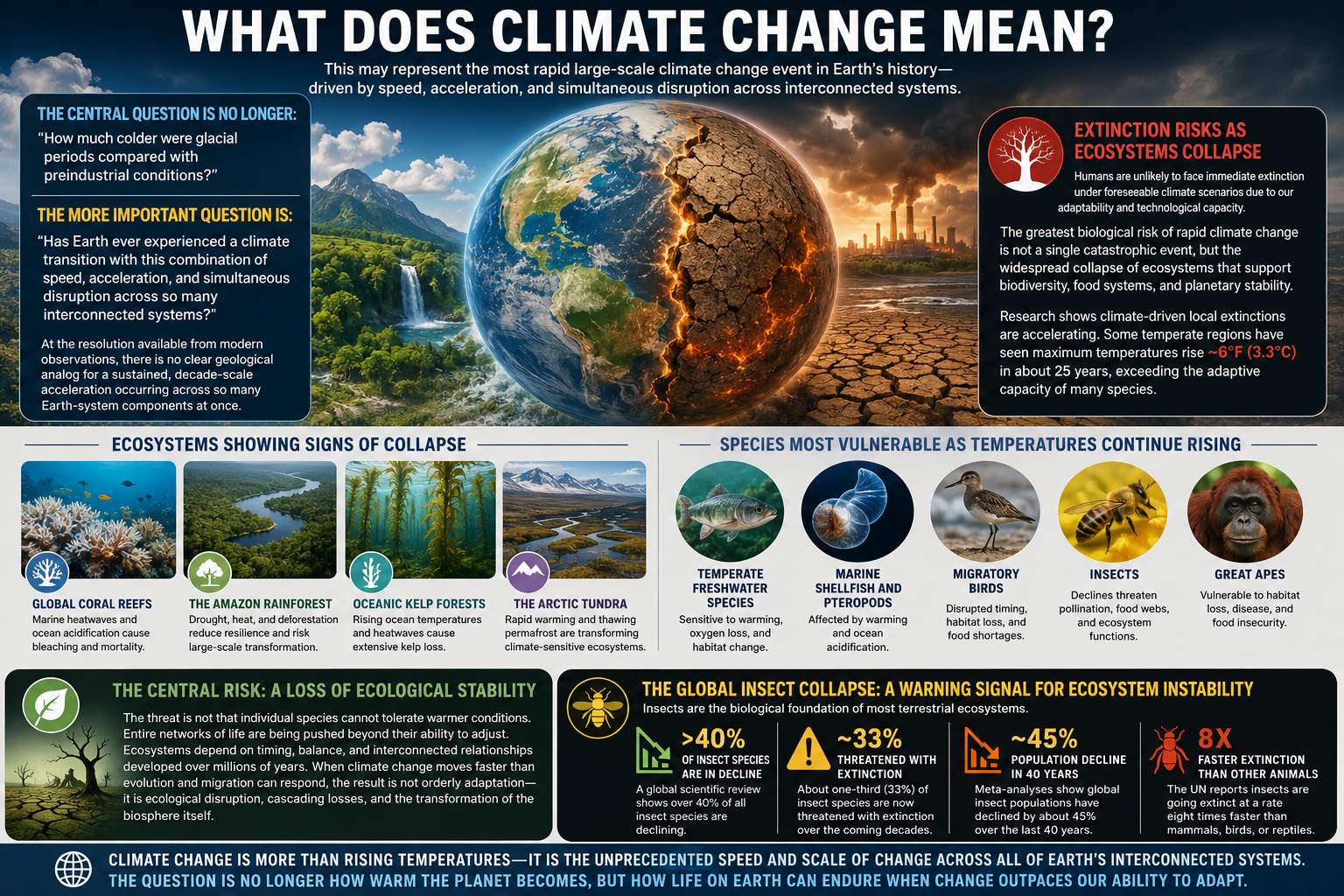
The central question is no longer:

Q: “How Fast Is the Earth Warming?”

The more important question is:

Q: “Has Earth ever experienced a climate change with this combination of speed, acceleration, and simultaneous disruption across Earth?”

There is no comparison in the geological record. The present is revealing a system changing at a rate that may be outside the range experienced throughout human civilization and perhaps for millions of years.

Q: “What Are the Immediate Impacts?

A: More extreme weather.

Severe weather is becoming more frequent, more intense, and more persistent, with extreme events lasting longer and affecting larger areas.

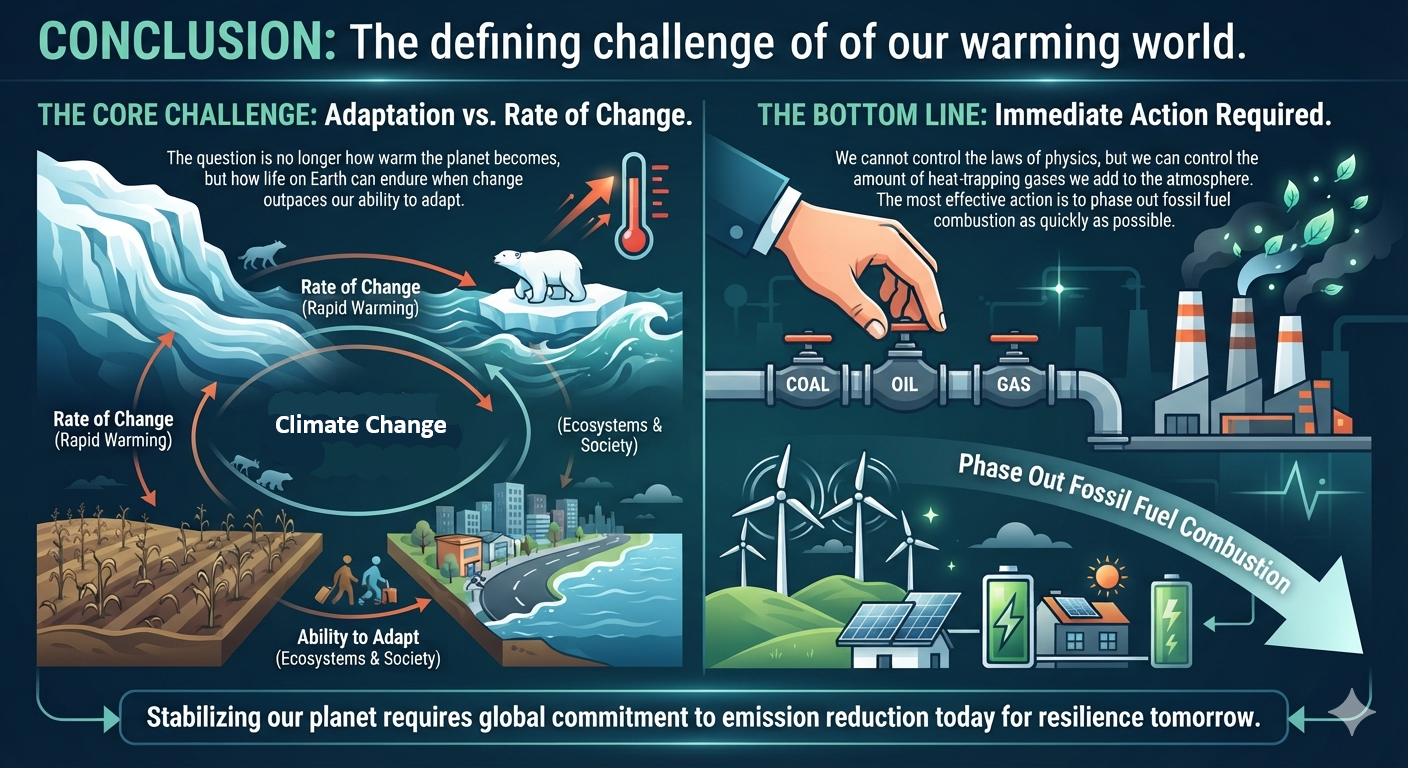
Bottom line: We cannot control the laws of physics, but we can control the amount of heat-trapping gases we add to the atmosphere. The most effective action is to phase out fossil fuel combustion as quickly as possible.

Q: What Causes Climate Change?

A: Human activities.

Climate Change Simplified

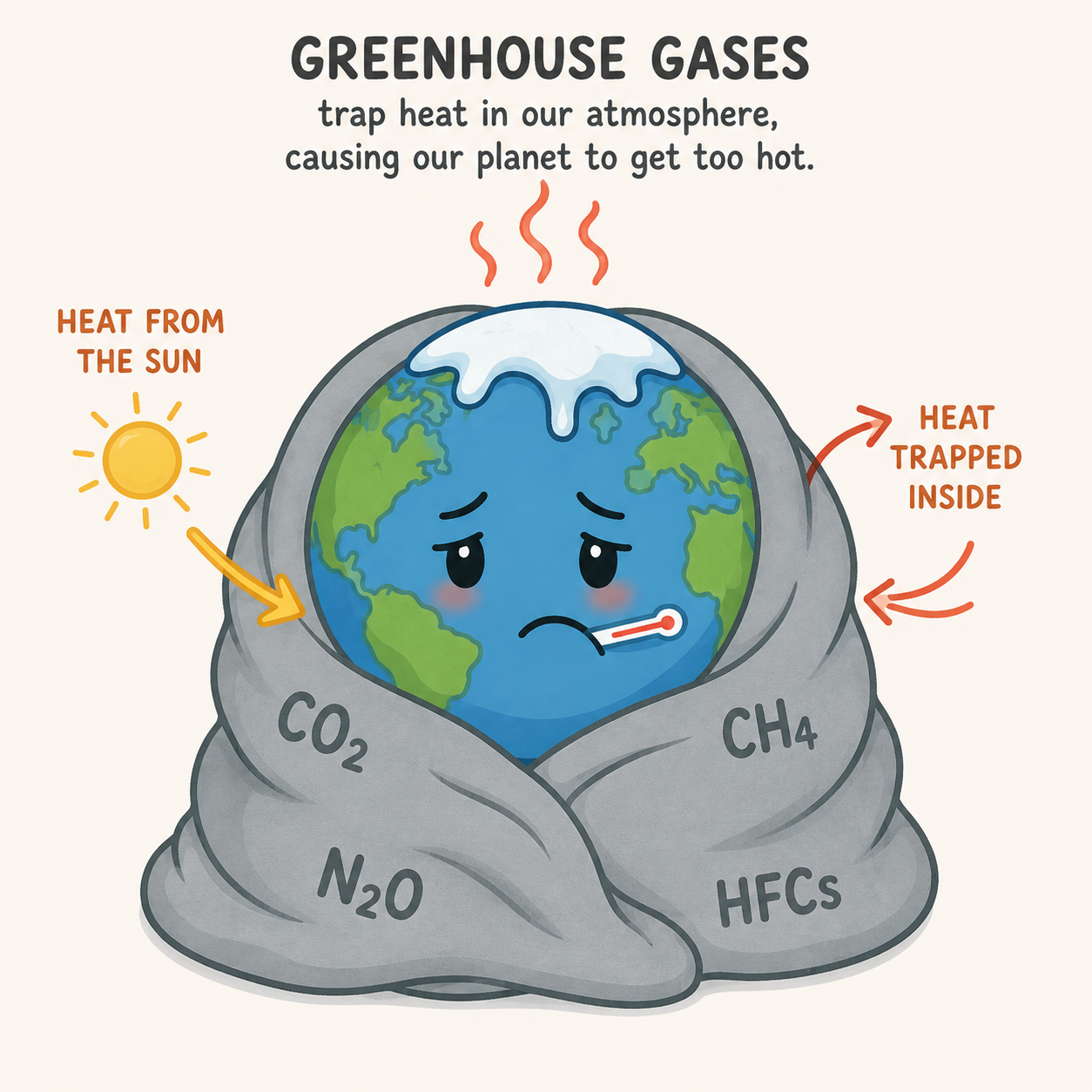
The primary driver of modern global warming is the increase in greenhouse gases released through human activities, especially the burning of fossil fuels. Carbon dioxide (CO2) and other greenhouse gases act like an insulating layer in the atmosphere, absorbing and re-emitting infrared radiation. This slows the loss of heat from Earth to space, creating an energy imbalance that causes the planet to warm.

Q: What Is Climate Change?

A: Climate change is energy transfer.

The phrase “global warming” is often misunderstood. While it correctly describes rising average temperatures, it does not tell the whole story. The real issue is the rapid buildup and movement of extra heat energy throughout Earth’s climate system.

Global warming is the beginning of climate change—not the end of it.

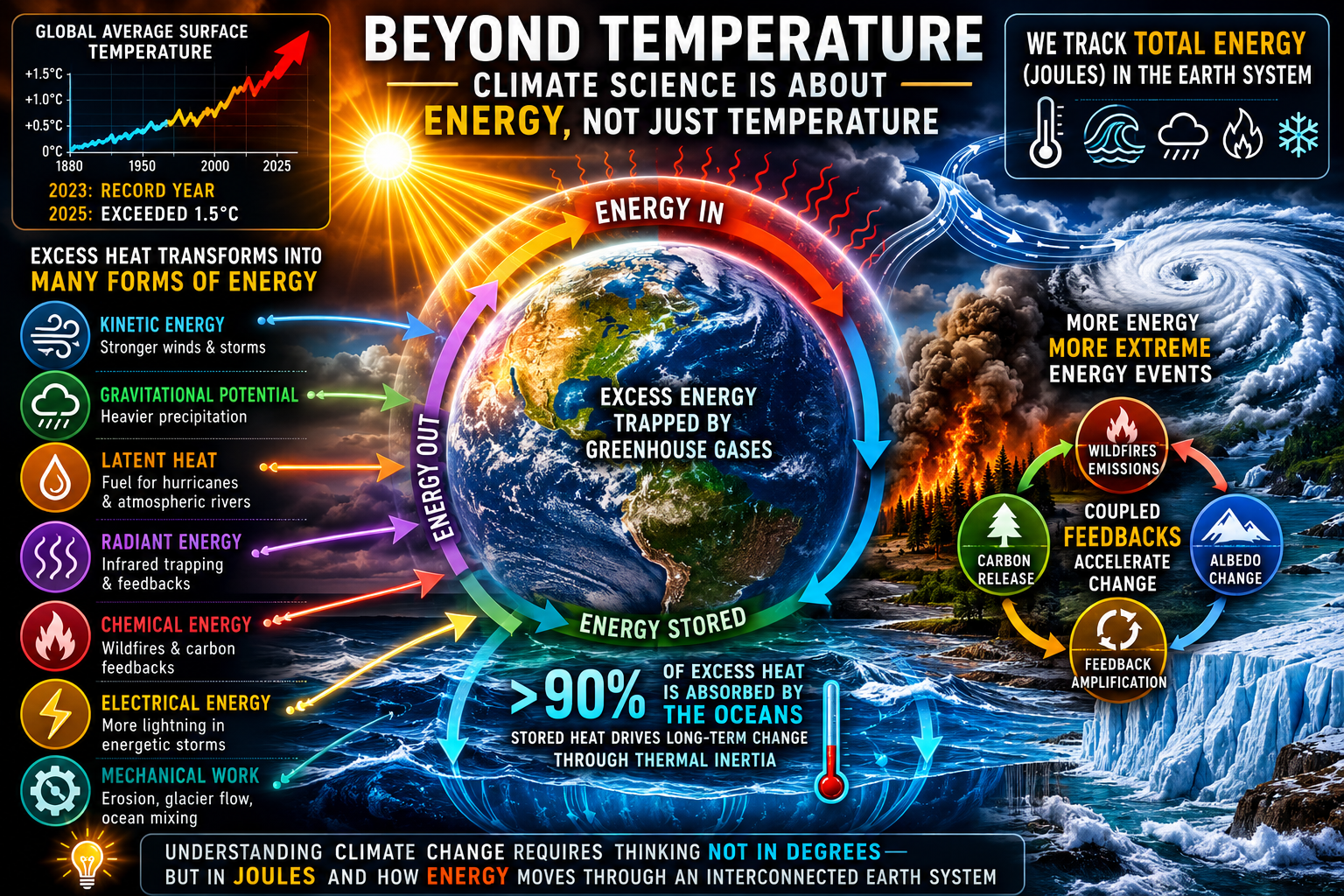
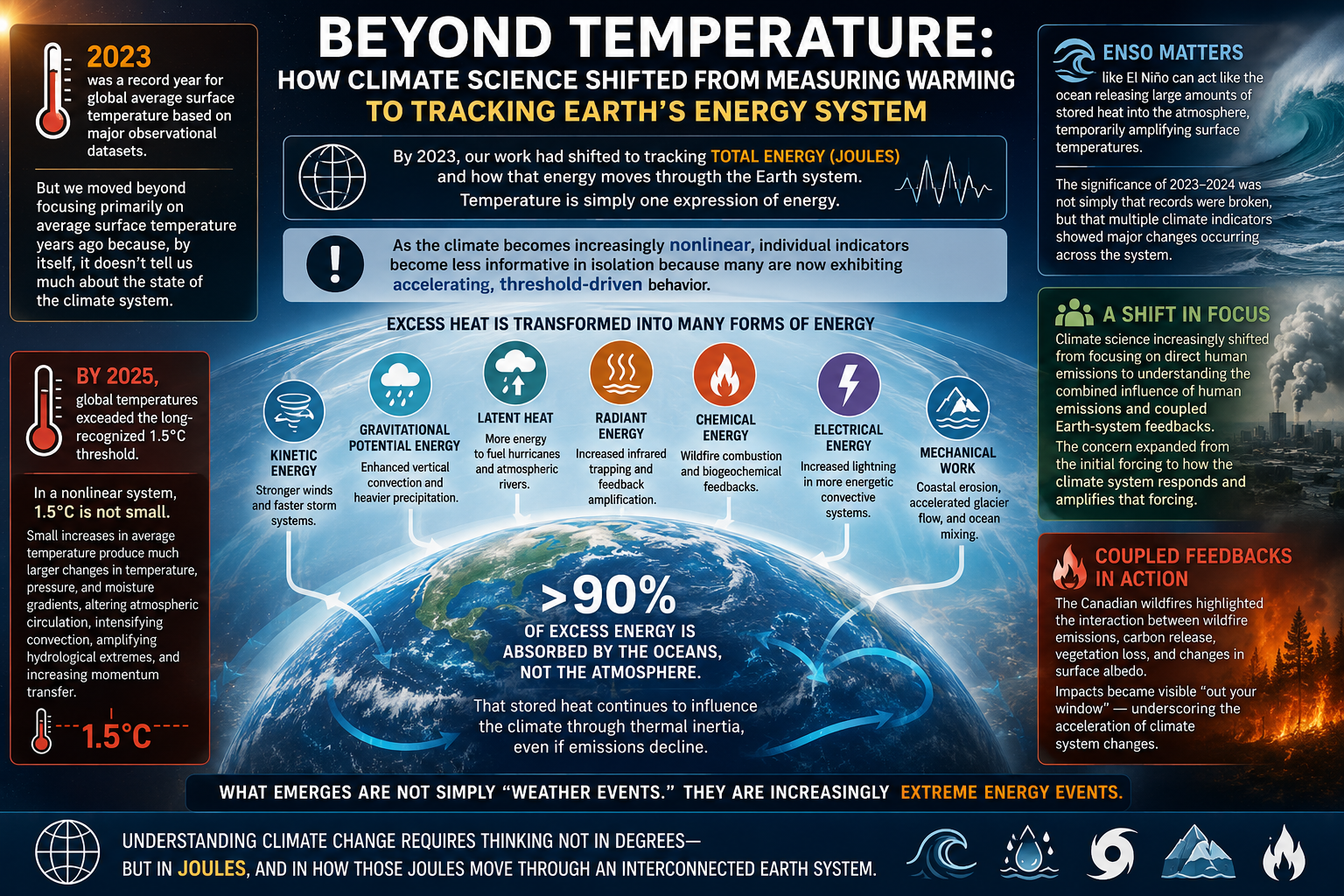
When greenhouse gases trap additional heat, that energy does not simply make the air warmer. It is continually transformed into other forms of energy, including:

  • Kinetic energy: Stronger winds and more powerful storms.
  • Gravitational potential energy: Greater vertical motion in the atmosphere and heavier rainfall.
  • Latent heat: More energy available to fuel hurricanes and atmospheric rivers.
  • Radiant energy: Increased trapping of infrared heat that amplifies warming.
  • Chemical energy: Wildfires and other processes that release additional greenhouse gases.
  • Electrical energy: More lightning in highly energetic thunderstorms.
  • Mechanical work: Coastal erosion, faster glacier movement, and increased ocean mixing.

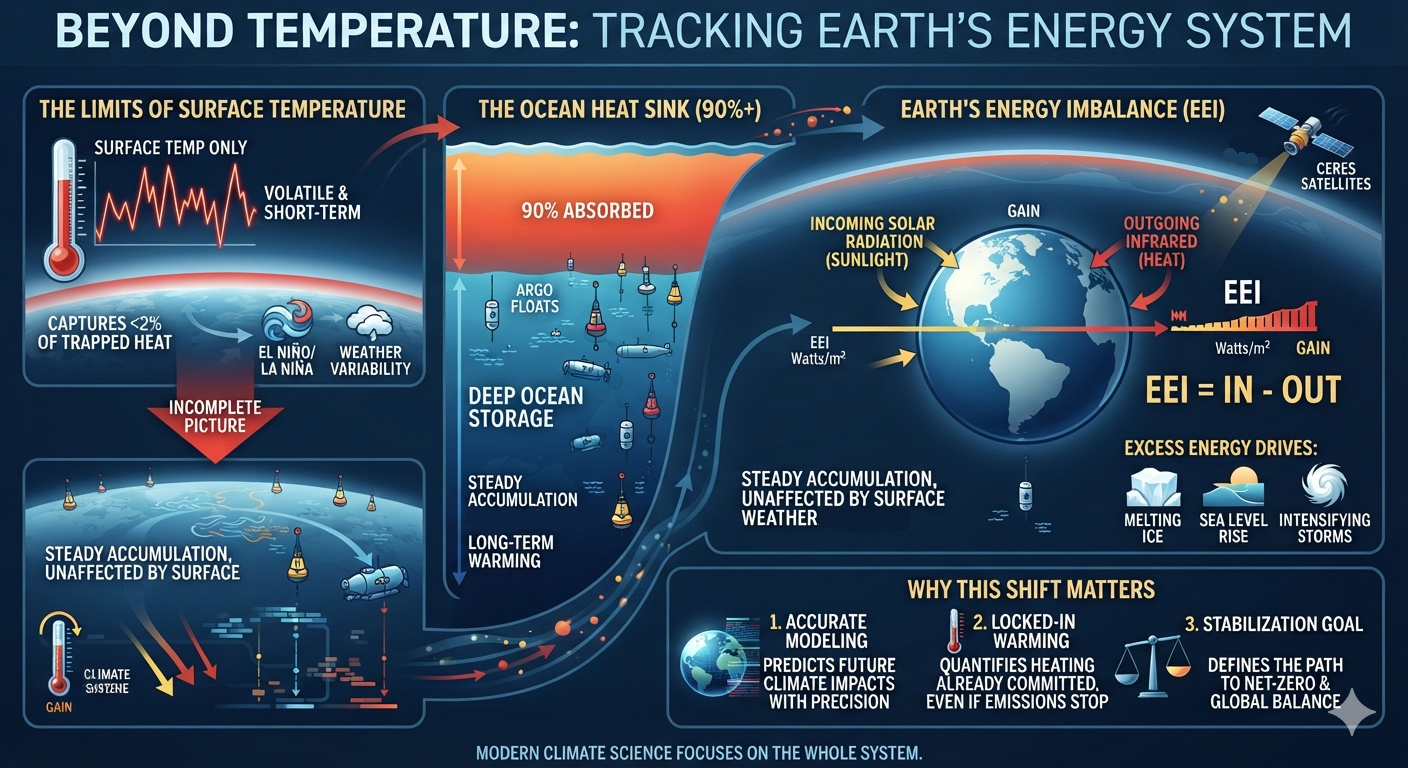
More than 90% of this excess heat is absorbed by the oceans, not the atmosphere. The oceans act like a giant heat reservoir, storing energy and releasing it slowly over time. Because of this thermal inertia, the climate can continue changing even if emissions begin to decline.

By 2025, global temperatures had exceeded the long-recognized 1.5°C (2.7°F) warming threshold. To many people, an increase of 1.5°C may sound small. In Earth’s climate system, it is not.

Small increases in average temperature can produce much larger changes in temperature differences, air pressure, and atmospheric moisture. These changes alter weather patterns, intensify storms, increase heavy rainfall, and make many extreme events more severe.

What we are witnessing are not simply isolated weather events. They are increasingly extreme energy events occurring within an interconnected Earth system.

To understand climate change, it helps to think not only in terms of degrees of warming, but also in terms of joules of energy and how that energy moves through the atmosphere, oceans, ice, and living ecosystems.

Q: How Fast Is the Climate Changing?

A: The climate appears to be changing at an exceptionally rapid pace—faster than at any time in human history and possibly faster than at any time in the past several million years.

Many past climate transitions unfolded over centuries, thousands of years, or longer. The modern climate system is experiencing simultaneous changes across the atmosphere, oceans, cryosphere, and biosphere over time scales measured in decades.

Climate change is often measured in degrees, but degrees alone cannot describe the full magnitude of the transformation now underway. The defining feature of the modern climate system is not simply that Earth is warmer than it was in the past, but that multiple components of the Earth system are changing simultaneously at rates that challenge the ability of natural systems, ecosystems, and human societies to adapt.

Historical climate records remain essential for understanding how the planet responds to changes in energy balance. However, the current climate trajectory represents a fundamentally different challenge: a rapidly accelerating transition occurring across the atmosphere, oceans, cryosphere, and biosphere within decades rather than centuries or millennia. The question is no longer only how much the climate has changed, but how quickly the rate of change itself is increasing and how those changes interact through a highly connected planetary system.

The past reveals what climate systems can do.

The present is revealing a system changing at a rate that may be outside the range experienced throughout human civilization and perhaps for millions of years.

Beyond Temperature: What Climate Change Really Means

Climate change is often framed around a simple comparison:

How much colder were ice ages than the climate before the Industrial Revolution?

While historical temperature comparisons remain scientifically important, they no longer capture the most significant feature of modern climate change.

The more important question today is:

Has Earth ever experienced a climate transition with this combination of speed, acceleration, and simultaneous disruption across so many interconnected systems?

Based on modern observations, there is no clear geological example of a sustained, decade-scale acceleration occurring simultaneously across numerous components of the Earth system. Rising temperatures are occurring alongside accelerating changes in oceans, ice sheets, ecosystems, atmospheric moisture, and extreme weather patterns. It is this convergence of rapid changes—not temperature alone—that defines the modern climate era. This may represent the most rapid large-scale climate change event in Earth’s history, based on the rate and simultaneous disruption now being observed across multiple interconnected Earth systems.

The Growing Risk of Ecosystem Collapse

Humans are unlikely to face immediate extinction under foreseeable climate scenarios. Our species possesses technological capabilities, global communication networks, and a remarkable ability to adapt to changing conditions.

Many other species, however, do not have those advantages.

The greatest biological danger posed by rapid climate change is not a single catastrophic event. It is the gradual breakdown of ecosystems that support biodiversity, food production, and the stability of the biosphere itself.

Research increasingly shows that climate-driven local extinctions are accelerating. Some temperate regions have experienced unexpectedly high biodiversity losses associated with rapidly increasing temperature extremes. In certain areas, maximum temperatures have risen by approximately 6°F (3.3°C) in only about 25 years, creating environmental conditions that exceed the ability of many species to adapt or migrate.

Ecosystems Already Showing Signs of Stress

Several major ecosystems are exhibiting characteristics consistent with ecological disruption and increasing instability:

  • Global Coral Reefs: Marine heatwaves and ocean acidification are causing repeated mass bleaching events and widespread mortality.
  • The Amazon Rainforest: Increasing drought, heat, and deforestation are reducing resilience and raising concerns about large-scale ecosystem transformation.
  • Oceanic Kelp Forests: Rising ocean temperatures and marine heatwaves are causing extensive losses of kelp ecosystems that support diverse marine life.
  • The Arctic Tundra: Rapid warming, thawing permafrost, and shifting vegetation are fundamentally altering one of Earth’s most climate-sensitive regions.

Species Most Vulnerable to Continued Warming

Some groups of organisms appear particularly vulnerable because they occupy narrow ecological niches or depend on highly synchronized environmental conditions.

Among the most at-risk are:

  • Temperate freshwater species
  • Marine shellfish and pteropods
  • Migratory birds
  • Insects
  • Great apes

The loss of these organisms can have consequences far beyond individual extinctions because each species is connected to larger ecological networks.

The Real Threat: Losing Ecological Stability

The defining danger of rapid climate change is not simply that individual species cannot survive warmer temperatures.

The larger threat is that entire networks of life are being pushed beyond their capacity to adjust.

Ecosystems depend on timing, balance, and intricate relationships that evolved over millions of years. Plants flower at specific times to coincide with pollinators. Predators and prey maintain dynamic balances. Migratory species depend on seasonal cues that have remained relatively stable throughout human history.

When climate change occurs faster than evolution, migration, and adaptation can respond, ecosystems do not smoothly transition to new conditions. Instead, they experience disruption, cascading losses, and fundamental reorganization.

The result is not merely a warmer planet. It is the transformation of the biosphere itself.

The Global Insect Collapse: An Early Warning Signal

One of the clearest indicators of accelerating ecological disruption is the worldwide decline of insect populations.

Insects form the biological foundation of most terrestrial ecosystems. They pollinate crops and wild plants, decompose organic material, recycle nutrients, and provide food for countless birds, fish, amphibians, reptiles, and mammals.

Scientific studies paint a concerning picture:

  • More than 40% of known insect species are experiencing population declines.
  • Approximately one-third of insect species are considered threatened with extinction over the coming decades.
  • Long-term analyses suggest that global insect abundance has fallen by roughly 45% over the past 40 years.
  • The United Nations has reported that insects are disappearing at rates estimated to be eight times faster than mammals, birds, or reptiles.

Because insects support so many ecological processes, their decline serves as an early warning signal of broader ecosystem instability. Reduced pollination, disrupted food webs, and diminished nutrient cycling can trigger cascading effects that extend throughout the biosphere.

Climate Change Is About More Than Degrees

Climate change is often discussed in terms of global average temperature—1°C, 2°C, or 3°C of warming. But the defining characteristic of the modern climate system is not simply how warm the planet becomes.

It is the unprecedented pace of change and the simultaneous disruption occurring across interconnected physical and biological systems.

The central question of climate change is therefore no longer:

“How different is today’s temperature from the past?”

The more consequential question is:

“How do ecosystems and societies respond when multiple Earth systems begin changing faster than they can adapt?”

The answer to that question may determine not only the future of individual species, but the stability of the biosphere upon which human civilization ultimately depends.

Conclusion

The question is no longer how warm the planet becomes, but how life on Earth can endure when change outpaces our ability to adapt.

Bottom line: We cannot control the laws of physics, but we can control the amount of heat-trapping gases we add to the atmosphere. The most effective action is to phase out fossil fuel combustion as quickly as possible.

The Climate Crisis: Violent Rain | Deadly Humid Heat | Limits of Human Adaptability | Climate-Driven Health Collapse | Extreme Weather Events | Insurance | Trees and Deforestation | Soil | Rising Sea Level | Food and Water | Updates

Feedback Loops → Tipping Points → Acceleration → Domino Effect
Feedback loops amplify climate change and can push interconnected Earth systems past critical tipping points. As tipping points are crossed, they can trigger additional feedback loops and destabilize other climate systems. This cascading “Domino Effect” compresses timescales, accelerates change, and increases the risk of rapid, nonlinear climate transformations.

bookmark_borderBeyond Temperature: What Climate Change Really Means

Climate change is often framed around a simple comparison:

How much colder were ice ages than the climate before the Industrial Revolution?

While historical temperature comparisons remain scientifically important, they no longer capture the most significant feature of modern climate change.

The more important question today is:

Has Earth ever experienced a climate transition with this combination of speed, acceleration, and simultaneous disruption across so many interconnected systems?

Based on modern observations, there is no clear geological example of a sustained, decade-scale acceleration occurring simultaneously across numerous components of the Earth system. Rising temperatures are occurring alongside accelerating changes in oceans, ice sheets, ecosystems, atmospheric moisture, and extreme weather patterns. It is this convergence of rapid changes—not temperature alone—that defines the modern climate era. This may represent the most rapid large-scale climate change event in Earth’s history, based on the rate and simultaneous disruption now being observed across multiple interconnected Earth systems.

The Growing Risk of Ecosystem Collapse

Humans are unlikely to face immediate extinction under foreseeable climate scenarios. Our species possesses technological capabilities, global communication networks, and a remarkable ability to adapt to changing conditions.

Many other species, however, do not have those advantages.

The greatest biological danger posed by rapid climate change is not a single catastrophic event. It is the gradual breakdown of ecosystems that support biodiversity, food production, and the stability of the biosphere itself.

Research increasingly shows that climate-driven local extinctions are accelerating. Some temperate regions have experienced unexpectedly high biodiversity losses associated with rapidly increasing temperature extremes. In certain areas, maximum temperatures have risen by approximately 6°F (3.3°C) in only about 25 years, creating environmental conditions that exceed the ability of many species to adapt or migrate.

Ecosystems Already Showing Signs of Stress

Several major ecosystems are exhibiting characteristics consistent with ecological disruption and increasing instability:

  • Global Coral Reefs: Marine heatwaves and ocean acidification are causing repeated mass bleaching events and widespread mortality.
  • The Amazon Rainforest: Increasing drought, heat, and deforestation are reducing resilience and raising concerns about large-scale ecosystem transformation.
  • Oceanic Kelp Forests: Rising ocean temperatures and marine heatwaves are causing extensive losses of kelp ecosystems that support diverse marine life.
  • The Arctic Tundra: Rapid warming, thawing permafrost, and shifting vegetation are fundamentally altering one of Earth’s most climate-sensitive regions.

Species Most Vulnerable to Continued Warming

Some groups of organisms appear particularly vulnerable because they occupy narrow ecological niches or depend on highly synchronized environmental conditions.

Among the most at-risk are:

  • Temperate freshwater species
  • Marine shellfish and pteropods
  • Migratory birds
  • Insects
  • Great apes

The loss of these organisms can have consequences far beyond individual extinctions because each species is connected to larger ecological networks.

The Real Threat: Losing Ecological Stability

The defining danger of rapid climate change is not simply that individual species cannot survive warmer temperatures.

The larger threat is that entire networks of life are being pushed beyond their capacity to adjust.

Ecosystems depend on timing, balance, and intricate relationships that evolved over millions of years. Plants flower at specific times to coincide with pollinators. Predators and prey maintain dynamic balances. Migratory species depend on seasonal cues that have remained relatively stable throughout human history.

When climate change occurs faster than evolution, migration, and adaptation can respond, ecosystems do not smoothly transition to new conditions. Instead, they experience disruption, cascading losses, and fundamental reorganization.

The result is not merely a warmer planet. It is the transformation of the biosphere itself.

The Global Insect Collapse: An Early Warning Signal

One of the clearest indicators of accelerating ecological disruption is the worldwide decline of insect populations.

Insects form the biological foundation of most terrestrial ecosystems. They pollinate crops and wild plants, decompose organic material, recycle nutrients, and provide food for countless birds, fish, amphibians, reptiles, and mammals.

Scientific studies paint a concerning picture:

  • More than 40% of known insect species are experiencing population declines.
  • Approximately one-third of insect species are considered threatened with extinction over the coming decades.
  • Long-term analyses suggest that global insect abundance has fallen by roughly 45% over the past 40 years.
  • The United Nations has reported that insects are disappearing at rates estimated to be eight times faster than mammals, birds, or reptiles.

Because insects support so many ecological processes, their decline serves as an early warning signal of broader ecosystem instability. Reduced pollination, disrupted food webs, and diminished nutrient cycling can trigger cascading effects that extend throughout the biosphere.

Climate Change Is About More Than Degrees

Climate change is often discussed in terms of global average temperature—1°C, 2°C, or 3°C of warming. But the defining characteristic of the modern climate system is not simply how warm the planet becomes.

It is the unprecedented pace of change and the simultaneous disruption occurring across interconnected physical and biological systems.

The central question of climate change is therefore no longer:

“How different is today’s temperature from the past?”

The more consequential question is:

“How do ecosystems and societies respond when multiple Earth systems begin changing faster than they can adapt?”

The answer to that question may determine not only the future of individual species, but the stability of the biosphere upon which human civilization ultimately depends.

Conclusion

The question is no longer how warm the planet becomes, but how life on Earth can endure when change outpaces our ability to adapt.

Bottom line: We cannot control the laws of physics, but we can control the amount of heat-trapping gases we add to the atmosphere. The most effective action is to phase out fossil fuel combustion as quickly as possible.

bookmark_borderBeyond Degrees: Why the Rate of Climate Change Matters More Than Historical Temperature Comparisons

by Daniel Brouse

Introduction

Climate change is often framed around a simple question: How much warmer is the planet compared with the past? While global temperature remains an important indicator, it does not fully capture the defining characteristic of the modern climate system.

The more fundamental shift is not only the magnitude of warming, but the rate, acceleration, and changing dynamics of the Earth system. If the Earth has not experienced a comparable rate of climate-system acceleration over millions of years, then historical records provide increasingly limited predictive value for the future. They tell us how the climate system responded under previous conditions, but they may not accurately describe how a rapidly accelerating, highly coupled system will behave under unprecedented rates of change.

At the same time, many of the climate indicators traditionally used for forecasting are exhibiting increasingly nonlinear and volatile behavior. Temperature anomalies, ocean heat content, sea-level rise, atmospheric moisture, ice loss, and extreme weather patterns are showing changes that are becoming more difficult to model using assumptions based primarily on historical variability.

The challenge is not that these indicators have lost their value—they remain essential observations of the Earth system. The challenge is that a climate regime undergoing rapid acceleration and increasing feedback coupling may behave differently from the relatively stable climate conditions on which many traditional predictive approaches were developed.

Historical climate records, including glacial cycles, provide essential context for understanding how the planet has responded to major changes in energy balance. However, their predictive power becomes increasingly limited when the current climate regime begins to operate outside the conditions and time scales represented in those records.

The defining feature of today’s climate change is not merely that the planet is warming. It is that the system is changing rapidly, with multiple interconnected components accelerating simultaneously.

The Limits of Historical Analogies

The geological record tells us that Earth’s climate has changed dramatically many times before. During glacial periods, global average temperatures were several degrees colder than preindustrial conditions, and transitions between climate states reshaped ice sheets, oceans, ecosystems, and atmospheric circulation.

Those records remain valuable for understanding climate sensitivity, feedback mechanisms, and long-term Earth-system behavior.

However, the question facing modern civilization is not simply whether Earth has been warmer or colder in the past. The more important question is whether previous transitions occurred at a comparable rate of change.

Many past climate transitions unfolded over centuries, thousands of years, or longer. The modern climate system is experiencing simultaneous changes across the atmosphere, oceans, cryosphere, and biosphere over time scales measured in decades.

This difference in timescale fundamentally changes the problem.

From Temperature Change to System Dynamics

Climate change is commonly described as an increase in average global temperature. While accurate, this description captures only one dimension of a much larger transformation.

The climate system is better understood as a complex, dynamic system whose behavior depends not only on its current state, but also on how quickly that state is changing.

The key question is no longer only:

How much has temperature increased?

It is also:

How quickly is the rate of change itself changing?

This introduces the importance of higher-order dynamics, including acceleration and the changing acceleration of climate variables. In physics, the third derivative of position is known as “jerk.” Applied conceptually to climate dynamics, it represents a system in which the acceleration of change is itself becoming nonlinear.

A system exhibiting increasing jerk is not simply moving toward a new state—it is moving toward that state at an increasingly rapid pace.

The Expanding Right Tail of Climate Extremes

The most visible consequence of this changing climate regime is not just a warmer average. It is a transformation of the entire probability distribution of climate events.

The temperature distribution is shifting toward warmer conditions while becoming increasingly right-skewed.

This means two things are happening simultaneously:

  • Average temperatures are increasing.
  • Extreme heat events are becoming disproportionately more common, intense, and persistent.

A simple shift of the entire distribution would produce a warmer climate. A growing right tail produces something more disruptive: a climate system increasingly capable of generating events beyond the historical range of experience.

The same principle applies beyond temperature.

As the distribution of climate states changes, the probability of extreme events shifts as well:

  • Extreme heat waves become more frequent and longer-lasting.
  • Marine heatwaves intensify.
  • Atmospheric rivers carry greater moisture loads.
  • Extreme precipitation events become more destructive.
  • Flash flooding increases.
  • Drought conditions intensify.
  • Wildfire conditions expand.
  • Tropical cyclones gain additional energy from warmer oceans.

These are not simply warmer versions of historical weather events. They are manifestations of a changing statistical regime.

From Individual Indicators to a Coupled Earth System

Early climate analysis often focused on individual indicators:

  • Global mean temperature
  • Sea level rise
  • Ocean heat content
  • Sea surface temperature
  • Ice loss
  • Atmospheric greenhouse gas concentrations

These measurements remain essential, but they are increasingly insufficient as standalone descriptions of system behavior.

The Earth system is not a collection of independent variables. It is a network of interacting components connected through feedback loops.

For example:

Polar amplification weakens equator-to-pole temperature gradients, affecting atmospheric circulation. Changes in circulation influence jet stream behavior and storm tracks. Altered weather patterns affect drought, flooding, agriculture, ecosystems, and human infrastructure. Ice loss changes freshwater distribution, ocean circulation, and planetary energy balance.

Each component influences the others.

As these connections strengthen, the behavior of the entire system becomes more important than any single measurement.

A New Framework for a Changing Climate Regime

The initial approach to understanding accelerating climate impacts focused on individual indicators and their changing growth rates, including the concept of shrinking effective doubling times.

The next step is moving beyond retrospective curve fitting toward a state-space view of Earth-system evolution.

This perspective asks:

  • How rapidly are climate variables changing?
  • Is the rate of change accelerating?
  • How are different components interacting?
  • Are feedbacks amplifying one another?

The objective is not merely to measure a warmer planet, but to characterize the evolving dynamics of a coupled Earth system.

The Climate Question Has Changed

The historical record tells us that Earth’s climate can change dramatically. It provides a foundation for understanding climate sensitivity and feedback processes.

But the modern challenge is different.

The central question is no longer:

“How much colder were glacial periods compared with preindustrial conditions?”

The more important question is:

“Has Earth ever experienced a climate transition with this combination of speed, acceleration, and simultaneous disruption across multiple interconnected systems?”

At the resolution available from modern observations, there is no clear geological analog for a sustained, decade-scale acceleration occurring across so many Earth-system components at once.

The past reveals what climate systems can do.

The present is revealing a system changing at a rate that may be outside the range experienced throughout human civilization and perhaps for millions of years.

Extinction Risks as Ecosystems Collapse

Although humans are unlikely to face immediate extinction under foreseeable climate scenarios due to our adaptability and technological capacity, the same cannot be said for many other species. The greatest biological risk of rapid climate change is not a single catastrophic event, but the widespread collapse of ecosystems that support biodiversity, food systems, and planetary stability.

The concept of “ecological whiplash” captures one of the defining dangers of climate change: the speed of environmental transformation. When climate conditions shift over decades rather than thousands of years, species are forced into a mismatch between the environments that shaped their evolution and the rapidly changing physical world around them. Instead of a gradual transition toward a new equilibrium, ecosystems can experience abrupt destabilization as food webs fracture, habitats disappear, and critical relationships between species break down.

Recent research indicates that climate-driven local extinctions are accelerating, with some temperate regions experiencing unexpectedly high biodiversity losses. These changes are strongly associated with rapid increases in temperature extremes, including a reported 6°F rise in maximum temperatures over roughly 25 years in some affected regions, creating conditions that exceed the adaptive capacity of many species.

Ecosystems Showing Signs of Collapse

Global Coral Reefs
Marine heatwaves are triggering widespread coral bleaching events across the planet. When ocean temperatures become too high, corals expel the symbiotic algae that provide most of their energy, leaving them weakened and vulnerable to mass mortality. Repeated bleaching events reduce recovery time and threaten the long-term survival of reef ecosystems.

The Amazon Rainforest
Rising temperatures, changing precipitation patterns, and increasing drought stress are pushing portions of the Amazon toward ecological fragmentation. As forests lose moisture and resilience, some regions risk transitioning from rainforest ecosystems into degraded savannah-like landscapes, reducing biodiversity and weakening one of Earth’s largest carbon sinks.

Oceanic Kelp Forests
Rapid ocean warming, combined with ecological disruptions such as predator loss, has caused widespread kelp forest declines. In some regions, once-thriving underwater forests have been replaced by barren “urchin barrens,” fundamentally altering marine ecosystems and eliminating habitat for countless species.

The Arctic Tundra
The Arctic is warming several times faster than the global average. Melting permafrost, landscape subsidence, vegetation shifts, and widespread “browning” events are transforming tundra ecosystems that evolved under stable frozen conditions.


Species Already Lost or Facing Severe Climate Pressure

The Bramble Cay Melomys
The Bramble Cay melomys is widely recognized as the first mammal considered to have gone extinct primarily because of human-caused climate change. Rising seas, storm surges, and habitat loss overwhelmed the species’ tiny coral island habitat.

The Arctic Bumblebee (Bombus polaris)
This highly specialized polar pollinator evolved thick insulating hair and behaviors adapted to extreme cold. Rapid Arctic warming threatens to push this species beyond its environmental limits as temperatures rise and seasonal patterns shift.

Alpine Butterflies
Many high-elevation butterfly species depend on narrow ecological conditions and specialized alpine plants. As mountain climates warm, these species face habitat loss because they cannot migrate upward indefinitely as suitable conditions disappear.

The Golden Toad
The golden toad, once found in Costa Rica’s cloud forests, disappeared after climate-driven changes disrupted the persistent mist and moisture conditions required for reproduction. Its loss became an early warning example of how climate shifts can destabilize specialized ecosystems.


Species Most Vulnerable as Temperatures Continue Rising

Temperate Freshwater Species
Freshwater ecosystems are among the most threatened environments on Earth. Changes in rainfall, rising temperatures, and wetland loss are increasing extinction risks for fish, amphibians, and aquatic invertebrates that depend on narrow environmental conditions.

Marine Shellfish and Pteropods
The ocean has absorbed a substantial portion of human carbon emissions, causing approximately a 30% increase in ocean acidity since the preindustrial era. Acidification makes it more difficult for organisms such as shellfish and pteropods to build and maintain calcium carbonate shells.

Migratory Birds
Climate disruption is altering migration timing and seasonal cycles. Earlier springs can create a dangerous mismatch between bird breeding periods and the availability of insect prey, reducing reproductive success and population stability.

Cold-Blooded (Ectothermic) Insects
Many insects rely on external temperatures to regulate their metabolism and survival. Rapid, unpredictable temperature swings can exceed their physiological limits, disrupting reproduction, migration, and population cycles.

Great Apes
Species such as orangutans and gorillas face compounding pressures from habitat destruction, drought, and climate-driven ecosystem changes. As forests become increasingly fragmented and stressed, remaining populations face shrinking ranges and declining resources.


The Central Risk: A Loss of Ecological Stability

The defining threat of rapid climate change is not simply that individual species cannot tolerate warmer conditions. It is that entire networks of life are being pushed beyond their ability to adjust. Ecosystems depend on timing, balance, and interconnected relationships developed over millions of years. When climate change moves faster than evolution and migration can respond, the result is not orderly adaptation—it is ecological disruption, cascading losses, and the transformation of the biosphere itself.


The Global Insect Collapse: A Warning Signal for Ecosystem Instability

Among the clearest indicators of accelerating ecological disruption is the widespread decline of insect populations worldwide. Insects represent the biological foundation of most terrestrial ecosystems, serving as pollinators, decomposers, nutrient recyclers, and a primary food source for countless birds, fish, reptiles, amphibians, and mammals.

Multiple long-term studies have documented substantial insect declines across regions, with losses observed in both abundance and diversity. A landmark analysis published in 2019 warned of a potential “insect apocalypse,” citing widespread declines driven by a combination of climate change, habitat destruction, pesticide exposure, invasive species, and pollution. While the magnitude of decline varies by location and species, the overall pattern is clear: many insect populations are experiencing unprecedented pressure.

Climate change is becoming an increasingly dominant driver because insects are highly sensitive to temperature changes. Unlike mammals and birds, most insects are ectothermic, meaning their body temperature and metabolic function depend on external environmental conditions. Rapid warming can push species beyond their thermal limits, disrupt reproductive cycles, alter migration patterns, and create mismatches between insects and the plants or animals that depend on them.

Key examples of insect decline include:

Butterflies and Moths
Long-term monitoring programs in Europe and North America have documented major declines in many butterfly and moth species. These insects are especially vulnerable because many have highly specialized relationships with particular plants, meaning climate-driven shifts in vegetation can eliminate their habitat faster than populations can adapt.

Pollinating Insects
Bees, butterflies, moths, and other pollinators are experiencing widespread stress from rising temperatures, changing flowering schedules, habitat loss, and chemical exposure. The disruption of pollinator populations threatens not only wild ecosystems but also agricultural systems that depend on insect pollination.

Aquatic Insects
Freshwater insects such as mayflies, stoneflies, and caddisflies are declining in many regions due to warming rivers, drought, pollution, and habitat degradation. These insects are critical indicators of freshwater ecosystem health and form the foundation of many aquatic food webs.

Tropical Insects
Tropical insects are particularly vulnerable because many already live near their upper thermal limits. Unlike temperate species, they often have little physiological capacity to tolerate additional warming. Even small increases in temperature can reduce survival, reproduction, and population stability.

Why Insect Loss Creates Cascading Ecological Effects

The decline of insects represents more than the loss of individual species—it threatens entire ecological networks. A reduction in insect abundance can trigger cascading effects:

  • Bird populations decline because many songbirds depend on insects to feed their young.
  • Freshwater ecosystems weaken as aquatic insects disappear from food chains.
  • Plant reproduction suffers when pollinator populations decline.
  • Soil systems degrade as decomposer insects become less abundant.
  • Food webs destabilize as the energy transfer from plants to higher organisms is disrupted.

The disappearance of insects is therefore a measurable sign of ecosystem stress. Because insects reproduce quickly and occupy nearly every terrestrial environment, their decline acts as an early warning indicator of broader biological instability.

A Planetary Threshold Indicator

The global insect decline illustrates the central danger of rapid climate change: ecosystems do not respond only to the amount of warming, but to the speed at which environmental conditions change. Species that evolved within relatively stable climate ranges can be overwhelmed when temperature, precipitation, and seasonal patterns shift faster than adaptation can occur.

The loss of insects may ultimately prove to be one of the most consequential ecological changes of the modern era—not because insects are individually dominant, but because they quietly support the biological systems upon which nearly all complex life depends.

Conclusion: Beyond Temperature—The Transformation of a Planetary System

Climate change is often measured in degrees, but degrees alone cannot describe the full magnitude of the transformation now underway. The defining feature of the modern climate system is not simply that Earth is warmer than it was in the past, but that multiple components of the Earth system are changing simultaneously at rates that challenge the ability of natural systems, ecosystems, and human societies to adapt.

Historical climate records remain essential for understanding how the planet responds to changes in energy balance. However, the current climate trajectory represents a fundamentally different challenge: a rapidly accelerating transition occurring across the atmosphere, oceans, cryosphere, and biosphere within decades rather than centuries or millennia. The question is no longer only how much the climate has changed, but how quickly the rate of change itself is increasing and how those changes interact through a highly connected planetary system.

The consequences of this accelerating transition are already visible. Rising ocean heat content, intensifying marine heatwaves, accelerating ice loss, changing precipitation patterns, increasing atmospheric moisture, and the expansion of extreme climate events are not isolated trends. They are interconnected signals of a climate system moving into a new and less predictable operating regime.

The biological consequences reveal the deeper significance of this transformation. Ecosystems evolved within relatively stable climatic boundaries, allowing species relationships to develop over thousands to millions of years. When environmental conditions shift faster than migration, adaptation, and evolution can respond, ecosystems do not simply relocate—they destabilize. Coral reefs decline, forests lose resilience, freshwater systems deteriorate, and species disappear as ecological relationships unravel.

The global decline of insects provides one of the clearest warnings of this instability. Because insects occupy nearly every terrestrial ecosystem and support pollination, decomposition, nutrient cycling, and food webs, their decline represents more than the loss of individual species. It signals disruption at the foundation of biological systems. When the smallest organisms that support complex ecosystems begin to disappear, the consequences propagate upward through the entire web of life.

The greatest risk posed by rapid climate change is therefore not a single catastrophic threshold, but a cascade of interacting disruptions. A warmer planet is not merely a hotter version of the world we know. It is a different climate regime with altered probabilities, intensified extremes, weakened ecological stability, and increasing uncertainty.

The central challenge of the twenty-first century is recognizing that climate change is not only a temperature problem—it is a systems problem. The future will be determined not just by the amount of additional warming that occurs, but by whether humanity can slow the rate of change before critical Earth-system processes move beyond the capacity of natural and human systems to respond.

The past demonstrates that Earth’s climate can change dramatically. The present demonstrates that it can change rapidly. The defining question before civilization is whether we can recognize the difference in time to influence the trajectory of the planet’s future.

bookmark_borderBeyond Temperature: How Climate Science Shifted from Measuring Warming to Tracking Earth’s Energy System

Introduction

2023 was a record year for global average surface temperature according to the major observational datasets. However, climate science moved beyond focusing primarily on annual temperature records years ago because, by itself, average surface temperature provides only a limited view of the state of the climate system.

Temperature is an important indicator, but it is only one expression of energy. A changing climate is fundamentally an energy problem: how much energy is entering the Earth system, how much is leaving, and how that excess energy is redistributed among the atmosphere, oceans, cryosphere, and biosphere.

By 2023, climate analysis had increasingly shifted toward tracking total energy accumulation (measured in joules) and understanding how that energy moves through the Earth system. As the climate becomes more nonlinear, individual indicators become less informative when viewed in isolation because many components of the system are beginning to exhibit accelerating and threshold-driven behavior.

Global Warming Is Only the Beginning

The phrase “global warming” is often misunderstood. While it accurately describes rising average surface temperatures, it can understate the broader transformation occurring within the climate system.

The central issue is not simply that the planet is warmer. The issue is that greenhouse gases have created a persistent energy imbalance, causing the Earth system to accumulate and redistribute additional thermal energy.

Global warming is the beginning of climate change—not its endpoint.

Once excess heat is trapped by greenhouse gases, it does not remain as a simple increase in temperature. That energy is transformed into multiple forms throughout the Earth system:

  • Kinetic energy — contributing to stronger winds, changing atmospheric circulation, and more energetic storm systems.
  • Gravitational potential energy — increasing atmospheric instability, vertical convection, and the potential for heavier precipitation events.
  • Latent heat — providing additional energy for hurricanes, atmospheric rivers, and extreme rainfall.
  • Radiant energy — increasing infrared energy retention and amplifying greenhouse feedbacks.
  • Chemical energy — influencing wildfire combustion, carbon cycling, and ecosystem feedbacks.
  • Electrical energy — contributing to increased lightning activity within more energetic convective systems.
  • Mechanical work — accelerating coastal erosion, glacier movement, ocean mixing, and other physical processes.

More than 90% of the excess heat trapped by greenhouse gases is absorbed by the oceans. This stored energy creates long-term consequences because the oceans have enormous thermal inertia. Even if atmospheric emissions decline, previously accumulated heat continues to influence climate behavior.

The Limits of Temperature Alone

Climate modeling is not focused primarily on average surface temperature. Surface temperature is one indicator, but it represents only a small part of the broader Earth system.

The significance of 2023–2024 was not simply that temperature records were broken. It was that multiple climate indicators showed simultaneous changes across the system.

The El Niño–Southern Oscillation (ENSO) cycle is an important example. During El Niño events, the ocean can release large amounts of stored heat into the atmosphere, temporarily amplifying surface temperatures. But the larger scientific question is how that additional energy interacts with other components of the climate system.

This period represented an important shift in climate analysis: moving beyond studying direct human emissions alone and toward understanding the combined influence of human forcing and coupled Earth-system feedbacks.

The focus expanded from:

“How much carbon dioxide are humans adding?”

to:

“How does the Earth system respond once that additional energy begins interacting with interconnected feedback mechanisms?”

From Climate Change to Climate Acceleration

One of the clearest examples of coupled feedbacks emerged during the Canadian wildfires. These events demonstrated the interaction between wildfire emissions, carbon release, vegetation loss, and changes in surface albedo.

When forests burn, they release stored carbon while also reducing the ability of ecosystems to absorb future carbon. Darkened landscapes can absorb more solar energy, creating additional warming effects. These processes interact rather than operate independently.

The result is a climate system where impacts can become increasingly visible at local and regional scales—effectively becoming observable “out your window.”

This does not mean that every individual weather event is caused by climate change alone. Rather, it reflects a growing understanding that a warmer, more energetic climate changes the background conditions in which extreme events develop.

Crossing Thresholds in a Nonlinear System

By 2025, global temperatures exceeded the long-recognized 1.5°C threshold. To a casual observer, a 1.5°C increase may appear small. In a nonlinear system, however, small changes in average conditions can produce much larger changes in physical processes.

Additional warming alters:

  • temperature gradients,
  • pressure differences,
  • atmospheric moisture capacity,
  • ocean circulation,
  • convection patterns,
  • and energy transfer throughout the climate system.

The result is not simply more “warm weather.” It is a more energetic system capable of producing increasingly extreme energy events.

Extreme storms, atmospheric rivers, marine heatwaves, wildfire outbreaks, and precipitation extremes are not merely isolated weather anomalies. They are manifestations of energy moving through an increasingly altered Earth system.

Understanding Climate Change in Terms of Energy

The future of climate science requires looking beyond a single number on a thermometer.

Temperature tells us what the system is expressing.

Energy tells us what is driving the system.

To understand climate change, we must think not only in degrees Celsius, but in joules—and in how those joules move through an interconnected planetary system.

The central question is no longer simply:

“How much has the planet warmed?”

The deeper question is:

“Where is the energy going, how is it being transformed, and what feedbacks are being activated as the Earth system responds?”

bookmark_borderTariff Refunds Arrive Faster Than Expected, Fueling Sharp Surge in U.S. Trade Deficit

The unexpectedly rapid release of more than $100 billion in tariff refunds is likely amplifying an already sharp increase in U.S. imports, contributing to a much wider trade deficit reported today by the Bureau of Economic Analysis.

According to the U.S. Bureau of Economic Analysis (BEA), the international trade deficit jumped 42.2% to $77.6 billion in May, up from a revised $54.6 billion in April. Imports climbed 3.3% to $395.3 billion, while exports fell 3.2% to $317.7 billion.

While businesses also accelerated purchases ahead of potential new tariffs and supply chain disruptions, the rapid release of tariff refunds appears to have become a major source of liquidity that enabled importers to dramatically increase orders from overseas.

Tariff Refunds Are Moving Much Faster Than Expected

The current refund program stems from the February 2026 U.S. Supreme Court ruling that invalidated many emergency tariffs imposed under the International Emergency Economic Powers Act (IEEPA). Since then, U.S. Customs and Border Protection (CBP) has been processing one of the largest customs refund programs in U.S. history.

The pace of payments has exceeded many expectations:

  • Approximately $166 billion in refund claims have been filed.
  • More than $104.3 billion has already been accepted.
  • Roughly $71 billion has been finalized and paid.
  • On June 29, CBP launched Phase 2 of its automated CAPE refund portal to process an additional 2.8 million older and more complex import entries.

The unexpectedly rapid return of more than $100 billion to importers has significantly improved corporate cash flow, allowing companies to replenish inventories and increase imports almost immediately.

Refund Liquidity Is Expanding the Trade Deficit

The refund process has created a powerful economic chain reaction:

More than $104 billion in accepted refund claims → Increased importer liquidity → Accelerated foreign purchasing → Larger U.S. trade deficit

Instead of remaining tied up in government accounts, tariff revenue is now flowing back into corporate balance sheets, enabling businesses to front-load imports while attempting to stay ahead of replacement tariff policies.

Tariff Revenue Has Effectively Disappeared

The refund program is also dramatically reducing federal customs revenue.

In May 2026, the U.S. Treasury paid out $21.97 billion in tariff refunds while collecting $21.93 billion in gross customs duties. The result was a net customs outflow of approximately $42 million, effectively eliminating tariff revenue for the month.

Growing Pressure on the Federal Budget

The reversal from collecting tariffs to issuing massive refunds is widening the federal fiscal deficit.

Because tariffs had become a significant source of government revenue, refunding those collections represents both a loss of expected receipts and a substantial increase in federal expenditures.

  • Moody’s Analytics estimates the immediate fiscal impact could exceed $133 billion.
  • The Congressional Budget Office (CBO) projects that related policy changes could increase federal deficits by roughly $2 trillion over the next decade.

Consumers See Little Benefit

Although corporations are receiving billions in refund payments, consumers are unlikely to see corresponding price reductions.

Several major retailers—including Nike, Amazon, and Costco—are facing class-action lawsuits alleging they retained tariff-related price increases while also receiving refund payments, allowing them to benefit from both higher prices and government reimbursements.

New Tariffs Could Offset the Windfall

Following the Supreme Court decision, the U.S. Trade Representative introduced new tariffs under alternative statutory authorities, including Section 122 and Section 301.

Many importers warn that these replacement tariffs could quickly erode the financial gains created by the current refund program. In the meantime, however, the rapid pace of tariff refunds is injecting substantial liquidity into import markets, contributing to a wider trade deficit and placing additional pressure on the federal budget.