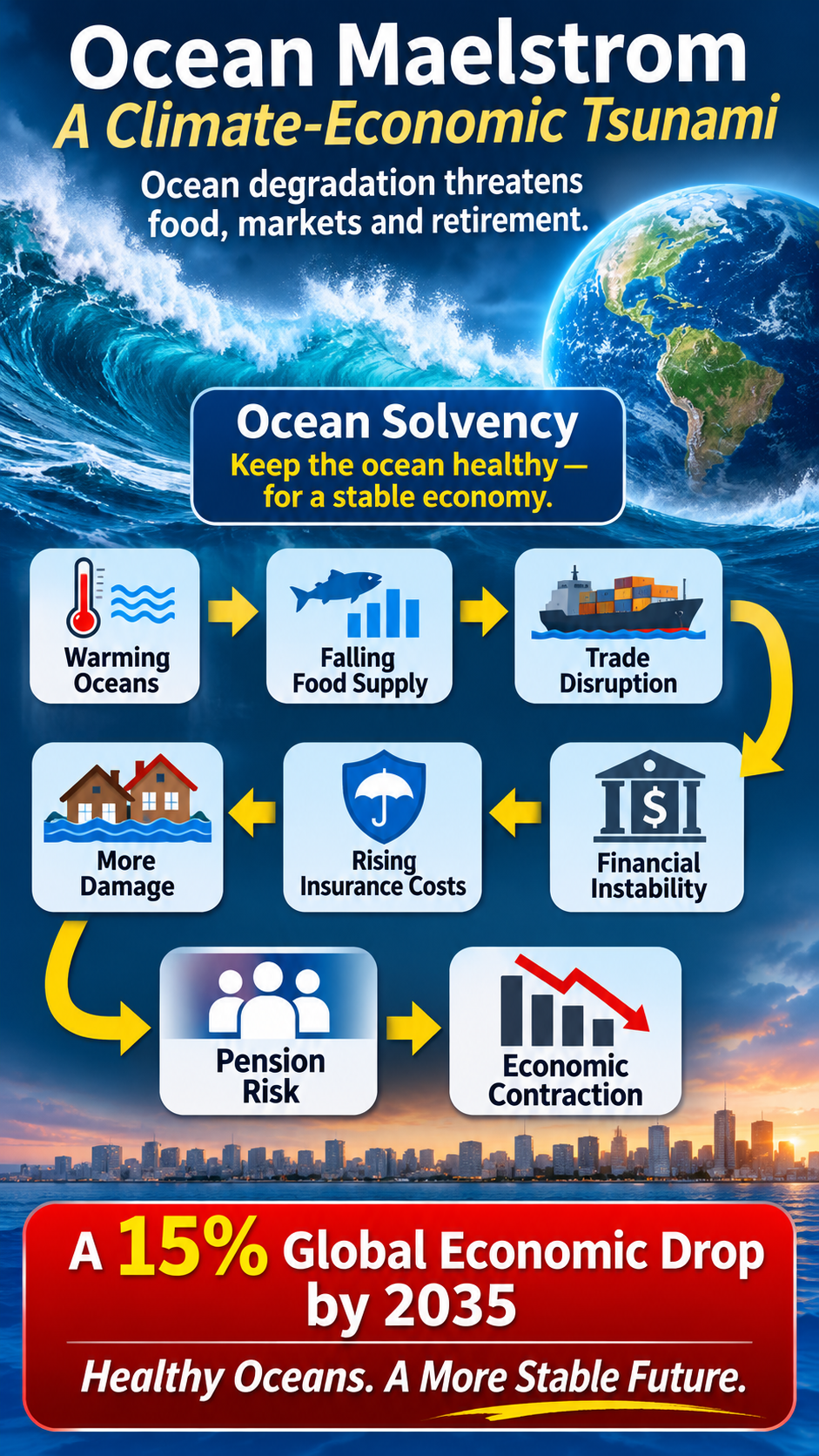
Simplified Overview
🌊 OCEAN MAELSTROM: THE CLIMATE-ECONOMIC SINGULARITY IS COMING INTO FOCUS
A landmark November 10, 2026 report from the Institute and Faculty of Actuaries, the University of Exeter, and The Ocean Race connects the dots between accelerating ocean degradation and global economic instability.
Its message is profound: The climate crisis is no longer just an environmental problem. It is becoming a systemic economic and financial crisis.
The report introduces Ocean Solvency—the ocean’s ability to continue providing the essential services upon which global civilization and economic activity depend.
But the implications go much further.
🌡️ Ocean degradation and climate disruption
→ Declining food production and rising prices
→ International trade and supply-chain disruptions
→ Increasing insurance losses
→ Financial market instability
→ Pension and retirement risks
→ Economic contraction.
Implications for Climate-Economic Coupling and Singularity
This is precisely the kind of interconnected, nonlinear risk that underlies the climate-economic coupling and singularity framework we’ve been developing.
Climate impacts do not occur in isolation. They propagate through interconnected physical, ecological, geopolitical, and financial systems. Each disruption creates additional pressures, while weakening the capacity of other systems to absorb the next shock.
The feedback becomes economic as well as environmental.
As climate disruption accelerates, economic losses increase. As economic stability deteriorates, the resources available for adaptation and resilience decline. That creates another reinforcing feedback loop.
The report explores a modeled scenario in which ocean-related shocks contribute to a 15% reduction in global economic output by 2035. This is a systemic-risk scenario.
The fundamental economic reality is difficult to escape:
The global economy cannot remain solvent while the natural systems supporting it become insolvent.
The climate-economic singularity is about more than rising temperatures. It is about the accelerating coupling of systems, the amplification of cascading failures, and the growing difficulty of containing consequences once multiple thresholds are crossed.
🌎 The ocean is not separate from the economy. It is part of the infrastructure that makes the global economy possible.
Read the report:
https://www.kingarthur.com/global_warming/Singularity-Climate-Economic-Coupling.html#Ocean-Maelsrtom
#OceanMaelstrom #OceanSolvency #ClimateEconomicCoupling #ClimateSingularity #SystemicRisk #ClimateEconomics #ClimateChange #FinancialStability
Update: Ocean Maelstrom — The Emerging Climate-Economic Feedback System
November 12, 2026
By Daniel Brouse and Sidd Mukherjee
5.5 Ocean Solvency and the Ocean Maelstrom: A New Dimension of Systemic Risk
Published November 10, 2026, Ocean Maelstrom: Navigating the Climate Storm is a landmark systemic-risk report developed by the Institute and Faculty of Actuaries (IFoA), the University of Exeter, and The Ocean Race.
The report provides an important independent assessment of the increasingly interconnected risks linking ocean degradation, climate instability, and global economic systems. Its central warning is that accelerating ocean degradation is not simply an environmental problem. It represents a growing threat to global food security, supply chains, insurance markets, pensions, financial markets, and overall economic stability.
Ocean Solvency: The Foundation of Economic Stability
The report introduces the concept of Ocean Solvency, defined by the ocean’s continuing ability to provide the essential ecosystem services upon which human societies and economies depend.
The ocean is fundamental to:
- Global climate regulation and heat redistribution.
- Food production and marine biodiversity.
- Oxygen production and carbon absorption.
- Global water cycles and weather patterns.
- International commerce and maritime transportation.
- Economic productivity and financial stability.
The report assesses current Ocean Solvency risk as severe, with the potential to become catastrophic to extreme by 2050 under a business-as-usual trajectory.
This introduces an important economic distinction: financial systems cannot remain solvent indefinitely if the natural systems supporting economic production become insolvent.
Ocean Maelstrom: A Systemic Risk Scenario
The report develops an Ocean Maelstrom scenario to demonstrate how multiple interacting pressures can produce cascading economic consequences.
Importantly, this is a plausible systemic-risk scenario, not a forecast. It examines how six individually plausible ocean, climate, and geopolitical pressures could interact between 2027 and 2035, producing consequences substantially greater than the sum of their individual impacts.
The scenario illustrates the transmission of physical climate and ecological disruptions through interconnected systems:
- Ocean and climate disruption: Marine heatwaves, ocean circulation changes, declining biodiversity, and deteriorating marine ecosystems undermine ocean productivity and climate regulation.
- Food and agricultural disruption: Changes in ocean conditions, fisheries, rainfall patterns, and agricultural production reduce food availability and increase food prices.
- Supply-chain and trade disruption: Disruptions to marine resources, maritime infrastructure, ports, and international commerce amplify economic instability.
- Insurance and infrastructure exposure: Increasing coastal damage, flooding, property losses, and infrastructure risks intensify insurance pressures and undermine asset valuations.
- Sovereign and financial instability: Economic contraction, inflation, declining revenues, and increased government expenditures create additional pressure on national finances and financial markets.
- Pension and retirement exposure: Investment losses, inflation, declining purchasing power, and weakened economic growth threaten long-term retirement security.
The Financial Consequences
One of the report’s most significant findings concerns the exposure of global retirement systems.
Global pension funds hold approximately $68.3 trillion in assets. Under the Ocean Maelstrom scenario, ocean-related shocks contribute to a modeled 15% reduction in global economic output by 2035.
This is not a prediction of a 15% economic contraction. It is a scenario-based assessment demonstrating the magnitude of potential systemic exposure.
The consequences extend beyond investment portfolios. Inflation reduces purchasing power, economic contraction weakens pension contributions, and deteriorating corporate and sovereign finances threaten the underlying assets supporting retirement systems.
The report identifies a particularly important problem with conventional financial risk models: ocean-related risks can simultaneously affect investment assets, liabilities, contribution capacity, and inflation. These risks are interconnected, persistent, and potentially difficult to diversify away.
Implications for Climate-Economic Coupling and Singularity
The Ocean Maelstrom report provides an important extension of the climate-economic coupling framework presented in this analysis.
It demonstrates how environmental degradation propagates through interconnected physical, ecological, geopolitical, and economic systems. More importantly, it illustrates how these interactions generate reinforcing feedback loops that reduce the capacity of societies and financial institutions to absorb subsequent disruptions.
The resulting feedback sequence can be expressed as:
Ocean degradation → Climate disruption → Food insecurity → Inflation → Economic contraction → Financial instability → Reduced adaptive capacity → Greater vulnerability
This is not simply a linear chain of economic consequences. The individual components interact, reinforce one another, and create opportunities for cascading failures.
The relationship is particularly important when considered alongside the third-derivative framework developed in this paper:
dI/dt > 0
d²I/dt² > 0
d³I/dt³ > 0
The significance is that climate impacts increase, their rate of increase accelerates, and the acceleration itself increases. As physical and economic systems become more tightly coupled, disruptions can propagate faster and produce increasingly disproportionate consequences.
The Ocean Is Not Separate From the Economy
Traditional economic models frequently treat environmental degradation as an external cost. Ocean Maelstrom challenges that assumption by demonstrating that the ocean is foundational economic infrastructure.
The economic system is not independent of the Earth system. It is embedded within it.
When natural capital deteriorates, the resulting losses do not disappear simply because they are excluded from conventional accounting. They reappear as food-price inflation, insurance losses, infrastructure damage, declining productivity, financial instability, and increased public expenditures.
This creates an additional dimension of systemic risk: the deterioration of the natural systems that support economic activity simultaneously weakens the financial resources available to respond to that deterioration.
Conclusion: An Expanding Climate-Economic Singularity
Ocean Maelstrom reinforces the central argument of this analysis: climate instability and economic instability are increasingly interconnected components of a larger nonlinear system.
The report’s contribution is particularly significant because it translates ocean degradation into recognizable financial and actuarial risks. Food security, insurance, sovereign finances, investment portfolios, and retirement security are not separate issues. They are interconnected consequences of the same underlying Earth-system disruption.
The emergence of Ocean Solvency as a financial risk framework represents an important recognition that economic stability ultimately depends on environmental stability.
The climate-economic singularity is therefore not confined to rising temperatures, accelerating sea-level rise, or increasing disaster losses. It encompasses the progressive destabilization of the interconnected systems upon which global civilization depends.
The ocean is not merely another economic resource. It is part of the infrastructure that makes the global economy possible.
Primary Source
Trust, S., Ranchin, A., Hunt, L., Joslin, S., Chapman, G., & Abrams, J. F. (2026). Ocean Maelstrom: Navigating the Climate Storm. Institute and Faculty of Actuaries, University of Exeter, and The Ocean Race. November 2026.