By Daniel Brouse
November 12, 2026
Me? Wow. Did you see that?
It was slightly severe here. I’ve never experienced thunderstorms in November quite like these.
What happened around me was on an entirely different scale.
About 15 miles southwest, in Delaware, a massive rotating circulation appeared to resemble a tornado.
Then, in virtually every direction, stretching across dozens of miles from Lancaster County to Central New Jersey, enormous hailstorms erupted.
Bizarre doesn’t begin to describe it.
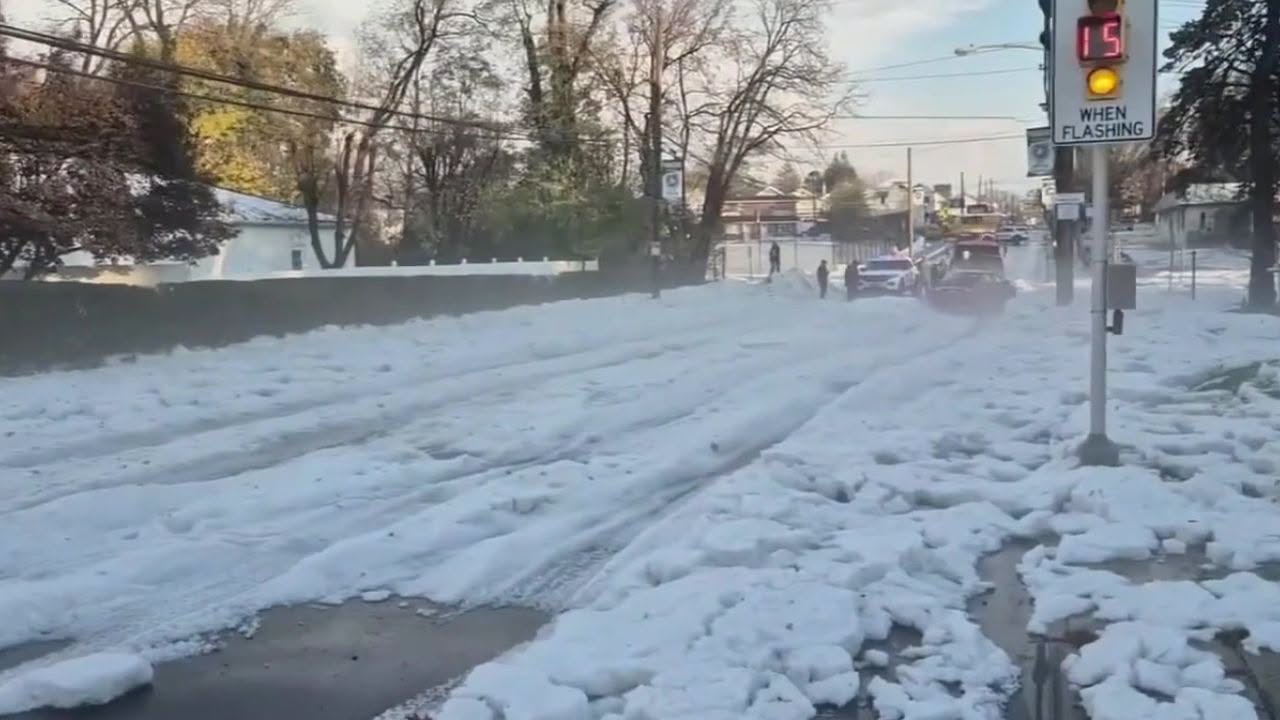
Here’s a picture from 6 ABC Action News:
“No, it’s not snow! Massive piles of hail blanketed parts of Parkside Borough in Delaware County on Thursday.”
A November Severe Weather Outbreak
Thursday, November 12, 2026, brought an extraordinary late-autumn severe weather outbreak across the Greater Philadelphia region, Delaware, and New Jersey.
This storm system developed as a complex area of low pressure moved north from Virginia. Rapid intensification produced an unusually unstable atmosphere, generating powerful thunderstorms before a dramatic transition to much colder, winter-like conditions.
What followed was one of the most unusual November weather events many residents in the region have experienced.
Confirmed Tornadoes in Delaware and New Jersey
The massive circulation southwest of my location was not simply an optical illusion. Reports from the region described confirmed tornado activity.
- New Castle County, Delaware: Around 1:15–1:30 p.m., a tornado reportedly touched down near Christiana. Video captured the circulation near Chapman Road and Eagle Run Road. The storm crossed I-95 and overturned a tractor-trailer.
- Burlington County, New Jersey: Later in the afternoon, another tornado was reported across the Delaware River, accompanied by funnel-cloud sightings near Pedricktown.
Snow-Like Hail Blankets Delaware County
The photographs and video from 6 ABC Action News captured some of the most extraordinary scenes of the day.
- Parkside Borough and Aston: Slow-moving thunderstorms dumped enormous quantities of hail, with some stones reaching approximately 1.25 inches in diameter.
- Road closures and snowplows: Hail accumulated so deeply along Edgmont Avenue and Route 352 in Parkside that police closed sections of roadway. Pickup trucks became stranded in drifts that looked remarkably like a midwinter snowstorm. Road crews brought out shovels and plows to clear the accumulated ice.
This wasn’t snow. It was hail, accumulating faster than the roads could be cleared.
Widespread Regional Impacts and Flooding
The storm system extended across a broad area, from central Pennsylvania through the Delaware Valley and into New Jersey.
- Flash flooding and rescues: Slow-moving downpours triggered flash flood warnings across Philadelphia, Delaware, Chester, and Montgomery counties. Drivers became trapped in rapidly rising floodwaters, prompting water rescues.
- Widespread hail: Severe thunderstorm warnings tracked large hail across Bucks and Montgomery counties, extending into Camden, Gloucester, and Burlington counties in New Jersey.
The Bigger Picture: Climate Energy Redistribution
What makes this event particularly remarkable is its timing.
November is supposed to be a transition into winter, not a repeat of summer’s most violent thunderstorms. Yet the atmosphere produced powerful rotating storms, tornadoes, widespread hail accumulation, and flash flooding across a substantial region.
Individual weather events are not, by themselves, proof of climate change. But the atmosphere operates within a climate system that is accumulating excess energy.
As the oceans absorb more than 90% of the excess heat trapped by greenhouse gases, that energy influences atmospheric circulation, moisture availability, instability, and the intensity of precipitation.
This is what climate energy redistribution looks like when it intersects with everyday life.
You don’t have to travel to Antarctica, watch melting glaciers, or study ocean temperatures to experience the consequences of an increasingly energetic climate system.
Sometimes, all you have to do is look outside your window.
So, how is climate energy hitting you?
Me? Wow. Did you see that?