bookmark_borderReferences for “Carbon Offsets: Planting Trees is Greenwashing”

By Daniel Brouse
June 21, 2024

Carbon Offsets and Sequestration: Planting Trees is Greenwashing — Brouse (2023)

To support the statement “Giving carbon offsets for planting trees and allowing for the continued use of fossil fuels is greenwashing and accelerates the pace of climate change,” here are some references:

  1. Carbon Offsets and Greenwashing:
    • Kollmuss, A., & Agyeman, J. (2002). “Mind the Gap: Why do people act environmentally and what are the barriers to pro-environmental behavior?” Environmental Education Research. This paper discusses the concept of greenwashing and the ineffectiveness of certain carbon offset schemes.
    • Gillenwater, M. (2012). “What is Additionality? Part 1: A Long Standing Problem.” Greenhouse Gas Management Institute. This paper critiques the concept of additionality in carbon offset projects, which is crucial for understanding greenwashing.
  2. Ineffectiveness of Tree Planting as Offsets:
    • Bastin, J.-F., et al. (2019). “The global tree restoration potential.” Science. This study discusses the limitations and potential of tree planting for carbon sequestration.
    • Houghton, R. A. (2013). “The emissions of carbon from deforestation and degradation in the tropics: past trends and future potential.” Carbon Management. This paper highlights the challenges and limited impact of reforestation projects.
  3. Fossil Fuels and Climate Change:
    • Intergovernmental Panel on Climate Change (IPCC). (2021). “Climate Change 2021: The Physical Science Basis.” This report provides comprehensive evidence on the impact of fossil fuels on climate change.
    • International Energy Agency (IEA). (2021). “Net Zero by 2050: A Roadmap for the Global Energy Sector.” This report emphasizes the need to reduce fossil fuel usage to meet climate targets.
  4. Accelerating Climate Change:
    • Anderson, K., & Peters, G. (2016). “The trouble with negative emissions.” Science. This article discusses the reliance on future technologies, like carbon offsets, and their impact on current fossil fuel use and climate change acceleration.
    • Harvey, F. (2021). “Climate crisis: the massive impact of global warming on the Arctic.” The Guardian. This article explores how ongoing fossil fuel use exacerbates climate change impacts, particularly in sensitive regions like the Arctic.

These references provide a foundation for understanding how carbon offsets, particularly through tree planting, can be seen as greenwashing when they allow for the continued use of fossil fuels, thus accelerating climate change.

The fossil fuel industry uses carbon offsets as a strategy to maintain and even expand the use of fossil fuels while attempting to address concerns about climate change. Here’s how this works:

  1. Promoting Carbon Offsets: The fossil fuel industry invests in or purchases carbon offsets, which are credits representing reductions in greenhouse gas emissions achieved by others. These offsets can come from various projects such as reforestation, renewable energy, or methane capture.
  2. Continuing Emissions: By purchasing carbon offsets, fossil fuel companies claim to neutralize their own emissions. This allows them to argue that they can continue extracting, refining, and burning fossil fuels without increasing their net carbon footprint.
  3. Public Relations: The industry uses carbon offsets as part of their public relations strategy to portray themselves as environmentally responsible. This helps to counter criticism and regulatory pressure related to their contributions to climate change.
  4. Regulatory Compliance: In some regions, carbon offsets are part of cap-and-trade systems or carbon pricing mechanisms. By using offsets, fossil fuel companies can meet regulatory requirements without reducing their actual fossil fuel production and consumption.
  5. Delaying Transition: By relying on carbon offsets, the fossil fuel industry can delay transitioning to renewable energy sources. Offsets can be cheaper and less disruptive to their current business models compared to investing heavily in clean energy technologies.
  6. Economic Benefits: Investing in carbon offset projects can also bring economic benefits to fossil fuel companies. For instance, they might invest in projects that align with their other business interests or use offsets to enter new markets.

In summary, the fossil fuel industry uses carbon offsets to give the appearance of reducing their environmental impact while continuing to produce and use fossil fuels. This approach helps them meet regulatory requirements, maintain public support, and delay the transition to a low-carbon economy.

THE REAL PROBLEM

The exact amount of O2 contributed and CO2 absorbed is a complicated equation on a daily or yearly basis. Trees both absorb and emit CO2. However, this calculation is relatively meaningless because CO2 has an average lifespan in the atmosphere of 100 years. In contrast, 99% of a tree’s carbon has an average cycle of 7 years. Essentially, 0% of the CO2 causing climate change is stored in a tree. The importance of trees and forests lies in their role within the soil ecosystem. Trees act as caretakers for the CO2 stored in the soil.

For a frightening example, look at the forest fires in Canada. These fires are more intense and frequent due to human CO2 emissions. Last year, Canada’s largest contributor to CO2 emissions was wildfires. While this may not be a significant factor in the long term, as that CO2 would have returned to the atmosphere within 50 years anyway, it creates a feedback loop that accelerates climate change.

But it gets worse. The real feedback loop problem is the permafrost. Forest fires and a warming climate have ignited the permafrost, causing ‘zombie fires’ that burned all winter under the snow and continue to burn this year. Millions of years of CO2 are stored in the permafrost. While we do not know exactly how much carbon is stored in nature, it is reasonable to assume that temperatures could be pushed from 3 degrees to 6 degrees above pre-industrial levels. Humans cannot thrive above a rise of 1.5 degrees. Much of the Earth will be uninhabitable if the temperature rises an additional 6 degrees Celsius. If humans also add 3 degrees Celsius, the temperature and humidity will approach a wet-bulb temperature that will not sustain human life.

CANADIAN WILDFIRE CASE STUDY
For a frightening example, look at the forest fires in Canada. These fires are more intense and frequent due to human CO2 emissions. Last year, Canada’s largest contributor to CO2 emissions was wildfires. While this may not be a significant factor in the long term, as that CO2 would have returned to the atmosphere within 50 years anyway, it creates a feedback loop that accelerates climate change.

But it gets worse. The real feedback loop problem is the permafrost. Forest fires and a warming climate have ignited the permafrost, causing ‘zombie fires’ that burned all winter under the snow and continue to burn this year. Millions of years of CO2 are stored in the permafrost. While we do not know exactly how much carbon is stored in nature, it is reasonable to assume that temperatures could be pushed from 3 degrees to 6 degrees above pre-industrial levels. Humans cannot thrive above a rise of 1.5 degrees. Much of the Earth will be uninhabitable if the temperature rises an additional 6 degrees Celsius. If humans also add 3 degrees Celsius, the temperature and humidity will approach a wet-bulb temperature that will not sustain human life.

Also see: Soil Degradation and Desertification
The Human Induced Climate Change Experiment

bookmark_borderThe Deadly Dog Days of Summer

by Daniel Brouse and Sidd Mukherjee

A dog panting helps with thermal regulation primarily through evaporative cooling. Here’s how it works:

  1. Evaporative Cooling: When a dog pants, it increases the airflow over the moist surfaces of its tongue and the lining of its upper respiratory tract. This enhances evaporation of moisture from these surfaces, which cools the blood vessels lying just beneath. As the blood circulates through the body, it helps to lower the overall body temperature.
  2. Heat Dissipation: Panting allows the dog to expel heat from its body. Dogs do not sweat through their skin as humans do, except for a minimal amount through their paw pads, so panting is their primary method of cooling down.

As for the wet-bulb temperature, it does impact a dog’s ability to cool itself through panting:

  • Wet-Bulb Temperature: This measurement takes into account both temperature and humidity. High wet-bulb temperatures indicate high humidity, which reduces the efficiency of evaporative cooling. When the humidity is high, the air already holds a lot of moisture, making it harder for the moisture on the dog’s tongue and respiratory tract to evaporate. This reduces the effectiveness of panting as a cooling mechanism.

In summary, dog panting helps with thermal regulation by facilitating evaporative cooling. However, its effectiveness can be impacted by the wet-bulb temperature, particularly in high-humidity conditions where evaporative cooling is less efficient.


Why is the wet-bulb temperature becoming so important?

The greatest short term climate change risk to human health is deadly humid heat (wet-bulb temperature) caused by a warmer average temperature enabling the air to hold more moisture. Increased moisture leads to higher humidity.

The Water Vapor Feedback Problem
Water vapor is a powerful greenhouse gas. Since the 1970s, its rise likely increased global heating by an amount comparable to that from rising carbon dioxide. We are now seeing the consequences. In the current climate, for average all-sky conditions, water vapour is estimated to account for 50% of the total greenhouse effect, carbon dioxide 19%, ozone 4% and other gases 3%. Clouds make up about a quarter of the greenhouse effect.

The main greenhouse gases — carbon dioxide, methane, nitrous oxide and ozone — don’t condense and precipitate. Water vapor does, which means its lifetime in the atmosphere is much shorter, by orders of magnitude, compared to other greenhouse gases. On average, water vapor only lasts nine days. The increased intensity of precipitation often results in violent rain.

Sidd said, “The biggest feedback loop is water vapor. Humans put CO2 in the air. CO2 is a greenhouse gas, so the earth gets warmer. Warmer air can hold more water vapor soaking up more water vapor from the oceans. Water vapor is a greenhouse gas, so it gets even warmer… rinse (sorry!) and repeat. Another interesting thing is that the precipitation (rain, snow, sleet) intensity is increasing.”

Due to climate change humans will experience greater loss and damage to life and quality of life from air pollution, decreasing supply of potable water, extreme weather events, and disease. The greatest short term climate change risk to human health is deadly humid heat (wet-bulb temperature).

* Our climate model uses chaos theory in an attempt to adequately account for humans and forecasts a global average temperature increase of 9 degrees Celsius above pre-industrial levels. Everybody has the responsibility not to pollute. There are plenty of things you can do to help save the planet. Stop using fossil fuels. Consume less. Love more. Here is a list of additional actions you can take.


Climate Change and Health

What you can do today. How to save the planet.

The Human Induced Climate Change Experiment


bookmark_borderConvincing a Climate Change Denier of Reality

By Daniel Brouse

Our climate model uses chaos theory in an attempt to adequately account for humans and forecasts a global average temperature increase of 9 degrees Celsius above pre-industrial levels. Everybody has the responsibility not to pollute. There are plenty of things you can do to help save the planet. Stop using fossil fuels. Consume less. Love more. Here is a list of additional actions you can take.

Convincing a climate change denier of the reality and urgency of the climate crisis can be challenging, but a strategic approach using clear, relatable, and credible information can be effective. Here are some steps to consider:

1. Personalize the Impact

People are often more convinced by information that directly affects them or their loved ones.

Example:

  • Extreme Weather Events: Discuss recent extreme weather events, such as the record heatwaves, wildfires, or hurricanes, and how these events have affected their local area or places they care about. Use data and visuals to show the increasing frequency and intensity of these events.
  • Health Impacts: Explain how climate change is affecting air quality, leading to respiratory issues, allergies, and other health problems. Highlight any local air quality alerts and their impacts on health.

2. Present Credible Scientific Evidence

Use data and statements from reputable scientific organizations and experts.

Example:

  • IPCC Reports: Refer to the Intergovernmental Panel on Climate Change (IPCC) reports, which are comprehensive reviews by thousands of scientists worldwide. Highlight key findings that show the human influence on climate change.
  • NASA and NOAA: Use data from NASA and the National Oceanic and Atmospheric Administration (NOAA) that show trends in global temperatures, sea-level rise, and shrinking ice sheets.

3. Economic and Security Arguments

Frame climate change in terms of its economic and national security impacts, which can be more persuasive for some individuals.

Example:

  • Economic Costs: Discuss the financial impact of climate change-related disasters. For instance, the billions of dollars spent on recovery from hurricanes, floods, and wildfires.
  • Job Creation: Highlight how investing in renewable energy and green technologies can create jobs and drive economic growth.
  • National Security: Cite statements from defense agencies and experts who warn that climate change poses significant risks to national and global security, leading to conflicts over resources and mass migrations.

4. Visual Evidence

Visuals can be more powerful than words. Use before-and-after images, graphs, and videos to illustrate the changes in the environment.

Example:

  • Glacier Retreat: Show time-lapse images of glaciers shrinking over the past few decades.
  • Sea Level Rise: Use maps and simulations that show the impact of rising sea levels on coastal communities.

5. Testimonials and Personal Stories

Personal stories from people affected by climate change can be very compelling.

Example:

  • Farmers and Fishermen: Share stories from farmers who are experiencing changes in growing seasons and crop yields or fishermen who are seeing changes in fish populations.
  • Residents of Impacted Areas: Use testimonials from residents of areas hit by severe weather events or rising sea levels.

6. Addressing Misconceptions

Directly address common misconceptions with clear, factual explanations.

Example:

  • Climate vs. Weather: Explain the difference between weather (short-term) and climate (long-term trends). Use analogies like comparing the daily fluctuations of the stock market (weather) to long-term economic growth (climate).
  • Historical Climate Change: Clarify that while the Earth’s climate has changed in the past, the current rate of change is unprecedented and largely driven by human activities.

References

  1. IPCC Reports
  2. NASA Global Climate Change
  3. NOAA Climate

Example Conversation

  • You: “Have you noticed how our summers are getting hotter and the winters less predictable? That’s climate change in action. Scientists from NASA and NOAA have been tracking these changes for decades.”
  • Denier: “But the climate has always changed.”
  • You: “True, but the rate at which it’s changing now is much faster. For example, the IPCC report shows that the current warming is about ten times faster than the average rate of ice-age-recovery warming. And it’s largely due to human activities like burning fossil fuels.”

By combining personal relevance, credible scientific evidence, economic implications, visual aids, personal stories, and addressing misconceptions, you can create a compelling argument to help a climate change denier understand the reality and urgency of the issue.

Some people appear numb or compassion-less about climate change for several reasons:

Psychological Distance

  1. Temporal Distance:
    • People perceive climate change impacts as happening in the distant future, reducing their sense of urgency and immediate concern .
  2. Spatial Distance:
    • Climate change effects are often seen as occurring in far-off places, affecting other people rather than one’s immediate environment .
  3. Social Distance:
    • Individuals might think climate change primarily impacts people who are different from them, such as those in different countries or socio-economic groups .

Cognitive Dissonance and Denial

  1. Cognitive Dissonance:
    • Confronting the reality of climate change can create psychological discomfort due to the conflict between awareness of the problem and the continuation of behaviors contributing to it. This can lead to denial or downplaying of the issue to reduce this discomfort .
  2. Denial and Defense Mechanisms:
    • Some people use denial as a defense mechanism to avoid the anxiety and fear associated with the overwhelming nature of climate change .

Lack of Awareness and Misinformation

  1. Information Deficit:
    • A lack of understanding or misinformation about climate change can lead to apathy. Many people might not fully grasp the science behind climate change or the severity of its impacts .
  2. Misinformation:
    • The spread of false information and climate change denial campaigns can confuse the public and diminish the perceived importance of the issue .

Psychological Barriers

  1. Perceived Inefficacy:
    • Feelings of helplessness or the belief that individual actions cannot make a difference can lead to disengagement. When people feel their efforts are futile, they are less likely to care or act .
  2. Optimism Bias:
    • Some individuals believe that technological advancements or future solutions will solve the problem without requiring immediate personal or societal changes .

Socio-Political Influences

  1. Political Ideology:
    • Political beliefs and affiliations significantly influence one’s stance on climate change. Conservative ideologies often correlate with skepticism about climate change, influenced by party lines and media sources .
  2. Economic Concerns:
    • Fear of economic repercussions, such as job losses in certain industries, can lead to resistance against acknowledging or addressing climate change .

Social Norms and Peer Influence

  1. Social Norms:
    • People tend to conform to the beliefs and behaviors of their social group. If climate change concern is not a norm within their community, they are less likely to prioritize it .
  2. Peer Influence:
    • The attitudes of peers and influential figures in one’s life can significantly impact one’s views on climate change. Lack of concern among peers can lead to similar attitudes .

References

  1. PsyPost – Temporal distance reduces concern about climate change
  2. Environmental Research Communications – Spatial distance affects climate change risk perception
  3. Climate Outreach – Climate change and social distance
  4. American Psychological Association – Cognitive Dissonance and Climate Change
  5. Psychology Today – Denial and Climate Change
  6. National Geographic – Lack of knowledge and climate change
  7. Nature – Misinformation and Climate Change
  8. ScienceDirect – Perceived Inefficacy and Climate Change
  9. Pew Research Center – Optimism Bias and Climate Change
  10. The Guardian – Political Ideology and Climate Change
  11. Forbes – Economic Concerns and Climate Change
  12. Journal of Environmental Psychology – Social Norms and Climate Change
  13. Harvard Business Review – Peer Influence and Climate Change

The Human Induced Climate Change Experiment

bookmark_borderUnderstanding Straight-Line Winds and Climate Change

By Daniel Brouse
May 18, 2024

Weather Like the Deadly Houston Windstorm Is Being Fueled in Part by Climate Change

Scientists have detected an increase since the 1980s in what are known as straight-line winds, and climate change is playing a significant role. These winds, which are often associated with severe thunderstorms, can reach speeds exceeding 100 mph and cause damage similar to that of a tornado, but they move along a straight path.

Understanding Straight-Line Winds

Straight-line winds, also known as derechos when they cover a particularly large area, are powerful, sustained winds that originate from downdrafts in thunderstorms. Unlike the rotating winds of a tornado, straight-line winds blow in a single direction, hence their name. These winds can flatten trees, knock down power lines, and cause extensive damage to buildings and infrastructure.

The Role of Climate Change

Recent studies indicate that climate change is contributing to an increase in the frequency and intensity of these wind events. The following factors explain how climate change is influencing straight-line winds:

  1. Increased Atmospheric Instability: As global temperatures rise, the atmosphere becomes more unstable. Warmer air holds more moisture, leading to more intense thunderstorms, which are a primary source of straight-line winds. The increased energy in the atmosphere enhances the formation of severe weather systems capable of producing strong downdrafts.
  2. Enhanced Convective Available Potential Energy (CAPE): CAPE is a measure of the energy available for convection, which is a key process in the formation of thunderstorms. Higher CAPE values are associated with more vigorous updrafts and downdrafts, resulting in stronger winds. Climate change is leading to higher CAPE values in many regions, contributing to more powerful straight-line winds.
  3. Changing Wind Patterns: Climate change is altering global wind patterns, which can influence the development and movement of severe weather systems. These changes can result in more frequent and intense straight-line wind events, particularly in areas that are becoming more prone to severe thunderstorms.

The Impact of Straight-Line Winds

The deadly Houston windstorm is a stark reminder of the destructive power of straight-line winds. The storm left a trail of devastation, with thousands of residents losing power and homes being damaged or destroyed. The aftermath of such storms can be particularly dangerous during extreme weather events like heatwaves, which are also becoming more common due to climate change.

Conclusion

As the climate continues to change, the occurrence of extreme weather events like straight-line winds is expected to increase. This poses significant challenges for communities, infrastructure, and emergency response systems. Understanding the role of climate change in these events is crucial for developing strategies to mitigate their impact and enhance resilience against future storms. Scientists and policymakers must work together to address the root causes of climate change and implement measures to protect vulnerable populations from the growing threat of severe weather.

What Can I Do?
Our climate model uses chaos theory in an attempt to adequately account for humans and forecasts a global average temperature increase of 9℃ above pre-industrial levels. Everybody has the responsibility not to pollute. There are plenty of things you can do to help save the planet. Stop using fossil fuels. Consume less. Love more. Here is a list of additional actions you can take.

How is All Real Estate at Risk From Climate Change?

The Human Induced Climate Change Experiment

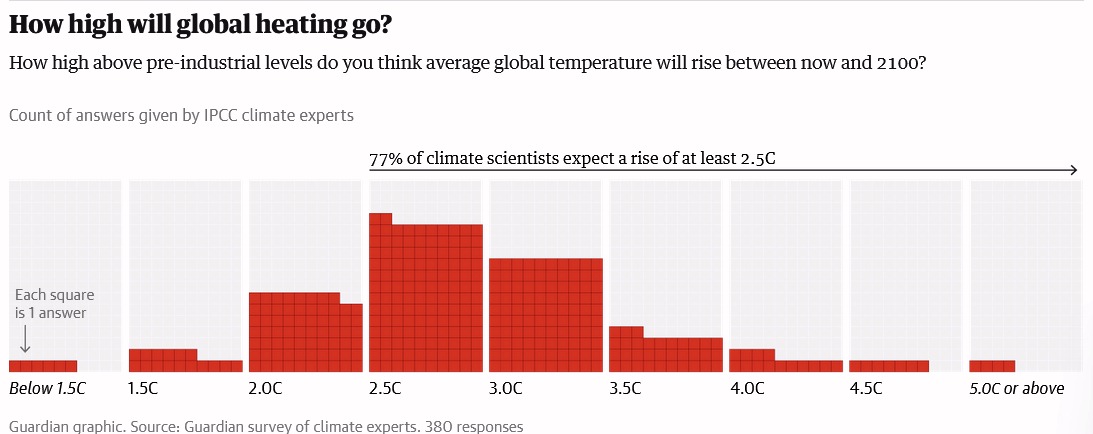
bookmark_borderSurvey of Experts: Climate Crisis Going Past 2.5 Degrees

by Daniel Brouse

The Guardian reports, “Many of the scientists envisage a ‘semi-dystopian’ future, with famines, conflicts and mass migration, driven by heatwaves, wildfires, floods and storms of an intensity and frequency far beyond those that have already struck.”

In a recent survey of climate scientists, the consensus suggests that global warming is on track to exceed 2.5 degrees Celsius this century, with some projections indicating a rise of over 5 degrees.

“I foresee significant societal upheaval within the next five years,” stated Gretta Pecl from the University of Tasmania. “We’ll face overwhelming challenges as extreme events become the norm, disrupting food production and beyond. The future seems increasingly bleak.”

Peter Cox from the University of Exeter emphasized, “Climate change isn’t waiting to become dangerous at 1.5 degrees Celsius – it already poses severe risks. Surpassing 2 degrees Celsius won’t signal ‘game over,’ but the urgency for action is dire.”

Nathalie Hilmi, representing the Monaco Scientific Centre, echoed the sentiment, asserting, “Limiting warming to 1.5 degrees Celsius is imperative. We cannot afford to exceed this threshold.”

The experts unanimously stressed the urgent need for extensive preparations to safeguard communities from impending climate catastrophes. Leticia Cotrim da Cunha from the State University of Rio de Janeiro expressed deep concern, particularly regarding the potential human toll.

The 1.5 degrees Celsius target, intended to avert the worst impacts of the climate crisis, has served as a crucial reference point in global climate negotiations. However, with current policies setting the world on a trajectory for around 2.7 degrees Celsius of warming, the survey indicates widespread skepticism among IPCC experts regarding the likelihood of sufficient action to curb emissions.

Climate Scientist Survey 2024

The Human Induced Climate Change Experiment

bookmark_borderClimate Change: Ruled Against UK

Litigation seeking compensation for loss and damage caused by the actions of oil companies and governments has the potential to reshape global economics. In the past year, several legal rulings have held governments accountable for their role in exacerbating the climate crisis, signaling a shift in legal accountability and prompting broader discussions on environmental responsibility.

The latest example, on May 3, 2024, a High Court judge delivered a significant ruling, declaring the U.K. government’s actions unlawful in approving a climate plan aimed at meeting crucial emission reduction targets without sufficient evidence of its feasibility. This marked the second occasion in two years where the government’s primary climate strategy faced legal challenge and was deemed inadequate in aligning with legally-binding commitments to curb greenhouse gas emissions.

Justice Clive Sheldon’s decision, following a case brought forth by three environmental organizations, underscored the government’s failure to substantiate its approval of the Carbon Budget Delivery Plan from the previous year. The judge concluded that the government lacked justification and the plan was “simply not justified by the evidence.”

Climate Change Law Suits

bookmark_borderKenya’s Frequency and Intensity of Extreme Weather

By Daniel Brouse

Kenya’s first-ever cyclone, Cyclone Kenneth, made landfall in April 2019, bringing heavy rainfall and strong winds to parts of eastern Africa, including Kenya. While Kenya is not typically in the path of cyclones, the occurrence of Cyclone Kenneth was attributed to changing climate patterns in the Indian Ocean, which allowed the cyclone to form further south than usual.

Cyclone Kenneth highlighted the increasing vulnerability of African countries to extreme weather events, including tropical cyclones, due to climate change. Rising sea surface temperatures in the Indian Ocean, fueled by global warming, provide favorable conditions for cyclone formation and intensification. As a result, countries like Kenya may face heightened risks of cyclones and associated hazards, including heavy rainfall, flooding, and storm surges.

In addition to Cyclone Kenneth, Kenya experienced several historic floods in the past year, further underscoring the country’s susceptibility to climate-related disasters. These floods were attributed to various factors, including prolonged and intense rainfall, poor land management practices, deforestation, and inadequate infrastructure for flood control and drainage.

Climate change exacerbates the frequency and severity of extreme weather events, including floods, by altering rainfall patterns, increasing the intensity of storms, and raising sea levels. In Kenya, as in many other parts of the world, climate change is contributing to more frequent and intense rainfall events, leading to an increased risk of flooding and associated impacts on communities, infrastructure, agriculture, and ecosystems.

Addressing the impacts of climate change in Kenya requires a comprehensive approach that includes efforts to reduce greenhouse gas emissions, adapt to changing climate conditions, improve disaster preparedness and response capabilities, and enhance resilience at the local, national, and regional levels. International cooperation and support are also essential to assist vulnerable countries like Kenya in addressing the challenges posed by climate change and building a sustainable future for all.

In 2024, the toll of flood-related incidents in Kenya has been devastating, with approximately 210 lives lost. Government data reveals that over 165,000 individuals have been displaced from their homes, and nearly 100 people are reported missing. The second ever hurricane, Hidaya, is expected to make landfall by May 4, 2024.

The Human Induced Climate Change Experiment

bookmark_borderClimate Change: The External Forcing

“Response to external forcings” refers to how a system reacts or changes in response to external influences or drivers. In the context of climate science, external forcings typically refer to factors outside of the Earth’s climate system that can influence the climate. These forcings can include natural factors such as volcanic eruptions, solar radiation, and orbital variations, as well as human-induced factors such as greenhouse gas emissions, land use changes, and aerosol pollution.

When scientists study the Earth’s climate system, they analyze how it responds to these external forcings. For example, changes in greenhouse gas concentrations due to human activities can lead to alterations in the Earth’s energy balance, resulting in global warming and climate change. Similarly, volcanic eruptions can release aerosols into the atmosphere, which can temporarily cool the climate by reflecting sunlight back into space.

Understanding the response of the climate system to external forcings is crucial for predicting future climate trends, assessing the impacts of human activities on the environment, and informing policies aimed at mitigating climate change. It involves complex scientific modeling and analysis to quantify the relationships between external forcings and climate variables such as temperature, precipitation, and atmospheric circulation patterns.

Chaos theory offers insights into the complex dynamics of the Earth’s atmosphere, particularly regarding the interactions between different atmospheric teleconnection patterns and their response to external forcings such as greenhouse gas emissions. Chaos theory can help elucidate how seemingly minor changes in atmospheric circulation patterns can lead to significant and often unpredictable changes in weather patterns across North America.

bookmark_borderChaos Theory: Evolving Winter Atmospheric Teleconnection Patterns

By Daniel Brouse

  1. Teleconnections: Teleconnections refer to climate anomalies and patterns that occur over large distances and are often linked to each other. These connections can manifest as recurring climate patterns, such as El Nino and La Nina events, the North Atlantic Oscillation (NAO), and the Southern Oscillation (SO). Teleconnections can influence weather and climate conditions globally, impacting precipitation, temperature, and atmospheric circulation patterns.
    • El Nino and La Nina: These are phases of the El Nino-Southern Oscillation (ENSO) phenomenon, characterized by anomalous warming (El Nino) or cooling (La Nino) of sea surface temperatures in the tropical Pacific Ocean. These events can lead to widespread changes in weather patterns worldwide, affecting rainfall, temperatures, and storm activity.
    • North Atlantic Oscillation (NAO): The NAO is a climate pattern characterized by changes in atmospheric pressure differences between the Icelandic Low and the Azores High over the North Atlantic Ocean. It influences weather patterns in North America, Europe, and North Africa, impacting temperatures, storm tracks, and precipitation patterns.
    • Southern Oscillation (SO): The SO is closely related to ENSO and refers to the atmospheric component of the El Nino-Southern Oscillation system. It influences weather patterns across the globe, particularly in the tropical Pacific region.
  2. Chaos Theory: Chaos theory emphasizes the inherent complexity and unpredictability of dynamic systems, such as the Earth’s climate system. It recognizes that small changes in initial conditions can lead to significant and unpredictable outcomes over time. In the context of climate change, chaos theory underscores the nonlinear interactions between various components of the climate system, including the atmosphere, oceans, ice, and biosphere.
    • Sensitive Dependence on Initial Conditions: Chaos theory highlights the sensitivity of complex systems to initial conditions, where small variations can amplify and lead to divergent outcomes. In the climate system, this sensitivity can manifest as abrupt shifts, tipping points, and feedback loops, contributing to nonlinear responses to external forcings like greenhouse gas emissions.
    • Emergent Behavior: Complex systems exhibit emergent behavior, where collective interactions between individual components give rise to new and often unpredictable phenomena. Climate change can lead to emergent properties such as extreme weather events, shifts in climate regimes, and changes in ecosystem dynamics.
    • Nonlinear Dynamics: Climate systems often exhibit nonlinear dynamics, meaning that changes in one component can trigger nonlinear responses in other parts of the system. This complexity makes it challenging to accurately model and predict the long-term impacts of climate change.

The study, “Evolving winter atmospheric teleconnection patterns and their potential triggers across western North American-Patterns” reports:

We present a comprehensive analysis diagnosing the primary factors driving the observed changes in major atmospheric teleconnection patterns in the Northern Hemisphere winter, including the Pacific North American pattern (PNA), North Atlantic Oscillation (NAO), and North American winter dipole (NAWD), with particular focus on their roles in shaping anomalous weather across North America. Our investigation reveals a consistent influence of the NAWD over seven decades, contrasting with fluctuating impacts from PNA and minor impacts from NAO. In particular, an emergent negative correlation between the NAWD and PNA, signaling a shifted phase of teleconnection patterns, is identified. Such a relationship change is traced to enhanced upper-level ridges across western North America, reflecting a reinforced winter stationary wave. Through attribution analysis, we identify greenhouse gas emissions as a probable driver for the northward drift of the Asia-Pacific jet core, which, aided by orographic lifting over the Alaskan Range, subsequently amplifies the winter stationary wave across western North America. This work emphasizes the pronounced effect of human-induced global warming on the structure and teleconnection of large-scale atmospheric circulation in the Northern Hemisphere winter, providing vital perspectives on the dynamics of current climate trends.

Chaos theory offers insights into the complex dynamics of the Earth’s atmosphere, particularly regarding the interactions between different atmospheric teleconnection patterns and their response to external forcings such as greenhouse gas emissions. Chaos theory can help elucidate how seemingly minor changes in atmospheric circulation patterns can lead to significant and often unpredictable changes in weather patterns across North America.

The analysis highlights the interplay between major atmospheric teleconnection patterns in the Northern Hemisphere winter, including the Pacific North American pattern (PNA), North Atlantic Oscillation (NAO), and North American winter dipole (NAWD). These patterns are known to influence weather conditions over vast regions and are sensitive to external drivers such as greenhouse gas emissions.

Chaos theory suggests that even small perturbations in the atmosphere, such as changes in temperature or pressure, can lead to nonlinear responses and amplify into larger-scale changes in weather patterns. In this case, the study identifies a consistent influence of the NAWD over several decades, indicating a robust relationship between this teleconnection pattern and anomalous weather across North America.

The emergence of a negative correlation between the NAWD and PNA, signaling a shifted phase of teleconnection patterns, is particularly noteworthy. This shift reflects a complex interplay of atmospheric dynamics, including the amplification of winter stationary waves across western North America.

Moreover, chaos theory underscores the role of human-induced global warming as a probable driver for these changes in atmospheric circulation. Greenhouse gas emissions are identified as a key factor contributing to the northward drift of the Asia-Pacific jet core, which, in turn, amplifies the winter stationary wave across western North America. This highlights the interconnectedness of human activities and Earth’s climate system, with potentially far-reaching consequences for weather patterns and climate trends.

Chaos theory provides a framework for understanding the intricate and often nonlinear relationships between atmospheric teleconnection patterns, external forcings, and the dynamics of current climate trends. By applying chaos theory principles, researchers can gain vital perspectives on the complex interactions shaping Earth’s climate system and inform efforts to mitigate and adapt to climate change.

Chaos Theory and Climate Systems

bookmark_borderThe Decline of Penn’s Sylvania

By Daniel Brouse

Penn’s Sylvania
Pennsylvania derives its name from the land grant bestowed upon William Penn. Penn’s grant, known as “sylvania,” translates to “forest” in Latin. Prior to the arrival of European settlers, the region was predominantly covered by vast expanses of dense forests, with a wide range of biodiversity and inhabited by indigenous peoples who relied on the land for sustenance and cultural practices.

In the 17th and 18th centuries, European settlers began to clear land for agriculture and settlement, leading to widespread deforestation in Pennsylvania. The demand for timber and wood products grew rapidly as the population expanded and industries such as shipbuilding, construction, and manufacturing developed. Logging became a prominent economic activity in Pennsylvania, with vast quantities of timber harvested. By the 19th century, Pennsylvania had become one of the leading timber-producing states in the United States, with extensive logging operations throughout the region. The emergence of the lumber industry brought prosperity to many communities but also led to widespread environmental degradation, including soil erosion, loss of biodiversity, and disruption of watershed systems.

As concerns grew over the sustainability of logging practices and the conservation of natural resources, efforts were made to regulate and manage forest resources more effectively. In the late 19th and early 20th centuries, the conservation movement gained momentum, leading to the establishment of state and federal agencies tasked with overseeing forestry and conservation efforts.

A Troubling Decline
In Pennsylvania, the once lush and verdant tree canopy is now facing a troubling decline, as the old growth trees succumb to the relentless pressures of human activities. The consequences of this ecological imbalance reverberate through the forest, as vines empowered by the thinning canopy are able to reach higher.

As these vines ascend to new heights, they cover and kill the venerable trees below. The intricate balance of nature is disrupted, as the loss of the old growth trees impacts biodiversity, soil stability, and wildlife habitats.

The gradual encroachment of vines into the upper reaches of the forest canopy represents a poignant symbol of the broader environmental challenges facing Pennsylvania and beyond. It serves as a stark reminder of the interconnectedness of all living beings and the urgent need for stewardship and conservation to preserve the natural wonders that enrich our lives.

ABOUT U.S. Temperate Zones
Climate change is significantly impacting the temperate zones in the United States in several ways:

  1. Shifts in Temperature: Temperate zones are experiencing changes in temperature patterns, with increases in both average temperatures and the frequency of extreme heat events. Winters are becoming milder, and summers are growing hotter, leading to shifts in growing seasons and ecosystem dynamics.
  2. Altered Precipitation Patterns: Climate change is causing alterations in precipitation patterns, including changes in rainfall intensity, frequency, and distribution. Some regions within temperate zones may experience more frequent and intense rainfall events, leading to increased flooding and soil erosion, while others may face more prolonged periods of drought, impacting water resources and agriculture.
  3. Changes in Ecosystems: The distribution and composition of ecosystems within temperate zones are being disrupted by climate change. Species ranges are shifting, and migration patterns are changing as plants and animals respond to altered temperature and precipitation conditions. This can lead to mismatches in timing between species interactions, such as flowering and pollination, or disruptions in food webs.
  4. Impacts on Agriculture: Climate change is posing challenges to agriculture in temperate zones, affecting crop yields, pest and disease dynamics, and the availability of suitable growing conditions. Heat stress, drought, and extreme weather events can damage crops and reduce agricultural productivity, impacting food security and economic livelihoods.
  5. Increased Risk of Wildfires: Warmer temperatures and drier conditions are contributing to an increased risk of wildfires in temperate zones, particularly in regions with dense vegetation and susceptible to drought. Wildfires can have devastating consequences for ecosystems, communities, and air quality, posing risks to human health and safety.
  6. Threats to Human Health: Climate change in temperate zones can exacerbate health risks associated with extreme heat events, air pollution, and the spread of vector-borne diseases. Vulnerable populations, such as the elderly, children, and individuals with pre-existing health conditions, may face increased risks of heat-related illnesses and respiratory problems.

Overall, climate change is reshaping the environmental, social, and economic landscapes of temperate zones in the United States, underscoring the need for proactive measures to mitigate its impacts and enhance resilience in affected regions.

* Our climate model / experiment employs chaos theory to comprehensively consider human impacts and projects a potential global average temperature increase of 9℃ above pre-industrial levels. Global warming is a consequence of elevated thermal energy in the climate system, which comprises various subsystems. Chaos theory underscores the intricate and nonlinear nature of dynamic systems. Human well-being is compromised above a 1.5-degree temperature rise, rendering much of the Earth uninhabitable. A 9-degree Celsius increase would bring the Earth close to a wet-bulb temperature incapable of sustaining human life.

Tree Extinction Due to Human Induced Environmental Stress

The Human Induced Climate Change Experiment

.