by Daniel Brouse
An AP-NORC poll reveals a deeply troubling contradiction in the American public’s understanding of climate change: Americans are increasingly experiencing the effects of extreme heat, yet fewer now believe climate change is actually happening.
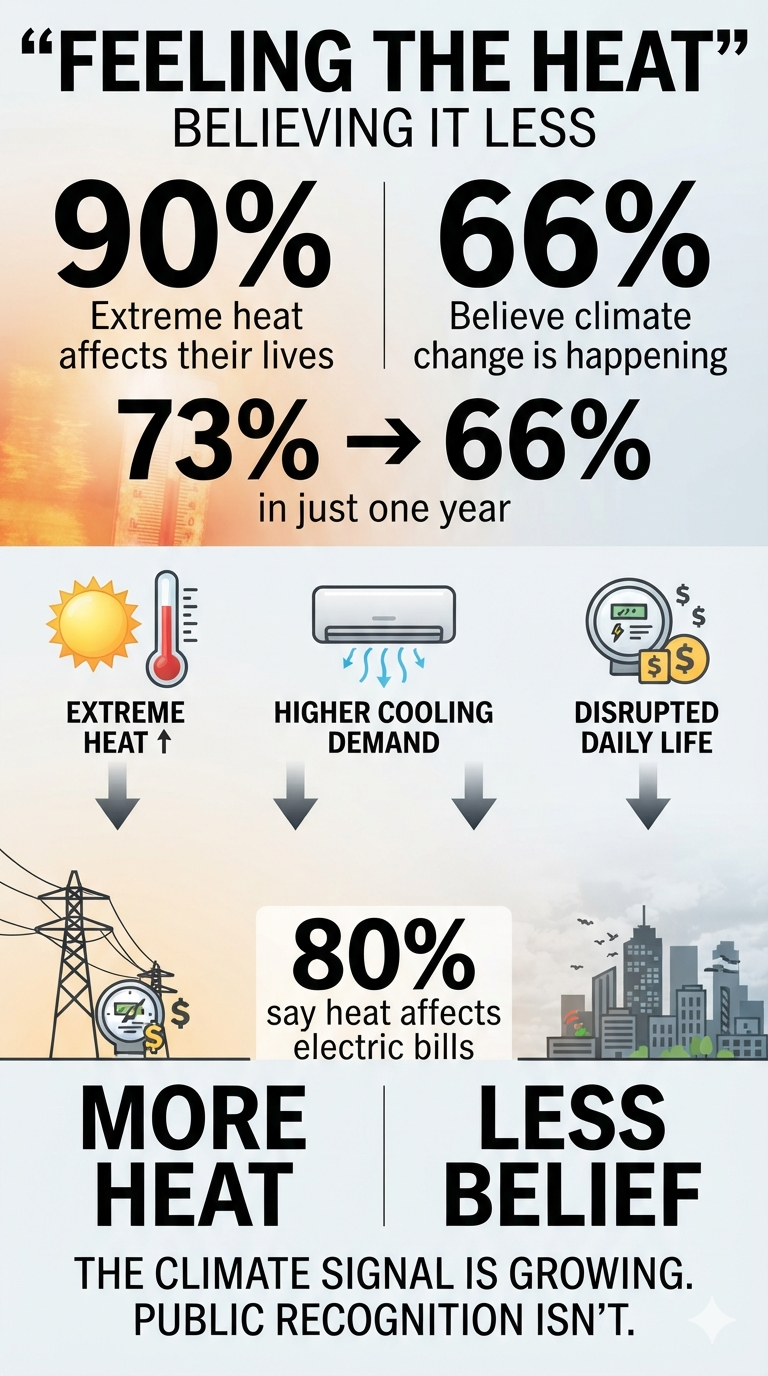
According to the poll, just 66% of Americans say climate change is happening, down sharply from 73% a year ago. That seven-percentage-point decline is particularly alarming because it comes at a time when Americans are reporting increasingly direct and disruptive experiences with extreme heat.
The disconnect raises an important question: How can people increasingly experience the consequences of a changing climate while becoming less likely to recognize climate change as the cause?
Extreme Heat Is Becoming Personal
The same poll found that 90% of Americans say extreme heat has affected their lives in some way, up from 83% in July 2024.
The impacts aren’t confined to abstract concerns about the environment. Americans report that extreme heat is affecting everyday life, including:
- Electricity bills
- Outdoor activities
- Sleep
- Travel and vacations
- Daily routines
Perhaps most significantly, about 80% say extreme heat has affected their electricity bills, up from 69% in 2024.
In the Midwest, the increase is even more striking: 44% now say extreme heat has had a major impact on their electricity bills, compared with 29% two years ago.
That is climate change translated into something tangible: a higher household expense.
The Perception–Attribution Gap
The most important finding may not be the increase in heat-related disruption. It may be the growing gap between what Americans experience and what they believe is causing it.
The survey presents two seemingly contradictory trends:
90% say extreme heat has affected their lives.
Yet only 66% say climate change is happening.
And that 66% figure is down from 73% just one year ago.
This is a remarkable perception–attribution gap.
Americans can recognize that summers are becoming more difficult, electricity costs are rising, outdoor activities are being disrupted and extreme heat is affecting sleep—without necessarily connecting those experiences to a changing climate.
The result is a potentially dangerous disconnect between physical reality and public understanding.
Political Division Is Part of the Explanation
Political ideology continues to play an enormous role in how Americans interpret climate-related experiences.
Democrats are substantially more likely than Republicans to describe extreme heat as having a major impact on their lives. But that doesn’t mean Republicans aren’t experiencing the same heat.
The distinction is increasingly about interpretation and attribution.
People across the political spectrum can experience the same 100-degree day. They can experience the same oppressive humidity, pay the same higher electricity bill and face the same restrictions on outdoor activity.
But they may reach very different conclusions about why it is happening.
That distinction matters because climate change doesn’t require public agreement in order to produce physical consequences.
Climate Change Is Becoming an Economic Issue
The AP-NORC findings also demonstrate why climate change should not be viewed exclusively as an environmental issue.
Extreme heat creates a chain of consequences:
Higher temperatures → greater air-conditioning demand → higher electricity consumption → increased household costs
But that is only one pathway.
Extreme heat can also affect worker productivity, agriculture, infrastructure, public health, insurance losses and energy-grid reliability.
The household electricity bill may therefore be only the first visible economic manifestation of a much larger systemic problem.
The public doesn’t need to understand atmospheric physics to experience these consequences.
They simply need to notice that something is different.
The Most Alarming Finding Isn’t the Heat
The increase in extreme-heat impacts is concerning, but the seven-point decline in belief that climate change is happening may be even more alarming.
The country is experiencing a growing number of climate-related disruptions while simultaneously becoming less certain—or less willing—to identify climate change as the underlying cause.
That creates a dangerous situation for public policy.
Democratic societies depend upon the public recognizing problems before governments can effectively address them. If the physical impacts become increasingly severe while public recognition of their underlying causes declines, political pressure for adaptation and mitigation can weaken precisely when the need for action is growing.
This creates a potential feedback loop:
More climate disruption → greater personal impacts → greater economic costs → political polarization → weaker recognition of climate change → less public support for climate action → greater future vulnerability
That is not merely a communications problem.
It is a systemic risk.
Experience Is Increasing Faster Than Understanding
The AP-NORC poll doesn’t measure the physical climate system. It measures what Americans are experiencing and what they believe.
Those are different things.
The survey cannot establish how much of an individual’s electricity bill, sleep disruption or outdoor inconvenience is attributable specifically to climate change. Establishing those causal relationships requires observational climate data and scientific attribution studies.
But the poll does reveal something extremely important about the human response to climate change.
The consequences are becoming increasingly personal while public recognition of climate change is moving in the opposite direction.
That should concern everyone, regardless of political affiliation.
The challenge is no longer simply convincing people that the climate is changing.
It is explaining why their increasingly familiar experiences—extreme heat, higher cooling demand, disrupted outdoor activities, poor sleep and growing economic costs—are connected to a much larger physical system.
Americans may not agree about climate change.
But increasingly, they are living with its consequences.
And the most alarming finding from this poll is that as those consequences become harder to escape, fewer Americans say climate change is actually happening: 66% today, compared with 73% a year ago.
America Is an International Outlier on Climate Change
The decline in American belief becomes even more concerning when viewed against the rest of the world.
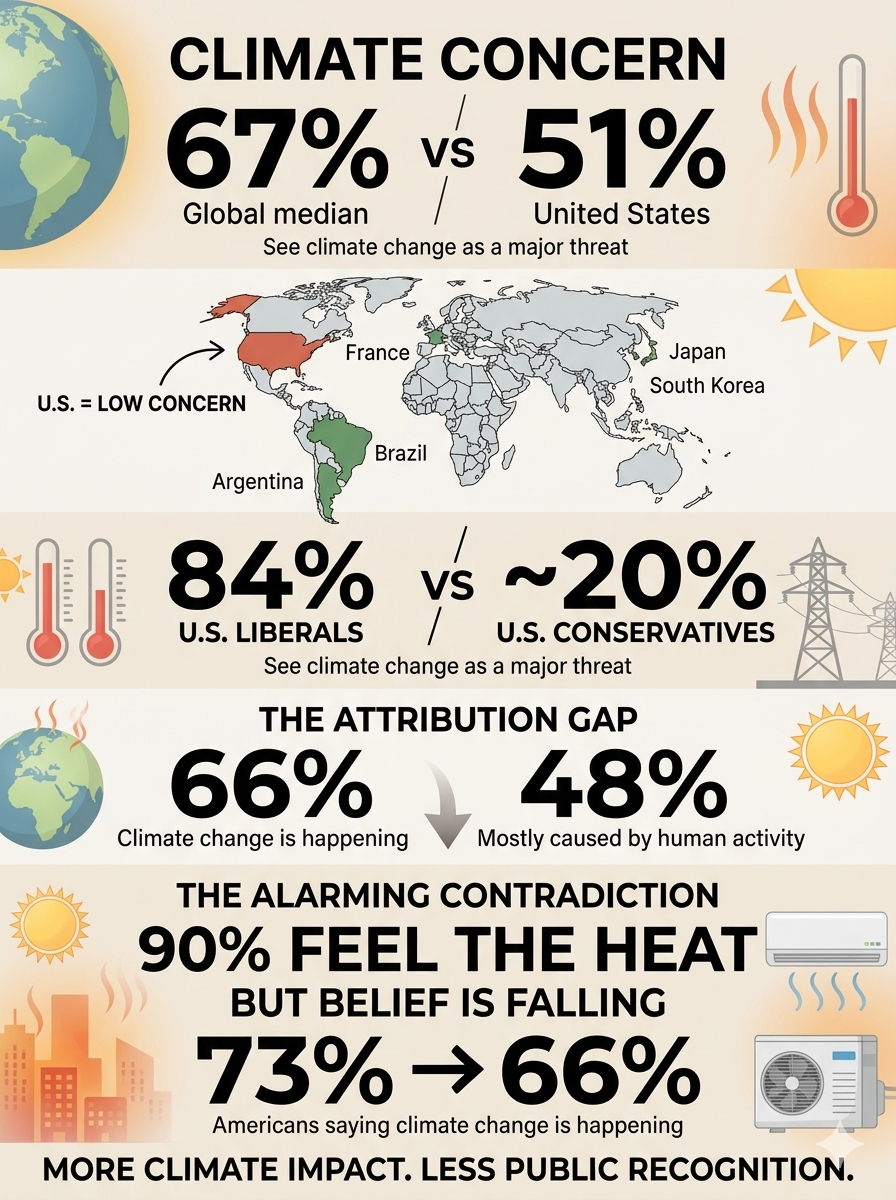
A 2025 Pew Research Center international survey of 25 countries found that a global median of 67% of respondents considered climate change a major threat to their country. In the United States, however, only 51% said the same—a gap of 16 percentage points.
The U.S. was among the least concerned countries surveyed. Americans were less likely than respondents in 13 of the 16 high-income countries included in the survey to view climate change as a major threat. In countries such as Argentina, Brazil, France, Japan and South Korea, roughly 80% of respondents regarded climate change as a major threat.
The difference is particularly striking because the United States is not insulated from climate impacts. Americans are experiencing extreme heat, rising cooling demand, disrupted outdoor activities and other consequences of a warming climate, yet concern about climate change remains comparatively low.
The American Divide Is Also Unusually Political
The international comparison becomes even more revealing when political ideology is considered.
Pew found that approximately 84% of U.S. liberals regarded climate change as a major threat, compared with only about 20% of U.S. conservatives. That enormous gap makes the United States an international outlier in the degree to which climate change has become politically polarized.
The result is a remarkable paradox.
Americans across the political spectrum can experience the same heat wave, pay the same electricity bill and endure the same disruption to their daily lives. Yet they may reach dramatically different conclusions about what those experiences mean.
The disagreement therefore isn’t simply about the physical environment. It is increasingly about how Americans interpret the physical environment.
Believing the Climate Is Changing Is Not the Same as Accepting Why
Another Pew measure illustrates the problem even more clearly.
In 2026, only 48% of Americans said the Earth is warming mostly because of human activity. That is substantially lower than the 66% who currently say climate change is happening in the AP-NORC poll.
The difference is crucial.
A person can acknowledge that the climate is changing without accepting that human activity is primarily responsible for that change. Others may accept human-caused warming but disagree about its severity, consequences or appropriate policy response.
This creates several layers of public perception:
Is the climate changing?
↓
Is human activity causing it?
↓
Is it becoming dangerous?
↓
Should government and society act?
Americans can answer those questions very differently.
An Alarming Combination
Taken together, the international and domestic polling reveals a troubling pattern:
90% — say extreme heat has affected their lives
80% — say heat has affected their electricity bills
73% → 66% — Americans saying climate change is happening
51% — Americans calling climate change a major national threat
48% — Americans saying warming is mostly caused by human activity
The numbers measure different things and should not be treated as interchangeable. But together they reveal a striking disconnect between experience, attribution and concern.
The United States is already an international outlier in climate skepticism and political polarization. Now, at a time when Americans report increasingly personal impacts from extreme heat, the share saying climate change is happening has fallen seven percentage points in only one year.
That may be the most troubling finding of all.
The physical climate signal is becoming harder to escape, while public recognition of that signal is moving in the opposite direction.