Understanding the Physical, Financial, and Market Risks Facing Property Owners
For generations, real estate has been viewed as one of the safest long-term investments. Land cannot be manufactured, buildings can be improved, and population growth has historically supported rising property values. Climate change is altering many of the assumptions that have underpinned real estate markets for decades.
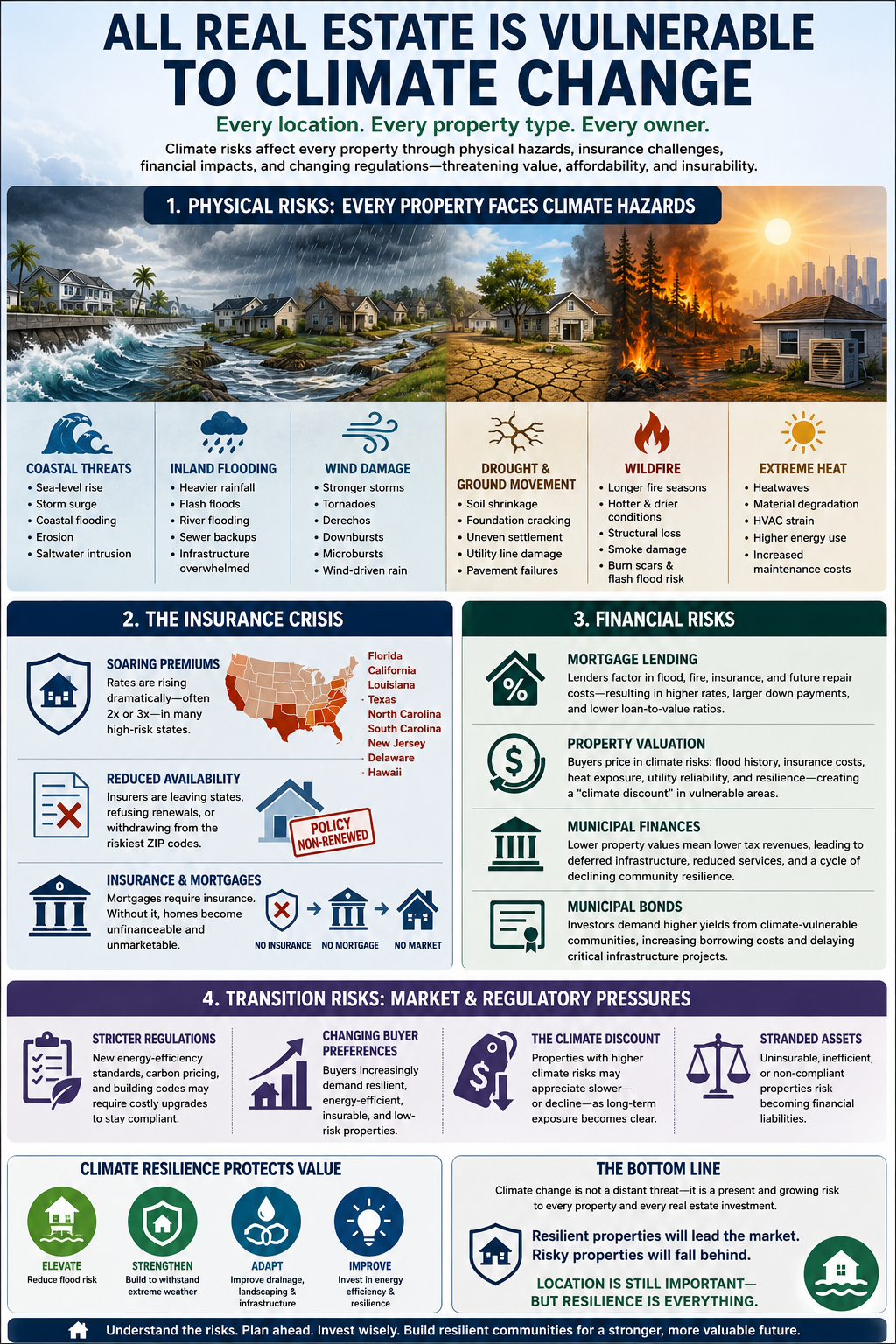
Contrary to popular belief, climate risk is not confined to beachfront homes or wildfire-prone forests. Every property is exposed to climate-related risks, although the specific hazards vary by location. These risks extend far beyond physical damage. They increasingly affect insurance availability, mortgage lending, municipal finances, infrastructure reliability, property values, and long-term market liquidity.
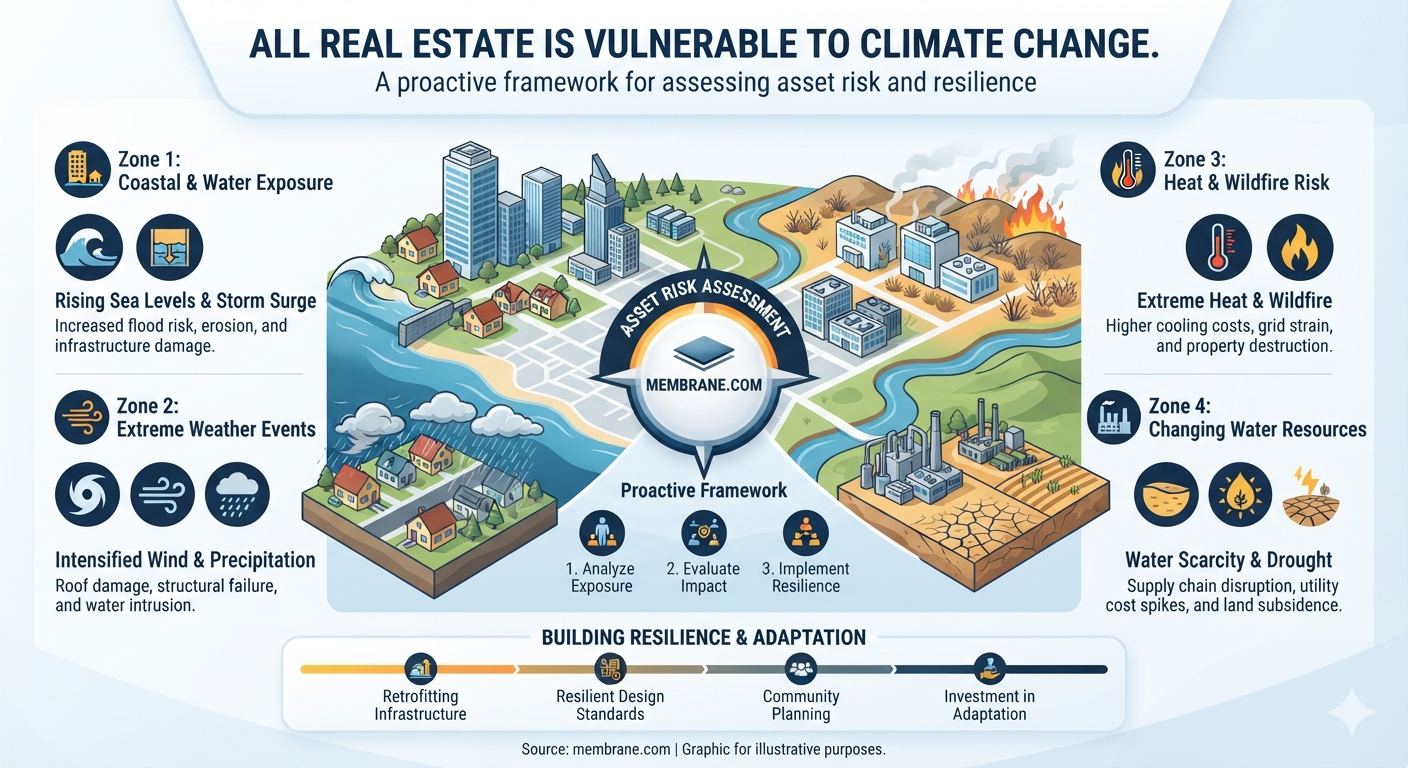
The vulnerability of real estate can be understood through four interconnected categories: physical risks, insurance risks, financial and lending risks, and transition risks.
1. Physical Risks: Every Property Faces Climate Hazards
Climate change is increasing both the frequency and intensity of many weather-related hazards. Every region experiences different threats, but no location is completely immune.
Coastal Regions
Coastal properties face some of the most visible climate risks, including:
- Rising sea levels
- More frequent nuisance flooding
- Stronger storm surges
- Accelerated shoreline erosion
- Saltwater intrusion into groundwater
Even modest sea-level rise significantly increases flood frequency because storm surges begin from a higher baseline.
Inland Flooding
Many inland communities once considered “safe” are experiencing increasing flood losses.
Warmer air holds approximately 7% more water vapor for every 1°C of warming, increasing the potential for intense rainfall events. As storms become more moisture-laden, drainage systems designed for twentieth-century rainfall often become overwhelmed.
Consequences include:
- Flash flooding
- River flooding
- Basement flooding
- Sewer backups
- Road washouts
- Bridge failures
Properties located well outside traditional floodplains are increasingly experiencing damaging floods.
Wind Damage
For much of the United States, wind represents the largest source of insured property losses.
Climate change is increasing atmospheric energy available for:
- Severe thunderstorms
- Derechos
- Tornado outbreaks
- Downbursts
- Microbursts
- Hurricane wind fields
Roofs, siding, windows, and mature trees are particularly vulnerable. Wind-driven rain often causes damage even when structures remain standing.
Wildfire
Longer fire seasons, hotter temperatures, and more frequent droughts have dramatically expanded wildfire risk.
Wildfires threaten real estate through:
- Direct structural destruction
- Smoke damage
- Utility failures
- Water contamination
- Long-term reductions in property desirability
Burn scars also increase the likelihood of flash flooding and debris flows during subsequent rainstorms.
Drought and Ground Movement
Extended drought affects soils in complex ways.
Clay-rich soils shrink as they dry, causing:
- Foundation cracking
- Uneven settlement
- Utility line damage
- Pavement failures
Conversely, periods of heavy rainfall following drought can produce rapid soil expansion that further stresses structures.
Extreme Heat
Heat affects virtually every building.
Higher temperatures accelerate deterioration of:
- Roofing materials
- Asphalt pavement
- Exterior paints
- Sealants
- HVAC systems
Buildings require more cooling energy while mechanical systems experience greater wear, increasing maintenance and operating costs.
2. The Insurance Crisis
Insurance is becoming one of the most important climate risks facing property owners.
Historically, insurance spread risk across large geographic regions. As climate-related losses increase, that model is becoming increasingly difficult to sustain.
Rising Premiums
Many homeowners and commercial property owners have experienced substantial premium increases.
States experiencing particularly rapid increases include:
- Florida
- California
- Louisiana
- Texas
- North Carolina
- South Carolina
- New Jersey
- Delaware
- Hawaii
In many communities, insurance costs are rising faster than home values.
Reduced Availability
Some insurers are:
- Leaving entire states
- Declining to insure specific ZIP codes
- Refusing policy renewals
- Restricting coverage amounts
- Increasing deductibles
As private insurers withdraw, many homeowners are forced into state-sponsored insurers of last resort, which often provide less comprehensive coverage at higher cost.
Insurance and Mortgage Lending
Insurance availability directly affects financing.
Most mortgage lenders require continuous hazard insurance throughout the life of the loan.
If insurance becomes unavailable or unaffordable:
- Mortgage approvals become more difficult.
- Existing homeowners may violate loan requirements.
- Buyers qualify for smaller loans.
- Market demand declines.
- Property values weaken.
Without insurance, many homes effectively become difficult or impossible to finance.
3. Financial Risks Beyond Property Damage
Climate change affects real estate markets even before disasters occur.
Financial institutions increasingly incorporate climate risk into lending and investment decisions.
Mortgage Lending
Banks and mortgage investors evaluate:
- Flood exposure
- Wildfire risk
- Insurance availability
- Future repair costs
- Local infrastructure resilience
Higher perceived risk may result in:
- Larger down payment requirements
- Higher interest rates
- Reduced loan-to-value ratios
- Shorter lending horizons
Properties once viewed as routine collateral may gradually become more difficult to finance.
Property Valuation
Real estate markets depend heavily on expectations of future value.
Buyers increasingly consider:
- Flood history
- Fire history
- Heat exposure
- Insurance costs
- Utility reliability
- Local resilience investments
Two otherwise identical homes may command significantly different prices simply because one carries greater long-term climate risk.
Municipal Finances
Local governments rely heavily on property taxes.
If climate risks reduce property values, municipalities may experience:
- Lower tax revenues
- Deferred infrastructure maintenance
- Reduced public services
- Higher municipal borrowing costs
This creates a feedback loop in which deteriorating infrastructure further reduces property values.
Municipal Bonds
Cities and counties finance roads, schools, water systems, and flood-control projects through municipal bonds.
Increasing climate risks may lead investors to demand higher yields from municipalities perceived as vulnerable. Higher borrowing costs can delay infrastructure improvements, making communities even more susceptible to future climate impacts.
Credit rating agencies are paying increasing attention to long-term climate resilience when evaluating municipal creditworthiness.
4. Transition Risks
Not all climate risks arise from weather.
Many result from changes in markets, technology, regulations, and consumer preferences.
Energy Efficiency Requirements
Governments are gradually adopting stricter standards for:
- Building efficiency
- Carbon emissions
- Appliance performance
- Building electrification
- Energy benchmarking
Older buildings may require expensive upgrades to remain competitive.
Changing Buyer Preferences
Homebuyers increasingly ask questions such as:
- Is the property insurable?
- How often does it flood?
- What are annual insurance costs?
- Does the home have backup power?
- Is the roof hurricane-rated?
- Are energy costs manageable?
These considerations increasingly influence purchasing decisions.
The Emerging Climate Discount
Economists have begun describing the possibility of a “climate discount” or “climate bubble.”
Properties with elevated climate risks may experience slower appreciation—or outright depreciation—as markets increasingly recognize long-term exposure.
Unlike traditional real estate cycles, climate-related devaluation may persist because the underlying physical risks continue to evolve.
5. Climate Risk Is Becoming a Core Investment Risk
Climate change is transforming real estate from an asset class valued primarily by location into one increasingly valued by resilience.
Future property performance will depend not only on neighborhood desirability but also on:
- Infrastructure quality
- Flood protection
- Insurance availability
- Building efficiency
- Utility reliability
- Community adaptation efforts
Investors, lenders, insurers, and homebuyers are already incorporating these factors into financial decisions.
Conclusion
Climate change does not mean that all real estate will suddenly lose value or become uninhabitable. Real estate will remain one of the world’s largest and most important asset classes. However, the factors that determine value are changing.
The greatest risk is not a sudden collapse of the housing market but a gradual repricing of climate risk. Some properties may remain highly desirable for decades, while others may face increasing costs from insurance, maintenance, financing, and regulatory compliance.
Understanding these risks allows homeowners, investors, developers, lenders, and policymakers to make informed decisions. Investments in resilient construction, improved infrastructure, energy efficiency, and thoughtful land-use planning can reduce long-term vulnerability and help preserve property values.
The future of real estate will increasingly be determined not simply by location, location, location, but by location, resilience, and adaptability.