by Daniel Brouse
Coastal Erosion, Property Loss & the Uninsurable Coast
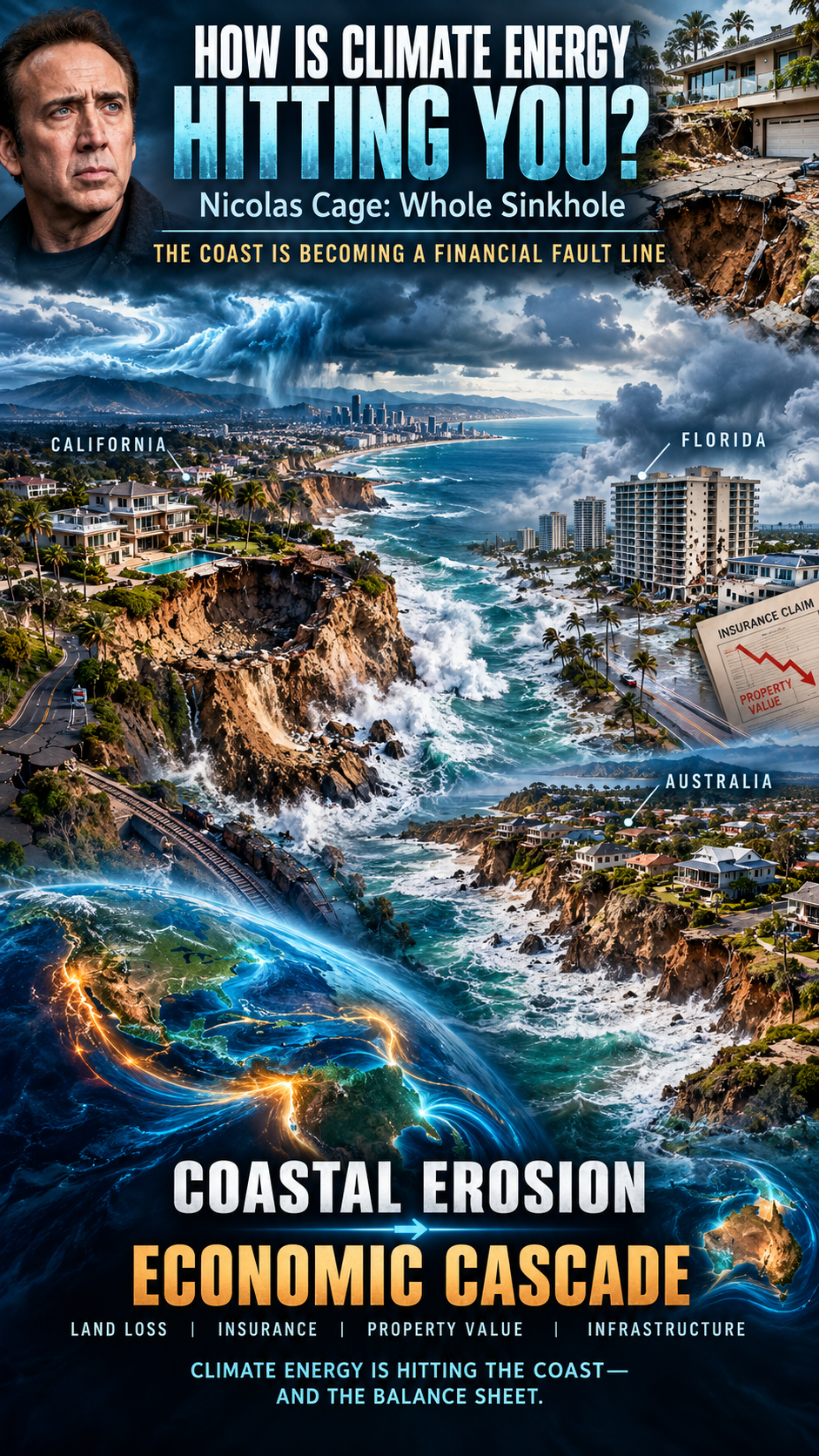
Nicolas Cage: Whole Sinkhole
On September 8, 2026, severe coastal erosion and high surf triggered by the aftermath of Hurricane Marie caused the driveway of Nicolas Cage’s $10.5 million beachfront mansion to completely collapse.
The resulting crater expanded to roughly 30 by 60 feet and plunged about 25 feet deep, swallowing the driveway, a construction-site portable restroom, and heavy concrete debris.
Powerful south swells, extreme high tides, and pounding waves from Tropical Storm/Hurricane Marie ate away at the coastline directly beneath the property.
The collapse ruptured a gas main, forcing utility crews to shut off natural gas along the street. Because the ground remained highly unstable, city officials declared a local state of emergency and red-tagged or ordered evacuations for roughly 30 surrounding homes. Fortunately, the home was unoccupied at the time, and no injuries were reported.
California’s Coastal Erosion
Climate change and coastal erosion are fundamentally reshaping California’s 1,100-mile coastline. What was once considered a slow-moving, long-term environmental shift has accelerated into a series of highly disruptive events, resulting in collapsing bluffs, shrinking beaches, and massive infrastructure vulnerabilities.
The severe impacts California is facing are driven by a combination of rising sea levels and intensifying ocean patterns.
1. Vanishing Beaches and the “Coastal Squeeze”
California’s famous sandy beaches are facing an existential crisis. The U.S. Geological Survey (USGS) estimates that 24% to 75% of California’s beaches could completely erode by the year 2100.
The Squeeze: Normally, a beach would naturally migrate inland as sea levels rise. However, much of California’s coast is experiencing a “coastal squeeze”: beaches are trapped between the rising ocean and human-made infrastructure such as seawalls, highways, and residential developments, leaving the sand nowhere to go.
Artificial Interventions: According to recent USGS satellite data, some Southern California beaches have artificially expanded, but this is entirely due to expensive human interventions, such as dredging and “beach nourishment” projects, rather than natural coastal resilience.
2. Sea Cliff Failures and Deadly Landslides
Roughly 70% of California’s coast is comprised of oceanfront bluffs and cliffs.
Increased Wave Attack: As baseline sea levels rise, waves strike the base of these cliffs more frequently and with greater force. This severely degrades their structural stability, triggering sudden and unpredictable cliff collapses and landslides.
Human and Property Risk: Bluff failures have turned deadly for beachgoers in areas such as Encinitas and San Francisco. They also pose an immediate threat to multi-million-dollar cliffside homes and vital transportation routes.
3. The “Triple Threat” of El Niño and Severe Storms
While climate change is steadily raising the global baseline sea level, seasonal weather anomalies can trigger immediate emergencies. Geomorphologists at the Scripps Institution of Oceanography warn that El Niño conditions create a devastating “triple threat”:
Elevated Ocean Height: El Niño patterns can temporarily push local sea levels up by an additional 6 to 13 inches. Combined with pre-industrial sea-level rise, this radically amplifies the baseline ocean height.
Powerful Swells: Stronger storms and intense wave energy eat away at protective sand berms at an accelerated rate.
Heavy Rain: Atmospheric rivers saturate coastal land, triggering landslides from the top down while waves batter the cliffs from the bottom up.
The compound effect of these forces was highly visible during recent extreme-weather events, which caused widespread flooding in Long Beach and massive coastal sinkholes in Malibu. Every 2 to 4 inches of sea-level rise effectively doubles coastal flood risks.
4. Compounding Economic and Ecological Damages
Infrastructure at Risk: The state’s Legislative Analyst’s Office estimates that $8 billion to $10 billion worth of existing property could be entirely underwater within the next few decades, with billions more at risk during high tides. Critical lifelines—including the Pacific Coast Highway and coastal rail links such as the Amtrak lines connecting San Diego to Los Angeles—frequently face service suspensions because of ground instability.
Ecological Degradation: California has already lost more than 60% of its historical coastal sand dune systems to development and erosion. This destroys critical habitats for native birds and mammals while removing the coastline’s natural buffer against storm surges.
Water Supply Risks: Rising tides put freshwater aquifers at risk of saltwater intrusion. Increased saltwater contamination in the Sacramento-San Joaquin Delta threatens the drinking-water supply for millions of Californians as well as adjacent agricultural land.
California’s Adaptive Strategy
In response, California passed legislation such as Senate Bill 272, requiring all local governments within the coastal zone to establish comprehensive sea-level-rise plans by January 1, 2034. Communities are forced to choose between “hard armoring”—building massive rock revetments and groins to hold back the sea—and “managed retreat,” the highly controversial process of moving structures and infrastructure entirely inland.
Florida Coastal Erosion
Florida is facing a systemic coastal real-estate crisis in which climate-driven physical erosion has collided with aggressive new legal and financial mandates.
The state is experiencing severe physical land loss, but the downstream financial impact—specifically skyrocketing condo fees, massive special assessments, and a plunging condo market—is reshaping the state’s housing economy.
Part 1: How Coastal Erosion Is Impacting Florida
Florida features a low-lying, highly vulnerable topography. Rising sea levels and climate-fueled hurricanes are causing severe coastline degradation.
Critical Erosion: The Florida Department of Environmental Protection has designated a majority of Florida’s coastline as facing “critical erosion risk.” Beaches and barrier islands are shrinking, eliminating natural buffers that protect buildings from storm surges.
Foundation Undermining: Storm surges and intense wave action systematically wash away sand beneath seawalls and structural slabs. Saltwater intrusion aggressively corrodes the steel rebar inside concrete foundations and parking garages, severely compromising structural integrity over time.
Boundary Shrinkage: Coastal erosion is shrinking the physical legal boundaries of private properties. By 2050, over 140,000 Florida properties are expected to be significantly altered by land loss.
Part 2: The Condo Crisis — Fees & Special Assessments
Historically, beachfront condo associations kept their Homeowners Association (HOA) fees artificially low by voting to “waive” reserve funding for long-term maintenance. The tragic 2021 collapse of Champlain Towers South in Surfside permanently ended this practice.
Following the disaster, Florida passed strict safety laws, including SB 4-D and subsequent updates such as HB 913, creating a financial perfect storm:
Mandatory Milestone Inspections: All buildings three stories or taller that reached 30 years of age—or 25 years if within three miles of the coast—were required to complete rigorous structural inspections. These inspections uncovered decades of hidden saltwater corrosion, concrete spalling, and foundation rot.
Structural Integrity Reserve Studies (SIRS): Associations must perform a SIRS to calculate the remaining lifespan of critical components such as roofs, foundations, and load-bearing walls.
The Ban on Waiving Reserves: Associations are strictly prohibited from waiving or underfunding reserves for structural items. They must collect the required cash.
The Financial Fallout
Six-Figure Special Assessments: Because buildings deferred maintenance for decades, unit owners are being hit with mandatory, one-time special assessments ranging from $50,000 to more than $400,000 per unit to pay for multi-million-dollar structural repairs.
Skyrocketing Monthly Fees: Regular monthly HOA fees have surged—sometimes by 20% to 50% in a single year—to cover ongoing reserve requirements and exploding commercial-property insurance premiums.
Surging Insurance Costs: Driven by storm damage and climate risk, many major private insurers have pulled out of Florida entirely. Condo buildings are forced onto high-cost, bare-minimum state-backed policies, adding thousands of dollars annually to an individual unit owner’s bottom line.
Part 3: Devastation of Real Estate Values
The financial strain of these assessments and fees has broken the economics of Florida condo ownership, resulting in a dramatic price correction along the coast.
The Mass Sell-Off: Fixed-income retirees and middle-class owners cannot afford a sudden $100,000 assessment or a doubling of their monthly dues. This has caused a massive influx of inventory as desperate owners try to unload their units before deadlines hit.
Evaporating Buyer Demand: Disclosures showing thousands of non-compliant buildings, paired with high risk, have terrified buyers. Buyers refuse to inherit pending six-figure structural repair bills, causing sales velocity to freeze.
Deep Price Disruption: According to market trackers, this massive supply glut and lack of demand has led to steep price drops for coastal condos. In stark contrast to single-family homes, aging coastal condos are seeing values plummet by 20% to 40%.
Coastal Gentrification: The ultimate trajectory is severe economic displacement. As middle-class owners are forced out, developers and wealthy buyers are buying up entire distressed buildings at steep discounts, either to demolish them or completely rebuild luxury projects out of pocket.
Australia Coastal Erosion
Over 250,000 Australian homes are at risk of coastal erosion, according to the “Rising Seas, Rising Bills” report published by the Climate Council on September 10, 2026.
Drawing on groundbreaking climate modeling from the University of Melbourne and the Australian National University, the report highlights the severe threat that rising sea levels and storm surges pose to Australia’s massive coastal population.
1. The Real Estate and Financial Risk
Properties Threatened: The report explicitly warns that more than 267,000 coastal properties—roughly a quarter of a million homes—are at risk of severe inundation and erosion damage by 2100.
The $855 Billion Economic Bill: Total economic losses are projected to hit at least $855 billion AUD by the end of the century. This includes $274.3 billion AUD in direct property damage, alongside $580.7 billion AUD in damage to farmland, nature reserves, and critical public infrastructure.
The Timeline: While 2100 is the benchmark for the worst damages, researchers stress that the economic shock waves will start crippling coastal real estate as early as 2040.
2. State-by-State Breakdown: Where Is Most Exposed?
The damage is not distributed evenly, with specific regions carrying extreme structural and financial burdens:
Queensland — 93,157 properties at risk: The worst-affected state by property count. The Gold Coast alone is officially named Australia’s most exposed urban area, facing a staggering $84.4 billion AUD in projected economic losses on its own.
New South Wales — 71,210 properties at risk: Communities in Northern NSW and the Central Coast are projected to experience far higher property losses than Greater Sydney.
Western Australia — 51,366 properties at risk: While it has fewer homes at risk than Queensland or New South Wales, Western Australia faces the highest overall financial loss, at $230.5 billion AUD, due to vast tracts of highly valuable coastal agricultural land that will be permanently lost to sea-level rise.
Victoria: Property losses are heavily concentrated in low-lying, densely populated urban areas around Melbourne’s Port Phillip Bay and the Yarra River.
3. The Uninsurable “Actions of the Sea”
Much like the condo crisis unfolding in Florida, Australia is facing a severe insurance reckoning.
The Exclusion Clause: Most standard private insurers in Australia explicitly exclude coverage for “actions of the sea.” This means regular ocean tidal flooding, steady coastal erosion, and sea-level rise are completely uncovered.
The Cost Burden: When a storm surge destroys a foundation or a cliff collapses, property owners will largely be forced to bear the multi-million-dollar stabilization or relocation costs entirely on their own. Experts warn that this will trigger massive drops in property values and result in “uninsurable” coastal ghost zones.
The Coast Is Becoming a Financial Fault Line
From California to Florida to Australia, coastal erosion is no longer simply a problem of disappearing sand or retreating shorelines. It is becoming a cascading climate-energy problem that reaches directly into property values, insurance markets, infrastructure, ecosystems, and household finances.
The Nicolas Cage sinkhole provides a dramatic example of how quickly coastal instability can turn an expensive piece of real estate into a dangerous hole in the ground. California demonstrates the growing physical vulnerability of beaches, cliffs, transportation corridors, and freshwater resources. Florida shows how physical climate risks can cascade into insurance crises, special assessments, and collapsing real-estate economics. Australia demonstrates how the same process can scale into a national financial exposure measured in hundreds of billions of dollars.
The underlying lesson is straightforward: coastal climate risk does not stop at the water’s edge.
As sea levels rise and extreme coastal events intensify, the physical loss of land can propagate through the economic system. Erosion undermines structures. Structural damage increases repair costs. Repair costs increase insurance premiums and assessments. Insurance becomes unavailable or unaffordable. Properties lose value. Buyers disappear. Communities face declining tax bases and increasingly expensive infrastructure protection.
What begins as coastal erosion can therefore become a cascading economic feedback.
Climate energy is hitting the coast—and increasingly, it is hitting the balance sheet.