by Daniel Brouse
Climate Change, Groundwater Depletion, and the Emerging Water Crisis
Türkiye is rapidly approaching a critical threshold at which it could officially become a water-poor nation by 2030, driven heavily by severe climate change and extensive groundwater mismanagement.
Located within the highly vulnerable Mediterranean Basin, Türkiye is experiencing plunging per-capita water availability, escalating drought, and an alarming 88 percent risk of nationwide desertification. The consequences extend far beyond water supplies. According to a climate assessment by the World Bank, a mere 10 percent reduction in water supply could cost the country 6 percent of its total GDP.
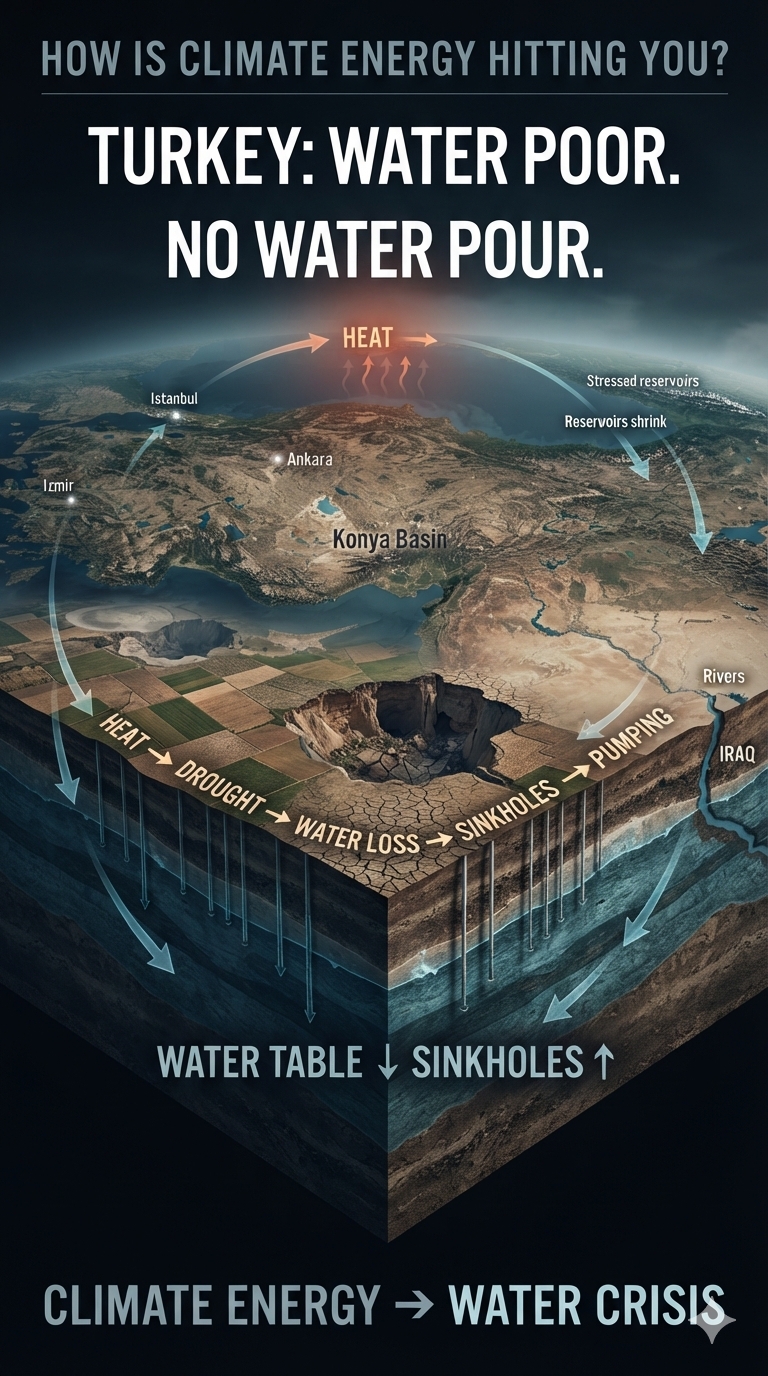
The emerging crisis illustrates how climate energy can propagate through an interconnected system: rising temperatures intensify drought; drought reduces surface water and reservoir replenishment; declining water supplies increase groundwater extraction; falling water tables destabilize the landscape; and the resulting agricultural, urban, and economic stresses compound one another.
Drivers of Water Poverty
Plunging Per-Capita Water Supply
The United Nations Convention to Combat Desertification warns that population growth combined with rising temperatures will push Türkiye into official water poverty within years.
As the population grows while available water supplies decline, the amount of water available per person continues to fall. Climate change compounds the problem by increasing evaporation, intensifying drought, and placing additional pressure on already limited freshwater resources.
Vanishing Natural Lakes
Environmental experts report that more than 75 percent of Türkiye’s lakes have completely dried up over the past 60 years.
The disappearance of natural lakes represents more than the loss of individual bodies of water. Lakes function as components of larger regional hydrological systems, storing water and supporting agriculture, ecosystems, and communities. Their disappearance is another visible indicator of a system under increasing water stress.
Diminishing Rainfall
Recurrent droughts occur every few years, causing critical declines in surface runoff and reservoir replenishment.
As precipitation becomes less reliable and temperatures rise, the same amount of rainfall can produce less usable water. Higher evaporation rates remove more moisture from soils, reservoirs, and landscapes, while shortened snowmelt cycles further alter the timing and volume of downstream water.
The Agriculture and Sinkhole Crisis
Groundwater Over-Extraction
As drought intensifies, farmers have increasingly turned to groundwater to sustain crops. An estimated 120,000 unlicensed wells have been dug to compensate for declining surface-water availability.
Groundwater therefore becomes a critical emergency reserve—but continued extraction faster than natural recharge transforms that reserve into a rapidly depleting resource.
Receding Water Tables
Heavy agricultural siphoning is causing underground water tables in central regions to decline by up to 16 feet annually.
This represents a profound alteration of the subsurface water system. As groundwater is removed faster than it can be replenished, the water table retreats deeper beneath the agricultural landscape.
Proliferating Sinkholes
The structural consequences are increasingly visible.
This underground depletion has contributed to the formation and collapse of more than 680 massive sinkholes across the crucial Konya Basin agricultural region.
The sinkholes provide a dramatic physical manifestation of the water crisis: what is being removed from beneath the landscape eventually manifests at the surface.
Urban and Geopolitical Strains
Stressed Mega-Cities
Major urban centers—including Istanbul, Ankara, and Izmir—face severe water scarcity as major reservoirs regularly fall below critical capacity.
The crisis is therefore not confined to rural agricultural regions. As water supplies tighten, cities must compete with agriculture, industry, ecosystems, and other demands for an increasingly constrained resource.
Downstream River Depletion
Shorter mountain snowmelt cycles are heavily reducing the natural volumes flowing into regional rivers.
Changes in snowpack and melt timing can disrupt the seasonal delivery of freshwater downstream, further stressing rivers, reservoirs, agriculture, and communities dependent upon predictable water flows.
Geopolitical Tensions
The water crisis also extends beyond Türkiye’s borders.
Restricted flows from dams on the Tigris and Euphrates rivers worsen severe water crises downstream in Syria and Iraq, according to The Water Project.
Water scarcity can therefore become a regional geopolitical problem, transforming climate-driven hydrological changes into competition among nations sharing increasingly stressed river systems.
The Climate-Energy Connection
Türkiye’s emerging water crisis demonstrates how climate energy does not remain confined to a thermometer reading.
Heat → drought → declining water supplies → groundwater pumping → falling water tables → sinkholes → agricultural stress → urban pressure → economic losses → geopolitical tension
The system is interconnected.
Climate change increases the energy available to the atmosphere and intensifies the hydrological cycle. The resulting extremes can simultaneously increase evaporation, alter precipitation, accelerate snowmelt, reduce water availability, and increase demand for irrigation.
When human water consumption is added to those climate stresses, the system can move rapidly toward a critical threshold.
Water poor. No water pour.
For Türkiye, the question is no longer simply whether climate change will affect water availability. The emerging question is how quickly multiple water-related stresses can begin comingling and amplifying one another—and what happens when a nation’s agricultural, urban, economic, and geopolitical systems all depend upon the same shrinking resource.