by Daniel Brouse
What will change consumer behavior when it comes to climate change?
Money. Insurance, interest rates, and taxes.
Most consumers do not substantially change their behavior until doing nothing becomes cost prohibitive.
For years, we assumed that climate change was unlikely to change consumer behavior in the near term. Climate change seemed too distant, too gradual, and too abstract to overcome the immediate economic incentives that drive everyday decisions.
That is now observably changing.
Climate change is increasingly entering the household economy through three powerful financial mechanisms:
Insurance. Interest rates. Taxes.
These mechanisms can transform climate change from an environmental issue that consumers can ignore into an economic reality they cannot.
Insurance
The United States, Australia, and parts of Asia and Latin America face some of the heaviest disruptions in insurance markets from climate change. The climate-driven insurance crisis is no longer just a problem for insurance companies. It has triggered a massive shift in housing and financial markets.
As climate risks increase, insurers are raising premiums, increasing deductibles, restricting coverage, and withdrawing from markets where losses have become too great.
That directly affects consumers.
Because most people rely on banks and mortgages to purchase homes, the withdrawal of insurers directly threatens both property values and mortgage stability. A home that cannot be affordably insured becomes more difficult to finance, sell, and maintain as an investment.
The chain is straightforward:
Climate change → insurance losses → higher premiums → reduced insurability → declining property values → mortgage disruption
This creates a powerful economic incentive for consumers to change where they live, what they buy, how they build, and how they protect their property.
Insurance therefore has become one of the first places where climate change forces consumer behavior to change—not through persuasion, but through price.
Interest Rates
Climate change is also becoming a financial problem through the cost of borrowing.
Developing and climate-vulnerable nations bear the heaviest burden. Climate change directly drives up sovereign bond yields, contributes to credit-rating downgrades, and locks vulnerable countries into a punishing vicious cycle of debt and disaster. A landmark 2026 report by ActionAid International revealed that across 65 of the world’s most climate-vulnerable countries, debt servicing is projected to consume a staggering 65% of all government revenue in 2026.
The mechanism is another accelerating feedback loop:
Climate disaster → economic losses → declining government revenue → increased borrowing → higher debt costs → reduced adaptive capacity → greater vulnerability
The consequences do not remain confined to developing nations.
The approximately $2 trillion annual climate-driven fiscal drain acts as a massive structural accelerator for interest rates in the United States. It does not directly determine daily Federal Reserve rate decisions. Instead, this enormous and growing economic burden alters the underlying macroeconomic conditions that the Federal Reserve and bond markets use to price capital.
Climate damage requires money. Rebuilding requires money. Infrastructure adaptation requires money. Insurance losses require money. Government deficits require money. And when the demand for capital rises while economic productivity and fiscal capacity are simultaneously pressured, the cost of capital rises.
Consumers ultimately experience that cost through mortgages, automobile loans, credit cards, business financing, and other forms of debt.
Taxes
Climate change affects taxation at both ends of the global economic spectrum.
Low-income developing nations face catastrophic losses in baseline tax revenue as climate disasters destroy crops, businesses, infrastructure, and productive capacity.
At the same time, wealthy economies are rapidly restructuring their tax systems around carbon emissions, energy production, subsidies, and the transition to lower-carbon energy.
The result is another financial feedback loop:
Climate damage → economic losses → reduced tax base → increased government spending → greater fiscal pressure → higher taxes and fees
In the United States, the financial impact of climate change is not represented by a single “climate tax.”
Instead, the costs are absorbed across federal, state, and local tax systems.
Local governments face increasing costs for damaged infrastructure, emergency response, stormwater management, roads, bridges, utilities, and other public services. Those costs ultimately have to be paid by taxpayers.
Property taxes can therefore become another mechanism through which climate change reaches the household balance sheet.
At the federal and state levels, climate-related disaster costs, infrastructure requirements, energy policies, and changes in taxation can add additional fiscal pressure.
Consumers may never see a line on their tax bill labeled “climate change.” They do not have to. They simply see the bill go up.
The Consumer Climate Feedback Loop
Insurance, interest rates, and taxes are not isolated financial effects.
They interact.
A homeowner faces higher insurance premiums because of increasing climate risk. Higher insurance costs increase the cost of homeownership. Reduced insurance availability threatens property values and mortgage financing. Climate-related disasters increase government expenditures. Government spending increases borrowing and tax pressure. Higher borrowing costs increase the cost of mortgages and other consumer debt.
The feedback loop becomes:
Climate disruption → financial losses → insurance increases → property and mortgage pressure → government spending → higher taxes and borrowing costs → higher household costs → changed consumer behavior
This is the critical transition.
Consumers do not necessarily have to become convinced by climate science before climate change changes their behavior. They only have to experience its economic consequences. A homeowner who can no longer afford insurance behaves differently. A buyer who cannot obtain a mortgage behaves differently. A family facing higher property taxes behaves differently. A business facing higher borrowing costs behaves differently. A community facing rapidly increasing infrastructure costs behaves differently.
The financial system can therefore become the transmission mechanism through which climate change reaches individual consumer decisions.
Ending Synthesis: When Climate Change Becomes Cost Prohibitive
The question is not whether climate change will eventually affect consumer behavior.
The question is when the financial consequences become large enough that consumers can no longer ignore them.
That threshold is already being crossed in parts of the world.
Insurance makes climate risk visible through premiums and availability.
Interest rates transmit climate-related economic and fiscal disruption into the cost of capital.
Taxes distribute the growing costs of climate damage, adaptation, infrastructure, and energy transition across households and businesses.
Together, they create a socioeconomic feedback loop:
Climate change → economic disruption → financial disruption → higher household costs → consumer behavior → market disruption → further economic pressure
This may prove far more powerful than climate messaging alone.
People can ignore a temperature graph.
They can dismiss a scientific projection.
They can debate climate policy.
But they cannot easily ignore an insurance cancellation, a mortgage that costs hundreds of dollars more each month, or a tax bill that keeps rising.
That is why money may ultimately become the mechanism that changes consumer behavior on climate change.
Climate change does not have to become universally accepted before it changes what people do.
It only has to become cost prohibitive to ignore.
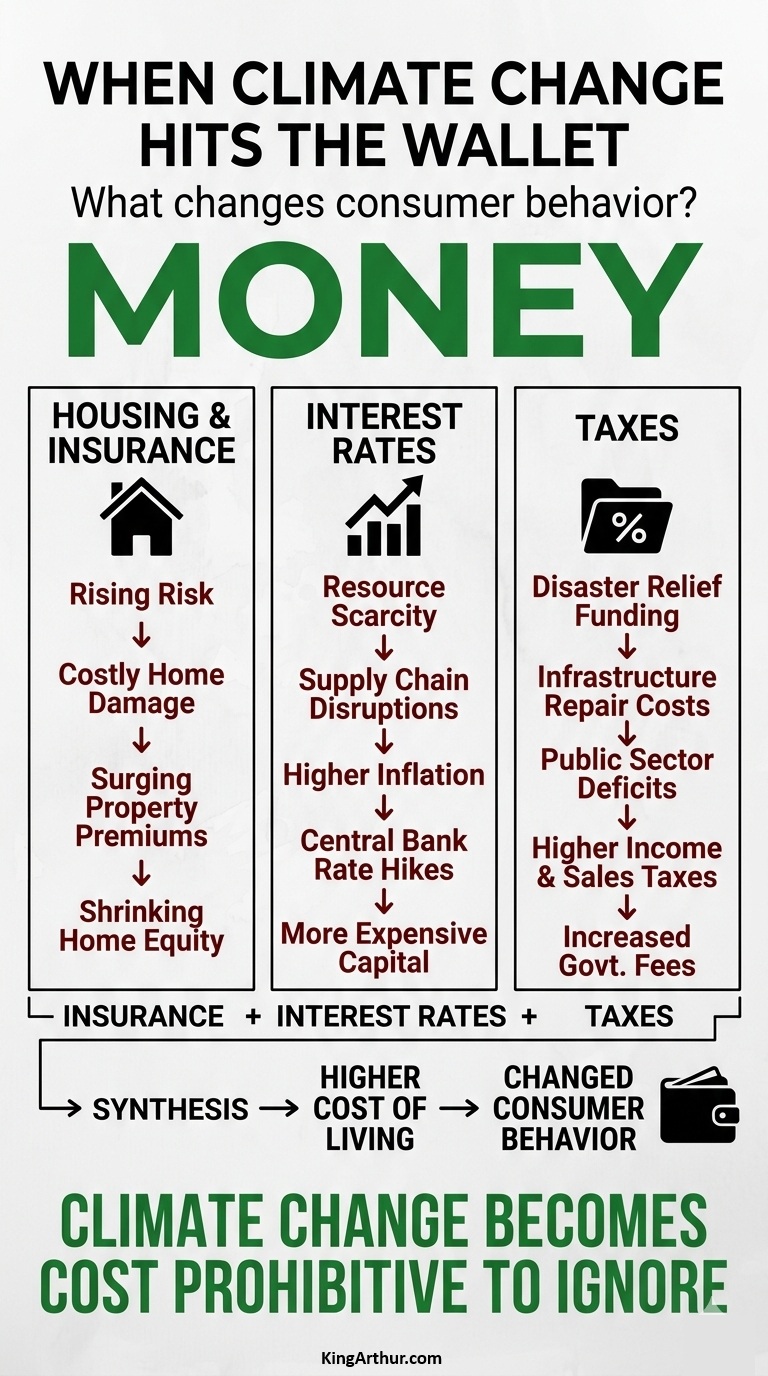
Simplified Social Media Version
💰 WHEN CLIMATE CHANGE HITS THE WALLET
What will actually change consumer behavior when it comes to climate change?
Money.
Insurance. Interest rates. Taxes.
For years, climate change was largely treated as an environmental issue. But that is changing as climate risk increasingly enters the household economy.
🏠 Insurance premiums and availability are being affected by rising climate risks.
💰 Climate-related economic and fiscal pressures are affecting the cost of capital.
🧾 The growing costs of climate damage, adaptation, infrastructure, and energy transition are increasingly flowing through tax systems.
These forces can reinforce one another:
Climate change → financial disruption → higher household costs → changed consumer behavior
Consumers may ignore a temperature graph. They are much less likely to ignore an insurance cancellation, a higher mortgage payment, or a rising tax bill.
Climate change does not have to be universally accepted before it changes behavior.
It only has to become cost prohibitive to ignore.
New paper:
“When Climate Change Hits the Wallet: Insurance, Interest Rates, and Taxes”