by Daniel Brouse
Introduction: Climate Change as an Economic and Human Security Crisis
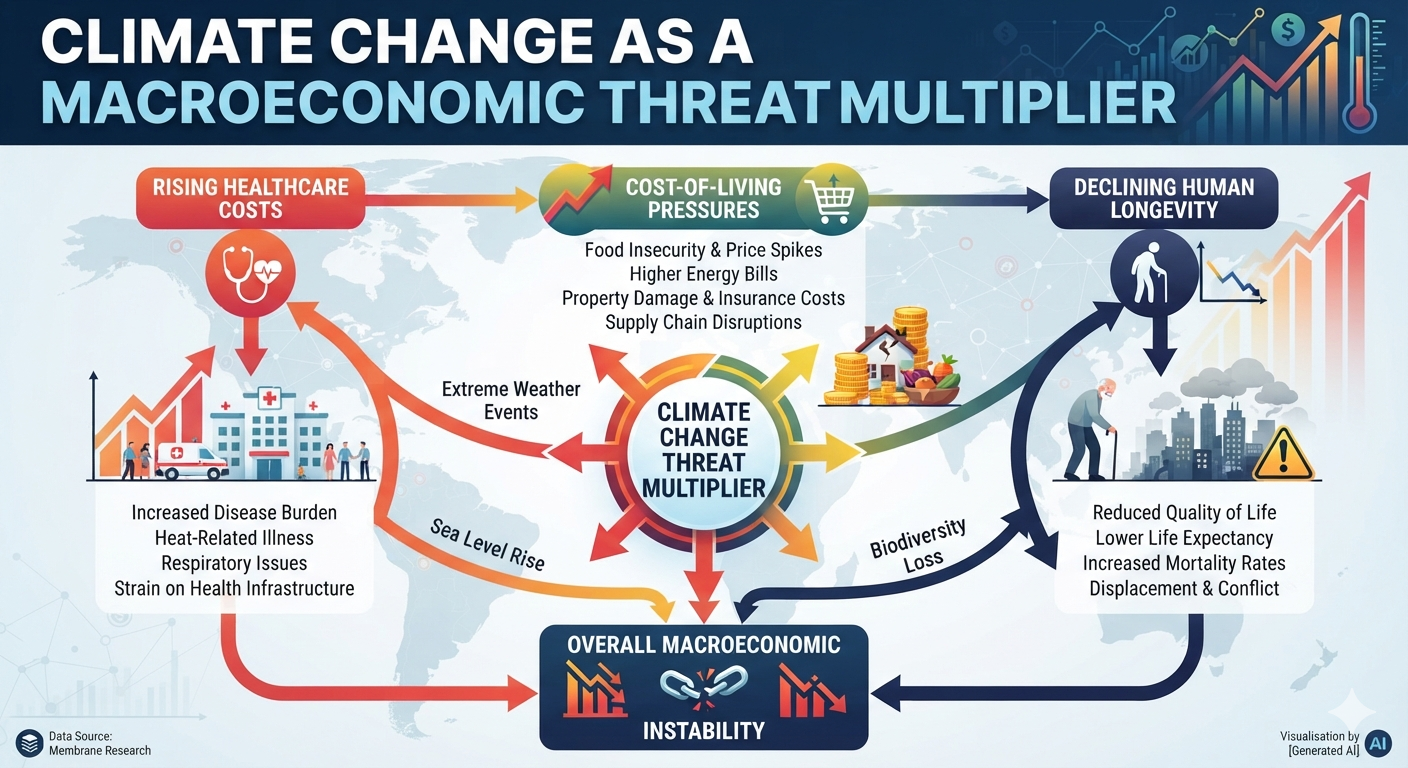
Climate change is no longer only an environmental challenge; it has become a powerful macroeconomic threat multiplier that amplifies existing social, economic, and public health vulnerabilities. Rising temperatures, increasingly extreme weather events, deteriorating air quality, and destabilized ecosystems are creating cascading financial pressures that extend from governments and businesses to individual households.
The economic consequences of climate change are increasingly visible through three interconnected pathways:
- Escalating healthcare costs caused by heat exposure, air pollution, infectious diseases, and climate-related disasters.
- Erosion of living standards through inflationary pressures on food, energy, insurance, housing, and public infrastructure.
- Declining human longevity as environmental stressors undermine physical health, increase mortality, and reverse decades of progress in life expectancy.
These impacts are not distributed equally. Low-income households, elderly populations, outdoor workers, and marginalized communities often face the greatest exposure while having the fewest resources to adapt. Climate change therefore transforms environmental instability into a localized economic and human health crisis.
I. Escalating Healthcare Costs: Climate Change as a Global Medical Expense Multiplier
Climate change is placing unprecedented strain on healthcare systems by increasing both the frequency and severity of climate-related illnesses while simultaneously disrupting healthcare infrastructure.
1. Trillions of Dollars in Climate-Driven Health Burdens
The financial consequences of climate-related health impacts are expected to reach historic levels.
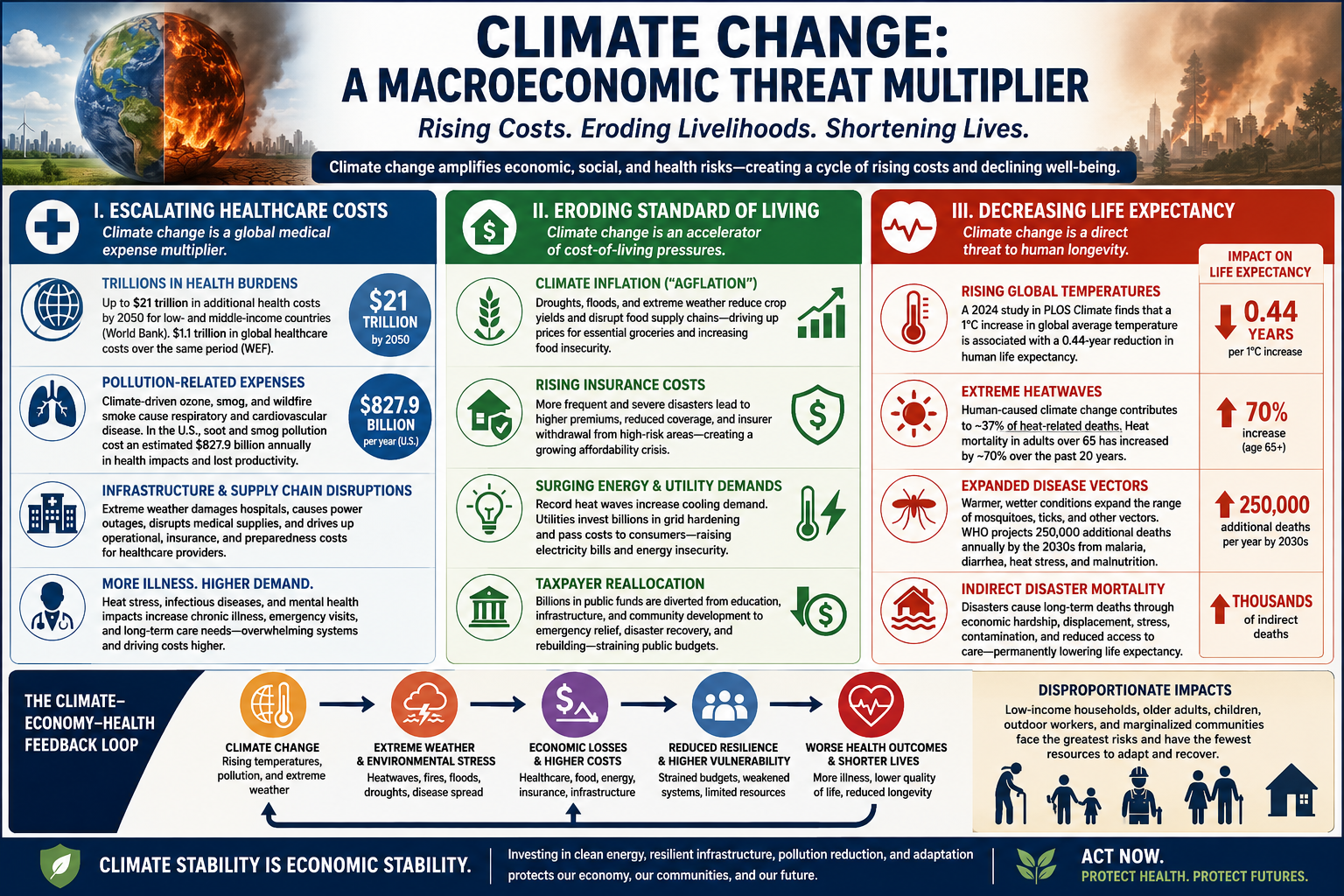
- The World Bank estimates that climate-related health crises could impose approximately $21 trillion in additional costs by 2050 across low- and middle-income countries, reflecting increased disease burdens, reduced productivity, and expanding healthcare needs.
- The World Economic Forum estimates that climate change could create approximately $1.1 trillion in additional global healthcare costs over the same period.
These costs represent more than direct medical expenses. They include lost productivity, reduced workforce participation, premature mortality, emergency response requirements, and infrastructure adaptation.
2. Pollution-Related Healthcare Expenses
Climate change and fossil fuel combustion are closely linked. Rising temperatures accelerate atmospheric chemical reactions that increase ground-level ozone formation, intensifying smog episodes and worsening respiratory and cardiovascular disease.
Fine particulate matter (PM2.5), ozone, wildfire smoke, and other pollutants contribute to:
- Asthma and chronic respiratory illness
- Heart attacks and strokes
- Lung disease
- Premature deaths
- Increased emergency room visits
In the United States alone, soot and smog pollution are estimated to generate hundreds of billions of dollars annually in health-related costs, including medical expenses and lost economic productivity.
The growing frequency of wildfire smoke events demonstrates how climate impacts can transform regional air pollution into a national health emergency. Smoke from distant wildfires can travel thousands of miles, exposing millions of people far from the original source.
3. Healthcare Infrastructure and Supply Chain Disruptions
Extreme weather events increasingly threaten the operational stability of healthcare systems.
Climate-related disruptions include:
- Hospitals losing electrical power during heat waves, hurricanes, and wildfires
- Flooding damaging medical facilities
- Disruptions in pharmaceutical and medical equipment supply chains
- Increased emergency response costs
- Higher insurance and operational expenses for healthcare providers
Hospitals are being forced to spend billions on climate resilience measures, including backup power systems, flood protection, cooling infrastructure, and emergency preparedness.
II. Eroding Standard of Living: Climate Change as a Cost-of-Living Accelerator
Climate change is increasingly becoming an economic reality experienced directly through household budgets. The same forces increasing healthcare costs are also driving inflationary pressures throughout the economy.
1. Climate Inflation and Agricultural Instability (“Agflation”)
Food systems are among the most climate-sensitive sectors of the global economy.
Rising temperatures, droughts, flooding, changing precipitation patterns, and extreme storms reduce agricultural productivity by damaging:
- Crop yields
- Livestock health
- Fisheries
- Agricultural infrastructure
- Transportation networks
These disruptions create supply-side inflation, increasing prices for essential goods including:
- Grains
- Fruits and vegetables
- Meat and dairy products
- Transportation-dependent food products
Climate-driven food inflation disproportionately harms lower-income households because food represents a larger percentage of their monthly expenses.
2. Rising Insurance Costs and the Retreat From High-Risk Regions
The insurance industry has become one of the clearest economic indicators of accelerating climate risk.
As hurricanes, wildfires, floods, and severe storms become more frequent and destructive:
- Insurance premiums increase dramatically.
- Coverage becomes more restricted.
- Insurers withdraw from vulnerable markets.
- Property values decline in high-risk regions.
Homeowners increasingly face a difficult choice: pay rapidly increasing premiums or assume greater financial risk without adequate coverage.
This creates a growing climate affordability crisis, particularly for homeowners living in areas exposed to wildfire, coastal flooding, extreme storms, and severe weather.
3. Rising Energy Demand and Utility Costs
Climate change increases energy demand while simultaneously placing stress on energy infrastructure.
During extreme heat events:
- Electricity consumption rises sharply due to increased air conditioning demand.
- Utilities must invest billions in grid upgrades.
- Transmission systems require additional protection against storms and wildfires.
- Maintenance costs are passed onto consumers.
The result is a climate feedback loop:
Hotter temperatures → Greater cooling demand → Higher electricity consumption → Increased infrastructure costs → Higher household energy bills
Energy insecurity becomes a growing concern as vulnerable households struggle to afford cooling during dangerous heat events.
4. Taxpayer Costs and Public Financial Burdens
Climate disasters increasingly redirect public resources away from long-term investments toward emergency response and recovery.
Government spending is increasingly allocated toward:
- Disaster relief
- Infrastructure repairs
- Emergency housing assistance
- Flood recovery
- Wildfire response
- Agricultural assistance
These expenditures compete directly with funding for:
- Education
- Transportation improvements
- Community development
- Public health programs
Climate change therefore functions as a long-term fiscal drain, increasing government expenditures while reducing resources available for economic development.
III. Declining Human Longevity: Climate Change as a Biological Stressor
Beyond economic impacts, climate change increasingly affects the fundamental measure of human well-being: life expectancy.
The cumulative effects of extreme heat, pollution exposure, disease expansion, food insecurity, and climate disasters are slowing—and in some regions reversing—historical gains in longevity.
| Climate Driver | Impact on Human Health and Longevity |
|---|---|
| Rising Global Temperatures | A 2024 study published in PLOS Climate found that a 1°C increase in global average temperature is associated with approximately a 0.44-year reduction in life expectancy. |
| Extreme Heatwaves | Human-caused climate change is estimated to contribute to approximately 37% of heat-related deaths. Heat-related mortality among adults over age 65 has increased substantially over recent decades. |
| Expanded Disease Vector Ranges | Warmer and wetter conditions allow mosquitoes, ticks, and other disease vectors to expand into new regions, increasing risks from malaria, dengue fever, Lyme disease, and other infections. |
| Food and Water Stress | Climate disruption increases risks of malnutrition, dehydration, agricultural failure, and water insecurity, particularly in vulnerable populations. |
| Indirect Disaster Mortality | Floods, hurricanes, wildfires, and other disasters create long-term health impacts through displacement, economic hardship, psychological stress, and environmental contamination. |
IV. The Climate-Economy-Health Feedback Loop
Climate change creates a reinforcing cycle:
Climate Change → Extreme Weather → Economic Losses → Higher Costs → Reduced Adaptation Capacity → Greater Vulnerability → Increased Health Impacts
This feedback loop means climate impacts are not isolated events. A wildfire, flood, or heat wave can simultaneously damage infrastructure, increase healthcare expenses, reduce productivity, raise insurance costs, and shorten human lives.
The poorest communities often experience the strongest effects because they have fewer resources to prepare, recover, and relocate.
Conclusion: Climate Stability Is Economic Stability
Climate change represents one of the largest economic and public health challenges of the modern era. Its consequences extend far beyond environmental degradation, affecting national budgets, household finances, healthcare systems, and human survival.
The emerging reality is clear:
- Climate change increases healthcare expenditures.
- Climate change accelerates inflationary pressures.
- Climate change reduces economic security.
- Climate change threatens human longevity.
Addressing climate change is therefore not simply an environmental investment—it is an economic resilience strategy and a public health imperative. Investments in clean energy, resilient infrastructure, pollution reduction, efficient buildings, and climate adaptation can reduce future costs while protecting both human health and economic stability.
The cost of inaction is no longer measured only in degrees of warming. It is measured in rising medical bills, shrinking household budgets, damaged communities, and lost years of human life.