by Daniel Brouse
From Biodiversity to Monoculture: The Socio-Economic-Ecological Feedback Loop
Climate change is often described as a problem of rising temperatures, but temperature is only one expression of the additional energy entering the Earth system.
That energy moves through the atmosphere, hydrologic cycle, soils, vegetation, ecosystems, agriculture, forests, and human economies. As each system responds, it can alter the conditions experienced by the others.
This creates feedback loops.
A recent investigation by the Center for Investigative Reporting found that glyphosate is being sprayed in California forests at record levels. The U.S. Forest Service, timber companies, and other land managers use glyphosate after wildfire or timber harvest to suppress competing vegetation and improve the establishment of commercially valuable conifers.
At first glance, this may appear to be a straightforward forestry practice: kill competing plants, plant trees, and accelerate forest recovery.
But viewed through the lens of climate-system dynamics, it raises a much larger question:
What happens when our response to climate disruption further simplifies the ecosystems we depend upon for resilience?
Climate Energy Is Changing the Recovery Environment
Western forests are already experiencing a combination of higher temperatures, increasing atmospheric moisture demand, changing precipitation and snowpack, declining soil moisture, drought stress, and increasingly severe wildfire.
Our earlier paper, Western U.S. Woodlands Ecosystem Conversion, examines what happens when these pressures push a forest beyond its ability to regenerate.
A forest can experience increasing stress for years without an obvious transformation. Then a threshold can be crossed.
Trees die.
Seed sources disappear.
Regeneration fails.
Shrubs and grasses occupy the landscape.
The ecosystem begins transitioning from one state to another.
As the paper explains, under moderate emissions scenarios, up to 40% of western conifer forests could convert to shrubland or grassland by 2100.
That is not simply forest damage.
It is ecosystem conversion.
And once we recognize that distinction, the economics of post-fire forest management look different.
The Economics of Reforestation
After a major wildfire, rapidly growing shrubs, grasses, ferns, and deciduous vegetation can compete with planted conifer seedlings for water, nutrients, and sunlight.
From a timber-production perspective, that competition is a problem.
Glyphosate provides an efficient way to remove it.
The Forest Service has used herbicide treatments as part of regeneration efforts because suppressing competing vegetation can improve the early survival and growth of desired seedlings. Forest research acknowledges that this is one reason herbicides have been used in reforestation.
The economic objective is therefore understandable:
reduce competition → increase seedling survival → accelerate timber production.
But that is not necessarily the same objective as:
restore biodiversity → restore ecological function → increase climate resilience.
Those two objectives can overlap.
They can also conflict.
A Forest Is Not a Tree Farm
The distinction matters because a forest is not simply a collection of trees.
A functioning forest contains an enormous biological network:
- multiple tree species
- shrubs
- grasses
- flowering plants
- fungi and mycorrhizal networks
- insects and pollinators
- birds
- mammals
- reptiles and amphibians
- soil organisms
- decomposers
- streams and wetlands
- genetic diversity
Each component participates in the functioning of the ecosystem.
When glyphosate is applied to eliminate “competing” vegetation, those plants are competitors only from the perspective of the desired crop.
From the perspective of the ecosystem, they may be food, shelter, habitat, soil cover, pollinator resources, firebreaks, nutrient sources, or participants in water and carbon cycling.
This creates a fundamental difference between restoration and production.
Production asks:
How efficiently can we produce the desired commodity?
Ecological restoration asks:
How effectively can we restore the biological relationships that make the ecosystem resilient?
Biodiversity Is Infrastructure
Biodiversity is often treated as an aesthetic or conservation issue.
It is much more than that.
Biodiversity is a form of ecological infrastructure.
Different species respond differently to drought, heat, insects, disease, fire, and changing precipitation. A diverse ecosystem therefore contains multiple biological responses to disturbance.
If one species performs poorly, another may survive.
If one food source disappears, another may remain.
If one plant cannot regenerate under new climatic conditions, another may occupy the available ecological niche.
This is one reason biological diversity can provide resilience.
A simplified ecosystem has fewer alternatives.
A diverse ecosystem has more.
That distinction becomes increasingly important as climate variability increases.
From Biodiversity to Monoculture
The problem becomes more obvious when forestry is compared with modern industrial agriculture.
Large-scale agriculture often relies on monocultures: enormous areas devoted to a single crop or a very small number of genetically similar crops. Monoculture creates economic efficiencies. Machines can plant, fertilize, spray, harvest, and transport a standardized product at enormous scale. But biological simplification creates vulnerabilities.
A pest that specializes in the crop has an enormous continuous food supply. A disease can spread rapidly through genetically similar plants. Soil nutrients can become depleted. Pollinator and insect diversity can decline. Herbicide and pesticide dependence can increase.
The economic system becomes increasingly dependent upon external inputs to maintain productivity.
The result can be a feedback loop:
biodiversity declines → ecological resistance declines → pests and disease become more consequential → chemical inputs increase → biodiversity declines further.
This is not an argument that all monoculture agriculture inevitably fails.
It is an argument that efficiency and resilience are not the same thing.
The same distinction applies to forestry.
The Forest Monoculture
When post-fire management suppresses naturally regenerating vegetation in order to establish commercially desirable conifers, the landscape can move toward a forest plantation rather than a naturally regenerating forest.
A plantation can contain thousands of trees and still possess considerably less biodiversity than the ecosystem it replaced.
This creates a dangerous semantic trap. We see trees. We call it a forest. But ecological function depends upon far more than tree cover.
A plantation of one or a few commercially valuable species can look green from above while functioning very differently from a diverse forest.
And in a warming climate, that distinction can become critical.
Ecosystem Conversion Versus Reforestation
This is where the concept of ecosystem conversion becomes important.
Suppose a severe wildfire destroys a mature conifer forest.
The original ecosystem does not necessarily return.
Under the warmer and drier conditions described in my Western U.S. Woodlands paper, grasses and shrubs may become better adapted to the post-fire environment than the trees that previously occupied it.
The landscape may therefore transition:
forest → wildfire → shrubland/grassland
That is climate-driven ecosystem conversion.
Now introduce intensive human intervention:
forest → wildfire → herbicide → removal of natural competitors → planted conifers → managed timber plantation
This is something different.
The second pathway is not simply allowing the ecosystem to respond to its new climate. It is imposing an economic land-use objective upon that response. That distinction should be explicit in public policy.
The Carbon Question
There is another important distinction. A green landscape is not necessarily equivalent to the forest that existed before. Grasslands and shrublands photosynthesize and absorb carbon.
So do plantations.
But carbon uptake is not the same thing as carbon storage.
A mature forest contains carbon in:
- trunks
- branches
- roots
- dead wood
- forest soils
- long-lived biomass
The Ecosystem Conversion paper makes this distinction explicitly:
carbon uptake ≠ carbon storage capacity
and
positive carbon flux ≠ preservation of the previous carbon stock.
A plantation may therefore satisfy a narrow definition of reforestation while failing to reproduce the carbon reservoir, biodiversity, hydrology, and ecological complexity of the original forest.
The Glyphosate Feedback
This brings us back to glyphosate. The current controversy is not simply about a herbicide. It is about the interaction between climate disruption, economic incentives, land management, biodiversity, and ecosystem resilience.
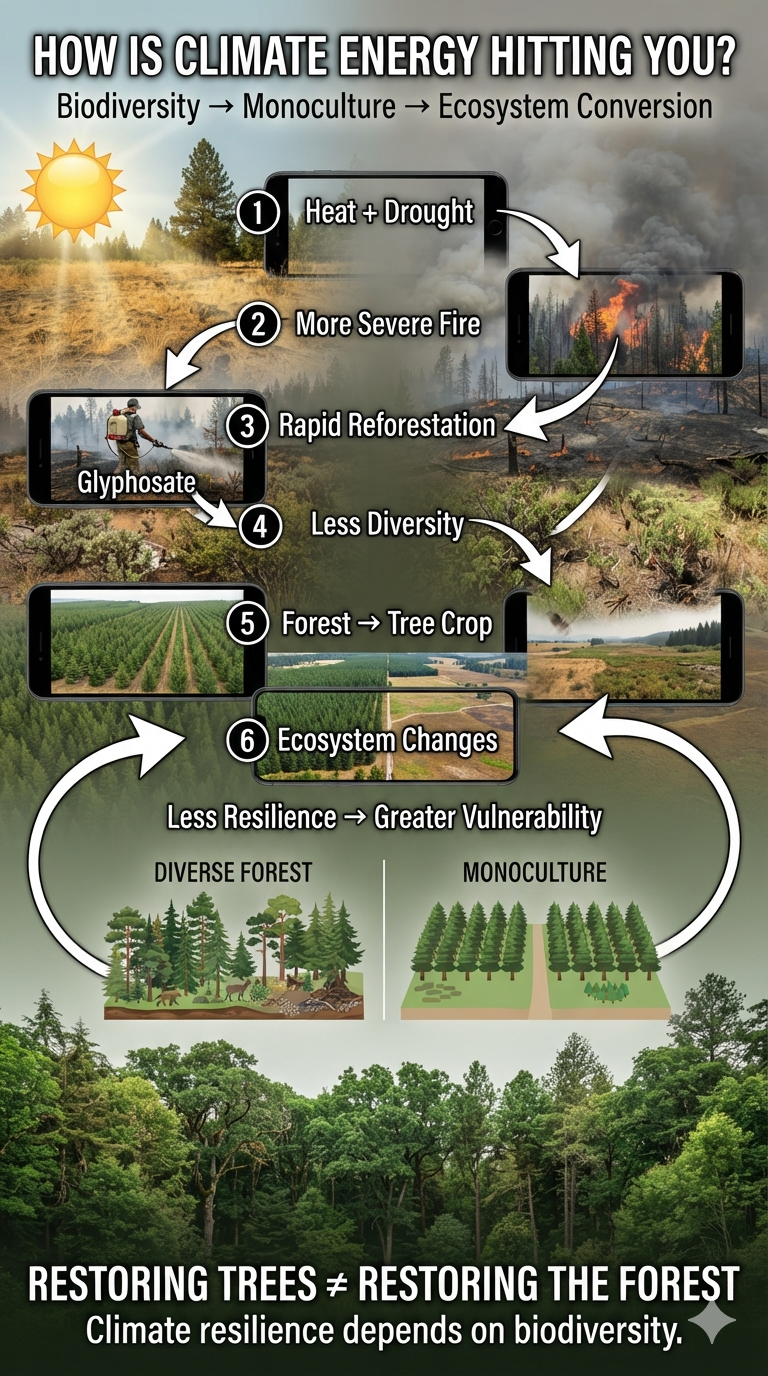
The emerging feedback looks something like this:
Climate warming
↓
Heat + drought + atmospheric moisture demand
↓
More severe wildfire
↓
Loss of mature forest
↓
Economic pressure to recover timber production
↓
Herbicide use to suppress competing vegetation
↓
Reduced vegetation diversity
↓
Simplified forest structure
↓
Greater dependence on managed inputs
↓
Potentially reduced ecological resilience
↓
Greater vulnerability to future climate disturbances
This does not mean glyphosate necessarily causes every subsequent step.
The feedback is systemic.
The larger point is that a management strategy designed to optimize one component of a complex system can unintentionally weaken other components.
The Scientific Evidence Must Be Independent
There is also a legitimate question about the evidence used to evaluate glyphosate. The recent investigation found that a study heavily relied upon by the Forest Service in assessing glyphosate safety was subsequently retracted after concerns about Monsanto’s involvement in the research process.That does not establish that every use of glyphosate is unsafe. It does establish why the underlying evidence should be independently reviewed.
When government policy determines what chemicals can be sprayed across public landscapes, the scientific foundation for those decisions should be exceptionally transparent.
Public land requires public confidence. And public confidence requires independent science.
From Wildfire Recovery to a National Policy
The issue also has a national economic dimension.
On February 18, 2026, President Donald Trump signed an executive order titled “Promoting the National Defense by Ensuring an Adequate Supply of Elemental Phosphorus and Glyphosate-Based Herbicides.”
The order invokes the Defense Production Act and directs federal action to ensure an adequate domestic supply of glyphosate-based herbicides. That places glyphosate within a much larger economic framework involving agriculture, forestry, chemical manufacturing, supply chains, and national security.
The feedback becomes:
climate disruption → increased agricultural and forestry stress → greater dependence on chemical intervention → greater economic importance of chemical production → stronger incentives to maintain chemical availability.
The system becomes self-reinforcing.
The Bigger Problem: Optimizing the Wrong Variable
Climate change forces us to rethink what we mean by efficiency. A system can be economically efficient while being ecologically fragile. A monoculture can produce enormous quantities of a commodity while containing very little biological diversity. A plantation can produce timber while failing to reproduce the ecological functions of a natural forest. A landscape can be covered in green vegetation while holding substantially less carbon than the forest it replaced. And a post-fire intervention can accelerate tree planting while simultaneously simplifying the ecosystem that must survive the next climate shock.
The central question is therefore not:
How quickly can we replace the trees we lost?
It is:
What kind of ecosystem will survive the climate that is coming?
The Resilience Test
Climate change is increasing the importance of resilience.
A resilient ecosystem does not necessarily maximize production under ideal conditions.
It maintains function when conditions become abnormal.
That means diversity matters.
Species diversity.
Genetic diversity.
Structural diversity.
Age diversity.
Habitat diversity.
Landscape diversity.
Biological diversity is effectively a portfolio of responses to uncertainty.
Industrial systems tend to reduce that diversity because standardization creates efficiency.
Climate instability does the opposite.
It increases the value of diversity.
That creates one of the central contradictions of the climate era:
The more unstable the climate becomes, the more we need ecological diversity—and the more economic pressure we may face to simplify ecosystems for efficiency.
Climate Energy Is Hitting the Whole System
This is ultimately what I mean by How Is Climate Energy Hitting You?
Climate energy does not stop with a thermometer reading or a measurement of atmospheric carbon dioxide. It moves through the entire coupled human-Earth system.
Heat changes water demand.
Water stress changes forests.
Forest stress changes wildfire.
Wildfire changes ecosystems.
Ecosystem disruption changes economic decisions.
Economic decisions change land management.
Land management changes biodiversity.
Biodiversity changes resilience.
And declining resilience feeds back into the next disturbance.
The resulting system is not a collection of unrelated environmental problems. It is a coupled socio-economic-ecological feedback system in which changes in one component propagate through the others.
Wildfire becomes an economic loss.
Economic loss creates pressure for rapid recovery.
Rapid recovery creates demand for herbicides, machinery, labor, and planted timber.
Those interventions alter ecosystems.
Altered ecosystems influence water, biodiversity, soil, carbon storage, and future fire behavior.
Government policy can then reinforce the economic system that produced the intervention in the first place.
The feedback can therefore become self-reinforcing.
The challenge is to recognize when a short-term economic solution becomes a long-term ecological feedback.
That distinction becomes especially important when an ecosystem crosses a threshold. Restoring the trees may not be the same thing as restoring the forest.
And once biodiversity has been converted into monoculture, replanting the landscape does not necessarily recreate the ecosystem that was lost.
Climate change is not simply changing the weather.
It is changing the decisions we make about the world around us—and those decisions can become feedbacks that determine how resilient that world remains.