by Daniel Brouse
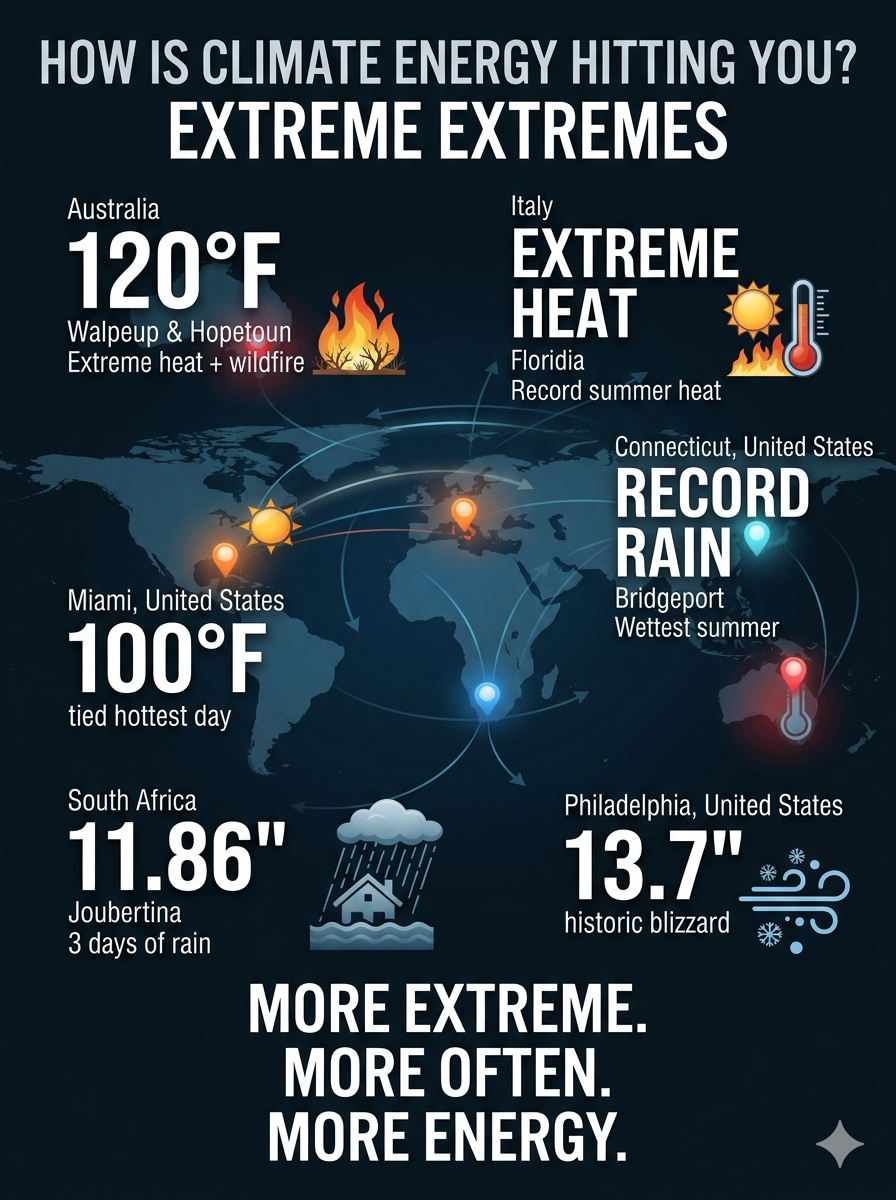
Extreme Extremes: Walpeup and Hopetoun, Australia; Floridia, Italy; Miami, Florida; Joubertina, South Africa; Bridgeport, Connecticut; Philadelphia, Pennsylvania
Extreme Extremes: Record Heat, Rain, Snow, and Flooding Around the World
Several towns and cities across the globe have broken or approached major historical extreme-weather records so far in 2026. From record-setting heat in Australia and Florida to extraordinary rainfall in South Africa and Connecticut—and a historic blizzard in Philadelphia—the pattern is increasingly difficult to characterize as ordinary weather variability.
🌡️ Extreme Heat & Wildfires
Walpeup and Hopetoun, Australia: In late January 2026, these two towns in Victoria baked under a staggering 48.9°C (120°F) during a catastrophic wildfire season, setting potential all-time temperature records for the region.
Floridia, Italy: This Sicilian town has continued to experience intense summer heat, drawing international attention as one of Europe’s extreme heat zones.
Miami, Florida: In August 2026, Miami officially tied its all-time hottest day on record at 100°F, another indication of how extreme heat is becoming an increasingly familiar feature of the climate.
🌧️ Torrential Rain & Flooding
Joubertina, South Africa: Between May 5 and May 8, 2026, an intense low-pressure system dumped a historic 301.2 mm (11.86 inches) of rain on the town in just three days, triggering devastating flash floods.
Bridgeport, Connecticut: In August 2026, Bridgeport recorded its wettest meteorological summer on record, following a relentless series of heavy downpours.
❄️ Severe Snow & Blizzards
Philadelphia, Pennsylvania: In late February 2026, a massive historic blizzard blanketed the region with 13.7 inches of snow, accompanied by intense, gale-force winds. It was the city’s most severe single-day snowfall event in a decade.
The Bigger Picture
These events span three continents and multiple climate extremes: record heat, wildfire conditions, torrential rainfall, flash flooding, extreme wetness, and major winter storms.
Climate change does not mean that every extreme-weather event is caused by climate change. It does mean that a warmer atmosphere and warmer oceans can alter the conditions in which these events develop—loading the climate system with additional energy and moisture and increasing the potential for extremes.
The question is no longer simply whether extreme weather is occurring.
The question is how much more extreme the extremes are becoming—and how quickly.