by Daniel Brouse
Death Valley: When the Desert’s Extremes Become More Extreme
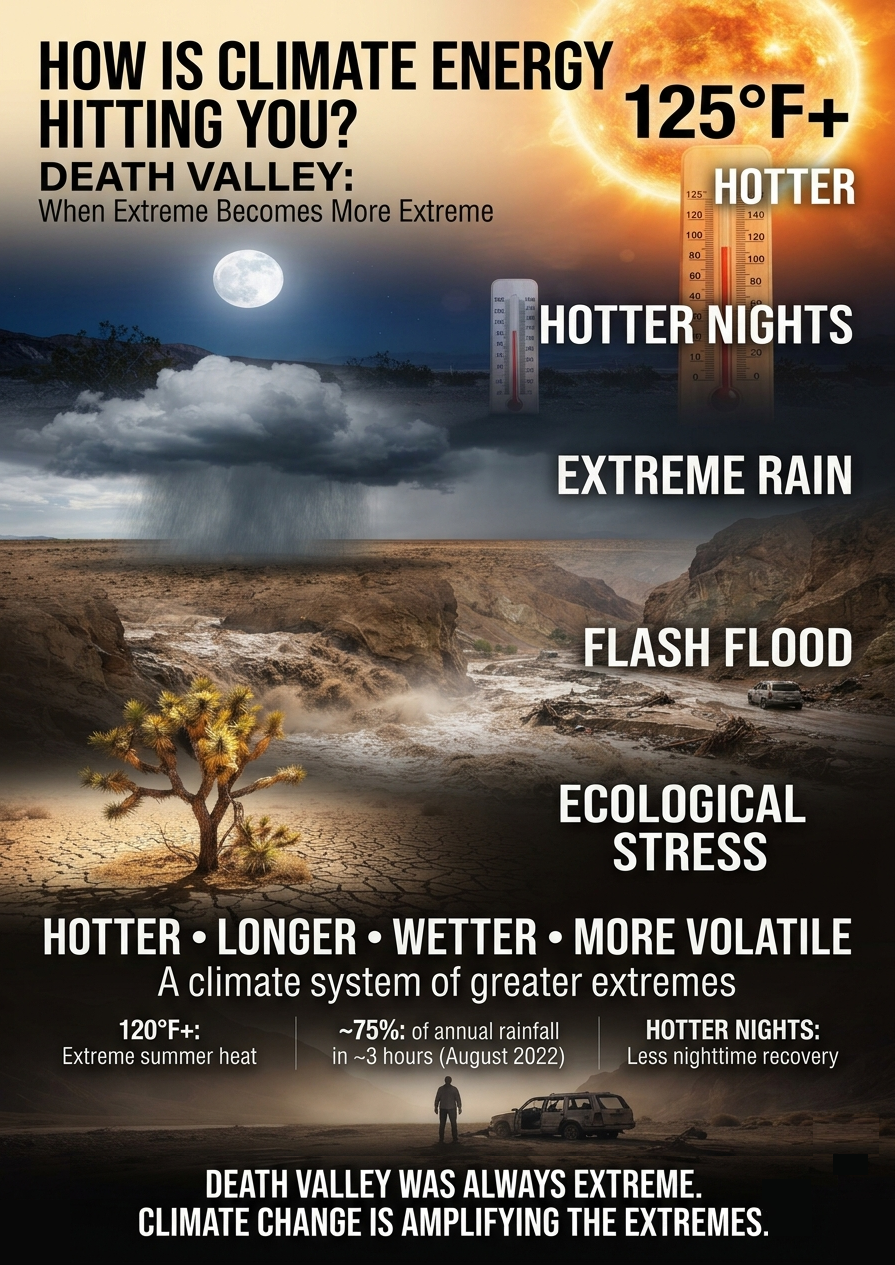
Death Valley has always been one of the hottest, driest, and most inhospitable places on Earth. But human-caused climate change is pushing those natural extremes into increasingly dangerous territory. The valley’s unique topography—essentially a vast natural basin that traps heat—can amplify warming, while changing atmospheric conditions are producing longer heat waves, warmer nights, more intense rainfall, and increasing ecological stress.
Death Valley is not simply getting hotter. Its entire pattern of extremes is becoming more extreme.
Death Valley Lives Up to Its Name
The danger is not theoretical. Extreme heat, difficult terrain, vehicle accidents, and sudden medical emergencies make Death Valley one of the most hazardous environments in the National Park System.
August 2026: Extreme Heat and Fatalities
- Pierre Michel Formosa — August 17, 2026: The 68-year-old French tourist died after his rental vehicle became stuck in mud on remote West Side Road. In temperatures reaching 116°F (46.6°C), Formosa and his companion attempted to walk across the open salt flats toward Badwater Road for help. Formosa collapsed and died roughly 1.3 miles into the trek. Park officials subsequently reminded visitors to remain with disabled vehicles, particularly where shade and visibility can improve the chances of rescue.
- Unresponsive visitor south of Badwater — August 2026: Emergency responders located a deceased woman after receiving reports of an unresponsive visitor during a stretch of consecutive days in which temperatures exceeded 120°F.
Extreme heat can also contribute to mechanical failures and indirect deaths. When temperatures become extreme, vehicles, tires, batteries, cooling systems, electronics, and other mechanical components are pushed beyond the conditions for which they were designed. A breakdown in a remote or dangerously hot environment can quickly become a life-threatening event.
Death Valley provides a stark example. Some deaths there have been associated with vehicle failures that left people stranded in extreme heat. In such cases, the vehicle failure itself may not be the direct cause of death, but it can become a critical link in the chain of events that ultimately leads to fatal heat exposure.
This is an important dimension of climate risk that is easy to overlook. Extreme heat doesn’t only affect the human body directly; it can destabilize the systems people depend on to survive. A failed vehicle can mean the loss of transportation, air conditioning, communications, or access to water and medical assistance. As extreme temperatures become more frequent and intense, these indirect pathways to injury and death become increasingly important to consider.
1. Scorching Heat Waves Are Lasting Longer
Death Valley has always experienced extraordinary heat. Climate change, however, is increasing the baseline temperature on which these extremes occur, making prolonged heat events more dangerous.
Persistent high-pressure systems and heat domes can trap hot air over the region. Instead of experiencing a brief spike in temperature followed by meaningful relief, the valley can endure successive days of extraordinary heat.
Death Valley has repeatedly approached or exceeded 125°F (51.7°C) during major heat events, including extraordinarily long runs of extreme temperatures. The park’s record-setting summers increasingly cluster in the recent decades, illustrating how the climate baseline has shifted.
The significance is not simply another record high.
A hotter baseline makes extreme heat easier to reach—and harder to escape.
2. The Nights Are Getting Hotter
One of the most consequential changes associated with global warming is the rise in nighttime temperatures.
Historically, desert nights provided at least some relief from daytime heat. But as temperatures rise, that recovery period is becoming less reliable. During prolonged summer heat events, nighttime temperatures can remain extraordinarily high, sometimes failing to fall below 80°F and, during the most extreme events, remaining near or above 100°F (37.8°C).
That matters because the human body needs opportunities to shed accumulated heat.
When nights remain unusually warm, people, animals, vegetation, and infrastructure begin the next day without fully recovering from the previous one. The result is a form of cumulative heat stress:
Hot day → insufficient nighttime cooling → hotter starting point → greater heat stress → even greater vulnerability.
In Death Valley, where daytime temperatures can already exceed 120°F, the loss of nighttime relief is particularly dangerous.
3. “Once-in-a-Thousand-Year” Flash Floods
Death Valley presents a striking climate paradox: one of the driest places in North America can also experience devastating flash floods.
Warmer air can hold more atmospheric moisture. When that moisture is released in intense thunderstorms, rainfall can overwhelm the desert’s ability to absorb and channel the water.
The result can be catastrophic.
In August 2022, a historic storm dropped roughly 75% of Death Valley’s average annual rainfall in only about three hours. Floodwaters trapped hundreds of visitors, damaged or destroyed vehicles, and severely damaged park infrastructure.
The event demonstrated an important feature of a warming climate:
Extreme drought and extreme rainfall are not opposites. They can occur in the same place—and increasingly interact with one another.
Parched, hardened or poorly infiltrating desert surfaces can transform intense rainfall into rapidly moving floodwater. Canyons and steep terrain then concentrate that water into powerful torrents.
A place can therefore become simultaneously hotter, drier, and more vulnerable to extreme flooding.
4. Seasons Are Shifting
The climate signal is not confined to the middle of summer.
Extreme heat can arrive earlier in the year, rapidly drying winter and early-spring vegetation and shortening the period when conditions are relatively hospitable.
That matters because Death Valley’s plants and animals have evolved within a narrow set of environmental conditions. They are adapted to heat and drought—but adaptation has limits when environmental conditions change faster than biological systems can respond.
The park’s famous desert ecosystems are therefore being exposed to multiple pressures at once:
- Earlier and more persistent heat
- Greater evaporative demand
- Reduced soil moisture
- Longer periods of drought
- More intense rainfall events
- Greater wildfire and vegetation stress
- Reduced opportunities for seasonal recovery
Species that depend on specific temperature and moisture conditions can be especially vulnerable. Joshua trees, for example, face increasing difficulty establishing new seedlings in portions of the Southwest as hotter and drier conditions alter the environments needed for successful reproduction.
Bird populations and other wildlife are also affected by changes in water availability, food resources, vegetation, and extreme heat.
Death Valley Is Becoming a Climate Stress Test
Death Valley has always been an extreme environment. That is precisely why it provides such a powerful illustration of climate change.
Climate change does not need to transform Death Valley into something completely different. It can amplify the characteristics that already define it.
The heat becomes hotter.
The heat lasts longer.
The nights provide less relief.
Rain falls less predictably and can arrive with greater intensity.
The seasons shift.
Ecological recovery becomes more difficult.
The result is not simply a warmer Death Valley. It is a more volatile and increasingly stressful climate system.
Death Valley has always lived up to its name.
The emerging question is whether the ecosystems—and the people who venture into them—can continue to live with the increasingly extreme conditions that made the valley famous in the first place.