by Daniel Brouse and Sidd Mukherjee
Why Do Scientists Use AI?
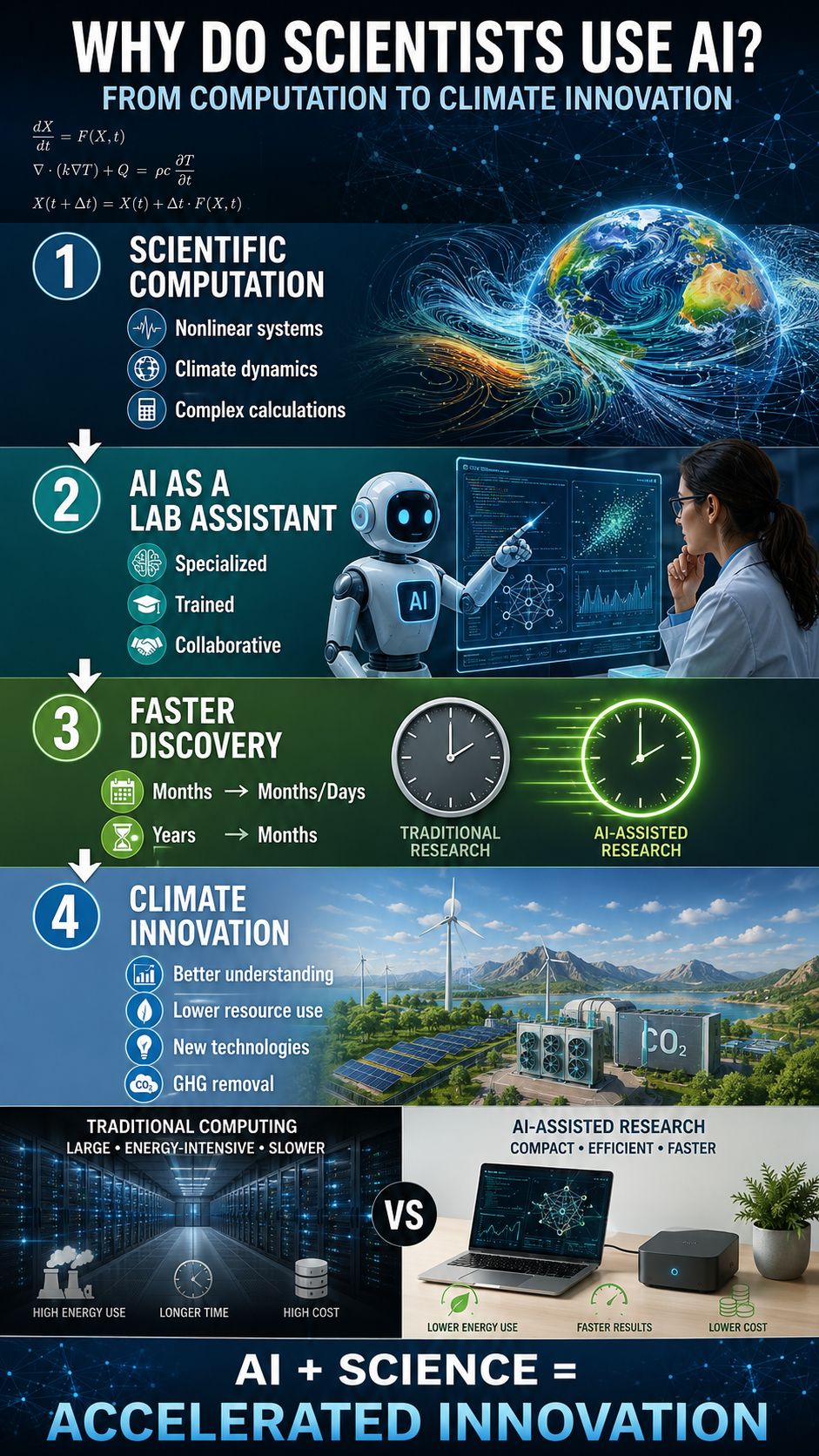
The short answer is:
We’ve conducted case studies on the use of AI in a wide variety of environments, including everything from the dynamics of nonlinear chaotic systems to songwriting and musical production.
All produced similar results—benefits to the environment, the economy, and society.
For instance, the climate education and graphics used for this post are based on this scientific paper as well as the publicly accessible version.
If I had created them manually, the costs in time, labor, energy, and resources would have been substantial. Using AI, the direct dollar cost to me was effectively zero, the graphics were generated in about a minute, and the estimated natural-resource cost was roughly $0.067 per image.
By comparison, producing similar graphics through traditional methods could easily have cost hundreds of dollars when accounting for labor, software, revisions, and associated natural-resource use. Mathematically, the AI-generated version required approximately 0.005% of those resources—just five thousandths of one percent of the traditional cost. These savings are equivalent to a reduction in environmental impact.
The benefits—in both environmental savings to the planet through reduced physical-resource use and in the ability to produce and distribute education—far outweigh the costs.
Most importantly:
The only effective way to stop the acceleration of climate change is through the reduction of fossil-fuel combustion.
However, the most likely way of reversing the trajectory of climate change is through people using AI to develop previously unthought-of methods and technologies that can fundamentally change how we produce, consume, and manage resources—and potentially remove greenhouse gases from the atmosphere.
Anti-Science and Technology Rhetoric
Unfortunately, the lack of science and technology literacy is at the root of many of society’s problems. Anti-AI opinions are ironically very similar to the anti-science rhetoric used by climate-change deniers.
Climate-change deniers tend to have little, if any, experience as climate scientists. They often show signs of impaired executive function: the brain’s ability to plan, analyze, and think abstractly. This makes processing complex or nuanced information nearly impossible, fostering an aversion to science, mathematics, and logic. Their thinking becomes rigid, emotionally driven, and black-and-white, leaving them highly susceptible to political propaganda, conspiracy theories, and fear-based messaging. Unable to reason critically or tolerate uncertainty, they cling to misinformation and reject rational discourse—no matter how much evidence is presented.
The same holds true for anti-technology opinions expressed in public. The ill-informed individual has likely never used AI in the role of a climate scientist. Scientists train their own highly specialized AI assistants. AI is artificial SUPPLEMENTAL intelligence. This is not how the ordinary individual usually interacts with AI.
In my case, I have spent years developing multiple specially trained “lab assistants” that have learned from scores of our own work. When Sidd and I started, our work had to be done on Ohio State computers and supercomputers that Sidd helped create. Things like “a floating decimal” were, and still are, a significant problem. Problems that needed solving would take months or years to process. The amount of energy spent on computation was enormous compared with today.
Things have changed for the better.
This year, we were able to establish third-derivative behavior across multiple climate indicators—extremely important developments in climate science that confirm that the acceleration rate of climate change is itself accelerating. This work was completed within four months. Historically, I would have been unlikely to complete this work in my lifetime if it were not for AI.
In the meantime, the United States has gone extremist in anti-science and anti-technology ideology, much to the detriment of science and scientists in the U.S. In fact, we are now working on bringing up our own AI computer using Chinese technology. It will be running on DeepSeek. The single computer will do the work of what used to take at least a dozen servers to accomplish, at a fraction of the price. It will not be run in a data center. It will not be costing society anything. In fact, it will be greatly benefiting society and helping to solve the climate crisis.
So, the next time you want to voice your opinion about AI, do your homework first. Start by getting at least a master’s-level education in climate science. Then spend years training your AI assistants. After completion, I would be happy to discuss AI with you.