by Daniel Brouse
December 16, 2025
Q3 2025: Extreme Global Temperature Anomalies
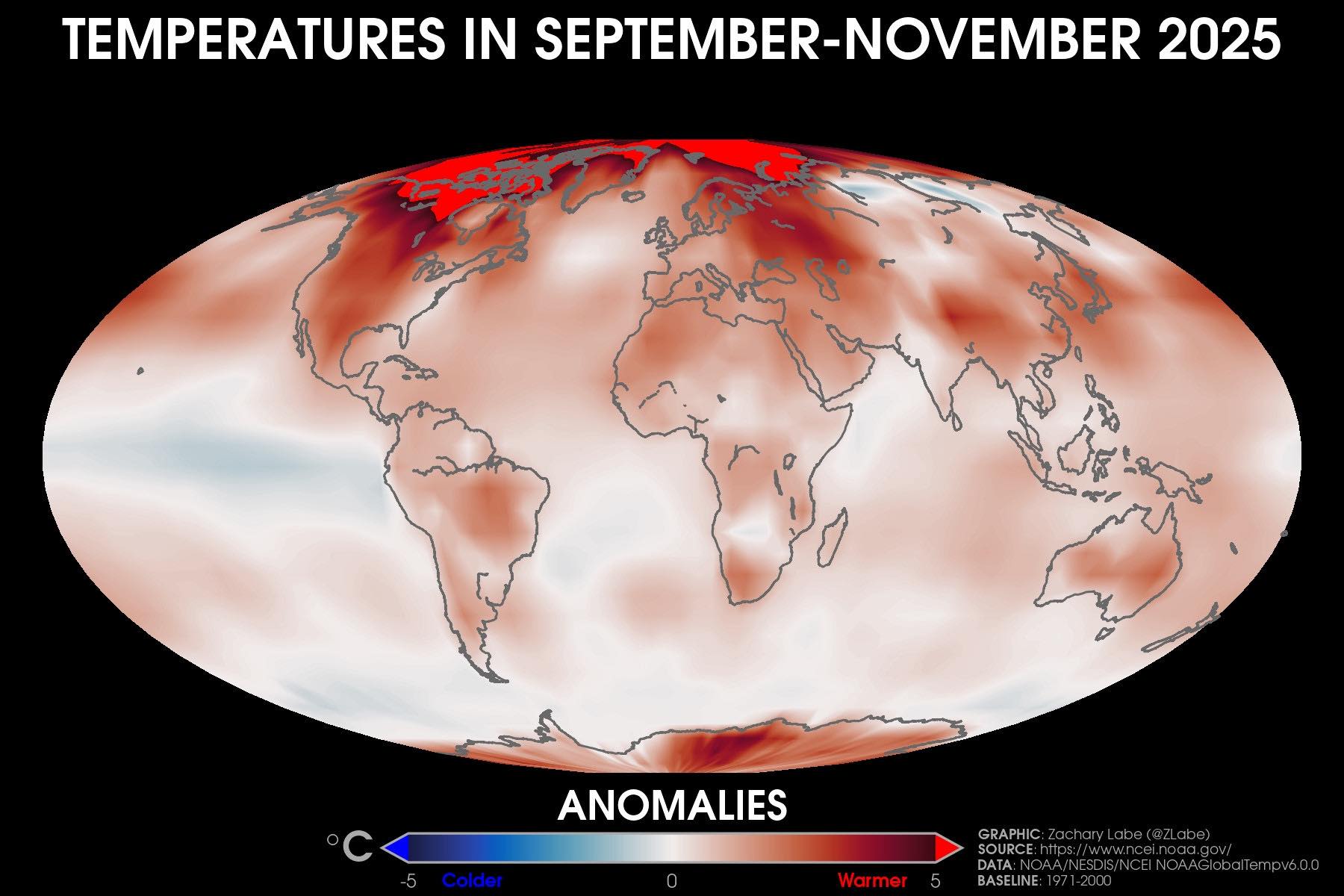
Autumn (September–November) climate data reveal two features that matter far more than the global average: what is happening at the poles and what is happening at the equator.
Both the Arctic and Antarctic are experiencing record-breaking temperatures—warming at rates up to 20 times faster than much of the rest of the planet, visible as deep red anomalies on global maps. This extreme polar amplification is not a regional curiosity; it is destabilizing the foundational circulation systems that regulate Earth’s climate, including the jet stream, the Atlantic Meridional Overturning Circulation (AMOC), and the Pacific Meridional Overturning Circulation (PMOC).
As a direct consequence, the Northeastern United States is now experiencing sharp climate whiplash: record cold conditions this week, followed by unseasonably warm temperatures days later. These are not random swings—they are signatures of a circulation system that is losing coherence.
The Poles: Where Climate Change Is Accelerating Fastest
The polar regions act as the planet’s thermal anchors. Normally, the large temperature contrast between the equator and the poles powers a fast, stable jet stream and robust ocean circulation. But as the Arctic warms nearly four times faster than the global average, and Antarctic ice loss accelerates, that temperature gradient is collapsing.
With less contrast to drive it, the jet stream weakens and becomes increasingly wavy and prone to stalling. This allows weather patterns to linger—producing prolonged heatwaves, extended cold outbreaks, persistent flooding, and flash droughts. At the same time, freshwater from polar melt is disrupting deep-water formation in the North Atlantic, weakening the AMOC and altering global heat transport.
The Equator: The Illusion of Cooling
The other key feature in the data is a small blue patch along the equatorial Pacific—a weak La Niña signal. This localized cooling will likely prevent 2025 from being recorded as the single hottest year on record by slightly suppressing the global mean temperature.
But this is precisely where the global average becomes misleading.
Oceans absorb the vast majority of excess heat and require far more energy to warm than air or land. A small cooling anomaly in the tropical Pacific can therefore offset massive heating elsewhere in the global average—especially at the poles—without reducing actual climate risk.
In other words, the planet can appear “less hot” on paper while becoming far more dangerous in reality.
Why “Global Average Temperature” Misleads
A 3 °C increase in the global average temperature sounds abstract and manageable. In reality, it masks extreme regional outcomes that determine human survivability.
-
The Arctic is already warming more than four times faster than the global mean, with localized increases exceeding 10 °C. In 2025, parts of the Arctic are running as much as 20 °C above normal.
-
Land and air temperatures rise far faster than ocean averages.
-
Human limits are governed not by global means, but by regional extremes and wet-bulb temperatures—the point at which heat and humidity overwhelm the body’s ability to cool itself.
When policymakers talk about “holding warming below 1.5 °C,” they are referring to a blended average across oceans, land, and atmosphere. But oceans absorb over 90% of the excess heat trapped by greenhouse gases, heavily damping the apparent rise in the global mean.
This creates a dangerous illusion of control.
The Ocean Heat Mask
Recent deep-ocean studies show that even the deepest layers of the ocean are warming. A change of just 0.1 °C in ocean temperature represents an enormous amount of stored energy. If that heat were redistributed over land, it would be equivalent to roughly a 35 °C increase—a level incompatible with large-scale human survival.
The oceans are acting as a temporary buffer, hiding the true magnitude of warming while simultaneously destabilizing themselves through:
-
Increased stratification
-
Slowing circulation
-
Oxygen loss
-
Ecosystem collapse
During 2025, the Pacific Ocean has been running approximately 1.6 °C above its long-term average—a deviation of six standard deviations above the mean. In climate science, values this far from normal variability are essentially off the charts.
The Thresholds That Matter
Two temperature thresholds now demand urgent attention:
-
~1.5 °C global average warming
This marks the widespread activation of major climate tipping points—ice sheet instability, circulation slowdown, ecosystem collapse. -
~9 °C land and air warming
This represents the upper boundary of human physiological survivability across much of the planet.
These are not distant, theoretical limits. They are rapidly approaching—and in some regions, already being exceeded.
The climate crisis is no longer about slow, linear warming. It is about where the heat is accumulating, how it is destabilizing Earth’s life-support systems, and how misleading averages are masking the speed and severity of the transformation now underway.
* Our probabilistic, ensemble-based climate model — which incorporates complex socio-economic and ecological feedback loops within a dynamic, nonlinear system — projects that global temperatures are becoming unsustainable this century. This far exceeds earlier estimates of a 4°C rise over the next thousand years, highlighting a dramatic acceleration in global warming. We are now entering a phase of compound, cascading collapse, where climate, ecological, and societal systems destabilize through interlinked, self-reinforcing feedback loops.
We examine how human activities — such as deforestation, fossil fuel combustion, mass consumption, industrial agriculture, and land development — interact with ecological processes like thermal energy redistribution, carbon cycling, hydrological flow, biodiversity loss, and the spread of disease vectors. These interactions do not follow linear cause-and-effect patterns. Instead, they form complex, self-reinforcing feedback loops that can trigger rapid, system-wide transformations — often abruptly and without warning. Grasping these dynamics is crucial for accurately assessing global risks and developing effective strategies for long-term survival.
Tipping points and feedback loops drive the acceleration of climate change. When one tipping point is breached and triggers others, the cascading collapse is known as the Domino Effect.
The Human Induced Climate Change Experiment
Runaway Feedbacks: Can Earth Warm 9°C This Century?