Which climate feedbacks are coupling at the fastest rates?
By Daniel Brouse and Sidd Mukherjee
Simplified Overview
Climate Change Is Accelerating—and the Acceleration Is Accelerating.
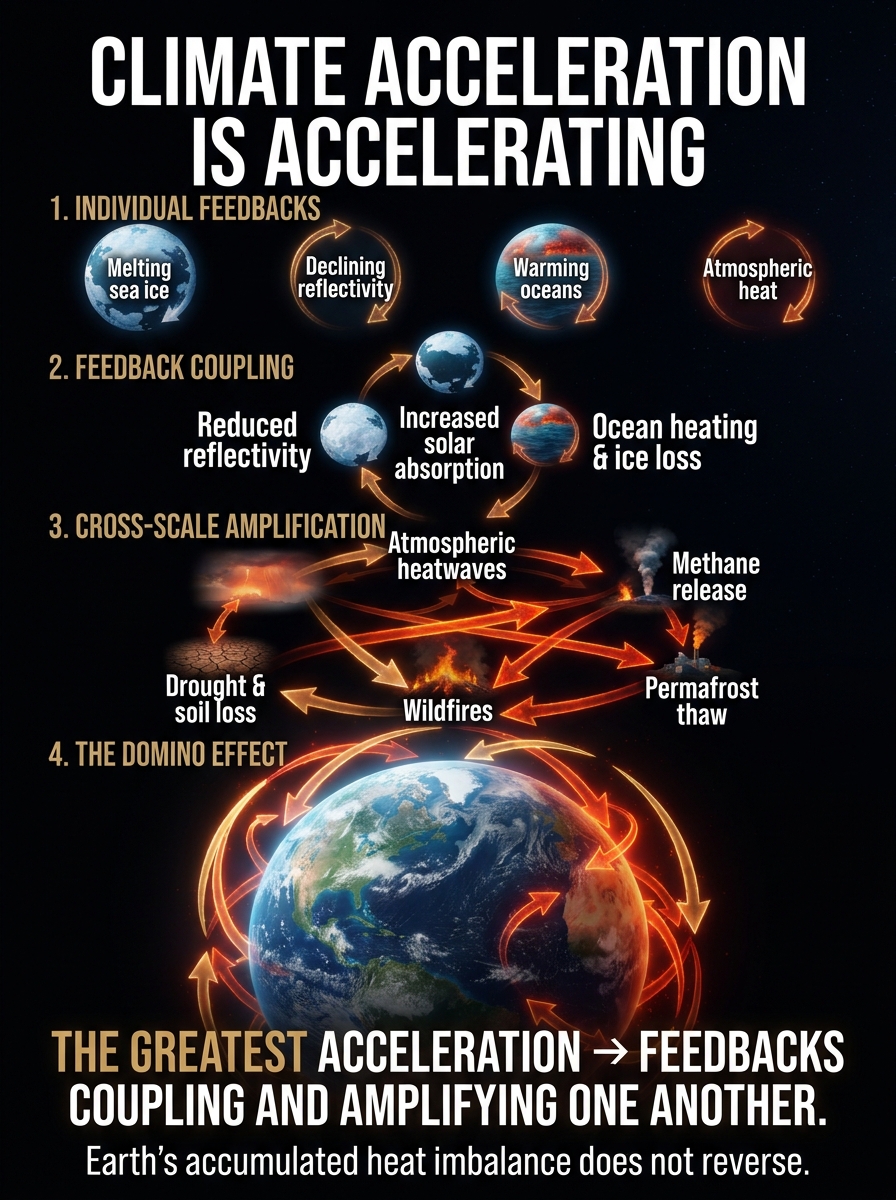
The most dangerous part of climate change isn’t any single feedback. It’s how they interact.
Melting ice reduces Earth’s reflectivity. Warming oceans add energy. Heatwaves intensify drought. Drying landscapes fuel wildfires. Thawing permafrost releases additional greenhouse gases.
These processes don’t operate independently. They activate, amplify, and reinforce one another across Earth’s interconnected systems.
Individual feedbacks eventually encounter physical limits, but that doesn’t reverse accumulated warming or restore Earth’s energy balance. Meanwhile, other feedbacks continue developing and coupling.
The greatest danger is the accelerating domino effect created when multiple climate feedbacks amplify one another.
Understanding which feedbacks are accelerating matters. Understanding which are coupling fastest—and how that coupling amplifies the entire climate system—matters even more.
Our children and grandchildren are counting on us to understand the science and act accordingly.
https://www.kingarthur.com/global_warming/Estate-Plan-Universal.html
#ClimateChange #ClimateScience #ClimateFeedbacks #TippingPoints #ClimateAction
Introduction
Climate change is accelerating, and the acceleration itself is accelerating.
The rate of change is constantly changing, producing predominantly upward jerks punctuated by occasional downward jerks. The magnitude, persistence, and intensity of this acceleration are governed by the behavior of individual climate feedbacks and, most importantly, their interactions.
Consider the sea-ice albedo feedback, currently one of the fastest-accelerating climate feedbacks. As Arctic and Antarctic sea ice disappear over the coming century, the available sea-ice area for additional albedo-driven amplification will progressively diminish. Eventually, this feedback’s acceleration will plateau. This does not mean Earth’s energy imbalance will return to historical levels or that accumulated warming will reverse. It means that the rate of additional acceleration from this particular feedback will gradually decline as the feedback approaches its physical limit.
Understanding the acceleration of individual feedbacks is essential to climate analysis. Understanding how multiple feedbacks couple, amplify one another, and propagate across Earth’s interconnected systems is even more important. The greatest acceleration occurs not simply within individual feedbacks, but through their interactions, as one accelerating process activates, strengthens, and amplifies others.
The critical question is not just which climate feedbacks are accelerating fastest, but which feedbacks are coupling fastest and how that coupling amplifies the acceleration of the entire climate system.
PART I. THE JERK-CONTINUOUS GROWTH-CONSTANT FRAMEWORK
Governing Mathematical Framework
The Jerk-Continuous Growth-Constant Framework describes nonlinear energy growth through a time-dependent growth constant whose acceleration and jerk evolve continuously.
1. Governing energy-growth equation
E′(t) = k(t)E(t)
2. Adaptive growth constant
k(t) = k₀ + ∫₀ᵗ k′(τ)dτ
3. Changing growth-constant acceleration
k″(t) = k″₀ + ∫₀ᵗ Jₖ(τ)dτ
4. Time-dependent growth-constant jerk
Jₖ(t) = k‴(t)
5. Climate-system acceleration
E″(t) = E(t)[k′(t) + k(t)²]
6. Climate-system jerk
Jₑ(t) = E‴(t)
Expanding the derivative:
Jₑ(t) = E(t)[k″(t) + 3k(t)k′(t) + k(t)³]
7. Exact time-dependent doubling time
∫ₜᵗ⁺ᵀᵈ⁽ᵗ⁾ k(τ)dτ = ln(2)
This formulation establishes the relationship between energy growth, changing acceleration, jerk, and the time-dependent doubling of the system.
The Albedo–Cloud–Ocean Heat Content Feedback Triad
Reference:
https://www.kingarthur.com/global_warming/Climate-Jerk-Surge-22-26.html
Planetary Albedo × Ocean Heat Content is coupling at the fastest absolute rate, while Cloud Cover × Ocean Heat Content exhibits the largest relative surge compared with its historical baseline.
Ranking the Fastest-Coupling Climate Feedbacks
Within the Jerk-Continuous Growth-Constant Framework, the time-dependent growth-constant jerk, Jₖ(t) = k‴(t), governs the acceleration of the coupling rate k(t).
The following ranking uses the 2022–2026 Mean Pair Jerk values reported on the referenced webpage as empirical inputs for Jₖ.
| Rank | Interacting Feedback Pair | 2022–2026 Mean Jerk (Jₖ) | 1970–2019 Baseline Jerk | Surge Multiplier | Surge Weight |
|---|---|---|---|---|---|
| 1 | Planetary Albedo × Ocean Heat Content | 0.00315 | 0.00015 | 21.00× | 14.3% |
| 2 | Cloud Cover × Ocean Heat Content | 0.00286 | 0.00008 | 35.75× | 13.2% |
| 3 | Planetary Albedo × Cloud Cover | 0.00264 | 0.00011 | 24.00× | 12.1% |
| 4 | Water Vapor × Surface Temperature | 0.00220 | 0.00032 | 6.88× | 9.0% |
| 5 | Cloud Cover × Water Vapor | 0.00198 | 0.00005 | 39.60× | 9.2% |
The ranking distinguishes two fundamentally different measures of acceleration:
- Absolute coupling acceleration: Planetary Albedo × Ocean Heat Content ranks first, with the highest mean jerk.
- Relative acceleration: Cloud Cover × Water Vapor has the largest surge multiplier at 39.60×, followed by Cloud Cover × Ocean Heat Content at 35.75×.
Cloud Cover × Ocean Heat Content therefore combines the second-highest absolute jerk with the second-largest relative surge. The Albedo–Cloud–Ocean Heat Content triad represents a powerful interconnected feedback structure.
PART II. INTERCONNECTED CLIMATE FEEDBACK NETWORKS
Beyond the Albedo–Cloud–Ocean Heat Content triad, several major interconnected feedback networks drive nonlinear climate acceleration and cascading changes throughout Earth’s systems.
1. Cryosphere and Polar Amplification
Arctic warming outpaces global averages. Atmospheric rivers transport moisture into polar regions, shifting precipitation from snow to rain. Melt-elevation feedbacks accelerate ice-sheet loss, while freshwater discharge traps subsurface ocean heat and intensifies cryospheric destabilization.
2. Atmospheric Circulation and Soil Moisture
High-pressure anticyclones deplete soil moisture and eliminate evaporative cooling. This shifts more incoming solar energy into sensible heating, amplifying heat waves and locking jet streams into prolonged heat domes.
3. Wildfires and Permafrost
Arctic peatland “zombie fires” smolder beneath winter snow, releasing carbon and soot. Simultaneously, thawing permafrost produces thermokarst terrain and wetlands that generate methane emissions. These processes expose additional ancient carbon to decomposition and amplify greenhouse-gas forcing.
4. Atmospheric Chemistry and Ecosystems
Increasing lightning generates nitrogen oxides and ground-level ozone. Ozone damages plant leaves, weakens terrestrial carbon sinks, and suppresses cloud formation, placing additional stress on the Amazon and boreal forests.
5. Ocean Stratification and AMOC
Freshwater from melting ice dilutes North Atlantic surface waters, weakening the Atlantic Meridional Overturning Circulation (AMOC). These changes alter atmospheric circulation, cloud tracks, and ocean carbon uptake.
Cross-Scale Dynamics and the Domino Effect
These feedback mechanisms operate across different timescales:
- Fast atmospheric processes: Days to years.
- Intermediate ocean and terrestrial processes: Seasons to decades.
- Slow threshold systems: Decades to centuries.
Rapid atmospheric changes compound over time, driving slower tipping elements toward irreversible thresholds. The resulting interactions create a cross-scale domino effect in which short-term disturbances accelerate long-term climate-system destabilization.
PART III. APPLYING THE JERK-CONTINUOUS GROWTH-CONSTANT FRAMEWORK TO SOIL MOISTURE, HEATWAVES, PERMAFROST, AND METHANE
Applying the Jerk-Continuous Growth-Constant Framework to the soil-moisture/heatwave and permafrost/methane networks demonstrates how rapid, threshold-driven feedbacks and persistent, compounding carbon feedbacks produce nonlinear energy growth across distinct timescales.
1. Soil Moisture and Heatwaves: Fast-to-Intermediate Timescale
This network is characterized by a sudden, threshold-activated increase in Jₖ(t) over periods ranging from days to seasons.
Persistent high-pressure anticyclones deplete soil moisture and eliminate evaporative cooling. This shifts solar energy directly into sensible heat, amplifying atmospheric wave patterns by approximately 24% and adding approximately 10% extra heating once critical temperature thresholds are crossed.
Time-Dependent Growth-Constant Jerk
Jₖ(t) = k‴(t)
The jerk behaves as a step function or sharp pulse during regional drying. Before soil desiccation, Jₖ(t) remains near its baseline. Once soil moisture crosses its critical dry threshold, Jₖ(t) spikes sharply as atmospheric blocking, soil drying, and sensible heating lock into a self-reinforcing three-way feedback loop.
Changing Growth-Constant Acceleration
k″(t) = k″₀ + ∫₀ᵗ Jₖ(τ)dτ
The integral accumulates the sharp jerk spike over a summer or drought season, producing rapid, acute acceleration in regional thermal coupling.
Adaptive Growth Constant
k(t) = k₀ + ∫₀ᵗ k′(τ)dτ
The growth constant rises rapidly during a heatwave, temporarily increasing the local energy-growth rate:
E′(t) = k(t)E(t)
It partially resets when seasonal precipitation returns.
Climate-System Jerk
Jₑ(t) = E(t)[k″(t) + 3k(t)k′(t) + k(t)³]
The dominant contribution is the sharp increase in the first term, E(t)k″(t). This produces extreme short-term hydroclimatic whiplash and rapidly compresses the local thermal doubling time Tᵈ(t) during peak drought.
2. Permafrost and Methane: Slow, Compounding Timescale
Unlike the soil-moisture network, the permafrost network operates over decades to centuries, functioning as a cumulative, irreversible ratchet.
Warming triggers ground-ice loss and thermokarst formation, expands wetlands, and intensifies overwintering zombie fires. These fires strip away insulating organic soil layers, exposing ancient carbon to microbial decomposition and releasing carbon dioxide (CO₂) and methane (CH₄).
Time-Dependent Growth-Constant Jerk
Jₖ(t) = k‴(t)
The jerk behaves as a sustained, monotonically rising function. Each incremental thaw layer, wetland expansion, or peat fire adds new, persistent greenhouse-gas forcing without seasonal recovery.
Changing Growth-Constant Acceleration
k″(t) = k″₀ + ∫₀ᵗ Jₖ(τ)dτ
Because Jₖ(τ) > 0 persists over decades, the integral accumulates continuously, steadily ratcheting up background acceleration k″(t).
Adaptive Growth Constant
k(t) = k₀ + ∫₀ᵗ k′(τ)dτ
The growth constant experiences a permanent upward drift. Because atmospheric CO₂ and CH₄ persist long after the initial thaw, k(t) does not reset. This steadily increases baseline global energy growth:
E′(t) = k(t)E(t)
Climate-System Jerk
Jₑ(t) = E(t)[k″(t) + 3k(t)k′(t) + k(t)³]
Over extended periods, the accumulated increases in k(t) and k′(t) cause the nonlinear interaction terms, 3k(t)k′(t) and k(t)³, to dominate climate-system jerk.
This permanently shortens the global energy doubling time Tᵈ(t), defined by:
∫ₜᵗ⁺ᵀᵈ⁽ᵗ⁾ k(τ)dτ = ln(2)
The resulting acceleration drives the system toward a cascading tipping-point transition.
Summary Comparison: Soil Moisture Versus Permafrost
| Framework Variable | Soil Moisture / Heatwaves | Permafrost / Methane |
|---|---|---|
| Timescale | Days to seasons (acute / episodic) | Decades to centuries (chronic / irreversible) |
| Behavior of Jₖ(t) | Sharp threshold spike during drought and atmospheric blocking | Sustained, continuous positive drift |
| Dominant term in Jₑ(t) | E(t)k″(t): sudden acceleration shock | E(t)[3k(t)k′(t) + k(t)³]: compounding baseline shift |
| Impact on doubling time Tᵈ(t) | Severe temporary compression during heat domes | Permanent structural shortening of global Tᵈ(t) |
An acute heatwave jerk produces only a minor, temporary shift in long-term doubling time (Tᵈ). A persistent permafrost/methane jerk, amplified by cross-scale zombie fires, compresses Tᵈ(t) by more than 90% over two decades.
PART IV. NUMERICAL SIMULATION: COMPARING TIME-DEPENDENT DOUBLING-TIME COMPRESSION
To solve:
∫ₜᵗ⁺ᵀᵈ⁽ᵗ⁾ k(τ)dτ = ln(2)
across a 20-year horizon, with t measured in years, we assign identical baseline conditions:
E₀ = 1.0
k₀ = 0.02 yr⁻¹
k′₀ = 0
k″₀ = 0
These initial conditions correspond to a static doubling time of 34.66 years.
We then examine three scenarios.
Scenario 1. Isolated Soil Moisture / Heatwave Pulse
A massive, short-lived jerk spike:
Jₖ,soil = 0.02 yr⁻⁴
occurs between t = 1 and t = 2, during an extreme drought or heat dome. Once soil moisture recovers, the jerk returns to:
Jₖ = 0
Scenario 2. Isolated Permafrost / Methane Drift
A small but continuous, irreversible jerk:
Jₖ,perm = 0.00015 yr⁻⁴
persists throughout the entire 20-year period as thawing peat continuously releases CO₂ and CH₄.
Scenario 3. Cross-Scale Coupled System: Heatwave → Zombie Fires → Permafrost
The heatwave between t = 1 and t = 2 dries Arctic peatlands and ignites overwintering zombie fires. These fires permanently triple the ongoing permafrost-loop jerk, increasing it from:
0.00015 yr⁻⁴
to:
0.00045 yr⁻⁴
for all t > 2.
Numerical Simulation Results
| Time (years) | Soil Pulse k(t) | Soil Pulse Tᵈ(t) | Permafrost k(t) | Permafrost Tᵈ(t) | Cross-Scale k(t) | Cross-Scale Tᵈ(t) |
|---|---|---|---|---|---|---|
| 0 | 0.02000 | 29.96 yrs | 0.02000 | 15.69 yrs | 0.02000 | 13.48 yrs |
| 1 | 0.02000 | 29.81 yrs | 0.02003 | 14.86 yrs | 0.02003 | 12.61 yrs |
| 2 | 0.02333 | 29.71 yrs | 0.02020 | 14.03 yrs | 0.02020 | 11.73 yrs |
| 5 | 0.02333 | 29.71 yrs | 0.02312 | 11.53 yrs | 0.02448 | 9.11 yrs |
| 10 | 0.02333 | 29.71 yrs | 0.04500 | 7.63 yrs | 0.07060 | 5.15 yrs |
| 15 | 0.02333 | 29.71 yrs | 0.10437 | 4.58 yrs | 0.21422 | 2.53 yrs |
| 20 | 0.02333 | 29.71 yrs | 0.22000 | 2.63 yrs | 0.51160 | 1.23 yrs |
Key Mathematical Takeaways
1. Why the Soil-Moisture Jerk Spike Stalls
Because:
k(t) = k₀ + (1/6)JₖΔt³
scales with the cube of duration (Δt³), a one-year pulse—even with a 133× larger Jₖ—increases k(t) from 0.0200 to only 0.0233. The doubling time consequently levels off at 29.71 years.
2. Why Permafrost Dominates Over Time
Even a small, sustained Jₖ compounds cubically over decades. By year 20:
k(20) = 0.2200
The resulting doubling time contracts to 2.63 years.
3. Why Cross-Scale Coupling Is Critical
When a short-term heatwave acts as a trigger rather than an isolated event, the tripled post-fire jerk drives:
k(20) = 0.5116
By year 20, the doubling time falls to 1.23 years.
The distinction is fundamental: an isolated atmospheric disturbance produces a temporary acceleration, while a disturbance that activates persistent carbon-cycle feedbacks changes the long-term trajectory of the entire system.
PART V. THE CROSS-SCALE COUPLING MECHANISM: HEATWAVE → ZOMBIE FIRES → PERMAFROST
Within the physical feedback network, the fast soil-moisture loop bridges into the slow permafrost loop through a four-stage ratchet mechanism.
Stage 1. Threshold-Activated Drying: The Jₖ,soil Spike
A persistent high-pressure heat dome depletes Arctic surface moisture and eliminates evaporative cooling. This creates extreme local sensible heating and desiccates carbon-rich peat soils.
Stage 2. Ignition and Overwintering: Zombie Fires
Dry lightning ignites the desiccated peat. Unlike surface forest fires, peat fires burn deep underground. The snow cover insulates the burning peat, allowing it to smolder continuously through subzero winter temperatures and re-emerge the following spring.
Stage 3. Thermal Insulation Loss and Albedo Decline
Underground combustion destroys the insulating surface layer of moss and organic soil. The fires also deposit black carbon (soot) onto surrounding snow and ice, accelerating spring melting and increasing solar energy absorption.
Stage 4. Permanent Increase in Jₖ,perm
Without its insulating organic cap, heat penetrates deeper into the active layer each summer. Previously frozen ancient carbon thaws into waterlogged thermokarst wetlands, triggering microbial decomposition and releasing CO₂ and CH₄.
These emissions permanently elevate the baseline jerk of the global carbon cycle, converting an acute regional heatwave disturbance into a persistent, compounding climate feedback.
CONCLUSION: CLIMATE ACCELERATION IS A COUPLED, CROSS-SCALE PROCESS
Climate change is accelerating, and the acceleration itself is accelerating. However, that acceleration is not uniform, constant, or unlimited. Individual feedbacks accelerate at different rates, produce upward and downward jerks, and eventually encounter physical limits. As individual feedbacks approach those limits, their contribution to additional acceleration changes. The accumulated energy imbalance and resulting warming do not reverse simply because a particular feedback stops accelerating.
The Jerk-Continuous Growth-Constant Framework distinguishes between the changing acceleration of individual feedbacks and the cumulative acceleration generated through their interactions. The critical distinction is between how quickly an individual feedback accelerates and how rapidly multiple feedbacks couple, amplify one another, and propagate through the climate system.
The Albedo–Cloud–Ocean Heat Content triad demonstrates the extraordinary acceleration occurring within interconnected feedbacks. The soil-moisture/heatwave network demonstrates how threshold-driven atmospheric disturbances produce rapid, acute acceleration. The permafrost/methane network demonstrates how persistent carbon feedbacks compound over decades, while zombie fires connect short-term atmospheric disturbances to long-term cryospheric and carbon-cycle destabilization.
The numerical comparisons illustrate why the duration and persistence of acceleration matter as much as its instantaneous magnitude. An isolated jerk pulse produces a temporary change in energy-growth dynamics. Sustained jerk produces cumulative changes in the growth constant and its derivatives. When multiple feedbacks couple, their amplification transforms individual disturbances into increasingly powerful, interconnected processes.
The most important measure of climate acceleration is not simply the acceleration of individual feedbacks. It is the rate at which feedbacks couple, the amplification produced by those interactions, and the persistence of that amplification across Earth’s interconnected systems.
Individual feedbacks can plateau as they approach physical limits. The climate system’s accumulated energy imbalance does not thereby disappear, and other feedbacks continue to evolve. The decisive danger is the coupling of multiple feedbacks into a self-reinforcing, cross-scale domino effect that drives nonlinear climate acceleration.
Climate feedbacks do not operate independently. Their coupling, amplification, and propagation determine the trajectory of climate-system acceleration.