By Daniel Brouse
Climate change is making water security impossible to ignore. You don’t need a scientific report to see it—just look out your window. Floods, droughts, shrinking reservoirs, and increasing competition for freshwater are becoming part of everyday life.
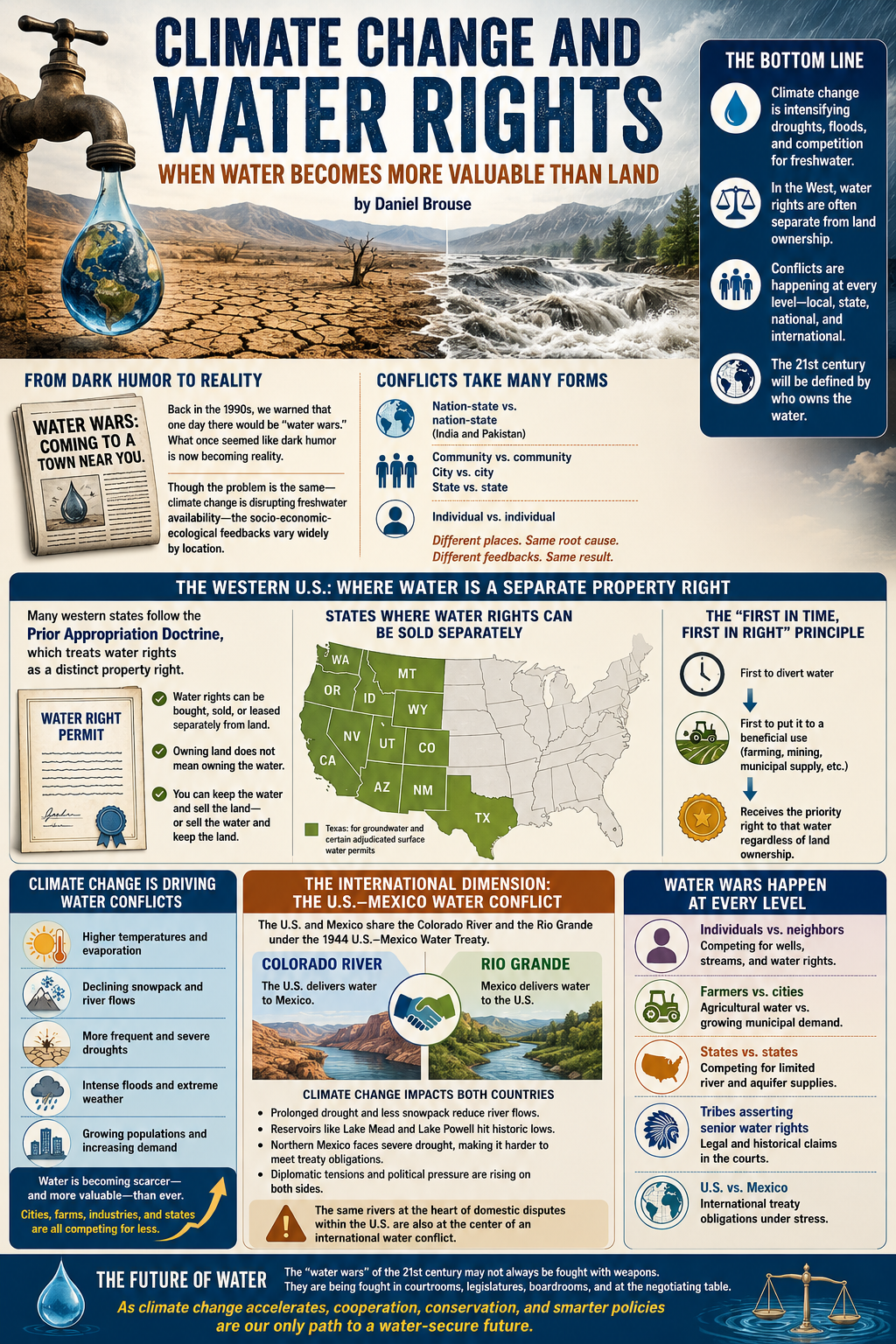
Back in the 1990s, we warned that one day there would be “water wars.” We jokingly wrote headlines like, “Water Wars: Coming to a Town Near You.” Unfortunately, what once seemed like dark humor is steadily becoming reality.
The underlying problem is the same everywhere: climate change is disrupting the availability of freshwater. However, the resulting socio-economic and ecological feedbacks vary dramatically depending on geography, politics, and legal systems. In some regions, conflicts arise between nations, such as India and Pakistan over shared river systems. In others, disputes occur between neighboring communities, businesses, or even individual property owners.
The western United States provides one of the clearest examples of these emerging water conflicts. Unlike most of the eastern United States, many western states treat water rights as separate from land ownership.
Water Rights Are Not Always Property Rights
In much of the western United States, water rights can be bought, sold, or leased independently of the land itself. These states generally follow the Prior Appropriation Doctrine, a legal framework that treats water rights as a distinct form of property.
Under this system, owning land does not necessarily mean owning the water that flows across or beneath it. Likewise, someone can retain ownership of valuable water rights even after selling the associated land.
States Where Water Rights Can Be Sold Separately
States that commonly allow water rights to be severed from real estate include:
- Colorado
- Arizona
- California
- Nevada
- New Mexico
- Utah
- Wyoming
- Montana
- Idaho
- Washington
- Oregon
- Texas (for groundwater and certain adjudicated surface water permits)
The “First in Time, First in Right” Principle
These states generally operate under the principle of “first in time, first in right.”
The first individual or entity to divert water and put it to a legally recognized beneficial use—such as agriculture, mining, industry, or municipal supply—receives a priority right to continue using that water.
Because the right is tied to beneficial use rather than land ownership, water rights become a separate economic asset. A farmer, for example, may sell a ranch while retaining the associated water rights, or sell those rights to a nearby city while continuing to own the land.
Climate Change Is Increasing the Value of Water
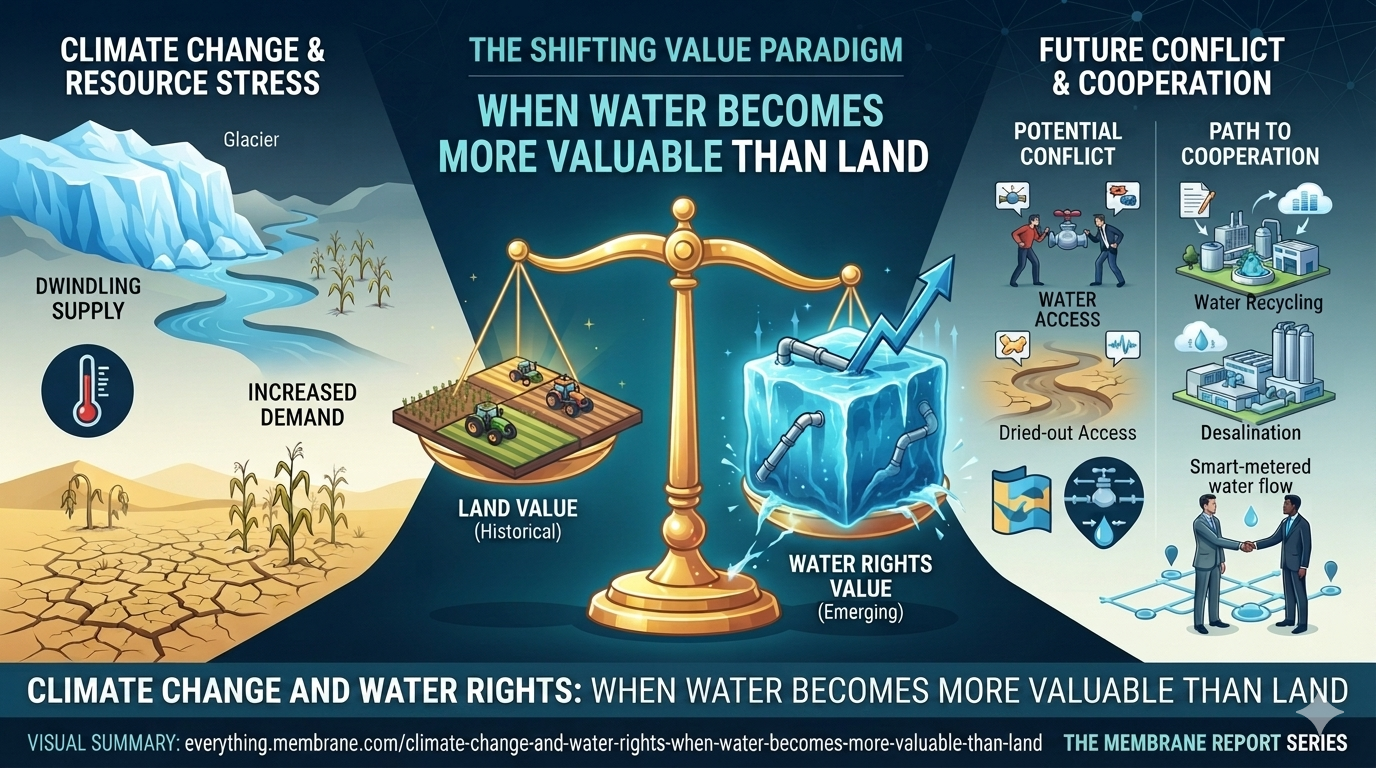
As climate change intensifies droughts, reduces snowpack, alters river flows, and increases evaporation, freshwater is becoming an increasingly scarce resource. In many regions, water rights are appreciating faster than the land they once served.
Cities are purchasing agricultural water rights to supply growing populations. Farmers compete with municipalities, industries, and neighboring states for limited supplies. Rivers that once flowed year-round now run seasonally, while reservoirs experience historic lows followed by damaging floods.
The result is an expanding marketplace where water is increasingly treated as a financial asset rather than simply a natural resource.
The Future of Water Conflicts
The “water wars” we predicted decades ago have already begun. They may not always resemble armed conflicts between nations. More often, they take the form of lawsuits, interstate compacts, regulatory battles, infrastructure disputes, and competition between agriculture, industry, municipalities, and environmental interests.
As climate change accelerates, freshwater will become one of the defining economic and political issues of the 21st century. In many regions, the question will no longer be who owns the land—it will be who owns the water.
The International Dimension: The U.S.–Mexico Water Conflict
The western United States is not only experiencing domestic “water wars” between states, cities, farmers, and industries—it is also involved in an increasingly contentious international dispute with Mexico over many of the same river systems.
The conflict centers primarily on the Colorado River and the Rio Grande, which are governed by the 1944 U.S.–Mexico Water Treaty. Under the treaty, the United States delivers water from the Colorado River to Mexico, while Mexico provides water from tributaries feeding the Rio Grande to the United States.
For decades, the agreement functioned reasonably well because both countries generally had sufficient water supplies. Climate change has dramatically altered that equation.
Prolonged drought, declining snowpack in the Rocky Mountains, higher temperatures, and increased evaporation have reduced river flows throughout the American Southwest. Reservoirs such as Lake Mead and Lake Powell have reached historically low levels, forcing difficult decisions about how increasingly scarce water should be allocated.
At the same time, northern Mexico has experienced severe drought, making it difficult to meet its treaty obligations to deliver water to the United States. The resulting shortages have led to diplomatic disputes, political pressure, and growing tensions between agricultural users, municipalities, and federal governments on both sides of the border.
What makes this conflict particularly significant is that it is driven by the very same rivers already at the center of domestic disputes within the United States. States such as California, Arizona, Nevada, Colorado, New Mexico, and Texas are competing with one another for diminishing supplies while simultaneously relying on international agreements that are becoming more difficult to satisfy under a changing climate.
In effect, the Colorado River and Rio Grande now support multiple layers of competition:
- Individuals versus neighboring landowners.
- Farmers versus rapidly growing cities.
- States versus other states.
- Native American tribes asserting senior water rights.
- The United States versus Mexico under international treaty obligations.
As climate change continues to reduce the reliability of freshwater supplies, these overlapping legal, economic, and political conflicts are likely to intensify. The future of water management will require not only engineering and conservation but also new approaches to interstate and international cooperation. The “water wars” of the 21st century are no longer a prediction—they are unfolding simultaneously at the local, state, national, and international levels.