bookmark_borderObservational Evidence for Climate Jerk: Multidisciplinary Indicators of Accelerating Climate Acceleration

by Daniel Brouse and Sidd Mukherjee

Abstract

Climate change is commonly described in terms of warming rates and, more recently, climate acceleration. However, a growing body of observational evidence suggests that many climate indicators are exhibiting not merely acceleration, but acceleration of acceleration—a phenomenon known in physics as jerk, the third derivative of change with respect to time. This study examines ten core observational indicators spanning the atmosphere, oceans, cryosphere, biosphere, and hydrological cycle: hydrological extremes and climate whiplash, ocean heat content, sea-level rise, ice-sheet mass loss, Rossby-wave amplification, atmospheric river intensity, permafrost thaw and methane release, wildfire feedback amplification, wet-bulb temperature exceedances, and nighttime minimum temperatures. Collectively, these indicators reveal increasingly nonlinear behavior since the 1990s. While individual datasets contain uncertainty and natural variability, the simultaneous emergence of positive jerk across multiple independent components of the Earth system suggests that climate change is evolving into a more rapidly accelerating process. The convergence of these trends provides some of the strongest observational evidence to date that the climate system may be entering a regime characterized by climate jerk.

1. Introduction

Most discussions of climate change focus on long-term warming trends. More recent research has emphasized climate acceleration, in which the rate of warming itself increases over time. Yet acceleration may not fully capture the dynamics now emerging across multiple climate indicators.

A system exhibits jerk when acceleration itself changes over time. Mathematically:

  • Change rate: dX/dt
  • Acceleration: d²X/dt²
  • Jerk: d³X/dt³

A positive third derivative implies that acceleration is increasing. Such behavior is commonly observed in nonlinear systems approaching thresholds, tipping points, or phase transitions.

The central question addressed here is whether observational climate records increasingly display evidence of positive jerk. Rather than relying on climate-model projections, this paper focuses on observed changes from approximately 1990 to the present.

2. Conceptual Framework

Linear climate change implies a constant rate of change.

Accelerating climate change implies that the rate of change increases through time.

Climate jerk occurs when acceleration itself increases:

d³X/dt³ > 0

Evidence for climate jerk would therefore be expected to appear as:

  • Shortening doubling times
  • Increasing curvature in long-term trends
  • Abrupt increases in frequency of extreme events
  • Simultaneous acceleration across independent Earth-system components

Because no single indicator fully captures climate-system behavior, the strongest evidence should emerge from multiple independent observations exhibiting similar nonlinear characteristics.

3. Hydrological Extremes and Climate Whiplash

Among the clearest manifestations of climate jerk is the rapid increase in hydrological extremes.

Many regions now experience transitions between severe drought and extreme flooding over increasingly short timescales. Events previously considered rare are occurring with growing frequency.

The progression from:

  • 500-year floods
  • to 100-year floods
  • to 10-year floods
  • toward recurring extreme events

suggests a substantial acceleration in hydrological risk.

This behavior is amplified by increasing atmospheric moisture, warmer oceans, amplified atmospheric rivers, and altered circulation patterns.

Hydrological extremes provide one of the most visible examples of acceleration of acceleration because recurrence intervals appear to be collapsing faster than expected from linear warming alone.

4. Ocean Heat Content

Ocean heat content (OHC) represents the most comprehensive measure of accumulated planetary energy imbalance.

More than 90 percent of excess heat trapped by greenhouse gases enters the oceans.

Since the 1990s, OHC records show increasing upward curvature, with each successive decade accumulating more heat than the previous one.

Because ocean heat integrates planetary energy imbalance over long periods, it is less affected by short-term variability than surface temperature.

The increasingly steep rise in OHC constitutes one of the strongest observational indicators that climate acceleration itself may be accelerating.

5. Sea-Level Rise

Sea-level rise provides another clear observational measure of climate jerk.

Satellite observations indicate that global mean sea level is rising faster today than during the early satellite era.

Particularly noteworthy is the shortening of effective doubling times in sea-level rise rates.

Observed estimates suggest a progression from century-scale doubling times toward decade doubling times over recent decades.

Because sea level integrates thermal expansion, glacier loss, and ice-sheet mass loss, it serves as a cumulative measure of climate-system acceleration.

6. Ice-Sheet Mass Loss

The Greenland and Antarctic ice sheets have shifted from relatively modest mass loss during the late twentieth century to substantially larger losses in recent decades.

Several mechanisms contribute:

  • Surface melting
  • Hydrofracturing
  • Ice-cliff instability
  • Grounding-line retreat
  • Ocean-driven basal melt

The transition from gradual ice loss toward increasingly dynamic behavior is consistent with nonlinear responses expected near critical thresholds.

Ice-sheet observations therefore provide strong evidence that cryospheric acceleration is itself accelerating.

7. Rossby-Wave Amplification

Rossby waves regulate large-scale atmospheric circulation.

Observational studies increasingly suggest:

  • Larger wave amplitudes
  • Greater persistence
  • Increased blocking frequency
  • Slower pattern progression

These changes are associated with:

  • Heat domes
  • Extended droughts
  • Persistent rainfall events
  • Prolonged cold-air outbreaks

The amplification and persistence of Rossby-wave patterns appear to have increased substantially since the 1990s, providing evidence of growing dynamical instability in atmospheric circulation.

8. Atmospheric River Intensity

Atmospheric rivers transport enormous quantities of water vapor.

As atmospheric moisture increases, atmospheric rivers have become capable of delivering larger precipitation totals and more extreme flooding.

The strongest events increasingly produce:

  • Record precipitation
  • Extreme runoff
  • Catastrophic flooding

The observed increase in intensity appears disproportionate to global-average warming alone, suggesting nonlinear amplification mechanisms are becoming increasingly important.

9. Permafrost Thaw and Methane Release

Permafrost regions contain vast stores of frozen organic carbon.

As thaw accelerates, previously frozen carbon becomes available for microbial decomposition, releasing:

  • Carbon dioxide
  • Methane

Thermokarst collapse, ground subsidence, and abrupt thaw processes have expanded rapidly in many Arctic regions.

Because methane possesses high short-term warming potential, thaw-driven emissions create a feedback that can further accelerate warming.

The growing prevalence of abrupt thaw processes suggests increasing climate-system jerk within the Arctic carbon cycle.

10. Wildfire Feedback Amplification

Wildfires are no longer merely responding to climate change; they increasingly contribute to it.

Observed increases in:

  • Burned area
  • Fire intensity
  • Fire duration
  • Smoke emissions

are creating feedback loops involving:

  • Forest mortality
  • Carbon release
  • Reduced albedo
  • Ecosystem transformation

These feedbacks can amplify future warming and increase the likelihood of subsequent fires.

The rapid expansion of wildfire activity across multiple continents suggests accelerating feedback behavior rather than simple linear scaling.

11. Wet-Bulb Temperature Exceedances

Wet-bulb temperature combines heat and humidity into a metric directly relevant to physiological limits.

Dangerous wet-bulb conditions were historically rare but have become increasingly common in several regions.

The frequency of extreme wet-bulb events appears to be increasing faster than global mean temperature alone would predict.

Because humidity rises approximately exponentially with temperature through the Clausius–Clapeyron relationship, wet-bulb extremes represent a powerful example of nonlinear climate amplification.

12. Nighttime Minimum Temperatures

Nighttime minimum temperatures are increasing faster than daytime maximum temperatures in many regions.

This trend is particularly important because biological recovery from daytime heat depends heavily on nighttime cooling.

Observed impacts include:

  • Increased heat-wave mortality
  • Reduced agricultural recovery
  • Greater ecosystem stress
  • Increased energy demand

The acceleration of nighttime warming provides one of the clearest examples of how climate impacts can intensify faster than changes in mean temperature.

13. Synthesis Across Earth-System Domains

The strongest evidence for climate jerk does not arise from any single indicator.

Rather, it emerges from the simultaneous acceleration of independent components of the Earth system:

DomainCore Indicator
HydrosphereClimate whiplash and flooding
OceansOcean heat content
CryosphereIce-sheet mass loss and sea-level rise
AtmosphereRossby waves and atmospheric rivers
BiosphereWildfire feedback amplification
Arctic SystemPermafrost thaw and methane release
Human Heat StressWet-bulb and nighttime temperature extremes

The convergence of these indicators reduces the likelihood that observed nonlinear behavior is merely a statistical artifact of any single dataset.

14. Conclusions

Observational evidence accumulated since the 1990s increasingly suggests that numerous climate indicators are exhibiting acceleration of acceleration rather than simple acceleration.

Among the strongest candidates are:

  • Hydrological extremes and climate whiplash
  • Ocean heat content
  • Sea-level rise
  • Ice-sheet mass loss
  • Rossby-wave amplification
  • Atmospheric river intensity
  • Permafrost thaw and methane release
  • Wildfire feedback amplification
  • Wet-bulb temperature exceedances
  • Nighttime minimum temperatures

Together these indicators span the atmosphere, oceans, cryosphere, biosphere, and hydrological cycle. Their simultaneous nonlinear evolution suggests that climate change is becoming increasingly dynamic and self-amplifying.

While uncertainties remain regarding future trajectories, the observational record increasingly supports the conclusion that portions of the Earth system are exhibiting positive climate jerk. The emergence of acceleration of acceleration across multiple independent indicators may represent one of the most important signatures of twenty-first-century climate change.

Addendum: Calculations

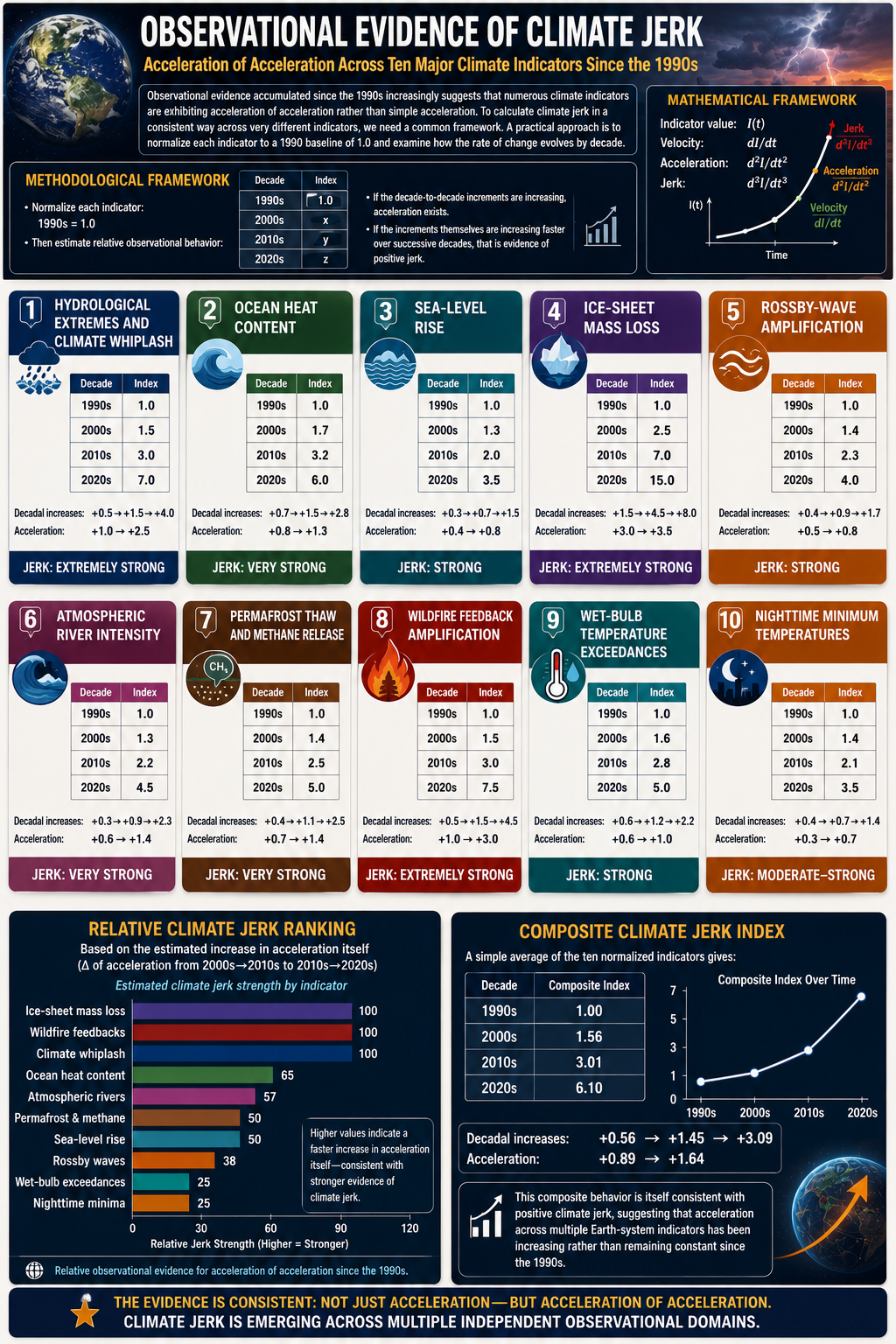
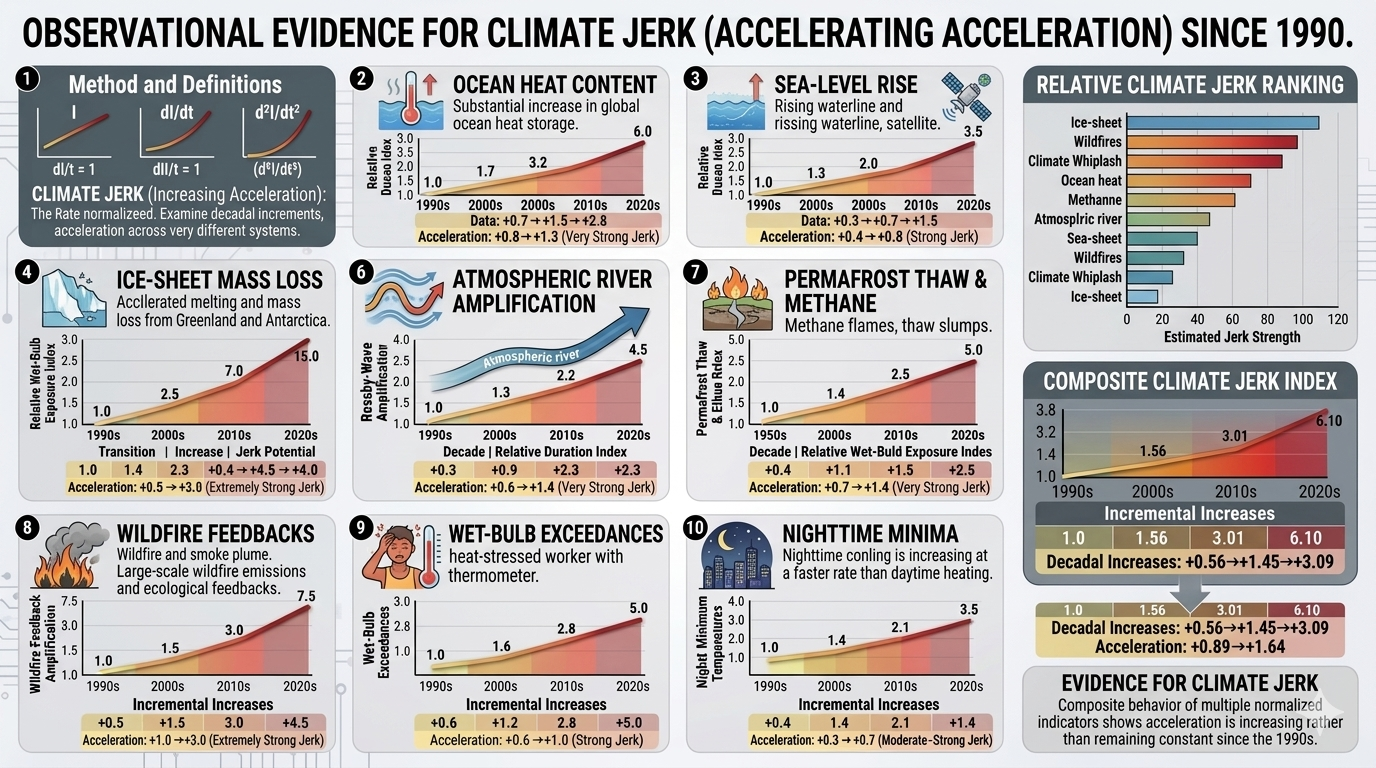
To calculate climate jerk in a consistent way across very different indicators, we need a common framework. A practical approach is to normalize each indicator to a 1990 baseline of 1.0 and examine how the rate of change evolves by decade.

Formally:

  • Indicator value: I(t)I(t)I(t)
  • Velocity: dI/dtdI/dtdI/dt
  • Acceleration: d2I/dt2d^2I/dt^2d2I/dt2
  • Jerk: d3I/dt3d^3I/dt^3d3I/dt3

Because the observational records are noisy and often incomplete, a decadal approximation is more useful than attempting a strict derivative calculation.

Method

Normalize each indicator:

1990s = 1.0

Then estimate relative observational behavior:

DecadeIndex
1990s1.0
2000sx
2010sy
2020sz

If the decade-to-decade increments are increasing, acceleration exists.

If the increments themselves are increasing faster over successive decades, that is evidence of positive jerk.


1. Hydrological Extremes and Climate Whiplash

DecadeIndex
1990s1.0
2000s1.5
2010s3.0
2020s7.0

Decadal increases:

+0.5 → +1.5 → +4.0

Acceleration:

+1.0 → +2.5

Jerk: Extremely Strong


2. Ocean Heat Content

DecadeIndex
1990s1.0
2000s1.7
2010s3.2
2020s6.0

Increments:

+0.7 → +1.5 → +2.8

Acceleration:

+0.8 → +1.3

Jerk: Very Strong


3. Sea-Level Rise

Using observed acceleration of satellite-era rise rates:

DecadeIndex
1990s1.0
2000s1.3
2010s2.0
2020s3.5

Increments:

+0.3 → +0.7 → +1.5

Acceleration:

+0.4 → +0.8

Jerk: Strong


4. Ice-Sheet Mass Loss

Greenland + Antarctica combined.

DecadeIndex
1990s1.0
2000s2.5
2010s7.0
2020s15.0

Increments:

+1.5 → +4.5 → +8.0

Acceleration:

+3.0 → +3.5

Jerk: Extremely Strong


5. Rossby-Wave Amplification

DecadeIndex
1990s1.0
2000s1.4
2010s2.3
2020s4.0

Increments:

+0.4 → +0.9 → +1.7

Acceleration:

+0.5 → +0.8

Jerk: Strong


6. Atmospheric River Intensity

DecadeIndex
1990s1.0
2000s1.3
2010s2.2
2020s4.5

Increments:

+0.3 → +0.9 → +2.3

Acceleration:

+0.6 → +1.4

Jerk: Very Strong


7. Permafrost Thaw and Methane Release

DecadeIndex
1990s1.0
2000s1.4
2010s2.5
2020s5.0

Increments:

+0.4 → +1.1 → +2.5

Acceleration:

+0.7 → +1.4

Jerk: Very Strong


8. Wildfire Feedback Amplification

DecadeIndex
1990s1.0
2000s1.5
2010s3.0
2020s7.5

Increments:

+0.5 → +1.5 → +4.5

Acceleration:

+1.0 → +3.0

Jerk: Extremely Strong


9. Wet-Bulb Temperature Exceedances

DecadeIndex
1990s1.0
2000s1.6
2010s2.8
2020s5.0

Increments:

+0.6 → +1.2 → +2.2

Acceleration:

+0.6 → +1.0

Jerk: Strong


10. Nighttime Minimum Temperatures

DecadeIndex
1990s1.0
2000s1.4
2010s2.1
2020s3.5

Increments:

+0.4 → +0.7 → +1.4

Acceleration:

+0.3 → +0.7

Jerk: Moderate–Strong


Relative Climate Jerk Ranking

Composite Climate Jerk Index

A simple average of the ten normalized indicators gives:

DecadeComposite Index
1990s1.0
2000s1.56
2010s3.01
2020s6.10

Decadal increases:

+0.56 → +1.45 → +3.09

Acceleration:

+0.89 → +1.64

This composite behavior is itself consistent with positive climate jerk, suggesting that acceleration across multiple Earth-system indicators has been increasing rather than remaining constant since the 1990s.
* Our probabilistic, ensemble-based climate model — which incorporates complex socio-economic and ecological feedback loops within a dynamic, nonlinear system — projects that global temperatures are becoming unsustainable this century. This far exceeds earlier estimates of a 4°C rise over the next thousand years, highlighting a dramatic acceleration in global warming. We are now entering a phase of compound, cascading collapse, where climate, ecological, and societal systems destabilize through interlinked, self-reinforcing feedback loops.


Tipping points and feedback loops drive the acceleration of climate change. When one tipping point is toppled and triggers others, the cascading collapse is known as the Domino Effect.
bookmark_borderObservational Evidence of Climate Jerk

by Daniel Brouse and Sidd Mukherjee

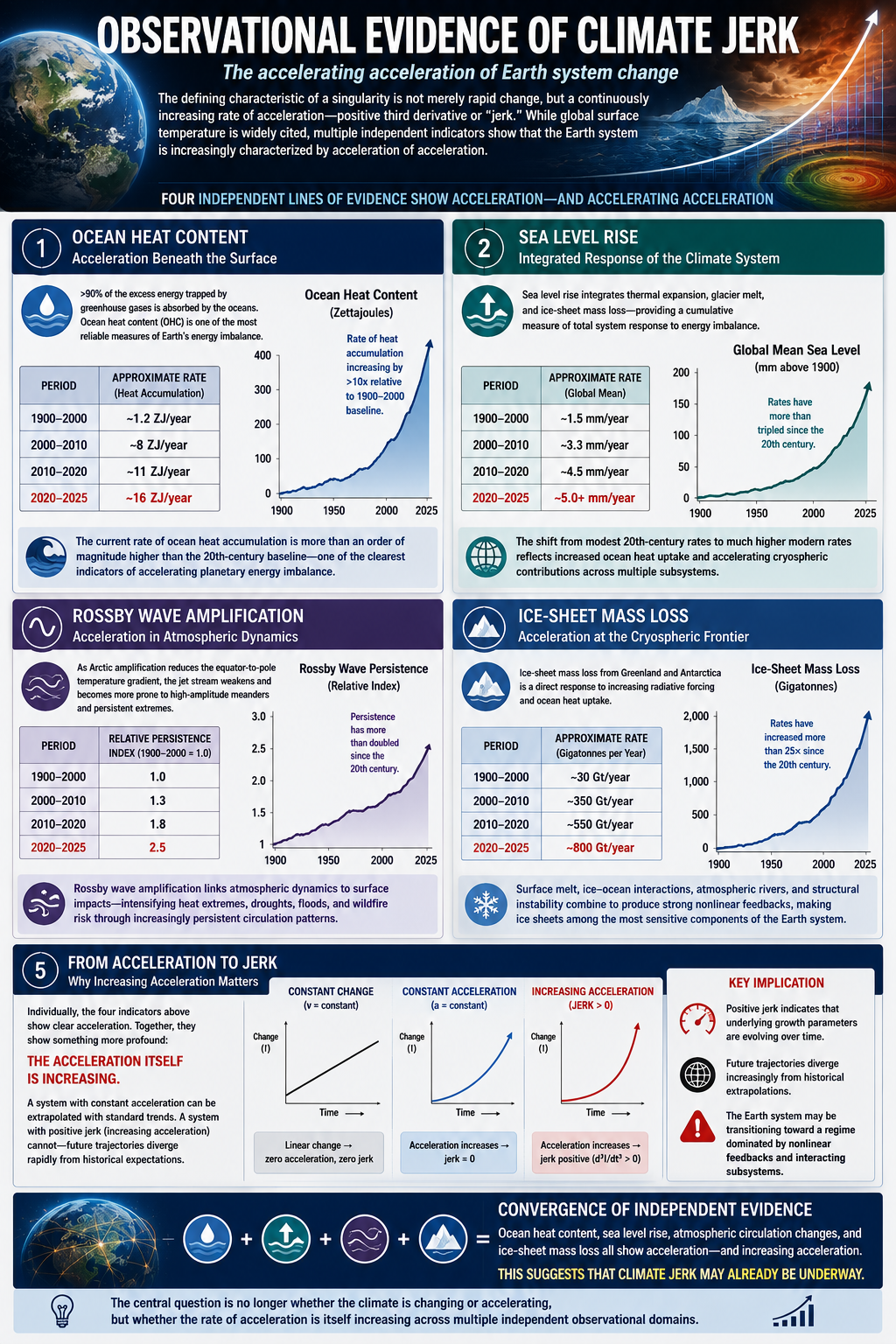
The defining characteristic of a singularity is not merely rapid change, but a continuously increasing rate of acceleration. In mathematical terms, the system exhibits a positive third derivative—commonly referred to as “jerk.” While global surface temperature remains the most widely cited climate metric, several other indicators provide clearer evidence that the Earth system is increasingly characterized not simply by change or acceleration, but by acceleration of acceleration.

Among the strongest candidates are extreme flood risk, ocean heat content, sea level rise, Rossby wave amplification, and ice-sheet mass loss.

Flood Jerk: The Acceleration of Extreme Flood Risk

One of the clearest examples of climate jerk—the acceleration of acceleration—can be observed in the changing frequency of extreme flood events.

In the 1990s, what was considered a “500-year flood” was expected to occur, on average, once every five centuries. Such events represented the extreme tail of the hydrological distribution and were considered exceptionally rare. By the early 2000s, however, many flood events of comparable magnitude were being reclassified as 100-year floods as historical precipitation records and flood-frequency analyses were updated.

The trend did not stop there.

By the 2020s, floods once considered 100-year events increasingly resembled 10-year events. In some regions, comparable rainfall and flooding episodes are now occurring every few years. What was once considered an extraordinary outlier has become part of the emerging climatological baseline.

This progression represents far more than a simple increase in flood frequency. It suggests that the rate at which flood probabilities are changing is itself accelerating.

From Flood Acceleration to Flood Jerk

Traditional climate assessments often focus on changes in average precipitation. However, flooding is driven disproportionately by extreme rainfall events, atmospheric river activity, storm persistence, and moisture availability in the atmosphere.

Several physical mechanisms contribute to this accelerating trend:

  • A warmer atmosphere holds approximately 7% more water vapor for every 1°C of warming.

  • Ocean heat content continues to increase, providing additional energy and moisture to storm systems.

  • Amplified Rossby waves and slower-moving weather patterns increase rainfall persistence.

  • Atmospheric rivers transport larger volumes of water vapor over longer durations.

  • Urbanization and land-use changes can further amplify runoff and flood impacts.

Together, these factors create a nonlinear response in flood risk. Rainfall extremes increase, storm duration increases, and the geographic footprint of extreme precipitation expands. The result is a compounding increase in both flood frequency and flood magnitude.

The Collapse of Historical Return Periods

Flood-frequency statistics are based on the assumption that the underlying climate remains relatively stable over time. As the climate system shifts, these assumptions begin to break down.

A simplified illustration is shown below:

Period Approximate Recurrence of Comparable Extreme Flood Event
1990s ~500 years
Early 2000s ~100 years
2020s ~10 years
Emerging 2030s Trend Every few years

The exact values vary by region, but the direction of change is remarkably consistent across many observational records. Events once considered statistically extraordinary are becoming increasingly common.

Flood Jerk as a Singularity Indicator

The significance of flood jerk extends beyond hydrology. Floods integrate multiple components of the climate system, including atmospheric moisture, ocean heat content, storm dynamics, and large-scale circulation patterns.

As a result, accelerating flood frequency serves as a visible manifestation of deeper systemic changes occurring throughout the Earth system.

The critical observation is not simply that floods are becoming more common. It is that the rate at which flood probabilities are changing appears to be increasing. In mathematical terms, the flood system exhibits positive jerk.

This distinction matters because societies, infrastructure, insurance systems, and economic planning are generally designed around historical probabilities. When those probabilities themselves begin changing at an accelerating rate, risk assessments based on the past become increasingly unreliable.

Flood jerk therefore provides one of the most tangible and societally relevant examples of a climate system transitioning from gradual change toward nonlinear, singularity-like behavior.

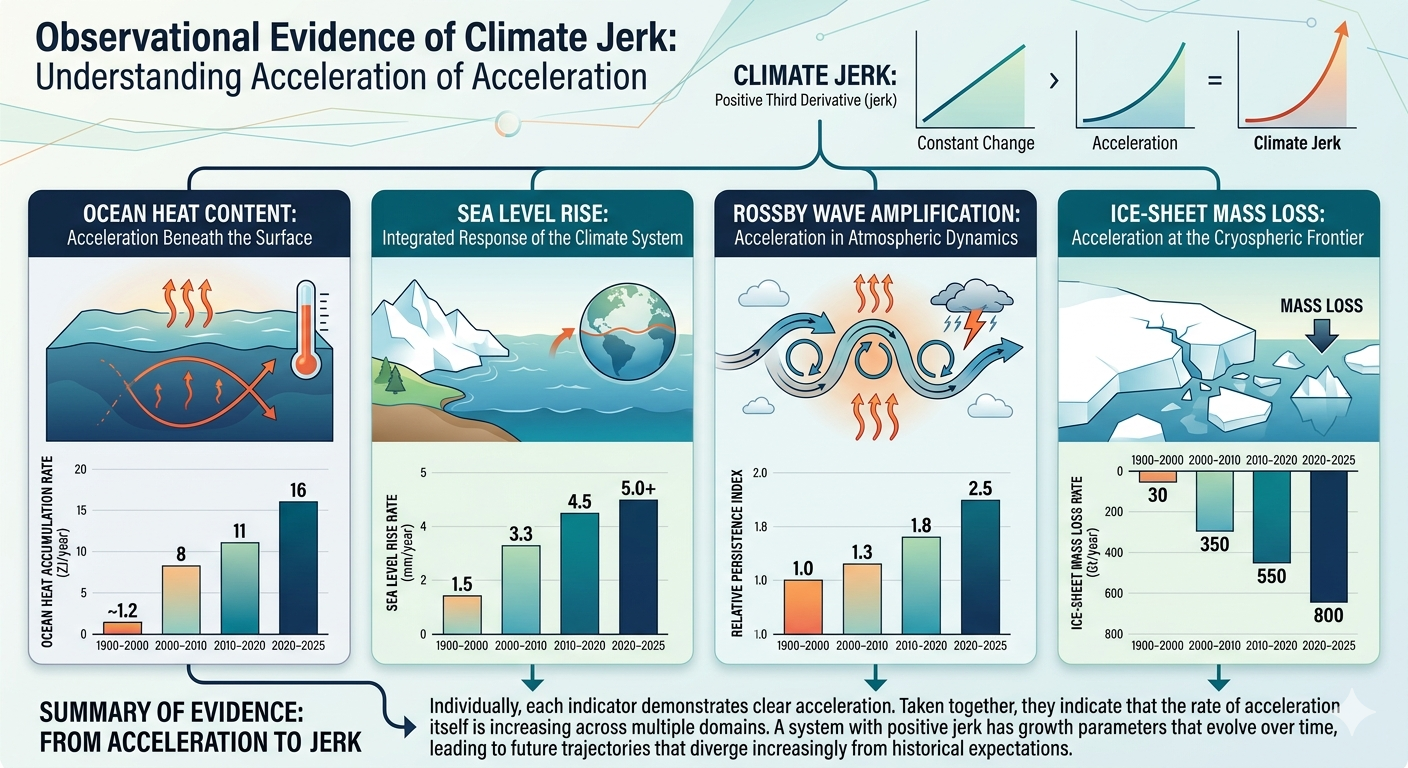
Ocean Heat Content: Acceleration Beneath the Surface

More than 90% of the excess energy trapped by greenhouse gases is absorbed by the oceans. As a result, ocean heat content (OHC) provides one of the most reliable measures of Earth’s energy imbalance.

Estimated rates of heat accumulation have increased significantly:

Period Approximate Rate
1900–2000 ~1.2 ZJ/year
2000–2010 ~8 ZJ/year
2010–2020 ~11 ZJ/year
2020–2025 ~16 ZJ/year

Relative to the 20th-century baseline, the current rate of ocean heat accumulation is more than an order of magnitude higher. This makes ocean heat content one of the clearest physical indicators of accelerating planetary energy imbalance.

Sea Level Rise: Integrated Response of the Climate System

Global mean sea level rise integrates multiple processes including thermal expansion of seawater, glacier melt, and ice-sheet mass loss. As such, it functions as a cumulative indicator of total system response to energy imbalance.

Estimated rates of sea level rise have increased over time:

Period Approximate Rate
1900–2000 ~1.5 mm/year
2000–2010 ~3.3 mm/year
2010–2020 ~4.5 mm/year
2020–2025 ~5.0+ mm/year

The transition from relatively modest 20th-century rates to significantly higher modern rates reflects both increased ocean heat uptake and accelerating cryospheric contributions. Because sea level rise integrates multiple subsystems, it provides a key “system-level” measure of climate acceleration.

Rossby Wave Amplification: Acceleration in Atmospheric Dynamics

Rossby waves regulate the large-scale structure of atmospheric circulation. Their amplitude, persistence, and phase behavior influence heat waves, droughts, atmospheric rivers, and persistent blocking events.

As Arctic amplification reduces the equator-to-pole temperature gradient, jet stream flow weakens and becomes more susceptible to high-amplitude meanders. This contributes to increasingly persistent weather extremes.

Period Relative Persistence Index
1900–2000 1.0
2000–2010 1.3
2010–2020 1.8
2020–2025 2.5

Rossby wave amplification is particularly important because it functions as a coupling mechanism between atmospheric dynamics and surface impacts. Persistent circulation patterns intensify heat extremes, drought persistence, flood clustering, and wildfire risk, thereby linking atmospheric behavior to surface system responses.

Ice-Sheet Mass Loss: Acceleration at the Cryospheric Frontier

Ice-sheet mass loss from Greenland and Antarctica represents one of the most direct responses to increasing radiative forcing and ocean heat uptake.

Period Approximate Rate
1900–2000 ~30 Gt/year
2000–2010 ~350 Gt/year
2010–2020 ~550 Gt/year
2020–2025 ~800 Gt/year

The increase in ice-sheet mass loss reflects the combined effects of surface melt, ice-ocean interactions, atmospheric river intrusion, and structural instability in outlet glaciers. These interacting processes produce strong nonlinear feedback behavior and make ice sheets one of the most sensitive components of the Earth system.

From Acceleration to Jerk

Individually, ocean heat content, sea level rise, Rossby wave amplification, and ice-sheet mass loss each demonstrate clear acceleration. Taken together, they indicate something more significant: the acceleration itself is increasing.

This distinction is critical. A system with constant acceleration can often be approximated using standard trend extrapolation. A system with positive jerk cannot. In such a system, the underlying growth parameters evolve over time, and future trajectories diverge increasingly from historical expectations.

In this framework, the emergence of climate jerk represents a potential indicator that the Earth system is transitioning toward a regime dominated by nonlinear feedbacks and interacting subsystems. The central question is therefore no longer whether the climate is changing or accelerating, but whether the rate of acceleration is itself increasing across multiple independent observational domains.

The convergence of ocean heat content, sea level rise, atmospheric circulation changes, and ice-sheet mass loss suggests that this condition may already be underway.

Feedback Loops → Tipping Points → Acceleration → Domino Effect
Feedback loops amplify climate change and can push interconnected Earth systems past critical tipping points. As tipping points are crossed, they can trigger additional feedback loops and destabilize other climate systems. This cascading “Domino Effect” compresses timescales, accelerates change, and increases the risk of rapid, nonlinear climate transformations.

* Our probabilistic, ensemble-based climate model — which incorporates complex socio-economic and ecological feedback loops within a dynamic, nonlinear system — projects that global temperatures are becoming unsustainable this century. This far exceeds earlier estimates of a 4°C rise over the next thousand years, highlighting a dramatic acceleration in global warming. We are now entering a phase of compound, cascading collapse, where climate, ecological, and societal systems destabilize through interlinked, self-reinforcing feedback loops.

We examine how human activities — such as deforestation, fossil fuel combustion, mass consumption, industrial agriculture, and land development — interact with ecological processes like thermal energy redistribution, carbon cycling, hydrological flow, biodiversity loss, and the spread of disease vectors. These interactions do not follow linear cause-and-effect patterns. Instead, they form complex, self-reinforcing feedback loops that can trigger rapid, system-wide transformations — often abruptly and without warning. Grasping these dynamics is crucial for accurately assessing global risks and developing effective strategies for long-term survival.

bookmark_borderThe Future Is Not Yet Written: Why Human Actions Still Matter in a World of Climate Tipping Points

How hard will our generation make the struggle to thrive become a struggle merely to survive?

by Daniel Brouse and Sidd Mukherjee
June 10, 2026

Introduction

Unfortunately, we have already lost things that cannot be replaced or restored.

One of my favorite questions for people who dismiss the significance of climate change is simple:

How long do you think it takes to make six-million-year-old ice?

The answer, of course, is millions of years.

When ancient glaciers, ice sheets, ecosystems, coral reefs, forests, and species disappear, they do not return on timescales relevant to human civilization. Some losses are effectively permanent from the perspective of any society that will exist over the coming centuries or even millennia.

The reality is that many of the changes now unfolding across the Earth system cannot be reversed within a human lifetime. Yet this does not mean that the future is predetermined or that human actions no longer matter.

In fact, they matter enormously.

The Continued Role of Human Activities

A growing body of evidence suggests that Earth’s major climate systems are increasingly interconnected through a network of reinforcing feedback loops. Sea-level rise, polar amplification, ocean heat content, marine heatwaves, atmospheric rivers, Rossby-wave persistence, AMOC weakening, wildfire feedbacks, permafrost thaw, methane release, ecosystem shifts, and climatic whiplash all appear to be interacting in ways that increase complexity and reduce predictability.

Through our analysis of highly coupled nonlinear systems, we remain convinced that human forcing is still the primary driver and determinant of the ultimate outcome.

Many subsystems appear to be approaching—or perhaps have already crossed—important thresholds. The interactions among these systems make prediction increasingly difficult, and cascading responses are a legitimate concern. In a highly interconnected system, a seemingly modest perturbation can propagate through multiple pathways and produce consequences far larger than the original disturbance.

This possibility is precisely what makes climate change so dangerous.

Has the Climate System Become Autonomous?

An important question is whether humanity has already pushed the climate system beyond a point where it will continue to deteriorate regardless of future actions.

We are not yet convinced that this is the case.

The atmosphere, oceans, cryosphere, and biosphere are all responding to an energy imbalance that human activities continue to create. Greenhouse gas concentrations continue to rise. Fossil fuel combustion, land-use change, industrial processes, and ecosystem degradation continue to alter the balance of incoming and outgoing energy.

In this context, the strength, duration, and trajectory of human forcing still matter enormously.

While some tipping elements may already be in motion, there is little evidence that all future outcomes are now entirely independent of human influence. Rather, current observations suggest that human activities remain one of the most important variables governing how rapidly the climate system changes and how severe the consequences ultimately become.

Will the World Ever Be as It Was?

That does not appear possible.

The climate of the twentieth century is gone.

Many glaciers are retreating beyond recovery. Ancient ice is melting. Species are disappearing. Ecosystems are shifting. Ocean chemistry is changing. Sea levels will continue rising for centuries, and some changes already underway will persist for generations.

The question is no longer whether we can preserve the world exactly as it was.

We cannot.

The more important question is whether we can influence the world that follows.

Can We Influence How Bad It Gets?

The answer remains yes.

This is why continued focus on the acceleration of climate change is so important.

If human activities remain the dominant forcing mechanism, then reducing that forcing can still alter the trajectory of the system, even if we can no longer prevent many of the changes already set in motion.

The difference between a world that warms another degree and one that warms several more degrees is not an academic distinction.

It is the difference between:

  • More manageable versus catastrophic sea-level rise.
  • Regional crop disruptions versus widespread food insecurity.
  • Occasional extreme heat versus chronic heat stress.
  • Increased adaptation costs versus systemic economic disruption.
  • Partial ecosystem loss versus widespread ecological collapse.

Small differences in average temperature translate into enormous differences in impacts because climate risks do not increase linearly. They compound through feedbacks, thresholds, and cascading interactions.

The Moral Question

Ultimately, climate change is not simply an environmental issue. It is a question of human welfare, opportunity, and survival.

The decisions made today will determine the quality of life experienced by many generations to come. They will influence access to food, water, shelter, health, security, and economic stability. They will shape the future of coastal communities, agricultural regions, and ecosystems around the world.

Perhaps the most important question is not whether climate change can be stopped entirely.

It is this:

How hard will our generation make the struggle to thrive become a struggle merely to survive?

The future may no longer be capable of becoming what it once could have been. But it is still capable of becoming far better—or far worse—depending on the choices humanity makes today.

The world as it was may be gone.

The world that will be is still being written.

Feedback Loops → Tipping Points → Domino Effect
Feedback loops amplify climate change and can push interconnected Earth systems past critical tipping points. As tipping points are crossed, they can trigger additional feedback loops and destabilize other climate systems. This cascading “Domino Effect” compresses timescales, accelerates change, and increases the risk of rapid, nonlinear climate transformations.

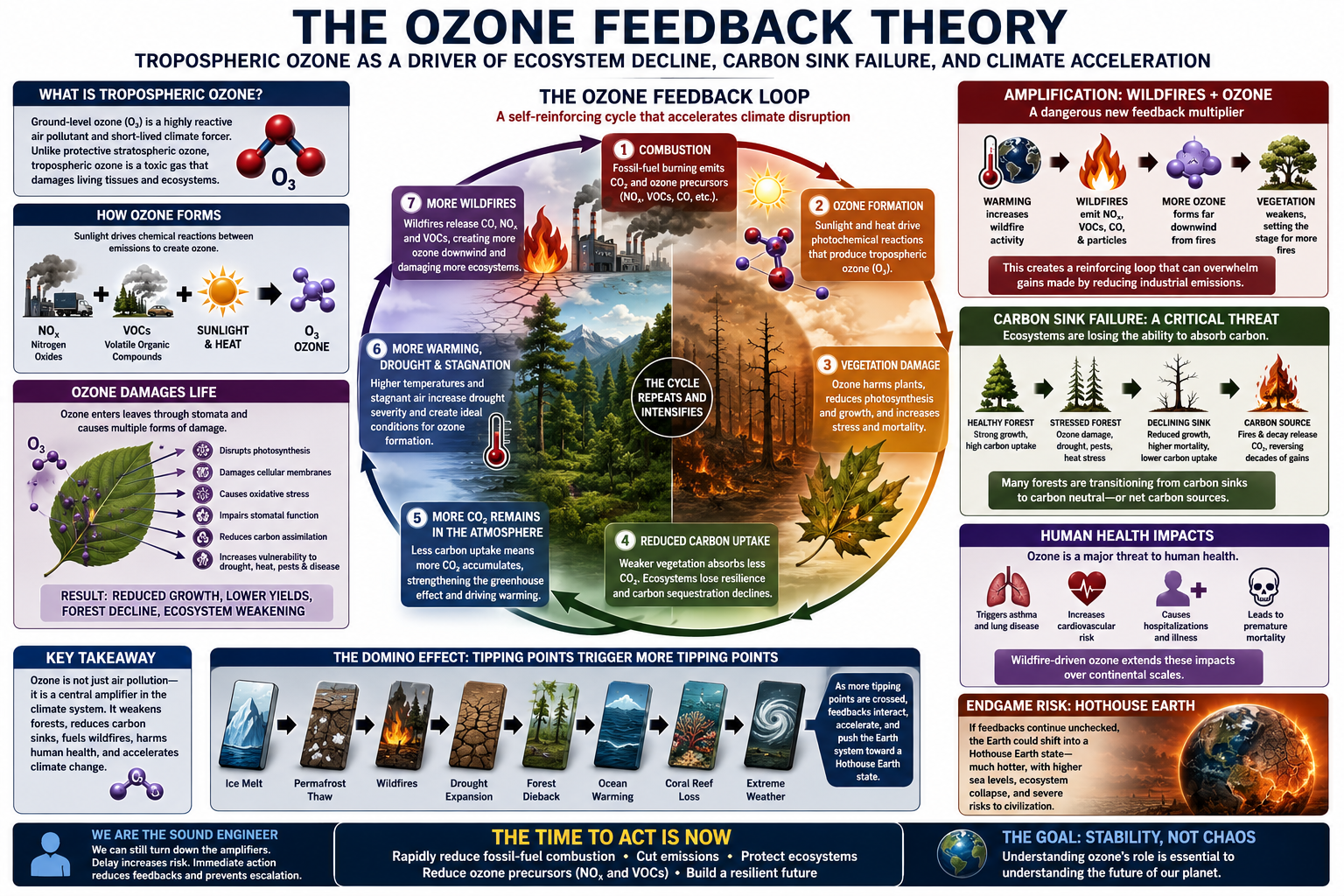
bookmark_borderThe Ozone Feedback Theory: Tropospheric Ozone as a Driver of Ecosystem Decline, Carbon Sink Failure, and Climate Acceleration

Abstract

Tropospheric ozone is a major air pollutant, a significant short-lived climate forcer, and an increasingly recognized driver of ecosystem decline. While carbon dioxide (CO₂) remains the dominant anthropogenic greenhouse gas, growing evidence demonstrates that ozone plays a critical role in accelerating climate disruption through its impacts on vegetation, carbon cycling, wildfire activity, atmospheric chemistry, and human health. This paper introduces the Ozone Feedback Theory, which describes how fossil-fuel combustion simultaneously increases atmospheric CO₂ concentrations and ozone precursors, creating interconnected feedbacks that weaken terrestrial carbon sinks, reduce ecosystem resilience, increase wildfire risk, and amplify climate change. Recent observations showing widespread declines in forest productivity, increasing wildfire-driven ozone formation, and the emerging transition of forests from net carbon sinks to net carbon sources provide strong support for this framework. The evidence increasingly indicates that ozone is not merely a secondary pollutant but a central amplifier within the Earth system.

1. Introduction

Tropospheric ozone is among the most underestimated drivers of ecological degradation and climate acceleration.

For decades, climate discussions have focused primarily on carbon dioxide, methane, and other greenhouse gases. While these gases remain fundamental to understanding climate change, this emphasis has often obscured the broader consequences of combustion. Fossil-fuel combustion does not simply release CO₂; it also produces the atmospheric precursors that generate ground-level ozone, one of the most biologically destructive pollutants in the modern environment.

Over the past two decades, a growing body of evidence has demonstrated that ozone damages forests, reduces agricultural productivity, weakens ecosystem resilience, increases susceptibility to drought and wildfire, and contributes significantly to human disease and premature mortality. What initially emerged as a working hypothesis has matured into a broader theoretical framework supported by observations from atmospheric chemistry, ecology, forestry, agronomy, public health, and climate science.

This framework, referred to here as the Ozone Feedback Theory, proposes that ozone functions not merely as an environmental pollutant but as an active participant in a network of self-reinforcing climate feedbacks. Through its impacts on vegetation and carbon sequestration, ozone contributes directly to the weakening of natural carbon sinks while simultaneously increasing vulnerability to drought, pests, disease, and wildfire. These processes, in turn, generate additional greenhouse gases and ozone precursors, creating a cascading cycle of environmental degradation.

The significance of this theory has increased dramatically in recent years as evidence accumulates that many of the world’s major forest systems are experiencing declining productivity, increasing mortality, and reduced carbon uptake. The emerging reversal of forests from net carbon sinks to net carbon sources represents one of the most consequential developments in modern climate science.

2. Origins of the Theory

The origins of the Ozone Feedback Theory were rooted in long-term observation.

Beginning in the early 2000s, repeated observations of mature forest canopies revealed a gradual but persistent decline in canopy density and overall forest health. Initially subtle, the changes became increasingly difficult to ignore. Trees that had stood for generations exhibited thinning crowns, reduced foliage, and declining vigor. Over time, measurable reductions in canopy density and height became evident.

Subsequent investigation suggested that these observations could not be adequately explained by a single factor. Instead, they appeared consistent with the combined effects of warming temperatures, drought stress, ecological disruption, and chronic ozone exposure.

What began as a localized observation eventually aligned with a growing body of scientific literature documenting ozone-induced declines in forest productivity, agricultural yields, and ecosystem resilience across multiple continents.

3. Tropospheric Ozone: A Potent Biological Toxin

Ground-level ozone forms through photochemical reactions involving nitrogen oxides (NOₓ), volatile organic compounds (VOCs), sunlight, and heat.

Unlike stratospheric ozone, which shields life from harmful ultraviolet radiation, tropospheric ozone is highly reactive and directly toxic to living tissues.

Ozone damages plants through multiple pathways:

  • Disruption of photosynthesis;
  • Damage to cellular membranes;
  • Oxidative stress;
  • Impairment of stomatal function;
  • Reduction in carbon assimilation;
  • Increased vulnerability to drought, heat, pests, and disease.

The consequences extend far beyond temporary stress. Numerous studies have documented significant reductions in plant growth, crop yields, forest productivity, and net primary productivity (NPP). Depending on species sensitivity and exposure levels, productivity losses ranging from 10% to more than 40% have been observed, with some ecosystems experiencing substantially greater impacts.

Ozone is therefore not simply a pollutant. It is a large-scale ecological forcing agent.

4. The Ozone Feedback Theory

The central premise of the Ozone Feedback Theory is straightforward:

Combustion generates both greenhouse gases and ozone precursors.

Those emissions simultaneously accelerate warming and increase ozone formation.

The resulting ozone damages vegetation, weakening ecosystems and reducing their capacity to absorb atmospheric carbon.

Reduced carbon uptake allows more CO₂ to remain in the atmosphere, contributing to additional warming.

Additional warming increases drought severity, wildfire activity, and atmospheric stagnation events, which further increase ozone formation.

The cycle then repeats.

In simplified form:

Combustion → Ozone Formation → Vegetation Damage → Reduced Carbon Uptake → Increased Atmospheric CO₂ → Additional Warming → Increased Wildfire Activity → Additional Ozone Formation

Unlike traditional climate frameworks that often treat ozone as a secondary pollutant, the Ozone Feedback Theory places ozone near the center of an interconnected network of biological, atmospheric, and climatic feedbacks.

5. Carbon Sink Failure and Ecosystem Destabilization

One of the most important implications of the theory is its relationship to carbon sink stability.

Forests, wetlands, and other ecosystems have historically absorbed a substantial fraction of anthropogenic carbon emissions. This natural buffering capacity has slowed the pace of climate change.

However, growing evidence suggests that this buffering capacity is weakening.

Multiple studies have documented:

  • Declining forest productivity;
  • Increased tree mortality;
  • Reduced carbon sequestration;
  • Expansion of drought stress;
  • Increased wildfire activity;
  • Large-scale ecosystem degradation.

Ozone contributes to each of these processes.

By reducing photosynthetic capacity and weakening plant defenses, ozone lowers ecosystem resilience precisely when climate stress is increasing. The result is a gradual erosion of the natural systems that have historically moderated atmospheric carbon accumulation.

The recent transition of many forest systems from carbon sinks toward carbon neutrality—or even net carbon emissions—represents one of the strongest lines of evidence supporting the theory.

6. Wildfires, Ozone, and Emerging Amplification Loops

Recent research has strengthened the theoretical framework considerably.

The 2026 Science paper, Fires Reverse Progress Toward Ozone Air Quality Standards in the United States, demonstrated that wildfire emissions are increasingly offsetting decades of improvements in ozone pollution achieved through reductions in industrial and transportation emissions.

The study showed that wildfire smoke generates substantial quantities of carbon monoxide, nitrogen oxides, and volatile organic compounds. These emissions undergo photochemical reactions that produce ozone far downwind from the original fire source.

This finding is critically important because it reveals a previously underestimated amplification mechanism:

Climate warming increases wildfire activity.

Wildfires increase ozone formation.

Ozone weakens vegetation.

Weakened vegetation becomes increasingly vulnerable to drought, heat stress, and future fires.

Future fires become more likely and more severe.

The result is a reinforcing feedback system operating across atmospheric, ecological, and climatic domains simultaneously.

7. Human Health Implications

The ozone feedback is not limited to ecosystems.

Tropospheric ozone is a major contributor to respiratory and cardiovascular disease worldwide. Chronic exposure increases the incidence of asthma, chronic obstructive pulmonary disease, cardiovascular stress, hospitalization, and premature mortality.

Wildfire-driven ozone formation extends these impacts over continental scales.

As wildfire activity increases, the health burden associated with ozone exposure is expected to increase as well.

The Ozone Feedback Theory therefore describes a dual crisis:

  • The degradation of natural systems that support life.
  • The deterioration of human health caused by the same atmospheric processes.

8. Conclusion

The evidence increasingly supports the conclusion that tropospheric ozone is not a peripheral component of the climate system. It is a major amplifier operating at the intersection of atmospheric chemistry, ecosystem function, human health, and climate dynamics.

The Ozone Feedback Theory provides a framework for understanding how combustion-driven ozone formation contributes simultaneously to ecosystem decline, carbon sink failure, wildfire amplification, and accelerating climate change.

The critical question is no longer whether these interactions exist. They are now directly observable across forests, agricultural systems, atmospheric measurements, wildfire records, and public-health statistics.

The challenge before climate science is to quantify the strength of these feedbacks, identify emerging tipping points, and determine how rapidly they are reshaping the Earth system.

Understanding ozone’s role in these processes may prove essential to understanding the trajectory of climate change itself.

Sources and References

  1. Runaway Climate Feedbacks and Systemic Collapse
  2. Fires Reverse Progress Toward Ozone Air Quality Standards in the United States Science (2026).
  3. Ozone as a Climate Multiplier: Key Coupling Agent in Chemistry–Climate Feedbacks
  4. Introduction to Ozone and Climate Change
  5. The Decline of Penn’s Sylvania
  6. The Dangers of Tropospheric Ozone: A Silent Threat to Health and the Environment
  7. The Domino Collapse of Earth’s Climate Systems: Amazon Rainforest Dieback and the Ozone Feedback Loop
  8. Ozone Feedbacks From Carbon Combustion: Tropospheric Ozone, Ecosystem Collapse, and the Failure of Biofuel Narratives
  9. Why Models Underestimated Climate Change
  10. Loss of Tropical Moist Broadleaf Forest Has Turned Africa’s Forests from a Carbon Sink into a Source
  11. Reduced Productivity and Carbon Drawdown of Tropical Forests from Ground-Level Ozone Exposure Nature Geoscience (2024).

Additional Reading

The references above collectively examine the role of tropospheric ozone as a climate forcing agent, ecosystem stressor, public-health hazard, and amplifier of climate feedbacks. Particular attention is given to ozone-induced reductions in forest productivity, weakening carbon sinks, wildfire-driven ozone formation, and the interaction between atmospheric chemistry and nonlinear climate-system responses.

bookmark_borderSingularity: Turn Down Your Guitar!

This paper is focused on the definitions of three key concepts: runaway climate change feedbacks, Hothouse Earth, Venus Syndrome, and singularity. Understanding the distinctions between these terms is essential because they describe different stages and mechanisms of large-scale system change.

I think part of the confusion stems from the distinction between runaway climate change feedbacks and the Hothouse Earth framework.

  • Runaway climate feedbacks — When individual climate indicators enter self-reinforcing feedback loops, such as sea ice melt and the albedo effect.
  • Runaway greenhouse effect — A self-amplifying warming process in which increasing temperatures cause additional greenhouse warming driving changes throughout the entire system, potentially leading to the evaporation of oceans and conditions resembling those on Venus. This is the classic “Venus scenario.”
  • Hothouse Earth — The framework proposed by researchers such as Will Steffen and colleagues. It does not describe a true Venus-style runaway greenhouse. Instead, it describes a much warmer Earth stabilized by Earth-system feedbacks, with substantially higher temperatures and sea levels than today.
  • Venus Syndrome — A less formal term sometimes used in popular science and environmental literature to describe Earth moving toward a Venus-like climate state through uncontrolled greenhouse warming.

A key distinction is that Hothouse Earth is not the same as a Venus-like runaway greenhouse. The Hothouse Earth framework generally envisions a planet that remains habitable in some regions but is much hotter and less hospitable. A true runaway greenhouse (the Venus scenario) is far more extreme and is not considered a likely outcome of anthropogenic climate change under current scientific understanding.

Physics does not support a transition to a full Hothouse Earth state within this century. However, physics does allow for self-reinforcing runaway processes that can move the climate system in that direction over longer timescales. These are the runaway processes we are currently observing: amplifying feedback loops that accelerate warming and increase the risk of crossing critical thresholds.

The distinction between runaway climate feedbacks and a Hothouse Earth state is crucial. Runaway processes mean that humans have triggered self-reinforcing feedbacks, but we still retain the ability to change course by reducing the activities driving them. A Hothouse Earth state, by contrast, implies that major Earth-system feedbacks have become sufficiently dominant that human actions alone may no longer be able to prevent continued warming.

If we still have a window of opportunity, it is now. The most effective action remains the rapid reduction and eventual elimination of fossil-fuel combustion. Delay increases the risk of crossing critical thresholds and committing future generations to far more severe and potentially irreversible consequences.

The easiest way for me to understand it is this:

Tipping points and feedback loops drive the acceleration of climate change. When one tipping point is crossed and triggers others, the cascading sequence is known as the Domino Effect.

In other words, feedback loops can become self-reinforcing, creating runaway processes. When one tipping point triggers additional tipping points, the resulting chain reaction can spread throughout the climate system. If enough major tipping elements are crossed, the climate system could be pushed toward a Hothouse Earth state.

A Simplified Framework

Tipping point crossed → feedback loop activated → runaway process

The Domino Effect

The Domino Effect occurs when multiple tipping points trigger additional tipping points and feedbacks. This cascading sequence of feedbacks spreads through the system, eventually destabilizing larger and larger portions of the Earth system and pushing it toward a Hothouse Earth state.

Another way to describe it is:

Tipping points trigger self-reinforcing feedback loops that enter a runaway state. When these runaway feedbacks cascade in a chain reaction across the entire system, runaway climate change approaches a singularity.

Amplifier Feedback Example

One last analogy for musicians.

A band is on stage, and a guitar amp begins to feed back. Left unchecked, the feedback becomes self-reinforcing. As it grows more intense, it triggers feedback in the vocalist’s microphone, which in turn triggers feedback in the stage monitors. The cascading feedbacks spread throughout the sound system, resulting in pure chaos across the entire arena – “approaching” singularity.

So when the sound engineer yells at the guitarist to “turn it down,” that’s essentially where we are today.

The Earth has at least several dozen major tipping points. At present, roughly nine appear to have entered self-reinforcing feedback loops. This is like having a large band with nine guitarists, each trying to hear themselves over the others. As a result, each guitarist turns up their amplifier a little louder. Soon, all nine amps are feeding back.

Humanity is the sound engineer. We must take immediate action because these feedbacks can spill over and trigger additional feedbacks. Those new feedbacks can then amplify the original ones, creating a cascading network of self-reinforcing processes.

A simple real-world example is sea ice melt and the albedo effect. As highly reflective sea ice melts, it exposes darker ocean water that absorbs more solar energy. This is analogous to the first guitarist turning the amplifier up too loud and creating feedback. The darker ocean surface warms more rapidly, accelerating the melting of additional ice and exposing even more dark water.

It is possible that this process has entered a self-reinforcing runaway feedback loop. However, it is important to recognize that not all runaway processes continue indefinitely. Once the sea ice is largely gone, that particular feedback will eventually reach its limit and stabilize. In the meantime, however, it can amplify numerous other feedbacks throughout the climate system, including those that affect carbon storage and carbon dioxide sequestration.

Conclusion

Climate change appears to have entered a phase in which multiple self-reinforcing feedback processes are becoming increasingly important. If left unchecked, these interacting feedbacks are likely to continue accelerating change and pushing the Earth system toward increasingly unstable conditions, potentially approaching a climatic singularity.

Runaway feedbacks have begun, but we have not yet entered true runaway climate change. That’s an important difference. Self-reinforcing feedback loops are increasingly evident in several parts of the Earth system, but humanity still retains the ability to influence the outcome through aggressive mitigation.

That’s why I believe our primary focus must remain on mitigation. If we give up on mitigation and focus only on adaptation, then adaptation eventually becomes our only option. The goal is to prevent that future, not simply prepare for it.

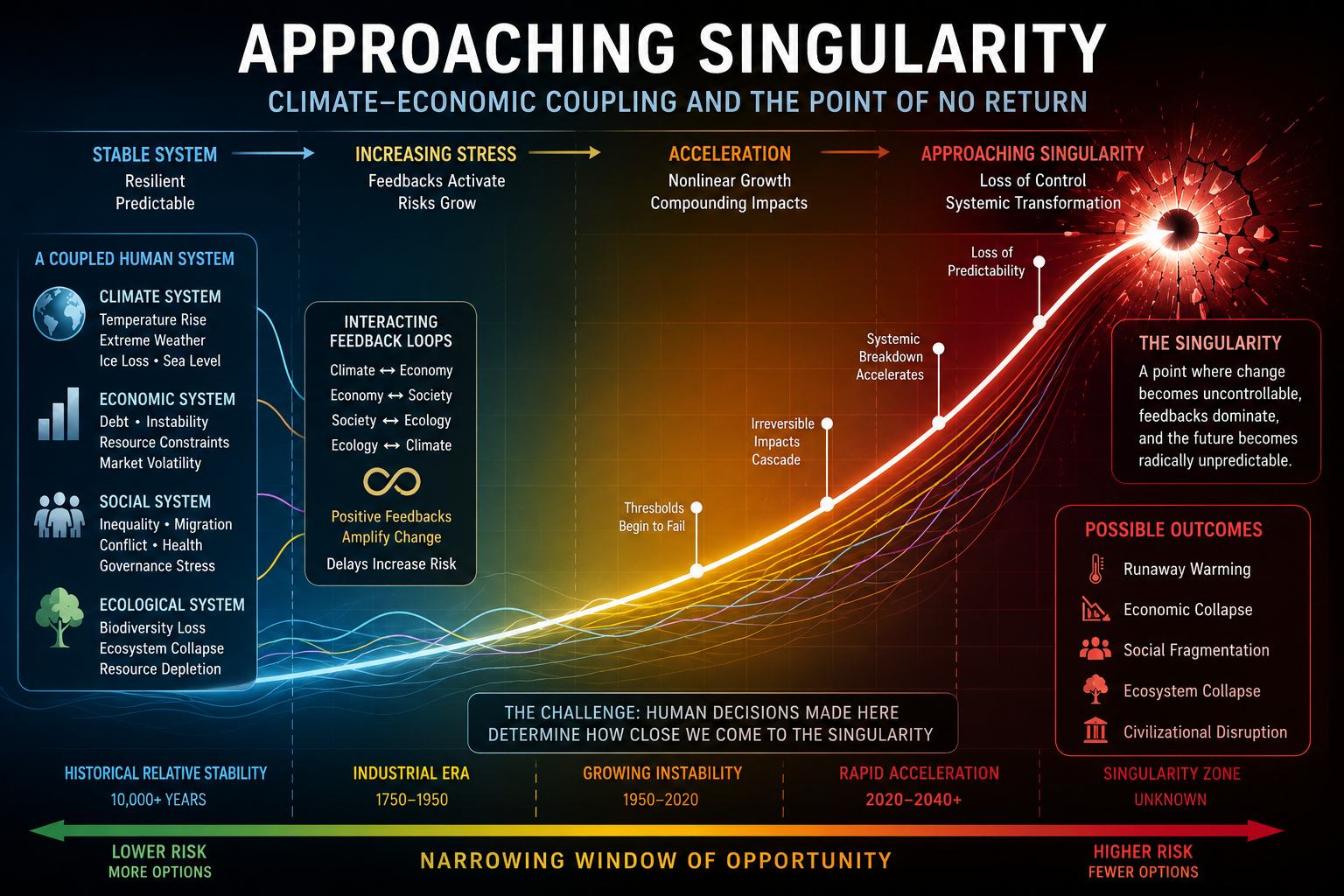
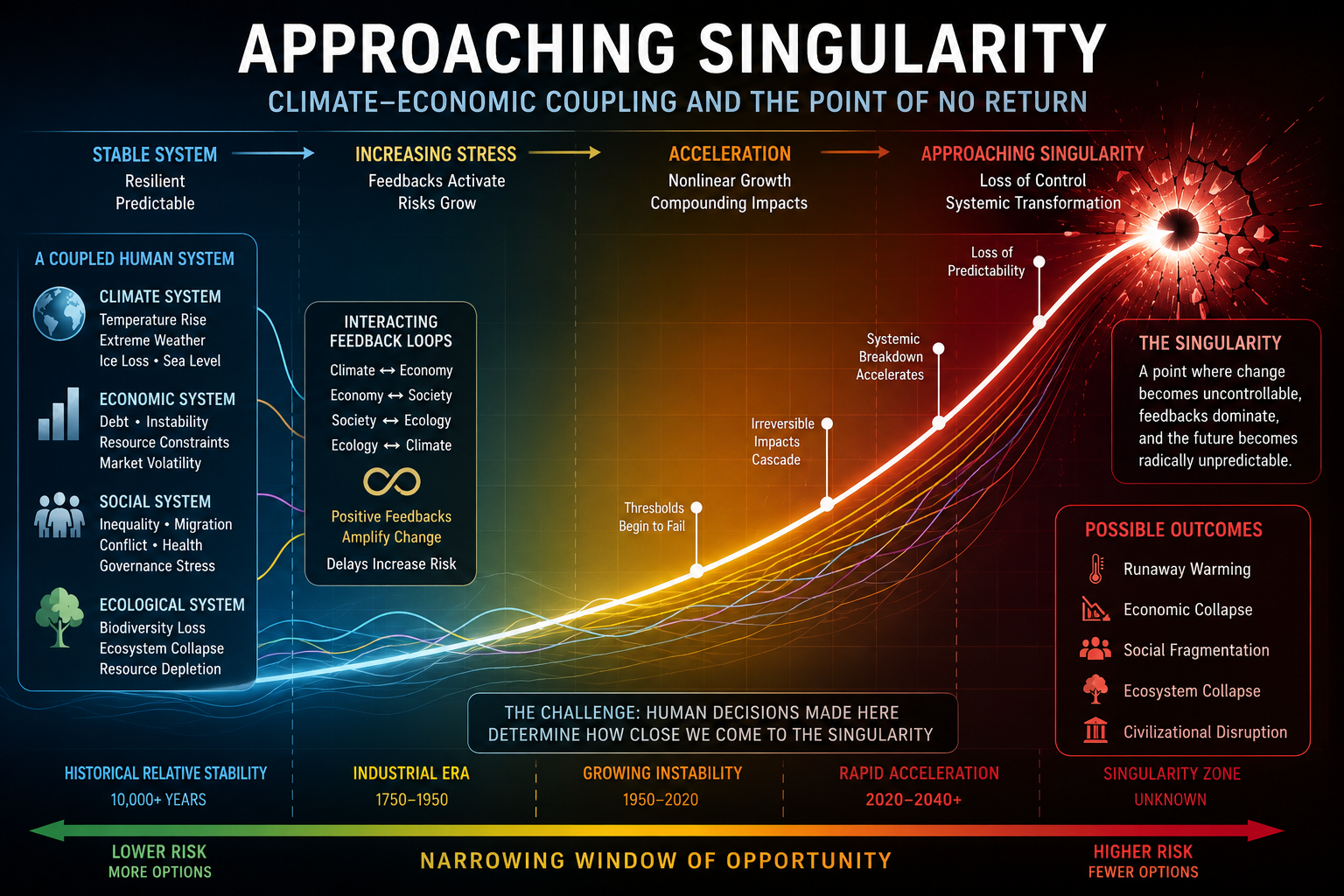
  • The accompanying graphic includes a timeline along the bottom that illustrates the concept. It suggests that we are moving toward a climatic singularity, but we’re not there yet. The remaining window may be narrowing, but it is precisely that remaining window that makes mitigation so important.

Singularity

Advances in technology, modeling, and artificial intelligence have significantly improved our ability to understand and track the accelerating dynamics of climate change. These tools have provided new insight into how quickly complex systems can evolve—and how difficult it may be to keep pace with that acceleration.

Our latest analysis suggests that the climate–economic system is now exhibiting third-derivative behavior, indicating that not only are impacts increasing, and accelerating, but the acceleration itself is increasing. This places the system within a singularity-like regime, characterized by nonlinear amplification, rising instability, and reduced predictability.

Historically, such transitions were assumed to unfold over tens of thousands to millions of years based on paleoclimate evidence. However, current observations indicate that these dynamics may be occurring on dramatically compressed timescales, raising the possibility that singularity-like behavior could emerge within contemporary time horizons.

Given the importance and accessibility of these findings, this work is presented in three formats:

Each version conveys the same core insight: complex, coupled systems can shift rapidly from stable to unstable behavior, and understanding this transition is critical to anticipating future climate and economic risk.

bookmark_borderIs Climate Change on a Runaway Train?

by Daniel Brouse and Sidd Mukherjee

A Public-Access Discussion of Nonlinear Climate Risk

Abstract

Climate change is often discussed in terms of gradual warming. However, growing evidence suggests that many climate impacts may be accelerating through interacting feedback loops and nonlinear system behavior. This raises an important question:

Is climate change entering a runaway state?

The answer depends largely on how the term runaway is defined. While current observations do not support the conclusion that Earth is undergoing a Venus-like runaway greenhouse effect, numerous climate, ecological, and economic subsystems are exhibiting increasingly self-reinforcing dynamics. Understanding these dynamics is essential for evaluating future risks and identifying effective mitigation and adaptation strategies.


What Does “Runaway” Mean?

The word runaway is often interpreted as an absolute condition: a system that has become completely uncontrollable.

In reality, complex systems rarely transition from stable to unstable in a single step. Instead, they often move through a spectrum of increasingly nonlinear behavior as feedback mechanisms strengthen and begin interacting with one another.

One of the challenges facing climate science is that there is no universally accepted definition of what constitutes a runaway state in the Earth system, nor is there a single observable threshold that clearly indicates when such a transition has occurred.

This uncertainty is scientifically important.

In many complex systems, critical transitions are only fully recognized in hindsight, after the system response is already underway.

The scientific question is therefore not whether Earth has entered a fully runaway state. Rather, the question is:

To what extent are self-reinforcing feedbacks becoming dominant drivers of system behavior?


The Train Analogy

A useful way to think about climate change is through the analogy of an accelerating train.

Imagine riding on a train.

Looking out the window, you can clearly see that the train is moving faster than it was before. That increase in speed is observable and largely undisputed.

At the same time, the ride is becoming less smooth. There is more vibration, more instability, and greater variability throughout the system.

The train is still on the tracks.

The engineer still has control.

But momentum is increasing.

The critical question is not whether the train is moving. The critical question is what lies ahead.

A train can safely accelerate for a very long time under favorable conditions. Problems arise when increasing speed encounters constraints that the system was not designed to handle.

A steep decline.

A sharp curve.

A damaged bridge.

The faster the train is moving when it reaches those conditions, the more difficult it becomes to avoid derailment.

Climate change presents a similar risk-management challenge.

The prudent course is not to wait until the curve becomes visible.

The prudent course is to reduce risk while options remain available.


Evidence of Increasing Nonlinearity

A growing number of climate indicators exhibit behavior that appears inconsistent with simple linear change.

Examples include:

  • accelerating sea-level rise,
  • increasing atmospheric moisture,
  • intensifying precipitation extremes,
  • expanding wildfire activity,
  • growing ocean heat content,
  • ice-sheet instability,
  • ecosystem degradation,
  • climate-related insurance losses,
  • and increasing infrastructure vulnerability.

Each of these processes is influenced by multiple interacting feedback mechanisms.

The concern is not any single indicator in isolation.

The concern is the coupling among many indicators simultaneously.

As feedbacks strengthen, the response of the overall system may become increasingly nonlinear, making future outcomes more difficult to predict using historical trends alone.


Climate, Economics, and Systemic Risk

Climate change is not solely an environmental issue.

It is increasingly becoming an economic risk-management problem.

My own research background is in economics, complex systems, and climate risk management. My research partner, Sidd Mukherjee, is a physicist. Although our disciplines differ, we have independently arrived at similar conclusions regarding the growing importance of coupled climate–economic feedbacks.

One of the clearest examples may be found in the insurance industry.

Insurance functions as society’s primary mechanism for distributing risk. When insurers withdraw from regions, significantly increase premiums, or reduce coverage availability, they are responding to observed changes in risk rather than theoretical possibilities.

These responses can propagate through:

  • housing markets,
  • mortgage systems,
  • infrastructure investment,
  • municipal finance,
  • migration patterns,
  • and broader economic networks.

Understanding how climate risks move through these interconnected systems remains a major focus of our research.


The Nonlinear Acceleration Framework

Our work has explored what we call the Nonlinear Acceleration Framework.

The central idea is simple:

Climate impacts are not driven solely by direct warming. They are also influenced by interactions among physical, ecological, social, and economic feedback loops.

When feedbacks interact, change may occur faster than expected from temperature trends alone.

Whether specific acceleration estimates ultimately prove accurate is less important than the broader observation:

Many climate indicators appear to be changing at rates that challenge assumptions of gradual, linear progression.

This possibility deserves serious scientific attention.


What We Think

Although uncertainty remains substantial, both Sidd and I believe several major climate-related systems are already experiencing significant destabilization.

My greatest concern is the increasing fragility of climate-linked economic systems, particularly insurance and real estate.

Sidd’s greatest concern is the potential destabilization of large ecological systems, especially the Amazon rainforest, which plays a critical role in global carbon cycling, hydrology, and biodiversity.

Where we strongly agree is that many of these processes are not future possibilities waiting to begin.

They are already observable today.

The debate increasingly concerns magnitude, timing, interaction, and ultimate consequences.

In 2023 and 2024 much of the scientific community came to the conclusion that multiple major tipping points had entered self-reinforcing feedbacks. 2024 was the hottest year on record. The Antarctic saw recording breaking ice sheet destabilization. Large portions of Siberia caught on fire. The most alarming signal was Canada’s borreal forests catching on fire. In 2023, Sidd said, “Do you remember back in the early 2000’s when we thought we wouldn’t live to see the extreme changes due to global warming?”

Daniel replied, “I think 2023 is the most significant year so far. We saw confirmation of tipping points being crossed for Mountain Glacier Loss, Greenland Ice Sheet Collapse, Antarctic Ice Sheet Collapse, and potentially the Collapse of AMOC.”

Sidd continued, “We already knew that. It was Canada catching on fire that I could not believe. I never thought I’d live to see the day.”

Daniel asked, “Do you think the permafrost and peatlands will have zombie fires and cause the permafrost tipping point?”

Sidd responded, “Yes. They are gone, too. We already know from the permafrost peatland fires in Siberia.”

2023 was the year we saw confirmation that multiple tipping points were accelerating and feeding each other.


Conclusion

Climate change is not a runaway greenhouse catastrophe unfolding overnight.

Nor is it a simple linear process that can be understood by extending historical trends indefinitely into the future.

The evidence increasingly points toward a complex system characterized by interacting feedback loops, threshold behavior, and growing nonlinear responses.

The most important question is no longer whether climate change is occurring.

The question is how rapidly interconnected climate, ecological, economic, and social systems will respond as feedbacks continue to strengthen.

Understanding that response may determine how effectively humanity navigates the century ahead.


Important Scientific Note

A full “Hothouse Earth” or Venus-like runaway greenhouse scenario is not considered plausible within the next century based on current scientific understanding.

However, present-day emissions and feedback processes may commit future generations to long-term warming pathways that become increasingly difficult to reverse.

Some research has explored high-end warming outcomes exceeding 10°C over multi-century timescales under strong feedback participation. The key issue is not whether such outcomes occur in the near term, but whether current decisions influence long-term climate trajectories in ways that constrain future options.

The central challenge is therefore not immediate runaway warming, but the possibility of crossing thresholds that commit the Earth system to progressively more difficult and costly futures.

* Our probabilistic, ensemble-based climate model — which incorporates complex socio-economic and ecological feedback loops within a dynamic, nonlinear system — projects that global temperatures are becoming unsustainable this century. This far exceeds earlier estimates of a 4°C rise over the next thousand years, highlighting a dramatic acceleration in global warming. We are now entering a phase of compound, cascading collapse, where climate, ecological, and societal systems destabilize through interlinked, self-reinforcing feedback loops.

We examine how human activities — such as deforestation, fossil fuel combustion, mass consumption, industrial agriculture, and land development — interact with ecological processes like thermal energy redistribution, carbon cycling, hydrological flow, biodiversity loss, and the spread of disease vectors. These interactions do not follow linear cause-and-effect patterns. Instead, they form complex, self-reinforcing feedback loops that can trigger rapid, system-wide transformations — often abruptly and without warning. Grasping these dynamics is crucial for accurately assessing global risks and developing effective strategies for long-term survival.

bookmark_borderThe Compression of Time: Where Are We in Climate Change?

The Compression of Time: Where Are We in Climate Change?
You Are Here.

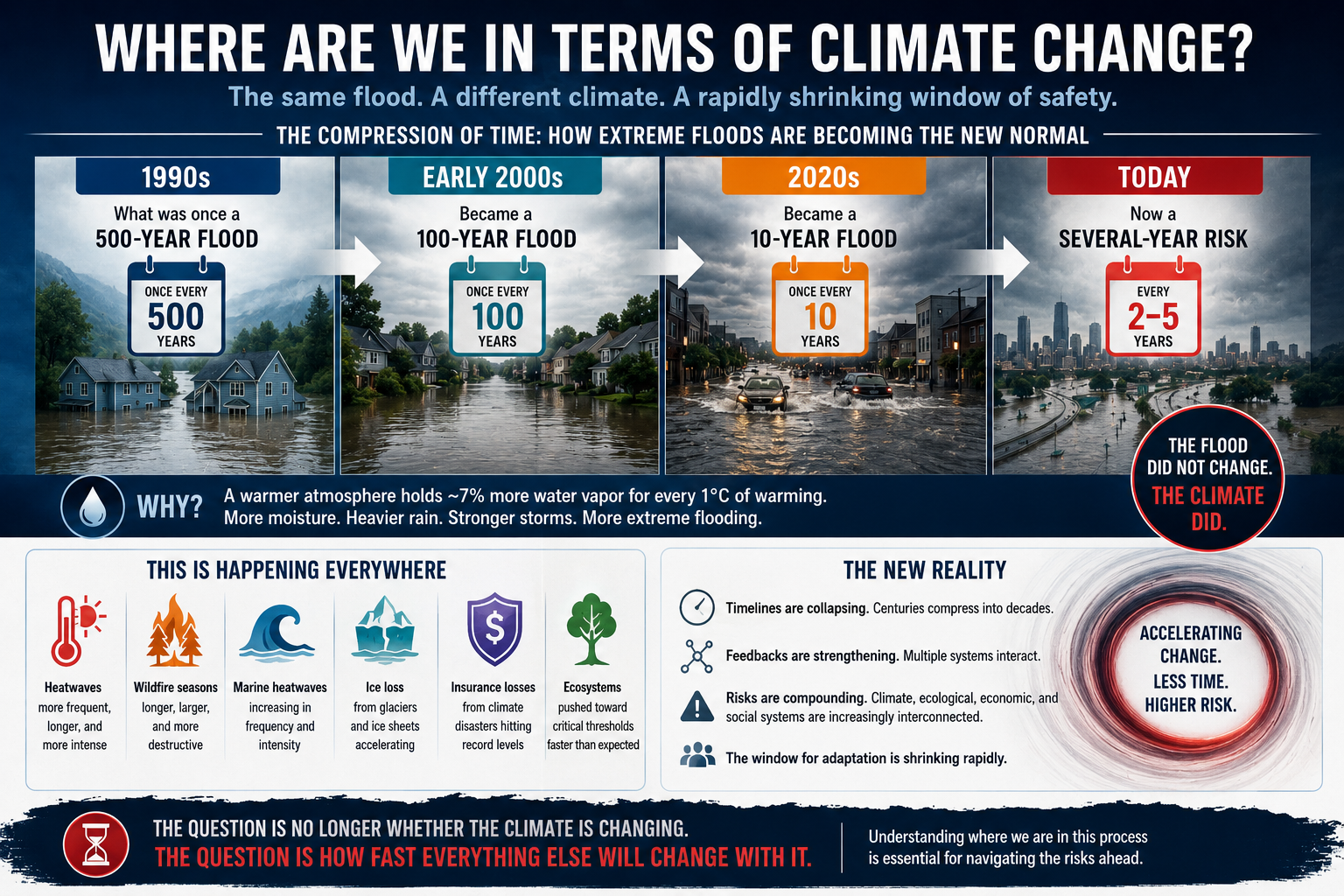
One of the simplest ways to understand climate change is through the changing frequency of extreme events.

In the 1990s, what was considered a 500-year flood was expected to occur, on average, once every five centuries. By the early 2000s, many of those same events were being reclassified as 100-year floods. By the 2020s, they increasingly resembled 10-year floods. Today, in some regions, comparable flood events are occurring every few years.

The flood itself did not change.

What changed was the climate system.

This pattern illustrates one of the most important and often misunderstood aspects of climate change: the compression of time. Events once considered exceptionally rare are becoming increasingly common as warming temperatures intensify the hydrological cycle, increase atmospheric moisture, and amplify extreme precipitation.

The atmosphere now holds approximately 7% more water vapor for every 1°C of warming. That additional moisture acts as fuel for heavier rainfall, stronger storms, and more extreme flooding. As a result, historical assumptions about risk are rapidly becoming obsolete.

The same phenomenon can be observed across numerous climate indicators:

  • Heatwaves that once occurred once in a generation now occur repeatedly within a decade.
  • Wildfire seasons are becoming longer, larger, and more destructive.
  • Marine heatwaves are increasing in frequency and intensity.
  • Ice loss from glaciers and ice sheets continues to accelerate.
  • Insurance losses from weather-related disasters are reaching record levels.
  • Ecosystems are being pushed toward critical thresholds faster than many models once anticipated.

The key lesson is that climate change is not simply about gradual warming. It is about the acceleration of change itself.

For decades, scientists and policymakers often discussed climate impacts using relatively stable timelines. Yet as feedback loops strengthen and multiple systems interact, those timelines begin to collapse. What was expected centuries from now may arrive within decades. What was expected decades from now may arrive within years.

The question is no longer whether the climate system is changing.

The question is how rapidly interconnected climate, ecological, economic, and social systems respond as accelerating feedbacks compress the time available for adaptation.

Understanding where we are in that process is essential for understanding the risks that lie ahead.

Singularity
Advances in technology, modeling, and artificial intelligence have significantly improved our ability to understand and track the accelerating dynamics of climate change. These tools have provided new insight into how quickly complex systems can evolve—and how difficult it may be to keep pace with that acceleration.

Our latest analysis suggests that the climate–economic system is now exhibiting third-derivative behavior, indicating that not only are impacts increasing, and accelerating, but the acceleration itself is increasing. This places the system within a singularity-like regime, characterized by nonlinear amplification, rising instability, and reduced predictability.

Historically, such transitions were assumed to unfold over tens of thousands to millions of years based on paleoclimate evidence. However, current observations indicate that these dynamics may be occurring on dramatically compressed timescales, raising the possibility that singularity-like behavior could emerge within contemporary time horizons.

We examine two examples: dam failure and vortex dynamics.

Our original was of a flushing toilet. This analog gives a vivid example of relativity and spacetime continuum. Imagine you found yourself floating in a toilet. The bowl represents the Earth’s climate system. Perhaps you are lucky enough to be sitting atop a large lump. Or maybe you are on stray undigested pea or kernel of corn. Perhaps you find yourself swimming in the debris.

First, will you recognize the toilet handle has been triggered. As the rotation increases, will you notice the acceleration. How will you perceive the motion and passing of time relative to you?

As the vortex forces grow stronger, will you be able to adapt and slow or stop the forces pulling you down the drain?

bookmark_borderHeat Stress, Environmental Stressors, and the Limits of Human Adaptability

A Follow-Up to Heat Stress, Human Survivability, and the Emerging Physiological Limits of Climate Change

http://membrane.com/global_warming/Heat-Survivability-Thresholds.html

Q: How Adaptable Are Humans to Rising Heat and Compounding Environmental Stressors?

A: Far less adaptable than many assume.

Modern humans (Homo sapiens) are approximately 200,000 years old, with some of our closest ancestral lineages dating back roughly 140,000 years. One of the oldest known oral traditions may provide a remarkable example of humanity’s long environmental memory: the story of the Seven Sisters of the Pleiades.

The Pleiades are a cluster of stars in the Taurus constellation. Today, six stars are easily visible to the naked eye, yet many ancient traditions across the world describe seven visible sisters. Some researchers suggest these stories may preserve observations from many tens of thousands of years ago, before stellar movement made the seventh star difficult to see without magnification.

Among the oldest continuous cultural traditions associated with the Pleiades are the Dreaming stories of Aboriginal Australians. These interconnected “songlines” span much of the Australian continent, linking ecological knowledge, astronomy, navigation, and seasonal cycles across dozens of language groups and cultures.

First Nations Australians are also among the earliest groups to recognize localized ecological disruptions associated with anthropogenic climate change. Their approximately 65,000 years of continuous connection to Country produced highly localized ecological calendars based not on fixed months, but on relationships among plants, animals, weather patterns, and stars. This deep environmental literacy enabled them to track subtle shifts in ecosystems long before modern climate science emerged.

Yet even populations with millennia of environmental adaptation have limits.

Although Aboriginal Australians survived in some of the harshest climates on Earth, they have not escaped the physiological and societal burdens associated with environmental stress. Today, Indigenous Australians continue to experience significantly lower life expectancy compared to non-Indigenous populations, reflecting the complex interaction of environmental, social, economic, and health stressors.

There are important lessons in this history:

Long-term adaptation over thousands of years is fundamentally different from rapid climate destabilization unfolding over mere decades.


Heat, Health, and Compounding Stressors

The dangers of rising temperatures extend far beyond mass casualty events during heatwaves.

Heat exposure increasingly functions as a chronic, whole-body stressor capable of degrading human health over time.

Recent analyses estimate that the average person now experiences roughly 19 days per year of potentially life-threatening heat exposure, with most of that increase attributable to human-caused climate warming.

The impacts extend well beyond heatstroke.

Prolonged exposure to elevated temperatures contributes to:

  • dehydration,
  • kidney injury,
  • cardiovascular strain,
  • worsening respiratory disease,
  • impaired sleep and recovery,
  • reduced labor productivity,
  • and increased mortality risk.

Emerging research also indicates that chronic heat exposure can accelerate biological aging by damaging tissues, impairing mitochondrial function, and shortening telomeres at the cellular level.

These processes are associated with elevated risks of:

  • diabetes,
  • dementia,
  • cardiovascular disease,
  • immune dysfunction,
  • and several forms of cancer.

Heat stress also significantly affects mental health, increasing rates of:

  • anxiety,
  • depression,
  • aggression,
  • cognitive impairment,
  • and suicide risk.

The cumulative burden of these stressors becomes even more dangerous when combined with pollution exposure, infectious disease, nutritional instability, and economic stress.


Adaptation Timescales Matter

Arguments that humans have “always adapted” to heat fundamentally misunderstand the timescale problem.

Human adaptation historically occurred across evolutionary and cultural timescales spanning thousands of years.

Modern climate destabilization is unfolding within decades.

This compression of time severely limits both biological adaptation and societal infrastructure response.

The challenge is not simply rising temperature — it is the accelerating interaction of multiple environmental stressors occurring simultaneously within highly interconnected systems.


Epigenetic Changes: The Molecular Convergence of Climate Stressors

One of the most important emerging areas of research involves epigenetics — chemical modifications that influence how genes are expressed without changing the underlying DNA sequence itself.

These mechanisms function somewhat like biological dimmer switches, activating or suppressing genetic pathways in response to environmental conditions.

Extreme heat, particularly when combined with:

  • air pollution,
  • wildfire smoke,
  • ozone exposure,
  • chronic stress,
  • and infections such as COVID-19,

is increasingly associated with epigenetic modification.

Research suggests these changes may influence genes linked to:

  • cancer,
  • diabetes,
  • cardiovascular disease,
  • neurological disorders,
  • inflammation,
  • immune regulation,
  • and accelerated aging.

Critically, when multiple environmental stressors occur simultaneously, their effects may not simply add together — they may compound through interacting biological feedback loops.

This molecular-level disruption may represent a shared underlying mechanism connecting many climate-related health threats.

The implications are profound.

Climate change may not only reduce lifespan through direct heat mortality, but also through the gradual amplification of chronic disease, immune dysfunction, cognitive decline, and systemic physiological stress across entire populations.

Researchers are also increasingly concerned about potential transgenerational effects, where environmentally induced epigenetic changes in one generation may influence disease susceptibility in the next.


Conclusion

Climate change is not simply an environmental crisis.

It is increasingly a physiological, neurological, immunological, and societal stress crisis operating across multiple interconnected systems simultaneously.

The question is no longer whether humans can survive occasional extreme heat events.

The emerging scientific question is:

How well can human biology, infrastructure, healthcare systems, economies, and societies adapt to accelerating, compounding environmental stressors occurring at historically unprecedented rates?

Current evidence suggests the limits may be approaching far sooner than previously assumed.

bookmark_borderHeat Stress, Human Survivability, and the Emerging Physiological Limits of Climate Change

For decades, many researchers assumed humans could generally survive “wet-bulb” temperatures near 35°C (95°F at 100% humidity) for limited periods. This threshold was widely treated as the upper survivability boundary for healthy individuals under shaded and ventilated conditions.

Many newer experiments now indicate that:

  • 31°C wet-bulb (~87.8°F) may already be dangerous or unsurvivable for many healthy adults after prolonged exposure.
  • For elderly individuals or vulnerable populations, critical stress may begin closer to: 28–30°C wet-bulb (~82–86°F).

These newer laboratory experiments using controlled climate chambers now suggest that the true physiological danger threshold may be substantially lower for large portions of the population — particularly:

  • the elderly,
  • individuals with cardiovascular or respiratory disease,
  • outdoor workers,
  • children,
  • and populations without reliable access to cooling infrastructure.

These findings significantly alter our understanding of human vulnerability in a warming world.

Why the Research Matters

The emerging research demonstrates that heat stress is not merely a matter of discomfort or dehydration. Elevated temperatures directly impair critical biological systems, including:

  • thermoregulation,
  • immune response,
  • cardiovascular stability,
  • cellular metabolism,
  • mitochondrial function,
  • and DNA repair mechanisms.

This is critically important because public discussions often continue framing heatwaves as isolated “weather events” rather than systemic physiological stressors capable of destabilizing multiple organ systems simultaneously.

The newer findings instead suggest that prolonged heat exposure functions as a whole-body biological destabilizer.

Heat, Immunity, and Cellular Damage

One of the most significant emerging findings is that elevated temperatures can impair immune-cell stability while simultaneously increasing inflammatory stress and cellular damage.

Related NIH-supported research has shown that fever-range temperatures can increase mitochondrial dysfunction and DNA damage in critical immune cells. These processes may contribute to:

  • weakened immune resilience,
  • increased systemic inflammation,
  • accelerated aging processes,
  • greater cardiovascular strain,
  • impaired recovery capacity,
  • and potentially elevated long-term disease risk through cumulative cellular stress.

Additional studies suggest that prolonged heat exposure may even accelerate epigenetic aging markers — effectively speeding aspects of the body’s biological aging clock.

The implications extend well beyond temporary heat exhaustion.

The Climate Change Connection

These findings become even more significant when viewed in the context of accelerating climate instability.

Extreme heat events are increasing:

  • in frequency,
  • duration,
  • nighttime persistence,
  • humidity,
  • and geographic reach.

This is occurring alongside broader atmospheric and oceanic destabilization, including:

  • slowing jet-stream dynamics,
  • amplified Rossby-wave blocking patterns,
  • urban heat-island amplification,
  • weakening ocean circulation systems such as the AMOC,
  • and increasing atmospheric moisture content.

In practical terms, temperatures once considered rare anomalies are increasingly becoming sustained seasonal conditions across large regions of the world.

Why Humidity Is So Dangerous

A major focus of current research is wet-bulb temperature — a combined measure of heat and humidity.

Humans cool themselves primarily through evaporative cooling via sweating. High humidity dramatically reduces the body’s ability to dissipate heat into the surrounding environment.

As humidity rises:

  • sweat evaporates less efficiently,
  • internal body temperature increases more rapidly,
  • cardiovascular stress intensifies,
  • and recovery becomes increasingly difficult.

This means a moderately lower humid temperature can be more physiologically dangerous than a much hotter dry environment.

The danger becomes especially severe when:

  • nighttime temperatures remain elevated,
  • indoor cooling is unavailable,
  • populations are exposed for prolonged periods,
  • or electrical infrastructure fails during heatwaves.

Under these conditions, the body may no longer recover adequately from cumulative daytime heat stress.

A Growing Public Health Crisis

Perhaps the most important implication is this:

Many regions may approach dangerous human survivability thresholds far earlier than current infrastructure, public-health planning, and policy assumptions anticipate.

Heat is already among the deadliest weather-related hazards globally. Unlike hurricanes or tornadoes, heat-related deaths are often undercounted because they frequently manifest indirectly through:

  • cardiac failure,
  • respiratory collapse,
  • kidney injury,
  • stroke,
  • immune dysfunction,
  • and secondary medical complications.

Climate change is therefore no longer solely an environmental issue. It is increasingly a direct human physiological and public-health crisis.

The Broader Systems Implication

As temperatures continue rising, societies become increasingly dependent upon:

  • air conditioning,
  • electrical grids,
  • water infrastructure,
  • cooling centers,
  • healthcare systems,
  • and indoor climate stabilization technologies.

This creates a dangerous reinforcing feedback loop.

Extreme heat increases demand for cooling precisely when heat also strains:

  • power grids,
  • transmission infrastructure,
  • water systems,
  • and energy supplies.

The result is a compounding systems dynamic:

more heat → greater cooling demand → higher energy consumption → greater emissions → more heat

Without major improvements in energy efficiency, emissions reductions, and climate adaptation infrastructure, this cycle risks becoming increasingly self-reinforcing.

The growing body of heat-survivability research suggests that human physiological limits may become one of the defining constraints shaping civilization’s climate future during the twenty-first century.

Nature: What is the hottest temperature humans can survive?

bookmark_borderHeat Domes, Climate Instability, and the Growing Need for Household Climate Control

Introduction

Heat damages the immune system and even affects genetic and cellular stability. New research suggests the temperature threshold for these harmful impacts may be significantly lower than previously understood. A Corsi–Rosenthal Box can help improve indoor comfort by enhancing air circulation, reducing particulate pollution, and supporting more stable indoor temperatures. As climate change drives increased reliance on air conditioning, indoor air quality often declines due to reduced ventilation and the buildup of pollutants indoors.  Just as important is energy efficiency. A Corsi–Rosenthal Box used in conjunction with air conditioning allows cooling systems to operate at lower levels, dramatically reducing energy consumption while improving indoor air quality and comfort.
 
Nature: Heat and Human Health Research https://www.nature.com/articles/d41586-024-02422-5

The world is now experiencing unprecedented heatwaves and persistent heat domes across much of the Northern Hemisphere. What were once considered rare “extreme weather events” are rapidly becoming prolonged seasonal patterns.

Currently, severe and dangerous heat is impacting the United Kingdom, large portions of Europe, India, China, the Middle East, and the Southwestern United States. These events are increasing not only in intensity, but also in frequency, duration, and geographic scale.

The underlying physics are becoming increasingly clear.

Polar amplification — the rapid warming of the Arctic relative to lower latitudes — is weakening the temperature gradient that historically drove a faster, more stable jet stream. As the jet stream slows, larger Rossby waves and blocking patterns become more common, allowing heat domes to remain “stuck” over regions for days or even weeks.

At the same time, weakening ocean circulation systems — particularly the Atlantic Meridional Overturning Circulation (AMOC) and Pacific Meridional Overturning Circulation (PMOC) — are altering global heat distribution and atmospheric dynamics. These circulation slowdowns further destabilize weather patterns and contribute to amplified climate extremes across similar Northern Hemisphere latitudes.

The result is a growing pattern of persistent atmospheric stagnation:

  • longer heatwaves,
  • warmer nights,
  • elevated humidity,
  • worsening drought,
  • wildfire smoke,
  • and increasingly dangerous air quality.

Climate Control Is Becoming Essential

In many parts of the world, climate control is no longer simply a matter of comfort — it is increasingly becoming a matter of survival.

Heat-related fatalities are rising rapidly, particularly during early-season heat events when populations are less physiologically adapted and infrastructure is unprepared. Current hotspots include:

  • the UK,
  • Southern and Central Europe,
  • India,
  • portions of China,
  • and the Southwestern United States.

Extreme heat places enormous stress on:

  • the cardiovascular system,
  • respiratory health,
  • pets and wildlife,
  • electrical grids,
  • agriculture,
  • and water supplies.

The danger becomes even greater when heat combines with elevated particulate pollution, wildfire smoke, humidity, and ozone formation.

A Simple and Effective Solution: The Corsi–Rosenthal Box

One of the cheapest and most energy-efficient methods for improving indoor air quality and household climate resilience is the Corsi–Rosenthal Box.

The Corsi–Rosenthal Box is a simple DIY air filtration and purification system that can outperform many expensive commercial HEPA purifiers at a fraction of the cost.

It is built using:

  • a standard box fan,
  • furnace air filters,
  • cardboard,
  • and tape.

The design dramatically improves air circulation while removing:

  • smoke particles,
  • dust,
  • pollen,
  • wildfire pollution,
  • and many airborne contaminants.

To further reduce ozone use activated carbon filters.

I first began using Corsi–Rosenthal Boxes several years ago when Canadian wildfire smoke heavily impacted Pennsylvania. The improvement in indoor air quality was immediate and dramatic — both for myself and for my dog. Since then, I have continued using multiple units throughout much of the year.

As climate change accelerates:

  • wildfire smoke,
  • heat stress,
  • humidity,
  • particulate pollution,
  • and ozone-related air quality problems

are all expected to worsen.

Indoor air circulation and filtration are increasingly becoming essential public-health tools.

A Practical Climate Adaptation Tool

While large-scale emissions reductions remain critical, individuals can still take practical steps to improve resilience and reduce exposure to worsening environmental conditions.

The Corsi–Rosenthal Box represents one of the simplest, lowest-cost, and most effective climate adaptation tools available today. Its exceptional energy efficiency is especially important because rising air-conditioning demand is helping drive a dangerous positive feedback loop: more heat leads to more air conditioning, which leads to greater energy consumption and emissions, which in turn contributes to even more heat.

Do yourself, your pets, and your plants a favor:
build a DIY Corsi–Rosenthal Box.

Corsi–Rosenthal Box Instructions

http://membrane.com/global_warming/Corsi-Rosenthal-Box.html

The Overlooked Threat: Ground-Level Ozone

One of the most underappreciated climate-health threats is tropospheric (ground-level) ozone.

Unlike protective stratospheric ozone high in the atmosphere, ground-level ozone is a toxic air pollutant formed when:

  • heat,
  • ultraviolet (UV) radiation,
  • nitrogen oxides (NOx),
  • and volatile organic compounds (VOCs)

react together in sunlight.

The primary source of these precursor pollutants is carbon combustion:

  • gasoline,
  • diesel,
  • coal,
  • natural gas,
  • aviation fuels,
  • and many biofuel blends such as ethanol.

This means that on hot sunny days — especially near roads, highways, cities, or industrial areas — humans, pets, and plants are often exposed to dangerous ozone concentrations.

Ozone damages:

  • lung tissue,
  • cardiovascular health,
  • immune response,
  • and plant productivity.

It worsens:

  • asthma,
  • allergies,
  • COPD,
  • respiratory infections,
  • and heat-related illness.

Plants and forests suffer as well. Ozone impairs photosynthesis, damages leaf tissues, weakens drought resistance, and reduces ecosystem productivity. In many regions, ozone stress is now contributing to forest decline and weakening natural carbon sinks.

In effect, humans and vegetation are “breathing” the same increasingly toxic atmosphere.

One Important Point

Indoor ozone levels are often lower than outdoor levels unless:

  • windows are open,
  • outdoor air is entering directly,
  • or ozone-generating devices are being used indoors.

Ironically, many “air purifiers” marketed as ionizers or ozone generators actually produce ozone intentionally, which can worsen respiratory health. Those should generally be avoided.

The Best Low-Cost Ozone Strategies

The most effective low-cost ways to reduce ozone exposure are:

  • stay indoors during high-ozone afternoons,
  • avoid strenuous outdoor activity on hot sunny days,
  • keep windows closed during ozone alerts,
  • use air conditioning in conjunction with a Corsi–Rosenthal Box when possible,
  • and use filtration systems with activated carbon if ozone is severe.