Abstract
Tropospheric ozone is a major air pollutant, a significant short-lived climate forcer, and an increasingly recognized driver of ecosystem decline. While carbon dioxide (CO₂) remains the dominant anthropogenic greenhouse gas, growing evidence demonstrates that ozone plays a critical role in accelerating climate disruption through its impacts on vegetation, carbon cycling, wildfire activity, atmospheric chemistry, and human health. This paper introduces the Ozone Feedback Theory, which describes how fossil-fuel combustion simultaneously increases atmospheric CO₂ concentrations and ozone precursors, creating interconnected feedbacks that weaken terrestrial carbon sinks, reduce ecosystem resilience, increase wildfire risk, and amplify climate change. Recent observations showing widespread declines in forest productivity, increasing wildfire-driven ozone formation, and the emerging transition of forests from net carbon sinks to net carbon sources provide strong support for this framework. The evidence increasingly indicates that ozone is not merely a secondary pollutant but a central amplifier within the Earth system.
1. Introduction
Tropospheric ozone is among the most underestimated drivers of ecological degradation and climate acceleration.
For decades, climate discussions have focused primarily on carbon dioxide, methane, and other greenhouse gases. While these gases remain fundamental to understanding climate change, this emphasis has often obscured the broader consequences of combustion. Fossil-fuel combustion does not simply release CO₂; it also produces the atmospheric precursors that generate ground-level ozone, one of the most biologically destructive pollutants in the modern environment.
Over the past two decades, a growing body of evidence has demonstrated that ozone damages forests, reduces agricultural productivity, weakens ecosystem resilience, increases susceptibility to drought and wildfire, and contributes significantly to human disease and premature mortality. What initially emerged as a working hypothesis has matured into a broader theoretical framework supported by observations from atmospheric chemistry, ecology, forestry, agronomy, public health, and climate science.
This framework, referred to here as the Ozone Feedback Theory, proposes that ozone functions not merely as an environmental pollutant but as an active participant in a network of self-reinforcing climate feedbacks. Through its impacts on vegetation and carbon sequestration, ozone contributes directly to the weakening of natural carbon sinks while simultaneously increasing vulnerability to drought, pests, disease, and wildfire. These processes, in turn, generate additional greenhouse gases and ozone precursors, creating a cascading cycle of environmental degradation.
The significance of this theory has increased dramatically in recent years as evidence accumulates that many of the world’s major forest systems are experiencing declining productivity, increasing mortality, and reduced carbon uptake. The emerging reversal of forests from net carbon sinks to net carbon sources represents one of the most consequential developments in modern climate science.
2. Origins of the Theory
The origins of the Ozone Feedback Theory were rooted in long-term observation.
Beginning in the early 2000s, repeated observations of mature forest canopies revealed a gradual but persistent decline in canopy density and overall forest health. Initially subtle, the changes became increasingly difficult to ignore. Trees that had stood for generations exhibited thinning crowns, reduced foliage, and declining vigor. Over time, measurable reductions in canopy density and height became evident.
Subsequent investigation suggested that these observations could not be adequately explained by a single factor. Instead, they appeared consistent with the combined effects of warming temperatures, drought stress, ecological disruption, and chronic ozone exposure.
What began as a localized observation eventually aligned with a growing body of scientific literature documenting ozone-induced declines in forest productivity, agricultural yields, and ecosystem resilience across multiple continents.
3. Tropospheric Ozone: A Potent Biological Toxin
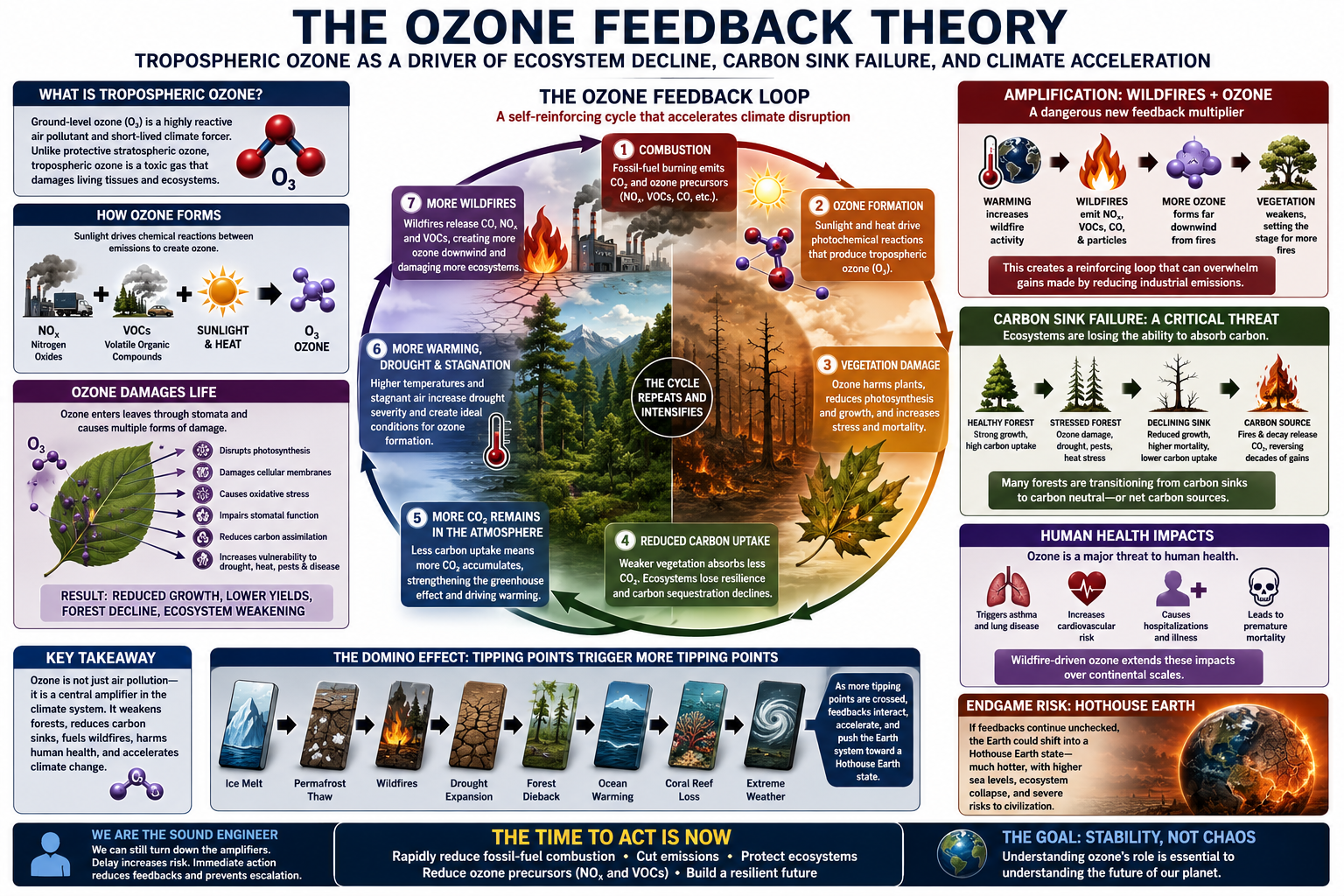
Ground-level ozone forms through photochemical reactions involving nitrogen oxides (NOₓ), volatile organic compounds (VOCs), sunlight, and heat.
Unlike stratospheric ozone, which shields life from harmful ultraviolet radiation, tropospheric ozone is highly reactive and directly toxic to living tissues.
Ozone damages plants through multiple pathways:
- Disruption of photosynthesis;
- Damage to cellular membranes;
- Oxidative stress;
- Impairment of stomatal function;
- Reduction in carbon assimilation;
- Increased vulnerability to drought, heat, pests, and disease.
The consequences extend far beyond temporary stress. Numerous studies have documented significant reductions in plant growth, crop yields, forest productivity, and net primary productivity (NPP). Depending on species sensitivity and exposure levels, productivity losses ranging from 10% to more than 40% have been observed, with some ecosystems experiencing substantially greater impacts.
Ozone is therefore not simply a pollutant. It is a large-scale ecological forcing agent.
4. The Ozone Feedback Theory
The central premise of the Ozone Feedback Theory is straightforward:
Combustion generates both greenhouse gases and ozone precursors.
Those emissions simultaneously accelerate warming and increase ozone formation.
The resulting ozone damages vegetation, weakening ecosystems and reducing their capacity to absorb atmospheric carbon.
Reduced carbon uptake allows more CO₂ to remain in the atmosphere, contributing to additional warming.
Additional warming increases drought severity, wildfire activity, and atmospheric stagnation events, which further increase ozone formation.
The cycle then repeats.
In simplified form:
Combustion → Ozone Formation → Vegetation Damage → Reduced Carbon Uptake → Increased Atmospheric CO₂ → Additional Warming → Increased Wildfire Activity → Additional Ozone Formation
Unlike traditional climate frameworks that often treat ozone as a secondary pollutant, the Ozone Feedback Theory places ozone near the center of an interconnected network of biological, atmospheric, and climatic feedbacks.
5. Carbon Sink Failure and Ecosystem Destabilization
One of the most important implications of the theory is its relationship to carbon sink stability.
Forests, wetlands, and other ecosystems have historically absorbed a substantial fraction of anthropogenic carbon emissions. This natural buffering capacity has slowed the pace of climate change.
However, growing evidence suggests that this buffering capacity is weakening.
Multiple studies have documented:
- Declining forest productivity;
- Increased tree mortality;
- Reduced carbon sequestration;
- Expansion of drought stress;
- Increased wildfire activity;
- Large-scale ecosystem degradation.
Ozone contributes to each of these processes.
By reducing photosynthetic capacity and weakening plant defenses, ozone lowers ecosystem resilience precisely when climate stress is increasing. The result is a gradual erosion of the natural systems that have historically moderated atmospheric carbon accumulation.
The recent transition of many forest systems from carbon sinks toward carbon neutrality—or even net carbon emissions—represents one of the strongest lines of evidence supporting the theory.
6. Wildfires, Ozone, and Emerging Amplification Loops
Recent research has strengthened the theoretical framework considerably.
The 2026 Science paper, Fires Reverse Progress Toward Ozone Air Quality Standards in the United States, demonstrated that wildfire emissions are increasingly offsetting decades of improvements in ozone pollution achieved through reductions in industrial and transportation emissions.
The study showed that wildfire smoke generates substantial quantities of carbon monoxide, nitrogen oxides, and volatile organic compounds. These emissions undergo photochemical reactions that produce ozone far downwind from the original fire source.
This finding is critically important because it reveals a previously underestimated amplification mechanism:
Climate warming increases wildfire activity.
Wildfires increase ozone formation.
Ozone weakens vegetation.
Weakened vegetation becomes increasingly vulnerable to drought, heat stress, and future fires.
Future fires become more likely and more severe.
The result is a reinforcing feedback system operating across atmospheric, ecological, and climatic domains simultaneously.
7. Human Health Implications
The ozone feedback is not limited to ecosystems.
Tropospheric ozone is a major contributor to respiratory and cardiovascular disease worldwide. Chronic exposure increases the incidence of asthma, chronic obstructive pulmonary disease, cardiovascular stress, hospitalization, and premature mortality.
Wildfire-driven ozone formation extends these impacts over continental scales.
As wildfire activity increases, the health burden associated with ozone exposure is expected to increase as well.
The Ozone Feedback Theory therefore describes a dual crisis:
- The degradation of natural systems that support life.
- The deterioration of human health caused by the same atmospheric processes.
8. Conclusion
The evidence increasingly supports the conclusion that tropospheric ozone is not a peripheral component of the climate system. It is a major amplifier operating at the intersection of atmospheric chemistry, ecosystem function, human health, and climate dynamics.
The Ozone Feedback Theory provides a framework for understanding how combustion-driven ozone formation contributes simultaneously to ecosystem decline, carbon sink failure, wildfire amplification, and accelerating climate change.
The critical question is no longer whether these interactions exist. They are now directly observable across forests, agricultural systems, atmospheric measurements, wildfire records, and public-health statistics.
The challenge before climate science is to quantify the strength of these feedbacks, identify emerging tipping points, and determine how rapidly they are reshaping the Earth system.
Understanding ozone’s role in these processes may prove essential to understanding the trajectory of climate change itself.
Sources and References
- Runaway Climate Feedbacks and Systemic Collapse
- Fires Reverse Progress Toward Ozone Air Quality Standards in the United States Science (2026).
- Ozone as a Climate Multiplier: Key Coupling Agent in Chemistry–Climate Feedbacks
- Introduction to Ozone and Climate Change
- The Decline of Penn’s Sylvania
- The Dangers of Tropospheric Ozone: A Silent Threat to Health and the Environment
- The Domino Collapse of Earth’s Climate Systems: Amazon Rainforest Dieback and the Ozone Feedback Loop
- Ozone Feedbacks From Carbon Combustion: Tropospheric Ozone, Ecosystem Collapse, and the Failure of Biofuel Narratives
- Why Models Underestimated Climate Change
- Loss of Tropical Moist Broadleaf Forest Has Turned Africa’s Forests from a Carbon Sink into a Source
- Reduced Productivity and Carbon Drawdown of Tropical Forests from Ground-Level Ozone Exposure Nature Geoscience (2024).
Additional Reading
The references above collectively examine the role of tropospheric ozone as a climate forcing agent, ecosystem stressor, public-health hazard, and amplifier of climate feedbacks. Particular attention is given to ozone-induced reductions in forest productivity, weakening carbon sinks, wildfire-driven ozone formation, and the interaction between atmospheric chemistry and nonlinear climate-system responses.