The Compression of Time: Where Are We in Climate Change?
You Are Here.
One of the simplest ways to understand climate change is through the changing frequency of extreme events.
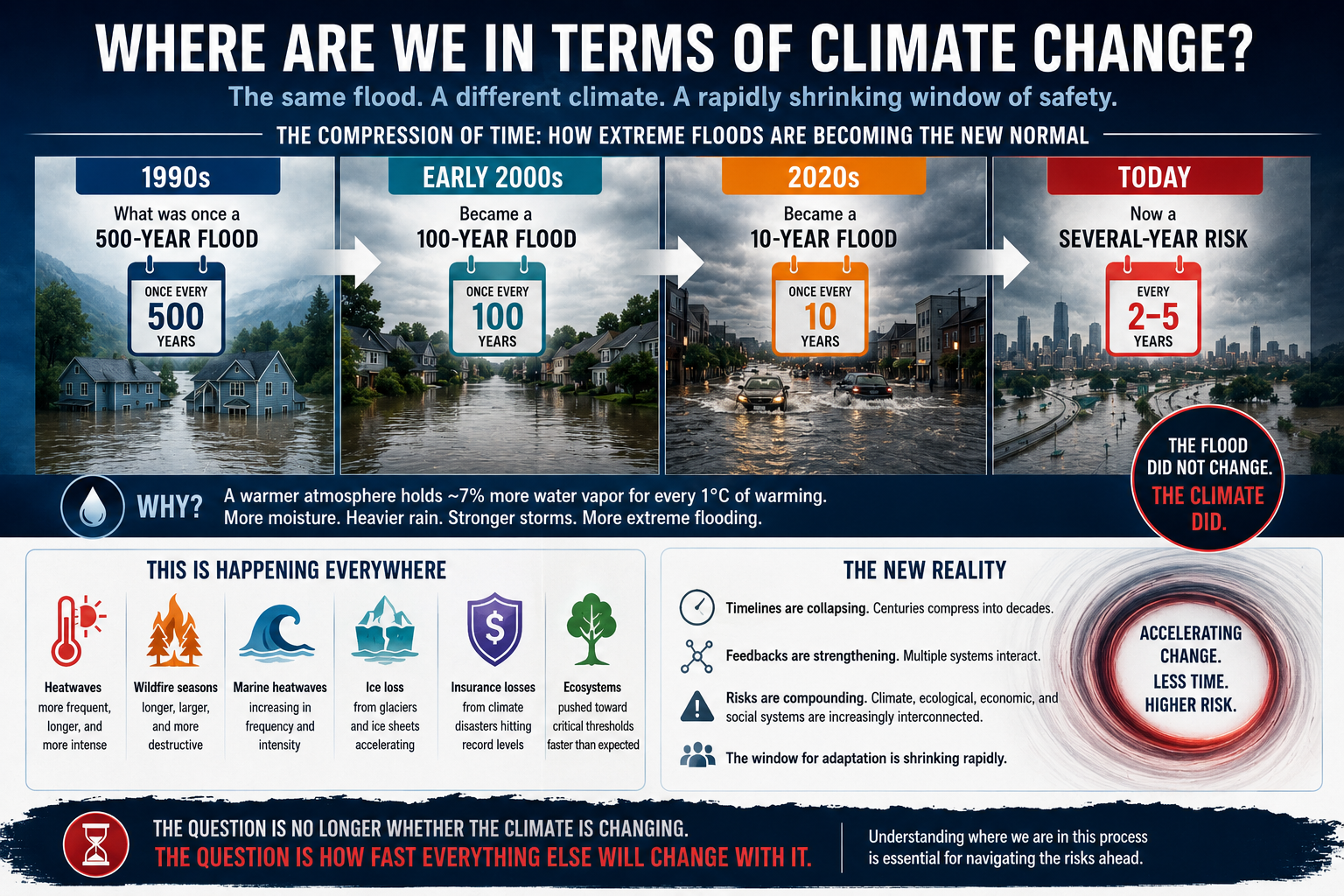
In the 1990s, what was considered a 500-year flood was expected to occur, on average, once every five centuries. By the early 2000s, many of those same events were being reclassified as 100-year floods. By the 2020s, they increasingly resembled 10-year floods. Today, in some regions, comparable flood events are occurring every few years.
The flood itself did not change.
What changed was the climate system.
This pattern illustrates one of the most important and often misunderstood aspects of climate change: the compression of time. Events once considered exceptionally rare are becoming increasingly common as warming temperatures intensify the hydrological cycle, increase atmospheric moisture, and amplify extreme precipitation.
The atmosphere now holds approximately 7% more water vapor for every 1°C of warming. That additional moisture acts as fuel for heavier rainfall, stronger storms, and more extreme flooding. As a result, historical assumptions about risk are rapidly becoming obsolete.
The same phenomenon can be observed across numerous climate indicators:
- Heatwaves that once occurred once in a generation now occur repeatedly within a decade.
- Wildfire seasons are becoming longer, larger, and more destructive.
- Marine heatwaves are increasing in frequency and intensity.
- Ice loss from glaciers and ice sheets continues to accelerate.
- Insurance losses from weather-related disasters are reaching record levels.
- Ecosystems are being pushed toward critical thresholds faster than many models once anticipated.
The key lesson is that climate change is not simply about gradual warming. It is about the acceleration of change itself.
For decades, scientists and policymakers often discussed climate impacts using relatively stable timelines. Yet as feedback loops strengthen and multiple systems interact, those timelines begin to collapse. What was expected centuries from now may arrive within decades. What was expected decades from now may arrive within years.
The question is no longer whether the climate system is changing.
The question is how rapidly interconnected climate, ecological, economic, and social systems respond as accelerating feedbacks compress the time available for adaptation.
Understanding where we are in that process is essential for understanding the risks that lie ahead.
Singularity
Advances in technology, modeling, and artificial intelligence have significantly improved our ability to understand and track the accelerating dynamics of climate change. These tools have provided new insight into how quickly complex systems can evolve—and how difficult it may be to keep pace with that acceleration.
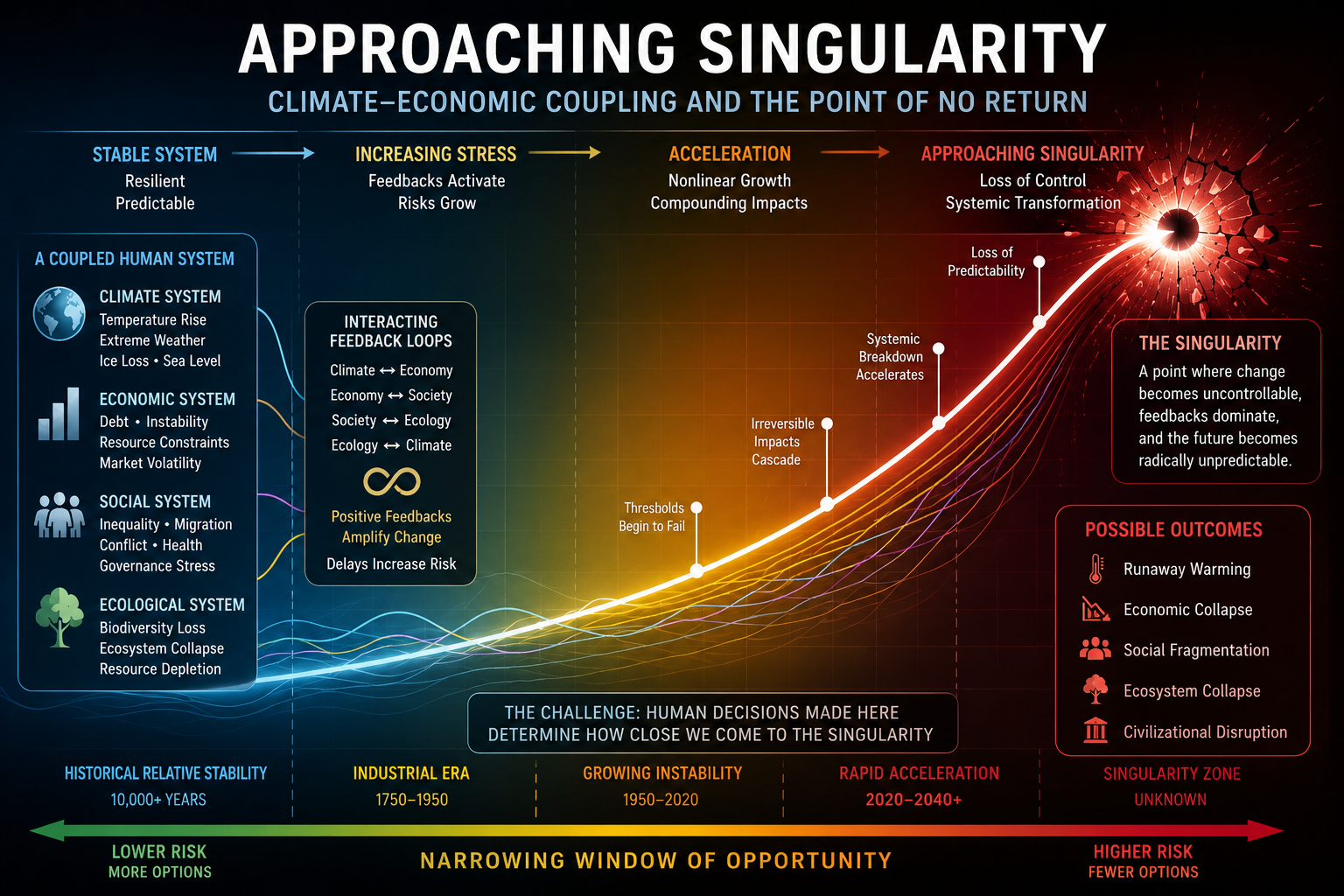
Our latest analysis suggests that the climate–economic system is now exhibiting third-derivative behavior, indicating that not only are impacts increasing, and accelerating, but the acceleration itself is increasing. This places the system within a singularity-like regime, characterized by nonlinear amplification, rising instability, and reduced predictability.
Historically, such transitions were assumed to unfold over tens of thousands to millions of years based on paleoclimate evidence. However, current observations indicate that these dynamics may be occurring on dramatically compressed timescales, raising the possibility that singularity-like behavior could emerge within contemporary time horizons.
We examine two examples: dam failure and vortex dynamics.
Our original was of a flushing toilet. This analog gives a vivid example of relativity and spacetime continuum. Imagine you found yourself floating in a toilet. The bowl represents the Earth’s climate system. Perhaps you are lucky enough to be sitting atop a large lump. Or maybe you are on stray undigested pea or kernel of corn. Perhaps you find yourself swimming in the debris.
First, will you recognize the toilet handle has been triggered. As the rotation increases, will you notice the acceleration. How will you perceive the motion and passing of time relative to you?
As the vortex forces grow stronger, will you be able to adapt and slow or stop the forces pulling you down the drain?