Q: Runaway? Are you suggesting that’s possible or likely?
A: It depends on how you define “runaway.”
The term “runaway” is often interpreted in a very binary or absolute way, when in reality what we are dealing with may be a spectrum of increasing nonlinear behavior and interacting feedbacks.
A core challenge is that we don’t yet have a universally agreed-upon definition of what “runaway” would look like in a complex Earth system, nor a clear observable threshold that tells us we have definitively crossed it in real time. That ambiguity itself is scientifically important.
In other words, part of the problem is epistemic: we may only fully recognize such a transition in hindsight, once the system response is already well underway.
In the strict physical sense of a fully self-sustaining, uncontrollable warming process that proceeds independent of external forcing, that is not something most mainstream climate science currently supports.
However, if by “runaway” you mean a state where multiple climate tipping points are being approached or crossed and begin to interact through reinforcing feedbacks, then the question becomes more about degree and timing than a simple yes/no threshold.
There is evidence that several components of the Earth system—ice sheets, ocean circulation, permafrost, ecosystems, and hydrological extremes—are under increasing stress, and some may already be exhibiting early nonlinear responses. What remains uncertain is how strongly these systems couple and whether feedbacks could begin to amplify one another in a coordinated way.
A useful way to think about this is the train analogy: imagine you are on a train that is accelerating. While you are inside the system, the motion can feel steady or even ambiguous. It is only when you look out the window—comparing against an external reference—that the acceleration becomes obvious. In the same way, Earth system change can appear gradual locally, while the broader system may be transitioning into a faster, more complex regime.
So the scientific answer is not a confirmed “runaway,” but rather: we are observing multiple potential tipping elements under increasing stress, and the degree of systemic interaction is still an active area of research.
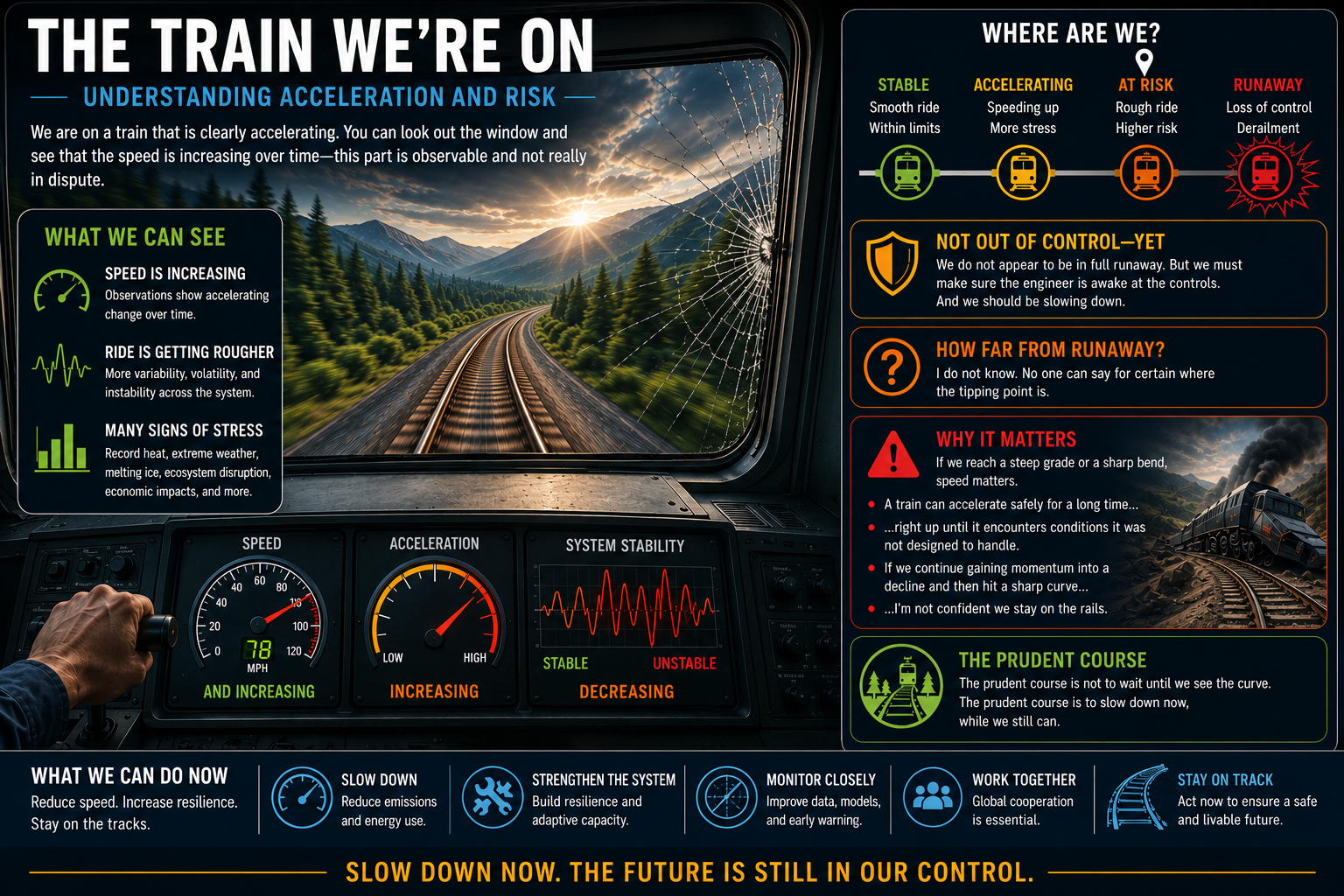
We can think of it like being on a train that is clearly accelerating. When you look out the window, you can see the speed is increasing over time. That part is not really in dispute.
Are we on a “runaway train” in the strict sense of no control or no external influence? No. Human radiative forcing is still the controlling input to the system, so there is no loss of overall control in that literal sense.
But are there growing concerns because the system is showing signs of increasing instability and potential nonlinear responses as we push further? Yes—that is where the serious scientific discussion is focused, particularly around coupled feedbacks and potential climate tipping points.
So the distinction matters: it is not a runaway system in the literal sense, but it may be a system entering a more unstable and higher-risk regime. That is precisely why the argument for reducing emissions is about acting while we still have strong control over the trajectory, rather than waiting until feedbacks make that control progressively harder to maintain.
The simplified version is something like this:
We are on a train that is clearly accelerating. You can look out the window and see the speed increasing over time. That much is observable and not really in dispute.
At the same time, the ride is becoming less stable. We are seeing increasing variability, volatility, and signs of stress across different parts of the system.
So no, we do not appear to be in a full runaway state—yet. But we should at least make sure the engineer has not fallen asleep at the controls. More importantly, we should be slowing down.
How far are we from a true runaway scenario? I do not know. No one can define that threshold with certainty.
What I do know is that if there is a steep grade ahead or a sharp bend in the tracks, speed matters. A train can accelerate safely for a long time right up until it encounters conditions it was not designed to handle.
If we continue gaining momentum into a decline and then hit a sharp curve, I am not at all confident that we stay on the rails.
The prudent course is not to wait until we see the curve. The prudent course is to slow down now, while we still can.
Author’s Note
What do we think?
I am an economist whose work has focused on climate risk management, complex systems, and nonlinear acceleration. My research partner, Sidd Mukherjee, is a physicist. While my background centers on economics, risk, and system dynamics, Sidd’s work extends into areas such as ultra-low-temperature physics, where measurements can approach within millikelvins of absolute zero.
Together, we developed:
-
The Human-Induced Climate Change Experiment
-
Research and Development Incorporating Complex Social-Ecological Feedback Loops Within a Dynamic, Nonlinear System
-
The Nonlinear Acceleration Framework: Collapsing Doubling Times in Climate Change Impacts
Although we approach the problem from different disciplines, we arrive at remarkably similar conclusions.
I believe several interconnected subsystems are already exhibiting signs of systemic collapse. Economically, the insurance industry may be the clearest example to watch in real time. Insurance functions as society’s risk-distribution mechanism. When insurers begin withdrawing coverage, dramatically raising premiums, or abandoning entire regions, it signals that climate risk is no longer theoretical—it is being priced into the real economy. In some locations, that process is already well underway.
Sidd’s primary concern is ecological. He believes one of the most consequential tipping points to watch is the potential large-scale destabilization of the Amazon rainforest. The Amazon is not merely a forest; it is a planetary-scale climate regulator, carbon reservoir, hydrological engine, and biodiversity hotspot. Significant degradation could trigger cascading effects far beyond South America.
Where we strongly agree is that these processes are not future possibilities waiting to begin. They are already occurring.
Our framework has been tested against a wide range of climate, economic, and social indicators. One of its most successful applications—both scientifically and economically—has been the intersection of climate change and real estate. Over time, our research increasingly focused on how climate instability propagates through insurance systems, mortgage markets, infrastructure investment, migration patterns, and broader financial feedback loops.
What makes the present moment especially concerning is not simply the magnitude of warming, but the apparent acceleration occurring across multiple interconnected systems simultaneously.
Our nonlinear acceleration framework describes a world in which impacts compound through feedback loops, cascading tipping behavior, and increasingly compressed timescales. Whether one accepts our specific scaling estimates or not, the broader observation remains difficult to ignore: many climate indicators are no longer changing in a linear fashion.
Sea-level rise, extreme precipitation, wildfire activity, ice-sheet instability, ocean heat content, ecological disruption, insurance losses, and climate-related economic impacts increasingly exhibit characteristics associated with nonlinear systems.
This is the central issue.
The question is no longer whether climate change is occurring. The question is how rapidly coupled climate, ecological, economic, and social systems will respond as feedbacks continue to interact and amplify one another.
That is the aspect of today’s climate experiment that may prove geologically unprecedented.
**Important Footnote
It is not possible to reach a full “Hothouse Earth” runaway state within a century. However, it is possible that current emissions and feedback processes could set in motion long-term, high-impact warming pathways.
Under strong feedback participation, some research has explored scenarios involving more than 10°C of global warming over centuries, often discussed within “Hothouse Earth” frameworks. The critical issue is not whether such outcomes occur within decades, but whether present-day actions commit future generations to warming trajectories that become increasingly difficult—or impossible—to reverse.
* Our probabilistic, ensemble-based climate model — which incorporates complex socio-economic and ecological feedback loops within a dynamic, nonlinear system — projects that global temperatures are becoming unsustainable this century. This far exceeds earlier estimates of a 4°C rise over the next thousand years, highlighting a dramatic acceleration in global warming. We are now entering a phase of compound, cascading collapse, where climate, ecological, and societal systems destabilize through interlinked, self-reinforcing feedback loops.
We examine how human activities — such as deforestation, fossil fuel combustion, mass consumption, industrial agriculture, and land development — interact with ecological processes like thermal energy redistribution, carbon cycling, hydrological flow, biodiversity loss, and the spread of disease vectors. These interactions do not follow linear cause-and-effect patterns. Instead, they form complex, self-reinforcing feedback loops that can trigger rapid, system-wide transformations — often abruptly and without warning. Grasping these dynamics is crucial for accurately assessing global risks and developing effective strategies for long-term survival.