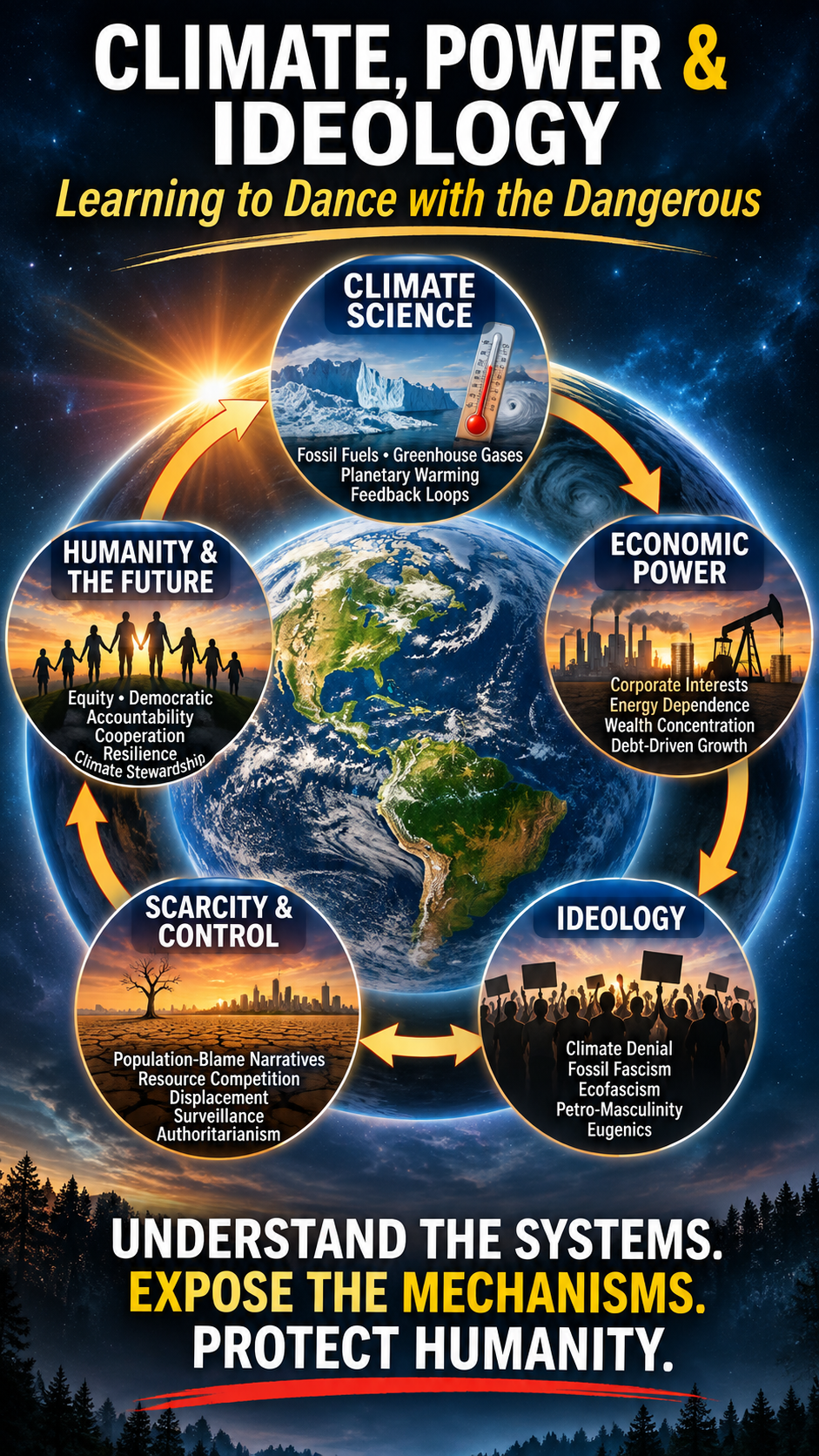
Understanding the Ideological, Economic, and Political Forces Shaping the Climate Crisis
Daniel Brouse¹
¹ Climatologist and Economist
November 27, 2026
Introduction: Learning to Dance with the Dangerous
Climate change is not simply an environmental problem. It is also an economic, political, ideological, and social challenge. The physical evidence is increasingly difficult to ignore, yet public understanding and political responses remain deeply divided. Scientific findings are disputed, suppressed, misrepresented, or normalized into narratives that minimize the scale of the crisis. Meanwhile, economic interests, political movements, and ideological networks influence how society interprets the evidence and decides what to do about it.
Understanding this conflict requires looking beyond the familiar debate over whether climate change is happening. The more consequential questions concern why established scientific findings are resisted, how misinformation becomes normalized, whose interests are served by delaying action, and how climate disruption can be used to advance political and ideological agendas.
This collection, Denialism, Ecofascism, and Reality, examines those questions from several interconnected perspectives. It explores the mechanisms of climate denial, the ideological movements that intersect with it, the economic and institutional structures that sustain it, and the historical and contemporary connections among ecofascism, eugenics, nationalism, and authoritarian politics.
The objective is not to assign a single ideology to everyone who questions climate policy or expresses concern about population, migration, resource scarcity, or economic disruption. Those subjects deserve serious examination. The objective is to distinguish legitimate questions from the ideological manipulation of those questions—and to recognize when environmental concerns become instruments for exclusion, hierarchy, coercion, or political control.
1. Climate Denial Is More Than Disagreement
Scientific disagreement is essential to the advancement of knowledge. Scientific conclusions must remain open to examination, testing, replication, and revision. But scientific disagreement is not the same as organized denialism.
Climate denialism operates through a broader set of mechanisms. These can include selective presentation of evidence, misleading comparisons, suppression of inconvenient findings, attacks on scientific institutions, manufactured uncertainty, and the normalization of claims that contradict the weight of available evidence.
Denial does not always require an outright rejection of climate science. It can acknowledge warming while minimizing its causes, consequences, rate of change, or urgency. It can accept individual observations while disconnecting them from the larger physical system. It can acknowledge climate risks while portraying meaningful responses as economically impossible, politically illegitimate, or socially unacceptable.
The result is a public narrative in which the existence of a problem is conceded while the significance of the problem is continually diminished.
The first paper in this collection, Climate Denialism, Obfuscation, Suppression and Normalization, examines these mechanisms and how they influence public understanding. It provides a foundation for considering denialism not merely as a collection of inaccurate statements, but as a system of communication, institutional influence, and political behavior.
2. From Climate Denial to Climate Authoritarianism
Climate disruption creates conditions that can intensify existing political and economic conflicts. Food and water insecurity, displacement, infrastructure damage, energy instability, and competition over resources can place increasing pressure on institutions and communities.
Those pressures can produce very different political responses.
One response emphasizes cooperation, democratic accountability, equitable resource allocation, scientific evidence, and resilience. Another exploits fear, scarcity, national identity, and social divisions to justify concentrated power and exclusionary policies.
This distinction matters because climate disruption does not automatically produce authoritarianism. Political outcomes depend on institutions, economic structures, public narratives, and the choices societies make.
The paper From Climate Denial to Climate Authoritarianism: Fossil Fascism, Ecofascism, and Petro-Masculinity examines ideological movements and political narratives that can connect fossil-fuel interests, resistance to climate action, authoritarian politics, and traditional hierarchies of power.
These movements are not interchangeable. Fossil fascism, ecofascism, and petro-masculinity describe different concepts and political dynamics. Their relationships must be examined rather than assumed. Understanding where they overlap—and where they differ—is necessary for meaningful analysis.
3. The Role of Religion, Cognition, and Political Identity
People do not evaluate scientific information in isolation. Their understanding is influenced by education, personal experience, cultural identity, social networks, political affiliation, religious beliefs, and trust in institutions.
These influences can affect how individuals interpret evidence, evaluate scientific authority, and respond to information that challenges established beliefs.
The paper Cognitive Ability, Christian Nationalism, and Climate Change Denial examines relationships among cognition, religious-political identity, and climate denial. Its subject requires careful distinctions between religious belief, Christian nationalism, individual cognitive differences, and political attitudes. These are not synonymous categories, and relationships identified in research should not be treated as proof that every member of a religious or political community shares the same beliefs.
The broader issue is how identity and group affiliation can shape the acceptance or rejection of scientific information—and how political narratives can turn scientific questions into tests of cultural or ideological loyalty.
4. Ecofascism and the Politics of Scarcity
Environmental concern can be directed toward protecting ecosystems, reducing pollution, conserving resources, and improving human well-being. But environmental language can also be used to justify exclusionary political objectives.
Ecofascist narratives commonly frame human populations, migration, or particular groups of people as environmental threats. They can transform legitimate concerns about ecological limits into arguments for hierarchy, exclusion, coercion, or the denial of equal human dignity.
Population growth and resource consumption are not the same thing. Neither can be understood independently of consumption patterns, wealth, technology, economic organization, historical emissions, and unequal access to resources.
Blaming population growth while ignoring disproportionate consumption and the historical contribution of wealthy, high-emitting economies can redirect attention away from the structures responsible for much of the environmental burden.
In its most dangerous forms, this framing can intersect with eugenics, white nationalism, and eliminatist thinking—the idea that certain populations are problems to be removed rather than human beings whose rights and well-being must be protected.
The paper Ecofascism and Denialism 101 provides an introduction to these concepts. It is an important starting point for distinguishing environmental protection from ideologies that use environmental concerns to rationalize discrimination and authoritarian control.
5. Institutions, Networks, and Ideological Influence
Political ideologies do not operate only through individual beliefs. They can influence institutions, policy development, public communications, research priorities, and the selection of experts who shape government decisions.
The paper The DOE Climate Working Group: Legal Violations, Ideological Networks, and Ecofascist Connections examines a particular institutional setting and the legal, political, and ideological questions surrounding it.
Institutional investigations require evidence-based analysis. Documented relationships, public statements, policy positions, legal findings, and organizational connections must be distinguished from speculation or guilt by association.
The larger question is how ideological networks can influence the institutions responsible for evaluating scientific evidence and developing public policy. When scientific institutions become vehicles for predetermined political conclusions, public trust and the integrity of scientific assessment are placed at risk.
6. The Convergence of Climate Acceleration and Eugenics Ideologies
Climate change is a physical process involving interacting components of the Earth system. Warming influences atmospheric, oceanic, biological, and cryospheric processes. Feedbacks can amplify or moderate changes, while interactions across different spatial and temporal scales can produce nonlinear behavior.
Understanding these processes requires more than examining individual climate indicators. It requires examining their interactions and the possibility that multiple changes can reinforce one another.
The paper Nonlinear Climate Acceleration and the Convergence of Ecofascist and Eugenics Ideologies, coauthored by Brouse and Mukherjee, brings the physical dynamics of climate change into a broader discussion of ideological responses to environmental disruption.
The connection is not that climate acceleration causes eugenics or that climate science itself supports any particular political ideology. Rather, the paper examines the danger of ideological movements exploiting environmental instability, scarcity narratives, and population concerns to promote exclusionary or eliminatist conclusions.
This distinction is fundamental: understanding the physical limits and risks of the planetary system must never become an excuse for abandoning human rights.
7. Investigating Ideological Networks
The final paper, The Accidental Fascist Hunter: How a Climate Investigation Uncovered Ecofascist Networks, describes the investigative path that brought these subjects together.
The investigation began with climate research and expanded into questions about political ideology, institutional influence, and the networks surrounding climate denial and environmental authoritarianism.
That progression illustrates why multidisciplinary research matters. Climate science, economics, political science, sociology, history, and legal analysis can reveal relationships that may remain invisible when each subject is examined independently.
It also demonstrates the importance of following evidence rather than beginning with a predetermined conclusion. An investigation should be willing to identify unexpected connections, but it must also distinguish documented facts from interpretation and association.
8. The Economic Dimension: Who Benefits from Denial?
Climate denial and delay have economic consequences.
Fossil-fuel dependence is embedded in infrastructure, investment, employment, trade, transportation, and political influence. The transition away from fossil fuels therefore involves substantial economic interests and institutional resistance.
The costs of climate disruption are also distributed unevenly. Communities with fewer financial resources often have less capacity to prepare for, withstand, and recover from extreme weather, infrastructure damage, food insecurity, and other consequences.
Scarcity narratives can obscure these economic relationships. They can present environmental protection as a competition between populations rather than examining who controls resources, who consumes the most, who benefits from existing arrangements, and who bears the costs.
A serious climate discussion must therefore examine both the physical science and the economic structures surrounding it.
The relevant questions include:
- Who benefits financially and politically from continued fossil-fuel dependence?
- Who bears the costs of pollution and climate disruption?
- How are scientific findings represented in public policy?
- How do wealth, consumption, and resource distribution influence environmental outcomes?
- How can technological innovation and economic restructuring reduce environmental harm while improving human well-being?
These questions move the discussion beyond ideological labels and toward the underlying systems of incentives, power, and responsibility.
9. Communicating Dangerous Ideas Without Reproducing Them
One challenge in examining ecofascism, eugenics, and authoritarian politics is that these subjects can provoke strong emotional reactions. That is understandable. They involve historical atrocities, human rights, discrimination, and the possibility of political violence.
But avoiding difficult subjects does not make them disappear.
The challenge is to communicate clearly without turning the communication itself into another instrument of polarization. We must expose dangerous ideas and the systems that support them without dehumanizing people who may have encountered those ideas through misinformation, social pressure, or political affiliation.
Visual communication can help.
Artificial intelligence offers new ways to translate complex multidisciplinary research into accessible images, diagrams, and explanatory posters. Properly used, these tools can make relationships among climate science, economic power, ideology, scarcity narratives, and political institutions easier to recognize.
The purpose should be to make mechanisms visible—not to replace evidence with emotionally manipulative imagery.
A useful approach is to build a connected series of explanations, each focused on a specific relationship, supported by research, and linked to the underlying papers. The goal is to encourage curiosity, critical thinking, and informed discussion.
This is what I mean by learning to dance with the dangerous: confronting difficult subjects directly, maintaining intellectual discipline, and recognizing the human consequences of the ideas being examined.
10. The Alternative: Reality, Cooperation, and Climate Stewardship
Exposing denialism and authoritarian ideologies is only part of the task. A meaningful response must also establish what a constructive alternative looks like.
Climate action should not depend on population blame, exclusion, or authoritarian control. It should be grounded in physical evidence, economic reality, technological innovation, democratic accountability, and the equal dignity of human beings.
We can reduce fossil-fuel dependence, improve energy efficiency, protect ecosystems, strengthen infrastructure, develop resilient communities, and distribute the benefits of technological progress more equitably.
We can address resource constraints without treating people as disposable. We can acknowledge environmental limits without embracing political extremism. We can recognize the economic costs of climate disruption while identifying opportunities to reduce those costs through innovation and responsible stewardship.
My own framework for this alternative is Integrated Climate Stewardship, built around the principle:
ZERO-OUT + BENEFIT-IN
The objective is not simply to reduce environmental harm. It is to develop systems and practices that eliminate avoidable burdens while producing measurable benefits for people and the planet.
Conclusion: Understand the Systems. Expose the Mechanisms. Protect Humanity.
The papers in this collection examine different parts of a larger problem.
Climate denialism can obstruct public understanding. Economic interests can reinforce resistance to change. Ideological movements can redirect environmental concerns toward exclusion and authoritarianism. Institutional networks can influence the presentation of scientific evidence. Climate disruption can intensify the conditions in which these narratives gain political traction.
These relationships deserve serious investigation.
But we must also maintain important distinctions. Scientific skepticism is not automatically denialism. Concern about population or resource scarcity is not automatically ecofascism. Religious belief is not synonymous with Christian nationalism. Environmental protection is not synonymous with authoritarian environmentalism. And identifying an ideological connection requires evidence, not assumption.
The purpose of this collection is to examine where these subjects intersect, how those intersections develop, and what their consequences may be.
Climate reality does not conform to political ideology. The physical processes of the Earth system continue regardless of whether societies acknowledge them. The consequences of delay are not determined by rhetoric, political identity, or wishful thinking.
Our responsibility is to understand the evidence, investigate the systems shaping public responses, challenge misinformation, and protect the human and ecological foundations of our shared future.
Understand the systems. Expose the mechanisms. Protect humanity.
Directory of Papers
Climate Science Resources – Ecofascism Collection