The Unexamined Atmospheric Consequences of Space-Based AI Infrastructure
By Daniel Brouse and Sidd Mukherjee
Simplified Overview
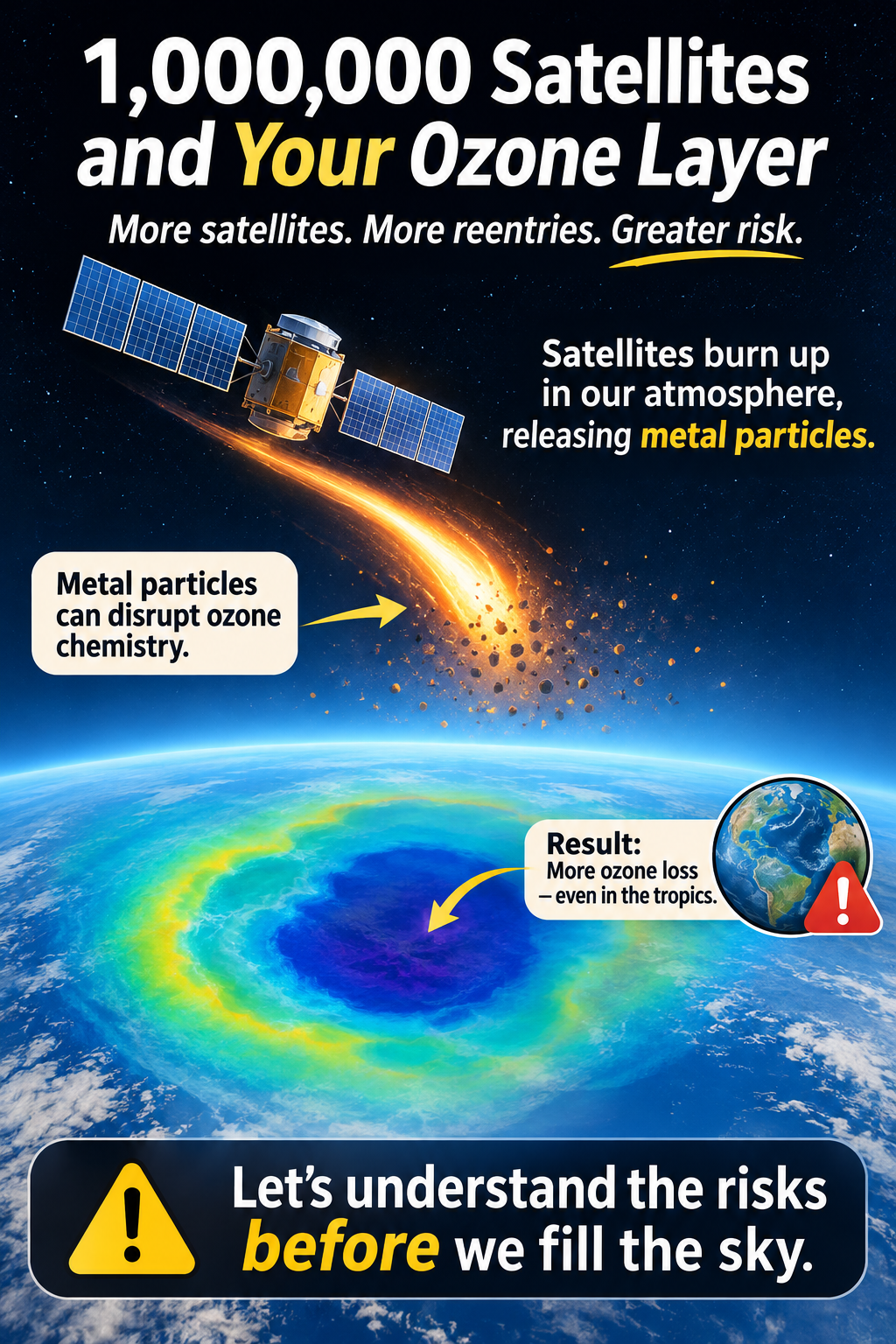
🚨 1,000,000 Satellites and Your Ozone Layer
How much pollution can we put into the upper atmosphere before we understand the consequences?
On November 25, 2026, the Federal Communications Commission (FCC) authorized SpaceX to deploy up to one million satellites for orbital AI data centers.
But every satellite eventually reaches the end of its operational life. When satellites burn up during atmospheric reentry, they release metallic particles and oxides into the upper atmosphere. These materials may persist and interfere with stratospheric ozone chemistry.
This is not an entirely new concern.
On July 22, 2022, Sidd Mukherjee published his concerns about Satellite Re-entry and Large, All-Season Ozone Losses Over the Tropics. At that time, he warned that thousands of satellites burning up during atmospheric reentry could introduce poorly understood metallic pollutants into the stratosphere, with potentially serious consequences for ozone chemistry.
Subsequent research has identified plausible mechanisms by which satellite-generated aluminum oxide nanoparticles could contribute to ozone depletion.
We are expanding our presence in space without fully understanding what we are putting into our atmosphere.
We are throwing $hit over our heads. And now we’re talking about doing it a million satellites at a time.
Read the paper by Daniel Brouse and Sidd Mukherjee:
#OzoneLayer #SatellitePollution #SpaceX #ClimateScience #AtmosphericChemistry #EnvironmentalResearch #ArtificialIntelligence
An Unprecedented Atmospheric Experiment
Stratospheric ozone chemistry faces a potentially significant new source of disruption: the growing number of satellites designed to burn up during atmospheric reentry.
On November 25, 2026, the Federal Communications Commission (FCC) authorized SpaceX to deploy up to 1,000,000 satellites for orbital artificial intelligence data centers. Known as the “Starmind” constellation, the proposed network is designed to harness near-constant solar energy to power massive artificial intelligence workloads in space and transmit the results back to Earth.
SpaceX presents this approach as an opportunity to expand computing capacity while reducing the energy and environmental burdens associated with terrestrial data centers.
But there is another side to the environmental equation.
What happens when these satellites reach the end of their operational lives?
Unlike terrestrial infrastructure, satellites in low Earth orbit cannot simply be dismantled and recycled. Many are deliberately deorbited, where atmospheric friction and heating destroy their structures. Their constituent materials become metal vapors, oxides, nanoparticles, and other aerosols that enter Earth’s upper atmosphere.
The environmental consequences of repeatedly introducing these materials into the atmosphere remain incompletely understood.
A typical Starlink satellite has an operational lifetime of approximately five years. If a similar replacement cycle were applied to a constellation of one million satellites, the resulting turnover could eventually involve hundreds of thousands of atmospheric reentries over successive years.
The question is whether we are creating a new source of atmospheric pollution on a scale that our environmental assessments have not adequately anticipated.
A Warning From 2022
This concern did not begin with the 2026 Starmind authorization.
In 2022, Sidd Mukherjee raised the issue of satellite reentries and their potentially disruptive effects on atmospheric chemistry.
At the time, he wrote:
“We might have another problem.
A whole buncha people, Elon Musk included, are launching thousands of satellites designed to fall into atmosphere at end of life (decade or less) and burn up, not to speak of rocket exhaust… except the products of that burning are all kindsa metal and other oxides whose chemical effects on the stratosphere is not at all well understood.
We are throwing all kindsa crap into the upper atmosphere, a system we do not fully understand. We are throwing $hit over our heads.
Now over the last few days I see reports of tropical ozone loss and elsewhere.
Something tells me this is not a good idea.”
— Sidd Mukherjee
This was an early warning about an emerging environmental problem: the chemical consequences of introducing large quantities of human-made materials into the upper atmosphere.
It also raised an important question about the relationship between atmospheric disturbances and ozone loss.
The Tropical Ozone Problem
On July 5, 2022, a paper titled Observation of Large and All-Season Ozone Losses Over the Tropics was published.
The reported observations concerned extensive ozone losses in the tropical lower stratosphere. The research described a region of ozone depletion substantially larger in area than the familiar Antarctic ozone hole.
The tropical atmosphere is particularly important because its structure and circulation differ significantly from those at higher latitudes.
The tropopause, which separates the troposphere from the stratosphere, is considerably higher in the tropics. This results primarily from warmer atmospheric temperatures and greater vertical expansion.
The tropical stratosphere also plays an important role in global atmospheric circulation and the distribution of ozone.
Ozone is not simply a protective layer that blocks ultraviolet radiation. It is an active component of atmospheric chemistry and helps regulate the temperature structure of the stratosphere.
Consequently, changes in ozone concentrations can have broader atmospheric consequences.
The 2022 observations provide important historical context for Sidd’s warning. They do not establish that satellite reentries caused the observed ozone losses. Rather, they underscore why introducing additional chemical pollutants into an already complex atmospheric system deserves careful investigation.
What Happens When Satellites Burn Up?
Satellites contain substantial quantities of aluminum and other metals.
During atmospheric reentry, extreme heating transforms these materials into vapor and particulate matter. Aluminum can react with oxygen to form aluminum oxide, also known as alumina.
These particles are not necessarily removed immediately from the atmosphere.
Their persistence, distribution, particle size, and chemical reactivity determine how they interact with other atmospheric constituents.
The distinction between the mesosphere and stratosphere is important. Much of the initial vaporization occurs at high altitudes, including the mesosphere. Atmospheric circulation and subsequent particle evolution determine how much material enters or influences the stratosphere.
This is particularly concerning because metallic aerosols can participate in chemical reactions that affect ozone.
A 2024 peer-reviewed study published in Geophysical Research Letters investigated the potential for aluminum oxide nanoparticles generated during satellite reentry to contribute to ozone depletion.
The researchers estimated that the destruction of a typical 250-kilogram satellite could produce approximately 30 kilograms of aluminum oxide nanoparticles.
Their molecular simulations identified a potential mechanism through which these particles could promote chlorine activation, a process associated with stratospheric ozone destruction.
The study also indicated that the particles could persist in the atmosphere for decades.
This research provides scientific support for the mechanism behind Sidd’s earlier concern.
The Atmospheric Consequences Could Be Much Larger
In April 2025, NOAA reported additional research examining the atmospheric effects of increasing satellite reentries.
The study considered a future scenario involving more than 60,000 satellites in low Earth orbit by 2040.
Under the modeled emissions scenario, approximately 10,000 metric tons of aluminum oxide could enter the upper atmosphere annually.
That amount could rival the natural influx of meteor-derived material.
The researchers modeled potential changes in atmospheric temperatures and circulation, including:
- Mesospheric temperature anomalies of approximately 1.5°C near Southern Hemisphere high latitudes.
- A reduction of approximately 10% in Southern Hemisphere polar vortex wind speeds.
- Changes in atmospheric circulation and the distribution of metallic aerosols.
- Potential changes in ozone-related atmospheric processes.
Importantly, the modeled effects on the Antarctic ozone hole were not simply an increase in ozone destruction. Some modeled scenarios produced a weaker polar vortex and a smaller springtime ozone hole.
This illustrates why the atmospheric response cannot be reduced to a simple assumption that more metallic particles automatically produce more ozone depletion.
The chemical and physical effects depend on particle characteristics, atmospheric location, circulation, temperature, and interactions with existing atmospheric compounds.
The larger point remains: satellite reentries can alter atmospheric processes in ways that are not yet fully understood.
One Million Satellites Changes the Equation
The NOAA research examined a future constellation scenario involving approximately 60,000 satellites.
The FCC has now authorized SpaceX to deploy up to one million Starmind satellites.
That is more than sixteen times the satellite population used in the NOAA scenario.
This comparison does not mean atmospheric pollution will increase by exactly the same factor. Actual emissions will depend on satellite mass, composition, operational lifetime, replacement rates, orbital altitude, and reentry practices.
Nevertheless, the scale of the authorization raises an important environmental question.
What happens when the number of satellites requiring eventual disposal grows beyond anything previously contemplated?
A five-year operational lifetime, if applied to a sufficiently large and continuously replenished constellation, would create a substantial recurring stream of atmospheric reentries.
The environmental impact would not be limited to the initial deployment. It would become an ongoing source of material entering Earth’s upper atmosphere.
Furthermore, Starmind is not the only proposed satellite constellation. Other companies and governments are expanding their own orbital infrastructure.
The cumulative effects must be considered.
An Environmental Impact Assessment Is Essential
The argument is not that space-based computing should automatically be prohibited.
Solar-powered computing in orbit may offer legitimate technological and energy advantages. But those advantages cannot be evaluated independently of the environmental consequences of launching, operating, replacing, and disposing of the satellites.
Before deploying an orbital infrastructure on this scale, we need answers to several questions:
- What quantities of aluminum oxide and other metallic aerosols will be released during satellite reentries?
- How long will these materials remain in the mesosphere and stratosphere?
- How will they interact with chlorine, nitrogen compounds, water vapor, and existing atmospheric aerosols?
- What are their effects on ozone chemistry and ultraviolet radiation reaching Earth’s surface?
- How will atmospheric circulation distribute these materials between tropical and polar regions?
- What are the cumulative consequences of millions of satellite launches and reentries over multiple decades?
We also need atmospheric monitoring capable of detecting and measuring these pollutants before their concentrations become significant.
Environmental assessments must account for the entire satellite lifecycle, not simply the energy used while the satellites are operating.
We Are Conducting an Uncontrolled Atmospheric Experiment
Humanity has already learned how difficult it can be to reverse atmospheric pollution.
The destruction of stratospheric ozone by industrial chemicals demonstrated that substances released into the atmosphere can produce consequences far beyond their original point of emission.
The recovery of the ozone layer required international cooperation, regulatory action, and decades of effort.
We should not repeat that mistake with a new class of atmospheric pollutants.
The proposal to deploy one million orbital computing satellites represents an enormous expansion of human activity in the upper atmosphere. Each satellite eventually becomes a potential source of metallic pollution during reentry.
The scientific mechanisms are sufficiently credible to demand investigation. The uncertainties are sufficiently large to demand caution.
We cannot assume that because the atmosphere is vast, it can absorb unlimited quantities of human-made material without consequences.
We are already changing the chemistry and energy balance of Earth’s atmosphere. Adding another potentially significant source of persistent metallic aerosols without understanding the consequences is an unnecessary environmental gamble.
We are throwing $hit over our heads. And now we’re talking about doing it a million satellites at a time.
References and Further Reading
1. July 5, 2022 — Tropical Ozone Loss
Observation of Large and All-Season Ozone Losses Over the Tropics
https://everything.membrane.com/wp-content/uploads/2022/07/tropic-ozone-hole.pdf
2. June 11, 2024 — Satellite Reentry and Ozone Depletion
Potential Ozone Depletion From Satellite Demise During Atmospheric Reentry in the Era of Mega-Constellations
Geophysical Research Letters.
https://doi.org/10.1029/2024GL109280
3. April 28, 2025 — NOAA Atmospheric Modeling
Within 15 Years, Plummeting Satellites Could Release Enough Aluminum to Alter Winds, Temps in the Stratosphere
NOAA Chemical Sciences Laboratory.
https://www.csl.noaa.gov/news/2025/427_0428.html
4. November 25, 2026 — FCC Authorization
FCC Authorizes 1 Million Satellites for Data Centers in Space
Federal Communications Commission.