By Daniel Brouse and Sidd Mukherjee
Insurance and Real Estate | Financial Analysis | Independent Climate Research | Physics and Climate Systems
Overview
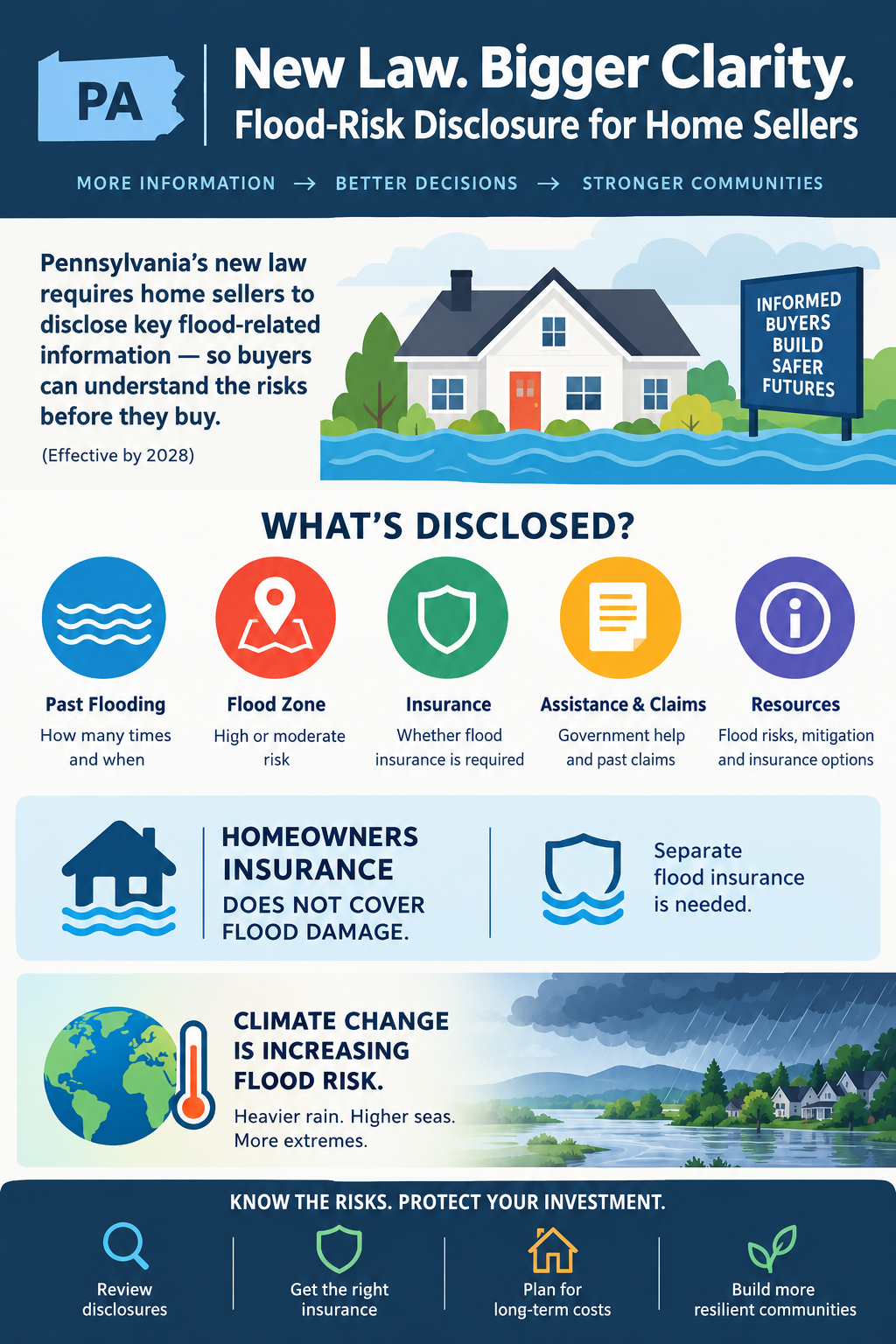
🏠 PENNSYLVANIA’S NEW FLOOD-RISK DISCLOSURE LAW: WHAT HOME BUYERS NEED TO KNOW
A home may be your biggest investment. Do you know its flood risk—and whether your insurance will cover the damage?
Pennsylvania’s new flood-risk disclosure law brings an important issue into focus: flood risk is not just an environmental problem. It is an insurance, real estate, financial planning, and consumer protection issue.
The paper, Flood-Risk Disclosure Is Financial Risk Management: Pennsylvania’s New Law and the Growing Climate Liability of Real Estate, Daniel Brouse and Sidd Mukherjee, examine the implications of this legislation and why informed property decisions matter.
Drawing on previous work in insurance, real estate, financial analysis, physics, and climate research, the paper explores:
• What Pennsylvania’s new law means for home buyers and sellers.
• Why standard homeowners insurance generally does not cover flood damage.
• How flood exposure can affect property values, insurance costs, and household finances.
• Why historical flood records alone cannot fully establish future risk.
• How climate change, better disclosure, insurance planning, and practical mitigation fit together.
• Why renters, existing homeowners, and taxpayers also have a stake in flood-risk awareness.
The bottom line: A property’s purchase price tells only part of the story. Buyers need to understand the risks, insurance limitations, and potential future expenses associated with owning it.
The conclusion is simple: Know the risks. Protect your investment. Build more resilient communities.
#FloodRisk #Pennsylvania #RealEstate #Insurance #ClimateChange #ConsumerProtection #ClimateAdaptation
Introduction
Pennsylvania’s new flood-risk disclosure law recognizes a fundamental principle of responsible financial decision-making: people cannot adequately evaluate a property’s financial risks when material information about those risks is unavailable or undisclosed. Signed into law on October 22, 2026, House Bill 1704 strengthens residential real estate disclosures concerning flood history, flood insurance, and related risk factors. The law also directs the Pennsylvania Insurance Department to provide public information about flood risks, mitigation, and insurance options.
This legislation has implications extending well beyond real estate transactions. Flood risk affects property valuation, mortgage lending, insurance adequacy, household financial security, municipal budgets, and taxpayer exposure. Climate change adds another dimension by altering the conditions under which property risks must be evaluated. Historical flood records and existing hazard maps are important, but they cannot, by themselves, establish the full range of future risks.
Drawing on decades of experience in insurance, real estate, financial analysis, and independent climate research, this paper argues that Pennsylvania’s legislation is an important step toward more informed property transactions. It also identifies the limitations of disclosure alone and the need for integrated climate-risk assessment, transparent insurance information, forward-looking property valuation, and financially responsible adaptation.
1. Introduction: The Financial Consequences of Undisclosed Risk
Pennsylvania has taken an important step toward protecting homebuyers from financial losses they may not anticipate when purchasing residential property.
On October 22, 2026, Governor Josh Shapiro signed House Bill 1704 into law. As reported by WHYY on October 27, the legislation expands the information residential property sellers must disclose about flooding and related risks. Compliance with the revised disclosure requirements is scheduled for the summer of 2028. WHYY’s report on the new law.
The underlying issue is straightforward: purchasing a home is one of the largest financial commitments most households make. Buyers need accurate information about the property’s condition, operating expenses, insurability, and exposure to foreseeable losses. When important risks are not adequately communicated, buyers can make decisions based on an incomplete assessment of the property’s true financial cost.
My professional experience spans real estate, mortgage banking, financial planning, accounting, and financial analysis. My independent climate research, which began in 1992, has focused on the physical processes driving climate change and the implications of a changing climate for human systems.
These fields converge on a common principle: risk that is omitted from a financial decision does not disappear. It remains a potential liability.
Flood-risk disclosure is therefore not simply a paperwork requirement. It is part of the larger responsibility to ensure that property buyers, lenders, insurers, and communities can make informed decisions about the assets and liabilities they assume.
2. What Pennsylvania’s New Law Requires
House Bill 1704 amends Pennsylvania’s residential real estate disclosure provisions under Title 68 of the Pennsylvania Consolidated Statutes.
The legislation strengthens the information buyers receive about flood-related risks. Among the provisions described in the enacted legislation and WHYY’s reporting are requirements concerning:
- The number of times a property has experienced flooding and the estimated dates of those incidents.
- Whether a property is located in a Federal Emergency Management Agency-designated high- or moderate-risk flood zone.
- Whether flood insurance is required for the property.
- Whether the seller has received government assistance for flood damage.
- Whether the seller has filed a flood insurance claim.
The law also directs the Pennsylvania Insurance Department to publish information about flood-risk factors, mitigation measures, insurance coverage, and resources for identifying properties in flood-hazard areas.
The revised disclosure process will include a written notice advising prospective buyers that many Pennsylvania properties face flood risks and that standard homeowners insurance typically does not cover flood damage. Buyers are encouraged to consult insurance professionals and investigate separate flood coverage.
These requirements are significant because they connect property disclosures with practical financial decisions. Buyers need to know not only whether a property has flooded but also whether the insurance they expect to protect their investment will actually cover the loss.
The important distinction is between knowing that a risk exists and understanding the financial consequences of that risk. Effective disclosure should help buyers investigate both.
Sources: Pennsylvania House Bill 1704 and the Pennsylvania Insurance Department’s announcement.
3. The Insurance Problem: Homeowners Coverage Is Not Flood Coverage
One of the most consequential misconceptions in residential property ownership is that a standard homeowners insurance policy covers every major source of property damage.
It does not.
Standard homeowners policies generally exclude flood damage. Flood insurance is typically purchased separately, either through the National Flood Insurance Program or an eligible private insurer. Coverage terms, exclusions, limits, deductibles, and eligibility vary by policy.
This distinction can have severe financial consequences.
A buyer may purchase a home, obtain a mortgage, and maintain homeowners insurance while remaining exposed to substantial flood losses. The existence of an insurance policy does not establish that the property is adequately insured against every material hazard.
From an insurance and financial-planning perspective, this is a problem of incomplete risk transfer. The homeowner retains a potentially substantial uninsured liability.
A flood can damage structural components, electrical systems, heating and cooling equipment, appliances, flooring, furnishings, and personal possessions. Recovery may involve temporary housing, repairs, reconstruction, and expenses that continue while a property is uninhabitable. Actual coverage depends on the applicable policies and circumstances.
The financial consequences extend beyond the initial repair bill. Flood damage may affect resale value, future insurance costs, mortgage affordability, and the amount of money a household can preserve for retirement or other needs.
This is why the insurance question must be addressed before a transaction closes.
Buyers should determine:
- What hazards the homeowners policy covers and excludes.
- Whether separate flood insurance is available and appropriate.
- What the policy limits, deductibles, exclusions, and waiting periods are.
- Whether the coverage is sufficient to address the property’s actual replacement and recovery costs.
- How premiums and other carrying costs affect the household’s long-term budget.
Pennsylvania’s new law directs attention to these questions. Its broader value will depend on whether buyers use the information to evaluate their actual exposure rather than treating disclosure as another form to sign.
4. Real Estate Valuation Must Account for Risk
Real estate valuation is not simply a matter of comparing square footage, location, amenities, and recent sales.
A property’s economic value also depends on the costs and risks associated with owning it.
Flood exposure can affect insurance premiums, repair and maintenance expenses, financing conditions, marketability, and the potential for future losses. Two otherwise comparable properties may therefore have materially different economic profiles.
A waterfront home, for example, may offer exceptional recreational value, scenic views, and personal enjoyment. Those benefits may justify a higher purchase price for a particular buyer. However, the same property may carry additional insurance expenses, mitigation costs, and exposure to flooding.
There is no universal answer to whether a property with elevated flood risk is a good investment. That determination depends on the buyer’s objectives, financial resources, risk tolerance, insurance options, and the property’s specific characteristics.
The essential requirement is informed consent to the financial risk.
My experience in real estate and mortgage banking reinforces the importance of distinguishing a property’s purchase price from its total cost of ownership. A transaction can appear affordable at closing while creating substantial future expenses that were not incorporated into the buyer’s original budget.
A more complete financial assessment should consider:
- Purchase price and financing costs.
- Property taxes and ordinary maintenance.
- Homeowners and flood insurance premiums.
- Expected mitigation and resilience investments.
- Potential deductibles and uninsured losses.
- The implications of future hazard changes for resale and financing.
Not every risk can be expressed as a precise dollar amount. Nevertheless, acknowledging uncertainty is better financial practice than treating an incomplete estimate as a comprehensive valuation.
A property’s market price does not automatically reflect its full climate-related financial risk.
Improved disclosures can help correct that information gap, although disclosure alone cannot guarantee that prices, insurance premiums, or lending decisions will fully reflect future exposure.
5. Climate Change Changes the Risk-Assessment Problem
Flood risk is not determined by property history alone. It also depends on precipitation, drainage, topography, river conditions, coastal processes, land development, infrastructure, and the changing physical environment.
Climate change adds an important consideration: historical conditions are not necessarily a complete guide to future conditions.
Warmer air can hold more water vapor, increasing the potential for heavier precipitation under suitable atmospheric conditions. Changes in precipitation patterns can affect runoff, streamflow, drainage systems, and flood hazards. The resulting effects vary by location and depend on local geography, infrastructure, and other factors.
At the same time, flooding can occur outside formally designated high-risk zones. Localized rainfall, overwhelmed drainage systems, changing waterways, and other conditions can produce losses that a buyer might not anticipate from a single map or a property’s previous history.
This does not mean every property will experience increasing flood risk at the same rate. Nor does climate change eliminate the value of historical flood records or FEMA flood maps. Both remain important sources of information.
It means that risk assessment should consider multiple sources of evidence and distinguish present conditions from future possibilities.
My climate research has focused on the interaction of climate processes, feedbacks, and changes in the Earth’s energy system. That work informs a broader concern about financial risk: physical systems can change, and risk assessments that assume past conditions will continue indefinitely can become inadequate.
The appropriate response is not to disregard established flood maps. It is to use them alongside other relevant information, including local flood histories, drainage conditions, infrastructure assessments, updated hazard analyses, and credible forward-looking projections.
For real estate, the distinction is critical. A disclosure based on what a seller knows about past flooding serves a different purpose from a scientific assessment of what could happen to the property over the coming decades.
Historical disclosure documents the past. Climate-informed risk assessment helps evaluate the future. Both are necessary for sound decisions.
6. Disclosure Is Consumer Protection and Fiscal Responsibility
The economic benefits of better disclosure extend beyond individual buyers.
When a homeowner experiences a major uninsured loss, the consequences may include depleted savings, additional borrowing, delayed repairs, mortgage distress, or the loss of accumulated household wealth.
Public assistance may help some affected households, but disaster assistance is not a substitute for comprehensive insurance and does not guarantee full compensation for losses.
Flood damage can also affect local governments through emergency response expenses, infrastructure repairs, drainage improvements, and other recovery costs. Public insurance programs and disaster assistance may expose taxpayers to additional financial obligations.
These consequences connect private property decisions to public fiscal responsibility.
Better disclosure can help buyers make more informed choices about whether to purchase a property, obtain insurance, invest in mitigation, or reconsider the transaction. It can also encourage earlier investments in measures that reduce potential losses.
Depending on the property and hazard, mitigation may include improving drainage, protecting critical equipment, installing appropriate flood-resistant materials, elevating vulnerable components, or undertaking professionally designed structural improvements.
Not every mitigation measure is appropriate for every property, and its cost-effectiveness should be evaluated individually.
Nevertheless, identifying a risk before a loss occurs generally provides more opportunities to plan than discovering it after the damage is done.
Pennsylvania’s legislation addresses one part of this problem by strengthening the flow of information between sellers and buyers. The next challenge is to ensure that the information supports practical decisions rather than merely satisfying a disclosure requirement.
7. The Remaining Gap: Renters and Existing Property Owners
The new law primarily addresses residential property sales. It does not establish a comparable general flood-risk disclosure requirement for landlords and renters.
That distinction matters.
Renters can face serious financial consequences from flooding, including damage to personal belongings, displacement, temporary housing expenses, and interruptions to employment or daily life. A landlord’s building insurance does not necessarily cover a tenant’s personal possessions or additional living expenses.
Tenants may also have limited control over building-level mitigation measures and may not know whether a property has flooded previously.
The absence of equivalent disclosure requirements for renters leaves an important consumer-information gap. WHYY reports that a separate proposal concerning flood disclosures for rental properties had not advanced beyond committee referral as of its October 27, 2026, report.
A comprehensive approach to flood-risk communication should consider both owners and tenants, while distinguishing the respective responsibilities of property owners, insurers, and occupants.
Existing homeowners also need access to understandable information about their current exposure. They should not have to wait until they sell their homes to discover that their insurance coverage is inadequate or that local flood conditions warrant further investigation.
The public information resources required by House Bill 1704 can help address this broader need, provided they remain accessible, useful, and responsive to changing information.
8. Recommendations for a More Comprehensive Approach
Pennsylvania’s new law creates an opportunity to strengthen the relationship between real estate transactions, insurance decisions, climate adaptation, and financial planning.
Several additional measures would build on its foundation.
A. Make flood-risk information accessible before an offer is made
Buyers should be encouraged to investigate flood history, mapped hazards, insurance requirements, and available coverage early in the purchasing process. Discovering significant costs after making a binding commitment can leave buyers with fewer practical options.
B. Distinguish historical records from forward-looking risk
Disclosure forms should communicate what is known about past flooding without implying that a property with no documented history is free from risk. Public resources should help buyers understand the limitations of historical records and hazard maps.
C. Encourage insurance review before closing
Buyers should obtain quotes and review relevant policy terms before finalizing a purchase. This allows insurance costs, deductibles, exclusions, and coverage availability to inform the household budget and purchase decision.
D. Incorporate climate risk into property and infrastructure planning
Local governments, lenders, insurers, and property owners should evaluate relevant forward-looking hazard information when making long-term decisions. The appropriate analysis will differ between inland river flooding, localized stormwater flooding, and coastal exposure.
E. Expand consumer education
Disclosure is most effective when people understand what the information means. Public education should explain the difference between homeowners insurance and flood insurance, how to investigate risk, what mitigation can accomplish, and where to obtain qualified advice.
F. Evaluate affordability and financial feasibility
Some households have limited alternatives when searching for affordable housing. Better information cannot, by itself, resolve that constraint. Policy responses should recognize the need to balance risk awareness with practical access to housing and the cost of mitigation and insurance.
G. Improve transparency across the property lifecycle
Risk information should not be viewed solely as a requirement at the point of sale. Property owners, renters, insurers, lenders, and local officials all benefit from accessible information that supports ongoing risk management.
These recommendations are consistent with a basic principle of financial analysis: identify material risks, estimate their potential consequences, evaluate the available responses, and make decisions with a clear understanding of the remaining uncertainty.
9. Integrated Climate Stewardship and Property Risk
My broader approach to climate solutions is called Integrated Climate Stewardship. It emphasizes reducing avoidable resource consumption and climate impacts while directing resources toward practical benefits and resilience.
Applied to real estate, this framework supports a comprehensive approach to property risk rather than treating flood disclosure, insurance, energy use, infrastructure, and climate adaptation as unrelated issues.
A property is part of a larger system. Its financial performance depends not only on the building itself but also on the surrounding environment, public infrastructure, insurance market, utilities, and community resilience.
The same principle applies to climate risk. Effective management requires attention to both the physical hazard and the economic systems that determine who bears the losses.
For an individual homeowner, that may mean evaluating insurance coverage, reducing avoidable exposure, and making cost-effective improvements. For a community, it may mean improving drainage, maintaining infrastructure, updating hazard assessments, and evaluating development decisions against long-term risks.
For lenders and insurers, it means recognizing that reliable risk information is essential to assessing potential losses. For policymakers, it means considering the distribution of costs among property owners, private insurers, public programs, and taxpayers.
This is not an argument that every climate-related risk can be eliminated. It is an argument that avoidable financial exposure should not be ignored simply because the relevant costs may occur years after a transaction.
10. Conclusion: Disclosure Is the Beginning, Not the End
Pennsylvania’s new flood-risk disclosure law establishes an important principle for residential real estate: prospective buyers deserve more complete information about a property’s flood history and related insurance considerations.
That principle aligns with longstanding practices in responsible insurance, real estate, and financial analysis. A major financial commitment should be based on an informed assessment of material risks, not merely on the purchase price or the assumption that existing insurance covers every foreseeable loss.
The legislation is a meaningful step, but its limits must be understood. Disclosure does not prevent flooding, guarantee affordable insurance, eliminate uninsured losses, or ensure that property values accurately reflect future climate conditions. Its effectiveness will depend on implementation, public understanding, and the decisions that buyers and other stakeholders make with the information provided.
Climate change adds urgency to the broader question of how society evaluates long-lived assets. Homes, mortgages, infrastructure, and insurance arrangements often extend across decades. Risk assessments that rely exclusively on past conditions can leave households and institutions exposed when relevant conditions change.
My experience in insurance, real estate, mortgage banking, financial analysis, and climate research leads to one central conclusion:
Sound property ownership requires more than knowing what a home costs today. It requires understanding the risks, liabilities, and future expenses that come with owning it.
Pennsylvania’s new law moves the state toward that objective. The next step is to connect better disclosure with informed insurance decisions, climate-aware valuation, practical mitigation, and financially responsible planning.
The goal should be straightforward: fewer preventable losses, better-informed buyers, more resilient communities, and less avoidable financial risk for homeowners and taxpayers alike.
Sources and Further Reading
- Sophia Schmidt, “Gov. Shapiro signs law requiring home sellers to disclose more about a home’s flood risk,” WHYY, October 27, 2026.
- Pennsylvania General Assembly, House Bill 1704, 2025–2026 Regular Session.
- Pennsylvania Insurance Department, “Governor Shapiro Signs New Law to Improve Transparency for Homeowners and Protect Pennsylvanians from Unexpected Flood Losses,” October 23, 2026.
- Commonwealth of Pennsylvania, Do I Need Flood Insurance?.
This paper presents professional and analytical commentary on flood-risk disclosure, insurance, real estate, and climate adaptation. It is not legal, insurance, investment, or property-specific advice.