by Daniel Brouse
Spoiled Soil
What Is Happening to the Dirt Beneath Your Feet?
Most people think of soil as nothing more than dirt. In reality, healthy soil may be one of the most important—and overlooked—parts of Earth’s climate system. Unlike the atmosphere, oceans, or glaciers, soil is alive.
A single handful of healthy soil contains billions of living organisms: bacteria, fungi, insects, earthworms, and countless other forms of life. Together, they recycle nutrients, store carbon, filter water, and support nearly every plant on Earth. Without healthy soil, there is no healthy ecosystem.
The Planet’s Crossroads
Soil is unique because it lies at the intersection of Earth’s major systems. Scientists classify it as its own domain, the pedosphere (from the Greek pedon, meaning soil or earth).
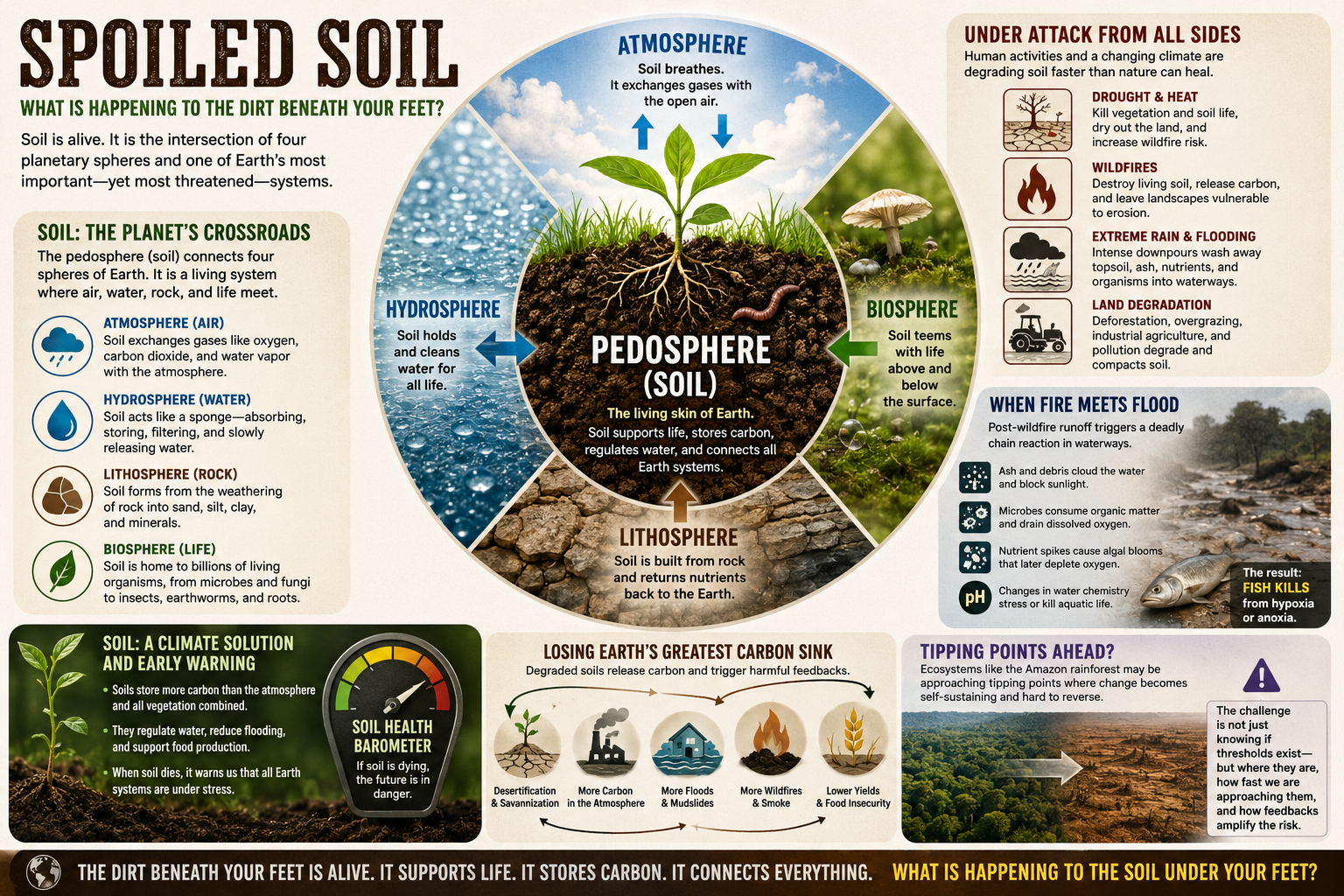
The pedosphere connects four planetary spheres:
- Atmosphere (Air): Soil constantly exchanges oxygen, carbon dioxide, methane, and water vapor with the atmosphere.
- Hydrosphere (Water): Soil absorbs, stores, filters, and slowly releases water, acting like a giant natural sponge.
- Lithosphere (Rock): Soil forms from the weathering of rock into sand, silt, clay, and minerals.
- Biosphere (Life): Soil is home to an astonishing diversity of plants, fungi, microbes, insects, and animals.
                Atmosphere
                     │
                     ▼
Hydrosphere ───► PEDOSPHERE ◄─── Biosphere
                     ▲
                     │
                Lithosphere
Because every one of these systems depends on healthy soil, changes in soil often reveal changes occurring throughout the entire Earth system.
Soil: A Living Climate Indicator
Healthy soil stores enormous amounts of carbon—more than the atmosphere and all vegetation combined. It also regulates water, reduces flooding, supports agriculture, and provides habitat for countless organisms.
When soil begins to deteriorate, it serves as an early warning that multiple environmental systems are under stress.
Unfortunately, human activities are placing unprecedented pressure on soils worldwide. Climate change, deforestation, intensive agriculture, pollution, and urban development are accelerating soil degradation faster than many ecosystems can recover.
Hydroclimatic Whiplash
One of the clearest examples is hydroclimatic whiplash—rapid swings between severe drought and intense rainfall.
Extended drought weakens vegetation, dries out soils, kills soil organisms, and greatly increases wildfire risk.
Then the weather often swings in the opposite direction.
Atmospheric rivers, microbursts, and other extreme rain events produce intense runoff that washes away the already damaged landscape. Instead of soaking into healthy soil, the water carries ash, sediment, nutrients, and debris into streams, rivers, and lakes.
This creates a cascade of environmental damage.
When Fire Meets Flood
Scientists refer to these events as post-wildfire runoff or rain-on-wildfire events.
The chain reaction can be devastating:
- Ash and debris cloud the water and block sunlight.
- Microorganisms rapidly consume the incoming organic material, using up dissolved oxygen.
- Nutrients such as nitrogen and phosphorus trigger algal blooms that later consume even more oxygen as they decay.
- Changes in water chemistry stress or kill aquatic organisms.
The result is often a fish kill, caused by hypoxia (dangerously low oxygen) or anoxia (complete oxygen depletion).
What began as a wildfire on land becomes an ecological disaster throughout an entire watershed.
Losing One of Earth’s Greatest Carbon Sinks
Healthy soils are among Earth’s largest natural carbon sinks. As soils degrade, they lose their ability to store carbon and instead may release additional greenhouse gases into the atmosphere.
The consequences extend far beyond agriculture.
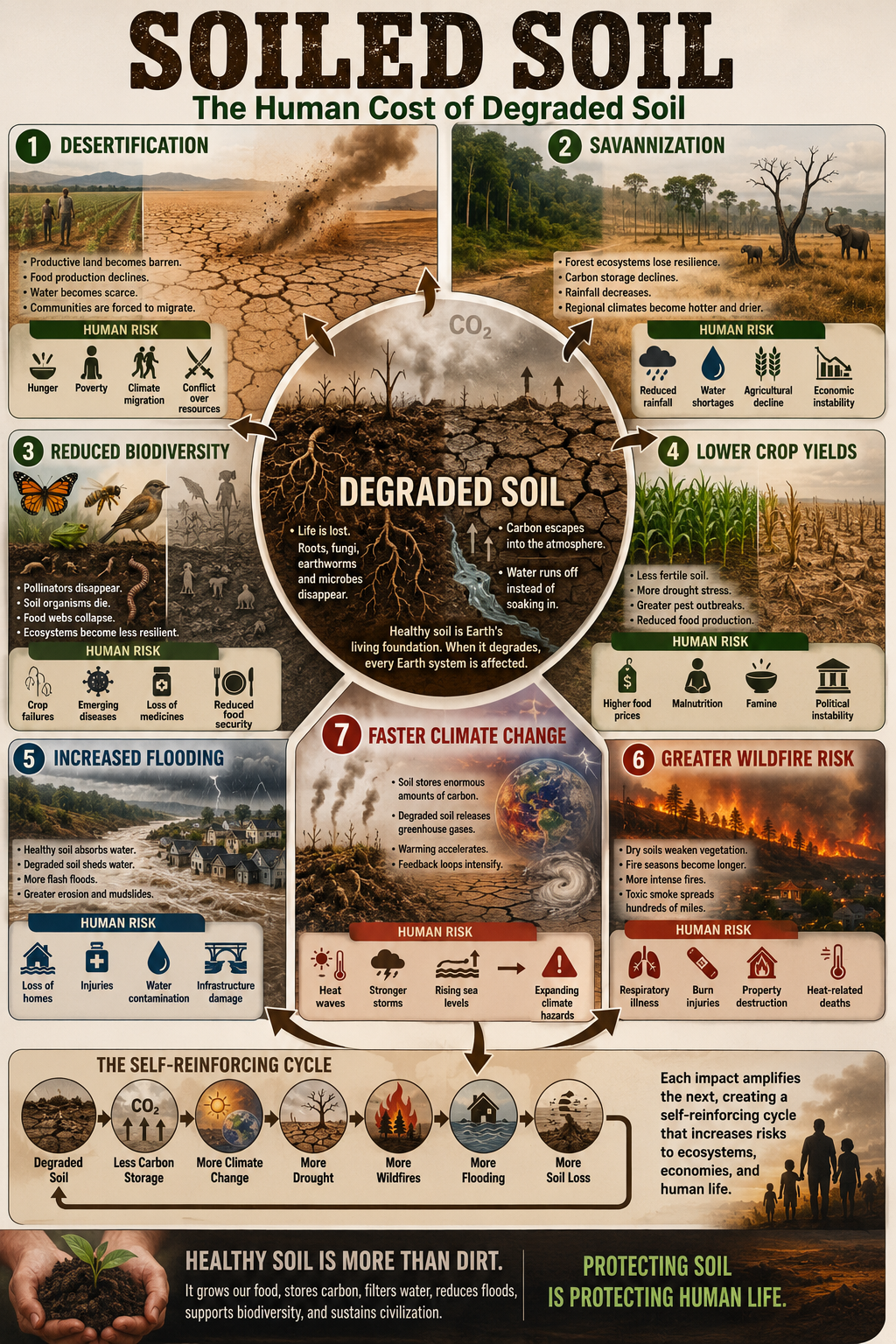
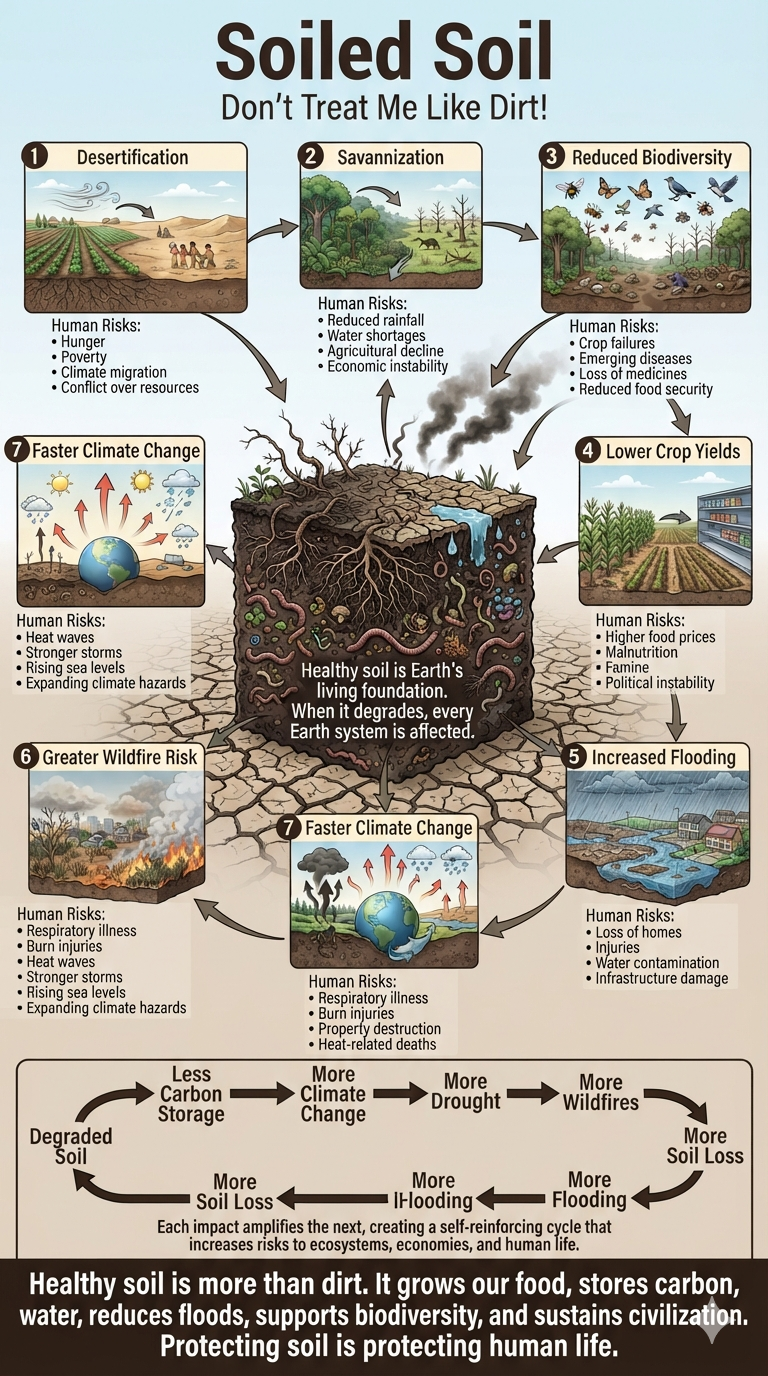
Degraded soils contribute to:
- Desertification
- Savannization
- Reduced biodiversity
- Lower crop yields
- Increased flooding
- Greater wildfire risk
- Faster climate change
Each of these impacts can reinforce the others, creating self-amplifying feedback loops that become increasingly difficult to reverse.
Why Scientists Are Concerned
Many scientists are studying whether some of Earth’s major ecosystems are approaching critical tipping points.
One of the most closely watched examples is the Amazon rainforest. Continued warming, drought, deforestation, and fire could reduce parts of the forest’s ability to sustain itself, transforming sections into a drier, more open landscape. While considerable uncertainty remains about exactly where these thresholds lie, growing evidence suggests that several Earth systems are becoming less resilient.
The challenge is no longer simply determining whether tipping points exist.
It is identifying where they are, how quickly we are approaching them, and how multiple feedback loops may interact to accelerate change.
The paper Amazon Rainforest Dieback: Emerging Risks, Feedback Loops, and Scenario-Based Projections illustrates the processes of ecosystem collapse and savannization.
The Ground Beneath Our Feet
We often look to melting glaciers, rising seas, stronger storms, or record-breaking temperatures as signs of climate change.
But one of the clearest indicators may be much closer.
The dirt beneath your feet is not just dirt.
It is a living ecosystem, a massive carbon reservoir, a water filter, the foundation of agriculture, and the meeting place of Earth’s atmosphere, water, rock, and life.
If the soil is becoming less healthy, it is a warning that the entire planetary system is under increasing stress.
The next time you stand on the ground, consider this question:
What is happening to the soil beneath your feet?
The Climate Crisis
Extreme Impacts: Extreme Weather Events | Violent Rain | Deadly Humid Heat | Sea Level Rise | Insurance
Ecosystems & Feedbacks: Ecosystem Collapse & Extinction Risks | Soil–Insect Climate Feedback Collapse | Insect Collapse | Soil | Trees & Deforestation
Human Health & Society: Personal Finance and Real Estate | Climate Tax | Climate & Human Health | Limits of Human Adaptability | Climate-Driven Health Collapse | Food & Water Security | Civilization Collapse