by Daniel Brouse
Wildfire Smoke, Climate Feedbacks, and Ecological Paradoxes: The Dual Impacts of Atmospheric Aerosols on Terrestrial and Marine Systems
Abstract
Wildfire smoke is an increasingly important variable in understanding climate impacts, ecosystem responses, and agricultural productivity. Prolonged smoke exposure can significantly reduce incoming solar radiation, creating a “sunblock” effect that suppresses photosynthesis, delays plant development, and reduces agricultural yields. However, wildfire emissions also generate complex ecological interactions that can produce unexpected secondary effects.
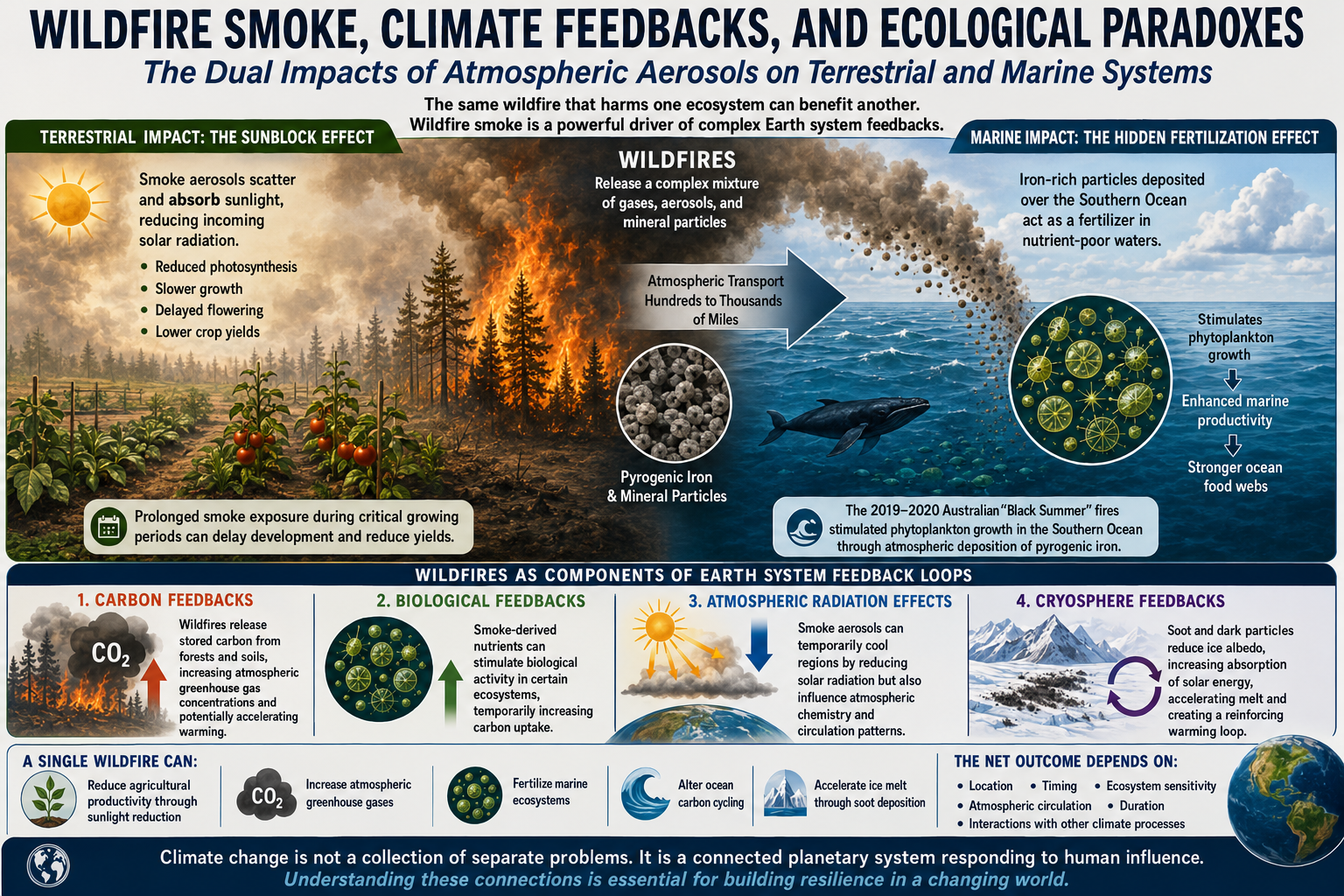
The same wildfire event that damages terrestrial ecosystems through heat, smoke, and carbon emissions can stimulate biological productivity in distant marine environments through nutrient deposition. The 2019–2020 Australian “Black Summer” wildfire season provides a striking example: enormous quantities of pyrogenic iron contained within smoke and ash aerosols were transported over the Southern Ocean, triggering significant phytoplankton growth. These contrasting effects demonstrate that wildfire impacts cannot be understood through a single-variable framework.
Wildfire aerosols represent a component of a broader Earth system feedback network involving atmospheric chemistry, biological productivity, carbon cycling, and cryospheric changes. Understanding these interactions is essential for accurately assessing future climate trajectories.
1. Introduction
Climate change is altering the frequency, intensity, and geographic distribution of wildfire activity. Rising temperatures, prolonged droughts, and changing atmospheric circulation patterns are contributing to longer fire seasons and more extreme fire behavior.
Wildfires are often evaluated primarily through their immediate destructive impacts:
- carbon dioxide emissions,
- habitat loss,
- human health effects,
- infrastructure damage,
- agricultural disruption.
However, wildfire smoke is not merely a pollutant. It is a complex atmospheric mixture containing gases, organic compounds, black carbon, minerals, and nutrients that can interact with ecosystems thousands of miles away.
These interactions reveal an important principle of Earth system science:
A climate disturbance can simultaneously create damaging effects in one system while stimulating biological activity in another.
2. The Agricultural Impact of Wildfire Smoke
One of the most direct effects of wildfire smoke on agriculture is the reduction of incoming solar radiation.
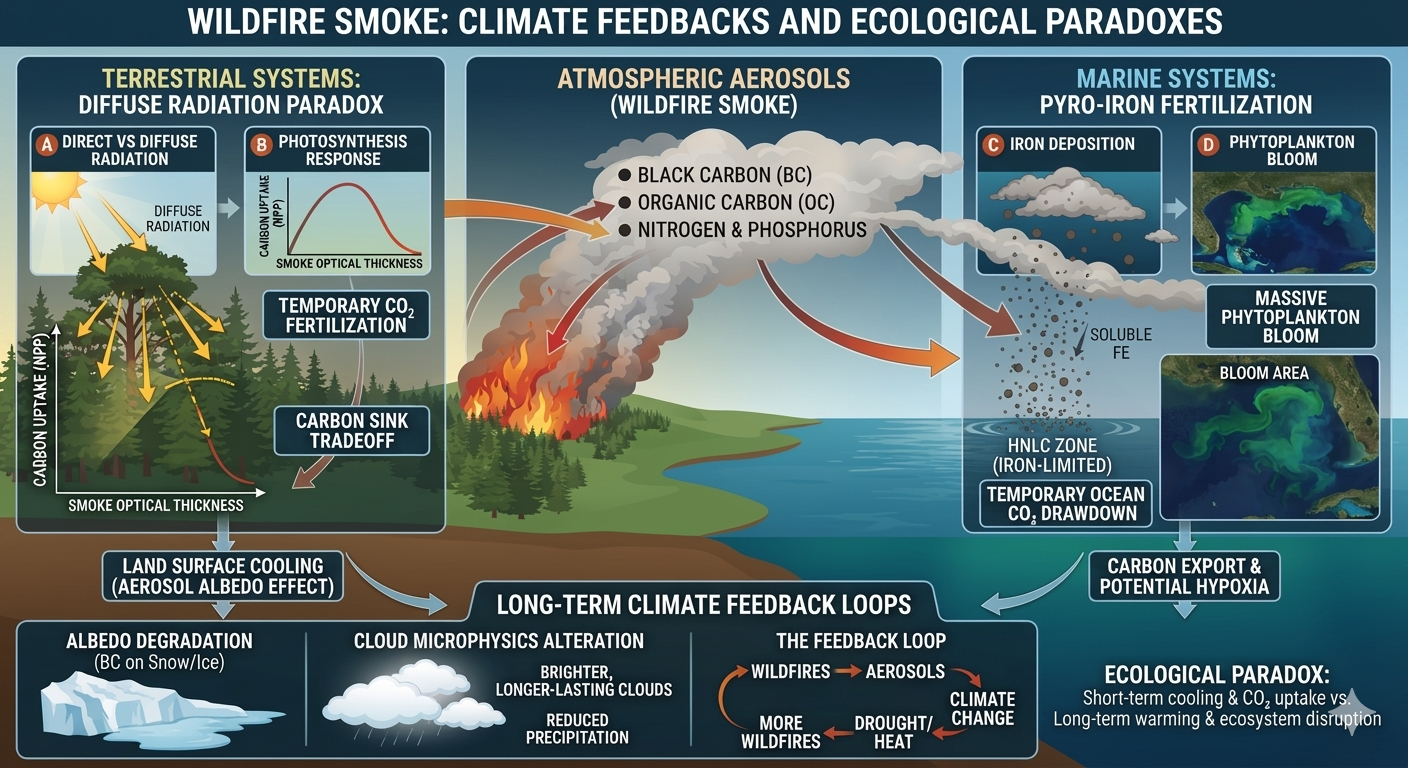
Smoke particles suspended in the atmosphere scatter and absorb sunlight, reducing the amount of photosynthetically active radiation reaching plants. During critical growing periods, this reduction can have measurable consequences:
- slower plant growth,
- delayed flowering,
- reduced fruit development,
- lower crop yields.
Backyard gardens and small-scale agricultural systems can be particularly sensitive because they often rely on seasonal sunlight thresholds. Extended periods of smoke exposure during June through August, for example, can interrupt peak growing conditions and delay maturation until clearer atmospheric conditions return.
This effect represents a climate-related agricultural stressor that may become increasingly important as wildfire seasons expand.
3. The Hidden Fertilization Effect of Wildfires
Despite these negative impacts, wildfire emissions can also create unexpected ecological benefits in specific environments.
A notable example occurred during Australia’s Black Summer wildfire season (2019–2020). These fires were among the largest recorded in modern Australian history, releasing enormous quantities of carbon, smoke aerosols, and mineral particles into the atmosphere.
Researchers observed a major increase in phytoplankton productivity in portions of the Southern Ocean following the fires.
The mechanism was not the carbon itself, but rather pyrogenic iron contained within wildfire smoke and ash.
Iron is a limiting nutrient in many ocean regions. When wildfire-derived iron particles were transported over the ocean and deposited into nutrient-poor waters, they acted as a fertilizer, stimulating the growth of phytoplankton—microscopic marine algae that form the foundation of ocean food webs.
This created a paradox:
- The wildfire released massive quantities of greenhouse gases.
- The same wildfire also temporarily enhanced marine biological productivity.
4. Wildfires as Components of Earth System Feedback Loops
The wildfire example demonstrates why climate systems cannot be evaluated through isolated cause-and-effect relationships.
Wildfires interact with multiple feedback mechanisms:
4.1 Carbon Feedbacks
Wildfires release stored carbon from forests and soils, increasing atmospheric greenhouse gas concentrations and potentially accelerating warming.
4.2 Biological Feedbacks
Smoke-derived nutrients can stimulate biological activity in certain ecosystems, temporarily increasing carbon uptake.
4.3 Atmospheric Radiation Effects
Smoke aerosols can temporarily cool regions by reducing solar radiation but can also influence atmospheric chemistry and circulation patterns.
4.4 Cryosphere Feedbacks
One of the most important long-term concerns is the effect of wildfire soot and dark particles deposited onto snow and ice.
Normally, snow and ice reflect a large portion of incoming solar radiation through the ice albedo effect. When dark particles accumulate on these surfaces:
- Reflectivity decreases.
- More solar energy is absorbed.
- Melting accelerates.
- Darker surfaces are exposed.
- Additional warming occurs.
This creates a reinforcing feedback loop that can accelerate ice loss.
5. The Challenge of Modeling Nonlinear Climate Systems
Wildfire impacts highlight a fundamental challenge in climate science: Earth is not a collection of independent systems.
Atmosphere, oceans, land ecosystems, and the cryosphere are interconnected through feedback mechanisms.
A single wildfire can:
- reduce agricultural productivity through sunlight reduction,
- increase atmospheric greenhouse gases,
- fertilize marine ecosystems,
- alter ocean carbon cycling,
- accelerate ice melt through soot deposition.
The net outcome depends on:
- location,
- timing,
- ecosystem sensitivity,
- atmospheric circulation,
- duration,
- and interactions with other climate processes.
These nonlinear interactions make climate prediction challenging because small changes in one part of the system can produce unexpected consequences elsewhere.
6. Conclusion
Wildfire smoke represents a powerful example of the complexity of climate change impacts. While smoke exposure can reduce sunlight, harm crops, and threaten human health, wildfire aerosols can also transport nutrients that stimulate biological productivity in distant ecosystems.
The Australian Black Summer fires demonstrate that climate impacts are rarely purely positive or negative. They are part of a dynamic Earth system where destructive processes can simultaneously trigger secondary effects across continents and oceans.
Understanding these interactions requires moving beyond simple cause-and-effect thinking and recognizing climate change as an interconnected system of feedbacks.
The challenge ahead is not merely predicting individual climate events. It is understanding how thousands of interacting processes combine to reshape the stability of Earth’s environmental systems.
Climate change is not a collection of separate problems. It is a connected planetary system responding to human influence.