by Daniel Brouse
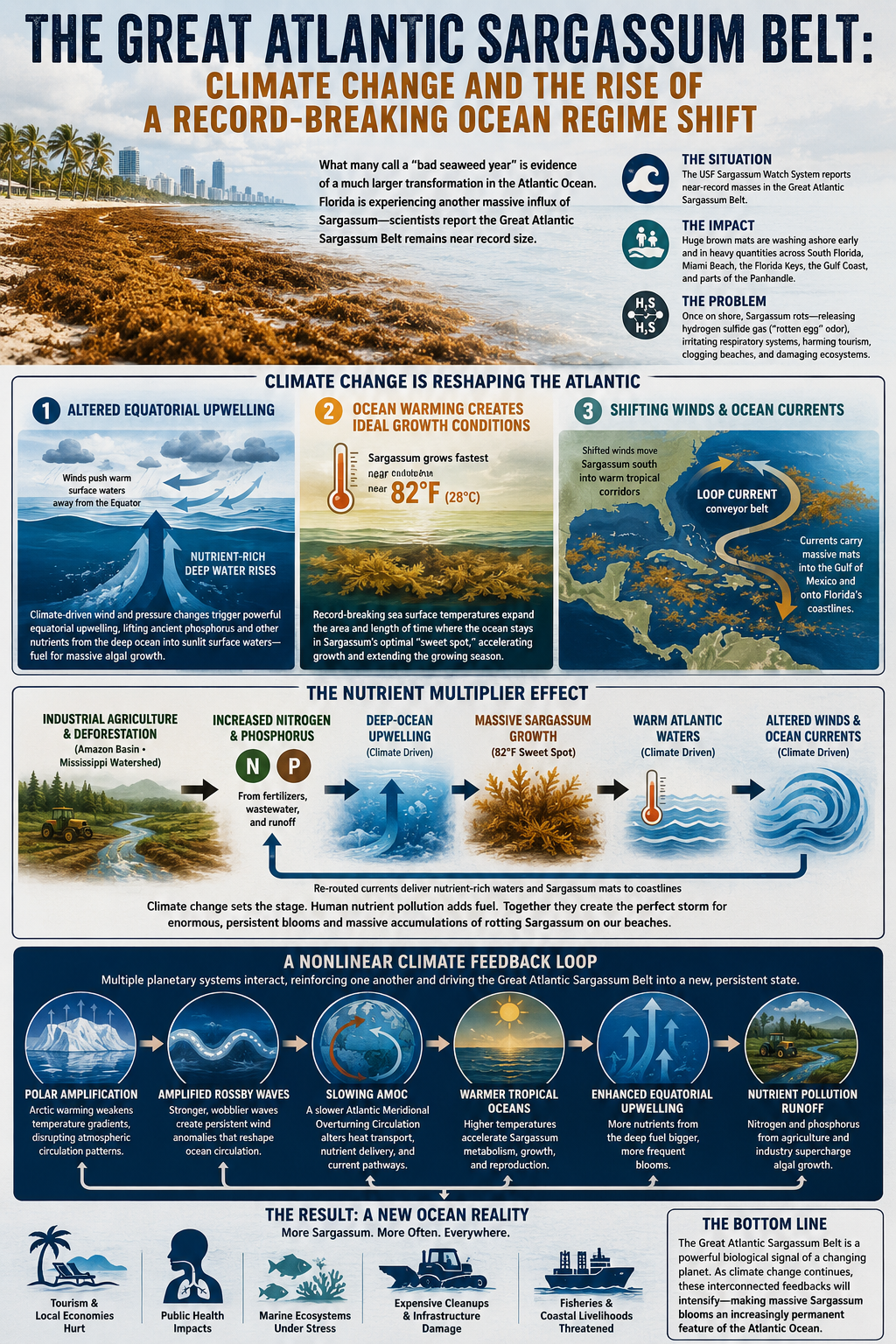
What many beachgoers describe as a “bad seaweed year” is actually evidence of a much larger transformation occurring across the Atlantic Ocean. Florida is experiencing another massive influx of Sargassum, and scientists monitoring the phenomenon report that the Great Atlantic Sargassum Belt remains near record size. Rather than an isolated event, this represents an emerging oceanic regime shift driven by climate change, altered ocean circulation, and increasing nutrient pollution.
Florida’s Record-Breaking Sargassum Season
The University of South Florida’s Sargassum Watch System reports that the Great Atlantic Sargassum Belt continues to contain near-record amounts of floating macroalgae.
Massive brown mats have already washed ashore across South Florida, Miami Beach, the Florida Keys, the Gulf Coast, and portions of the Florida Panhandle. While Sargassum provides important habitat for marine life while floating offshore, conditions change dramatically once it reaches land.
As the seaweed accumulates on beaches, it begins to decompose, releasing hydrogen sulfide gas, the source of the familiar “rotten egg” odor. The gas can irritate the eyes and respiratory system, reduce tourism, damage coastal ecosystems, and require costly cleanup efforts.
Climate Change Is Reshaping the Atlantic
Researchers increasingly recognize the explosive growth of the Great Atlantic Sargassum Belt as the product of multiple interacting climate processes rather than a single environmental change.
1. Altered Equatorial Upwelling
The Mechanism
Climate change is modifying major ocean-atmosphere circulation patterns, altering the timing and strength of equatorial upwelling.
Changes in atmospheric pressure systems—including the North Atlantic Oscillation—produce persistent wind anomalies that push warm surface waters away from the equator. This allows colder, nutrient-rich water from the deep ocean to rise toward the surface.
The Impact
This upwelling functions like a giant ocean elevator, transporting enormous quantities of phosphorus and other nutrients that have accumulated in deep water over centuries into the sunlit surface ocean where Sargassum thrives.
The result is a dramatic increase in the nutrient supply available for rapid algal growth.
2. Ocean Warming Creates Ideal Growth Conditions
The Mechanism
Sea surface temperatures across the tropical Atlantic have repeatedly reached record highs.
The Impact
Sargassum grows fastest near 82°F (28°C), an optimal metabolic temperature.
As climate change warms the Atlantic, larger areas of the ocean remain within this ideal temperature range for longer periods each year. This lengthens the growing season while expanding the geographic area capable of supporting explosive biomass production.
Warmer water not only accelerates growth—it also allows the algae to persist farther north and for much longer portions of the year.
3. Shifting Winds and Ocean Currents
The Mechanism
Global warming is altering atmospheric circulation, trade winds, and large-scale ocean currents throughout the Atlantic Basin.
The Impact
Historically, much of the Atlantic’s Sargassum remained confined within the cooler waters of the Sargasso Sea.
Today, changing wind patterns and ocean circulation have shifted massive “seed populations” into warmer tropical waters where growth rates are substantially higher.
Ocean currents—including the Caribbean Current, the Gulf Stream, and especially the Loop Current—then act as high-speed conveyor belts that transport enormous floating mats directly toward the Gulf of Mexico and Florida’s coastlines.
The Nutrient Multiplier Effect
      Industrial Agriculture & Deforestation
      (Amazon Basin • Mississippi Watershed)
                      │
                      ▼
        Increased Nitrogen & Phosphorus
                      │
                      ▼
Deep-Ocean Upwelling ─────────────► Massive Sargassum Growth ◄────────── Warm Atlantic Waters
     (Climate Driven)                   (82°F Sweet Spot)                 (Climate Driven)
                      ▲
                      │
          Altered Winds & Ocean Currents
Climate change supplies the physical conditions necessary for explosive Sargassum growth, but human nutrient pollution greatly amplifies the process.
Agricultural fertilizer runoff, wastewater discharge, and deforestation throughout the Amazon and Mississippi River basins deliver enormous quantities of nitrogen and phosphorus into the Atlantic.
When these nutrient-rich waters combine with warmer ocean temperatures and increased deep-ocean nutrient upwelling, they create ideal conditions for sustained, large-scale algal blooms.
A Nonlinear Climate Feedback
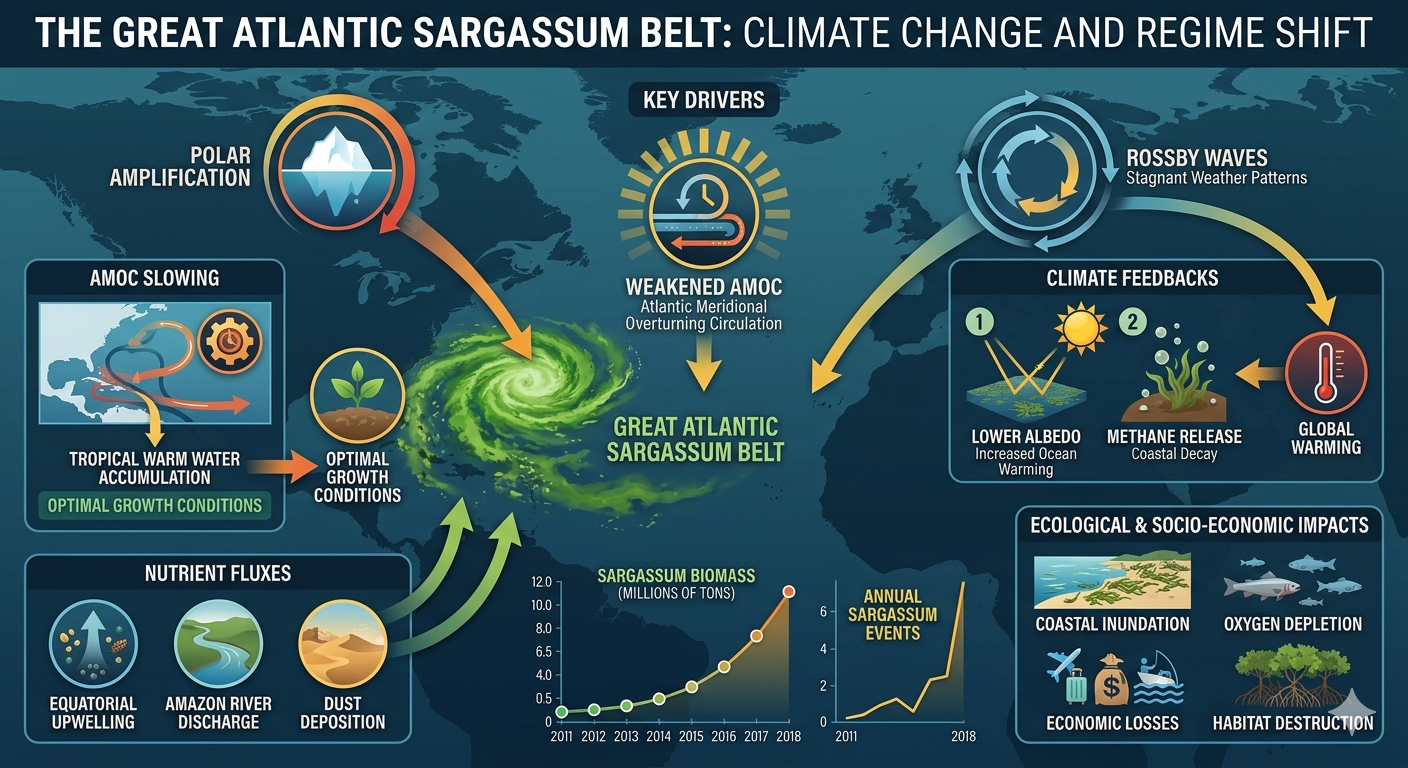
The expansion of the Great Atlantic Sargassum Belt is not simply another symptom of a warming planet. It represents a nonlinear ecological feedback in which multiple climate systems reinforce one another.
Several large-scale climate processes appear to be working together:
- Polar amplification alters atmospheric circulation across the Northern Hemisphere.
- Amplified Rossby waves produce more persistent wind anomalies that reshape ocean circulation.
- A slowing Atlantic Meridional Overturning Circulation (AMOC) changes nutrient transport, sea surface temperatures, and Atlantic current pathways.
- Warmer tropical oceans accelerate Sargassum metabolism and reproduction.
- Enhanced equatorial upwelling delivers nutrient-rich deep water to the surface.
- Agricultural and industrial nutrient runoff provides an additional fertilizer source that further accelerates growth.
Each process strengthens the others, producing a classic positive feedback loop that drives increasingly frequent and larger Sargassum blooms.
Conclusion
The Great Atlantic Sargassum Belt is no longer an occasional natural curiosity. It has become one of the clearest biological indicators that the Atlantic Ocean is undergoing a fundamental climatic transformation.
What was once a relatively stable ecosystem has shifted into a new state characterized by warmer waters, altered circulation, enhanced nutrient transport, and unprecedented macroalgal production. The resulting seaweed invasions are affecting tourism, public health, fisheries, coastal infrastructure, and marine ecosystems across the Caribbean, Gulf of Mexico, and southeastern United States.
Far from being an isolated nuisance, record-breaking Sargassum demonstrates how climate change can reorganize entire ocean systems. As warming continues, these interconnected feedbacks are likely to intensify, making massive seasonal Sargassum blooms an increasingly permanent feature of the Atlantic Ocean.