by Daniel Brouse
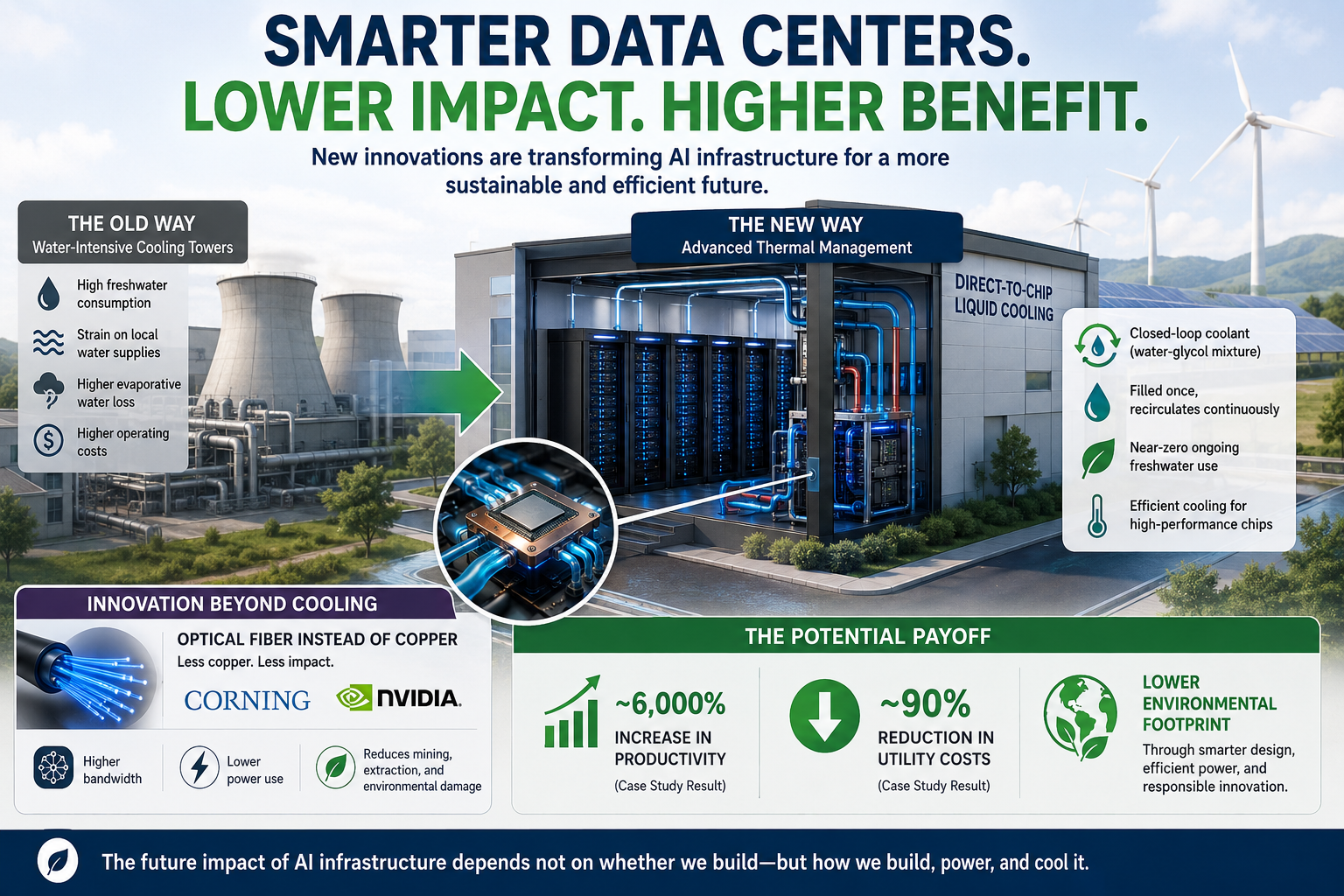
New data center designs are dramatically reducing—or in some cases eliminating—direct freshwater consumption by replacing traditional, water-intensive cooling towers with advanced thermal management technologies. Major technology companies and hardware manufacturers are rapidly deploying infrastructure designed to minimize strain on local water supplies while supporting rapidly growing computational demand.
One of the most significant developments is the adoption of modern direct-to-chip liquid cooling systems. These systems use a closed-loop coolant, typically a water-glycol mixture, which is filled once during installation and then continuously recirculated. Because the coolant is reused within a sealed system, these designs require little to no ongoing freshwater input while still efficiently removing heat from high-performance processors.
As these technologies become more widespread, it is important to recognize that blanket opposition to AI or new data centers may unintentionally slow the deployment of infrastructure that is substantially more water- and energy-efficient than earlier generations. The environmental impact of data centers depends less on their existence and more on how they are designed, powered, and cooled.
Beyond cooling systems, there are additional innovations shaping the next generation of AI infrastructure that are often overlooked. One example is the gradual replacement of copper interconnects with optical fiber. Companies such as Corning are partnering with Nvidia to introduce advanced optical networking within AI data centers. This transition significantly reduces reliance on copper, which has downstream implications for mining, extraction, and other environmentally intensive industrial processes. In turn, this shift has the potential to lower the broader ecological footprint associated with large-scale computing infrastructure.
The reason I’m outspoken on this issue is that the potential benefits of AI and modern data centers can far outweigh their costs when they’re deployed responsibly. In my work as an economist and climate scientist, I have documented a case study indicating approximately a 6,000% increase in productivity alongside a reduction of roughly 90% in utility costs under modernized systems and workflows.
That doesn’t mean every AI deployment is beneficial or that environmental concerns should be ignored. It does mean we should evaluate these technologies based on current evidence and engineering advances, rather than broad, generalized claims that treat all AI and all data centers as inherently harmful.
Addendum: A Case Study in AI Efficiency
As an economist and climate scientist, I’ve been experimenting with different AI graphic generators to evaluate them from both a marketing and an economic perspective. My objective is simple: maximize impact while minimizing cost and environmental footprint.
Rather than focusing solely on image quality, I compare the complete cost-benefit equation, including environmental resource use, computational efficiency, human labor, production time, and audience response. My goal is to identify which tools produce the greatest overall value.
My current comparison has focused primarily on ChatGPT and Google’s Nano Banana image generator. Thus far, ChatGPT has proven to be slightly more computationally expensive but often produces graphics with greater visual impact. Nano Banana, on the other hand, tends to generate a cleaner, more formal aesthetic that may resonate better with certain audiences. Both systems have strengths, and each may be the better choice depending on the intended purpose.
What surprised me most was not how difficult it was to generate the images, but how easy it became once the underlying work had been completed. The challenging part was researching the subject, writing the paper, and translating complex scientific concepts into a clear set of instructions for the AI. Once those instructions existed, both systems produced high-quality graphics in well under a minute.
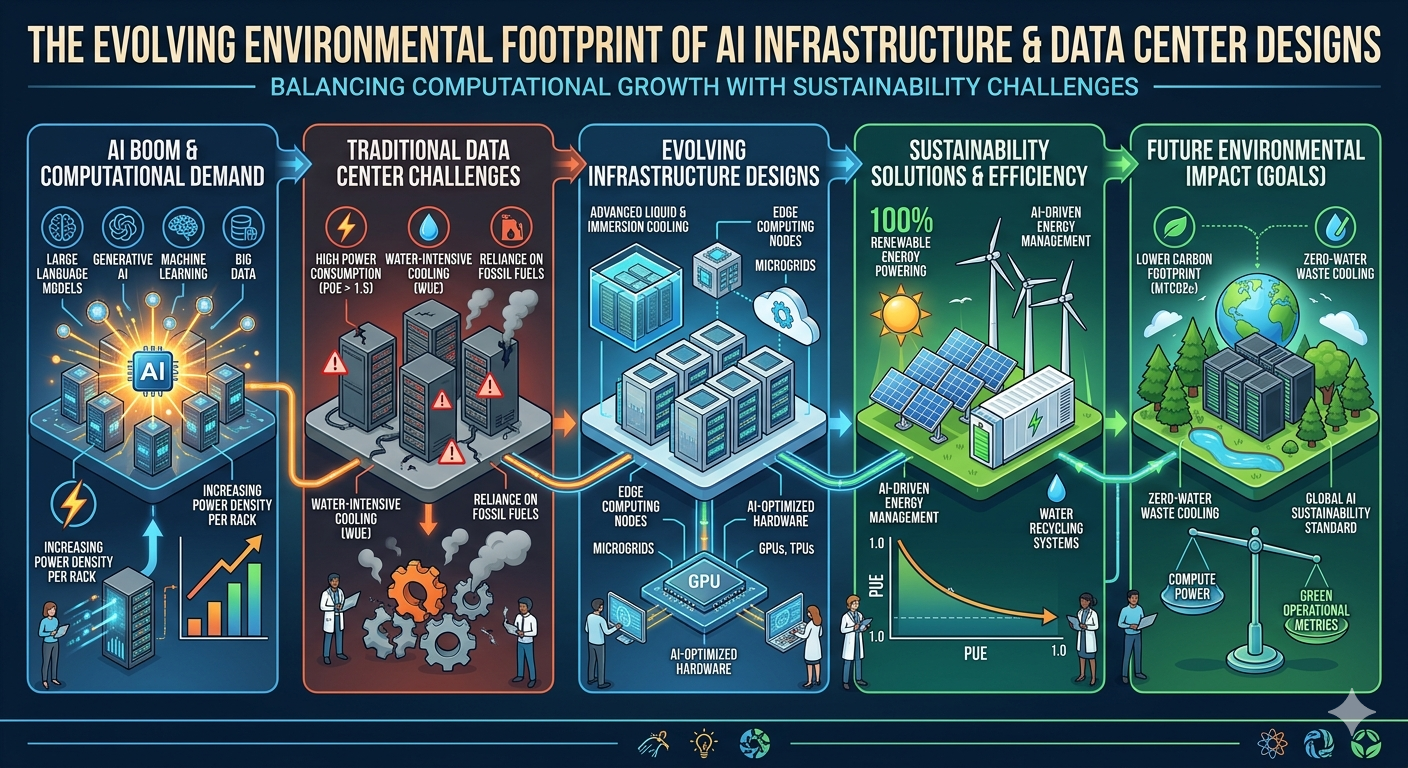
The two graphics accompanying this article illustrate the point. They were created from essentially the same prompt using two different AI systems. The Google version is estimated to have required roughly 25% fewer tokens, making it somewhat more computationally efficient, while the ChatGPT version produced a result I judged to have slightly greater marketing impact.
From an economic standpoint, the comparison is striking. Producing comparable illustrations through traditional methods could easily require hundreds of dollars in labor, software, revisions, and project management, along with the associated energy and material costs of conventional production. By contrast, the AI-generated graphics required only minutes to produce and incurred essentially no direct production cost beyond access to the AI platforms.
Although precise energy, water, and material consumption varies by hardware, data center design, and electricity source, my estimates suggest that using AI tools for this project reduced total resource consumption by well over 99% compared with creating equivalent graphics entirely through traditional manual workflows. In my own workflow, the estimated natural-resource cost was only a few cents per image.
This experience reinforces an important economic principle: productivity gains are often accompanied by reductions in resource intensity. When modern AI infrastructure is designed efficiently, it has the potential to reduce not only labor costs but also energy consumption, material use, water consumption, and overall environmental impact. Like any technology, AI should be evaluated based on measurable outcomes rather than assumptions. As the underlying infrastructure continues to improve, the environmental efficiency of these systems is likely to improve as well.
But, But, But… What About All the Other Costs and Environmental Impacts?
I understand your concerns—they’re important goals that I share. That’s why I’ve written this article explaining why I believe the benefits of modern AI infrastructure can outweigh the costs when it’s designed responsibly.
Ironically, many of the newest data center technologies can help advance the very objectives often listed. They’re becoming far more water-efficient through closed-loop cooling, more energy-efficient through advanced hardware and optical networking, and can reduce material demand by replacing large amounts of copper with fiber. AI is also accelerating the design of better batteries, more efficient renewable energy systems, smarter electrical grids, and improved land-use planning—all of which can help reduce environmental impacts over time.
From an economic perspective, I’ve found AI to be extraordinarily productive. One of our economic models projects that AI-driven automation could reduce the demand for human labor by as much as 90% over the next decade. Whether that estimate proves accurate or not, the broader trend points toward substantial productivity gains.
To me, that means the bigger societal question isn’t simply whether to build AI infrastructure. It’s how we prepare for an economy where productivity increasingly comes from intelligent systems. Issues like universal basic income, negative income taxes, wage subsidies, or other forms of national or global income support may become some of the most important policy discussions of the coming decades.
Technology itself isn’t inherently good or bad. The challenge is ensuring we deploy it in ways that improve both human well-being and environmental sustainability.