by Daniel Brouse
Sweden: Heatwaves, Hydroclimatic Whiplash, Forest Decline, Coastal Erosion and the Northward Spread of Disease
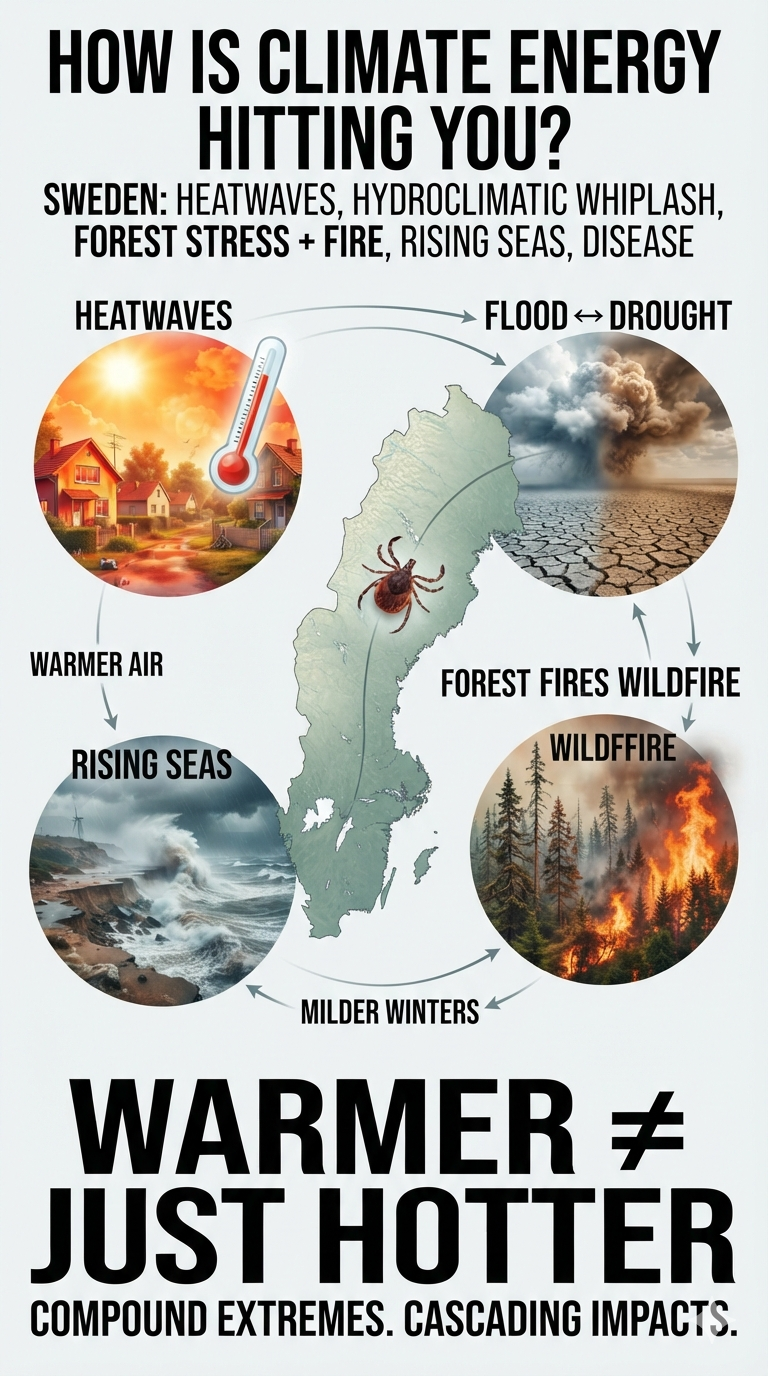
Sweden is warming rapidly, and the impacts of that warming are increasingly moving from long-term projections into everyday disruptions. A changing climate is reshaping Sweden’s risks across multiple interconnected systems—from heat and water to forests, coastlines, agriculture, and human health.
The Swedish Meteorological and Hydrological Institute (SMHI) and climate-impact assessments identify several major vulnerabilities that are becoming increasingly important.
1. Disruptive Heatwaves and the “Unprepared Housing” Crisis
More Frequent Extreme Heat: Sweden is experiencing increasingly frequent and intense heat events, including prolonged periods above 30°C (86°F) and, in extreme cases, 35°C (95°F) or higher. Although Sweden’s climate remains relatively cool compared with many parts of the world, its population and infrastructure are not designed for sustained extreme heat.
The Insulation Paradox: Much of Sweden’s housing stock was designed primarily to retain heat during long, cold winters. That efficiency can become a liability during prolonged summer heat, particularly in buildings without mechanical cooling or adequate passive ventilation.
Dangerous Warm Nights: Rising nighttime temperatures are especially important. When homes and buildings cannot cool overnight, people receive little physiological relief from daytime heat. Older adults, people with chronic conditions, outdoor workers, and other vulnerable populations face increased risks of heat exhaustion, cardiovascular stress, and premature death.
What was once considered an unusual summer inconvenience is increasingly becoming a public-health and infrastructure challenge.
2. Hydroclimatic Instability: Flash Floods vs. Drought
Climate change is intensifying Sweden’s water-cycle extremes, creating a dangerous contradiction: more intense rainfall can occur alongside longer periods of water scarcity.
Extreme Rainfall and Cloudbursts: A warmer atmosphere can hold more water vapor, increasing the potential for intense precipitation. Short-duration summer cloudbursts can overwhelm urban drainage systems, flooding streets, buildings, transportation networks, wastewater systems, and critical infrastructure.
Agricultural and Soil Drought: At the same time, prolonged periods without sufficient rainfall can rapidly dry soils. Higher temperatures increase evaporation and plant water demand, making drought conditions more severe even when annual precipitation does not decline dramatically.
Groundwater Stress: Extended dry periods can also reduce groundwater recharge and threaten local water supplies. Agriculture, forests, ecosystems, and municipalities can therefore experience water stress even during a year that produces damaging floods.
The result is increasingly hydroclimatic whiplash—rapid transitions between excessive water and insufficient water.
3. Forest Stress, Degradation and Wildfires
Sweden’s forests are both an economic resource and a major carbon store, making their increasing climate stress particularly consequential.
Heat and Drought Stress: Repeated heatwaves and prolonged drought reduce soil moisture and place trees under physiological stress. Weakened trees become more vulnerable to disease, insects, wind damage, and other disturbances.
Norway Spruce Vulnerability: Norway spruce, an important commercial species particularly in southern Sweden, is vulnerable to drought and heat stress. Water-stressed trees can become more susceptible to secondary pest outbreaks, accelerating forest decline.
A Longer Wildfire Window: Climate change does not necessarily create the ignition source for a wildfire, but it can make the landscape substantially more receptive to fire. Hotter temperatures, low humidity, dry vegetation, and prolonged drought can extend the period during which fires spread rapidly.
Large wildfires can destroy ecosystems and communities while releasing carbon stored in vegetation and soils—creating another feedback between climate change, forest health, and atmospheric carbon.
4. Coastal Erosion and Rising Sea Levels
Sweden’s coastline faces increasing pressure from rising sea levels, changing storm patterns, and coastal erosion.
Rising Baseline Water Levels: Global sea-level rise raises the starting point from which storm surges occur. Even where local land uplift moderates the rate of relative sea-level rise, some coastal areas remain increasingly exposed to flooding and erosion.
Storm-Surge Amplification: Strong autumn and winter storms can temporarily push water levels far above the average sea level. As the baseline rises, the same storm can produce greater coastal flooding and erosion.
Southern and Western Coastlines: Low-lying areas, particularly along parts of Skåne and Sweden’s western coast, face increasing long-term risks to beaches, wetlands, roads, buildings, and other infrastructure.
Cities and population centers including Malmö and Gothenburg face a particularly important challenge: protecting densely developed coastal areas while adapting to a coastline that is increasingly dynamic.
5. Vector-Borne Diseases Moving North
Climate change is also altering Sweden’s biological geography.
Expanding Tick Habitat: Warmer temperatures and milder winters can improve survival conditions for ticks and allow them to establish or remain active farther north and for longer portions of the year.
Tick-Borne Disease Risk: Diseases such as Lyme disease and tick-borne encephalitis (TBE) are therefore becoming increasingly important public-health concerns as environmental conditions change.
The northward expansion of vectors illustrates an important feature of climate change: the impacts are not limited to temperature. Warming can reorganize ecosystems and alter where infectious diseases can persist and spread.
Sweden’s Climate Risk Is Becoming a Systems Problem
These hazards do not occur independently.
Heat increases evaporation and worsens drought. Drought weakens forests and increases wildfire risk. Wildfires release stored carbon and damage ecosystems. Extreme rainfall can then produce flash floods after dry periods. Rising seas increase coastal exposure, while warmer conditions alter the distribution of disease-carrying organisms.
The emerging pattern is therefore not simply “Sweden is getting warmer.”
It is a more complicated transformation of the country’s water cycle, forests, coastlines, infrastructure, ecosystems, and public-health systems.
Climate energy is increasingly expressing itself through compound and cascading extremes—where one disruption increases the vulnerability to the next.
For Sweden, climate change is becoming less about a distant future and more about how quickly its existing systems can adapt to a rapidly changing physical environment.