by Daniel Brouse
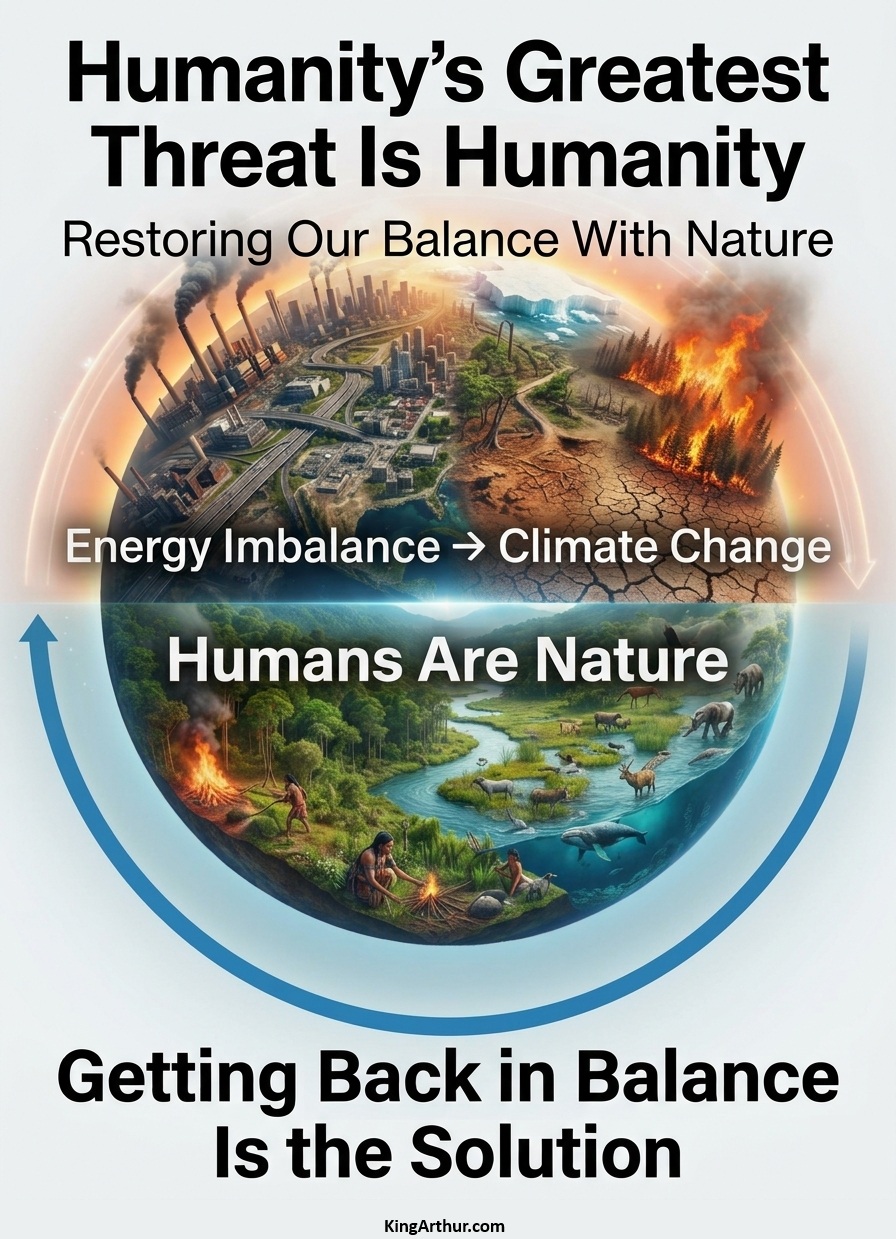
Humans are part of nature. Yet much of modern society has become fundamentally out of balance with the natural world that sustains us.
The energy imbalance is the cause of climate change. Human activity has disrupted the Earth’s natural energy balance, creating an accelerating accumulation and redistribution of energy throughout the climate system.
Getting back into balance with nature is therefore not simply an environmental objective. It is the only sustainable solution.
Indigenous Peoples: Stewards of the Earth’s Ecosystems
Indigenous Peoples protect an estimated 80% of the world’s remaining biodiversity while representing less than 5% of the global population. For millennia, Indigenous communities have lived in structural balance with the natural world, managing roughly a quarter of the Earth’s surface.
Today, their traditional ecological knowledge is increasingly recognized by international bodies such as the United Nations Framework Convention on Climate Change (UNFCCC) as a critical pillar in addressing climate change, protecting ecosystems, and maintaining planetary carbon sinks.
Scientific assessments repeatedly show that ecosystems managed by Indigenous Peoples are often in significantly better condition than ecosystems outside their territories.
Carbon and Forest Custodians
Indigenous territories cover roughly 37% of the planet’s remaining natural land and overlap with at least 36% of the world’s intact forests. Securing Indigenous land rights and legal land tenure has been shown to reduce deforestation rates, in some regions by as much as a quarter below broader regional or national averages.
These territories therefore serve not only as homes and cultural landscapes but also as major reservoirs of biodiversity and carbon.
Active Adaptation
Indigenous knowledge also represents thousands of years of practical observation and adaptation to changing environmental conditions.
Traditional controlled forest burning, for example, can reduce the accumulation of combustible material and substantially lower wildfire intensity and emissions. Indigenous communities have also developed localized agroforestry systems and cultivated highly resilient, drought-resistant crops adapted to specific environmental conditions.
These practices demonstrate an important principle: ecological knowledge is not simply about preserving nature. It is about actively managing human relationships with natural systems in ways that allow both communities and ecosystems to persist.
Cultivating Harmony: Examples of Balanced Practices
Around the world, Indigenous and local communities have developed customary laws and practices that actively protect ecological systems.
Kichwa — Ecuador
Kichwa communities maintain protected buffer zones around major rivers, giving aquatic ecosystems room to regenerate and reducing human disturbance.
Yukir — Russia
The Yukir maintain ritual silence near waterways during salmon spawning, recognizing that even temporary human disturbance can affect vulnerable life cycles.
Pocut — Kenya
The Pocut prohibit fires in designated areas during sensitive seasons, protecting pollinators and other species during critical ecological periods.
Sámi — Fennoscandia
Sámi communities work with organizations such as the Snowchange Cooperative to rewet degraded peatlands, restoring carbon storage, water systems, and fish habitat.
Kayapó — Amazon
Kayapó communities manage large Indigenous territories using traditional knowledge of forests, rivers, fire, and seasonal resources. Their territories help protect some of the Amazon’s remaining intact forests while supporting food, medicine, and cultural practices.
Māori — New Zealand
Māori communities use customary systems such as rāhui, temporary restrictions on harvesting or access, to allow fish, shellfish, forests, and other resources to recover.
Australian Aboriginal Communities
Traditional Indigenous fire management uses carefully timed, low-intensity burns to reduce fuel loads, protect biodiversity, and limit the destructive potential of larger wildfires.
Andean Indigenous Communities
Traditional agricultural systems—including terracing, water harvesting, and the cultivation of diverse crop varieties—help conserve soil and water while increasing resilience to drought and changing climate conditions.
Community Forests — Himalayas
Community-based forest management in the Himalayas has restored degraded forests, improved watersheds, and strengthened local control over natural resources through collective rules governing harvesting and regeneration.
Together, these examples reveal a common principle:
Balance with nature requires understanding that human communities are participants in ecosystems—not observers standing outside them.
The goal is not to eliminate human interaction with nature.
It is to make that interaction sustainable.
Together, these examples illustrate a broader principle:
Balance with nature requires understanding that human communities are participants in ecosystems, not external observers standing outside them.
The Lesson of Indigenous Stewardship
Indigenous communities do not represent a single culture or a single approach to nature. Their knowledge systems, customs, economies, and environments are extraordinarily diverse.
But many share a fundamental understanding that modern industrial society has increasingly forgotten:
Human beings are part of nature.
The natural world is not an unlimited storehouse of resources existing solely for human consumption. Forests, oceans, rivers, soils, wetlands, wildlife, and the atmosphere form interconnected systems upon which human civilization ultimately depends.
When those systems are pushed beyond their limits, humans do not stand outside the consequences.
We experience them.
Climate change is one manifestation of that fundamental imbalance.
The energy imbalance created by human activity is altering atmospheric circulation, ocean conditions, ice systems, ecosystems, weather patterns, and biological cycles. As individual changes interact, feedbacks can amplify the original disturbance and produce increasingly disruptive consequences.
The solution is therefore not simply to manage individual symptoms.
We must restore the balance.
That means recognizing that economic systems, technological systems, agricultural systems, and human communities all operate within the larger Earth system.
Indigenous and community-led stewardship provides thousands of examples of what that relationship can look like.
The objective is not to return humanity to the past.
It is to recover an understanding that the past has preserved:
We cannot separate ourselves from the natural systems that sustain us.
We are nature.
And if humanity is to survive and prosper, we must learn to live in balance with it.