by Daniel Brouse
Low Clouds, Ozone, and the Emerging Climate Jerk Surge
The Question We Should Be Asking
A common assumption in climate projections is that if humanity eventually stops adding greenhouse gases to the atmosphere, global temperatures will eventually stabilize. That basic physical expectation remains important. But it leaves out a potentially critical question:
What happens when the climate system itself begins generating additional warming through feedbacks that have been activated by the warming already produced?
This distinction becomes particularly important as global warming approaches and exceeds 1.5°C above the preindustrial baseline.
The issue is no longer simply how much additional carbon dioxide humans will emit. It is also whether the Earth system is beginning to change in ways that reduce its ability to regulate incoming energy, weaken natural carbon sinks, and couple multiple feedback mechanisms together.
Two feedbacks deserve particular attention:
- The diminishing cooling influence of low clouds and the resulting decline in planetary reflectivity.
- The tropospheric ozone feedback, in which ozone simultaneously contributes to warming and damages vegetation that removes carbon dioxide from the atmosphere.
Together, these mechanisms illustrate why climate change cannot necessarily be understood as a simple linear relationship between greenhouse-gas emissions and temperature.
The emerging evidence instead points toward a more complicated possibility: a climate system in which feedbacks are becoming increasingly coupled—and in which the rate of that coupling may itself be accelerating.
From Warming to Feedback Activation
The traditional climate-change framework can be summarized relatively simply:
Human emissions → greenhouse gases → warming.
But the actual Earth system is more complicated:
Human emissions → warming → feedback activation → additional warming → additional feedback activation.
Some feedbacks are negative and tend to stabilize the system. Others are positive and amplify the initial disturbance. The critical issue is therefore not merely whether a feedback exists. Positive climate feedbacks have been known for decades. The more important question is whether previously modest feedbacks become stronger, interact with other feedbacks, or cross thresholds as warming increases.
That is where the recent climate record becomes particularly interesting.
A 2022–2026 analysis examined six major climate-system variables: cloud cover, planetary albedo, sea-ice extent, atmospheric water vapor, ocean heat content, and surface temperature. The analysis identified increasing coupling among these variables beginning most notably around 2022.
The three strongest interaction pathways are:
- Planetary Albedo × Ocean Heat Content
- Cloud Cover × Ocean Heat Content
- Planetary Albedo × Cloud Cover
Together, these three pathways account for 39.6% of the displayed surge weight in the analysis. This is important because these relationships describe an energy pathway rather than merely a temperature trend.
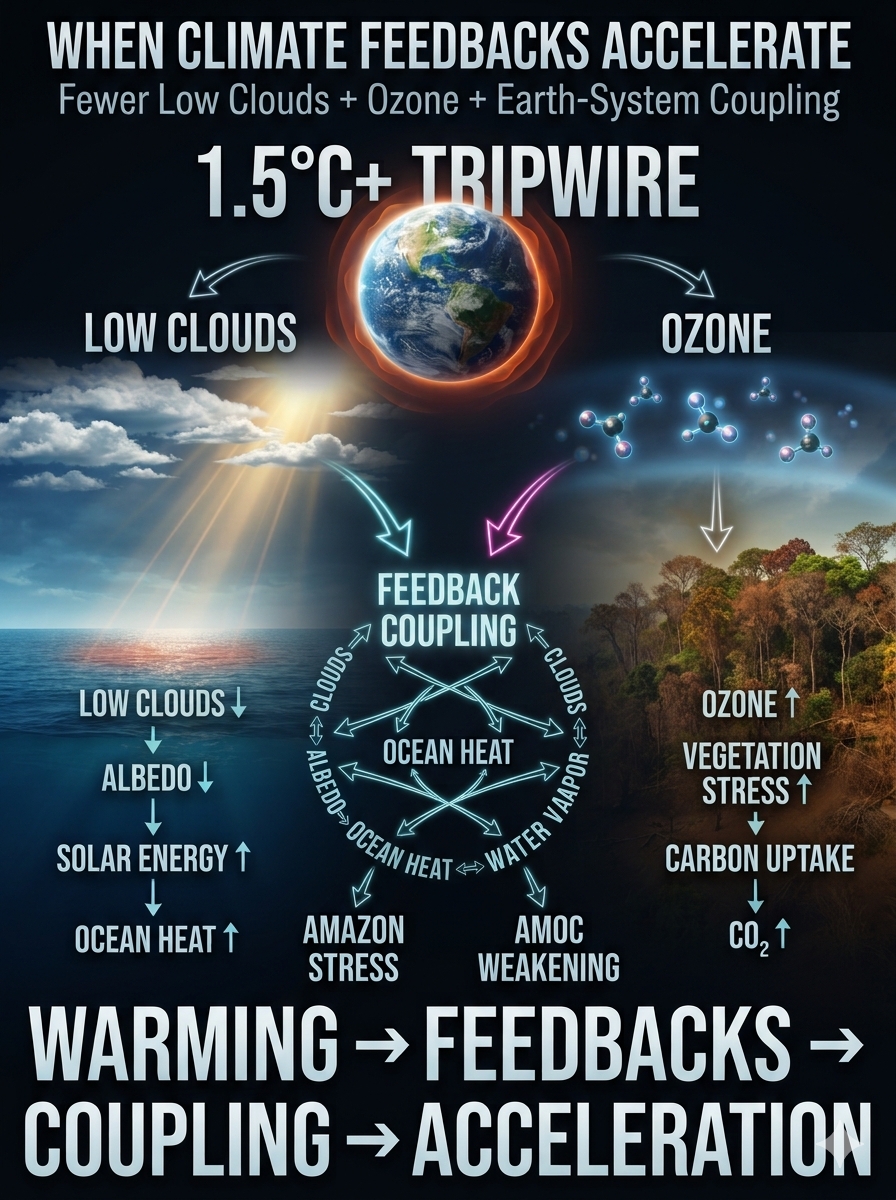
Cloud changes can alter planetary reflectivity. Changes in reflectivity alter solar absorption. Greater solar absorption increases energy entering the climate system. Much of that additional energy enters the ocean. Ocean warming then influences atmospheric moisture, clouds, sea ice, and other components of the climate system.
The result is a network rather than a single feedback.
Feedback #1: The Diminishing Low-Cloud Effect
Low clouds are among Earth’s most important regulators of incoming solar energy.
Because low clouds are generally reflective, they send a portion of incoming sunlight back toward space. A reduction in reflective low-cloud cover therefore has the potential to increase the amount of solar energy absorbed by the Earth system.
This creates a straightforward energy pathway:
Low clouds ↓
→ planetary albedo ↓
→ reflected sunlight ↓
→ absorbed solar radiation ↑
→ ocean heat uptake ↑
→ warming ↑
The Climate Jerk Surge analysis identifies the Cloud Cover × Ocean Heat Content pathway as contributing 13.2% of the displayed surge weight, while Planetary Albedo × Cloud Cover contributes another 12.1%. Planetary Albedo × Ocean Heat Content contributes 14.3%.
The significance is not that clouds have suddenly become a new climate feedback. They have always been part of the climate system. The significance is that a change in cloud behavior can become coupled to changes in planetary albedo and ocean heat content.
That transforms a relatively simple cloud-radiation relationship into a potentially self-reinforcing energy pathway:
Cloud cover ↓
→ albedo ↓
→ solar absorption ↑
→ ocean heat ↑
→ atmospheric and cloud response
→ further changes in cloud cover and albedo.
This is particularly important in the context of reduced marine aerosol emissions. Marine aerosols can influence cloud formation and reflectivity. Reductions in shipping-related sulfur emissions therefore have the potential to remove part of the atmospheric masking effect that previously reflected sunlight or influenced cloud properties.
The Climate Jerk Surge analysis does not require aerosol reductions to be the sole explanation for recent changes. Rather, it identifies the reduction in marine aerosols as a physically testable external perturbation occurring within a climate system already experiencing greenhouse-gas forcing, ocean warming, internal variability, sea-ice loss, and changing cloud behavior.
That distinction matters.
The argument is not:
“Shipping aerosols caused the recent warming.”
The more important question is:
“Did a reduction in an existing cooling influence help expose or amplify a climate system that was already becoming increasingly sensitive?”
That is a question that can be tested against observations.
The Energy Problem
The importance of low clouds becomes clearer when climate change is viewed through energy rather than temperature alone.
The Earth does not warm because a thermometer says it should warm. It warms when the planet retains more energy than it releases to space. A reduction in low-cloud reflectivity can therefore matter even before its effect becomes obvious in surface temperature.
The sequence begins with radiation:
Reflectivity ↓
→ solar energy absorbed ↑
→ planetary energy imbalance ↑
→ ocean heat content ↑.
Because the oceans store enormous quantities of heat, the surface-temperature response does not necessarily occur immediately or proportionally. This creates an important distinction between the climate state and the climate trajectory. A system can be accumulating energy at an accelerating rate even while surface temperature temporarily fluctuates.
That is one reason temperature alone can obscure changes occurring within the climate system.
Feedback #2: The Ozone Climate Multiplier
Tropospheric ozone presents an entirely different kind of feedback. Ozone is commonly discussed as an air-pollution problem or as a greenhouse gas. But its climate significance extends beyond its direct radiative effect.
Tropospheric ozone can damage vegetation. Vegetation, in turn, removes carbon dioxide from the atmosphere through photosynthesis.
That creates a second pathway:
Ozone ↑
→ plant damage ↑
→ photosynthesis ↓
→ carbon sequestration ↓
→ atmospheric CO₂ ↑
→ warming ↑.
The result is a two-pathway climate effect:
Ozone ↑
→ direct greenhouse warming ↑
and simultaneously:
Ozone ↑
→ vegetation damage ↑
→ carbon sinks weaken ↓
→ atmospheric CO₂ ↑
→ additional warming ↑.
This is why ozone can function as a climate multiplier rather than simply another greenhouse gas.
A Nature Geoscience study cited in the ozone analysis estimated that anthropogenic ozone pollution reduced tropical-forest net primary productivity by approximately 17% globally since 2000. That finding is important because tropical forests constitute a major component of the terrestrial carbon sink.
If atmospheric ozone damages that sink, the consequence is not confined to local air quality or forest health.
It can alter the global carbon cycle.
Ozone Creates a Different Kind of Feedback
The low-cloud feedback changes the Earth’s energy budget directly.
The ozone feedback can change both the energy budget and the carbon budget.
That makes the ozone pathway particularly important when considering nonlinear climate behavior.
Consider the sequence:
Warming → vegetation stress → reduced carbon uptake → more atmospheric CO₂ → additional warming.
Now introduce ozone:
More ozone → additional plant damage → still less carbon uptake → still more atmospheric CO₂.
The feedback therefore has the potential to operate simultaneously through atmospheric chemistry and the biosphere.
The effect is compounded when ozone interacts with other climate stresses.
Heat, drought, fire, insects, disease, and hydrological changes can all affect vegetation. Ozone does not have to be the sole cause of forest decline to become climatically important.
In fact, interaction may be the more important issue. A forest already stressed by warming and drought may be less capable of absorbing an additional ozone burden. Likewise, vegetation damaged by ozone may be less capable of recovering from heat, drought, or fire.
This creates another nonlinear pathway:
Climate stress → vegetation vulnerability → ozone damage → weaker carbon sink → more CO₂ → additional climate stress.
The ozone analysis therefore describes ozone as both an atmospheric forcing agent and an ecological forcing agent.
Two Feedbacks, Two Different Amplification Mechanisms
The importance of these two feedbacks is that they attack different components of the climate system.
The low-cloud pathway affects the energy budget:
Low clouds ↓
→ reflectivity ↓
→ absorbed solar energy ↑
→ ocean heat ↑.
The ozone pathway affects the carbon budget:
Ozone ↑
→ vegetation damage ↑
→ carbon uptake ↓
→ atmospheric CO₂ ↑.
Put them together and the problem becomes more complicated:
Lower cloud reflectivity can increase the amount of energy entering the climate system.
Ozone can reduce the biosphere’s ability to remove one of the greenhouse gases already accumulating in the atmosphere.
One mechanism increases the energy entering the system.
The other can reduce the system’s ability to remove a major forcing agent.
Neither mechanism needs to “run away” independently for the combined effect to matter.
They only need to become increasingly coupled with other components of the Earth system.
From Feedbacks to Coupling
The question is not simply:
“Are climate feedbacks operating?”
They obviously are.
The more consequential question is:
“Are multiple feedbacks becoming increasingly interconnected, and is that interconnection itself accelerating?”
Six climate variables generate 15 pairwise coupling pathways. These are not interpreted as 15 independent feedback mechanisms. Instead, they represent different observable relationships within a connected climate system.
Conceptually:
Climate forcing
↓
Warming
↓
Feedback activation
↓
Increasing coupling
↓
Coupling acceleration
↓
Positive coupling jerk.
The third derivative is important because it asks a different question from ordinary warming measurements.
Temperature tells us how warm the system is.
The first derivative tells us how rapidly temperature is changing.
The second derivative tells us whether the rate of warming is changing.
A third derivative—the “jerk”—asks whether the acceleration itself is changing.
Applied to feedback coupling, the same logic becomes:
How quickly are feedbacks interacting?
How quickly is that interaction accelerating?
And is the acceleration of that interaction itself increasing?
Why 1.5°C Matters
The significance of 1.5°C is therefore not that a magical switch flips at precisely that temperature.
Rather, crossing approximately 1.5°C places the Earth system increasingly far from the climate conditions under which many modern observations and historical relationships developed.
As warming progresses, the probability of activating additional feedbacks increases.
Ice declines.
Water vapor increases.
Cloud behavior changes.
Ocean heat accumulates.
Vegetation experiences increasing stress.
Atmospheric chemistry changes.
Carbon sinks can weaken.
The important question becomes whether these processes remain largely independent or increasingly interact. If they remain independent, the climate response may remain comparatively manageable. If they become strongly coupled, one feedback can change the conditions under which another feedback operates.
That is the mechanism by which a collection of individually understood processes can produce a nonlinear system response.
What This Means for Temperature Stabilization
This brings us back to the original question:
If humans stopped emitting greenhouse gases, how long would it take for temperatures to stop rising?
The conventional answer depends heavily on the assumption that the climate system’s feedback structure remains sufficiently stable. But that assumption deserves increasing scrutiny. Stopping anthropogenic emissions would remove the primary source of additional human forcing. It would not instantly reverse ocean warming, restore lost ice, rebuild reflective cloud regimes, repair damaged vegetation, or restore weakened carbon sinks. Nor would it necessarily turn off feedbacks that have already been activated.
This does not mean that continued warming after net-zero emissions is inevitable, nor does it establish a specific future temperature. It means the stabilization problem is more complicated than simply setting future human emissions to zero. If climate feedbacks are already amplifying the rate of warming, emissions must reach zero faster, and even greater reductions will be required to slow the accelerating rate of climate change. In other words, the longer we wait, the more difficult it becomes to reverse the acceleration already underway.
The relevant equation is not merely:
Human emissions → atmospheric CO₂ → temperature.
It is closer to:
Human forcing → warming → feedback activation → feedback coupling → changing energy and carbon flows → additional warming.
If the coupling terms themselves are accelerating, then projections based on a relatively stationary feedback structure may underestimate the possibility of nonlinear behavior.
The Emerging Climate Jerk Surge
The importance of the 2022–2026 observations is therefore not simply that several climate indicators have moved in an unfavorable direction. The more interesting signal is that multiple indicators appear to be moving together.
The strongest relationships identified involves precisely the variables expected to participate in an energy-amplification pathway:
Planetary albedo
↕
Cloud cover
↕
Ocean heat content.
The combined triad accounts for 39.6% of the displayed surge weight in the analysis.
At the same time, the ozone pathway operates through an entirely different part of the Earth system:
Atmospheric chemistry
↕
Vegetation
↕
Carbon sequestration
↕
Atmospheric CO₂.
These pathways can ultimately converge on the same outcome: additional energy retained within the climate system. That is why the distinction between individual feedbacks and feedback coupling is so important. A single feedback can be studied in isolation; a nonlinear Earth system cannot.
Two of the most consequential impacts already emerging are the increasing stress and potential dieback of the Amazon rainforest and the weakening of the Atlantic Meridional Overturning Circulation (AMOC). Both illustrate how individual climate stresses can propagate through interconnected Earth-system processes, potentially amplifying changes far beyond their initial point of origin.
A Different Climate Question
The conventional climate question has been:
How much will temperatures rise for a given amount of greenhouse-gas emissions?
An increasingly important question may be:
How is the climate system itself changing as warming increases?
That requires monitoring more than temperature.
It requires watching:
- planetary energy imbalance
- ocean heat content
- cloud cover and cloud radiative effects
- planetary albedo
- atmospheric water vapor
- sea ice
- vegetation productivity
- carbon-sink strength
- tropospheric ozone
- atmospheric chemistry
- and, critically, the changing relationships among these variables.
Conclusion: The Feedback Problem Is Becoming a Coupling Problem
Low clouds and tropospheric ozone illustrate two very different ways in which natural systems can amplify anthropogenic climate forcing.
Diminishing low-cloud reflectivity can allow more solar energy to enter the climate system.
Tropospheric ozone can both warm the atmosphere directly and weaken biological carbon sequestration by damaging vegetation.
The first primarily changes the energy budget.
The second can alter both the energy budget and the carbon budget.
Neither mechanism needs to operate alone.
Both exist within a larger network of interacting climate processes.
The important development is the increasing coupling among these processes rather than the activation of any single new feedback. The strongest observed relationships involve cloud cover, planetary albedo, and ocean heat content, forming a tightly connected radiative-energy pathway.
This changes the central question.
The question is no longer simply whether stopping greenhouse-gas emissions would eventually stabilize global temperature.
The question is whether the climate system we are trying to stabilize is still the same system that existed when many of those stabilization expectations were developed.
If positive feedbacks are becoming more strongly coupled—and if the coupling itself is accelerating—then the timescale and magnitude of future warming may depend increasingly on processes that are no longer controlled directly by human emissions.
The warning is not simply that the planet is warming.
It is that the machinery producing and amplifying that warming is itself changing.
And if that machinery is accelerating, temperature may be the last variable to reveal how rapidly the underlying system has changed.
Climate Jerk Surge: Albedo–Cloud–Ocean Heat Content Triad
Known Ozone: The Climate Change Agent That Damages the Carbon Sink.