by Daniel Brouse and Sidd Mukherjee
Climate Change
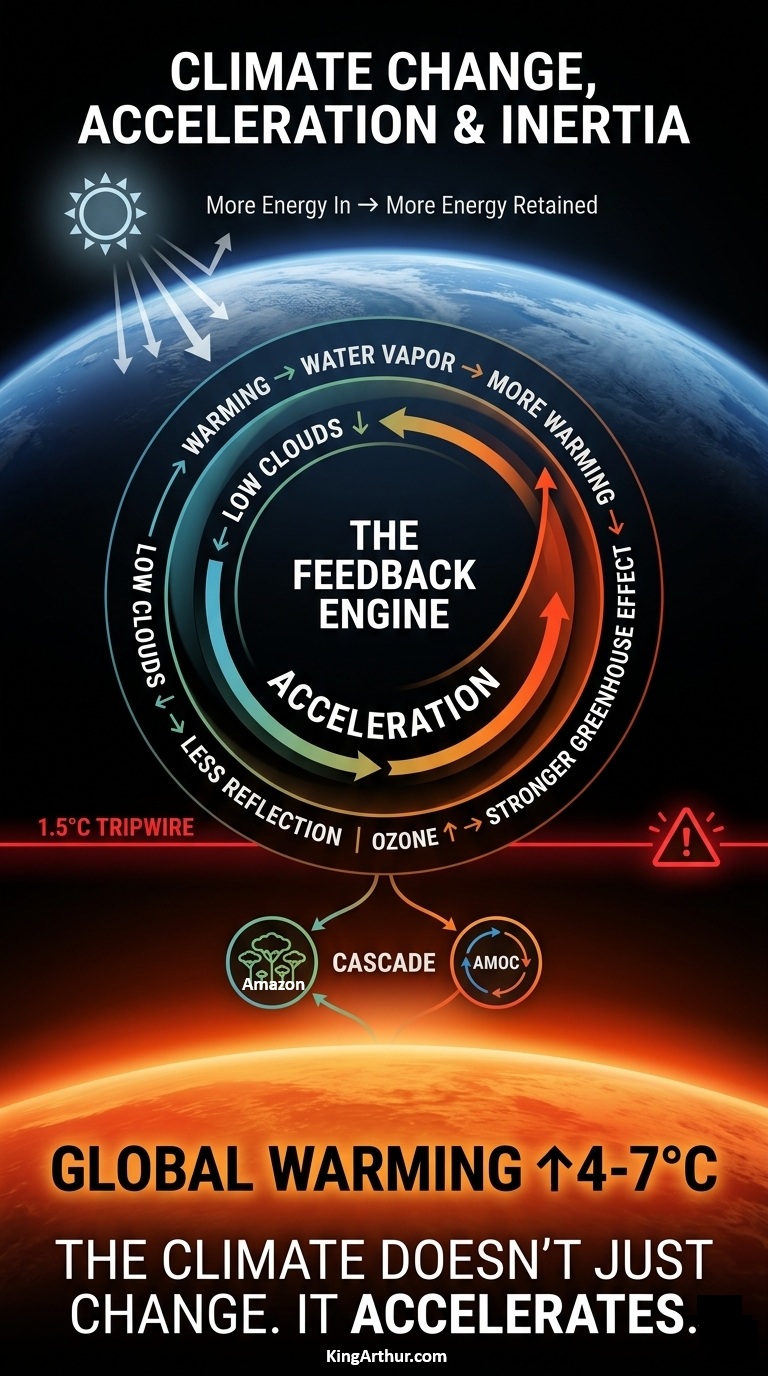
Climate change has been primarily driven by fossil-fuel emissions creating an energy imbalance. More energy is entering the climate system than is leaving. The accumulation of that energy manifests first as rising temperatures and increasingly as extreme weather energy events such as storms and heatwaves.
Most of the increase in the energy imbalance is stored in the oceans. Consequently, global warming has inertia: even after humans stop adding greenhouse gases to the atmosphere, the climate system will continue responding to the energy already accumulated within it.
The Times They Are a-Changing
Nearly all of the climate scenarios developed over the past several decades were based on avoiding sustained warming above the 1.5°C threshold. Once temperatures began exceeding the 1.5°C tripwire on a regular basis, as has happened since 2020, self-reinforcing feedbacks began to be increasingly activated.
There are millions of feedback processes operating throughout the Earth system. Many accelerate the rate of warming. The most observable is the water-vapor feedback and its connection to the water cycle. Warmer air can hold more water vapor, and water vapor is the most abundant and one of the most potent greenhouse gases.
More warming → more water vapor → more warming → more water vapor ↺
This is a positive feedback loop: the initial warming creates conditions that amplify subsequent warming.
Diminishing Low-Level Clouds and Increasing Ozone
There are two feedback systems that are much less understood but potentially far more consequential.
The diminishing of low-level clouds reduces Earth’s albedo—the fraction of incoming solar energy reflected back into space. Less reflection means more energy is retained by the climate system, causing the energy imbalance and its rate of acceleration to become increasingly nonlinear.
At the same time, increasing tropospheric ozone strengthens the greenhouse effect while also affecting the carbon cycle, shortening the timeline over which carbon remains sequestered.
Within each of these systems are multiple interacting feedbacks that can themselves be amplified and reinforced.
This is the critical distinction between individual feedbacks and a nonlinear Earth system: feedbacks do not necessarily operate independently. They can couple together, creating pathways through which warming accelerates other processes that then accelerate warming again.
The Tipping Points
By 2027, two major climate tipping systems showed evidence of approaching or entering potentially irreversible changes: Amazon dieback and the slowdown of the Atlantic Meridional Overturning Circulation (AMOC).
These are not isolated events. They are components of an interconnected climate system in which changes in one part of the Earth system can alter conditions elsewhere, increasing the potential for cascading effects.
The New Reality
Having tripped the 1.5°C tripwire, both the acceleration and inertia of climate change have created a new reality.
The most likely scenario is global warming of approximately 4°C this century.
If humanity does not reach net zero by 2035, approximately 4–7°C of warming by 2150 becomes the most likely scenario.
The fundamental problem is no longer simply how much warming greenhouse-gas emissions cause. It is how the warming already produced is activating feedbacks that can accelerate the rate of further warming—and how the enormous amount of energy already stored in the oceans creates inertia that will persist long after the initial forcing changes.
Climate change is therefore not a linear process moving steadily toward a predetermined endpoint.
It is an accelerating, coupled Earth-system process with both momentum and feedback.
The question is no longer simply how much we warm the planet.
It is how quickly the climate system begins warming itself.