The Antarctic Ice Sheet, Atmospheric Rivers, Feedback Coupling, and the Emerging Domino Effect
Tipping Point Season Hunting Manual — Antarctic Case Study
October 2026
Daniel Brouse¹, Sidd Mukherjee²
¹ Climatologist, Economist
² Physicist
Simplified Overview
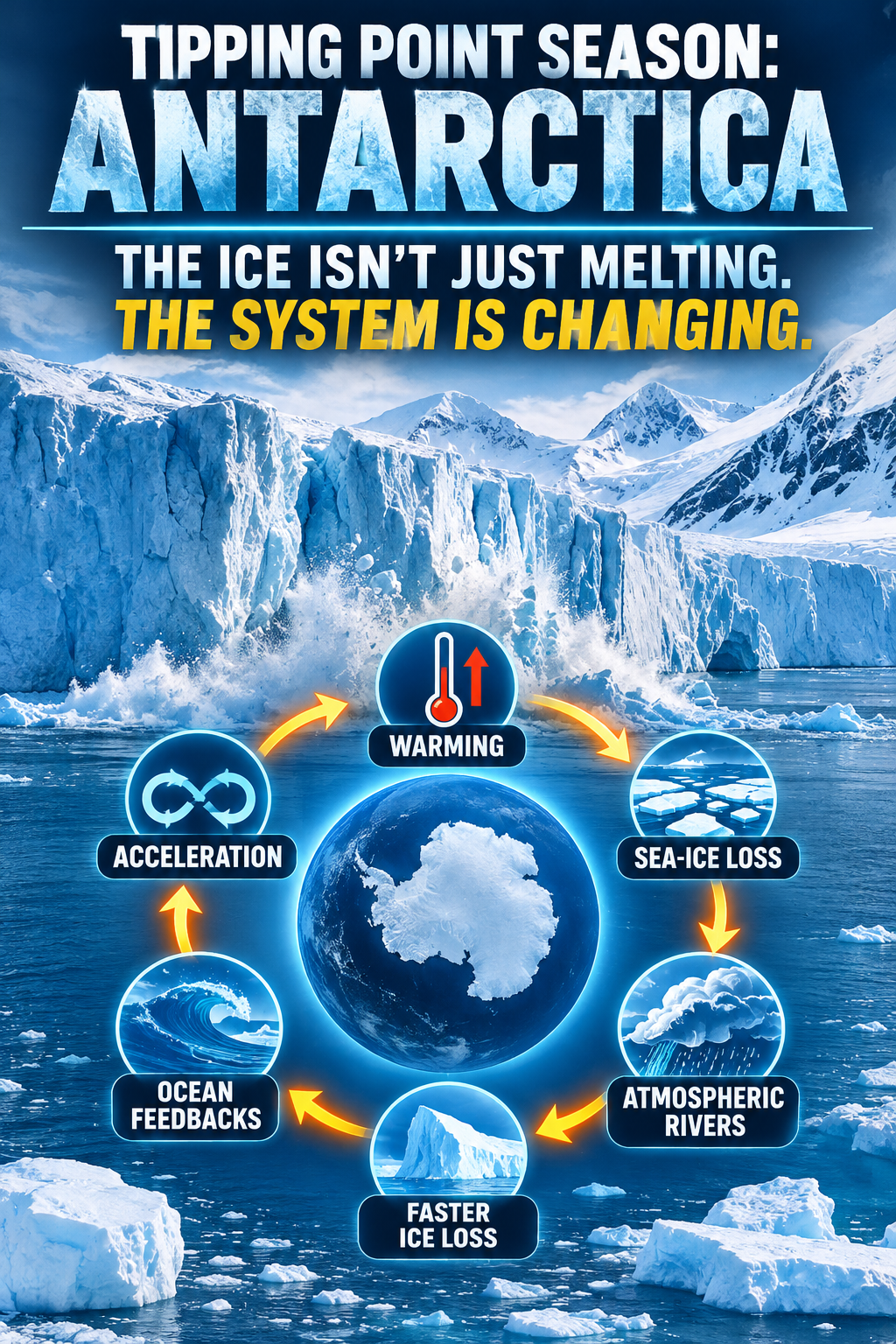
🌎 TIPPING POINT SEASON: ANTARCTICA
THE ICE ISN’T JUST MELTING. THE SYSTEM IS CHANGING.
Antarctica is sending some unmistakable warning signals.
Record-low sea-ice coverage. Rapid glacier retreat. Deteriorating ice shelves. Changing ocean circulation. Increasingly important atmospheric rivers. And new research identifying mechanisms that can accelerate ice-sheet instability.
But the biggest concern isn’t any single event. It’s how these processes interact.
🔥 Warming oceans weaken ice shelves.
🧊 Sea-ice loss increases solar energy absorption.
🌧️ Atmospheric rivers transport heat and moisture toward Antarctica.
🌊 Changing ocean conditions influence glacier stability and ice discharge.
⚠️ Coupled feedbacks can amplify the changes.
Our Nonlinear Climate Acceleration Hypothesis examines how these processes interact:
WARMING → FEEDBACK ACTIVATION → COUPLING → AMPLIFICATION → THRESHOLD → CASCADE
Antarctica also demonstrates why looking at individual climate indicators can be misleading. Increased snowfall can temporarily offset ice loss while glaciers continue discharging ice into the ocean.
The question isn’t simply how much ice Antarctica is losing.
It’s how quickly the interconnected systems governing its ice, atmosphere, and ocean are changing.
This is another installment in our Tipping Point Season Hunting Manual, exploring the evidence behind climate tipping points, feedback coupling, and the emerging planetary Domino Effect.
One planet. One interconnected climate system. Multiple tipping points.
The ice isn’t just melting. The system is changing.
📖 Read the research:
https://www.kingarthur.com/global_warming/Tipping-Point-Season.html
#ClimateChange #Antarctica #ClimateTippingPoints #ClimateAcceleration #AtmosphericRivers #FeedbackLoops #SeaLevelRise #ClimateScience #TippingPointSeason
Introduction: Antarctica Is Changing
Antarctica is experiencing a profound change in its climate and ice dynamics. Record-low sea-ice coverage, rapidly retreating glaciers, weakening ice shelves, and changing atmospheric circulation are revealing a complex system under increasing stress.
Several developments make Antarctica particularly important to our investigation of climate tipping points:
- The eastern ice shelf of Thwaites Glacier is losing its structural integrity, threatening its ability to restrain the grounded ice behind it.
- Hektoria Glacier experienced approximately 25 kilometers (15 miles) of retreat in just 15 months, including the fastest observed retreat of grounded glacier ice in the modern satellite record.
- Antarctic sea ice reached its third-lowest winter maximum in the satellite record in September 2026.
- Atmospheric rivers are increasingly important to Antarctic precipitation and ice-sheet mass balance.
- New research identifies rate-induced tipping as a mechanism through which rapidly changing climate conditions can destabilize marine-based ice sectors before traditional equilibrium thresholds are reached.
At the same time, new research provides an important qualification: some exposed ice cliffs stabilize after rapidly retreating, demonstrating that not every destabilization produces an unstoppable collapse.
The larger concern is the interaction of multiple processes: warming oceans, atmospheric heating, changing wind patterns, sea-ice retreat, precipitation, and glacier dynamics.
Antarctica is not simply losing ice. Its interconnected systems are changing.
1. Thwaites Glacier: The Weakening Buttress
Thwaites Glacier remains one of the most consequential components of the global sea-level system.
Often called the “Doomsday Glacier,” Thwaites is particularly vulnerable because its grounded ice rests on a bed that deepens inland. This geometry makes retreating grounding lines susceptible to marine ice-sheet instability.
Its floating eastern ice shelf provides an important restraining force, slowing the movement of grounded ice toward the ocean.
But that structural support is deteriorating.
Ice Shelf Disintegration
The eastern ice shelf is experiencing extensive fracturing and structural deterioration. Its connection to an underwater ridge has been weakening, reducing its ability to restrain the glacier.
As the ice shelf loses structural integrity, the grounded glacier becomes increasingly exposed to accelerated discharge into the ocean.
Loss of Buttressing
The floating ice shelf acts like a cork restraining the movement of the glacier behind it.
When that support weakens, the grounded ice can accelerate toward the ocean. This is particularly dangerous where the grounding line retreats into deeper water.
Grounding-Zone Melting
Warm ocean water reaches beneath floating ice and attacks the glacier near its grounding zone.
Tidal pumping and changing ocean circulation can transport relatively warm water farther beneath the ice, increasing basal melting and weakening the connection between grounded and floating ice.
The important issue is not simply how much ice melts at the surface.
It is the loss of structural support that allows enormous quantities of grounded ice to move into the ocean.
Thwaites demonstrates how ocean warming, ice-shelf deterioration, grounding-line retreat, and glacier acceleration can interact as reinforcing processes.
2. Record-Breaking Glacier Retreat and Iceberg Movement
Antarctica is experiencing changes that challenge assumptions about the speed of glacier retreat.
Hektoria Glacier: 15 Miles in 15 Months
Between January 2022 and March 2023, Hektoria Glacier retreated approximately 25 kilometers (15 miles).
During one two-month period, its grounded terminus retreated more than 8 kilometers (5 miles).
NASA identified this as the highest rate of grounded glacier-ice loss observed in the modern record.
This is particularly important because the retreat was not simply the disappearance of floating ice. It involved the rapid withdrawal of grounded glacier ice, which directly contributes to sea-level rise.
The Hektoria event demonstrates how quickly glacier dynamics can change when floating ice support is lost.
Source: NASA — Record-Setting Retreat of Hektoria Glacier
Iceberg A-81: A 1,400-Mile Journey
The enormous iceberg A-81, approximately 600 square miles in area, broke away from Antarctica’s Brunt Ice Shelf in January 2023. After spending more than three years moving through the Weddell Sea, it traveled north toward South Georgia.
By October 2026, NASA satellite observations showed the iceberg approaching South Georgia, approximately 1,400 miles from its point of origin.
This journey illustrates the enormous scale of Antarctic ice movement and the influence of ocean circulation on the redistribution of ice throughout the Southern Ocean.
Source: NASA — A-81 Reaches South Georgia
Rate-Induced Tipping: A New Dimension of Ice-Sheet Instability
An October 20, 2026 study published in Nature Geoscience identifies an important mechanism known as rate-induced tipping. Traditional tipping-point analysis often focuses on whether a system crosses a particular critical temperature or equilibrium threshold.
Rate-induced tipping introduces another possibility: the climate system can change so rapidly that stabilizing processes cannot respond quickly enough. In Antarctic ice sheets, the relevant stabilizing mechanism includes the gradual uplift of the underlying bedrock as ice is removed.
If warming and ice loss outpace that adjustment, grounding lines can retreat into vulnerable terrain and initiate self-sustaining retreat before the traditional equilibrium threshold is reached.
The study identifies particular vulnerability in the Recovery and Aurora subglacial basins of East Antarctica.
The rate at which the climate changes can be just as important as the eventual temperature reached.
3. Antarctic Sea Ice: A Major Change in the Energy Balance
On September 14, 2026, Antarctic sea ice reached its annual winter maximum at approximately 17.59 million square kilometers. This was the third-lowest winter maximum in the satellite record.
The significance extends beyond the amount of missing ice.
Between 1979 and 2014, Antarctic sea ice exhibited a modest overall increase, although considerable regional and year-to-year variability existed. That pattern reversed beginning in 2015–2016.
Since then, Antarctic sea ice has experienced repeated periods of unusually low coverage, including record-low seasonal minimums and maximums.
The 2026 observations reinforce the significance of this shift. Antarctic climate feedbacks are increasingly self-reinforcing, while the system’s remaining resilience appears insufficient to reverse the deterioration. These developments signal an increasing risk of approaching critical tipping points.
The Albedo Feedback
Sea ice reflects incoming solar radiation. Dark ocean water absorbs considerably more energy.
As sea ice retreats:
- More dark ocean becomes exposed.
- More incoming solar radiation is absorbed.
- Ocean-atmosphere heat and moisture exchange changes.
- Atmospheric moisture availability increases in affected regions.
- Regional temperatures and precipitation patterns respond.
This creates opportunities for reinforcing feedbacks between ocean warming, sea-ice loss, atmospheric moisture, and ice-sheet behavior.
The Southern Ocean is not simply surrounding Antarctica. It is an integral part of the global energy-distribution system.
Source: NASA — Antarctic Sea Ice Grows to Its 2026 Maximum
4. The October 2026 Temperature Record: Atmospheric Rivers and Foehn Winds
On October 2026, Ukrainian researchers at the Akademik Vernadsky Antarctic research station recorded an air temperature of +11.1°C (52°F).
This established a new October temperature record for the station’s vicinity, surpassing the previous October record of +7.9°C set in 1968. Even more remarkable was the speed of the temperature change.
The air warmed from +1.2°C to +11.1°C in approximately two and a half hours.
At the same time:
- Wind speed increased from 1.5 to 13.1 meters per second.
- Relative humidity dropped from 90% to 54%.
- Wind direction changed.
These observations are consistent with an intense foehn wind event.
Foehn Winds: Rapid Atmospheric Heating
Foehn winds develop when air crosses a mountain range, loses moisture as it rises, and descends on the opposite side. As the descending air is compressed by increasing atmospheric pressure, its temperature rises. The result can be an exceptionally rapid increase in local temperature.
In Antarctica, these winds can accelerate surface melting and alter the stability of snow and ice.
Atmospheric Rivers: Transporting Heat and Moisture
The Ukrainian National Antarctic Scientific Center identified an atmospheric river as a possible contributing factor to the October event. Atmospheric rivers are concentrated corridors of atmospheric moisture that transport enormous quantities of water vapor across long distances. They are important because they connect distant oceanic and atmospheric conditions with precipitation and temperature changes in polar regions.
The event illustrates the kind of atmospheric interaction known as coupled feedbacks and the domino effect.
Source: National Antarctic Scientific Center — October Temperature Record
5. Atmospheric Rivers: The Antarctic Ice-Mass Paradox
One of the most important developments in Antarctic climate research appeared in February 2026 in Communications Earth & Environment.
The study, “Atmospheric rivers and winter sea ice drive recent reversal in Antarctic ice mass loss,” examined an unexpected development. Despite continued increases in dynamically driven ice discharge from outlet glaciers, satellite measurements showed a substantial slowdown in overall Antarctic ice-mass loss and a period of net mass gain beginning around 2020.
The explanation was increased snowfall.
Atmospheric rivers, strengthened westerly winds, and changing atmospheric circulation increased precipitation over large areas of Antarctica. That additional snowfall temporarily offset ice losses occurring through glacier discharge.
The Paradox
Antarctica can gain overall ice mass while individual glaciers continue losing ice at accelerating rates.
The study found that:
- Atmospheric rivers became more frequent and intense after 2020.
- Increased precipitation produced substantial positive surface-mass-balance anomalies.
- Glacier discharge continued to accelerate.
- Increased snowfall temporarily exceeded the additional losses from ice discharge.
- Reduced sea ice contributed to increased precipitation, but large-scale atmospheric circulation was the dominant driver.
The researchers estimated that sea-ice reduction accounted for approximately 11% of the recent winter surface-mass-balance increase.This is an excellent example of why examining only one climate indicator can produce an incorrect conclusion.
A temporary increase in Antarctic ice mass does not establish that the ice sheet has recovered or that its underlying structural instability has disappeared.
The same atmospheric process can contribute to both temporary ice accumulation and longer-term ice destabilization.
Atmospheric rivers transport moisture that becomes snowfall, but warm and moist atmospheric intrusions can also contribute to surface melting and changes in ice dynamics.
6. Ice Cliff Resilience: An Important Scientific Qualification
A major four-year satellite investigation published in Science on October 15, 2026 examined more than 15,000 Antarctic ice cliffs.
Researchers from MIT and Woods Hole Oceanographic Institution investigated whether exposed ice cliffs necessarily initiate runaway collapse after floating ice shelves disappear.
Traditional marine ice-cliff instability models suggested that cliffs exceeding approximately 100 meters could collapse under their own weight, exposing taller inland cliffs and triggering a self-sustaining retreat.
The observations revealed a more complicated process.
Researchers found that:
- Taller cliffs can retreat faster than previously modeled.
- Their collapse does not necessarily trigger an unstoppable chain reaction.
- Dynamic thinning and retreat into regions with lower ice-thickness gradients can stabilize retreat.
- Cliff stability depends on more than height alone.
This is an important qualification to worst-case ice-sheet projections. It does not eliminate the danger of Antarctic ice loss. In fact, the researchers found that some cliffs retreat faster than earlier models predicted, potentially increasing short-term ice loss and sea-level contributions.
The finding demonstrates that climate feedbacks are not necessarily unlimited. Some processes provide stabilizing responses even while other components of the system continue deteriorating.
The important distinction is between temporary stabilization and recovery of the larger ice system.
Source: MIT — Satellite Data Reveal How Antarctica’s Ice Cliffs Behave Over Time
7. How Antarctica Fits the Nonlinear Climate Acceleration Hypothesis
The most important implication is that Antarctic climate change cannot be adequately understood by examining temperature or ice loss independently.
Our research framework identifies three stages of climate change:
First Derivative: Climate Change
The planet is warming.
Second Derivative: Climate Acceleration
The rate of climate change is increasing.
Third Derivative: Climate Jerk
The rate of acceleration itself is changing.
Climate Jerk is particularly relevant when examining abrupt changes in atmospheric circulation, precipitation, wind patterns, glacier dynamics, and ice-sheet stability. A rapidly changing climate system does not necessarily produce a smooth increase in temperature.It can produce abrupt transitions in the behavior of interconnected systems.
The broader feedback-coupling model describes the progression:
WARMING → FEEDBACK ACTIVATION → COUPLING → AMPLIFICATION → THRESHOLD → CASCADE
Antarctica provides important examples of these processes:
| Our framework | Antarctic manifestation |
|---|---|
| Warming | Record October station temperature and ocean warming |
| Feedback activation | Sea-ice retreat and changing ocean-atmosphere energy exchange |
| Coupling | Atmospheric rivers, foehn winds, moisture, and ice dynamics |
| Amplification | Surface melting, basal melting, and glacier discharge |
| Threshold | Ice-shelf structural deterioration and grounding-line instability |
| Cascade | Glacier retreat, sea-level rise, freshwater redistribution, and further Earth-system disruption |
The important question is not simply whether each individual process is accelerating.
It is whether their interactions are increasing the rate and magnitude of change throughout the larger system.
8. The Antarctic Domino Effect: Connecting the Planetary System
Antarctica is connected to the rest of the planet through ocean circulation, atmospheric circulation, and the global energy balance.
Changes in one region can influence conditions thousands of miles away.
Consider the following interconnected processes:
OCEAN WARMING
↓
CHANGES IN ATMOSPHERIC CIRCULATION
↓
ATMOSPHERIC RIVER FREQUENCY AND INTENSITY
↓
ANTARCTIC HEAT AND MOISTURE TRANSPORT
↓
SEA-ICE AND ICE-SHEET CHANGES
↓
ALBEDO, FRESHWATER, AND OCEAN-CIRCULATION FEEDBACKS
↓
FURTHER EARTH-SYSTEM DISRUPTION
These are not necessarily one-way processes. Many operate simultaneously and influence one another. A particularly important new development appeared in Nature Climate Change on October 28, 2026. Researchers documented a reversal in the long-term trends of Antarctic Intermediate Water, a water mass that plays an important role in global ocean circulation.
They linked the change to the dramatic decline in Antarctic sea ice since 2016.
The study identified changes in freshwater input, ocean stratification, salinity, and water-mass properties, demonstrating that Antarctic sea-ice changes are affecting ocean processes extending well beyond the immediate polar region.
This is another important example of the planetary connections central to the Domino Effect research.
9. What We Should Be Hunting For Next
Our Antarctic research will focus on the interactions between the following variables rather than treating them as independent measurements.
| Research variable | What we need to monitor |
|---|---|
| Atmospheric rivers | Frequency, intensity, duration, and integrated water vapor transport |
| Antarctic sea ice | Seasonal maximum, minimum, concentration, and regional distribution |
| Ocean heat | Subsurface temperature, heat transport, and basal melting |
| Ice-sheet dynamics | Grounding-line migration, ice discharge, and glacier velocity |
| Ice shelves | Fracturing, thinning, structural integrity, and buttressing |
| Atmospheric extremes | Foehn events, temperature anomalies, humidity, and wind patterns |
| Ocean circulation | Freshwater input, salinity, stratification, and water-mass changes |
Three coupled relationships in the existing Coupled Climate Feedback Index:
1. Atmospheric River × Sea-Ice Loss × Ice Discharge
This relationship helps distinguish temporary increases in snowfall from continuing deterioration of glacier dynamics.
2. Ocean Heat × Ice-Shelf Weakening × Grounding-Line Retreat
This relationship examines how accumulated ocean energy translates into structural ice loss and accelerated glacier movement.
3. Albedo × Ocean Heat × Atmospheric Moisture
This relationship examines how disappearing reflective surfaces influence energy absorption, ocean-atmosphere exchange, and atmospheric moisture transport.
1979–2015: Earlier Antarctic sea-ice behavior.
2016–2019: The major sea-ice reversal.
2020–2026: Increased atmospheric-river activity, unusual snowfall, and changing Antarctic ice-mass behavior.
Conclusion: We Are Not Simply Watching the Ice Melt
Antarctica provides one of the clearest opportunities to examine how multiple climate-sensitive systems interact.
The evidence is not limited to rising temperatures.
We are observing:
- Rapid glacier retreat.
- Deteriorating ice-shelf structures.
- Repeatedly low Antarctic sea-ice coverage.
- Increasingly important atmospheric-river activity.
- Changes in ocean circulation and water-mass properties.
- Rate-dependent ice-sheet instability.
- Temporary stabilization mechanisms that can mask continuing ice loss.
The October 2026 temperature record provides another illustration of how rapidly atmospheric conditions can change in the Antarctic environment. But the larger story is the interaction between these processes.
Atmospheric rivers can increase snowfall while transporting heat and moisture. Sea-ice loss changes the energy balance and ocean-atmosphere exchange. Ocean warming attacks ice shelves from below. Glacier retreat changes the distribution of ice and freshwater. Changes in ocean properties can influence circulation throughout the planet.
These processes do not operate independently.
They are interconnected components of one planetary climate system.
Our central proposition is that climate acceleration must be understood through the interaction of these processes—not simply by measuring the temperature of the atmosphere. The greatest danger may not be one isolated tipping point. It may be the interaction of multiple tipping elements, each changing the conditions under which the others operate.
WARMING → FEEDBACK ACTIVATION → COUPLING → AMPLIFICATION → THRESHOLD → CASCADE
This is what we are hunting for during Tipping Point Season. We are not simply watching the ice melt. We are watching for evidence that the climate system is beginning to behave differently.
One planet. One interconnected climate system. And an increasingly important question:
How quickly are the connections between climate tipping points changing the trajectory of the entire Earth system?
Tipping Point Season Hunting Manual — Antarctic Case Study
http://membrane.com/global_warming/Tipping-Point-Season.html
Daniel Brouse, Climatologist & Economist
Sidd Mukherjee, Physicist
Part of the ongoing investigation into nonlinear climate acceleration, coupled feedbacks, and the emerging planetary Domino Effect.